Category Archives: food

The preciousness of people

100_0218
A knock on the door revealed a stranger holding a white enamel colander full of strawberries. We had moved into this house in town the day before, and he introduced himself as a neighbour.

That was a very meagre description of what he was, he was a glorious eccentric who I watched every day cycle slowly past on a very high old fashioned bike with a basket on the front, which gave the impression of being far too big for his small skinny frame, and liable to go out of control at any minute. He was on his way to the docks where he was a dock worker – a somewhat unconventional one I imagine.

Again a meagre description of this blue- eyed, wildly bearded, elderly Irishman, who revealed to us that he was a sort of remittance man, exiled from Ireland by his despairing family to make his somewhat erratic way in the antipodes.

He was a poet, he told us. I believed him though I never saw any of his work. His life was a poem. We went to his house, which was a poky little state house. Inside it gave the impression of being a miniature stately home, along the lines of an Irish demesne… a few good but battered antiques, the odd oil painting and large old-fashioned sofa and chairs covered in old fashioned country house flowered linens.

This splendid impression of stateliness continued into the garden, which was quite big, being on a corner. He had transformed this rocky site into a miniature paradise, grass walks edged with pleached fruit trees, a vegetable patch, a strawberry bed, a tiny terrace and lawn, and best of all, a deep pond edged with large rocks, which he had created by levering the huge rocks day after day over a period of six months, until a deep hole had been carved out of the stony ground.

He was an eccentric, one of the many who, when I look back, have enriched our lives and given us fun and pleasure. There was Mr Macdonald, a direct descendant of Beatrix Potter’s Mr Mcgregor, who was our neighbour in the country, another Irishman. He only wore a pink woollen vest with long sleeves  and braces, all summer and winter, except on Sundays when he looked quite unnatural, shaved and spruced up in a short sleeved shirt in which he looked very ill at ease. Every spring he would arrive at my door in his pink vest, braces and hob-nailed boots, bearing a huge bunch of sweet-smelling narcissi which I had once told him reminded me of spring in England. He never missed a year thereafter.

There was Alf, an Englishman who served in the Malayan Police, and every three years when his leave was due, not having any family he wished to return to, he would sail to the bottom of the Arabian Peninsula. There he would buy a large flock of goats, and then proceed to drive them through the desert, using the goats as food and currency, until he reached Port Said. There he would get a boat to Liverpool, make a quick visit to his sister there, and then return to his tropical home in Kota Bahru.

Here too, lived Mammy, a giant White Russian, over six feet tall, wearing thick pebble specs for her short sighted grey eyes, and wearing the first caftans I ‘d seen over her enormous frame, all in brilliant colours and garish patterns . Mammy ran the local hotel where everyone gathered in Kota Bahru, and was a local joke too. As a seventeen year old I didn’t think she was such a joke. She and her husband had escaped the revolution in Russia, and made it safely to Shanghai like so many other White Russians.

They had survived the rigours of Japanese occupation and then fled Mao’s Communist takeover, ending up in Singapore. There, one afternoon, Mammy’s husband had walked down the road to buy an evening newspaper, and had never returned. No-one knew whether he had run away or was the victim of some crime. And Mammy was now surviving in this rather heartless superficial society in the remotest part of Malaya but creating laughter and fun all around her – actually rather more than a survivor.

Another neighbour was our Dutch friend Andrea, who had an antique shop full of the most exquisite items of a particular sensitivity, many of which I still posses. She was as nutty about animals as I, and far more lawless, striding into a bikie house to steal/rescue weeping puppies with no tails. I revelled in her poetic garden and laughed to see her huge magenta magnolia blossoms each wrapped in a plastic bag to protest them from the wind… not a good look actually!

Her house was beautiful in that glorious Dutch interior way of Pieter de Hooch and Vermeer, her pottery made you want to hold it and stroke it – and I have some – and her paintings were romantic and exquisite, and I have some of them too. I could actually write a book about her…

These memories were prompted by a conversation with a neighbour on my walk this morning. Since some of them read my blog, I cannot reveal what we talked of, or his glorious quirks of personality, but he reminded me of the joy of being with people who allow their personalities to flower, with no thought of what anyone else may think. Eccentricity is simply individuality, unself-consciousness, and the courage to be and do what feels right. When we are in the company of such people it feels as though ‘the waters of life’ are flowing, there are no limitations, and all things are possible.

Martin Buber, the great Jewish philosopher wrote that: ‘Everyone has in him something precious that is in no one else. But this precious something in a man is revealed to him only if he truly perceives his strongest feeling, his central wish, that in him which stirs his inmost being.’

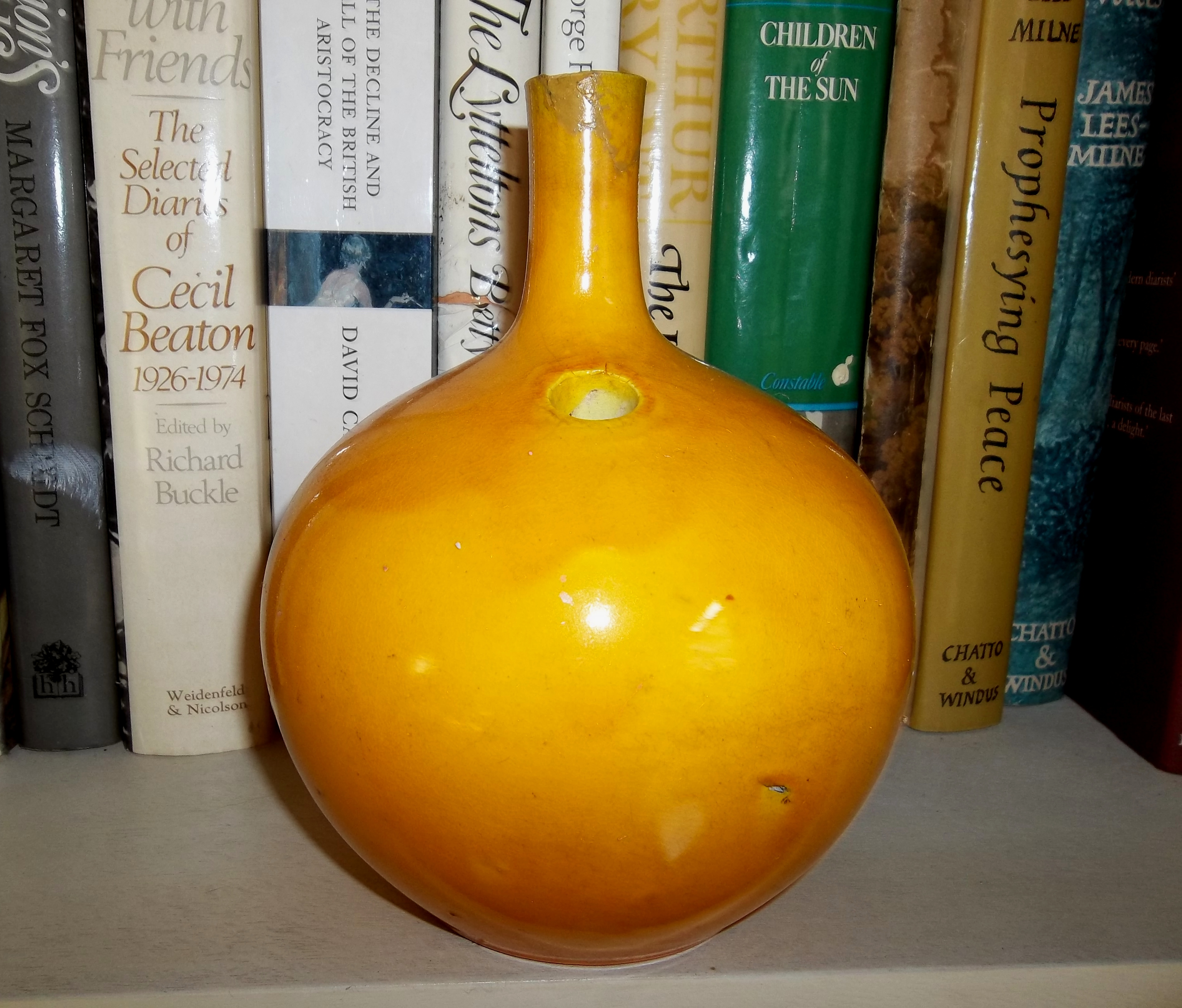
P.S. The picture is of an antique English drinking jar given me by my friend Andrea.

Food for threadbare gourmets

A faithful follower e-mailed me yesterday and asked if I had a recipe for Simnel cake. This is the light fruit cake that’s traditional at Easter, so I told her I’d blog it today. I use Nigella Lawson’s recipe with my own adaptations.

When I make it, I prepare the tin as usual, and then cream 175 g of soft unsalted butter with 175 g of caster sugar. Then mix 225 g of SR flour with half a teasp of cinnamon, a quarter of a teasp of ginger and 25 g of ground almonds. Add one egg with some of the flour mixture to the butter mixture, and mix two more eggs into the rest of the mix in the same way, before adding two tblsp of milk. Finally, fold in 500g of mixed dried fruit, plus some chopped glace cherries if you like them.

At this stage I put half the cake mix in the tin, roll out about 400g of marzipan, cut into a cake sized circle and place on the cake mix, then cover with the rest of the cake. Bake for an hour at 170 C, then turn it down to 150C and cook for another hour and a half. It’s cooked when it’s risen and firm. Let it cool completely on a rack before taking it from the tin.

When cool, paint the top with apricot jam, and roll out another 400g of marzipan and stick it on. With 200g of marzipan, make balls representing the eleven apostles – Judas surplus to requirements here – and stick them on using an egg white – beaten to just frothy. Some people quickly put it under the grill to make it look slightly toasted.

32 Comments

Filed under colonial life, cookery/recipes, culture, food, gardens, great days, life/style, philosophy, spiritual, Thoughts on writing and life, Uncategorized, village life

Ordeal by wardrobe

100_0800

There will not be many people wearing soft fuchsia coloured leather gloves in the North Island of New Zealand this winter, but I will be one of them.

They were a gift from my daughter last Christmas. She brought forward the present giving ceremony, and insisted that I open my presents first before anyone else opened theirs, because she wanted to see the look on my face when I saw them. She’d brought them back from London months before. I hoped my face showed everything she hoped when I unwrapped them. I can’t put them away. They sit on my dressing table – a symbol – of many things.

But her solicitude for my wardrobe doesn’t stop at leather gloves. This weekend she pounced, and said that the following day we were going to go through my clothes, and I was going to sort everything into keep, store and throw away! I had a friend who had also undergone this ordeal by wardrobe, when her daughters dismissed all her lovely clothes as ‘tragic,” so I knew what I was in for.

I had to agree that something had to be done, as I was always losing things in the muddle of too many hangars on the rail. As the morning wore away, it got easier and easier to let go.

“You’ve got too many white T-shirts.” was the first pronouncement. “There are five days in the week, how many do you think you can wear?” Resisting the temptation to correct her arithmetic I feebly tried to think why I would want more than a dozen white T-shirts, but nothing came to mind…

“No more brown, or dull sludgy colours” was the next diktat. “They don’t suit you. You need bright clear colours.” No arguing with the considered opinion of an expert… so out went two thirds of my wardrobe.

I tried to salvage a few comfortable jumpers and slide them into the store –and- second- thoughts pile. “No,” said the arbiter  – “how long is it since you bought that? – fifteen years?  – Well it may have looked nice then, but it’s hopelessly out of date now – anyway, it’s got moth holes”…

No, that’s worn, no, that’s got pilling, no, that’s the wrong colour … gradually the wardrobe emptied, and the to-keep pile was pitifully small. The throw- out pile (for the womens’ refuge) was huge.

“No, you have to give up labels”, she pronounced. “But I always cut mine out,” I protested… “Yes, but look – you just said ‘but that’s a Jaeger, ‘when I tried to throw away that jumper.”

“Okay, I get it”, I sighed. “I can’t believe you’d have bought this,” she exclaimed, holding up a black and gold embroidered evening coat.” “No, I can’t either,” I agreed, “so I’ve never worn it”. “Right, Trademe”, she said. “Anything with tags you haven’t worn we can sell and just think, even if you only get five dollars each for all this stuff you’ve never worn, it’s all money towards a new wardrobe!”

By now she’d found various un-worn shirts I had had made that had never worked.“I hope by the time I’m your age, I’m not making these sort of mistakes,” she muttered…“What are these?” she cried, holding up a pair of well tailored tartan pyjamas beautifully piped in red. “What on earth have you got these for? How long have you had them?”

“Exactly nineteen years,” I replied truthfully. “I saw a picture in a magazine of a model wearing pyjamas like these, cuddled up in front of a log fire with a cup of hot chocolate, looking so cosy and glamorous.” She looked at me disbelievingly. “Have you ever worn them, have you ever done that?”“Not yet”, I admitted, “but I might.” She opened her mouth to say something withering, but then took pity on me –“OK, you can have your dreams,” she said, and dropped the pyjamas on the to-keep pile.

By now we had descended into the bottom of the wardrobe to the shoe department. While I sat on a small stool scrabbling around in the darkness, she took the opportunity to tweet her friends. “Sorting my mum’s wardrobe” went the message – “keep, store and throw.” Back came a flutter of twitters from people who obviously had time on their hands that morning. The opinion seemed to be unanimous – too hard basket for them… I thought to myself, now at least one third of Auckland knows I’m throwing away my clothes.

There had been a time when my daughter needed a whole cupboard for her shoe fetish, but no more, it seems. “If I buy a new pair, I gash another pair,” she lectured me… so out went shabby oldies,  Moroccan slippers, shoes that pinched, boots that had the wrong sort of heel… the good news was that I found a pair of beautiful black suede indoor shoes that I’d never even worn and had lost about seven years ago. Needless to say a whole harvest of handbags was dissipated. “But you know I’m a bag lady,” I whimpered….

At the end she shook her head in a tolerant and kindly way.  ”I’m proud of you, I never thought you’d do it so quickly and easily – now don’t you feel better?” she coaxed…” A lot lighter?”  “Definitely a lot lighter”, I answered, looking at the giant pile destined for the womens’ refuge… a smaller pile that I could have second thoughts about and store, and then the  emasculated line of shirts and skirts, trousers and jackets hanging on the rail.

But as I looked, I had to admit she was right. She’d even hung them so I could see what to wear with what. Best of all, I’d found the three jackets she’d lavished on me last year that I’d forgotten about – one Jaeger and two Ralph Lauren… labels, I said!

Yes, there is nothing like a daughter… and thankfully, they keep you on your toes, as they can always see room for improvement. I do hope she approves of what I choose to wear with the fuchsia pink leather gloves when winter comes. Maybe I‘d better get her advice – after she‘s finished stacking the three metres of fire-wood sitting in my garage…  there really is nothing like a daughter!

PS. She checked out this story, and said she could add a few more items – what about that lost evening bag you were so thrilled to find under a pile of jumpers? Enough is enough, I said firmly.


Food for threadbare gourmets

Our neighbours have a banana tree which is weighed down with small sweet bananas, and they don’t eat them. This largesse comes our way, and I use this recipe when we have too many to eat.

Mash a cup of bananas, and melt 150gms of butter. Put both in a dish and add two eggs and a cup of sugar… I often use brown for the taste. Mix them together and then add two cups of self raising flour. Dissolve a teasp of baking soda in 3 tablspns of milk, and stir that in too. Beat lightly, before tipping the mixture into a greased 20cm cake tin, the base lined with baking paper. Bake at 180 degrees for 50 to 55 minutes. It’s cooked when the cake springs back when lightly touched. Lovely with thick lemon icing.

Food for thought

Comparison is the thief of joy. Anonymous


66 Comments

Filed under cookery/recipes, family, fashion, food, great days, humour, life/style, The Sound of Water, Thoughts on writing and life, Uncategorized

Our best friends

100_0816

100_0818 - Copy

This magnificent creature was making the most of the water in the dog’s bowl at my gate. He could have been Captain Scott’s dog Osman, the wonderful husky who saved so many dog’s lives when the team fell into a deep icy crevasse. Gallant Osman hung on at the brink, taking the whole weight of the dogs and the sleds until they were rescued. This hero survived Scott’s disastrous Antarctic expedition, and ended his days here in New Zealand.

If I’m reading history, it isn’t the dates and the battles that stick in my mind but the children and the animals, and I hate to read in the news that a head of state has donated two Russian wolf-hounds, or a splendid race horse on a state visit. The poor creatures are torn away from their homes and given to uninterested strangers speaking a foreign language.

To this day, I sorrow for Mary, Queen of Scots’ little Skye terrier who came with her to the block, hidden in her long skirts. When the Queen’s head had been severed, the faithful creature rushed out and stood howling between the body and the head. Nothing would entice the little dog away from the remains of the person she was devoted to. Finally, when the Queen’s body was removed the little dog was repeatedly washed by her grieving ladies to remove the blood and the smell, but she refused to eat, and died shortly after of a broken heart.

Marie Antoinette’s pet- dog who shared her solitary confinement, was left behind when the white-haired, dignified Queen was hustled out to the guillotine, and was adopted by the prison governor – we don’t know for how long that little dog pined.

And Joy, the Russian Tsarevich’s spaniel, was found in the deserted house in Ekaterinberg, eight days after the massacre of the Russian Royal family, when an army of White Russians took the city and a group of officers rushed to the Ipatiev house where the family had been imprisoned. The little dog was starving and wandering around looking for his master. History does not put my mind at rest as to the fate of this little dog. (It also seems to suggest that being the beloved of royalty is a dangerous destiny.)

But just as bad was the fate of Joseph Banks’ dogs. Banks was the naturalist who sailed with Captain Cook on his first great voyage in 1768. Besides cluttering up the tiny ship with four servants, Banks also brought his two pet greyhounds with him.

After two years voyaging, still at sea, the Endeavour called at Savu Island, and after a drunken night dining with the local Rajah who wanted an English sheep and an English dog, Cook gave him the last sheep on board, and Banks gave him one of his greyhounds. What the sensitive greyhound went through pining and parted from his life-time companion, and the men who he knew and loved, to be abandoned on a tropical island among people who had no idea of what a dog or a sheep was, doesn’t bear thinking of – not by me at any rate.

And at Matavai Bay, Tahiti, ten years later, the captain of another English ship, the Mercury, reported that an English pointer left behind by a previous ship: “singled them out, showing its joy by every action the poor animal was capable of.” Which tells us that the dog was capable of distinguishing between races, and was homesick, and was probably hoping to go back to its old familiar home across the sea when it recognised the sailors. I wish I knew that the sailors had taken it back home, but I fear they didn’t.

Then there was Mackenzie, from New Zealand’s South Canterbury, a cattle rustler. His dog was brought into Lyttleton court as a witness. She slipped her chain and ran over to the dock, scratching and whining, trying to get in and join her master. The red- bearded rustler, who’d refused to speak a word until then, began to weep. He begged to keep the dog and take any punishment the court meted out.

“I ‘ll make your roads, I’ll break your stones… only let me keep her.” They didn’t let him keep her of course, being men of stone themselves, and the little black dog was sold to a farmer who she refused to work for, only knowing commands in Gaelic. We don’t know the end of either her or her master.

But what we do know is that too often it’s only their owners who care about their dogs. Once the person who loved them is no longer there, a dog’s life is an uncertain one. Which is why I love the wonderful people – and many of them are bloggers – who rescue and adopt the dogs who have been left behind. And in my experience there is no dog as devoted as one who has been rescued. I used to have three at a time, and wherever I walked, from kitchen to garden, from bedroom to study, fourteen feet moved

The gratitude of a rescued dog never ends. They know that all their happiness is the gift of love from a stranger who becomes their beloved.Last year, when his mistress died, Lochi, a rescued German shepherd, a beautiful silvery creature, went to mass every day at the church of San Donaci in Italy as soon as he heard the bells ringing. He sat where his owner last lay in her coffin. He died two months after her of a broken heart. (wonderfully, so as not to disturb him, the local priest served mass down in the church instead of at the altar.)

If only people had hearts as big and loving as dogs we wouldn’t have places like Syria and Palestine, Ukraine and Afghanistan and all the other broken hearts in the world. There is a mantra : let only love prevail…


Food for threadbare gourmets

Still lotus-eating at the end of the long dry summer, I sat in a bower in my dearest friend’s green garden, enjoying a long talk and a simple lunch with her. Just a delicious glass of chilled rose, a slice of salmon on a bed of brown rice with goodies in it, and a salad of green leaves, translucent slices of ripe pear, and parmesan flakes mixed through with the vinaigrette, followed by coffee and a chocolate truffle… what more could one desire… love and lotus –eating !

The brown rice had been cooked and then marinated in soya sauce. Sun flowers seeds, sultanas soaked until plump, chopped apricots,  spring onions, and walnuts then mixed through. Delicious with the salmon, but just as good with warm lamb or chicken I suspect…


Food for thought

You might quiet the whole world for a second if you pray.       And if you love, if you really love,      our guns will wilt.

St John of the Cross, translated by Daniel Ladinsky


60 Comments

Filed under animals/pets, bloggers, cookery/recipes, food, great days, history, love, royalty, The Sound of Water, Thoughts on writing and life, Uncategorized

Souvenirs of life

100_0871


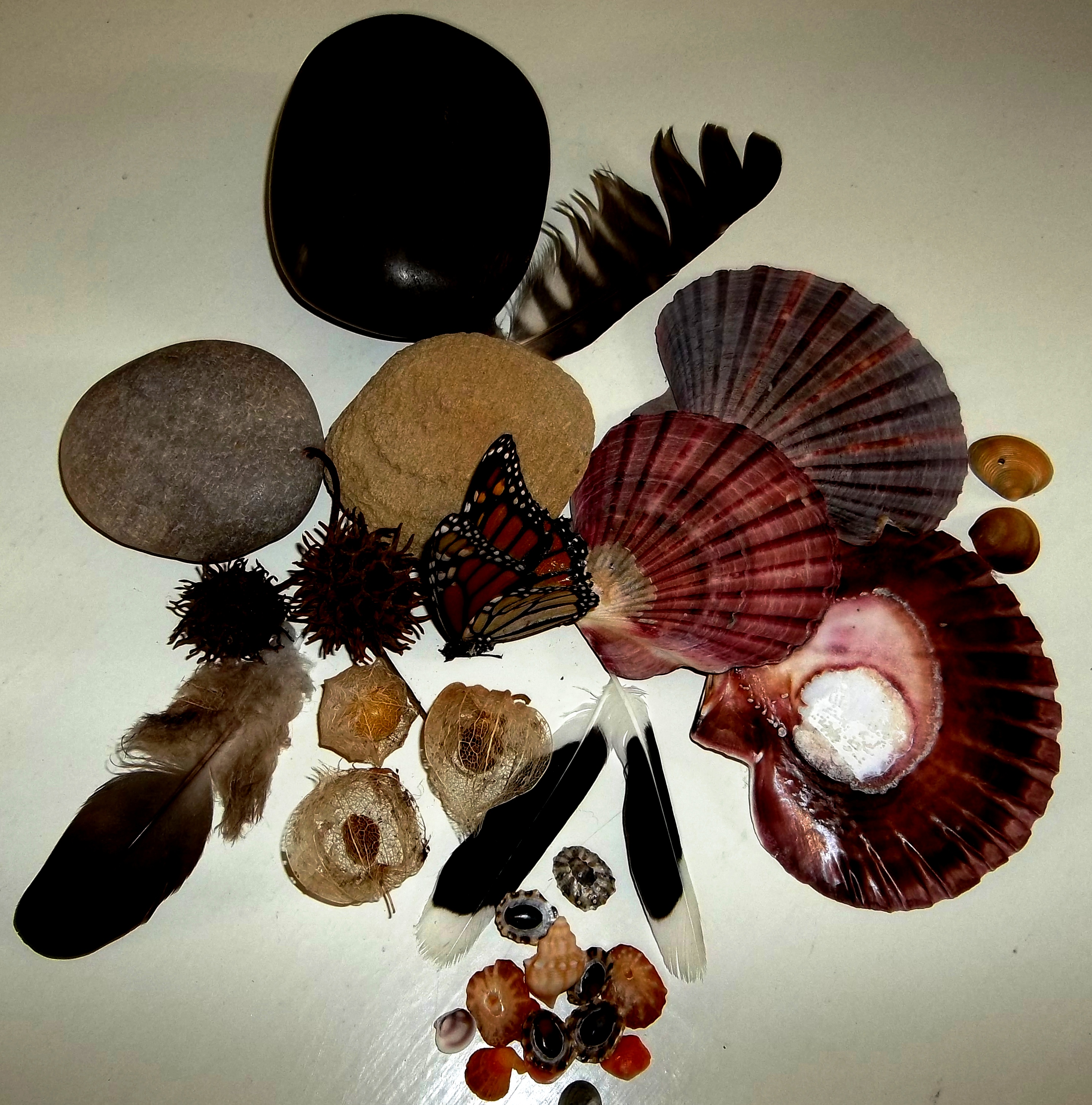
These stones and feathers and shells can tell the story of my life in the last few decades… shells collected with the children on a Northland beach, a black and white feather lying outside the door when I opened it on our first day in a new house –  greeting from a tui… the brown and cream morepork feather found on a long walk around the harbour with the thoughts and dreams of that afternoon threaded through its fronds.

An ancient stone from a river bed in the Blue Mountains of Australia was picked up after a day spent abseiling in abject terror, another from a cold pebbled beach in Devon, the chill of the Atlantic  breakers still embedded in it after all these years, while the polished brown stone came from an underground cave in the central North Island where glow-worms illuminated the roof, and a river flowed through.  These things are the stuff of my life… as they are of every life in which they are valued.

As I looked at them I thought of how other collections can also tell the story of a life. When I renewed my passport recently I found all my old ones, going back to when I was twelve and going to France on my own to learn French. In that passport photo two frightened brown eyes gazed out at the world. I had been so appalled at this picture that I promptly destroyed the evidence.

Which left the rest – a twenty one year old about to go on holiday to Spain, well- groomed hair, immaculate lipstick, and veiled blank eyes… the next, an exhausted mother of two toddlers about to go to Hong Kong, badly cut hair, eyes sad and resigned. And then, a picture of a thirty five year old woman, lots of dark hair piled up confidently, smiling eyes, relaxed smile. Life to be lived now, not endured. In the decades since, the hair has got shorter and then faded, and the last photo was so awful I hoped to be un-recognisable, but the story of a life is told in those passport photos.

Another can tell the story of their life in their jewellery, the coral necklace given at a christening, the charm bracelet for a little girl, pearls for a twenty-first, the engagement ring and the gold band…  a gift to mark the first child,  a clumsy pottery brooch made  at school and proudly presented to a beloved mother… the ring inherited from a grandmother, the eternity ring at a silver wedding…  such precious collections can mark out the steps of a life quite as well as a photograph album.

I wonder if there is even a market these days for photograph albums now all our photos are taken on phones and I-pads. I was never much  of a photographer, so that the photos of my honeymoon were on the same roll of film as the pictures of my first baby. But I did have a memory.

I remember one summer’s afternoon when the children were three and four as they tumbled around on the grass, one wearing a sun-suit in glorious colours of pink and orange and red, the other in matching shirt and orange shorts. As I looked at them, revelling in their laughter, their shining hair, and sparkling eyes, pearly teeth and glowing sun-tanned faces, I thought to myself, I’m going to remember this moment forever.

It was a turning point, because I found I did never forget that moment. So now, I know I can fasten those moments I want to remember with that little intention, and our minds are so obedient that they obey the instructions, and can call up the images whenever they are wanted. On the other hand, I wonder if the ease of communication, the instant photos, the selfies sent from Rome or Khatmandu which reach every member of the family all over the world the same day, make it easy to forget. We don’t have to remember, because it’s all there, on Facebook or in the picture file on the computer.

But for how long? Until the internet crashes? Or some other disaster hits the net? The computer is stolen? Few people will be able to pick up old albums in the future and leaf through them re-living their own lives, or discover the lives of their ancestors. And how will biographers fare in the future? In the past we’ve had portraits and miniatures in pre-photography days; then the wonderful stilted posed photos of the early days of photography, with the expert’s head hidden under a black cloth over a tripod while he captured forever the people and that moment in their time.

Then came the brownie box camera and all the other simple do- it- yourself cameras, and families recorded their events and special moments themselves. Biographies of the famous from the twenties until the sixties are full of revealing snaps, but what will there be for future  writers and historians wanting to illustrate their books about the powerful and famous? Not much, I suspect.

In the past, many anonymous photos turned out to be records of history – impromptu black and white snaps of Battle of Britain pilots ‘scrambling’, shots of families crouched in air –raid shelters from London to Leningrad, soldiers in Africa or Italy taking grainy pictures of each other to send back home… joyful hugs and kisses of victory – all these spontaneous pictures of humanity enduring both the ordeals and the pleasures of the twentieth century, captured in black and white film, are the stuff of history.

But I wonder what history is being preserved today in our somewhat ephemeral records? Will collections of jewellery or stones, in the end be the things to jog people’s memories in the future? Maybe the photos in passports and on driving licenses will the best concrete records we will have… time to get a decent picture taken for these official documents perhaps !


Food for threadbare gourmets

Summer salads don’t always mean lettuce for me… One of my favourites is grated cauliflower, mixed with chopped hard- boiled egg, some chopped Medjuel dates, toasted slivered almonds, and lots of chopped parsley. Then stir in enough good mayonnaise to the consistency you like. Chopped apple or banana is a variation, but actually anything can be added, and it still tastes good. But it can’t sit around, or it turns watery. I eat it on its own, but it’s also good with cold chicken.

Food for thought

And a poet said, Speak to us of Beauty. And he answered: Where shall you seek beauty, and how shall you find her unless she herself  be your way and your guide?  Beauty is not a need but an ecstasy. It is… a heart inflamed and a soul enchanted … a garden forever in bloom and a flock of angels in flight.

‘The Prophet’ by Kahlil Gibran, Lebanese poet, 1883 -1931. ‘The Prophet’ has never been out of print since it was published in 1923.

I

44 Comments

Filed under birds, cookery/recipes, family, food, great days, happiness, history, life/style, love, poetry, The Sound of Water, Thoughts on writing and life, Uncategorized

The birds in our hands

100_0510

Every morning the pink breasted doves are waiting for me and their breakfast at the top of the steps, cooing like pigeons, and many mornings their cooing makes me think of Cher Ami.

Cher Ami, a black checker cock, was one of six hundred homing pigeons British bird fanciers had given to the American Army when they arrived to fight in the last six months of World War One. Trained pigeons were an indispensable part of warfare then. Cher Ami won fame when he became the last of the pigeons left with a doomed battalion fighting in the Argonne forest. Their commander, a hero named Whittlesey, had warned that the plan was a disaster before they began, but no-one was game to take on General Pershing and argue it with him. So as Whittlesey had feared, the battalion was surrounded by the Germans. When he sent a pigeon bringing their position to HQ,  US artillery came to their rescue and began pounding the Germans surrounding the trapped men. Disaster – they were actually shelling the trapped men.

Whittlesey had one pigeon, Cher Ami, left out of the eight he’d started with, so he sent a message: “Our own artillery is dropping barrages directly on us. For heaven’s sake stop it”. After a few false starts, Cher Ami took off, and the Germans tried to shoot him down. He circled overhead before setting off through a storm of German shrapnel. Once he staggered and fluttered helplessly before gathering himself together and continuing his flight. One leg was shot off, but he continued on. Somehow he got back to HQ, dropping like a stone onto his left breast. He staggered on one bloody leg to the trainer who caught him. The capsule bearing the precious message hung by the ligaments of the wounded leg, and he had been shot through the breast bone as well.

Thanks to him, the artillery barrage was lifted and lives saved, though the heroes in the pocket still had several more dreadful days trapped, until un-aided by their own side, a handful of survivors made it safely out. Heroic Cher Ami lived for another year, was stuffed and now resides at the Smithsonian museum.

Human beings (not homo sapiens) have used pigeons for their purposes for some thousands of years. By crossing breeds, they’ve evolved fast pigeons who can do roughly 60 miles per hour, fast ones up to 110 miles per hour. Paul Reuter of the famous news agency used them, a pigeon took the news of Waterloo from Brussels to Britain, and even in the eighties, pigeons were being used to carry blood samples to and fro from two Southern English hospitals. Here in New Zealand an enterprising Kiwi founded a pigeon- post from Great Barrier Island to Auckland back in 1897.

Though people assume it’s just instinct that gets them back home, during World War One, while the French were pushing back the Germans from the Marne, they took the pigeon lofts forward with them, yet when the birds returned from Paris they always managed to find their lofts, even though they had been moved… intelligent too…

Pigeons are not the only birds men have used for their purposes. Here in NZ  the Maoris used to catch the male birds and trim the brush-like growth at the end of their tongues so they could train them to speak. They taught tuis chants as long as fifty words, keeping them imprisoned in the dark in a tiny cage till they were trained. Each poor prisoner, when able to do all the Maori cries and chants, was then imprisoned for the rest of his life in a cage, shaped rather like a Maori eel-pot, fifteen inches wide at the bottom, and thirteen inches high. The bird-cage was often hung at the entrance to a marae. This reminds me of the old Chinese men in long grey or brown robes, in Hongkong, who would solemnly take their caged birds for a walk in the parks, still in their cages.

Parrots too have always had a raw deal locked up in cages with their wings clipped. In Japan recently one escaped and a few days later ended up at the local police station. With a captive audience the intelligent bird told them his name and address and telephone number. His relieved owner then came to fetch him.

When Time magazine ran an article discussing the intelligence of animals and other creatures, they ended by quoting the example of a pet parrot being taken to the vet and having to stay behind for treatment. The bird understood he was being left, and began begging his owners not to leave him, promising to be a good boy. This is the exact pattern of small children left in hospital, and attributing the horror of it to what seems like punishment for their own misdeeds. The parrot had responded with the same emotional pattern as a human toddler, but the researchers described him as ‘mimicking human behaviour’.  This did not prove that birds and animals had feelings, the article ended.

I gave away a book on birds in disgust a few weeks ago. It was a detailed account of how they hear see, fly, etc etc. The book opened with a vignette of a white goose waiting by the side of an icy road beside its dead mate, somewhere in the frozen north. Three weeks later it was still there, still waiting, still grieving for its lost mate. The book closed by returning to this grief-stricken creature, and said, just like that  Time article, that neither this behaviour, nor that of the birds they had observed mating for life, returning year after year to each other, flying around each other, greeting and calling ecstatically when they’d been parted, proved that birds had emotions like us. So how do these heartless researchers explain what birds are doing when fluttering around the body of their mate killed on the road, hiding from cats in the garden, protecting their young, showing fear?

Scientists seem terrified to admit that other species have emotions like us. They call it anthropomorphism and think those of us who practise it are mistaken and merely sentimental. And though St Francis was allowed to acknowledge the feelings of all creatures, the rest of us are still supposed to accept Descartes’s malign thinking that since animals and other creatures don’t have feelings and don’t feel pain, they can be used for any purposes (there are still scientists who argue for this).

Descartes’s theories have influenced our society since the so-called Age of Enlightenment.  But if only we really had been enlightened! If we were, would we all be anthropomorphists? I suppose it depends on whether we come from our head or our heart.


Food for threadbare gourmets

Reverting to an ancient English tradition, we had roast lamb for Sunday lunch! I never do it with mint sauce, since originally the idea of the vinegar and mint was to disguise the taint of meat that wasn’t fresh, but I do like the mint, so I chop it up and stir it into the gravy. (When my seven year old son first encountered mint sauce at a friend’s house, he told me the meat was covered in: “yucky black tea-leaves!”). When putting the lamb in the oven, I rub the skin with salt to make it crisp.

I also make an onion sauce, which I suppose is some sort of throwback to the capers in white sauce that used to be served with mutton- a meat no-one seems to encounter in the west these days. I boil a large chopped onion, and drain the onion water, using it to make a white sauce which is then enriched with milk or cream and a good tasting of nutmeg. Then stir in the chopped onion – delicious with the lamb.


Food for thought

Accuracy is not a virtue; it is a duty.

AE Housman, 20th century English poet and brilliant classicist, best known for his poems in ‘A Shropshire Lad’.


57 Comments

Filed under animals/pets, army, birds, cookery/recipes, food, great days, history, military history, philosophy, The Sound of Water, Thoughts on writing and life, Uncategorized, world war one

A rose is a rose is a hose !

100_0532

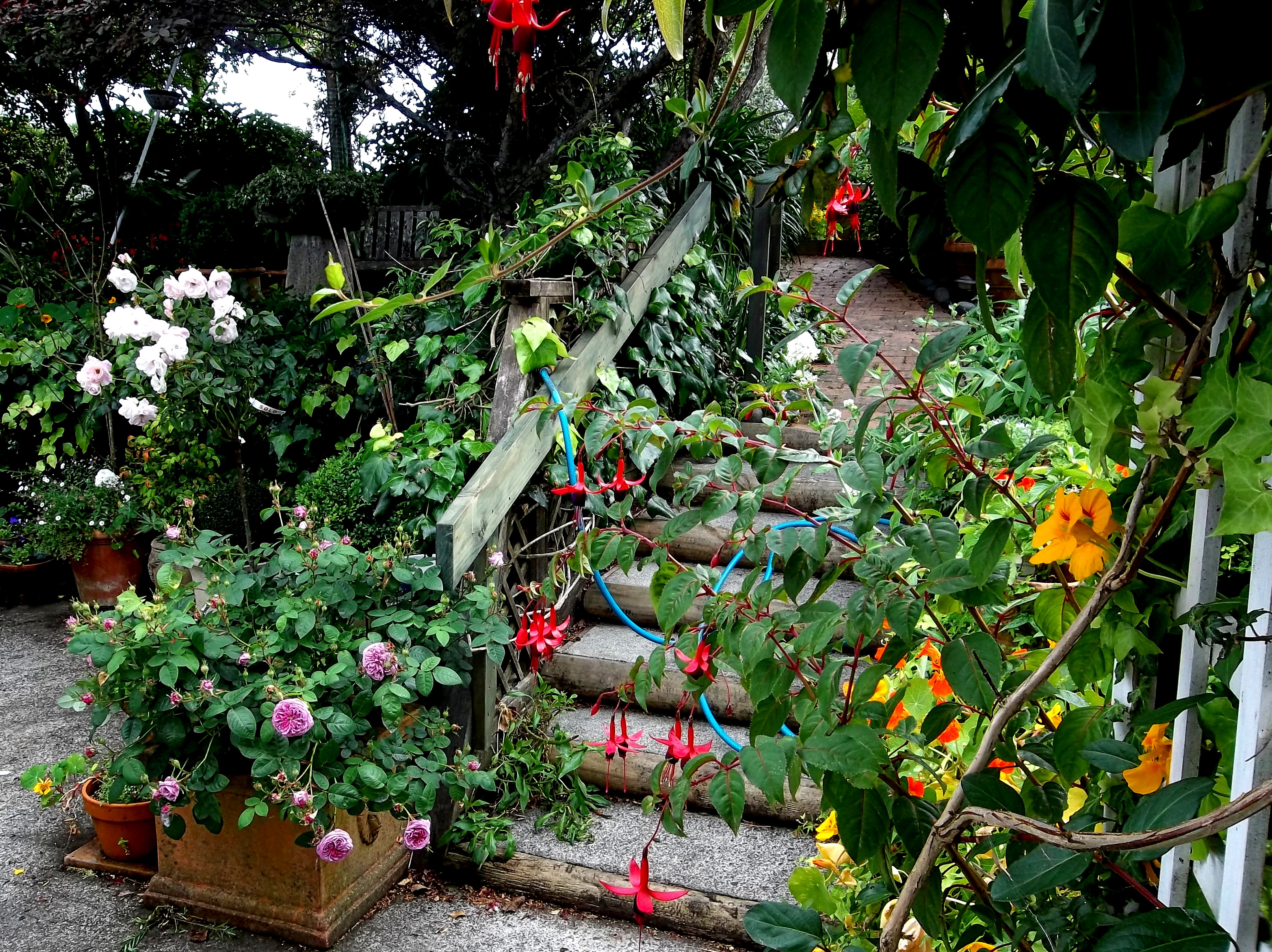
This was supposed to be a picture of a rose. When I developed it, it turned out to be a picture of a hose. I was shocked. How could I have been so one-eyed, and not seen what was shouting at me in a loud turquoise voice? I only see what I want to see, and eliminate even the obvious, it seems.

So when I went for my walk in the summer evening, I reminded myself to actually look, and not to assume or to expect. I wanted to see what was there, not what I thought was there. Down near the harbour where I usually turn around I always end up by a bougainvillaea sprawling through the trees, and just out its reach, a queen of the night holding her own. Braving bougainvillaea prickles, I can just reach the greenery-yallery sprigs of tiny flowerheads.

Two nights ago I broke one off and carried it back with me, sniffing the glorious fragrance, and ending up sitting on the warm marble bench in the cemetery at the other end of the peninsula, still smelling the sweet blossoms. I did what I’d never thought of doing before, and took it in and put it in a glass in the bed-room. The scent filled the whole room, and whenever I turned over in my sleep, the scent was drifting past.

The next day the tiny pale green flowers closed up, and the sprig sat nondescriptly on the window- sill all day, before bursting into glorious scent in the evening again. So now I plan to keep a permanent supply of these modest blossoms that don’t look big enough to be able to scent a whole room… The scent lasts for three nights I’ve discovered.

Walking back tonight with a fresh sprig of blossom, I passed a big shrub on the road where it dips and there’s a muddy spring.  Before now I’ve smelt its fragrance, but not given it a passing glance. Its reputation as a deadly poison and hallucinogen had somehow got in the way of me actually seeing this innocent plant. Tonight I looked at it, and ended up gently holding one incredibly beautiful flower-head after another, each one slightly different, gazing at their two layers of frilly white petals, and seeing deep inside the long white tube, white stamens pushing their way up to the light. The pendulous buds are so yellow it’s a surprise that the flowers are so white

The slender pale green calyx was smooth and soft and somehow tender to touch and to hold, and ended where the green- veined white trumpet – shaped flower began. Its ugly official name is brugmansia, but its folk name is angels trumpets. Angels trumpets spread their scent so far that long before I get there I can smell them.

Enchanted now with the idea of white scented flowers, I noticed the exquisite waxy looking candle-shaped buds of the king magnolia further down the road, the dark shiny leaves supporting each smooth creamy bud like a candlestick. Only one flower had opened, but it was enough. The scent of just one flower wafted past me.

I walked down the long drive to some friends’ house, knowing they were not there, but that they wouldn’t mind me visiting the frangipani plant flourishing by their veranda. The scent of frangipani takes me back to Singapore when it was still an eastern city and I was a girl, where all the alleys were hung with long bamboo poles suspended from every window on each floor, drying thin cotton tropical clothes in the brilliant un-ending sunshine.

We were staying in a hotel just around the corner from the famous Raffles Hotel, and the entrance was flanked with rows of frangipani trees.  Their fragrance followed us into the hotel courtyard and drifted in through the big open bedroom windows where we slept with no air conditioners, but beneath draped mosquito nets.

And when the velvet tropical night had fallen promptly at six thirty, every night in the darkness I would look down from the bedroom and see small groups of people squatting on the pavement in a circle. They would have tiny flickering lights and little spirit stoves in their midst to cook their dinner, delicious smells rising tantalisingly through the frangipanis, and I would hear their soft chatter and their laughter.

There were no blossoms on the frangipani growing here in New Zealand… wrong time of year perhaps. Back home, there was one white gardenia open.  I savoured the perfume before bringing it inside and putting it in a shallow bowl, floating on the water. So though no angels trumpets, I have queen of the night, gardenia and creamy honeysuckle from the porch scenting the house – even the names are poetry.

I don’t know whether I did what I intended when I began my walk, or whether I saw what was really there, but just by looking – truly looking at the beautiful angels trumpets – unnoticed before –  the walk turned into something else – a successful quest for white scented flowers. And like all successful quests, that was good enough.

And I wonder if this is how life is… we set off in one direction and find that imperceptibly we’ve drifted down other unsuspected paths; and looking back, we see that it was the perfect journey, and our travelling had a purpose, and was not random at all.


Food for Threadbare Gourmets

Friends for dinner before they left after the summer holiday to go back to the city. On a summer evening cold food seemed appropriate. So we had chicken with curry mayonnaise on rice salad. The cooked chicken chopped and mixed into a bowl of good bought mayonnaise, with about a big tablesp of golden syrup and desert sopn of curry powder to taste… I taste until I like it. Stir through enough cream to make it a soft consistency to stick to the chicken.

Cold basmati rice is jollied up with a vinaigrette dressing with salt, plenty of freshly ground black pepper, mustard, and sugar. Add to the rice generous helpings both of peas and sultanas soaked in boiling water, lots of crunchy chopped almonds lightly toasted in a frying pan, and lots of chopped parsley. Nice with a salad and chilled pinot gris .

In deference to our French connections we now have the cheese course before the pudding! This was some of our plums cooked to Nigella’s lovely recipe in red wine, one star anise, two cloves, teasp of cinnamon and a bay leaf, plus honey to taste. We had them with a mix of plain yogurt, whipped cream and runny honey stirred gently together, and a little shortbread biscuit.


Food for thought

That mighty power that sways the tides and works the million miracles of spring is ranged forever on the side of love.

The writer: known only to God .  Seen on an embroidered sampler hanging over a bedroom fireplace in an English cottage


73 Comments

Filed under cookery/recipes, flowers, food, gardens, great days, happiness, life/style, love, perfume, spiritual, Thoughts on writing and life, Uncategorized

Summer song

100_0751

Walking around the cemetery on New Year’s Eve the sky was still and clear, no silver, almost transparent moon yet, rising above the sea looking like a silver sliver of dried honesty in the pale night sky. Instead there were gulls circling silently and intently overhead, weaving endlessly in and out, never touching or interrupting the arc of another bird.

After a while I chose one single gull, and watched its movements, following its wide circles and trajectories and swoops until finally it headed out to sea in the direction of Little Barrier Island, which hovers, misty indigo, on the horizon.

It felt like a holy silence, the tracery of the gulls’ flight woven like a network of silver filaments overhead, the cemetery a cathedral, silent, sacred and undisturbed. The Universe may have been un-aware that it was New Year’s Eve around Planet Earth, but surely that thought -form which meant we were all conscious of this moment in time, must have created that charged and sacred energy which I was feeling then.

Today it has rained. Things can start growing again, and I can stop watering – for a few days anyway. The countryside has the richness of high summer. The trees are billowing with green foliage, the fields have been cut for hay, and the grass in the meadows is so high that when the calves lie down, their heads just peep out of the tops of grass heads, plantains, buttercups and clover. I thought I saw a flight of big brown butterflies the other day, and it was the tips of their velvet ears reaching out of the pasture. The thrush in the garden sings continuously between pecking at the apple nailed to the top of the fence.

Tonight I was strolling round the cemetery, and the harbour below was the deep dark green of an Arthurian mere. It was as still as a mere too, and the boats at anchor were reflected with perfect clarity. Turning to face out to sea, the ocean was quite colourless with a deep band of blue on the horizon.

I’m constantly re-filling the dogs’ water bowl by the pavement. I hear them slurping away, as people walk past to the beach, thirsty Labradors and dobermans, bitzers and bichon frises, poodles and pointers… even a bulldog.

Earlier today, reading James Lees-Milne’s diaries, listening to the summer rain, I discovered his description of an English summer night in 1946: “the smell of new-mown hay and hedgerows, of eglantine and elder… how I love these long gentle Shakespearean summer evenings…”  Me too. The scent of the queen of the night comes drifting in from the open window at night here. It’s sweet and lovely… but I miss that indefineable atmosphere of those English summer nights.

Those nights throb with nostalgia and a richness. Somehow, it’s as though the layers and layers of lives lived in those parts, the echoes of history stretching back beyond memory and beyond record, the people in the millenniums before Christ, who trod out the ancient paths that still thread across hills and ridges and valleys and fords, can all still be sensed. The voices are silent, but their presence still lingers, as one century after another passes across the meadows and the woods.

The oak and the ash, the hazel and the hawthorn, the holly and the honeysuckle have been growing there since the last ice-age twelve thousand years ago. The smells, the sweet blossom, the new mown hay, the whiff of manure, the fresh rain, the damp leaves, have smelt the same in every age and every summer since. Standing in a quiet English lane on a soft summer night, you can feel those long centuries, and it is very touching.  I haven’t experienced a summer evening for a long time. I’ve always been back in autumn or in winter. But I must savour a June night once more!

Feeling homesick for the English country-side, I got “Far from the Madding Crowd” and “Tess of the D’Urbervilles off the top shelf of the book-case, and had an orgy of Hardy. Tess first, and the sweetness of Talbothays farm, then Bathsheba and her story… I read it differently this time, not so much for the drama of the story, but for the feeling of the country.

So I really took in for the first time, the delicious characters of the farm-folk, and the details of farming life, from the signs of an approaching storm, to the rituals processing through the year of lambing and dipping, and fattening and shearing, to the yearly sheep fair, the shearing supper and the harvest supper.

It was a way of life which had existed for over a thousand years when Laurie Lee in the enchanting ‘Cider with Rosie’, told the story of his childhood, and an archaic way of life  which then vanished forever, with the combine harvester, chemical farming, agri-business and of course the destruction of communities  by the carnage of the First World War.

I’m always struck in Hardy’s books, and in Jane Austen’s letters, by the isolation and “localness” of country life back then. So many people hardly ever left their village, unless they were gentry, and the next village was a foreign country. So when people fell in love in these tiny societies, and lost the object of their affections, through death, departure or rejection, there was often no-one else to love. People literally did grieve and die in different ways, from broken hearts.

Hardy’s description of the hopeless love by the dairy-maids at Talbothays farm for the un-attainable gentleman, Angel Clare, had the unmistakeable ring of truth.  I remembered from closed societies I lived in when I was young, whether in an English village, or a tiny colonial community far away from any other European habitation, how intense relationships were when there were no others. No-one could console themselves before the population explosion, and peripatetic habits of the twentieth century, that there were plenty of other pebbles on the beach. There weren’t.

Yet now, though I live in a tiny village with only four hundred souls, we are no longer prisoners of geography. Not only do people take off to holiday in Alaska and Italy, and their families return from Vancouver and Hanoi, but we all have the world of the internet at our fingertips, to use that well-worn, but accurate cliché in this instance.

It’s eighty- six years since Thomas Hardy died, and in those years our worlds and our lives and maybe our minds have expanded beyond imagining. The world is our village, and the internet is our community. There are pebbles past counting and wherever we direct our vision, we can find the glory of summer somewhere around the globe at the push of our buttons.


Food for threadbare gourmets

Apart from being full of healthy fats, potassium and Vitamin E, avocados are delicious.  I sometimes use them as a dressing over a salad. To one avocado you need  ground coriander – I use a quarter of a teasp, but less is more… the juice of a lime or a lemon, quarter of a teasp of ground cumin, a tblsp of apple cider vinegar, salt, and about half a cup of water. Whizz these ingredients until smooth and creamy, and use straight away.


Food for thought

To write or even speak English is not a science but an art. Whoever writes English is involved in a struggle that never lets up even for a sentence. He is struggling against vagueness, against obscurity, against the lure of the decorative adjective, against the encroachment of Latin and Greek, and, above all, against the worn-out phrases and dead metaphors with which the language is cluttered up.

George Orwell, English writer 1903 -1950.  Wikipedia records that : ‘His work is marked by lucid prose, awareness of social injustice, opposition to totalitarianism, and commitment to democratic socialism.’ Animal Farm and 1984 have continuing relevance.


61 Comments

Filed under birds, books, consciousness, cookery/recipes, culture, food, great days, history, jane austen, literature, love, The Sound of Water, Thoughts on writing and life, Uncategorized, village life

The necessity of beauty

100_0764

Pamela was my lodger. She was living in the third bedroom in my flat for the same reasons that Mr Micawber pronounced the immortal words:”Annual income twenty pounds, annual expenditure nineteen pounds nineteen and six, result happiness. Annual income twenty pounds, annual expenditure twenty pounds nought and six, result misery.”

I’d tried to fill the gap between my meagre salary (women were paid far less than men in the Hongkong I lived in ) and my expenditure, by doing TV quiz shows,  radio programmes, using the children as photographic models and even doing PR for the Anglican church until I could stand being hypocritical no longer. So Pamela was my next attempt at solvency. While she lived with me my life was filled with her dramas, love affairs, crises and disasters.

She arrived with one fiancée, dressed demurely in twinset and pearls, tweed skirt and silk head –scarf. Soon she found a more exciting prospect, and changed her style  to newly fashionable jeans, her hair swung up into dashing styles and lots of makeup. The new fiancée lent her his new VW while he went back to England to sort out his divorce, and hereby hangs the tale. Pamela rolled the car her first night in possession of it, and I was awakened in the middle of the night by a Chinese policeman who couldn’t speak English.

I pieced together that Pamela had had an accident, and was in a Chinese hospital since she had no insurance to cover her for a European one.  The next morning the children, four and five years old, and I, packed up a few things for Pamela and made an expedition to the enormous  building which housed some thousands of sick and penniless Chinese.

We found our way through a maze of corridors to Pamela’s ward, and by the time I reached her bed I was deeply shocked. The ward held eighty women. They were all dressed in faded brown cotton shifts including Pamela. The noise was horrendous. Cantonese is the noisiest language on earth. To hear our amah chatting to another outside the kitchen was deafening. To hear seventy- nine women chatting in a confined space was probably higher than the safe decibel level.

Pamela was bruised and shocked but not injured. After doing our duty, and promising to return that afternoon with more things she wanted, the children and I went home, leaving her with a little bunch of camellias I’d picked. Only six blossoms because that was all that were flowering.

When we returned in the afternoon, something had changed. There was a hush in the ward and a sense of peace, and all eyes were on the gwailo (long- nose) and her children. Being watched was something one accepted as part of life then, but this felt different. And the hush was a sort of reverence. Pamela whispered to me what had happened after I left.

When we walked out of the ward, the women came crowding round her to see the flowers and smell the fragrance. They were ecstatic at this exquisite beauty in their harsh unfriendly environment. Deprived as the women were, of all colour and texture and smell and beauty, the flowers brought something like heaven into their lives.

They didn’t speak English, and Pamela didn’t speak Cantonese, but with the aid of the ward sister’s few words of English, they worked out a roster for the flowers. Each woman would have one camellia by her bed-side in a glass for three hours in every twenty-four. Pamela had one all the time, and the sixth flower which had fallen off its stem, the ward sisters had in their office, floating in a saucer.

Back at the office the next day I rang the dean of the cathedral and several hotels and they agreed to send their flowers to the hospital whenever they changed them. I wonder if they still do.

The great Catholic thinker Monsignor Hildebrand wrote that: ‘the poor need not only bread. The poor also need beauty’. But it’s not just the poor. We all need beauty.

It’s strange to me that Abraham Maslow in his hierarchy of needs didn’t include beauty. Sometimes beauty is the the only thing that keeps us going. As Resistance fighter Odette Churchill was being locked back in her cell after a bout of torture by the Gestapo, she snatched up the skeleton of a leaf being blown in the door with her. The beauty of that leaf sustained her and gave her hope and courage and a belief in goodness that carried her through her  dreadful ordeal.

Quaker writer, Caroline Graveson wrote that: ‘ there is a daily  round for beauty as well as for goodness, a world of flowers and books and cinemas and clothes and manners as well as mountains and masterpieces.’ She talked of beauty: ‘not only in the natural beauty of the earth and sky, but in all fitness of language and rhythm, whether it describe a heavenly vision or a street fight, a Hamlet or a Falstaff, a philosophy or a joke: in all fitness of line and colour and shade, whether seen in the Sistine Madonna or a child’s knitted frock…’

The sad thing is that those deprived Chinese women in that joyless hospital ward, came from a culture, which before the blight of industrialisation and the tyranny of plastic, was incapable of producing anything that wasn’t beautiful – from their baskets to their bowls, to their porcelain and their poetry.  And there was something very beautiful about buying a kati of vegetables in the markets and watching them being skilfully wrapped in a beautifully folded sheet of re-cycled Chinese newspaper, or a large leaf, and tied with a knotted reed.

Perhaps their own sage should have the last word, Confucius said that everything is beautiful, to those who can see it….

Food for Threadbare Gourmets

Salady food feels right in the Antipodean Christmas season.This is one of my favourites. Boil new potatoes for the number of people you have, plus hardboiled eggs. Chop them and mix them with sliced artichoke hearts fresh from the delicatessen or from a jar. Gently toss in a good vinaigrette  dressing, and sprinkle with capers if desired. Delicious on its own with crusty rolls, or with cold chicken or cold salmon.

68 Comments

Filed under colonial life, cookery/recipes, culture, flowers, food, great days, life/style, The Sound of Water, Thoughts on writing and life, Uncategorized

Midsummer Christmas, dawn to dusk


100_0758100_0650100_0760100_0624100_0772100_0584100_0767100_0730It would be good to find some quiet inlet where the waters were still enough for reflection. where one might sense the joy of the moment, rather than plan breathlessly for a few dozen mingled treats in the future…
Kathleen Norris

50 Comments

Filed under environment, flowers, food, great days, happiness, life/style, philosophy, Thoughts on writing and life, Uncategorized, village life

A peculiar Christmas feast and the 4th Wise Man

100_0742Polar explorer Captain Scott and his team celebrated Christmas on their way to the South Pole in 1911. As a foodie, I find their feast a little lacking in… je ne sais quoi …

After his historic Christmas dinner with Wilson and Oates, Bowers and Evans, Scott recorded in his diary what he grandly termed four courses: ” The first, pemmican, full whack, with slices of horse meat flavoured with onion and curry powder and thickened with biscuit; then an arrowroot, cocoa and biscuit hoosh sweetened; then a plum pudding; then cocoa with raisins, and finally a dessert of caramels and ginger.”

Pemmican was the classic polar food, preserved, dried meat and fat… not my idea of gourmet nosh, but Birdie Bowers, and Taff Evans both felt so filled with warmth and human kindness after this extraordinary collection of unpalatable rubbish, that they decided when they got back to England they would: “get hold of all the poor children we can and just stuff them full of nice things,” in bachelor Bowers’ words.

I just feel the polar feast could have been warmed up with a wee dram of whisky perhaps, or even a swig of medicinal brandy. But then, I feel the cold.

Bowers was responsible for this jolly Christmas celebration, having smuggled the food over and above the allowed weights for the journey. Once the recalcitrant and desperate Mongolian ponies – who had suffered so terribly on the sea journey to the Antarctic, and who had then struggled endlessly in appalling weather and conditions with food they couldn’t eat- had been killed, every man carried his own food and equipment on the heavy sleds.

Bowers had always sneaked his night-time biscuit to his pony. On the night before they were all killed, Wilson, St Francis’s man, gave his whole biscuit ration to the poor creatures, like the condemned man’s last meal. This was the only time I cried during the film: ‘Scott of the Antartic’ with John Mills.  I was twelve, and blow the men, it was the ponies I wept for.

Thankfully my Christmases have never been as cold as theirs, though it felt like it in the hall in which we rehearsed for the Nativity Play when I was five. I had no idea what a rehearsal was, or why we had been marched – or straggled would be a better word – to the hall just down the road. Neither did I really understand the story we were acting in. We seemed to stand around for hours in the unheated hall while teachers talked animatedly to each other, and shifted bodies and chairs around the stage.

I just knew that the white nightie thing I was wearing like all the other little girls, was freezing. To cap it all – like the other angels in their nighties – I had a boring triangle to keep chinging on. This was a watershed in my understanding of the world. I understood then for the first time, that boys had all the fun. Not only were they all dressed up as kings and shepherds, but they got to play drums and tambourines, trumpets and recorders.

I felt as aggrieved as I did when I first saw huge Persil ads, in which the dark haired woman had the grubby grey sheets, and a bright blonde had the sparkling Persil washed sheets. Apparently blondes were better than brunettes.

But that’s another story… a year later my grandmother took me to a midnight carol service. I was riveted. A boy sang the first verse to: ‘Once in Royal David’s City’ in an un-earthly soaring treble, and then read the lesson. At one point his clear voice rang out with the words “And Mary pondered these things in her heart”. My heart leapt. I had no idea what the beautiful words meant, but for many years I treasured them and pondered them in my heart too.

The next memorable nativity play was when my daughter was five, and she was playing Mary. I thought she was utterly precious as she gazed at the world with her big brown eyes, her little face framed by a blue head covering, her solemn gaze taking in far more than I ever did. I sat and watched her with tears running down my face and my heart nearly burst with love. And the same when my small son sang the solo so sweetly at his Christmas concert.

Much the same too at all my grandsons’ nativity plays, only not tears, laughter. My heart nearly burst with love then too, and lots of giggles, as the head mistress darted down from her pulpit to drag a little finger from some-one’s little nose, and then he simply used the other finger on the other hand and the other nostril as soon as she was safely back in the pulpit.

None of them were magnificently garbed magi, just lowly shepherds … but we all sang the sombre, beautiful carol, ‘We three kings of Orient are…’ My favourite wise man is the fourth one, and that old Christmas legend telling his story is one of the most beautiful Christmas stories, to my mind…

He had set out with the other three Magi, but on the way, they came upon a traveller who’d had an accident, and the fourth wise man stopped to help him. Seeing he would be a while, he told the other three to carry on with their journey, and he would catch them up. But he never did, for he kept meeting some creature or traveller who needed his help to get them to safety, and by the time he got to Bethlehem the kings had been and gone, and so had the Child he was seeking.

He spent many years following the trail which had always gone cold when he got there, to Egypt and Nazareth and elsewhere. He was constantly delayed by yet another needy person who asked for his help. The gifts he brought and the stock of gold he had carried with him for the journey, dwindled until he had hardly enough left to buy himself food.

And then he heard that Jesus was in Jerusalem. He hurried there, and arrived in time to stand and watch Jesus carry his cross through the streets. He had one final treasure that he was keeping to give to the One he had been seeking, a beautiful sapphire jewel. But just before Jesus passed, a Roman soldier began to assault a young woman. The fourth wise man intervened, and by now, old and frail, was unable to stop the soldier. Finally he offered him his last possession, the precious sapphire, his gift for the Messiah, and the soldier took it and left.

At that moment Jesus reached the fourth wise man, and he knelt and asked Jesus’ forgiveness for having nothing for him because he’d stopped so often on the way to help the hungry or lost or needy. And Jesus looked at him and said: ‘For as much as you have done it unto these, you have done it unto me.’

In other words… we are all one… so a happy Christmas-tide to us all, dear friends around the world of blogging.

Food for threadbare gourmets

When Christmas is here, our little purply-red plums are ripe, and though I gave this recipe last year, I think it’s worth repeating  The plums which are only so-so for eating raw, are delicious when cooked. Every-one who receives a basket of these fruits also gets the recipe I use – borrowed from Nigella Lawson.

To a kilo of plums – more or less, use 300 ml of red wine – more rather than less! Nigella says stone them – I don’t bother, the stones come out quite easily when cooked.

Put the plums in an oven proof dish. In a saucepan boil the wine with two bay leaves, half a teasp of ground cinnamon, two cloves, one star anise, and 200g of honey. Pour over the plums, seal with foil or a lid, and bake for an hour or longer at 160 degrees, until they’re tender. You can keep them in the fridge for three days, and you can freeze them.

Serve with crème fraiche, ice-cream, or custard. I also think they’d be good with rice pudding on a cold day. The aromatic scent while they are cooking is so delectable that I’d love to catch it in a bottle and spray it regularly around the kitchen.

Food for thought

“My idea of Christmas, whether old-fashioned or modern, is very simple: loving others. Come to think of it, why do we have to wait for Christmas to do that?”                                                                                                                                                                                                                                                                               Comedian  extraordinaire, Bob Hope  1903 – 2003 His grandson said that when asked on his deathbed where he wanted to be buried, he characteristically quipped: “ Surprise me .”

63 Comments

Filed under cookery/recipes, food, great days, history, love, philosophy, spiritual, The Sound of Water, Thoughts on writing and life, Uncategorized