Category Archives: happiness

Souvenirs of life

100_0871


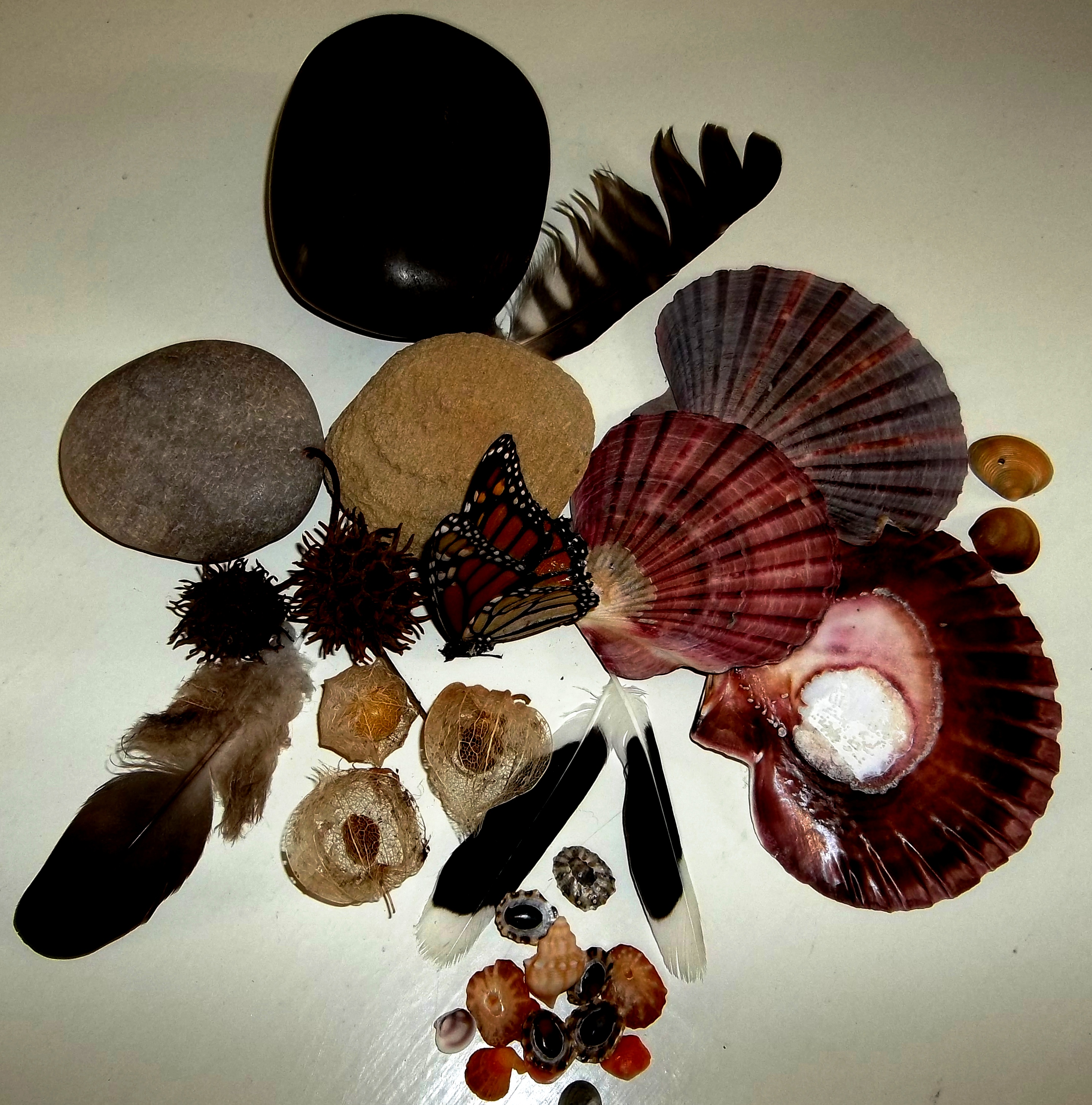
These stones and feathers and shells can tell the story of my life in the last few decades… shells collected with the children on a Northland beach, a black and white feather lying outside the door when I opened it on our first day in a new house –  greeting from a tui… the brown and cream morepork feather found on a long walk around the harbour with the thoughts and dreams of that afternoon threaded through its fronds.

An ancient stone from a river bed in the Blue Mountains of Australia was picked up after a day spent abseiling in abject terror, another from a cold pebbled beach in Devon, the chill of the Atlantic  breakers still embedded in it after all these years, while the polished brown stone came from an underground cave in the central North Island where glow-worms illuminated the roof, and a river flowed through.  These things are the stuff of my life… as they are of every life in which they are valued.

As I looked at them I thought of how other collections can also tell the story of a life. When I renewed my passport recently I found all my old ones, going back to when I was twelve and going to France on my own to learn French. In that passport photo two frightened brown eyes gazed out at the world. I had been so appalled at this picture that I promptly destroyed the evidence.

Which left the rest – a twenty one year old about to go on holiday to Spain, well- groomed hair, immaculate lipstick, and veiled blank eyes… the next, an exhausted mother of two toddlers about to go to Hong Kong, badly cut hair, eyes sad and resigned. And then, a picture of a thirty five year old woman, lots of dark hair piled up confidently, smiling eyes, relaxed smile. Life to be lived now, not endured. In the decades since, the hair has got shorter and then faded, and the last photo was so awful I hoped to be un-recognisable, but the story of a life is told in those passport photos.

Another can tell the story of their life in their jewellery, the coral necklace given at a christening, the charm bracelet for a little girl, pearls for a twenty-first, the engagement ring and the gold band…  a gift to mark the first child,  a clumsy pottery brooch made  at school and proudly presented to a beloved mother… the ring inherited from a grandmother, the eternity ring at a silver wedding…  such precious collections can mark out the steps of a life quite as well as a photograph album.

I wonder if there is even a market these days for photograph albums now all our photos are taken on phones and I-pads. I was never much  of a photographer, so that the photos of my honeymoon were on the same roll of film as the pictures of my first baby. But I did have a memory.

I remember one summer’s afternoon when the children were three and four as they tumbled around on the grass, one wearing a sun-suit in glorious colours of pink and orange and red, the other in matching shirt and orange shorts. As I looked at them, revelling in their laughter, their shining hair, and sparkling eyes, pearly teeth and glowing sun-tanned faces, I thought to myself, I’m going to remember this moment forever.

It was a turning point, because I found I did never forget that moment. So now, I know I can fasten those moments I want to remember with that little intention, and our minds are so obedient that they obey the instructions, and can call up the images whenever they are wanted. On the other hand, I wonder if the ease of communication, the instant photos, the selfies sent from Rome or Khatmandu which reach every member of the family all over the world the same day, make it easy to forget. We don’t have to remember, because it’s all there, on Facebook or in the picture file on the computer.

But for how long? Until the internet crashes? Or some other disaster hits the net? The computer is stolen? Few people will be able to pick up old albums in the future and leaf through them re-living their own lives, or discover the lives of their ancestors. And how will biographers fare in the future? In the past we’ve had portraits and miniatures in pre-photography days; then the wonderful stilted posed photos of the early days of photography, with the expert’s head hidden under a black cloth over a tripod while he captured forever the people and that moment in their time.

Then came the brownie box camera and all the other simple do- it- yourself cameras, and families recorded their events and special moments themselves. Biographies of the famous from the twenties until the sixties are full of revealing snaps, but what will there be for future  writers and historians wanting to illustrate their books about the powerful and famous? Not much, I suspect.

In the past, many anonymous photos turned out to be records of history – impromptu black and white snaps of Battle of Britain pilots ‘scrambling’, shots of families crouched in air –raid shelters from London to Leningrad, soldiers in Africa or Italy taking grainy pictures of each other to send back home… joyful hugs and kisses of victory – all these spontaneous pictures of humanity enduring both the ordeals and the pleasures of the twentieth century, captured in black and white film, are the stuff of history.

But I wonder what history is being preserved today in our somewhat ephemeral records? Will collections of jewellery or stones, in the end be the things to jog people’s memories in the future? Maybe the photos in passports and on driving licenses will the best concrete records we will have… time to get a decent picture taken for these official documents perhaps !


Food for threadbare gourmets

Summer salads don’t always mean lettuce for me… One of my favourites is grated cauliflower, mixed with chopped hard- boiled egg, some chopped Medjuel dates, toasted slivered almonds, and lots of chopped parsley. Then stir in enough good mayonnaise to the consistency you like. Chopped apple or banana is a variation, but actually anything can be added, and it still tastes good. But it can’t sit around, or it turns watery. I eat it on its own, but it’s also good with cold chicken.

Food for thought

And a poet said, Speak to us of Beauty. And he answered: Where shall you seek beauty, and how shall you find her unless she herself  be your way and your guide?  Beauty is not a need but an ecstasy. It is… a heart inflamed and a soul enchanted … a garden forever in bloom and a flock of angels in flight.

‘The Prophet’ by Kahlil Gibran, Lebanese poet, 1883 -1931. ‘The Prophet’ has never been out of print since it was published in 1923.

I
44 Comments

Filed under birds, cookery/recipes, family, food, great days, happiness, history, life/style, love, poetry, The Sound of Water, Thoughts on writing and life, Uncategorized

The eternal search – for the perfect coffee

100_0834

I lost my wallet the other day. Going to pay for the dry cleaning, I found my big red Guy Laroche wallet given to me by my generous daughter had disappeared. Panic. The last place I’d had it was at the garden centre a mile away. And since I’d paid for the plants, the wallet must still be sitting in the trolley. More panic.

I ran through the things that mattered in my mind… credit cards … but ‘they’ wouldn’t know my pin number. Pain to have to cancel… forget them for now. Money? Who cared. But oh, my photographs of the grandchildren and moments caught in time that I wanted to remember… they were irreplaceable… and the two little love letters with terrible spelling and seven year old scrawls from them … one which I had found written in the diary they always used to keep when they came to stay with me… on this occasion they had decided that they would stay permanently and be home-schooled by me:

‘Five time a week I have fun. It can be so wonderful. I will like to say that I am writing this because it came from my hart and I kodn’t get it out of my hed….I hope that we can stay heer for homeschool it will be so fun and it will asol be fun because I love my granny so much it can be fun every day but I love staying heer and I like feeding the eels’… how could I replace a letter like that? My heart curled over at the thought of such a loss…

What else?  Oh … my collection of coffee cards. Each one stamped for every coffee I’d had, and nearly ready for a free coffee. The restaurant down by the river, the cafe in the garden where they make pottery, the lovely place where they also make hand-made chocolates, my stopping off place in town…

Zipping up my stiff upper lip I hurried back to the garden centre, and there was the red wallet, waiting for me at the office. (gardeners are good  people!) “It was my coffee cards I was worried about,” I explained when I picked it up, and everyone laughed because they knew how I felt.

I have travelled the length and breadth of one country, which shall remain nameless for fear of hurting millions of people’s feelings, looking for a decent cup of coffee. I finally found one in a far-flung cathedral crypt cafe.  I will drive for miles for the sake of that elusive perfect cup.

I know as soon as it’s put in front of me if it’s going to be a good one. The cream will be thick and won’t just dwindle into a thin froth when stirred. It will be smooth and not too creamy and not too strong. The most memorable coffee I’ve ever had was in an Italian restaurant in Melbourne.

Creating this ambrosia obviously came naturally to the maker… and in that search for the perfect cup, I’ve discovered that the maker actually matters. Yes, I know the machine has to be properly cleaned so the coffee doesn’t taste bitter, and the milk the right temperature, but there’s more to it than that. And the deciding factor in the quality of a cup of coffee for me, seems to be the person.

Everyone makes the coffee the same way on the same sort of machines I’m assured, but it doesn’t work out like that. Every barista is different and so is their coffee. A grumpy barista does not produce a good cup of coffee. A good cup of coffee is hand-crafted and a work of love, so I know if it’s going to be delicious by the quality of the barista’s smile. A nice person makes great coffee! They even do lovely patterns in the froth, like a Christmas tree at Christmas time, or a flower or smiley face at other times!

And what despair and thwarted desire when I arrive at a favourite coffee place to find a new member of staff, or the nice coffee person has taken off overseas, and we have to start all over again, with a learner driver as it were!  Or the tantalising times when the best coffee maker is busy cutting cake or sorting spoons, and not at her post, and I have to make do with a cup which I know won’t be as good as hers.  C’est la vie, but coffee is so much more than beans, milk and water!

And when the perfect coffee arrives, what sybaritic pleasure – the delicate sinking of the spoon into the froth, and a gentle stirring. Sometimes a fragrant teaspoon of coffee crystals for the sheer pleasure of stirring and dissolving them in the glorious liquid. And then a sip, and a contented settling into satisfaction as I slowly savour one of civilisation’s minor works of art.

Sadly the second cup never reaches the same level of pleasure as the first. And I’ve even read that scientific research has proved this to be true. No wonder it matters that that first cup is as good as it can get!


Food for Threadbare Gourmets

One of my favourite coffee places serves gingerbread with their coffee. I love it. To make it myself, I use two eggs, a cup of sugar, a cup of milk and a cup of golden syrup (the cup rinsed out with oil before measuring the syrup). Beat them together. Melt 225g butter. Mix two cups SR flour, two teasp or more of ground ginger, a teasp each of mixed spice and of cinnamon, and a teasp of baking soda into the egg mixture and then stir in the melted butter.

Pour into a loaf tin with the base lined with baking paper. Bake at 180 degrees for an hour. If you’re using a fan-bake oven test after 45 minutes. Let it cool in the tin for 30 minutes before turning out. You can ice it, but I like it cut into slices and spread with a little butter.

Food for Thought

“The artist’s task is to save the soul of mankind; and anything less is a dithering while Rome burns. If artists cannot find the way, then the way cannot be found.”
Terence McKenna  (1946 –  2000) was an American philosopher, ethnobotanist, lecturer, writer and author of several books.. He was also the creator of a mathematical theory of time based on patterns found in the I Ching which he termed novelty theory.[1]


65 Comments

Filed under cookery/recipes, culture, great days, happiness, humour, life/style, love, philosophy, The Sound of Water, Thoughts on writing and life

A rose is a rose is a hose !

100_0532

This was supposed to be a picture of a rose. When I developed it, it turned out to be a picture of a hose. I was shocked. How could I have been so one-eyed, and not seen what was shouting at me in a loud turquoise voice? I only see what I want to see, and eliminate even the obvious, it seems.

So when I went for my walk in the summer evening, I reminded myself to actually look, and not to assume or to expect. I wanted to see what was there, not what I thought was there. Down near the harbour where I usually turn around I always end up by a bougainvillaea sprawling through the trees, and just out its reach, a queen of the night holding her own. Braving bougainvillaea prickles, I can just reach the greenery-yallery sprigs of tiny flowerheads.

Two nights ago I broke one off and carried it back with me, sniffing the glorious fragrance, and ending up sitting on the warm marble bench in the cemetery at the other end of the peninsula, still smelling the sweet blossoms. I did what I’d never thought of doing before, and took it in and put it in a glass in the bed-room. The scent filled the whole room, and whenever I turned over in my sleep, the scent was drifting past.

The next day the tiny pale green flowers closed up, and the sprig sat nondescriptly on the window- sill all day, before bursting into glorious scent in the evening again. So now I plan to keep a permanent supply of these modest blossoms that don’t look big enough to be able to scent a whole room… The scent lasts for three nights I’ve discovered.

Walking back tonight with a fresh sprig of blossom, I passed a big shrub on the road where it dips and there’s a muddy spring.  Before now I’ve smelt its fragrance, but not given it a passing glance. Its reputation as a deadly poison and hallucinogen had somehow got in the way of me actually seeing this innocent plant. Tonight I looked at it, and ended up gently holding one incredibly beautiful flower-head after another, each one slightly different, gazing at their two layers of frilly white petals, and seeing deep inside the long white tube, white stamens pushing their way up to the light. The pendulous buds are so yellow it’s a surprise that the flowers are so white

The slender pale green calyx was smooth and soft and somehow tender to touch and to hold, and ended where the green- veined white trumpet – shaped flower began. Its ugly official name is brugmansia, but its folk name is angels trumpets. Angels trumpets spread their scent so far that long before I get there I can smell them.

Enchanted now with the idea of white scented flowers, I noticed the exquisite waxy looking candle-shaped buds of the king magnolia further down the road, the dark shiny leaves supporting each smooth creamy bud like a candlestick. Only one flower had opened, but it was enough. The scent of just one flower wafted past me.

I walked down the long drive to some friends’ house, knowing they were not there, but that they wouldn’t mind me visiting the frangipani plant flourishing by their veranda. The scent of frangipani takes me back to Singapore when it was still an eastern city and I was a girl, where all the alleys were hung with long bamboo poles suspended from every window on each floor, drying thin cotton tropical clothes in the brilliant un-ending sunshine.

We were staying in a hotel just around the corner from the famous Raffles Hotel, and the entrance was flanked with rows of frangipani trees.  Their fragrance followed us into the hotel courtyard and drifted in through the big open bedroom windows where we slept with no air conditioners, but beneath draped mosquito nets.

And when the velvet tropical night had fallen promptly at six thirty, every night in the darkness I would look down from the bedroom and see small groups of people squatting on the pavement in a circle. They would have tiny flickering lights and little spirit stoves in their midst to cook their dinner, delicious smells rising tantalisingly through the frangipanis, and I would hear their soft chatter and their laughter.

There were no blossoms on the frangipani growing here in New Zealand… wrong time of year perhaps. Back home, there was one white gardenia open.  I savoured the perfume before bringing it inside and putting it in a shallow bowl, floating on the water. So though no angels trumpets, I have queen of the night, gardenia and creamy honeysuckle from the porch scenting the house – even the names are poetry.

I don’t know whether I did what I intended when I began my walk, or whether I saw what was really there, but just by looking – truly looking at the beautiful angels trumpets – unnoticed before –  the walk turned into something else – a successful quest for white scented flowers. And like all successful quests, that was good enough.

And I wonder if this is how life is… we set off in one direction and find that imperceptibly we’ve drifted down other unsuspected paths; and looking back, we see that it was the perfect journey, and our travelling had a purpose, and was not random at all.


Food for Threadbare Gourmets

Friends for dinner before they left after the summer holiday to go back to the city. On a summer evening cold food seemed appropriate. So we had chicken with curry mayonnaise on rice salad. The cooked chicken chopped and mixed into a bowl of good bought mayonnaise, with about a big tablesp of golden syrup and desert sopn of curry powder to taste… I taste until I like it. Stir through enough cream to make it a soft consistency to stick to the chicken.

Cold basmati rice is jollied up with a vinaigrette dressing with salt, plenty of freshly ground black pepper, mustard, and sugar. Add to the rice generous helpings both of peas and sultanas soaked in boiling water, lots of crunchy chopped almonds lightly toasted in a frying pan, and lots of chopped parsley. Nice with a salad and chilled pinot gris .

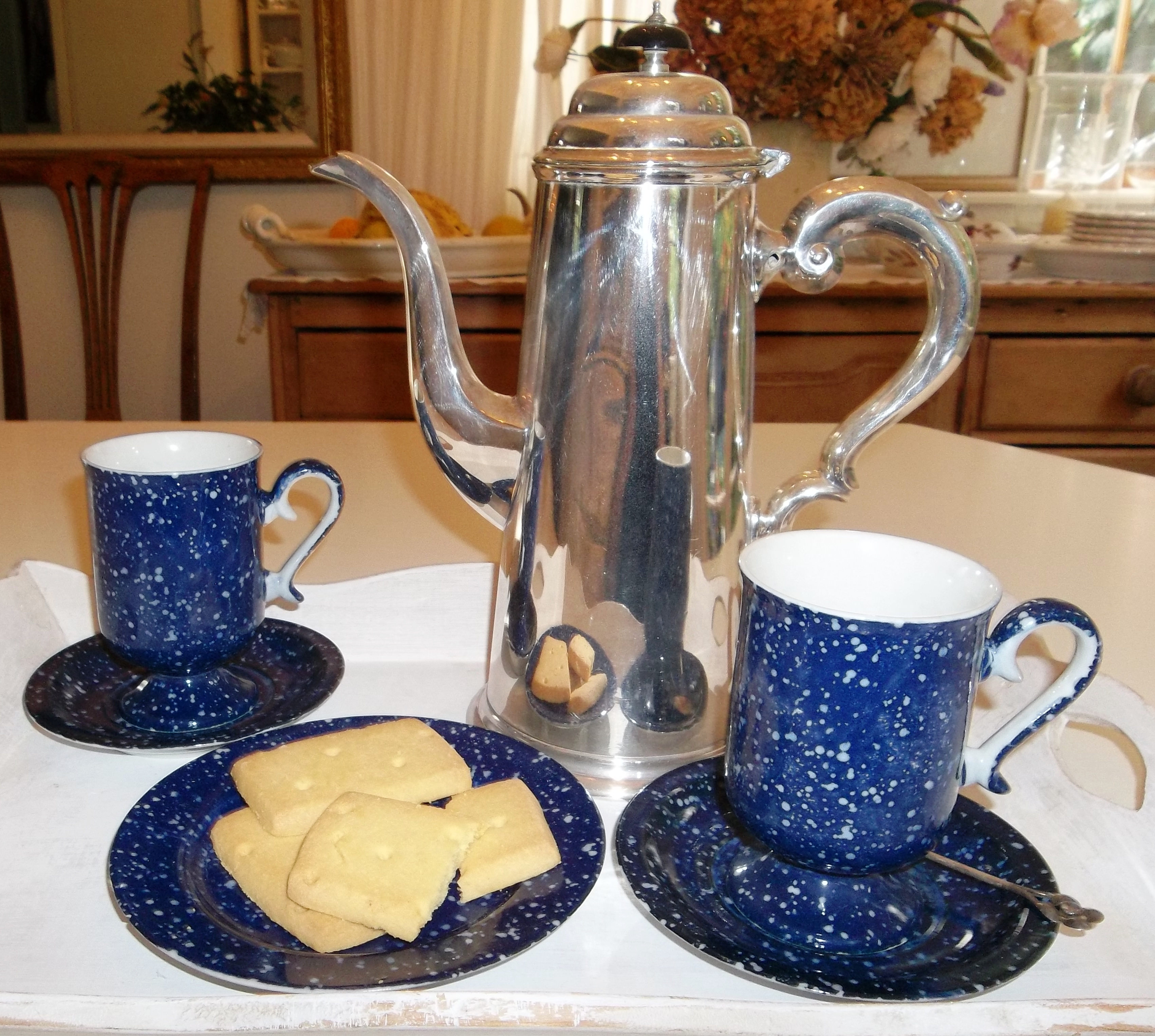
In deference to our French connections we now have the cheese course before the pudding! This was some of our plums cooked to Nigella’s lovely recipe in red wine, one star anise, two cloves, teasp of cinnamon and a bay leaf, plus honey to taste. We had them with a mix of plain yogurt, whipped cream and runny honey stirred gently together, and a little shortbread biscuit.


Food for thought

That mighty power that sways the tides and works the million miracles of spring is ranged forever on the side of love.

The writer: known only to God .  Seen on an embroidered sampler hanging over a bedroom fireplace in an English cottage


73 Comments

Filed under cookery/recipes, flowers, food, gardens, great days, happiness, life/style, love, perfume, spiritual, Thoughts on writing and life, Uncategorized

Nuns and their habits

100_0807

I can’t help feeling that nuns are getting a bad press at the moment after seeing the film Philomena, and like everyone else in the cinema, running out of tissues. I thought back to the nuns at my convent… mostly French or Belgian, a couple of English and a few Polish ones. Some were old, some were beautiful, some were wise and some were silly – at least to a bigoted ten year old.

My father didn’t know about my past in which I’d  read all my grandmothers anti-Popish books, which included Westward Ho, and Foxe’s Martyrs, a catalogue of the three hundred people Mary Tudor burned for being Protestant. So sending me to a convent for a good education seemed a good idea to him.

I didn’t discuss it with him, for on our first day with our new parents, I’d been told I had to do exactly as I was told – always – so there didn’t seem to be any room for discussion. So a prejudiced Protestant got to observe the strange Catholic goings-on at her new school!

The nuns all looked wonderful in their no-expense spared rich plum-red gabardine habits, with wide swinging pleated skirts and wide sleeves. They wore a long snowy  white veil over the wimple which framed their faces and had a splendid thick knotted red cord round their waists to which they attached their rosaries.

We had a roller skating rink where we skated most days, and obsessed about how many ball-bearings our skates had. At night when I boarded for a while, and when everyone was supposed to be in bed and asleep, we could look down from the gabled windows, and see the nuns swirling round the rink on our borrowed roller skates,red  habits swinging, veils flying. An unforgettable sight.

The order had been formed by three aristocratic Belgian ladies, and we heard their history interminably when we sat in silence in the refectory at lunch, while tall, serious, severely beautiful Mother John stood at the carved lectern and read it to us during retreats. Retreats and the numerous saints Feast Days were a wonderful way of not doing schoolwork, which my parents disapproved of, since they were paying school fees.

During retreat, for several days we never spoke (which I loved even then), and did nothing but pray, draw holy pictures, tally what good deeds we’d managed to perform each day, using a flower as a symbol (I used a violet), process around the school grounds singing hymns, and if we were Catholic, celebrate mass with a portly priest imported for the job. I couldn’t bear him and the way all the nuns fawned over and spoiled the only man who ever came into their orbit! Apart from no speaking and mass, Feast Days were the same round of prayers and processing.

Mother Michael was our housemistress, a tall bony woman, English, and almost the only nun there who had no charm. She wore thick horn-rimmed spectacles, and I noticed uncharitably that in the chapel at prayers every day after lunch, she twiddled her Bride of Christ gold wedding ring and didn’t seem particularly devout.

I rather enjoyed this lunch-time prayer ritual, it also cut into time for lessons, as we walked in a long crocodile along the corridors on miles of polished linoed floors, passing numerous statues of saints frequently adorned with rosaries or necklaces. I thought most of the statues were ‘soppy’, a word we used then, and actually I think they probably were – mass-produced, sentimental, pastel- coloured and idealised images. I glared at them all like a latter-day Cromwell.

Chapel however, with its scent of incense was a pleasure, and a respite from effort and intrigue. Yes, the convent was a hotbed of intrigue and occasionally swept by gusts of vague hysteria – what convent girls would probably call ‘scharmerei’ – with favourites, crushes and gossip part of the mix.

I was Mother Michael’s favourite for more than a term. It was, in a good Catholic phrase – purgatory – because I was imprisoned every day in the airy second floor cloakroom in the Georgian house which was the home of the junior girls. It was a pleasant sunny room, but it might just as well have been a dungeon because I was chained, as it were, to a chair, and every lunch break Mother Michael undid my long dark brown plaits and spent the rest of the lunch hour break brushing my hair.

Friends came and went, washing their hands and changing their indoor shoes, but I was pinned to my penitential chair with my hair loose. Just before the bell Mother Michael would re-plait it, dragging it round my face like a Victorian orphan, and every day when I got home my stepmother would ask what was going on, and when I told her, say it had to stop. I would have loved it to stop, but I didn’t know how to make it stop.

It went on until Mother Michael found another pair of promising plaits, not as long as mine, but long enough. The new favourite was rather smug to me, but I knew what she was in for, and watched with some pleasure as Barbara found herself nailed to the chair, and like me,  unable to join in the games of skipping and hopscotch, playing five stones and weaving cats cradles going on outside. Mother Michael had seriously interfered with my social life, and I felt no pity for her next victim.

The other nuns were civilised and kind, unbigoted and happy. Unlike the only teacher who wasn’t a nun, and who constantly tried to outdo them in piety and holiness. She was the maths teacher, so it was inevitable that our relationship would founder.

In fact it never recovered from the day when I finally rebelled and tried to speak my mind. As an Irishwoman, her constant theme was the ‘puir’ persecuted Catholics and all the dreadful things Protestants had done to them, including  executing Guy Fawkes and his co-conspirators – we never celebrated Guy Fawkes day at the convent – and ‘puir ‘ St Thomas More, beheaded by Henry VIII.

Baulking at having to pray for the souls of my Protestant parents because they weren’t Catholic – after we’d interrupted long division yet again to recite the Angelus – my stroppy ten-year old self started to tell her about the Inquisition, and Borgia Popes etc.  But I got no further than the Inquisition. “Oh what a pack of Protestant lies!“ she shrieked dramatically, clapping her hands over her ears.

Not only was my relationship soured with Miss Cummins, but it never recovered from the disapproval of all the other Catholics in the room either… I paid the price for this rebellion, and was always left until last to be picked for rounders teams and  netball. I left the convent after a year without regret, and yet looking back I’ve had more fun from my memories of that unique environment than from some of my more conventional schools.

The beautiful High Victorian Gothic building, which housed the foreign nuns so far from their homes in Europe, and generations of schoolgirls, has now been turned into smart flats, surrounded by the glorious trees and grounds where we played so happily, watched by little red squirrels perched in the black branches of bare trees silhouetted against the snow.

I wonder if the skating rink is still there. I think no-one since would have enjoyed it as much as those gentle souls swirling silently around in the dusk, plum coloured habits swaying, veils flying and rosaries swinging. I do hope they bypassed purgatory and skipped straight into heaven.


Food for threadbare gourmets

Going cold turkey day after day post Christmas is not my idea of enjoying food. So after the second day I chop it into small pieces and freeze it. Yesterday we were ready to eat more turkey, so I defrosted it, stirred small pieces into a thick white sauce with plenty of nutmeg, some parsley and plenty of chopped mushrooms fried in butter. Served over savoury rice, it was good. Into the hot basmati rice I stir a chopped fried onion, plus a handful of peas, a handful of sultanas soaked in boiling water to plump them out, and plenty of toasted slivered almonds, salt and pepper plus more parsley. It beats the boredom of cold turkey.

Food for thought

The angels keep their ancient places;

Turn but a stone, and start a wing!

‘Tis ye, ‘tis your estranged faces,

That miss the many splendoured thing

Francis Thompson 1859-1907, great English poet, mystic, vagrant who lived on the streets for most of his drug-addicted life.


49 Comments

Filed under cookery/recipes, happiness, humour, life/style, spiritual, Thoughts on writing and life, Uncategorized

Midsummer Christmas, dawn to dusk


100_0758100_0650100_0760100_0624100_0772100_0584100_0767100_0730It would be good to find some quiet inlet where the waters were still enough for reflection. where one might sense the joy of the moment, rather than plan breathlessly for a few dozen mingled treats in the future…
Kathleen Norris

50 Comments

Filed under environment, flowers, food, great days, happiness, life/style, philosophy, Thoughts on writing and life, Uncategorized, village life

Days of wine and roses

100_0503

It’s been the one of those glorious days when ‘cherubim and seraphim are casting down their golden crowns around the glassy sea.’  Silence… a small white yacht gliding over the still shining water, scarcely leaving a wake, using the engine because there’s no wind for the sails… the islands we never normally see, floating on the horizon, palest purple against a lavender blue sky… an enchanted stillness, the only sound the cooing of the doves in the trees.

When I awoke this morning the sky was just turning pink, so early though it was, I jumped out of bed, dressed, and headed out to watch the rising sun across the sea. The dawn chorus was just beginning, so I turned around and walked by houses with curtains drawn and solitary gardens, thrush and blackbird seeming to pass me on from one song to the next.

Theirs was the longest and sweetest serenade, while the soft incessant cheeping of the sparrows filled the spaces, and the slow crescendo of the doves cooing began. As I retraced my footsteps back along a grassy track, I saw with pleasure that mine were the only footprints in the dewy grass. I never met another soul as I meandered around the sleeping village.

Back home I crossed into the cemetery and disturbed a couple of speckled hens who scurried  fussily back into their own garden next door, clucking agitatedly. I walked across to the end of the peninsula to get my daily fix looking out to sea through the grey gnarled branches of the ancient pohutakawas.

Later, I sat on the veranda feasting my eyes on the glittering water, with breakfast of toast and a boiled egg from the errant chickens. When I had visited their owner Kate the day before, she had given me a handful of newly laid eggs, and the one I ate now was so beautiful I could hardly bear to break the shell. It came from her oldest hen, she said, a black Arakan, a breed which presumably comes from Arakan in Burma, and this little black hen lays eggs of the same pale blue as the sky today.

During the morning I went to the next village to buy a birthday card for a man. No flowers then, and since most men’s cards are covered with the inevitable cars or golf clubs, I did some lateral thinking and came away with a card with a message: “ If you resolve to give up drinking, smoking and loving, you don’t actually live longer: it just seems longer.” My son-in-law will be delighted with this encouragement to enjoy these permitted pleasures.

Stopping off at the garden cafe down a long avenue of poplars, the vivacious young Indonesian proprietor greeted me as usual with: ‘Ah Miss Valerie, are you ready for your coffee today?” Since she always jumps the queue for me, and makes piping hot coffee I can forgive her the spinsterly ‘Miss’. I sat in an ivy- covered alcove framed with late wisteria blossom and white jasmine, their scents wafting over the smell of coffee.

Before getting home, I called in on Friend, to collect various things from yesterday’s rollicking party for 45 oldies who came from far and wide. Others were there too to collect their vases, or napkins or fish slices. “The sun’s over the yard arm”, announced the man of the house, which though it was only lunch-time, gave us the excuse to finish off the champagne from the previous day.

Then, we had sat on the terrace in the sun, looking out over the turquoise sea, the lawn fringed with white iceberg roses in full bloom, and red roses lining the long white table cloths.

We’d enjoyed a four course lunch, starting with a terrine followed by freshly baked ham, salmon and asparagus, the cheese course – big rounds of fresh Brie, fresh strawberries and blueberry tarts – each course accompanied by different wines and champagne –French of course! And finally the birthday cake, a pyramid of moist chocolate brownies and truffles. In other words a feast! And all made by friends.

At the end of the afternoon someone brought out a guitar. We sang ‘Blowing in the wind,’ ‘Michael row the boat,’ ‘Kumbiya, ‘He‘s got the whole world in his hands’… all the old favourites. I sang my heart out, and had to restrain myself from dancing.

But as a somewhat acid -tongued acquaintance observed to me, all the men were glued to their seats – and they all look alike, she said. “They all have white hair, and are wearing the same sort of blue and white checked shirts, most of them have walking sticks and a lot of them have paunches!” The women on the other hand, were younger, sprightlier, beautifully dressed and immaculately groomed.

That evening several of the guests came to dinner, though we couldn’t eat much. We sat on the veranda in the dusk, by the loquat tree covered in golden fruit, with a fat green and white wood pigeon rustling around swallowing them whole. We had wine and laughter and fun, discussed everything irreverently, and enjoyed the party all over again.

Days of wine and roses and golden laughter  …when I returned flushed with champagne from Friend today, I found another generous neighbour had called while I was out, and left a bag full of freshly picked broad beans hanging on the door handle.

They were so delicious that for supper, I simply ate a dish of the tender little green jewels glistening with hot butter, though the old chap had steak with his. And I’ve just returned from the field above the harbour where the two little white goats live. They feasted on the broad bean pods, and seemed to feel the way I do about them.

‘Gather ye rosebuds while ye may’, wrote the poet, ‘Old time is still a-flying’, and I’m dedicated to this advice…. my rosebuds may be different to other people’s ideas of rosebuds, but I’m picking them as fast as I may.

So I sit here on the veranda writing, watching the evening sky turn pink and lilac and pale turquoise over the still, silver water, the scent of sweet peas, a gift from a friend’s garden drifting through the house, and savour my blessings. I began with the words of a hymn, so I’ll end with some. These shining days are filled with rosebuds – moments of pleasure and goodness – friends and fun and flowers, chickens and birdsong and beans, ‘all things bright and beautiful, all creatures great and small’.


Food for threadbare gourmets

The strawberry season means Eton Mess for me! The first time I tasted it was just outside Eton, at a place called Datchett, at a rather grand dinner to entertain some visiting Argentinian polo players who’d been playing on Smith’s Lawn at Windsor. My best friend and I knew we were only there simply because they needed some girls to balance out the chaps. But we gave the food a lot of attention too.

The version I ate then was a variation, because the crushed strawberries and broken meringue were pressed into a big dish of ice-cream, and then re-frozen. Whipped cream was piled on  when it was served, on a huge carving dish. I like doing it this way too, using freshly made local artisan ice-cream. Really, the amounts are up to you… you can’t go wrong. As an added touch I sometimes whizz up a punnet of the fresh strawberries with some sugar, and hand that round in a sauce bowl, to drench the already sumptuous mixture in it! Food for the gods….


Food for Thought

He had picked it up, he said, on a beach; it was a piece of sea-washed wood in the shape of a human head. It was made of hard wood, shaped by the waters of the sea, cleansed by many seasons. He had brought it home and put it on the mantelpiece; he looked at it from time to time and admired what he had done.

One day he put some flowers round it and then it happened every day; he felt uncomfortable if there were not fresh flowers every day and gradually that piece of shaped wood became very important to his life. He would allow no one to touch it except himself; they might desecrate it; he washed his hands before he touched it. It had become holy, sacred, and he alone was the high priest of it; he represented it; it told him of things he could never know by himself. His life was filled with it and he was, he said, unspeakably happy.

From Krishnamurti’s Journal


59 Comments

Filed under birds, environment, flowers, great days, happiness, life/style, philosophy, spiritual, The Sound of Water, Thoughts on writing and life, Uncategorized, village life

Talking about silence

100_0542

A friend went for a happy break away with distant family, and returned home to find the bliss of silence awaiting her. She shared it with her readers, the deep need for solitude and silence, and how simply being with her plants, communing with her creatures, savouring the long views, the huge skies, and never speaking a word, she felt restored and at ease with herself.

Her readers, a band of like minds, responded that silence and solitude were necessities in their lives too. We discovered that we were not strange, we were not eccentric recluses, but that we were all strangely normal !

I thought about this, and realised that this group of women who had responded had probably reached that point in life when we want to experience our Hestia natures. Hestia was the Greek Goddess of the hearth and in her wonderful book, ‘The Goddesses in Everywoman’, Jean Bolen explores Hestia’s nature, and describes the Hestia archetype as being centred on home and family. She suggests that if Hestia wrote a book about her inner process she would call it Zen and the Art of Housekeeping.

Attention to the household, which includes the plants and animals in our care, is almost a spiritual process for a Hestia person. Women with this archetype find a sense of inner harmony as they cherish their surroundings and they know that this  nurturing of their corner of the planet, is a form of mindfulness. Jean Bolen called this time in which the Hestia archetype is totally absorbed in her  activities: ‘kairos’ time, a lovely Greek word describing that sense of being outside time, and feeling completely fulfilled. It’s also time-Less, we emerge from the ‘Zone’ as some call it, to find that time has flown while we were unconscious of the very word.

It feels like a creative activity, which it is, when we are so immersed in our tasks that time is meaningless. This is psychologically  nourishing, and we feel deeply satisfied and energised, powerful and peaceful when we come out of the ‘Zone’; like a writer feels  on completing a piece, a poet when her poem has emerged, or an artist after an inspired day at the easel.

Hestia women need and seek solitude, and as children they often felt out of kilter with their families, finding refuge in books and withdrawing emotionally. As adults, they need ‘A Room of Their Own’. The late Ardis Whitman, free-lance writer quoted  in ‘The Feminine Face of God’, said that: “…when we are surrounded by people, some of the passion and insight natural to us leaks away through the sieve of small talk. At your most daring moments you believe that what is going on is the ultimate human work – the shaping of a soul. The power of life comes from within: go there. Pray, meditate. Reach for those luminous places in yourself”

The obstacle to taking this time for self is women’s guilt. Too often they feel guilty at making time for themselves, fear they are being selfish, and so give away their vital self-nourishment by trying to please others. With maturity and the confidence of age, they can reclaim the time and space they need, knowing the truth of Rabbi Hillel’s ancient imperative: ‘ If not me –who? If not now – when?’

I have a friend whose stepmother is part Native- American. She was brought up by her Native -American grand-parents, and she told me:  “there was no idle chatter in our house. It was silent. My grandparents believed silence was sacred and should not be broken unless we had something of worth to say” …  Whenever I feel the need for silence at home, I say to my husband (politically incorrectly – sorry chaps!):  Red Indians! He gets the message.

Living in an intimate relationship with one person is so demanding when they no longer go to the office every day, in order to regain the silence and solitude that I need, we have a silent Tuesday, when no words are spoken. The house fills with something more than silence, a full, flowery, beautiful essence, which is only present in that magic space. Sometimes we have a Tuesday on a Thursday or a Sunday… whenever we feel we need it.

It isn’t just women who need solitude… I suspect there are many men too, who need the refreshment of peace and quiet… Thoreau famously wrote that he found it “wholesome to be alone the greater part of the time… I love to be alone”, while one of the early Desert Fathers, Abbas Isias said : ‘Love to be silent rather than to speak. For silence heaps up treasure, while speaking always scatters.’

We’re not talking of the harsh, ascetic, masculine discipline of a Trappist silence, but  respite from continual communication. This respite is more like immersing the self in a deep well of nourishment, from which we emerge refreshed and invigorated. In his book ‘A Time to Keep Silence’, famous travel writer Patrick Leigh Fermor described his stay at a Benedictine monastery in France. The Benedictine order with its gracious silences and routines was a revelation to him, and he went through three stages – depression and despair for a few days, then days of deep exhausted sleep, from which he emerged feeling purified, energised, joyful and peaceful.  When he remarked one day to the Abbott what a blessed relief it was to refrain from talking all day long, the Abbott replied, ‘Yes, in the outside world, speech is gravely abused.”  And even sixty years ago, C.S. Lewis said: “We live… in a world starved for solitude, silence, and privacy.”

I haven’t mentioned the word introverted, as I feel that Jung has no place in this discussion since he felt that spirituality was a masculine quality. Yet the thoughtful, mindful qualities that both men and women develop when they seek silence, which he would define as introversion, does lead to a greater awareness of the spiritual side of life. This inward turning of focus is a path that both men and women are taking more and more in these turbulent times, and if anything women are more likely to take it than men.

I’ve always loved Hestia, the home-loving, feminine personality who is her own woman. Not all women have this side to their personality, but when we deeply focus on our inner life, or give ourselves time to calmly enjoy our household chores – sorting a cupboard or baking a loaf, we are getting in touch with that aspect of ourselves. We all have other archetypes in our natures, from Aphrodite to Athene, Demeter to Hera, the goddesses of love and careers, motherhood and marriage, but as we grow older and wiser it seems that Hestia is more present in our consciousness.

When I was a child we used to buy Vesta matches in red and yellow oblong boxes. I didn’t know then that Vesta was the Roman name for Hestia, the goddess of the hearth, believed to be present in the living flame. Her sacred fire was supposed to provide light, warmth, and heat for food, and her presence to inspire peace,  meaning, and sanctuary for family. These things seem very precious in our tempestuous times…  they are what can sustain us, and make our homes a serene and happy refuge – and not just for ourselves – but for those we love.

Celi’s post ‘The lack of chatter in the box’ at her beautiful blog  http://www.thekitchensgarden.com    inspired this post.

Food for Threadbare Gourmets

The French call them ‘bonne-bouche’, and I needed a little something to start an impromptu supper with friends. To make it fun, I collected together the big pink and maroon shells I’d collected from the beach, lined them with slices of cucumber, arranged on the cucumber four fat prawns lightly sauted in garlicky butter, and dabbed freshly made aoli over them. Sprinkled with finely chopped parsley, they were a hit, eaten with fingers, but served with a paper napkin that matched the rest of the table.

Food for Thought

To everything there is a season and a time to every purpose under heaven… a time to keep silence and a time to speak. Ecclesiastes: chapter 3, verses 1 and 7

73 Comments

Filed under consciousness, cookery/recipes, environment, family, food, great days, happiness, life/style, philosophy, spiritual, The Sound of Water, Thoughts on writing and life, Uncategorized

We’re all born brainy !

100_0108When Catherine Windsor aka Kate Middleton drove away from hospital the other week with her day old baby she did an interesting thing. She waved to the ecstatic crowds with her left hand, but her right hand was resting gently on the baby’s stomach as he lay in his car seat for the first time in his short life. She was so tuned in to her baby that she knew instinctively not to let go physical contact with him, but to re-assure him with her touch. It was rather beautiful, and I wished that all babies could have had that gentle bonding with their parents, meaning I wished that all babies could be secure and happy!

I find it incredible that we all, from day one, possess nearly all the neurons in the brain that we will ever have – nerve cells to you and me – even though most are not yet connected in networks. And this connecting process is so rapid in the first year, that by twelve months, the baby’s brain is close to the adult brain. Sound, sight, touch, taste and smell are the senses through which from birth to one year we learn about the world, usually through playing.

From eighteen months to three years, when the brain is at its most active, children are like sponges, soaking up words, information and new skills. It’s amazing to me that between the ages of eighteen months and three, the toddler’s brain is twice as active as the adult brain.

And this is also when the structures of the brain that are sensitive to language and social-emotional responses develop, while motor development, or physical skills are developing at a rapid pace too.

When we actually look at what babies learn to do in those first few years of life, the range of skills, physical, mental and emotional is awe-inspiring. By the time children reach three to six years, they enter the fastest growth period for the frontal lobe networks, including emotional development, speed of processing, memory and problem solving. By six years, the brain is at ninety per cent of its adult weight.

And at the same time babies are learning how to be people! Modern research has shown that when babies are happy, talked to, sung to, cuddled, included, and have lots of eye contact, what are known in neuropsychology as the “ the hormones of loving connection” nourish the brain and stimulate the growth of connections in the regions of the brain to do with emotions. The simple things that loving parents do with their babies, help them to grow into considerate, loving and confident people from the very beginning.

This nourishment for the emotional centres of the growing brains makes babies feel secure and happy, and means they tend to be more independent, confident, more resilient, empathetic and caring. Babies who are comforted when they’re upset, grow up knowing that nothing is really a disaster, so they are the ones who don’t panic or go into despair when things go wrong.

Because they learned when they were little that everything passes, they can cope. Adults who didn’t get this sort of  supportive parenting tend to re-act to stress with behaviour like flying off the handle, losing their temper, blaming other people, or going into despair and depression -because they grew up with a lot of fear and no faith that life would support them.

Researchers now know that when a baby is left to cry, cortisol levels rise in the brain. If the baby is lovingly comforted after a stressful incident, the body absorbs the excess cortisol. But if the stress happens regularly the cortisol levels remain high and become toxic to the brain cells. Cortisol can cause damage to the emotional centres of the brain, and if this happens regularly children grow up prone to anxiety, anger and depression. The old advice to leave a baby to cry has meant many insecure and sad children, and sometimes, angry violent adults.

Enlightened child experts now feel that this deprivation of loving attention, comfort and understanding of a baby is responsible for many problems in older children – problems ranging from ADHD, depression, panic attacks, phobias, eating disorders, anxiety and substance abuse. So children and young adults with these problems are not innately troublesome or born with a pre-disposition to these problems. They simply didn’t get enough emotional food for the brain – those hormones of loving connection.

I researched this stuff for an article in a parenting magazine I write for. It blew me away to realise what intelligence and potential are already contained within those tiny wizened little day-old babies. It’s so easy to think that just because they can’t talk or communicate with us yet, that they don’t have the thoughts and feelings that research shows us they do. Maybe it’s we who need to work on our communication skills, rather than the babies, who seem to be doing huge amounts of unseen work and learning while we change their nappies and feed them and put them to sleep.

They are so hard-wired to learn and absorb and connect with our world, that as long as we cuddle and talk and sing to them, they seem to do most of the work themselves. Babies are such miracles of complexity and potential, and each single one, wherever it is born in the world, has all this potential and complexity. And yet at this moment we all know too, that only some babies will have the chance to become who they were born to be.

Food for Threadbare Gourmets

When I want to spoil my grandchildren – and that is all the time – I make them their favourite pudding. For one it’s chocolate mousse, for another a family favourite we call pink pudding, and for everyone – a lemon meringue tart.

I usually make the pastry case ahead, so all there is to do later is to squeeze two lemons and make up their juice to half a pint with water. Use some of the liquid to mix with an ounce of cornflour, and boil the rest before stirring it on the cornflour mixture. In a pan, boil it for three minutes, then stir in an ounce of butter, an ounce of sugar and the grated rind from the two lemons. Cool slightly, add three egg yolks and pour this mixture into the tart case. Bake in a moderate oven for about 25 minutes or until set.

Whisk the egg whites until stiff, gently fold in three ounces of castor sugar, and pile onto the lemon tart. Dredge with castor sugar and return to a cool oven until the meringue is set and slightly browned.

 Food for thought

If you have not often felt the joy of doing a kind act, you have neglected much, and most of all yourself.   Anonymous


76 Comments

Filed under babies, consciousness, cookery/recipes, family, great days, happiness, human potential, The Sound of Water, Thoughts on writing and life, Uncategorized

Not Royal but Remarkable

100_0175The attention of the whole country was focussed on a charming country house set amid quiet leafy lanes. Everyone was waiting for the Royal baby to be born. The Royal mother had gone home to her mother to have her first baby, which would be the Queen’s great grandson. And it would be the first time in history that there had been three generations of heirs to the throne. When the baby was born, he and his mother stayed with their grandmother at White Lodge for another six weeks.

 So many people wanted to congratulate Princess May, who later became Queen Mary, that a marquee was set up on the lawn for hundreds of people to sign the visitors’ book. Queen Victoria came over from Windsor to see the baby, bringing her grand-daughter Alex, and her fiancée- soon to become last Tsar and Tsarina of Russia and eventually meet their fate at Ekaterinburg.

 History repeats itself. A hundred and nineteen years later, another mother- to- be and baby are keeping everyone waiting.  Catherine, Duchess of Cambridge is going home to her mother’s country home for six weeks, and her baby is also the third in line to the throne. But her baby is the lucky one, whatever lies ahead. And this baby’s great grandmother, Queen Elizabeth, is also awaiting news of the birth at Windsor.

 The baby born to Princess May was David, better known as Edward V111, the only king to have abdicated. His mother was not a natural mother, and left him to his nanny. She used to pinch the baby before he came into the room in the evening to see his parents, so he entered, crying, and was hastily sent back in disgrace to his nanny. When he was three this woman had a nervous breakdown, and it was discovered that she had not had a day off in three years.

 The next generation was this Queen, and her mother used her own old nanny – Alah, who gave the Queen and Princess Margaret a happy tranquil childhood. This was not the case for the Queens’ children, who had a fierce old dragon to look after them. Like all the Royal children before them, except for Queen Alexandra’s, Charles and his brothers and sisters too only saw their mother for an hour before bed-time, and for a short time in the morning. Someone who knew the Queen well has commented that if she had given her children the same time and attention she had given to her horses, things might have turned out differently.

 We all know that Charles’ wife Diana was a devoted mother. But she was back at work within two months carrying out Royal duties, leaving William in the care of his nanny Barbara Barnes. He adored her, and one day after Diana found him cuddled up in bed in the morning with his nanny, she couldn’t cope with this competition so Barbara Barnes left when he was four…  a huge emotional blow for him.

 So his decision and his wife’s to manage without a nanny is a huge breakthrough in the pattern of Royal maternal and emotional deprivation! Catherine – as she is known in her family rather than the media’s Kate – is the daughter of a devoted hands- on mother. Carol Middleton has endured many slights for her humble background as a working- class builder’s daughter, and as an upwardly mobile air hostess.

 But the slim, elegant figure in pale blue who arrived at Westminster Abbey for her daughter’s wedding is a remarkable woman. When her children went to Marlborough other parents said they just gave up – they couldn’t cope with the care that she gave her children right down the beautifully embroidered and hand sewn Cash’s name-tapes on their clothes. We all had these name tapes in my day, but most people use indelible marking pencils these days. She didn’t just give her own children hampers of tuck food, but also supplied a girl from a broken home with a hamper too.

 When her flamboyant younger brother who she had always mothered, was set up by the press for a drug sting, rather than belabour him for the bad publicity, she rang and apologised that because of their public profile with Kate, he had been targeted. She’s kind, sensible and conscientious.

 And as everyone knows she is the creator and driving force behind the thriving business which supports their now rich life-style. When Catherine was born, her mother devised a little business from her kitchen table so that she could stay at home with the children. From this grew their party-bags empire.

 William spends much time in her home with great enjoyment, savouring the tight-knit family and loving informality he never knew. Carole Middleton sounds as though she’ll be the perfect grandmother – always there, experienced, loving, and well-adjusted. So this baby, born in the green English country-side will have all the good fairies ranged on his/her side, and people watchers and royalty fans will have a new and intriguing family saga to watch.

 And the builder’s daughter born in a council house, brought up by working class parents with the values of hard work, thrift and good manners will be the the most important maker and shaper of a modern king or queen – if the monarchy lasts for another fifty years.

 Walter Bagehot, the Victorian authority on Royalty famously wrote that a ‘Princely marriage is the brilliant edition of a universal fact”, and the birth of a new prince or princess to a couple who we’ve followed with various degrees of interest for years is magnified also. To see Diana’s son emerge from all his childhood traumas to become a father in his own right is of immense interest to many of us, monarchists or not… there’s something irresistible about watching glamour and goodness combined with history, high fashion, drama and domesticity. And this is where Carole Middleton- grandmother- waiting, steps onto the stage to join the other players !


Food for Threadbare Gourmets

 I get bored with bread ! So sometimes I make something else to go with bread and cheese – this is a courgette loaf, good with soft blue cheese, or even just good old Cheddar. Mix two cups of SR flour with one cup of grated courgette/zucchini, half a teasp salt, one teasp mild curry powder, and a cup of grated cheese like Cheddar.  Add a quarter of a cup of oil, one egg and one and three quarters of a cup of milk.

 Lightly mix and tip into a greased loaf tin. Sprinkle the top with grated cheese and bake in a hot oven for forty minutes or so until brown. Switch the oven down after ten to fifteen minutes if it starts to brown too quickly. Serve warm with butter and cheese for a tasty supper…

 Food for Thought

 The feminine principle is the eagerness to collaborate rather than compete, it is the eagerness to relate rather than stand out as an individual, it is the longing for harmony and community and caring and nurturing.

 Lynne Twist –  Global activist, fundraiser, speaker, consultant, coach and author. Dedicated to global initiatives that serve humanity.


52 Comments

Filed under cookery/recipes, family, food, happiness, history, kate and pippa middleton, life/style, princess diana, Queen Elizabeth, Royals, The Sound of Water, Thoughts on writing and life, Uncategorized

A Winding Path or the Dance of Life?

100_0221I’m an unashamed veteran of every whacky new age activity that has ever been available. Some of them are reputable, and some have a reputation for what is known as new age mush – a description which is usually wholly accurate!

The first steps along this eccentric path were taken at a little village fete just outside Stratford- on -Avon. I was detailed, as they say in the army, to look after the guests of honour, actor Sir John Mills and his daughter Juliet – I can’t remember why at this distance, and when I had done my duty I wandered off in my dark green uniform to the fortune- telling tent. The gypsy had a crystal ball, and I didn’t think she needed one to tell that I was in the army. But what she said was that my hands were the hands of a writer and I would spend my whole life writing. As a twenty- one year old lieutenant this was a surprise and seemed unlikely to me – like reaching for the moon.

The next significant step along the road less-travelled was when a friend told me that her stepmother could read tea-leaves! This seemed so really off the planet, that I really wanted to experience it, and it so happened that her stepmother was going to be changing planes at Heathrow, on the way from Bonn where her father was stationed,  to Ireland where their family home had been burned down by the IRA.

We met the stepmother, and rushed off to get cups of tea. But at places like air-ports you don’t have tea-pots. You have huge urns with made-up tea. We explained to the waitress that we really needed tea-leaves and she obligingly scraped the bottom of the urn and tipped a handful of leaves plus some tea into three cups for us. We had a very successful tea-leaf session, and as time went by I saw the various events she’d foretold, unfold.

At the Derby a couple of years later, my first husband mischievously asked an ancient gypsy crone who was going to win the Derby? She went into a trance and kept muttering mysteriously:“Where d’you come from, where d’you come from?” which we dismissed as gibberish. We came from Larkhill actually, and twenty minutes later an outsider, Larkspur, won the Derby.

Marriage, babies, career, all these kept me distracted from esoteric pursuits until the children had left home. And then I became involved in helping to set up a group who ran self-transformation courses ranging from a week to six months. I did every one. It took about seven years of my life. And along the way I began dabbling and experimenting with every other form of New Age activity that offered itself – and have done ever since.

They ranged in alphabetical order from acupuncture, aromatherapy and aura- soma to breath-work, body talk, body harmony and Bowen work. There was chiropractise, channelling, chakra cleansing, cranial osteopathy, flotation tanks and Feldenkrais.  There was holotropic breathing, homeopathy and hypnotherapy, kinesiology, massage, minimum movement, sitting in a pyramid to ease the pain of a chronic illness, psycho-therapy and breath-work to cure it, re-birthing, Reiki, Shiatsu, Tai chi…. I know this isn’t all…. I’m sure there’s more!  There was The Journey, The Enneagram, NSA,( Neuro Spinal Adjustment ) Spiritual Geometry, various Indian groups teaching breath and meditation, and yoga of course.

Then there were the courses with people like Zondra Ray and Jean Houston and Denise Linn,  lectures from Dipak Chopra, Wayne Dyer, Stuart Wilde, the Dalai Lama. The books – beginning with Sir George Trevelyan’s ‘A Vision of the Aquarian Age’ and the New Age bible, Marilyn Fergusson’s  ‘ The Aquarian Conspiracy ‘, going on with  Barbara Anne Brennan and Caroline Myss,  Marianne Williamson and Jean Shinoda Bolen’s ‘The Goddesses in Everywoman’. There was ‘The Feminine Face of God’ and Eckhart Tolle and ‘Conversations with God’ and our philosopher and guide to the consciousness evolution, Ken Wilbur, among a host of others we read.

There were years with Self-transformation, years learning about herbs and nutrition, and others. There were Shiatsu courses, Reiki courses, re-incarnation courses, counselling courses; the cleanses and the retreats; meditation, Tibetan chanting, circle dancing – the thing I loved best of all – then there were diets, the Pritikin, the Zone, the Blood Type diet, the Sandra Cabot Liver Cleanse… we were suckers for them all. And the fun fringe, the palmistry, the crystals, the tarot cards, the angel cards, the I Ching – hmm, not so much fun – very severe and serious.

You’ll be surprised to learn that I haven’t done colonic irrigation, Rolfing, sweat lodges or vision quests. I’ve listened to various gurus including the startlingly beautiful Gurumayi.  But I never wanted a guru. So I gave Rajneesh and Sai Baba and Da Free John in his various guises a wide berth.

None of this came cheaply… In the thirty years since I began this career of New Age dissipation I’ve sold old silver, precious rugs, loved china to finance my expensive hobby… I’m an object of ridicule to some members of my family, though not to those closest to me,  I’m glad to say. They also dabble sometimes. Not my husband, who calls me, with some justification, a New Age Nutter.

The others wonder why on earth I do all this… surely one course is enough to discover the secret of life, sort out old personality quirks, learn who and what you are? Why would you want to meditate when you can take Mogadon? And why on earth would I want to buy vitamins and herbs when I could have Prozac and statins, blood pressure pills and flu injections for free! The proof of the pudding is in the eating. I have none of the health problems the others have, and when I had to have a medical this morning for a new driving license the doctor said I was amazing.

So apart from good health, what else did I get out of all this seeking and experimenting? Lots of good friends, on the same path, for one. I have several friends who’ve been on nearly every course with me for the last thirty years. These friendships go deep. And as we’ve let go lots of old tensions, energy blocks and limiting beliefs, life has become easier, more fulfilling. Troubles come, as they do to everyone on earth, but we see them now as flags waving to show us something we haven’t mastered yet. Like many when I first began, it was like rowing across a river, and looking back to the other side, realising there was no way back, no way to go back to thinking the way I had. That from now on, life would be different.

I sometimes think all these activities, books, fads, are like tourist souvenir booths at places like NASA. They keep us amused and busy. The courses are like a conducted tour of the space programme, showing us how things work.  But none of these things take us into space. They can show us what it’s like, but to explore space, we have to do it ourselves. And all the crystals and courses and mushy wallpaper music make outsiders assume that this is all the New Age is about. When really, it’s a rocket taking off to explore and experience the furthest reaches of consciousness. Going, in that old cliché, where no man has gone before – except the mystics. But travellers in these realms feel that this is the next big step for all mankind.

And there are now millions of people all over the world on this journey – ripe and ready – they only needed a nudge, unlike all our exploring. They are, in the words of Arjuna Ardagh, ‘No longer willing to separate spiritual experience from the fabric of our everyday existence. Our most mundane circumstances are the very context in which realisation lives and breathes. An unattended life segregates realisation into a small box called “spirituality.” A well- attended life can make a trip to the grocery store a sacred pilgrimage.’

So did we need to do all that stuff?  Maybe not, but we enjoyed it, learned to love the present, and love creation and all that is, had many moments of insight and bliss, discovered a lot about ourselves and others, and became happier, more relaxed parents, partners and people. If life is a dance, that was our dance. And the more I experience the cosmos, the more I realise it is all a dance, a dance of galaxies and grains of sand, a dance of asteroids and atoms, a dance of energy and ecstasy, a dance of light and love, a dance of you and me.

Food for Threadbare Gourmets

Family coming for lunch in this freezing weather, so a good hot pudding seems to be called for… blackberry and apple crumble. I’ll be using a tin of boysenberries or fresh frozen if I have any in the deep freeze, with stewed apple, gently mixed together. The crumble is rich – eight ounces of flour, two of ground almonds, six ounces of brown sugar and four of butter. Rub the butter into the flour, add the sugar and almonds, and at this stage I often add the grated rind of a lemon. This mixture keeps in the fridge for a couple of days until I want to use it. Put the fruit in an ovenproof dish, cover with the crumble and bake in a hot oven for forty minutes. Serve with cream or crème fraiche.

( Boysenberries are a cross between a raspberry, a blackberry and a loganberry. They were first bred in California by a man called Mr Boysen..)

Food for Thought

Will the old dinosaur minds draw us all into their conflicts, destroying life as we know it in the process, or will the emerging translucent view midwife us into another way of loving? In the translucent vision of the world there is no other, no enemy. It is a political view that encompasses the well-being of all sentient beings, not just of one group or another. Either we all win or we all lose.

Arjuna Ardagh  – teacher  and writer of ‘The Translucent Revolution,’ a book which has become the equivalent of Marilyn Fergusson’s ‘The Aquarian Conspiracy’ for the 21 century.


64 Comments

Filed under consciousness, cookery/recipes, great days, happiness, human potential, humour, life/style, love, philosophy, spiritual, The Sound of Water, Thoughts on writing and life, Uncategorized