Category Archives: spiritual

Could this experiment change the world?

100_0395

Andrea was a Dutch woman who had lived through the German occupation of Holland. Her brother hid in a wardrobe in her bedroom for the whole five years of the war to avoid being carted off as slave labour to Germany. When there were searches by Nazi soldiers she had to fend them off to save her brother.

When the war was over, after a stint as a glamorous air hostess with KLM, she emigrated to this country to put the miserable years of her adolescence and then a failed marriage behind her. Her degree in social science was a passport to nowhere in the early sixties in New Zealand. The only work she could find here was teaching; and the only teaching domestic science, which was called “manual”- which meant cookery and needlework.

Her resourcefulness raised these two domestic chores to an art form. The children didn’t actually learn the boring basics of scones, custard and rock buns like most other unlucky students back then. No, they learned to cook with garlic and herbs and spices, unheard of in the days when the only use for olive oil was for curing earache with a few drops on a dab of cotton wool, and garlic was a wild flower…

Her manual classroom became a mecca for school inspectors when Andrea transformed it with the glorious colours and designs the children created in sewing, and was a source of chagrin to the resident art teacher. Andrea taught both boys and girls, and I still have one of the vivid embroidered hangings they made.

To keep the whole class occupied while she taught them one by one to thread the sewing machine, she tossed a selection of brilliantly coloured wools on the floor, with some square pieces of hessian, and told them to make shapes with the colours and embroider them onto the squares. These wonderful squares still vibrate with colour and spontaneity. Andrea then sewed all the squares onto large sheets of hessian, and had these amazing techni-coloured wall-hangings draped across the drab manual classroom walls.

She taught the children how to thread a sewing machine by giving each step of the process a phrase about an animal – “Catch the fish, watch the bird……” Twenty years later, at the testing station for a warrant of fitness for her car, a tousled head popped up out of the inspection pit beneath the car, and said delightedly: “It’s Mrs Winter, isn’t it ? ” and then proceeded to recite his sewing lesson – “Catch the fish, watch the bird… !”.

These sewing classes were heaven on earth for one little Indian boy, who seemed to have been born as a master tailor. One day, he made a wonderful waistcoat, but there was only enough material for the edges to meet, and he and Andrea were puzzled as to how to fasten it. At the next lesson he told her he had had a dream and had solved the problem.

He then solemnly created frogging and bobbles to loop across and fasten it. When Andrea told this story in the staffroom, everyone was amazed. This child had long since been written off as so dumb that everyone else had given up on him. He sat in class, one of the silent, forgotten army of apparent no-hopers.

So, one by one, each teacher crept into the manual class to silently observe this child, and was blown away by his vivacity and calm confidence, and how all the other children deferred to the “master” of this skill. It changed his life.

I thought of Andrea and her little master tailor who moved from miserable anonymity to confident authority when I read the story of Japanese scientist Professor Masaru Emoto. He’s already famous for his discoveries about water and how it absorbs and reflects both good and negative energies. His latest experiment was with rice.

He put a handful of rice grains into three glass beakers and covered them with water. Placing them on a table, he visited them every day for a month. The first glass he thanked every day. The middle glass he ignored. The third glass he insulted every day.

At the end of the month the rice in the first glass was fermenting gently and emitting a sweet smell. The insulted rice had mouldy patches and didn’t look very good. The ignored rice in the middle glass had rotted and turned black.

What a metaphor for how we treat people, and how we can actually change the world by appreciating everyone. Could we turn around the brutality and pain that rages in places like the Middle East, in ghettoes all around the world, in zoos and in jails if we all stopped judging people and creatures in our minds, stopped writing them off, or ignoring them?

Andrea changed one little boy’s life by acknowledging and thereby encouraging him, and giving him self- respect, and this changed everyone else’s minds about him. What could we do for the sulky hurt person on welfare who feels judged, for the dunce at the bottom of the class who has no-one to encourage him and root for him, for the pining desolate animals in zoos far away from their natural habitat and their fellow creatures. What could we do to heal the ignored and insulted planet by acknowledging and thanking it every day?

If we all sent a different energy to thugs and terrorists of any creed or colour, suspending judgement, anger, condemnation or horror at their actions, could we change our world and help to spare their victims? If parents found new ways of talking to their children and encouraging them instead of criticising them; if they treated their children with the same respect and courtesy as their friends, so that children didn’t lapse into desperate negative attention seeking, could we have a world of happy loving children growing into loving adults?

Utopia has been a dream for centuries, but maybe this simple experiment, showing us that words can make a difference, that the right words can create miracles, and that the wrong words can destroy, could be the breakthrough. This simple experiment shows us that with our words and our feelings we can create the energy of life or death, of happiness or misery: that we can all be responsible for our own world, and we could each make a world in which only goodness and mercy exist and where only love prevails.

It’s like the prayer that Jesus taught – not something to publically parade and talk about, but something we can do privately for the world, and no-one need ever know… Could we change our world? I’m going to have a go… maybe you will too – in private…as I said to a friend – think ‘rice’.

The video on youtube is worth watching https://talesfromthelou.wordpress.com/2015/05/12/can-thoughts-affect-the-environment-masaru-emotos-rice-experiment-120/

Food for threadbare gourmets

Sticking with no sugar, and loving sweet things, I found this cake was delicious. Take two cups of chopped baking dates and gently boil them in half a cup of water… adding more water if they get too dry… they need to be moist and soft. Stir or mash to a mush.
Put them in a bowl and stir in half a cup of oil – I used light olive as I’m suspicious of some other manufactured oils ( the recipe said to use melted butter, but I wanted a dairy free zone too). Grate a courgette, a carrot and 200grams of sweet potato/orange kumara. Stir them all into the date mixture.
Then add four beaten eggs, grated zest of two lemons, three teaspoons of mixed spice, 200 grms of almond meal, a 100 grms of self rising flour, either gluten free or ordinaire, a teasp of baking powder and quarter of a teasp of salt.
Mix everything together with a slotted metal spoon and tip into a prepared greased and lined cake tin. Bake for an hour in 180 degree oven. If it starts to brown, cover the top with tin foil. Leave in the tin for ten minutes before turning out. (I used a loaf tin)
The recipe suggested icing of cream cheese, zest of 2 lemons, two tablsp of lemon juice and three or four tablesp of maple syrup.
Sounds delicious but I decided not to despoil the sugar free zone, contenting myself with a little sprinkling of sugar on top of the cake before it went in the oven just to make it shiny and sweet.
It’s good while still warm and keeps well wrapped in foil in the fridge for several days. I sometimes had a slice spread with butter too.


Food for Thought

“I’ve learned that people will forget what you said, people will forget what you did, but people will never forget how you made them feel.” – Maya Angelou
24 Comments

Filed under consciousness, cookery/recipes, environment, food, great days, happiness, Japan, life and death, love, peace, spiritual, Thoughts on writing and life

The preciousness of people

100_0218
A knock on the door revealed a stranger holding a white enamel colander full of strawberries. We had moved into this house in town the day before, and he introduced himself as a neighbour.

That was a very meagre description of what he was, he was a glorious eccentric who I watched every day cycle slowly past on a very high old fashioned bike with a basket on the front, which gave the impression of being far too big for his small skinny frame, and liable to go out of control at any minute. He was on his way to the docks where he was a dock worker – a somewhat unconventional one I imagine.

Again a meagre description of this blue- eyed, wildly bearded, elderly Irishman, who revealed to us that he was a sort of remittance man, exiled from Ireland by his despairing family to make his somewhat erratic way in the antipodes.

He was a poet, he told us. I believed him though I never saw any of his work. His life was a poem. We went to his house, which was a poky little state house. Inside it gave the impression of being a miniature stately home, along the lines of an Irish demesne… a few good but battered antiques, the odd oil painting and large old-fashioned sofa and chairs covered in old fashioned country house flowered linens.

This splendid impression of stateliness continued into the garden, which was quite big, being on a corner. He had transformed this rocky site into a miniature paradise, grass walks edged with pleached fruit trees, a vegetable patch, a strawberry bed, a tiny terrace and lawn, and best of all, a deep pond edged with large rocks, which he had created by levering the huge rocks day after day over a period of six months, until a deep hole had been carved out of the stony ground.

He was an eccentric, one of the many who, when I look back, have enriched our lives and given us fun and pleasure. There was Mr Macdonald, a direct descendant of Beatrix Potter’s Mr Mcgregor, who was our neighbour in the country, another Irishman. He only wore a pink woollen vest with long sleeves  and braces, all summer and winter, except on Sundays when he looked quite unnatural, shaved and spruced up in a short sleeved shirt in which he looked very ill at ease. Every spring he would arrive at my door in his pink vest, braces and hob-nailed boots, bearing a huge bunch of sweet-smelling narcissi which I had once told him reminded me of spring in England. He never missed a year thereafter.

There was Alf, an Englishman who served in the Malayan Police, and every three years when his leave was due, not having any family he wished to return to, he would sail to the bottom of the Arabian Peninsula. There he would buy a large flock of goats, and then proceed to drive them through the desert, using the goats as food and currency, until he reached Port Said. There he would get a boat to Liverpool, make a quick visit to his sister there, and then return to his tropical home in Kota Bahru.

Here too, lived Mammy, a giant White Russian, over six feet tall, wearing thick pebble specs for her short sighted grey eyes, and wearing the first caftans I ‘d seen over her enormous frame, all in brilliant colours and garish patterns . Mammy ran the local hotel where everyone gathered in Kota Bahru, and was a local joke too. As a seventeen year old I didn’t think she was such a joke. She and her husband had escaped the revolution in Russia, and made it safely to Shanghai like so many other White Russians.

They had survived the rigours of Japanese occupation and then fled Mao’s Communist takeover, ending up in Singapore. There, one afternoon, Mammy’s husband had walked down the road to buy an evening newspaper, and had never returned. No-one knew whether he had run away or was the victim of some crime. And Mammy was now surviving in this rather heartless superficial society in the remotest part of Malaya but creating laughter and fun all around her – actually rather more than a survivor.

Another neighbour was our Dutch friend Andrea, who had an antique shop full of the most exquisite items of a particular sensitivity, many of which I still posses. She was as nutty about animals as I, and far more lawless, striding into a bikie house to steal/rescue weeping puppies with no tails. I revelled in her poetic garden and laughed to see her huge magenta magnolia blossoms each wrapped in a plastic bag to protest them from the wind… not a good look actually!

Her house was beautiful in that glorious Dutch interior way of Pieter de Hooch and Vermeer, her pottery made you want to hold it and stroke it – and I have some – and her paintings were romantic and exquisite, and I have some of them too. I could actually write a book about her…

These memories were prompted by a conversation with a neighbour on my walk this morning. Since some of them read my blog, I cannot reveal what we talked of, or his glorious quirks of personality, but he reminded me of the joy of being with people who allow their personalities to flower, with no thought of what anyone else may think. Eccentricity is simply individuality, unself-consciousness, and the courage to be and do what feels right. When we are in the company of such people it feels as though ‘the waters of life’ are flowing, there are no limitations, and all things are possible.

Martin Buber, the great Jewish philosopher wrote that: ‘Everyone has in him something precious that is in no one else. But this precious something in a man is revealed to him only if he truly perceives his strongest feeling, his central wish, that in him which stirs his inmost being.’

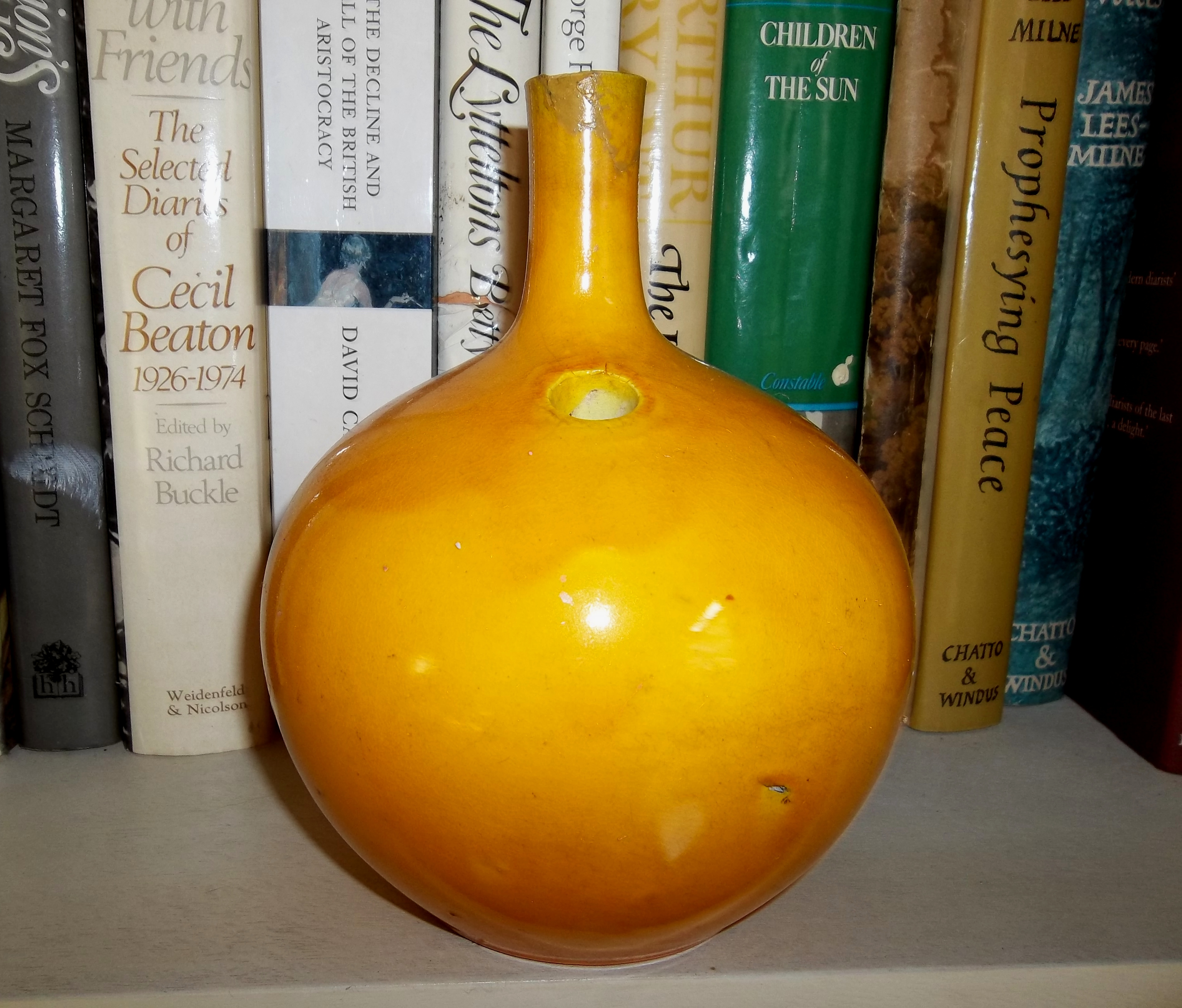
P.S. The picture is of an antique English drinking jar given me by my friend Andrea.

Food for threadbare gourmets

A faithful follower e-mailed me yesterday and asked if I had a recipe for Simnel cake. This is the light fruit cake that’s traditional at Easter, so I told her I’d blog it today. I use Nigella Lawson’s recipe with my own adaptations.

When I make it, I prepare the tin as usual, and then cream 175 g of soft unsalted butter with 175 g of caster sugar. Then mix 225 g of SR flour with half a teasp of cinnamon, a quarter of a teasp of ginger and 25 g of ground almonds. Add one egg with some of the flour mixture to the butter mixture, and mix two more eggs into the rest of the mix in the same way, before adding two tblsp of milk. Finally, fold in 500g of mixed dried fruit, plus some chopped glace cherries if you like them.

At this stage I put half the cake mix in the tin, roll out about 400g of marzipan, cut into a cake sized circle and place on the cake mix, then cover with the rest of the cake. Bake for an hour at 170 C, then turn it down to 150C and cook for another hour and a half. It’s cooked when it’s risen and firm. Let it cool completely on a rack before taking it from the tin.

When cool, paint the top with apricot jam, and roll out another 400g of marzipan and stick it on. With 200g of marzipan, make balls representing the eleven apostles – Judas surplus to requirements here – and stick them on using an egg white – beaten to just frothy. Some people quickly put it under the grill to make it look slightly toasted.

32 Comments

Filed under colonial life, cookery/recipes, culture, food, gardens, great days, life/style, philosophy, spiritual, Thoughts on writing and life, Uncategorized, village life

When is right wrong?

100_0955

It’s always been quite easy to be a pacifist in New Zealand for the last fifty years. Vietnam seemed indefensible to many, and our nuclear free policy made it feasible to take the moral high ground and declare that war is wrong.

I was forced to think about this on reading of the First World War project at Paddington Station in London, where a magnificent and moving statue of an unknown warrior stands. In full battle kit and helmet, he is reading a letter. As part of the commemorations marking the start of World War One, writers have been invited to write a letter to him, and Stephen Fry, wit, comedian and actor was amongst the first to write his, and it caused a sensation.

He wrote it as from a pacifist brother. Though he got historic details wrong – a pacifist would not be sitting at home then, he’d either be in prison or working on a farm, his letter moved many people. I’ve always been firmly behind conscientious objectors – (I like the moral high ground!) but this letter made me think hard about what was the right thing to do then, and how the right thing could very easily seem to be the wrong thing.

I thought about the horrific killings at schools and other places in the last few years, where deranged gun-owners shot numbers of their fellows, and if they didn’t end up shooting themselves, were shot, in order to stop them killing any more innocent victims. These incidents made me think when is it wrong to kill another human being, if there is no other way to stop them killing others. As pacifists do we stand and watch while others are killed, or do we intervene in whatever way we can, to protect the innocent?

This was actually the dilemma in the World Wars. Revisionist historians have said that there was no need for Britain to go to war in 1914. But Britain had informally agreed to support France if she was attacked in order to keep the balance of peace and power in Europe. More importantly, she had signed a pact in 1839 with four other countries of Europe, including Germany, to protect Belgium and allow this war-torn corner of Europe to enjoy being a neutral country, safe for the first time in history from being fought over. It was known as the cock-pit of Europe. It took the British Foreign Secretary, Lord Palmerston, nine years of diplomacy and negotiations to get the five signatories to agree to preserve Belgium, and they included France, Russia and England, and also Germany and Austria.

But Belgium was doomed as soon as the Prussian General Schlieffen began planning a war for German supremacy, because his plans for invading France, took in Belgium first. By then, under Bismarck’s influence, the German nation had become a military one. Invading Belgium didn’t bother them, though it did the honest German ambassador in London, Prince Lichnowsky, whose anguished telegrams begging the Kaiser not to invade, I have read.

In Belgium the Germans did what they did at Lidice in Hungary and Oradour in France in the Second World War, when they blamed the Nazis for these unspeakable atrocities. No Nazis around in the first war, but they still burned villages, hanged one man in ten and sometimes one man in two, and shot women, children and babies, the youngest three weeks old – at Dinant – as reprisals against any Belgians who had attempted to resist. Before the war was four weeks old, towns and villages had been sacked and burned, their people shot, and Louvain, and its ancient library reduced to cinders. So the choice for many Englishmen was clear – stand by and watch as a pacifist, or try to stop what seemed like a barbarian host?

The British soldiers who went to war then, were part of the history of England which had always tried to stop one power dominating and enslaving all of Europe, from Louis the Fourteenth of France to Napoleon. To go to war seemed to many who joined up then, to be a heroic attempt to save civilisation, and even more so in the Second World War, when Hitler was enslaving the civilised world.

The tragedy of resisting a violent and merciless enemy is that too often all the combatants find themselves using the same methods as the aggressor… war. But can we stand by and hang onto our principles of not killing, when all those we love will be destroyed, and not just those we love – our society, our country, and our whole civilisation. This was the choice which thinking people faced in both world wars.

When World War One was declared, England’s army was smaller than Serbia’s – the tiny country where the match had been lit at Sarajevo. So England’s armies were citizen armies, in both wars, made up of peace-loving men called up to defend their country. There’s a lot of research to show that many soldiers when they fired their rifles at the advancing enemy, didn’t actually shoot at the enemy, but aimed to miss, and that even more didn’t shoot at all. They too faced choices on the battle field which are impossible for us to imagine, when like me, we are living in a safe, peace-loving democracy.

So though I believe in peace, and have always supposed I was a pacifist, and attended Quaker meeting, where everyone was a declared pacifist, do I still believe it is possible to be one when the chips are down? I don’t know any more … Aggression turns easy choices upside down, when right – not killing – seems wrong, and wrong – fighting – seems right.

The wonderful story of the American colonel in Iraq, surrounded by an angry mob intent on violence, calling his armed troop to a halt, ordering them to kneel and point their guns to the sky, immediately defused the threat of violence on that occasion. So how do we defuse the violence of would- be psychopathic conquerors who believe that might is right? Maybe only people power can do that – and that can happen – as it did at the Berlin Wall.

Maybe it just needs enough of us to say: “They shall not pass…”
Food for threadbare gourmets

Something to eat with a glass of wine is one of our specialities in this village – among my friends anyway. It’s so easy to share a glass of wine and a nibble on a Friday night, without all the hassle of a dinner party. The latest craze is kumara skins – kumara are the Maori sweet potato that Kiwis pine for when they leave this country, but even ordinary potatoes are good this way.

Boil scrubbed orange and golden kumara until soft, and then cut them into thin wedges, leaving about a cm of flesh. Heat hot oil until it’s just smoking. Dust the kumara with seasoned flour and fry until golden. Drain and sprinkle with sea salt. Eat the skins with sour cream sauce – half a cup of sour cream mixed with a tbsp on mustard, fresh herbs and lemon juice.

Food for thought

There is something that can be found in one place. It is a great treasure, which may be called the fulfilment of existence. The place where this treasure can be found is the place on which one stands.

Martin Buber 1878- 1965  Jewish philosopher


48 Comments

Filed under army, british soldiers, cookery/recipes, history, life and death, military history, peace, philosophy, spiritual, The Sound of Water, Thoughts on writing and life, Uncategorized, world war one, world war two

Dancing to the music of time

100_0440 - Copy
I climbed up the rusty fire escape smothered in trails of blue flowering morning glory and stepped onto the veranda of a very big two- storied, shabby white house built on the side of a volcano. The morning glory swung from trees, twisted up the fire escape, and swathed both house and garden in carpets of greenery and purple trumpet shaped flowers. With pillars, porticoes, verandas and banisters all festooned in drooping creeper, it looked like a romantic, deserted Southern mansion.

Once on the veranda I peered through the windows, and beckoned to my slightly reluctant partner in crime to join me. It was obviously the home of students or alternative life stylers on this floor, the only unusual thing about their chaotic living arrangements being the live rabbits who were hopping about the grubby carpets. Downstairs a motor bike gang who seemed to have wrecked the place, had their bikes parked inside the entrance hall.

Reader – to quote Charlotte Bronte – we bought the house. It took time to track down the owner and persuade him to sell, but we did. The room where the rabbits had bred was forever known as the rabbit room during our years in the house. The occupants moved out, but that was all. It was up to us to break down partitions, rip up revolting carpets, clean, scrub, paint and restore – including dozens of missing banisters – used no doubt for firewood. The bikies had left behind more than indescribable squalor but awful energy as well. But for the first time since its original owner the house had become a family home again, not a collection of shabby flats.

The house had been built in 1875 by a French architect for himself, described on the title as Jean le Bailly Hervei, gentleman. The first thing we did was to rip out a partition and remove a door and two huge cupboards. This revealed Jean’s conception of a huge central hall, twelve feet high, thirty feet long and ten feet wide, stretching down the centre of the house, and looking out over the harbour and then to distant hills beyond. When I stood at the huge French doors and watched the flaming sunsets or the black clouds scudding in from the hills so that I knew what the weather would be like in half an hour, I felt close to Jean le Bailly Hervei.

He designed this splendid roomy house with every French window and door opening towards the sun and these magnificent views, and each room led off from the airy hall on both the top and the bottom floors. The floor of the top hall I painted a rich pumpkin colour which picked up the shades of pumpkin and rose and purple and cream in a long Kelim rug which fitted the space. The bottom hall which matched the top, I painted white, including the floor, and blue and white curtains and matching table cloth over a round table obliterated traces of the former tenants and their bikes. My son painted his bedroom floor lime green to go with his colour scheme.

The children and the little frolicking dogs brought life and fun into the house, and music rang through all the spacious rooms – the children played the piano and their flute and clarinet – me – the stereo –  mostly Bach’s Brandenburg concertos, Beatles, Joan Baez and Cat Stevens.

One day while clearing the garden of morning glory, I found a three foot high, concrete garden gnome hidden under the greenery. We dragged him inside, and since we had friends staying and my birthday feast that night, I invited the gnome to dinner too. He presided in a chair at the head of the table and we had lots of laughter at his expense.

When we moved on, children gone, the psychiatrist who bought the house from us, an hour after it went on the market, asked me six months later at a party, what we had done to remove the brutal vibrations of drugs, alcohol, violence and fear which we had inherited. I was fascinated that a conventional medicine man should acknowledge that old energy, and that he had thought about it.

We brought colour and energy into the house, I said, along with all the books and precious things we’d loved and collected, including tapestry and patchwork cushions and crocheted bedspreads I’d made. We had bowls of pot-pourri and flowers, and often used candle- light. But the two things that must have made the real difference, I told him, were that we all meditated, and there was always music being played. I think more than anything, it was the meditation and the music, I said.

These memories came back to me today when I was reading that world-renowned neuro-scientist Oliver Sacks says that music affects the brain more than any other discipline. It is, he says, the only discipline that actually changes the physical appearance of the brain. We are designed for music, for ‘its complex sonic pattern woven in time, its logic, its momentum, and its unbreakable sequences’

In Australia in a school where they have a Music Excellence programme the students spend many hours playing rehearsing and having music lessons. At prize-givings, eighty percent of the top students receiving awards for academic excellence were also music students.

They mostly spend more than ten hours a week involved in their music and have almost no behaviour problems or any upsetting emotional or social issues even though they come from both rich and poor homes, single parent homes and every the other variation on backgrounds which could spell problems for children.

Do we know whether the music acts as a stress release, or whether it builds such emotional equilibrium and peace of mind that its practitioners can weather all sorts of stresses without problems? Maybe it doesn’t matter. What does matter to us is that we recognise the value of music, and allow ourselves to receive and enjoy its healing and strengthening properties. Some research has shown that people who learn a musical instrument are less likely to suffer from Alzheimer’s.

Music is supposed to teach basic skills such as concentration, counting, listening, and cooperation, help with understanding of language, improve memory, and help learning in all other areas. But actually, it doesn’t matter what the benefits are, it’s the sheer joy of music that enriches our lives. Perhaps it should be compulsory in schools, and be ranked along with writing and arithmetic as one of the necessities of life.

And what I find amazing is that music healed a house. Once it had dissolved the top layers of fear and anger and violence, it seemed to penetrate to other layers of energy and atmosphere… reaching through levels of sadness and regret and loss, until finally the sweetness of the music uncovered all the layers of time, and we reached the gentleness and joy of Jean the Bailly Hervei .

It was a voyage of discovery travelling back into the past and becoming aware of the lives of so many who had lived there before us. Music gathered together threads of sweet feelings from the past, and stitched them into the tapestry of life that we were adding our colours to. And it was the invisible vibrations of music which conducted us gently through those layers of time and feeling so we were able to hand on to the next owners the intangible beauty of a well-loved house. .

Food for threadbare gourmets

For these hot, dry, sunny days of Indian summer, sitting on the veranda, cicadas clattering, I like to make a spinach and salmon quiche which is good hot or cold. After lining a quiche dish or similar with thin short crust pastry – though I have used filo too, I simply pour the filling in and bake in a moderate oven for 40 minutes or until gently firm. For the filling I use 150 gm of chopped smoked salmon, a packet of frozen chopped spinach, defrosted and squeezed dry, 300 to 400mls of thick cream, three large eggs, salt and pepper. Mix everything together, adding the spinach and salmon last, and either a little grated nutmeg or a little parmesan cheese if you fancy, and pour into the partly cooked pastry case. Good with salad of course…

Food for thought

I think the sages are the growing tip of the secret impulse of evolution… I think they embody the very drive of the Kosmos towards greater depths and expanding consciousness. I think they are riding the edge of a light beam, racing towards a rendezvous with God.

From ‘ A Brief History of Everything’, by Ken Wilber, Influential American writer and philosopher.

47 Comments

Filed under animals/pets, cookery/recipes, culture, family, great days, happiness, life/style, love, philosophy, spiritual, The Sound of Water, Thoughts on writing and life

Heaven’s scent

100_0542

The first time I smelt it was at sea. One of my dearest friends had drowned there a few days before with her baby and two small children. Her husband’s ship, trading between New Zealand and the Islands, had caught fire in a heavy storm just off the coast not far from here, and they had had to take to the life-boats. Their mayday signal was never picked up, and the life-rafts, which are reputed to be safer near the coast, had broken away. So my friend and her children didn’t survive the mountainous waves.

Her heroic and tragic story before this happened, is too long to tell here, but her partner, a French sea captain, did survive. He came to stay with us for the next few days until the body of one child was washed ashore.

We all trekked up to Northland, and after the heart-wrenching funeral, Jean asked us to take all the flowers to a nearby bay. There, a police launch was waiting, and with a few close friends we loaded the flowers into the cabin – then thankfully shut the door on the overpowering scent of freesias, jasmine and other spring flowers, and took off for the bay where my beautiful friend had died.

When we reached the spot where she had slipped from his grasp, Jean stopped the launch, and then, in an old Breton custom, went to toss the flowers into the sea. As the launch stopped, the sun was shining, the blue sea was calm, and the line of golden sand on the shore, still guarded by a watching policeman, lay ahead. Only another mile from here, but a mile too far for my friend.  We sat silently and breathed in the heavenly fragrance wafting around us. Exquisite. Then the door to the cabin was opened and the scent of the flowers inside was entirely different.

When we talked about this to a friend, he told us about the writer Rosamund Lehman, whose daughter had died suddenly – of polio, I think – in Indonesia. A heavenly fragrance permeated the hall outside Rosamund’s flat. People didn’t believe it until they went to visit her, and then were overwhelmed by the perfume.

A few years later, we began to experience the same wafts of flowery perfume in our sitting room. I searched for the source, but it came from none of the flowers in the room. The scent cut through the smell of the coal fire, and every other momentary odour. In the end, we gave up, and just accepted, as a friend said, that we had angels there. After a week of this, one of our cavalier King Charles spaniels was diagnosed with an untreatable disease. We gave ourselves five agonising last days with him, and then took him to the vet for the last time.

When I got back home my nine year old daughter was waiting on the veranda, home with flu. She couldn’t wait to tell me. “The flowers came from that patch on the floor where Sheba used to lie to get cool,” she cried. (Sheba was an afghan who’d died the previous year) “She was warning us about Benedick.”

When we went inside, the fragrance had gone, but later, as I sat by the fire crocheting and wiping stray tears, I suddenly smelt a strong scent of lavender. Knowing well that I hadn’t got any, I still searched my knitting basket for a bottle of lavender. I called through to my daughter in bed – ‘have you spilt some lavender water?’

Then we realised that my son had picked a bunch of lavender and camellias to go with Benedick on his last journey… the scent was a last message from his little dog.

Since then we’ve heard of other instances of these heavenly perfumes. In her beautiful account of a year living in the Blue Mountains, Australian poet Kate Llewellyn, describes sitting next to two nuns on a train, and their gentle simple conversation with her. After they had left, she felt that she could smell violets… “the odour of sanctity,” she called it.

The Catholic Church calls it the ‘odor of sanctity’, but always associates it with the bodies of saints who have died. But these heavenly scents are like a gift sent from who knows where, and have nothing to do with sanctity. Rather, they are like gifts from a benevolent and loving source who for some reason allows these emanations of beauty to visit and to comfort. No-one has to be holy or to deserve them, they are simply a manifestation of another order of beauty and wholeness that we may be conscious of, but can never see or grasp.

They are the moments that we can hold onto in a world where man can create so much pain and misery. Beyond this world created by man is this other level of love. And how exquisite that it’s the fragrance of flowers that delivers this message of hope – that the world doesn’t have to be the way we make it – that there are other worlds of truth and beauty and peace that these fragrances remind us exist.

Rabindranath Tagore talked of the air filling with the perfume of promise… sometimes I wonder if that is what these flowery messages are – both a consolation and a promise.

Food for threadbare gourmets

With a family of gluten free addicts, I’m always looking for recipes without wheat. This is a lovely chocolatey treat. I melt 125 g of butter and 150 of dark cooking chocolate gently in a large saucepan. Stir in half a cup of sugar and a teasp of vanilla. Next, stir in three egg yolks and a cup of ground almonds. Beat the egg whites until peaks form and then beat in two tablsp of sugar.  Using a slotted spoon, gently fold the whites into the chocolate mixture. Line a 20 cm cake tin with a base of cooking paper, and bake at 180 degrees for 25 minutes. The cake will come out soft, and will sink and firm when cool. It’s very rich, so a sprinkling of icing sugar on top is all it needs.

Food for thought

In a rich moonlit garden, flowers open beneath the eyes of entire nations terrified to acknowledge the simplicity of the beauty of peace…

Aberjhani, American historian, novelist, poet and blogger

45 Comments

Filed under animals/pets, cookery/recipes, flowers, great days, life and death, love, peace, perfume, philosophy, poetry, spiritual, Thoughts on writing and life, Uncategorized

Pooh Bear has the answers

100_0273

I’ve only been on one teddy bear’s picnic. There were lots of teddy bears, crammed into a little dolls pram, my three year old grand- daughter and me.  We solemnly walked the pram to a tree in the park in Melbourne next to the house where they lived.

There, on a cold, slightly misty winter’s afternoon, we carefully propped a huddle of teddies of different sizes and varying shades from honey to dark brown, around the base of a tree. After careful discussion as to what teddy bears might eat, we had plumped for very small brown bread and honey sandwiches – we thought that arbiter of bear behaviour, Pooh Bear, would have approved, and that was all we needed to know really. We thought bears would probably only have wanted to drink water, so that was easily solved….

I was thrilled that she still remembers this occasion now she’s old enough to be at university. And she remembers too, jumping on our shadows the year before, and learning to sing ‘Kumbaya, my Lord’ when she was even smaller (in an English accent!). These memories may be more precious to me than to my grand-daughter, and most grand-parents will understand just how precious they are.

When I look back to my memories with my grandmother, I marvel at what I learned from her, much more, I suspect than today’s grand children learn from theirs. She taught me to knit and sew and do French knitting, and embroider dozens of stitches I’d forgotten till leafing through an old Mrs Beaton cook book recently – daisy stitch, herringbone stitch, blanket stitch, chain stitch, back stitch, buttonhole stitch, cross stitch. She told me the names of flowers and saints and cousins I’d never seen, the stories of dead great uncles in the war. She taught me prayers and proverbs and songs.

But somehow, once the days of reading aloud Pooh Bear and Dr Seuss and Dear Dinosaur had passed, all my grand-children were so engrossed in their play stations and favourite, regular afternoon TV programmes, that there was rarely a space for the sort of boredom or blank days we used to have in my childhood; those times when for lack of something better to do, we mastered a new skill and learned to knit, or read a book considered too hard or too boring before, and which was now discovered to be a treasure.

It was on those long empty days that I discovered the joys of rambling alone with the dog, or daring to cross the weir by the mill with friends, or digging around the Roman mines, hoping after two thousand years to find a Roman coin; it was when we picked primroses in the woods, and carried catkins and pussy willow home as spring announced itself … As we grew older we made egg sandwiches and took a bottle of ginger pop to picnic on empty beaches with names like Man o’ War Bay and Arish Mell Gap, coming home tired and sunburned.

But my grand-children have done it differently. Today they’re not free to roam alone as we were – instead, they went on exciting holidays, in the tropics or to fishing lodges, or learned to sail or ski. But then they’d come to stay with me, and do ordinary and yet totally absorbing things. Leaving their play stations, they’d feed the eels in the river at the bottom of the garden, spend days making boats out of flax leaves, and floating them down the waterfall, building dams, playing Pooh Sticks.

They could spend an afternoon totally absorbed in throwing stones down into another river, far below, and listening for the plop. Another morning in the city when I took all four of them to a secret spot above the harbour, where old oak trees spread, they spent a whole morning searching for acorns and throwing them down into the water. Not aimlessly, but aiming.

And not a question of little things please little minds, but being ‘in the zone’, alive and  present. Blowing bubbles from my veranda and seeing who could make the biggest one that drifted furthest and lasted longest; or the ritual playing of hunt the thimble with the same silver thimble every time, seemed to give them more fun and shrieks of laughter than watching their Japanese TV serials and videos or war games on the computer. And grandparents have time for long conversations about the size of universe and whether ice-cream is good for you, and what dogs are dreaming about – and about important things – like ethics – which even small children understand in terms of right and wrong, or better still, kind or unkind  …

Sometimes I think that this is one of the few gifts we can give our grand-children in this busy technological age when our grandchildren know more than their grandparents, and learn to teach us, instead of us teaching them. We can give them the time and the space to savour the little things. We can listen to them uncritically.  We can give them unconditional love, because we don’t have to make sure they eat up all their vegetables. And the utter bliss of it is that they give us the same unconditional love too. “I’ve got to, but I’ll still be your darling”, said one when I asked him not to grow up!

It’s that ubiquitous bear, Pooh, that ‘bear of very little brain’, who puts into words what I would say to my precious ones in the future. He says so memorably and so truly: “If ever there is tomorrow when we’re not together… there is something you must always remember. You are braver than you believe, stronger than you seem, and smarter than you think. But the most important thing is, even if we’re apart… I’ll always be with you.”


Food for threadbare gourmets

It’s that wonderful time of year for both birds and people – when the figs are ripe. A friend made the most delicious salad the other day using real lettuce – not mixtures of baby leaves – and tossed them with chopped- not sliced – cucumber, fresh peas, and thinly sliced figs, with a vinaigrette sauce. The sweetness of the figs with the crunchiness of the cucumber and the crispness of the lettuce was delicious with cold lamb and couscous.

Food for thought

…’It often takes great courage to follow intuition. It takes a Viking, who is unafraid to sail in unknown seas…. to live intuitively is to live fourth-dimensionally’…                                           Florence Scovel Shinn, 1871 – 1940   New Thought writer who influenced Louise Hay.

75 Comments

Filed under cookery/recipes, family, great days, happiness, love, spiritual, The Sound of Water, Thoughts on writing and life, Uncategorized

A summer storm

100_0841 - Copy

It arrived unannounced at roughly eleven- thirty in the morning. Before then it had been a quiet silvery morning, still silver sea, and pale grey sky. The wind built up, the clouds lowered, and rain flew in the wind. By evening it was a fully fledged storm and too good to miss, and I decided this was the day I tackled the hundred and fifty- seven steps up and down to the harbour, a trial of strength I’d avoided for too long since I twisted my ankle.

They led down through a ravine of tangled woods, and at the bottom as I stepped onto the wet sand there was a Buddha-like figure, a girl in a  faded pink jerkin sitting in the lotus position, meditating on the rocks. With this blessing at my back I carried on round the edge of the water, past a few old fishing cottages, now expensive sea-side dwellings.

Being a holiday, most of them had their families snugly tucked inside against the weather. Where they had their lights on in the grey day, I peered inside, approving when I saw walls of book- shelves, and enjoying a family gathered round a table eating their supper. A teenager was sitting on the branch of a pohutakawa leaning over the water, and when I waved, he waved back, his long arm a great wide semi-circle of  greeting.

The path wound round the edge of the harbour, sometimes deep in trees and woodland, and sometimes looking straight over the water with fishing boats at anchor swinging around in the wind and the waves. Promising myself to complete the circuit the next day I retraced my footsteps, and returned to the foot of the staircase leading up to the road.

A young man was now kneeling in front of the meditating girl, and as I approached she gazed at him with a look of such tender love that I flicked my eyes away and hurried up the steps so as not to disturb them.  Not that I could, even in bright red jacket and black trousers I was un-observed.

The hundred and fifty seven steps were not as bad as I feared, and I strode back along the road bent into the gale. Back to my end of the peninsula, where the shelter of the harbour no longer protected us, the great pohutakawa trees ringing the cemetery and leading out onto a little rocky peninsula bucked and swayed in the tempest. It wasn’t even high tide, but huge green waves were surging onto the rocks and white spray flying through the air.

As I looked down onto the rocks, and leant against a tree trunk to avoid being blown off myself, watching the hungry waves hurling themselves against the rocks, and the boiling white water swirling around them, it truly felt like ‘the cruel sea’.

The sound of the water and the trees was deafening, and mesmerising. There was nothing else outside this circle of wind and waves and sound and solitude. Impossible not to be totally present to the wild beauty and magnificence.

Finally the wind became so furious that I felt I had to make a dash between lulls. But there were no lulls, so I made a dash anyway, and  wandered back through the cemetery – which is still full of the stuff of life – one grave –stone facing out to sea inscribed:  “ He loved life and his fellowmen”,  another, saying: ”Sleep on grumpy” and another, telling passersby that this man had left Scotland for this new world, in 1865. His gravestone was at one end of a miniature cricket bowling pitch, with three stumps set in concrete the other end.

Reluctant to leave the aliveness of the storm I stood on the edge of the cliff, and wondered where had all the birds gone – no gulls or pigeons, tuis or doves. Somewhere dozens and dozens of birds were silently riding out the storm in places that no human could see.

We don’t have to worry about ‘those in peril on the sea’ these days. Fishing boats stay at anchor when they get the weather forecast and the big ships can ride out the storms. This storm, unlike so many others around the world, caused no harm or hardship. So savouring the elements is a guilt-free pleasure, and those like me, far from city pavements, are so privileged that we can. But maybe more importantly, this pleasure has a spiritual dimension,  since it’s also an acknowledgement of our beautiful and irreplaceable planet.


Food for threadbare gourmets

I’ve had so many people dropping in for various reasons, that rather than make a cake I’ve been making a succession of scones- fresh out of the oven, melting in the mouth, served with unsalted butter, strawberry jam and cream, they always disappear quicker than the proverbial hot cakes. They’re so simple to make, and I never add sugar, currants, cheese, or chopped anything. They are perfect just as they are.

Put six spoonfuls of self raising flour in a bowl with an ounce to an ounce and a half of softened butter. Rub it in, break an egg into a well in the centre and add half a cup of milk. Just mix it altogether with a knife, adding more milk if needed. It should all come together into a soft dough. I simply press it down on the pastry board, at least an inch thick, and cut it into squares. Half an hour in the fridge, covered is good for them. Bake on a floured or greased tray in a medium to hot oven for ten minutes or until raised and slightly brown. The trick is to serve them at once !


Food for thought

Blessed is the influence of one true, loving human soul on another.

George Eliot  1819 – 1880  Great English novelist

(New Zealand readers might be interested to hear me being interviewed on Kim Hill’s programme on Saturday morning, choosing favourite records and talking in between)

http://www.radionz.co.nz/national/programmes/saturday)


24 Comments

Filed under birds, environment, spiritual, The Sound of Water, Thoughts on writing and life, Uncategorized, village life

Poignant symbolism

100_0812

‘Mummy doesn’t like carnations,’  the nine year old told him coldly, her information holding a world of meaning as she correctly assessed that the man at the front door was a suitor.

She was right, and though he persevered on that occasion, he never gave me carnations again. It’s a shame about carnations, but at the time I could only see the sad, scentless etoliated versions wrapped in cheap cellophane and sold on garage fore-courts. They symbolised the  capitalism and commercialism that exploits and corrupts even beauty.

The real thing has a big, heavy deliciously clove- scented head, with a tangle of frilly petals, and was originally used by the Romans for wreaths and garlands, known in Latin as corona. When these flowers first came to England with the legionaries nearly 2000 years ago, their name was coronation, until the word evolved into carnation.

I was just as dismissive about daffodils, when I was presented with a bouquet – or rather some bouquets – which I rather regret now. In my salad days when I was a twenty two year old in the army, and stationed outside a beautiful village in Shakespeare country, I was the only girl in an all male officers’ mess. I had my own little cottage where I lived with the mongrel I’d rescued and dignified by calling him Rupert.

Late one night there was a loud knocking, so I dragged myself from deep sleep, hurried on my pink dressing gown, and stumbled to the door.  Grouped there were all the young officers who had gone to watch a rugby match at Twickenham. It had taken them many hours to get back here, judging by the time – two o’ clock in the morning – and one of the things which had delayed them, apart from merrymaking at every pub on the way back, was that they had also stopped at every roundabout, it seemed, between my cottage and London.

Each roundabout they had stripped of its spring flowers, and here at my door was the result of their labours. Each young man was wearing a proud grin and holding a big bunch of golden daffodils in the moonlight. Sadly, I was not amused, deeply disapproved, and was more intent on getting them to go away, and stopping Rupert from barking and waking senior officers slumbering nearby, than in being grateful for their generosity at the expense of every town council between here and London!

So I did know how my three year old grand- daughter felt when I gave her a disappointing bunch of flowers. I’d chosen a big blowsy thank you bouquet  for her mother, and had as much pleasure in choosing the flowers as my daughter- in –law had in receiving them. My grand-daughter was also ravished by them, so I decided to walk back to the shop through the bitter Melbourne winter’s day and get her the little bunch of flowers I’d refrained from getting on the first visit.

I brought home a posy of exquisite purple violets, the perfect symbol, I thought, for my exquisite flower-like little grand-daughter. She took one look at the dainty flowers and burst into indignant tears, and then threw an uninhibited tantrum in which she expressed her un-utterable disappointment at not having a big grown-up bunch of flowers like her mother’s. Mortified, I could see her point.

Two years later a small posy of white rosebuds with one word ‘Mummy’ on Princess Diana’s coffin reduced half a world to tears.

The symbolism of flowers is far more profound that the sentimental Victorian descriptions of the language of flowers. The flaming red poppy, whose name is now synonymous with the word Flanders, is a poignant reminder still, of every young man who died in the terrible war that my grandmother called The Great War.

And in the next terrible war  flowers softened another battlefield. I remember my father telling me how the hills of Tunisia were smothered in glorious spring flowers as his tank regiment fought their way to join up with Montgomery’s army.

Bruce Chatwin painted an unforgettable image of flowers in that same war, in his book ‘The Songlines’. On the first page he wrote of a Cossack from a village near Rostov on Don, who was seized by the Germans to be carted off for slave labour to Germany. One night, somewhere in the Ukraine, he jumped from the cattle-truck shunting him and other captives away from their homelands and fell into a field of sunflowers.

Soldiers in grey uniforms hunted him up and down the long lines of yellow sunflowers, but somehow he managed to elude them. I can still see in my mind those rows of strong, towering green stalks and leaves,  great, yellow tangled- petalled heads benignly sheltering the fugitive crouched beneath.

I can never forget the endless fields of shimmering purple lupins alive with dancing blue butterflies, stretching along- side thousands of burnt -out tanks near Belsen concentration camp in Germany just after the war.  And I could never bear the pink rose bay willowherb, which grew on every English bomb site… the only plant that seemed to thrive in those derelict tragic places. They came to symbolise for me as a small girl, all the horror and sadness and destruction of the war I didn’t understand.

But perhaps the most powerful flower image of all, is that glorious girl on an American campus in the sixties, walking up to a row of armed, helmeted men, and tremblingly pushing a flower into the barrel of a gun pointed at her, her hand shaking slightly as she dared the outrageous.  A girl and a flower speaking the in-effable language of peace.

Food for threadbare gourmets

Sometimes home-made mayonnaise can seem a bit heavy, but I use a quick and easy French recipe to lighten it up, learned from my French neighbour. After making the mayonnaise, beat the white of an egg until stiff, and then gently beat it into the freshly made mayonnaise. It gives it a lovely creamy texture, and is particularly good with fish like freshly poached salmon. Another variation is to use a clove of garlic when making the mayonnaise and then add finely chopped avocado with the egg- white. This is a good accompaniment to the chicken mousse from the last post.

Food for thought

That is at bottom the only courage that is demanded of us: to have courage for the most strange, the most singular and the most inexplicable that we may encounter. That mankind has in this sense been cowardly has done life endless harm; the experiences that are called ‘visions’, the whole so-called “spirit-world,” death, all those things that are so closely akin to us, have by daily parrying been so crowded out of life that the senses with which we could grasp them are atrophied. To say nothing of God.         Rainer Maria Rilke 1875 – 1926  Austrian mystical poet

45 Comments

Filed under army, cookery/recipes, family, flowers, gardens, great days, history, humour, life/style, philosophy, princess diana, spiritual, The Sound of Water, Thoughts on writing and life, Uncategorized, world war one, world war two

A rose is a rose is a hose !

100_0532

This was supposed to be a picture of a rose. When I developed it, it turned out to be a picture of a hose. I was shocked. How could I have been so one-eyed, and not seen what was shouting at me in a loud turquoise voice? I only see what I want to see, and eliminate even the obvious, it seems.

So when I went for my walk in the summer evening, I reminded myself to actually look, and not to assume or to expect. I wanted to see what was there, not what I thought was there. Down near the harbour where I usually turn around I always end up by a bougainvillaea sprawling through the trees, and just out its reach, a queen of the night holding her own. Braving bougainvillaea prickles, I can just reach the greenery-yallery sprigs of tiny flowerheads.

Two nights ago I broke one off and carried it back with me, sniffing the glorious fragrance, and ending up sitting on the warm marble bench in the cemetery at the other end of the peninsula, still smelling the sweet blossoms. I did what I’d never thought of doing before, and took it in and put it in a glass in the bed-room. The scent filled the whole room, and whenever I turned over in my sleep, the scent was drifting past.

The next day the tiny pale green flowers closed up, and the sprig sat nondescriptly on the window- sill all day, before bursting into glorious scent in the evening again. So now I plan to keep a permanent supply of these modest blossoms that don’t look big enough to be able to scent a whole room… The scent lasts for three nights I’ve discovered.

Walking back tonight with a fresh sprig of blossom, I passed a big shrub on the road where it dips and there’s a muddy spring.  Before now I’ve smelt its fragrance, but not given it a passing glance. Its reputation as a deadly poison and hallucinogen had somehow got in the way of me actually seeing this innocent plant. Tonight I looked at it, and ended up gently holding one incredibly beautiful flower-head after another, each one slightly different, gazing at their two layers of frilly white petals, and seeing deep inside the long white tube, white stamens pushing their way up to the light. The pendulous buds are so yellow it’s a surprise that the flowers are so white

The slender pale green calyx was smooth and soft and somehow tender to touch and to hold, and ended where the green- veined white trumpet – shaped flower began. Its ugly official name is brugmansia, but its folk name is angels trumpets. Angels trumpets spread their scent so far that long before I get there I can smell them.

Enchanted now with the idea of white scented flowers, I noticed the exquisite waxy looking candle-shaped buds of the king magnolia further down the road, the dark shiny leaves supporting each smooth creamy bud like a candlestick. Only one flower had opened, but it was enough. The scent of just one flower wafted past me.

I walked down the long drive to some friends’ house, knowing they were not there, but that they wouldn’t mind me visiting the frangipani plant flourishing by their veranda. The scent of frangipani takes me back to Singapore when it was still an eastern city and I was a girl, where all the alleys were hung with long bamboo poles suspended from every window on each floor, drying thin cotton tropical clothes in the brilliant un-ending sunshine.

We were staying in a hotel just around the corner from the famous Raffles Hotel, and the entrance was flanked with rows of frangipani trees.  Their fragrance followed us into the hotel courtyard and drifted in through the big open bedroom windows where we slept with no air conditioners, but beneath draped mosquito nets.

And when the velvet tropical night had fallen promptly at six thirty, every night in the darkness I would look down from the bedroom and see small groups of people squatting on the pavement in a circle. They would have tiny flickering lights and little spirit stoves in their midst to cook their dinner, delicious smells rising tantalisingly through the frangipanis, and I would hear their soft chatter and their laughter.

There were no blossoms on the frangipani growing here in New Zealand… wrong time of year perhaps. Back home, there was one white gardenia open.  I savoured the perfume before bringing it inside and putting it in a shallow bowl, floating on the water. So though no angels trumpets, I have queen of the night, gardenia and creamy honeysuckle from the porch scenting the house – even the names are poetry.

I don’t know whether I did what I intended when I began my walk, or whether I saw what was really there, but just by looking – truly looking at the beautiful angels trumpets – unnoticed before –  the walk turned into something else – a successful quest for white scented flowers. And like all successful quests, that was good enough.

And I wonder if this is how life is… we set off in one direction and find that imperceptibly we’ve drifted down other unsuspected paths; and looking back, we see that it was the perfect journey, and our travelling had a purpose, and was not random at all.


Food for Threadbare Gourmets

Friends for dinner before they left after the summer holiday to go back to the city. On a summer evening cold food seemed appropriate. So we had chicken with curry mayonnaise on rice salad. The cooked chicken chopped and mixed into a bowl of good bought mayonnaise, with about a big tablesp of golden syrup and desert sopn of curry powder to taste… I taste until I like it. Stir through enough cream to make it a soft consistency to stick to the chicken.

Cold basmati rice is jollied up with a vinaigrette dressing with salt, plenty of freshly ground black pepper, mustard, and sugar. Add to the rice generous helpings both of peas and sultanas soaked in boiling water, lots of crunchy chopped almonds lightly toasted in a frying pan, and lots of chopped parsley. Nice with a salad and chilled pinot gris .

In deference to our French connections we now have the cheese course before the pudding! This was some of our plums cooked to Nigella’s lovely recipe in red wine, one star anise, two cloves, teasp of cinnamon and a bay leaf, plus honey to taste. We had them with a mix of plain yogurt, whipped cream and runny honey stirred gently together, and a little shortbread biscuit.


Food for thought

That mighty power that sways the tides and works the million miracles of spring is ranged forever on the side of love.

The writer: known only to God .  Seen on an embroidered sampler hanging over a bedroom fireplace in an English cottage


73 Comments

Filed under cookery/recipes, flowers, food, gardens, great days, happiness, life/style, love, perfume, spiritual, Thoughts on writing and life, Uncategorized

Nuns and their habits

100_0807

I can’t help feeling that nuns are getting a bad press at the moment after seeing the film Philomena, and like everyone else in the cinema, running out of tissues. I thought back to the nuns at my convent… mostly French or Belgian, a couple of English and a few Polish ones. Some were old, some were beautiful, some were wise and some were silly – at least to a bigoted ten year old.

My father didn’t know about my past in which I’d  read all my grandmothers anti-Popish books, which included Westward Ho, and Foxe’s Martyrs, a catalogue of the three hundred people Mary Tudor burned for being Protestant. So sending me to a convent for a good education seemed a good idea to him.

I didn’t discuss it with him, for on our first day with our new parents, I’d been told I had to do exactly as I was told – always – so there didn’t seem to be any room for discussion. So a prejudiced Protestant got to observe the strange Catholic goings-on at her new school!

The nuns all looked wonderful in their no-expense spared rich plum-red gabardine habits, with wide swinging pleated skirts and wide sleeves. They wore a long snowy  white veil over the wimple which framed their faces and had a splendid thick knotted red cord round their waists to which they attached their rosaries.

We had a roller skating rink where we skated most days, and obsessed about how many ball-bearings our skates had. At night when I boarded for a while, and when everyone was supposed to be in bed and asleep, we could look down from the gabled windows, and see the nuns swirling round the rink on our borrowed roller skates,red  habits swinging, veils flying. An unforgettable sight.

The order had been formed by three aristocratic Belgian ladies, and we heard their history interminably when we sat in silence in the refectory at lunch, while tall, serious, severely beautiful Mother John stood at the carved lectern and read it to us during retreats. Retreats and the numerous saints Feast Days were a wonderful way of not doing schoolwork, which my parents disapproved of, since they were paying school fees.

During retreat, for several days we never spoke (which I loved even then), and did nothing but pray, draw holy pictures, tally what good deeds we’d managed to perform each day, using a flower as a symbol (I used a violet), process around the school grounds singing hymns, and if we were Catholic, celebrate mass with a portly priest imported for the job. I couldn’t bear him and the way all the nuns fawned over and spoiled the only man who ever came into their orbit! Apart from no speaking and mass, Feast Days were the same round of prayers and processing.

Mother Michael was our housemistress, a tall bony woman, English, and almost the only nun there who had no charm. She wore thick horn-rimmed spectacles, and I noticed uncharitably that in the chapel at prayers every day after lunch, she twiddled her Bride of Christ gold wedding ring and didn’t seem particularly devout.

I rather enjoyed this lunch-time prayer ritual, it also cut into time for lessons, as we walked in a long crocodile along the corridors on miles of polished linoed floors, passing numerous statues of saints frequently adorned with rosaries or necklaces. I thought most of the statues were ‘soppy’, a word we used then, and actually I think they probably were – mass-produced, sentimental, pastel- coloured and idealised images. I glared at them all like a latter-day Cromwell.

Chapel however, with its scent of incense was a pleasure, and a respite from effort and intrigue. Yes, the convent was a hotbed of intrigue and occasionally swept by gusts of vague hysteria – what convent girls would probably call ‘scharmerei’ – with favourites, crushes and gossip part of the mix.

I was Mother Michael’s favourite for more than a term. It was, in a good Catholic phrase – purgatory – because I was imprisoned every day in the airy second floor cloakroom in the Georgian house which was the home of the junior girls. It was a pleasant sunny room, but it might just as well have been a dungeon because I was chained, as it were, to a chair, and every lunch break Mother Michael undid my long dark brown plaits and spent the rest of the lunch hour break brushing my hair.

Friends came and went, washing their hands and changing their indoor shoes, but I was pinned to my penitential chair with my hair loose. Just before the bell Mother Michael would re-plait it, dragging it round my face like a Victorian orphan, and every day when I got home my stepmother would ask what was going on, and when I told her, say it had to stop. I would have loved it to stop, but I didn’t know how to make it stop.

It went on until Mother Michael found another pair of promising plaits, not as long as mine, but long enough. The new favourite was rather smug to me, but I knew what she was in for, and watched with some pleasure as Barbara found herself nailed to the chair, and like me,  unable to join in the games of skipping and hopscotch, playing five stones and weaving cats cradles going on outside. Mother Michael had seriously interfered with my social life, and I felt no pity for her next victim.

The other nuns were civilised and kind, unbigoted and happy. Unlike the only teacher who wasn’t a nun, and who constantly tried to outdo them in piety and holiness. She was the maths teacher, so it was inevitable that our relationship would founder.

In fact it never recovered from the day when I finally rebelled and tried to speak my mind. As an Irishwoman, her constant theme was the ‘puir’ persecuted Catholics and all the dreadful things Protestants had done to them, including  executing Guy Fawkes and his co-conspirators – we never celebrated Guy Fawkes day at the convent – and ‘puir ‘ St Thomas More, beheaded by Henry VIII.

Baulking at having to pray for the souls of my Protestant parents because they weren’t Catholic – after we’d interrupted long division yet again to recite the Angelus – my stroppy ten-year old self started to tell her about the Inquisition, and Borgia Popes etc.  But I got no further than the Inquisition. “Oh what a pack of Protestant lies!“ she shrieked dramatically, clapping her hands over her ears.

Not only was my relationship soured with Miss Cummins, but it never recovered from the disapproval of all the other Catholics in the room either… I paid the price for this rebellion, and was always left until last to be picked for rounders teams and  netball. I left the convent after a year without regret, and yet looking back I’ve had more fun from my memories of that unique environment than from some of my more conventional schools.

The beautiful High Victorian Gothic building, which housed the foreign nuns so far from their homes in Europe, and generations of schoolgirls, has now been turned into smart flats, surrounded by the glorious trees and grounds where we played so happily, watched by little red squirrels perched in the black branches of bare trees silhouetted against the snow.

I wonder if the skating rink is still there. I think no-one since would have enjoyed it as much as those gentle souls swirling silently around in the dusk, plum coloured habits swaying, veils flying and rosaries swinging. I do hope they bypassed purgatory and skipped straight into heaven.


Food for threadbare gourmets

Going cold turkey day after day post Christmas is not my idea of enjoying food. So after the second day I chop it into small pieces and freeze it. Yesterday we were ready to eat more turkey, so I defrosted it, stirred small pieces into a thick white sauce with plenty of nutmeg, some parsley and plenty of chopped mushrooms fried in butter. Served over savoury rice, it was good. Into the hot basmati rice I stir a chopped fried onion, plus a handful of peas, a handful of sultanas soaked in boiling water to plump them out, and plenty of toasted slivered almonds, salt and pepper plus more parsley. It beats the boredom of cold turkey.

Food for thought

The angels keep their ancient places;

Turn but a stone, and start a wing!

‘Tis ye, ‘tis your estranged faces,

That miss the many splendoured thing

Francis Thompson 1859-1907, great English poet, mystic, vagrant who lived on the streets for most of his drug-addicted life.


49 Comments

Filed under cookery/recipes, happiness, humour, life/style, spiritual, Thoughts on writing and life, Uncategorized