Category Archives: Uncategorized

Let them eat ( Christmas ) cake!

Image result for christmas cake images free

Poor Marie Antoinette. She never said it. But she’s suffered from that blighting propaganda ever since. What she needed, and still needs, is a good spin doctor to right her dreadful wrongs, but until she gets one, her name is indelibly associated with cake. (She was actually a devoted and intelligent mother, and I think I’d have gone mad if I’d been her, and known of the barbaric treatment the revolutionaries meted out to her eight- year -old son after she was beheaded during The Terror. Her son died two years later, by then completely mute, disease-ridden, covered in scars from beatings, and unable to walk. The past was sometimes as cruel as the present…)

But to return to the subject of cake. In the days when a woman’s place was in the home, and preferably in the kitchen, cake was part of that equation. I grew up in the fifties when women were still supposed to be there, and watched my stepmother struggle with the expectations around cake in those days. Her steak and kidney puddings had to be tasted to be believed, her steak pies with perfect pastry were sumptuous, as were her heavenly steamed ginger puddings and apple pies, but cakes were not her thing.

The pinnacle of cake-makings skills back then was the Victoria sponge. A pretty boring version of cake, and now long out of favour, but back then, the classic Victoria sponge was a firm cake cooked in two tins, and glued together with raspberry jam, the top sprinkled with icing sugar. Simple, but like all simple things, more difficult than it looks.

I would come home from school in the afternoon, and find my stepmother had had another go at a sponge, and was pretty down in the mouth, because as usual, it had sunk in the middle. As much as we were allowed to do, I fell on these failures, and revelled in the sunken, soggy, sweet middle – the best part of the cake, I thought. Sadly, years later, I discovered that my stepmother thought I was sending her up when I enthused about how delicious it was.

A few years later, living in Malaya, she was rescued from the kitchen by an amah who certainly didn’t bake cakes. Instead, like every other amah, she delivered a tea tray with rich tea biscuits and tiny Malayan bananas to the bedroom every day at four o’clock, to wake the dozing memsahibs from their afternoon rest in the tropical heat. With the pressure to produce the perfect sponge lifted from her shoulders, my stepmother began to be more interested in cake, and one holiday I came home from boarding school and was invited to experiment with making something called a boiled fruit cake – no creaming and beating, just a bit of mixing and boiling before baking.

So began the process of producing a cake in the tropics in the fifties. First the flour had to be sieved to get the weevils out. Every egg had to be broken into a separate cup to make sure none of them were bad, as indeed, many of them were. The rest of the makings came out of the food safe, which was a primitive cupboard made with wire mesh to ensure some movement of air in the sticky heat. It stood on legs two feet off the floor. The legs were placed in used sardine tins or similar, which were kept filled with water, to deter ants from invading the food.

The cake was simply a mix of all the ingredients and then baked. It wasn’t just soggy and sweet in the middle, it was soggy and sweet all through – just my sort of cake.

When I had my own kitchen, my ambition to eat cake was permanently at war with my determination never to get bogged down with the hard labour of creaming and beating that seemed to be involved in making a cake. But I found a temporary solution in the first months of my marriage – a cake that didn’t even have to be cooked – it was made from mostly crushed biscuit crumbs, melted butter and chocolate and finished off in the fridge. It was even a success with an old school friend who’d mastered the whole baking thing, and could even do a crème brulee.

But the real break-through came when reading the old Manchester Guardian, as it was called back then. Highbrow though the women’s pages were, Guardian women were not too cerebral to eat cake. And hidden away one day in a sensible article on cakes – nothing frivolous, just egalitarian, down to earth, common sense advice – I found the answer to cake-making. Instead of creaming the butter, or beating it with the eggs or the sugar, all we had to do was MELT the butter and stir it in.

This simple technique I applied to chocolate cakes, lemon cakes, you- name- it cakes. It‘s carried me through a life-time of eating cake and I’ve never even considered making a Victoria sponge.

But now I have another triumphant addition to my cake making repertoire – just in time for Christmas too. The NZ genius known as Annabel Langbien, who invented the three ingredient scones I wrote about, has also invented the three ingredient Christmas cake. This of course, is meat and drink to me, though being the over-the top person I am, (if half is delicious – twice as much must be twice as delicious!) I did actually embellish this gloriously simple recipe.

1kg mixed dried fruit, 2½ cups (600ml) milk or almond milk, 2¾ cups self-raising flour , 1 tbsp sherry, rum or whiskey, to brush (optional)

icing sugar, to dust (optional)

Place dried fruit in a bowl, cover with milk and leave to soak overnight in the fridge.

The next day, preheat oven to 160°C and line a medium (23cm diameter) springform cake tin with baking paper.

Stir flour into fruit mixture until evenly combined and smooth into prepared tin. Bake until it is risen, set and golden and a skewer inserted into the centre comes out clean (check after about 1¼ hours and return to oven for a little longer if needed). Remove from oven and, while still hot, brush with sherry, rum or whisky, if using. Cool in the tin before turning out. Stored in an airtight container, it will keep for 3-4 weeks.

My embellishments included soaking the fruit in brandy and lapsang souchong cold tea, using a cup of almond meal and one and a half cups of  flour…plus a cup of melted butter, cup of brown sugar and three beaten eggs…then I couldn’t resist adding a teasp of vanilla essence, plus two teasp mixed together of nutmeg, cinnamon and mixed spice –  and then a good table spoon of golden syrup… (still simple, No creaming beating etc – just all mixed together and utterly delicious).

I ‘m also thinking of going the whole hog when I unwrap it to eat, and layering on apricot jam to hold some marzipan, and icing on top of that. Otherwise I would arrange crystallised ginger on the top before baking.

I also cooked the cake very slowly, for far longer than Annabel suggests – wrapping the tin in layers of thick brown paper.

I wrote the first half of this blog on 5 June 2012… but thought I must share the updated version with this blindingly simple recipe for Christmas cake.


Food for thought

Thought control is the highest form of prayer. Therefore think only on good things, and righteous. Dwell not in negativity and darkness.

And even in those moments when things look bleak – especially in those moments – see only perfection, express only gratefulness, and then imagine only what manifestation of perfection you choose next.

In this formula is found tranquillity. In this process is found peace. In this awareness is found joy.

Donald Neale Walsch   Conversations with God Book 3
36 Comments

Filed under cookery/recipes, family, food, history, life/style, philosophy, spiritual, uncategorised, Uncategorized

Dancing to the music of time

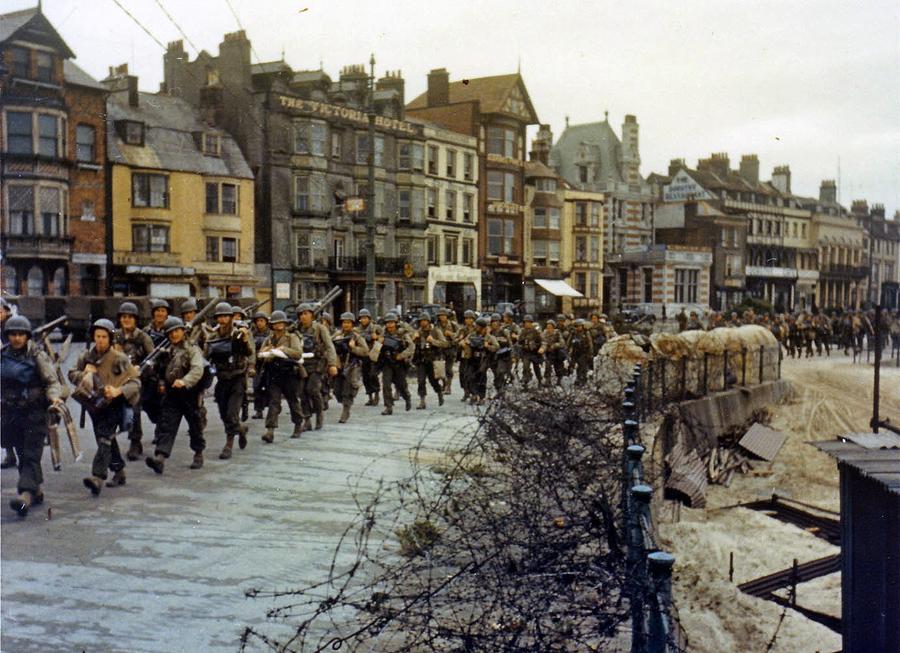
Image result for world war two photos of us soldiers marching to the docks before d day

I was born in 1938, and have always been fascinated by what was happening in the world at that point in time when I was conceived and born, because the atmosphere and events of those times would have had huge and unknown emotional pressures on the people who bore me.

My father was an army reservist and had been re-called to the army by the time I was ten months. He didn’t return home until I was nearly nine, and when he did, came with a new step-mother. It was like being adopted by strange people who didn’t know me. My own mother had disappeared when I was six.

And in that time of first emerging into this world –  my world, and the world of everyone else – was convulsed by war. That world was on fire and I didn’t know it. Battles raged in the sky overhead, warships ranged the sea a few miles away, the country-side and the towns prepared for siege. And I didn’t know it.

So I have tried to track what was happening when I lived in this world, but was unconscious of it, and have read so many diaries which tell me far more than official histories…  I’ve read the inner stories of housewives and politicians, pacifists and generals, and have a shelf of books telling how it was for those who lived through the mayhem.

I’ve just finished reading the diaries of Sir Alec Cadogan, who was Permanent Under-Secretary at the Foreign Office from the last two years of Appeasement, and then during, and after the war. I learned so much from him that isn’t in the history books.  I’d first come across him, when Churchill was wrestling with Stalin over the Russian plans for that tragic country, Poland. His advice, based on the fact that Britain had gone to war to defend Poland, put the moral viewpoint un-erringly.

And the tragedy was that Britain was in no position to risk a third world war by defying Stalin, supported as Stalin was at that time, by Roosevelt. The Free Poles had been based in London throughout the war, and Churchill, Eden, Cadogan and company had had to placate, comfort, and put up with – what I hadn’t realised until reading Cadogan’s diary – the Poles, nagging away all the time, plus fending off the aggressive resident Russians at the Russian Embassy.

The British were also juggling de Gaulle and the internecine rivalries of the resident Free French, plus the touchy Dutch, the slippery Turks, trying to keep them neutral, the belligerent Yugoslavs, the Americans and their suspicions of the English, as well as of de Gaulle, (Roosevelt and his advisers preferred the Vichy government),  the Spanish and problems over them supplying the Germans with wolfram, the Portuguese and negotiations to use the Azores, and the Greeks and their Communists, to mention only a few of Cadogan’s continuing diplomatic challenges. And then there were all the floating kings and queens who had fled Europe, been deposed, or abdicated. London must have been a fascinating place to be then.

Reading of the sixteen hours a day spent in cabinet meetings and conferences, puzzling over how best to handle Hitler during the last period of Appeasement was a revelation to me. Appeasement has been seen as so shameful, but as Cadogan kept advising his political masters, they just didn’t have the military muscle to do anything But negotiate. While they had only ten out of fifteen battleships with the other five in dry dock, the navy was impotent, as was the non-existent air force, and the tiny ill-equipped army, still managing on World War One weapons. On the other hand, Germany, after breaking the Versailles agreements, had built up a modern army and air force equipped with the latest weapons.

To read the endless agonising over the exact words of a telegram to Hitler, trying to gauge the impact of each word, whether it would conciliate, offend, alienate, deter, appease, buy time to re-arm, while at the same time juggling with Roosevelt’s imperious interference, even though at the time he had no intention of becoming involved, left me awed and admiring at the brilliance, industry, patience, and implacable integrity of Cadogan.

He was a direct descendant of the first Earl Cadogan who had been the principal Staff Officer and Director of Intelligence in ten campaigns for the Duke of Marlborough, Churchill’s famous ancestor. On the eve of a battle in Flanders in 1702, Marlborough reconnoitred the positions. He threw down his glove, and harshly told Cadogan to pick it up, which he did. That night, when Marlborough said he wanted the main battery set up at the place where he dropped his glove, Cadogan was able to say that it was already in place. His intuition was so finely tuned to his chief, that he had understood immediately the purpose of the supposed insult.

On 13 June 1940, Churchill took his Cadogan with him to Tours when he flew over to try to stiffen the collapsing French Government.  Seeing them together as “they listened to the agonising tale at Tours”, Sir Edward Spears, who was interpreting, wrote: “ here were the descendants of the two great leaders, brought together as their forebears had been by virtue of the services their Houses have rendered, generation after generation, to the country…. I thought how fortunate England has been to be served through the centuries by such men, and by others imbued with the same transcendent loyalty, though bearing lesser names… at that moment… the old story of the Flanders battlefield… flashed in my mind… as I watched the two men in that small room at Tours.”

It was Cadogan who framed the formulae at Dumbarton Oaks which became the basis of the UN Charter. And at San Franscisco, Cadogan, who was the permanent British representative, despaired over the obstructions of the Russians. I particularly enjoyed the story of the UN being broadcast all around America, and as a particularly verbose bore got up to speak, Cadogan could be heard groaning to himself in his clipped English tones, “Oh God!”

I finished the book last night, and regretted doing so. I read it slowly over about three weeks, all seven hundred pages or more. He would go down to Kew Gardens in London like we used to do, to see the magnolias out, or the bluebells, or the autumn trees. He never failed to notice the first crocuses of spring, and watched with approval the progress of the tulips and the wall flowers in the gardens as he paced through Green Park and St James on his way to his office in Whitehall. His idea of relaxation at the end of a tough week, if he wasn’t painting, was to dig over a garden bed, and plant it. This book was a good two dollars- worth from Trademe, and worth ten times the price.

More than any of the books I’ve read as I’ve tried to piece together the world as it was when I entered it, this one filled in many blanks and felt like a logbook of human experience. And more than that, while I was reading it, it gave me the experience of living with someone of the utmost integrity and unself-conscious goodness. In a world still convulsed with problems of an immensity that mankind seems to feel powerless to solve, goodness is precious and inspiring.

Fifteen-year-old Anne Frank, who was destroyed by the world I grew into, wrote these indestructible words back then: ‘In spite of everything I still believe that people are really good at heart. I simply can’t build up my hopes on a foundation consisting of confusion, misery, and death. I see the world gradually being turned into a wilderness, I hear the ever- approaching thunder, which will destroy us too, I can feel the sufferings of millions and yet, if I look up into the heavens, I think that it will all come right, that this cruelty too will end, and that peace and tranquillity will return again.’

This is the sort of goodness and optimism that we needed then and we still need now too.

The picture is of US troops marching to the docks to embark for D-Day… It looks like Weymouth where I spent the war years.

Food for threadbare gourmets

I want to eat masses of vegetables at the moment, and cook meals consisting of nothing else some days… wilted greens, a mix of broccolini, spinach, grated or sliced courgettes or asparagus lightly steamed, is one of my favourite combinations at the moment, and is good with meat or eaten on its own. Lightly cook the broccolini and asparagus, gently fry the courgettes in a little butter and then add the torn spinach leaves. When all these vegetables are lightly cooked, toss them together in a little dijon mustard. In a separate bowl mix together a table spoon of horseradish sauce, quarter of a cup of sour cream, and a few table spoons of cream, pour over the vegetables and boil up quickly. I sometimes slice cooked new potatoes into this mix too, and it’s satisfying and filling. It’s good with grilled chicken.

Food for thought

We are each made for goodness, love and compassion. Our lives are transformed as much as the world when we live these truths.

Archbishop Edmund Tutu


29 Comments

Filed under army, books, british soldiers, cookery/recipes, history, life and death, military history, Thoughts on writing and life, uncategorised, Uncategorized, world war two

A composer, a journalist and an activist

Image result for welles hangen


A composer, a journalist and an activist.  One of the great boons of technology is the ability to find about people I’m curious about, have known in the past, or want to know about now!.

I was looking up on Google to find out more about the Polish priest, Jerzy Popieluszko, hideously martyred during the struggle for Solidarity in Poland. In the text I found the name of Andrzej Panufnik, who had written a piece of music commemorating Popieluszko, so I followed this up, discovering that he was a much more interesting person than the  rather weary, elegant, middle-aged composer I had met on Christmas evening at Twickenham Vicarage, my in-law’s house, back in 1964.

He had refused a Christmas mince pie then, thinking that we crude Anglo-Saxons were eating beef mince pies, after all the previous Christmas feasting earlier in the day. I felt he had not been entirely convinced even after having it explained in very simple English.” Too much food, too much food”, he kept murmuring.  (My problem on meeting him was that I was young, unhappy, ignorant and probably crass).

His life, surviving in war-time Warsaw, composing and playing music at cafes – the only way Poles could hear live music since the Germans had forbidden public meetings – and then escaping with his mother just before the Warsaw Uprising, sounded harrowing in the extreme. When he returned to bury his brother and collect his music manuscripts, he found they had all been destroyed, including his ‘Songs for the Underground Resistance’. It got worse. Under Communism, he was required to reflect in his music ‘the realities of socialist life’, and even his symphonies for peace were considered politically unsafe, while his links with other great, but suspect composers, like Shostakovich and Khatchaturian in Russia, were also unhelpful. He was criticised for ‘Formalism’!

In the end he managed to defect. Visiting Switzerland in 1954 to conduct a specially arranged concert, organised so that he could defect, he ended up in a chase in a Zurich taxi, escaping from the pursuing Polish Secret Police.  Reaching England, he was supported by other sympathetic composers, including Vaughan Williams, until he established himself. At the same time he was declared a traitor and a non-person by the Communists after his much-publicised flight from Poland.

Eventually he married his second wife, Camilla, an heiress, photographer, and efficient organiser, who lived in a beautiful old house on the banks of the Thames, near my in-laws. From then on he pursued a tranquil and distinguished career, composing and conducting, and was knighted by the Queen. Yehudi Menuhin commissioned a violin concerto from him and Rostropovich, a cello concerto. Compositions streamed out of him, including a ‘Paean” written for the Queen Mother’s eightieth birthday. England, happy marriage, prosperity and professional success, must have seemed like heaven after the perils and dangers of Poland, during and after the war. His obituaries described him as one of the most ‘potent voices in music in the twentieth century’.

Still playing on Google, I found Welles Hangen, head of the NBC Bureau in Hong Kong when I was there. He had disappeared in Cambodia in 1970. I had lost touch with Pat, his wife, one of my close friends when I first came here. I felt she had no energy for anything but the search for Welles. I had spent the last day in Hong Kong with her, the children playing together for the last time. She gave me some delicate dark green jade earrings, with a gold setting in Chinese characters meaning happiness and good fortune, to take with me on my terrifying expedition into the unknown – New Zealand. Welles had given them to her.

In the stories about Welles on Google, I found an account of the Christmas party I went to in their palatial white house with walls of windows, looking down over the harbour from the Peak. A woman who was a war-correspondent, just arrived in Vietnam, had written it. Her description of the fabled party was totally unlike my perception of it. I saw no glamorous Chinese courtesans in exotic cheongsams, circling the room looking for “foreign devils” to subsidise them, nor even any CIA agents, or any other conspirators.

I just saw a sea of middle-aged Yankees – many of whose stout, slightly boring wives I had met at the American Women’s Association lunches, talks and fairs that Pat always took me to. And I was stuck at one of the little round tables with a handful of them, eating dinner with a group of people talking their own private language of acquaintances and domestic doings, which I could hardly hear anyway, above the din of conversation all round. I left early.

When I arrived, wearing an Edwardian-style turquoise crepe blouse, and a quilted silk, darker turquoise ankle-length skirt, my long dark hair piled up into a Japanese geisha chignon, I climbed the steps to the terrace behind Robert Elegant, the English writer and correspondent and his wife, who had had a reputation as a beauty. Welles greeted them at the top of the steps, and then turned to me, took my hands in his, and paid me a glowing compliment. Mrs Elegant swung round and glared at me. For the first time I understood the chagrin of growing older, when I saw it written in her face.

The next morning, party over, Welles left at five am to return to the chaos in Cambodia. Pat, their adopted children, a son, four year old Dana, and Claire, the plump little blue- eyed blonde toddler they’d brought back from the States the previous year, celebrated Christmas without him. A few weeks later, Pat showed me the elegant writing desk she had had designed by an architect, to give to Welles for his 40th birthday when he returned. It was waiting in his study, standing on one of the oriental rugs he’d brought home, literally loaded over his shoulders, when they lived in the Middle East. The desk was simply two elegant rosewood trestles and a sheet of black glass suspended over them.

Welles never saw it. The last news Pat had of him was that he and his camera-man had been captured. She went into a frenzy of effort, ringing and writing, and answering the phones endlessly, and even – in this night-mare – collaborating with “the underground”. Actually, Quakers, who were equipping a ship with medical supplies to sail to the stricken North Vietnam. Previously scornful of pacifists, now, if helping the enemy would help Welles, Pat would help them. She bought up stocks of bandages, quinine, and everything else she thought could be useful from all the chemists in Hong Kong, hoping that somehow a good deed to the North Vietnamese would ricochet into better treatment for Welles, wherever he was.

Later, and shortly after I arrived in New Zealand, I had a dream of Welles. He came to me and asked me to tell Pat that he was alive, but that he was also dead. He was very insistent that I let her know this, so she would stop waiting for him. But in the cold light of morning I didn’t dare write such a letter to Pat, to rob her of the hope which was her equilibrium. Hope was what was keeping her going, and capable of continuing to mother the children, a role which never came easily to her, much as she loved them.

She was the most unhandy and clueless mother I ever knew. She had collected Dana from the New York orphanage the night of the huge power black-out in New York, and had been stuck in a strange unlit house with a hungry crying baby she didn’t even know how to feed. She was in her forties, and had a busy life, so Dana, and then Claire, spent much time with a rather bored, unprepossessing Chinese amah. Which was why Pat loved my children coming to play with hers. I always felt I had let Welles down by not doing as he asked.

I learned from Google that Pat and the children stayed on in Hong Kong for another two and a half years, before returning to family in San Francisco. And there too, was the story of Welles’s end, and the discovery of his remains, in 1993, when the Americans were finally allowed back into Cambodia to investigate, twenty-three years after his disappearance. According to a local peasant, Welles and the others had been captured by the Viet Cong and Khymer Rouge, taken to a hut, kept for a few days, then marched to the riverbed and beaten to death.

Investigations revealed the four bodies, which were identified, and then Pat attended a ceremony at Arlington National Cemetery, where Welles’ ashes were interred. Two years later Pat was laid to rest beside him. Earlier, at Arlington Cemetery, she had said she would have preferred to go on hoping, but at least now she had finality.

And then there was Cheryl. I didn’t need to google her, she was a friend and  back from her world-wide conference in Melbourne. She told me of a woman from a remote community in the Arctic Circle. The woman lives in a village of two-hundred-and- seventy-eight souls, and they depend on fish and caribou for their food. The fish, they know are now contaminated by the poisons we flush into the world’s oceans. So this year, conscious of dwindling fish stocks world-wide, and in the interests of responsible conservation, they agreed to limit themselves to catching two-hundred-and-twenty fish this season. They caught eight.

And because the summer had been so warm, the snow had melted on the caribou’s feeding grounds. When winter came the tundra froze over, and the caribou cannot break through the ice with their hooves to get to their food below the surface. So the caribou were starving.

Cheryl is an interesting person. I know she is highly distinguished, and even has a papal knighthood, but when she talked of her Journey at a meeting of souls, I couldn’t fathom where this exceptionality was hidden in her. But the more I have met her, the more I see what deep wisdom she has. She must have – she understands the concepts I’m talking of, when no-one else does!!! At each encounter, she says something that illuminates, and I think about it for days.

This time, after her story about the Inuit village, we were talking of summer, and how we have both planted queen of the night for its scent. She mentioned how she listens for that moment during each day, when the rasping of the cicadas turns into the clicking of the crickets. I was fascinated, and realised that I had never even thought about it. I shall now. And I shall listen. Among many of her activities, she seeks out and shows films about the planet and global warming to her community, and has started a local chapter of the Red Hat Society (that is a story in itself))

These are some of the rare people I treasure having encountered, or having loved in my life… yes, there are so many more, because every person is so unique – a uniqueness that shines through in every blog I read. So vive all our differences and specialness and uniqueness… there is no-one else like us and never will be – everyone who reads these words is not just unusual but a one-off – what a thought!

Food for threadbare gourmets

I needed a quick, quick meal – we were starving. Chopped mushrooms and chopped bacon quickly fried. At the same time a packet each of instant noodles was soaking in boiling water. Salt, pepper and some cream tipped into the mushroom mixture and boiled up to reduce slightly. Noodles drained, mixture tipped over, and a sprinkling of grated parmesan from the deep freeze. Supper ready in five minutes!

Food for thought

Those who do not have power over the story that dominates their lives, power to re-tell it, to re-think it, deconstruct it, joke about it, and change it as times change, truly are powerless, because they cannot think new thoughts.      Salman Rushdie, novelist.


12 Comments

Filed under bloggers, cookery/recipes, culture, history, human potential, life and death, technology, Thoughts on writing and life, uncategorised, Uncategorized

Stop Press !!! recipe was wrong !!!!

Dear friends who may have read  Food for threadbare gourmets in the latest blog here… my daughter has e-mailed me to let me know I’d got the  amounts of the ingredients wrong in the speedy scone recipe. If this is of interest to you, the blog has now been corrected, and I hope no-one had tried their hand at cooking these cheese scones in the last two hours since I posted the recipe !!!

And thank you so much,  Victoria XXX

3 Comments

Filed under Uncategorized

The present needs the past

100_0624

I began sorting through drawer loads of recipes collected since the early sixties. I’ve dragged them around more twenty- six homes and three countries, and frequently can’t find the one I want; and though I try to keep my favourites altogether, they still stray into other collections of ‘intending to try’, and ‘must try’. After hours spent sorting them into piles, and several rubbish bags filled with the unwanted trimmings of yellowing newsprint and magazine borders, I realised that this truly was what is called a back-breaking job. I hadn’t even handled a quarter of the clippings.

Method: sort through the whole lot, putting them into cake, pudding, pasta, rice, chicken, fish piles, soups, salads, suppers, savouries, sauces and so on. Then sort the piles, throw out the duplicates, and trim yet again, to fit into scrapbooks, and stick them in. The cake book was huge, almond, fruit, lemon, plum, rhubarb, apple, madeira, chocolate, coffee, the whole nine yards. It has taken me days to get this far.

The interesting thing is that I recognise most of the recipes, know where we were living then, and even remember with many of them, how and when I tore or cut them out, right back to 1964, when we were living in a country house called  Newney Hall in the hidden country-side of Essex.

I can remember many of the dinner parties and the people who were there and the menus. Crocenbouche in the height of a Hongkong summer, with no air-conditioning in the kitchen, dripping with sweat, as I baked choux pastry balls, whipped up cream with cointreau, and made the caramel to dribble over the pyramid of puff pastry balls. Biskotten torte, a Danish coffee and walnut confection which could be made a week beforehand, given to me when I was engaged, by my stepmother’s best friend, staying with them in Shrewsbury; vol-au-vent, one of my father’s favourites, and mint and orange salad, a Robert Carrier special from the then new Sunday Times colour supplement.

Then there were the handwritten ones, salmon slice from Jenny, fruit cake from some people who read my columns, and who delivered a cake personally – then a recipe which the children still hanker after – a vegetarian meat loaf, made principally from pea-nuts, garlic, carrots and herbs, this sent by a reader in Tauranga, after a column on vegetarianism – Marianne’s beetroot relish, Frances’s apple cake, Evelyn’s strawberry jam. So the whole exercise raked over old memories, stretching back for fifty years. Many of the favourites had greasy or jammy finger-marks all over them, splotches of grease, or wine-stains!

I now have three thick scrapbooks catalogued into easily discovered sections, and decorated with beautiful pictures of food, fruit or vegetables cut out from magazines, and when I need a new idea for a meal, I go to leaf through them, and find something to inspire me.

In another day and age, I would have bequeathed them to my daughter, and they would have become family heirlooms like the treasured notebooks in browning spidery hand-writing of previous generations. But alas, already, even I now go to the internet for a quick fix on how to cook asparagus in the micro wave, and when I asked my daughter for a recipe for hot cheese scones we’d had for lunch, she sent me the internet reference.

I have shelves of cookbooks I used to love reading, but which I rarely ever open these days… apart from Elizabeth Luard’s book on family life which includes a number of my favourite recipes, and I can’t cut them out and ruin the book, so there they stay.

So it seems to me that my recipe scrapbooks are as obsolete as the family photograph albums. As with cookbooks, I have a shelf groaning with photograph albums. Not many from my early years, I have to admit – not much photographing went on in our family during the war, with my father overseas for seven years at the war, and my mother gone. But some from schooldays as a teenager, a precious few of previous generations – when taking a photo was serious stuff – and dozens and dozens of pictures of my children and grand- children. They and I used to pore over them when they were little, and reminisce about their childhoods. Maybe one day they would have been interested, not just in the records of their childhoods, but in the older family photos too, the records as it were, of their ancestors.

But it’s been many years since I received any up to date physical photos of my family to insert into an album. Lots yes, on the internet, but will they still be there in twenty years? Will this generation and succeeding ones have any of the family records that we, and previous generations have had since the camera was invented by Frenchman Louis Daguerre in1838 and Englishman William Fox- Talbot in 1839? Even before then, portraits, miniatures, sketches, silhouettes provided some family records.

But today, we seem to have lost something precious, something perhaps that we only appreciate as we get older. Young people are too busy taking their selfies, and posting on Facebook and all the other social media outlets to realise that the impermanence of this new technology has its drawbacks.

Then, I think to myself, is it just me that sees it this way? And then another inner voice stoutly proclaims that honouring the past, recognising the lives and achievements of our ancestors matters; knowing where we come from gives us a standard to live by, a knowledge that our forbears have faced and overcome great challenges in their lives, and therefore, so can we.

Even the trivial recognitions as we peer at good-looking Great-Aunt Jessie and recognise our nose, our eyes, and realise that we are part of a long chain of lives and family, gives us a sense of rootedness, and a feeling of permanence. Seeing faded pictures of poor Great – Uncle Arthur and remembering that he died on HMS Vanguard which un-explainedly exploded in Scapa Flow in 1917 taking him and another 799 sailors to the bottom, puts us in touch with history; learning about valiant Great-Aunt Violet who overcame childhood polio, lived with painful irons on her legs all her life with no complaint, and brought up a happy family, can inspire us to believe that we too have profound inner strengths with which to face the challenges of our own lives.

So yes, in some ways, as I look at my proud achievement of those gathered recipes into thick scrapbooks, I feel sad, as they symbolize so many other facets of life absent in this brave new world of convenience and technology. And yes, I know too, that there is no turning back, so that like my ancestors I must make the best of it, suspecting that my descendants have no idea of what they might have lost!

As wave is driven by wave
And each, pursued, pursues the wave ahead,
So time flies on and follows, flies, and follows,
Always, for ever and new. What was before
Is left behind; what never was is now;
And every passing moment is renewed.”
Ovid wrote this sometime before the birth of Christ… he also wrote that everything changes and nothing perishes – his words are my conundrum, my lesson and my answer.


Food for threadbare gourmets

My daughter gave me delicious hot cheese and bacon scones when I dropped in at lunch time. “Only three ingredients,” she boasted, “apart from the bacon which I added”.  I couldn’t wait to try them myself! Annabel Langbein, a NZ  cookery writer invented them: two  and a half cups of SR flour, two and a half cups  of grated cheddar cheese, and two cups of Greek yogurt, plus salt and pepper. Mix them all together, drop spoon-fuls onto a greased tray, and cook in a moderate oven for ten to fifteen minutes. Mine took a bit longer than the stated time to cook because I simply put the whole lot on the tray in one piece and cut it into triangular segments. But they were good. Next time I’ll add some chopped cooked bacon, and might add some Parmesan too.

PS I experimented with last week’s recipe for broad beans etc, and found that by leaving out the garlic, and using nutmeg instead, it was subtler and to my taste, more delicious…

Food for thought

The more faithfully you listen to the voice within you, the better you will hear what is happening outside. And only she who listens can speak.

Dag Hammarskjold Swedish Secretary-General of the UN for eight years. He died in a mysterious plane crash in Africa in 1961 at the age of forty-seven, and JFK described him as one of the greatest statesmen of our time.


35 Comments

Filed under cookery/recipes, family, history, life and death, life/style, The Sound of Water, Thoughts on writing and life, uncategorised, Uncategorized, world war one, world war two

All people great and small

 dresser
 He wrote to a ninety-one- year old woman begging to be allowed to be a footman in her household, even if it was just for a day. Her secretary wrote back to the young Fijian and said yes, this could be arranged.

So a few weeks later, when the Queen entered a state room to meet an assortment of ambassadors, governors and other Very Important People, the young Fijian was in attendance, resplendent in his Royal household footman’s uniform. She saw him straight away and ignoring all the Very Important People waiting to exchange a few pallid jokes and platitudes with her, she walked straight across the room to talk to her newest recruit. The guests probably assumed he was an even more important person then they were….

I love such little vignettes which give an unexpected insight into character. On this occasion, the Queen’s humanity would have meant an unforgettable experience for the young man from the Commonwealth and the other side of the world.

I think of the story I read in a blog, when a South African blogger I used to follow was taking her dying daughter for a specialist appointment. While they were waiting outside the lift, the daughter sitting in her wheelchair, the doors opened, and out stepped a tall African. On seeing the mother and daughter, he walked over to them, and bent down and had a few gentle words with the dying woman, before smiling at her mother and continuing on his way… another act of kindness and connectedness – from Nelson Mandela who could well have just continued on his busy way.

I loved reading about Albert Schweitzer, the famous doctor, musician and founder of the hospital at Lambarene in Africa, standing on a train platform in the US where he had been invited. One minute the old man was talking to his group, the next, he was nowhere to be seen. And then someone saw him down at the end of the platform, carrying the suitcases of an old woman, helping her onto the train.

The Queen’s mother was famous for these sort of spontaneous kindly deeds, though one of my favourite stories was of her as a young woman… she had a sweet tooth even then and was happily chewing a caramel as she drove through Liverpool… she caught the eye of a young policeman, and tossed him a caramel, which he caught! Did he chew it too, or keep it in a glass cabinet as an unlikely relic?

A shopkeeper whose shop was on her route to Cheltenham races once wrote to her to say he would like to present her with a bunch of flowers when she drove past on her annual visit. She replied, and for the next eighteen years, until she stopped attending the race meeting, she stopped to talk to him on her way. By then, a crowd was always waiting too, and she never failed to stop and chat with her faithful admirer.

Her grandson’s wife, Diana, not one of her favourites, also had this gift. Few people know of the time when she was visiting this country as a twenty-one -year old. She came out of a reception in Wellington, the country’s capital, and a noisy group of IRA sympathisers was waiting for her with hostile banners and angry shouts. Gathering her courage so as not to disappoint the other people who were waiting to see her, this brave young woman walked over to them, and ignoring the heckling of the Irish, talked to the others. That took real character.

And later, in Auckland, she came out of a banquet late at night, and seeing a little girl standing in a knot of spectators, crossed the road in the pouring rain, red shoes and white tulle dress getting soaked, and bent down to talk to her and take the posy being offered.

General de Gaulle has never been one of my favourite people. Hating the British who sheltered him, gave him offices, staff, aeroplanes, money to support him throughout the war, he could rudely say to Mr and Mrs Churchill while lunching with them at Number 10, and discussing how to handle the French fleet in North Africa, he said it would give the French great satisfaction to turn their guns  onto the British. This, of course, was the man who was able to write a history of the French Army without ever mentioning Waterloo.

But many years later, sitting next to Churchill’s youngest daughter Mary, when she was the wife of the British ambassador, he asked how she passed her time. She blurted out, ‘walking my dog’, and was deeply touched that he spent the rest of the lunch discussing the best places to do this. Even de Gaulle had a heart! He showed it again, writing a tender and touching letter to Lady Churchill on the first anniversary of Churchill’s death.

And talking of animals James Herriott the Yorkshire vet who wrote the popular series ‘All Creatures Great and Small’, was the vet to some of my closest friends. He lived up to his reputation. Anthony told me that when they first moved to Yorkshire and signed up with Herriott, then just an unknown country vet, their cat seemed unwell. It was Sunday but they rang their vet anyway. Herriott was enjoying Sunday drinks before lunch at a friend’s home, but he dropped everything and came to the house to treat Anthony’s cat.

These are not great acts of heroism, but little random acts of goodness, kindness or humanity, spontaneous responses in circumstances where pomp and ceremony were often the order of the day… and that’s why they are so revealing… they demonstrate character and connectedness. And there are many people who are not public figures who also respond to everyday situations with spontaneity and kindness, and we never hear of them… let us now praise famous men, as the psalmist wrote… and some there be which have no memorial.

When I listed all the beautiful gifts a friend had given me over the years, and all her acts of kindness and imagination towards me, my love said why don’t you write and tell her. I said I have and I do…. But I made a mental note to tell all my other friends too, how much their friendship and love have meant to me over many years.

I thought about all the wonderful things people tell about their loved ones at their funerals. I always hope the spirits of the dead may be hovering to hear these words of love and appreciation. But how much more they would have enjoyed these tributes during their lifetimes. So one of my resolutions for the rest of my life-time is to make sure those I know and love also Know how much they are loved and valued… not just for their deeds or gifts but for the essence of who they are. Seeing a person’s essence is to recognise their soul. There can be nothing more satisfying than to know you have been Seen, that you have been recognised for who you are, and that who you are is precious, beautiful and utterly loveable.

This is a priceless gift which should be the birthright of every child, and this is my daily prayer: that the parents of all children may see and love the essence of each child, so they grow up undiminished by self- doubt. Then they can feel, and are, whole and happy and loving themselves. A world of loving souls would be a world without fear, and a world of peace, the sort of world we all long for – where peace and goodwill to all men would obliterate the divisions of race, religion and other limiting ideas which separate and divide us. For, as Thich Nhat Hahn says: ‘We are here to awaken from the illusion of separateness.’


Food for threadbare gourmets

The picture is my kitchen dresser groaning with summer produce. We’ve had lots of fresh asparagus this spring, but I had reached satiety with asparagus with melted butter, asparagus with vinaigrette dressing, and asparagus with a complicated Japanese dressing. So when I was the grateful recipient of a harvest of fresh broad beans from my daughter-in law’s garden, I decided to try something else. This is it!.

Wrap enough asparagus stalks for two in a sheet of kitchen paper, putting the join underneath so it doesn’t blow open. Sprinkle the paper with water, and cook the asparagus for just over a minute in the micro-wave. At the same time, chop and fry in a little butter a small piece of good thick ham, then pour in cream, a capful of brandy, a couple of chopped garlic cloves, (I used chopped garlic from a jar!) and half a teaspoon of Dijon mustard. Boil it all up until it thickens.

Blanch the broad beans -enough for two. Cook in boiling water until tender – I used small fresh ones, so didn’t need to pop then out of their outer skin. Then cut the asparagus stalks in two, and add them and the broad beans to the ham and cream mix. Eat with good bread to mop up the delicious juices – and I had a glass of champagne too, to enhance the feeling of well-being!

Food for thought

Until he extends his circle of compassion to include all living things, man will not himself find peace.  Albert Schweitzer


‘.


27 Comments

Filed under cookery/recipes, human potential, kindness intelligence, life and death, life/style, love, princess diana, Queen Elizabeth, The Sound of Water, Thoughts on writing and life, uncategorised, Uncategorized

Chickens coming home to roost

Nobel prize-winner Malala Yousafzai

I’ve wondered why I’ve been so fascinated by it. I normally never read the news, especially salacious negative or destructive items, but I’ve been rivetted to the Harvey Weinstein story.

As I finished the washing up after lunch today, I realised why, and what I’ve been trying not to remember… all those times it was happening every day and as part of life when I was growing up.

I thought of the maths teacher when I was fourteen. When I started this school, my new friends warned me that when he called me out to his desk to go over some maths problem, he would run his hand up under my gym slip, and massage my thigh. Whether the massaging was more than that and my friends couldn’t bring themselves to say, I don’t know, because I was a very immature, slow developer, and he never tried it on me.

I remembered joining the army when I was eighteen, and being measured for my uniform by the regimental tailor. Afterwards when we compared notes back in the barrack room, we all found we’d had the same experience of him feeling our breasts as he took our measurements.  And I thought of a night at cadet school a few months later, when eleven of us were sitting around late at night over a cup of hot chocolate, and we discovered that nine out of the eleven of us had had the experience of a man exposing his hairy genitals to us as a child.

The following year one of us who had been to a wedding in Scotland, was raped in the sleeper on the train back from Edinburgh.  Jo – as I’ll call her – a gentle sweet-natured girl, was so intimidated by the notice which said the fine was five pounds for pulling the emergency chain un-necessarily, that she didn’t dare reach over to pull it and save herself.

There were plenty of us who felt intimidated like that back in the fifties and sixties. When I worked on the South China Morning Post in Hongkong supporting my children on my meagre pay, the managers brought in a time and motion expert from the UK to assess whose job was necessary or financially worthwhile. The expert took a fancy to me, and I was over a barrel between trying to avoid him by fleeing the office and inventing interviews, and being seen conscientiously bending over my type-writer justifying my existence and my salary.

It became a joke on the women’s page that  he was always asking where I was, but it was no joke to me. Finally, I could avoid having dinner with this married man having a bit of fun while he was away from his family no longer, and at the end of the evening, feeling completely powerless, I ended up on the sofa at his flat. I escaped as he undid his zipper, and then had the anguish for weeks of wondering if, when he wrote his report, I would still have a job.

I’ve often wondered since why I didn’t just say no thank you when he pressed me to go up to his flat after dinner, replying:’ I have to get my children up for school in the morning, and get to the office on time!’ End of story. But I was too fearful then of men’s power as I battled for custody of my children, and struggled to keep my job.

Just as when the editor sent me to interview a friend of his a few weeks later, and the blonde handsome Swede behaved as though I was a call girl. Once again, as I escaped his clutches, I knew it was no use complaining to the editor about his influential friend… I would just have been a trouble maker, who couldn’t take it. I wasn’t just trying to get a job like the Hollywood stars I’ve been reading about, I was trying to keep a job which paid me half what a man was paid, in order to house and feed my children.

The choices are just as bad for so many women even now… there are Filipino maids all over the world putting up with all sorts of forms of exploitation and wicked treatment because their families are relying on the money they send home. I read that it is now illegal for men in India to rape their teenage or child wives. But how many child brides know their rights, and how many would dare to offend a strong powerful man who had total power over her life?

There are women and children both in Africa and England and everywhere in between, who endure the horrors of Sharia law, which often includes genital mutilation. There are states in a western country like the US where it’s legal for a husband to beat his wife, while both fundamental Muslims as well as fundamental Christians also claim this right. And many women stay in abusive relationships in order to protect their children and try to bring them up, while leaving a violent marriage simply isn’t a financial possibility for too many other women.

So-called honour killings – when a woman or a girl has been raped – means that in many Muslim countries, it is the woman who is punished for the crime – often with death by stoning or barbaric whipping. That old joke, a woman’s place is in the wrong, is no joke in those countries. Yazidi women raped by Isis, school girls captured by Boko Haram soldiers, women forced to hide behind, and under, curtains of black material invented by men to deny their uniqueness, are up against something much worse than the harassment of Hollywood actresses and their fear for their careers that we’ve been reading about.

Nobel peace prize-winner Malala Yousafzai was a school-girl when she was shot by Taliban in Pakistan for advocating education for women. Since then, she’s recovered from her dreadful wounds, though she’s lost the hearing in one ear. She went to England for medical treatment and to be educated safely away from the murderous men who wanted her dead, and now she’s just started her degree studies at Oxford. She has never given up her cause, and says: “I raise up my voice – not so I can shout but so that those without a voice can be heard…we cannot succeed when half of us are held back.”

There are unheard voices all over the world, and if this scandal about harassed actresses can remind us of those other unseen, unheard women, it will be a service to them all. Because I’m human it feels good to know that one bully is being held to account for his actions, but the other part of me wants to feel that something good  can also come out of this story of human frailty.

When truth is revealed it can be the catalyst for change. I hope this story is big news everywhere, so that people everywhere get the message that it’s not okay to misuse power and terrify or deprive women; that they learn that women do have the right to all the freedoms and goodness in the world that men enjoy too.  Let’s hope that this change of heart and mind can work its way into the consciousness of all men everywhere because of the public downfall of one powerful man.

Not into the consciousness of the many good men who do care about women, but into the hearts and minds of men whose cultures have taught them that it’s okay or even de rigeuer to oppress and suppress the feminine – whether it’s their wives or daughters or other women, or the feminine in their own natures.  The qualities of the feminine – gentleness, nurturing, empathy, creativity, are the things that most of us want in our homes and families, and societies, as well as the masculine qualities of strength and power. Balance, wholeness, the middle way, are what makes for health in people and in societies and honouring both sides of our natures is the way to this balance and goodness.

A tacky scandal in the western world of entertainment may seem trivial when set against the appalling suffering of so many silenced women all over the rest of the world. But good can come out of this saga of silence if it causes a change of heart and mind beyond the homes and habitats of Hollywood and its power brokers. I do so hope so.

Food for threadbare gourmets

Spring is coming to this end of the world and I feel like different food. With cold chicken the other day I used a favourite way with avocado. To half a cup each of chopped avocado and cucumber, use three quarters of a cup of cream, a quarter of a cup of lemon juice, one finely chopped onion, two cloves of chopped garlic, salt and black pepper, and put it all in a blender. Whizz until smooth. I love this with raw or cooked vegetables as well as with chicken, cold turkey or ham.

Food for thought

Feminism has never been about getting a job for one woman. It’s about making life more fair for women everywhere. It’s not about a piece of the existing pie; there are too many of us for that. It’s about baking a new pie.” Gloria Steinem


38 Comments

Filed under army, consciousness, cookery/recipes, culture, family, life/style, Thoughts on writing and life, uncategorised, Uncategorized, womens issues

Earth’s greatest treasure

Lot18again
In this place, I look up to the stars at night and there is nothing apart from the clouds to hide them from my gaze… the Milky Way seems an infinite cloud of light, the Southern Cross pointing as it has guided centuries of sailors, Orion’s Belt clear and bright.

I watch the moon from a fingernail of light right through to the fullness of it, and the delicious phase we call a gibbous moon. I see the sun move across the horizon with the months and then at the farthest point of winter, see it begin its journey back to the sunlit mountain behind which it sets in summer. We are halfway across as I write this and the sun sets behind ‘our mountain’.

Though we live here and bought the acres of forest we technically own, we have no sense of ownership… we are simply the fortunate tenants of this beautiful podocarp forest, teeming with species of tree and plant life.

Here are hidden species of frogs and lizards and fungi, almost extinct in the rest of the world, and rare butterflies are still seen here. Fungi in colours that are psychedelic, brilliant blue and purple and orange, green and red grow in the dense green canopy which shelters them from the brilliant New Zealand sun-shine.

Because it is spring, on distant vistas there are patches of white to be seen scrambling up to the tops of tall trees and the sun-light – the fragrant white clematis. It grows too, on some of the ancient trees surrounding our little home in the woods. The birds we feed are gathering as spring advances, and we hear the sound of the tuis bell-like call, the heavy flapping of the wood pigeon’s wings as they circle  our valley, the harsh call of the quails who visit us to enjoy the bird seed we dispense, and the soft hooting of the moreporks – the New Zealand owl – connecting with each other across the dark forest through the night. We watch the kingfisher perching on the branch where the moreporks also sit, and see him dive like lightning into the grass to grab a morsel of food – be it grasshopper or beetle.

Those tend to be the only sounds we hear, just occasionally the drone of a distant aircraft and the rushing water of our stream after heavy rain. We feel the wind on our faces, and hear it in the trees, we savour the soft spring rain filling our water tank, and keeping the forest moist and green.  We feel the springy ground beneath our feet, centuries of humus which have accumulated undisturbed.

We feel the mysterious life around us, knowing that beneath the surface the trees are connected and communicate with each other through their root systems; that the abundant life of bees and beetles, moths and grasshoppers, birds and tiny ancient species of reptile are part of a vital chain of life which has existed millennia before homo sapiens conquered the planet. We sit in the sun, and feel the warmth on our faces, and hold smooth sun-warmed stones, and feel a connectedness with the earth and with the natural life that many people who live amid concrete, steel and glass cities, can lose.

Technology has tamed the cold and the heat with air conditioning and central heating; we have tamed the seasons, with imported food bringing us fruit and vegetables from all over the globe, regardless of whether it’s summer or autumn or winter. We may even have become unconscious of the rhythm of our own bodies, of the way we once responded to the passing of the seasons and of the years, as our culture devotes itself to prolonging youthful bodies and a belief that we can conquer the ravages of age and the vagaries of climate – until a hurricane or earthquake shatter some of these illusions.

It seems to me that when we lose this sense of connection with the life which throbs around us, with the rhythms of the sun and the moon and the movements of the starry sky, and the dance of joy in a greater whole, we may lose something very precious… and that in the end, we may in Cardinal Newman’s words: ‘choke up all the avenues of the soul through which the light and breath of heaven may come to us.’

We know that we do not own these acres that we live on and look out across. We call it our mountain but we know that that is just our figure of speech. We are simply the present guardians of this patch of our precious planet. We’ve signed a covenant that we will not disturb the forest, cut down any trees, or despoil any part of it. We cherish its silent solitude, and share the seasons with it. Does this place know or feel how sacred, cherished and unpolluted it is, I wonder?

Robert Macfarlane writes in his wonderful book ‘The Wild Places’, that even on the beaches of the Isle of Skye in the remote north of Scotland, the beaches were littered with: “milk bottle crates, pitted cubical chunks of furniture foam cigarette butts, bottle caps, aerosol canisters…”

Here in this empty place we have escaped that blight of the so- called civilised world. Even the beaches on this remote peninsula are unsullied and unspoiled. We are the fortunate ones, I know, and my heart aches at the knowledge of the poisoned polluted oceans devoid of the teeming fish and life Thor Heyerdahl wrote of during the Kon Tiki Expedition, seventy years ago this year.

John Aspinall was a successful gambler, who, while stripping rich men of their money in London during the sixties and seventies, used his ill-gotten gains to establish two zoos, which are now famous for being animal refuges where he successfully bred species and returned them to the wild, a policy his son Damian is still pursuing (you can follow his work on Youtube)

Before he died, John Aspinall wrote his creed: “I believe in Jus Animalium, the Rights of Beasts, and Jus Herbarum, the Rights of Plants. The right to exist as they have always existed, to live and let live. I believe in the Buddhist concept of Ahimsa – justice for all animate things. I believe in the greatest happiness for the greatest number of species of fauna and flora that the Earth can sustain without resultant deterioration of habitat and depletion of natural resources.

“I believe in the sanctity of the life systems, not in the sanctity of human life alone. The concept of sanctity of human life is the most damaging sophism that philosophy has ever propagated – it has rooted well. Its corollary – a belief in the insanctity of species other than man – is the cause of that damage. The destruction of this idea is a prerequisite for survival.

“I believe that wilderness is Earth’s greatest treasure. Wilderness is the bank on which all cheques are drawn. I believe our debt to nature is total, our willingness to pay anything back on account, barely discernible. I believe that unless we recognise this debt and renegotiate it, we write our own epitaph.

“I believe that there is an outside chance to save the earth and most of its tenants. This outside chance must be grasped with gambler’s hands.

“I believe that terrible risks must be taken and terrible passions aroused before these ends can hope to be accomplished. If a system is facing extreme pressures, only extreme counter-pressures are relevant, let alone likely to prove effective.

“I believe that all who subscribe to these testaments must act now; stand up and be counted. What friends Nature has, Nature needs.”

In the twenty-first century, in the face of overpopulation, pollution and climate change, his words remind us of the urgency of the task. It still isn’t too late to stand up and be counted. And I feel that Lao Tzu’s words written two and a half thousand years ago, can still point the way for us all:

If there is to be peace in the world,
There must be peace in the nations.

If there is to be peace in the nations,
There must be peace in the cities.

If there is to be peace in the cities,
There must be peace between neighbours.

If there is to be peace between neighbours,
There must be peace in the home.

If there is to be peace in the home,
There must be peace in the heart.

The picture is our house in the forest


Food for threadbare gourmets

The cupboard was bare so imagination was needed. Pasta did the trick…  with a couple of rashers of bacon chopped and fried with sliced mushrooms while the pasta was cooking. I added cream to the bacon mix, boiled it up to thicken it, added a grated courgette, chopped parsley, a small dollop of mustard, and a sprinkling of nutmeg, salt and pepper. This mixture was poured over the cooked pasta, and then sprinkled with grated parmesan. It went down well !


47 Comments

Filed under birds, consciousness, cookery/recipes, environment, life/style, philosophy, pollution, technology, Thoughts on writing and life, uncategorised, Uncategorized

Saving the West

Image result for hastings uk images

Hastings

We’ve been re-watching a favourite TV series on Youtube from some years back… Foyle’s War. Unlike real life, it’s one of those satisfying forms of entertainment in which the baddies always get their come-uppance, and the goodies triumph – hurray !

Second time around I relish the masterly performances by actors at the top of their art…and notice many little quirks and anachronisms I’d missed first time around. But this time, I’m really aware of Foyle in a way I hadn’t been before. Much water has passed under the bridge since the years when this series – a favourite with watchers on both sides of the Atlantic – was created.

And since then the world has changed in so many ways, which include the upsurge of terrorism with the advent of Isis, the  unprecedented invasion of Europe by another culture – not just by refugees – but  by armies of young men from third world countries looking to improve their lot and enjoy the largesse of western society; and many other factors like the spread of sex changes even among young school children, drunkenness among women in the UK on a scale unheard of previously, homelessness on the streets of many  towns and cities, plus the religion of political correctness which means that on Twitter, another new arrival, people can be metaphorically crucified for using the wrong word…

I try not to equate the pictures of society men and women at various depraved looking parties where guests are encouraged to personify ’filth’, the photos of young people on the streets reduced to zombies by killer drugs, and stories about university students who feel it’s Ok to sue their  instructors for not helping them get better grades, with the decline and fall of the Roman Empire… Society collapsed then for many reasons, not least the gulf between rich and poor, and the bacchanalian  orgies of self- indulgence which we see today with the zillion dollar superyachts, and four or five day weddings of the rich and famous costing millions of pound/dollars, typical of the Roman over-indulgence and selfish hedonism in the last years of that Empire.

Christopher Foyle, the detective chief living in Hastings, the pretty coastal town where William the Conqueror landed, and defeated the defending Anglo-Saxon army in 1066, reminds me of some of the qualities of civilisation that I sometimes fear that Western culture is forgetting. While all around – to mis-quote Kipling – are losing their heads, failing to take responsibility, and blaming the war for profiteering, dishonesty of various degrees, for petty crime, spying, revenge and murder, Foyle remains incorruptible, refusing to cede one iota of the rule of law, built up over the centuries by generations of lawgivers and members of Parliament to create a fair and decent society.

He’s an ordinary person in every way, laconic, kind, and generous, but implacable when it comes to refusing to accept wrong in any form, never sparing family, friends and colleagues, as well as law breakers. He reminds me of Marcus Aurelius’s words: “Whatever anyone does or says, I must be emerald and keep my colour.” He keeps his colour no matter who around him is losing their integrity, and integrity is the word which most describes the quality that is Foyle.

Winston Churchill once said of Ernest Bevin, the great post-war Labour foreign secretary that: ‘he had many of the strongest characteristics of the English race. His manliness, his common sense, his … simplicity, sturdiness and kind heart, easy geniality and generosity, all are qualities which we who live in the southern part of this famous island regard with admiration.’

He called him a great man, and by that measure, so is Foyle. Why do I dwell on this fictional character in a long running detective series – the only one I’ve ever watched since murder, mayhem and mystery don’t tickle my fancy? I do so because this sort of person was not so rare as to be unusual many years ago. I can think back to many fine characters who people the English way of life – the only one I can write about with any knowledge.

People like the great statesman and gentle man, Edward Balfour, noble Sir Edward Grey, foreign secretary who tried to be peacemaker before World War One, to the thoroughly honest, decent, modest man who succeeded Churchill as prime minister – Clement Atlee. Honest politicians were not so unusual back then. They upheld the values of civilisation without even considering that by living lives of integrity this was what they were doing. And every person, however unknown, living such a life, is still today, of inestimable value to their society and civilisation.

Kenneth Clark at the end of his magisterial book ‘Civilisation’, wrote he believed: “that order is better than chaos, creation better than destruction. I prefer gentleness to violence, forgiveness to vendetta… I think that knowledge is better than ignorance and I am sure that human sympathy is more valuable than ideology… I believe in courtesy, the ritual by which we avoid hurting other people’s feelings by satisfying our own egos. And I think we should remember that we are part of a great whole, which for convenience we call nature. All living things are our brothers and sisters.”

He goes on to say that it is a lack of confidence more than anything else which kills a civilisation, and that we can destroy ourselves by cynicism and disillusion. And this to me is what Foyle is all about. He never succumbs to cynicism and disillusion, but sticks to the great truths of kindness, justice, the rule of law, compassion and courtesy. These are the qualities which can preserve and save our civilisation, despite the depravity of the rich few, and the hopelessness of the homeless and deprived.

Western civilisation, with its ideals of freedom, kindness, fairness, justice for all, value for learning and for literature, for art, music and science, our recognition of the rights of all people and all races, and for all creatures; our care for the environment and for those who need protection, is a way of life worth preserving.

If we do believe this and do not succumb to the belief that we have to cede these freedoms and rights to other cultures and customs which deprive others of freedom, dignity and the right to happiness, cultures which dictate how people should think, what they should wear, and mutilate women in the belief that a Creator demands this, we can still save our own way of life – what one blogger calls ‘the True West” in Arthurian/Camelot terms.

We can still bequeath peace and harmony to our children and grandchildren, and we can try to share these blessings with all people. We can continue to believe in those great words from the American Declaration of Independence written in 1776, that: ‘all men are created equal, that they are endowed by their Creator with certain unalienable Rights, that among these are Life, Liberty and the pursuit of Happiness’.

Tolkien defines the task for us in the Lord of the Rings, his epic about saving civilisation: ‘I wish it need not have happened in my time,’ said Frodo. ‘So do I,’ said Gandalf, ‘and so do all who live to see such times. But that is not for them to decide. All we have to decide is what to do with the time that is given us.’

Food for threadbare gourmets

Cakes- easy ones. This is one of my favourites – combining lemons with the easiest method ever. I adapted it from one of Elizabeth Luard’s recipes, and use 175 gms of SR flour, 175 gms of sugar and the same of mild olive oil, three eggs, pinch of salt and zest and juice of a lemon. I also add a teasp of vanilla into this mix in memory of my grandmother who always used vanilla in her cakes. Stir it all together and tip into a greased lined loaf tin, and sprinkle a generous helping of caster sugar on top. Cook in a moderate oven for about forty minutes or until ready.

Food for thought

Even as our few remaining wilderness areas are threatened, each day more of us venture into these beautiful landscapes to experience the energy for ourselves. And, immersed in the natural rhythms of the earth and the wind and the sky, our minds relax and we view our lives with quiet perspective. We can see our paths and can recognise the synchronicity that has guided our footsteps.
James Redfield from The Tenth Insight


23 Comments

Filed under consciousness, cookery/recipes, culture, history, spiritual, Thoughts on writing and life, uncategorised, Uncategorized

Tour de France

Image result for french chateaus


France in 1950 was unspoilt by either holidaymakers or tourists. I was there to spend a month with friends, and improve my French.

Alex, the son of the friends, came to stay with us first, a sophisticated fourteen- year -old who bullied me, took shameless advantage of my literal interpretation of my father’s instructions to be a good hostess, and used me as dogsbody, maid and batman all in one. After one of our regular rows he came downstairs from his room and his dictionary, and in front of my parents announced to me: ” You are ‘aughty, arrogant and proud.”

Coming from a quiet Yorkshire country town, Paris seemed a massive city of radiant light and celebration. Looking down from the family home in the heart of the city, I watched rainbows of light rolling along the wide roads, as hundreds of cars sped round the boulevards.

Having a bath that night was an ordeal in which I seemed to be accompanied by a crowd as my reflection followed me round a huge, mirrored bathroom. The flat was empty except for a resident maid and the chauffeur who was to drive us down to the chateau. It was huge and overwhelming and Alex was more arrogant than ever. It seemed that his father hadn’t briefed him on being a good host.

However, the next day, he and the chauffeur took me on a whirl around Paris – Notre Dame, cavernous and crowded and Catholic. I was disappointed. I had expected the sacred silence of empty Anglican cathedrals, but this was bustling with chattering people treating the place like their home, and selling souvenirs at stalls by the door. Twelve-year old-righteousness remembered stalls being overturned in another temple.

Today, of course, every Anglican cathedral in England  bustles with tourists too, the whispers and commentaries coiling up the perpendicular arches, and bouncing off the roof and coming back down magnified a million times. But in Notre Dame that day they managed to pray amidst the din.

From the steps of the cathedral we drove past the Louvre, circled the Arc de Triomphe and ended up at the Eiffel Tower – which turned out to be closed on Sundays. It didn’t matter – Paris in summer, nearly seventy years ago, was a beautiful, fragrant city, where people lounged outside on the pavements beneath the trees, and where, when we walked beside the Seine in the sun-shine, it was uncrowded and peaceful.

After lunch, I persuaded Alex to show me how to get out of the flat, and wandered onto the streets, looking for a bookstall. A terrible thought had suddenly wriggled into my consciousness. I had nothing to read! The worst thing that could happen to me! At a corner shop, my eyes raced over the shelves as the full horror of my situation became clear. Everything was literally a closed book- it was all in French. I came out with the only two English language publications in the shop- a copy of Life magazine, which was mostly pictures, and the August 1950 copy of Reader’s Digest, a magazine I’d never seen before.

Though I soon became bored with its banal, monotonous, uniform prose, I read it regularly for the next month, until I knew most of it by heart. I read ad nauseam about some chap called Billy Graham and how he had met and married his sweetheart, ‘The Most Unforgettable Character I’ve Met’ finally palled, the jokes got worse as the month went by, but ‘How To Improve Your Word Power’ was a winner, I got a hundred per cent before the month was out.

The first reading got me through the evening in Paris, and the next morning we set off for Vienne. Our destination at the chateau was everything that a romantic, unformed imagination could have visualised. We approached it down a long avenue of ancient trees. Those which had succumbed to old age had been chopped down to a height of three feet, hollowed out, and planted with foaming pink geraniums spilling out over the stumps.

The chateau was a moated, ivy-covered, turreted, thirteenth century family home. The moat had been filled in with sand, where the smaller children played. Where the drawbridge had once been, there was now a wide bridge leading to the iron- studded front door which was always open. From the high, dark hall hung with family portraits and armour and weapons, one door led to the dining room, a very solemn place, and the other to the salon, a light, airy room furnished with a variety of gilt sofas and chairs of different periods, mirrors, and objets d’art, while at the end of the hall, a staircase rose to the family quarters.

All seven brothers and sisters returned every summer with their families for the shooting, and they all had their own family accommodation. Alex and his family had a self-contained flat at the other end of the chateau but I was placed in one of the spare bedrooms of the main chateau, a beautiful room hung with toile de jouy in pale green with its own bathroom. The elegant, shuttered windows were hung around with more ivy, and from it would emerge huge, black, long-legged spiders, bigger and hairier than any English variety that had terrorised me in the bath at home, and which perched themselves on the mouldings in corners of the ceiling.

The ceiling was far too high to reach with a broom and a chair, so Alex and his cousins would troop in every evening with their pop guns and have great sport shooting the hairy beasts. I went to bed every night in this gorgeous room, wondering if I would wake and find another monster had somehow insinuated itself through the shutters and into the hangings round my bed.

Breakfast was taken en famille, and was the one meal of the day I enjoyed, though I didn’t do as they all did, and dip my buttered toast into my bowl of coffee. The bread was freshly baked and brought from the village by one of the maids when she came on duty before breakfast. In the afternoon, another delivery of fresh bread was made by a boy on a bike, and we would eat it for gouter at about three o’clock, we children standing around in the kitchen, illegally eating great slices of this heavenly bread, spread with runny home- made confiture which I called jam.

Those were the good times. Lunch and dinner in the stately main dining room, with at least thirty of us round the enormous, oval table was a long drawn- out ordeal. No allowance was made for an Anglo-Saxon barbarian who was accustomed to eat with a knife and fork. Every course was eaten with a fork only and I fought a losing battle with pastry and delicate vegetable dishes served whole, or legs of chicken and partridge.

My appetite would go before we began these marathon meals, so it was with no pangs that my half-eaten courses were taken away, after I had given up the struggle to keep the food on the plate while I chased it round with the fork. But then a solicitous adult, or maid serving the next course would enquire if I hadn’t enjoyed it, or try to coax me to eat a little more. Neither could I stomach the richness of it all after a life-time of grim war-time English rations.

Every lunch time began with a slice of orange melon. In the beginning, I loved it, but by the end I could scarcely bear the smell of it when the maid placed it in front of me. No-one ever skipped or left a course, so neither could I. The melon was followed by vegetable courses or soup, and then the meat course. I hated the meat on its own without the vegetables, it tasted too rich for my austere war-time palate. After cheese and fruit, we would have what everyone else considered a great delicacy. It was called fromage blanc. It looked like whipped meringue, and we could sprinkle a little sugar on it to mask the sourness. I could barely swallow it without retching.

Dinner was a variation on lunch, but whereas after lunch the adults retired to snooze in the hot afternoon, after dinner, we all trooped into the salon. Coffee was served in exquisite little coffee cups, and the children had to sit and make polite conversation until we younger ones were sent to bed.

I had a particular friend, one of the cousins, the same age as me. She spelt her surname for me and wrote it down with pride, telling me she had a very proud surname. She was right and it was only years later that I recognised it as one of the great names in French history. Josephine and I had very little of each other’s language but we made it work for us.

She took me with her maid to pick champignons one misty morning, and as the sun rose, the mist rolled away, and revealed a field of tiny, blue flowers shimmering with hosts of tiny, iridescent blue butterflies the same blue as the flowers. The dusty, country lanes were festooned with sweet, juicy bunches of blackberries as big as grapes, and everywhere there were shrines and crucifixes.

We played tennis together on the court set a little way back from the chateau. In the afternoon when the adults and toddlers were resting, we were roped in for deadly games of croquet on a long lawn well away from the shuttered windows where dozing parents wouldn’t hear the vicious battles and bullying of the victors, and tears and tantrums of the defeated. The girls were mostly the defeated. I tried desperately to hold back my tears as my ball disappeared regularly into the rhododendrons. They were all such terrible sports I felt it my duty to try to maintain the Anglican tradition of good sportsmanship, but my sang froid crumbled very easily.

Other days, we were lined up for the partridge shooting, and issued with white rags on sticks. We then had to advance in line across the vine yards and fields, driving the birds in front of us in the cruel time- honoured method. I did it without a pang, because I had no idea what we were doing, since the instructions were in rapid French. It wouldn’t have made any difference if I had understood, I was too handicapped by trying to be a good guest to voice any objections.

It was fun of course. We grabbed bunches of purple grapes to stuff into our mouths as we advanced slowly, and then dropped them as we came upon a bigger and better bunch a few yards on. When the shoot was over, we children were transported to the chateau whose land we were shooting over. There were four or five other chateaus within a few miles of our village, several which I could see on the sky-line – romantic and elegant eighteenth century pavilions.

On one day after tumbling around and sliding down the hay in the barns, frightening the hens, we were taken to clean up, and then ushered into the salon for afternoon tea. I was fascinated, for not only was our hostess beautiful, but so was the room. Whereas the salon at Persac was a higgledy-piggledy mixture of French furniture of different styles which had simply accumulated over the centuries in order to seat the family, this was a room with great style and elegance, even to my ignorant eyes.

The colours were clear, pale pastels, with gleaming gilt or pale, painted furniture. The portraits were not heavy oils, and sturdy worthies, like Persac, but delicate, gilt- framed frivolous likenesses, and translucent miniatures. The chairs and sofas and gilt tables were arranged with a wonderful sense of symmetry. There were flowers everywhere and big windows with the light streaming in – I fell in love with the place. I wanted to ask them how come they hadn’t they been obliterated in the French Revolution and the chateau destroyed? How come you got away with it, I longed to ask, but didn’t dare.

These people were cousins, as were all the people in the neighbouring chateaux, but they had quite a different atmosphere to the rather provincial heaviness of Persac. I was sad to go back to the ivied, spidered chateau. But it was necessary. I was secretly feeding the farm dog, who slunk around the farm yard some way away from the Chateau, but within the grounds. It was a real French farm yard, with ducks and geese waddling around, a dung heap and a fetid pond, chickens clucking over their new laid eggs in the hay filled barns, and an assortment of cows, pigs and horses.

Patou, the starving farm dog, seemed the only animal who wasn’t looked after, presumably because he wasn’t intended for eating. The maids in the kitchen let me have a few stale crusts, and I lobbied them every day for more for the poor creature. Patou -which the mads said meant ugly – was the first of many animals who have ruined my holidays.

One afternoon I was herded with the other children into the narrow  grey cobbled streets of the village at the gates of the chateau. The whole village seemed to be standing there, including old ladies dressed entirely in black, and others who leaned out of shuttered windows overlooking us. As I stood there feeling bewildered, a column of bikes suddenly  hurtled past us to the cheers and waves of all the spectators. That, I was proudly informed, when they had passed, was the Tour de France. No outriders, no loudhailers, no crowd control, no yellow jerseys – just tanned -looking men on bikes pedalling hell – for- leather.

Shortly after, I caught an early plane back to London, driving through grey, early morning streets of Paris craning to see elegant ladies of fashion. ” There weren’t any,” I told my parents disgustedly. My stepmother pointed out that they hadn’t even woken at that hour in the morning, and all I had seen was people going to work. This was my tour de France.


Food for threadbare gourmets

 I love cake, but if I’m making one myself it has to be easy. So this recipe which I found years ago was perfect. It’s called Hurry-up coffee cake and uses left-over percolator coffee. I particularly love coffee and walnut cake with lashings of coffee icing…

In a large bowl put one and a half cups of self -raising flour, two table spoons of cornflour, a good cup of brown sugar, 125 grammes of softened butter, half a cup of strong black coffee, two eggs beaten, a few drops of vanilla, and three quarters of a cup of chopped walnuts. Beat all this together until smooth, spoon into a greased cake tin and bake in a moderate oven (180C or 350F) for thirty minutes. When cool, cut in half and spread with coffee icing – a cup of icing sugar, two tablespoons of softened butter and one tablespoon of strong black coffee.

Food for thought

“And remember, as it was written, to love another person is to see the face of God.”  Les Miserables by Victor Hugo


14 Comments

Filed under beauty, cookery/recipes, culture, history, life/style, love, travel, Uncategorized