Home, history and a house

After three years in foreign parts – tropical ones, with only bougainvillea, cannas and frangipani to excite me, I found myself walking in an English field of shiny buttercups and shimmering green grass … hawthorn hedgerow cascading with pink and white blossom on one side, river on the other. I could hear a cuckoo. It felt like very heaven.

I was eighteen and this was how I had remembered the scenes of my childhood… shades of Sir Walter Scott’s:

Breathes there the man with soul so dead

 Who never to himself hath said,

This is my own, my native land…

We were living in a house lent to us by friends, far out in green hills and deep valleys. Offa’s Dyke was reputed to end in our garden, just above a huge S-bend in the River Wye. Offa lived from 757 to 796, and invented the penny. His dyke separated Mercia from Wales and stretched for ninety-eight miles from north to south. Whatever the truth of the rumour, behind the un-used stables there was a huge mound stretching into the back garden from the fields and woods beyond, and covered in hazel and hawthorn.

 Our nearest market town sported a magnificent ruined castle stretched above the river, and further out, poetic Tintern Abbey. And at nearby Devil’s Pulpit, a rocky outcrop looking over the river and across to the abbey, there was the usual legend of someone leaping his horse over in the dark, and coming to a sticky end far below.

The house was part Queen Anne and part Georgian, with a charming regency style wrought iron porch stretching along the garden side of the house. It looked over a lawn, where two ancient lime trees hummed with bees in summer, and seemed like silent sentinels in the wintry mist which hovered among their thick tangle of branches in damp winter months. Beyond the lawn was a ha-ha, but not deep enough to keep out the piebald pony who led a small herd of young steers through the gate-posts, up the drive, over the ha-ha and across the garden while every-one else was at church one morning.

By the time I’d rushed downstairs to shoo them away, they had meandered on into the little sheltered garden with a sundial, and pushed their way through the scraggy hedge which gave onto a lane, leaving only their deep hoof-prints.

The lane led down to a farm house, but before I got there, I would branch off through the woods with my puppy, and take the winding path which meandered down to the river. Just below the tree-line, and in the grass which borderedthe riverside was the ruin of a tiny fifth century church, only its outer walls still standing, empty windows framing the sky, ivy climbing part of the grey stone walls, and tangled brambles guarding the foundations. In spring the woods were filled with bluebells and windflowers. It too seemed like heaven.

The house was faded and gentle, dreaming in the silence of the country-side, no neighbours within sight. My bedroom had pretty flowered wallpaper, pale green painted thirties furniture and long windows looking over the garden. It had a soft sweet atmosphere. The other place that I loved, and where I spent solitary afternoons engrossed in a book was the so-called ballroom. Not a grand one, its claim to fame being the ceiling which had been copied from some famous library in a grand house.

Apart from the large and somewhat threadbare faded old carpet on the polished floor, the only other furniture in the room was a big drab-green brocade-covered Knole sofa, and a large gilt mirror over the carved fireplace. That was all I needed. On sunny days I sat on the cushioned window seat, on other days I curled up on the sofa. When I shut the door the silence and the solitude were absolute.

In the drawing room where everyone gathered, I amused myself by reading ancient copies of bound Punches from the book-shelves, and cracked up over stiff Edwardian jokes. Once, after a fearful row in which my step-grandfather took my side, calling me his little high-brow, I managed to get the wireless to myself to listen to Beethoven’s Ninth Symphony, and so I dreamed around the place, head in the clouds, picking flowers, adopting two wild kittens as well as the puppy, and driving everyone else mad.

I didn’t know anyone, but once a boy nearby invited me to a hunt ball at Tintern, and the rather erudite and elegant bachelor who lived on the corner further down, in a house filled with books and good furniture invited us to a pre-ball party. I thought he was much more interesting than my escort, and found the ball very dull, spoiled with too many in Malaya.

In Jane Austen’s time I suppose I would have loved the older man hopelessly, and ended up marrying the boy. As it was, I was catapulted into the army, my father hoping that “it would wake me up”.

Thirty years later on one of my trips back to England I went to see the house. I hardly recognised it. The beautiful grey stone walls had been covered with suburban ‘pebble-dash’ cement and stones. The grounds seemed to have been subdivided anda boring brick bungalow built in the new area. A row of dark evergreen windbreak trees replaced the charming informal groups of old deciduous trees down by the vegetable garden, and the ha-ha seemed to have been filled in. I wished I had never come back.

I drove sadly on down the lane. Walking through the woods, nothing had changed there, and thirty years had passed over the ruined church with barely a blink. Just a few more stones tumbled off the end wall, and the empty windows more crowded with ivy. Nature is gentler than mankind.

These memories were prompted by reading Clanmother’s lovely blog on Tintern Abbey

http://ladybudd.com/2013/09/29/tintern-abbey-on-the-banks-of-the-river-wye/#respond

So it looks as though my tea-break is over… it’s been a busy one, with lots of family commitments as well as my own, but I’ve been so touched by messages from my blogging friends  – with so many blogs to read, I find it truly wonderful to be remembered and to receive so many messages encouraging me to return. Thank you all, so much. My word press settings seem to have changed since I took my tea-break, and I can’t work out how to put in pictures or any other paraphernalia, so in some ways this is an experimental post!

Food for Threadbare Gourmets

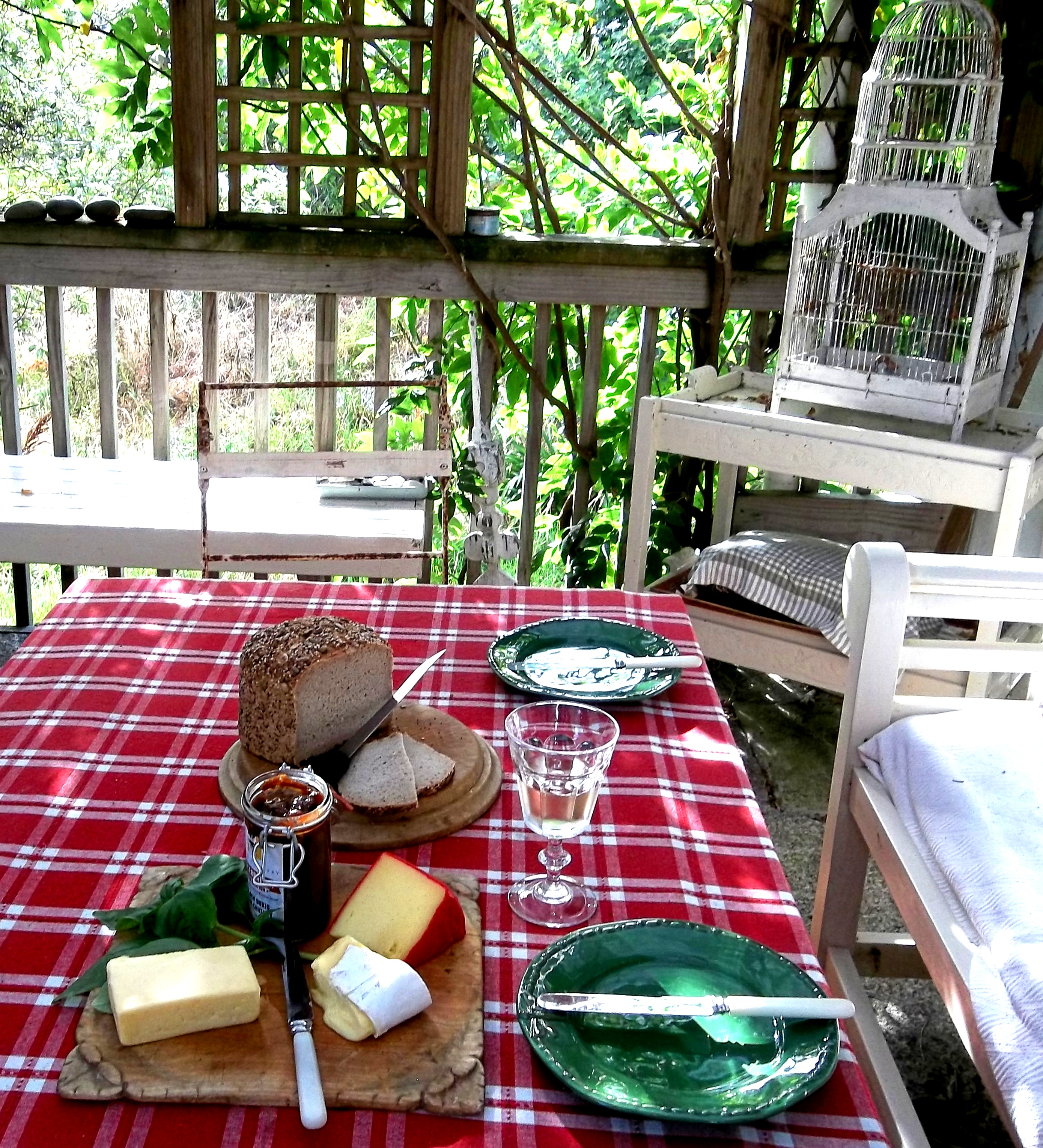
Ah well, Friend and I have been at it again. Meeting to have a glass of wine to catch up and discuss the mechanics of hiring chairs glasses etc etc for an eightieth birthday party she’s organising, we take to heart the dictum of always having something to eat with the wine. We’ve discovered a wonderful new spread to eat with a small chunk of roll.Roast a couple of aubergines, and scrape out the flesh into a blender. Pour in a cup of cashew nuts, ground coriander and ground ginger powder to taste, the juice of a lime or a lemon, and salt to taste. Whizz this into a thick textured paste and enjoy with relish and some bread or biscuits!

Food for Thought

A grace found in an old book of recipes…

Lord, forgive us that we feast while others starve.

Bishop Charles Gore at a banquet


73 Comments

Filed under Uncategorized

Time for a tea-break

100_0266I have kept my blogging vows: to write regularly, for better or worse – (you be the judge),   for richer for poorer – (mostly poorer), in sickness – (sometimes) and in health, till circumstances do us part.

But recently I’ve let the other half of my blogging commitment slip – the agreement to read and follow and like and comment. Circumstances have been squeezing me, so that I’ve been lagging guiltily behind on this part of the blogging commitment.

So, it feels like time for a tea-break. Thanks to Clanmother recommending the fascinating book: ‘For all the Tea in China’, after reading my blog on tea – I now know I couldn’t make a healthier choice. Apparently wherever tea drinking caught on, those societies became healthier- they were boiling their water for the tea, and didn’t have to slake their thirst with polluted water, beer or wine.

So they remained sober, and sustained by calories in the cheap sugar from the Colonies, and protein in the milk for their tea! It’s even suggested that tea-drinking societies like the British were fifty years ahead in the Industrial Revolution because the workers were kept alert over their machines, having tea-breaks instead of becoming drowsy or sozzled with another sip of wine or beer. (Over dinner last night, a friend described Italian workers falling off the scaffolding after another sip of wine in the blazing heat as they toiled over Brunelleschi’s Dome – he had wine diluted with water brought up to them to save them the long journey up and down !)

So  here’s to: ‘ the cup that cheers but doth not in-ebriate!’  Lapsang Souchong of course !

The circle of friendship in our blogging world never fails to amaze me and move me, and though technology is what has brought us together, in the end, it’s the written word that’s made it possible. As a writer, I treasure the words of Carl Sagan who said that: ”Writing is perhaps the greatest of human inventions, bringing together people who never knew each other, citizens of different epochs. Books break the shackles of time. A book is proof that humans are capable of working magic.”

For me, it seems that blogging has become the book of life for many of us, the magic of the written word bringing us together in time and space, and showing us how connected we all are. These connections are ties that won’t be broken, even when circumstances, in my case, have dictated a tea-break.

So though this is a break, it is not an ending, and I send to all my dear friends and fellow bloggers, the (Good) witches blessing:

Merry meet, and merry part, and merry meet again!

Food for Thought

Every secret of a writer’s soul, every experience of his life, every quality of his mind, is written large in his works.                             Virginia Woolf 1882 -1941  Great English novelist


89 Comments

Filed under bloggers, great days, The Sound of Water, Thoughts on writing and life, Uncategorized

A is for Dictionary

100_0360There was a framed photograph of me as a toddler on the wall, which just showed my head, with a mop of dark hair, dark eyes, and my neck fading away into nothing. When I was between two and three years old I used to gaze up at it and study it, and wonder when my arms and legs and the rest of me grew.

We lived in a tiny cottage on a farm in deepest Dorset countryside, far away from the bombs. I stood in the soft summer night and watched overloaded hay-wains swaying and creaking down the narrow lane past our cottage, pulled by huge, tired dray horses. Stray wisps of hay were straggled horizontally as the load brushed against the high hawthorn and hazel hedgerows. I could smell the fragrance of the hay, the warm sweet smell of the horses, the honeysuckle in the hedge and the scent of yellow gorse flowers.

On our way to the village shop we passed over an ancient stone bridge. I used to push my head between the balusters encrusted with lichen to watch the emerald green weed rippling in the clear water, until I realised my mother was far ahead with the push chair and I rushed panic-stricken after her. I dreaded going into the shop. Hanging from the ceiling was a flypaper covered in buzzing, screaming, struggling, dying flies. I felt frantic to get away from the noise and carnage.

In those halcyon days before I was four, our mother sang us to sleep in her beautiful voice with lullabies like: ‘Where the bee sucks there suck I, in a cowslip’s bell I lie, there I couch while owls do cry, and on a bat’s back I do fly,’ ‘One fine day,’ from Madame Butterfly, was another, and ‘Cherry ripe, cherry ripe’. The words, even to a small child, were as beautiful as the music.

In the same room as the picture of me sans arms and legs, was an enormous book. It got smaller as I got older.  It was so thick and heavy I couldn’t lift it back then, but it was irresistible. It was covered in maroon coloured morocco, and had fascinating black thumbnail places at the side, and in the front coloured pages with patches of colour, green and blue, and pink (the British Empire I learned later!) These pages I also discovered later, were called maps, and I learned too, that the book was Webster’s Dictionary.

The A’s came straight after the maps, and there-in lay my downfall. I played for hours with this book, and inevitably, since the A’s came after the maps, they got a lot of wear. The pages became torn and dog-eared, wrinkled so as to be un-readable, crumpled, dirty, and scribbled on. Some pages of A’s disappeared altogether.

When my father came back from the war when I was nearly nine and re-claimed his dictionary along with his children, the dictionary became a source of anguish to us all. We were living at Belsen, and grim post-war Germany had no diversions like TV, cinema, or all the other entertainments we take for granted now. So everyone did the crossword, either from the Times or The Daily Telegraph, as it was called back then.

I think there must have been a sweepstake at the officers’ mess, because there was always great competition to get it finished first. If ever phone calls came from the mess – which was actually the Duke of Hanover’s palace – asking my parents – we lived in the Beast of Belsen’s former home  – to quiz me about Alice in Wonderland or The Wind in the Willows, that would set my stepmother off on a frenzied hunt for a previously unrecognised clue.

Then the agony began when my somewhat unknown father wanted to look up a word beginning with ‘A’. He’d pick up the now shrunken dictionary, and start leafing bitterly through those tattered first pages as I watched anxiously. Finally he’d give up in disgust, with the exclamation: “Bloody kids!” and I’d slink guiltily away. He never normally swore, so it seemed all the worse. As the years went by, he said it every time, and as I got older, I finally realised it was a joke, and was able to stop flinching.

I still can’t resist dictionaries, almanacs, encyclopaedias and the like. My step grandfather used to give the family a copy of wonderful Whitaker’s Almanack every year at Christmas, and even now if I see an old copy in a second hand book-shop I’ll buy it… and read up about the scientific discoveries for that year, symptoms of every disease, orders of precedence in the English peerage, major architectural triumphs for that year, politics in outer Mongolia and what the stars have to say – astronomy, not astrology – amongst other pieces of useless but fascinating information.

 Sadly, we gave away the thirty well loved and well travelled volumes of Encyclopaedia Brittanica last year to a boy’s school which needed some reference books. With all the glories of Google at our disposal, we never opened those heavy volumes with tiny print any more. I even bought my own thick copy of Webster’s years ago, but we never even use that now – the Concise Oxford is easier to handle, as well as Google.

All this came back to me as I tried to piece together a talk I’ve been asked to give about books to a local retired professionals club. I’ve dodged them for years, but have no more excuses left to fob them off with. So now I have to settle down to the hard work of talking, instead of the fun of writing – especially about books! How shall I start – “The A’s have it – dabbling in a dictionary – or what to give a three year old to read?”


Food for Threadbare Gourmets

Gallivanta asked me what pink pudding is…since I gave this recipe over a year ago, I’ll repeat it now for others who’ve missed out on a real treat! I found it over forty years ago in an old Vogue Living, and it’s been a favourite ever since. All you need if half a pint of cream, the same amount of plain or strawberry/ raspberry yogurt, and a tin of boysenberries or raspberries.

Drain the juice from the berries. I don’t use frozen, as they get watery and spoil the dish. Whip the cream until thick, fold the yogurt and fruit in, add caster sugar to taste, and chill in the fridge. You can melt some marshmallows in some of the fruit juice to make a firmer pudding, but we like all natural ingredients. Serve in a big glass dish with a rose in the middle or in individual glass dishes with a tiny hearts-ease flower to pretty it. Good shortbread is nice served with it.

Food for Thought

If souls were compared to moving vehicles, an unforgiving soul could be seen as a dump truck with tin cans dragging off the backside. Clatter, clatter, clang, clang!! If you listen you can hear them coming.               from ‘Love Without End. Jesus Speaks’, by Glenda Green


52 Comments

Filed under books, cookery/recipes, great days, humour, life/style, literature, The Sound of Water, Thoughts on writing and life, Uncategorized

We’re all born brainy !

100_0108When Catherine Windsor aka Kate Middleton drove away from hospital the other week with her day old baby she did an interesting thing. She waved to the ecstatic crowds with her left hand, but her right hand was resting gently on the baby’s stomach as he lay in his car seat for the first time in his short life. She was so tuned in to her baby that she knew instinctively not to let go physical contact with him, but to re-assure him with her touch. It was rather beautiful, and I wished that all babies could have had that gentle bonding with their parents, meaning I wished that all babies could be secure and happy!

I find it incredible that we all, from day one, possess nearly all the neurons in the brain that we will ever have – nerve cells to you and me – even though most are not yet connected in networks. And this connecting process is so rapid in the first year, that by twelve months, the baby’s brain is close to the adult brain. Sound, sight, touch, taste and smell are the senses through which from birth to one year we learn about the world, usually through playing.

From eighteen months to three years, when the brain is at its most active, children are like sponges, soaking up words, information and new skills. It’s amazing to me that between the ages of eighteen months and three, the toddler’s brain is twice as active as the adult brain.

And this is also when the structures of the brain that are sensitive to language and social-emotional responses develop, while motor development, or physical skills are developing at a rapid pace too.

When we actually look at what babies learn to do in those first few years of life, the range of skills, physical, mental and emotional is awe-inspiring. By the time children reach three to six years, they enter the fastest growth period for the frontal lobe networks, including emotional development, speed of processing, memory and problem solving. By six years, the brain is at ninety per cent of its adult weight.

And at the same time babies are learning how to be people! Modern research has shown that when babies are happy, talked to, sung to, cuddled, included, and have lots of eye contact, what are known in neuropsychology as the “ the hormones of loving connection” nourish the brain and stimulate the growth of connections in the regions of the brain to do with emotions. The simple things that loving parents do with their babies, help them to grow into considerate, loving and confident people from the very beginning.

This nourishment for the emotional centres of the growing brains makes babies feel secure and happy, and means they tend to be more independent, confident, more resilient, empathetic and caring. Babies who are comforted when they’re upset, grow up knowing that nothing is really a disaster, so they are the ones who don’t panic or go into despair when things go wrong.

Because they learned when they were little that everything passes, they can cope. Adults who didn’t get this sort of  supportive parenting tend to re-act to stress with behaviour like flying off the handle, losing their temper, blaming other people, or going into despair and depression -because they grew up with a lot of fear and no faith that life would support them.

Researchers now know that when a baby is left to cry, cortisol levels rise in the brain. If the baby is lovingly comforted after a stressful incident, the body absorbs the excess cortisol. But if the stress happens regularly the cortisol levels remain high and become toxic to the brain cells. Cortisol can cause damage to the emotional centres of the brain, and if this happens regularly children grow up prone to anxiety, anger and depression. The old advice to leave a baby to cry has meant many insecure and sad children, and sometimes, angry violent adults.

Enlightened child experts now feel that this deprivation of loving attention, comfort and understanding of a baby is responsible for many problems in older children – problems ranging from ADHD, depression, panic attacks, phobias, eating disorders, anxiety and substance abuse. So children and young adults with these problems are not innately troublesome or born with a pre-disposition to these problems. They simply didn’t get enough emotional food for the brain – those hormones of loving connection.

I researched this stuff for an article in a parenting magazine I write for. It blew me away to realise what intelligence and potential are already contained within those tiny wizened little day-old babies. It’s so easy to think that just because they can’t talk or communicate with us yet, that they don’t have the thoughts and feelings that research shows us they do. Maybe it’s we who need to work on our communication skills, rather than the babies, who seem to be doing huge amounts of unseen work and learning while we change their nappies and feed them and put them to sleep.

They are so hard-wired to learn and absorb and connect with our world, that as long as we cuddle and talk and sing to them, they seem to do most of the work themselves. Babies are such miracles of complexity and potential, and each single one, wherever it is born in the world, has all this potential and complexity. And yet at this moment we all know too, that only some babies will have the chance to become who they were born to be.

Food for Threadbare Gourmets

When I want to spoil my grandchildren – and that is all the time – I make them their favourite pudding. For one it’s chocolate mousse, for another a family favourite we call pink pudding, and for everyone – a lemon meringue tart.

I usually make the pastry case ahead, so all there is to do later is to squeeze two lemons and make up their juice to half a pint with water. Use some of the liquid to mix with an ounce of cornflour, and boil the rest before stirring it on the cornflour mixture. In a pan, boil it for three minutes, then stir in an ounce of butter, an ounce of sugar and the grated rind from the two lemons. Cool slightly, add three egg yolks and pour this mixture into the tart case. Bake in a moderate oven for about 25 minutes or until set.

Whisk the egg whites until stiff, gently fold in three ounces of castor sugar, and pile onto the lemon tart. Dredge with castor sugar and return to a cool oven until the meringue is set and slightly browned.

 Food for thought

If you have not often felt the joy of doing a kind act, you have neglected much, and most of all yourself.   Anonymous


76 Comments

Filed under babies, consciousness, cookery/recipes, family, great days, happiness, human potential, The Sound of Water, Thoughts on writing and life, Uncategorized

The nuts and bolts of writing

100_0100The man who tried to teach me to write was a very patrician academic, who wrote book reviews for The Times and was also an army officer. He was my charismatic headmaster at boarding school in Malaya, tall, elegant, witty and charming. School was in the cool of the Cameron Highlands, surrounded by jungle which hid both the aborigine Sakai people, and also the communist bandits.

 We travelled to school in what were known as coffins, and they felt like it. They were metal boxes on wheels with tiny slits to let in the stifling tropical air. This convoy of coffins was escorted by armoured cars between each one. It usually took me two days to get to school, flying out by a light Auster plane from Kota Bahru to Bangkok, via a change at a lonely air-strip at Alor Star. In Bangkok I changed planes for Kuala Lumpur. Here I spent the night and joined everyone else for the train journey up to the rendezvous with the coffins. We then had another six hours of tough travel before reaching the Highlands in the evening.

 We never knew the date of the beginning or end of term until the day before, so the bandits couldn’t ambush us. We children didn’t worry terribly. We might have felt differently had we realised that our school food was so awful because the cooks were giving our rations to the bandits surrounding us in the jungle. I learned this from the headmaster some years after I’d left school, by which time they’d uncovered the problem. Every night the school was patrolled by armed guards, but somehow I never really believed the bandits could be so close. In hindsight, the fact that they were depending on our food was our best protection! I lost half a stone every term.

 Robin, my headmaster, decided that the new A level exams which had been introduced a couple of years before, were a challenge that he and I could rise to, and that he would coach me to pass them in one year instead of two. This was a stretch, but I had a one- on-one lesson with him most days.

 I would sit side by side with him at a table in the school library while he neurotically smoked his way through a round tin of fifty cigarettes, lighting each one, taking a few puffs and then stubbing out three quarters of the cigarette before lighting up the next. He, like so many army officers I knew then, was still suffering from the effects of the war, only in those days there was no counselling or understanding of their trauma.

 I quickly discovered that I was a sloppy thinker, with very little idea of how to write. This uncomfortable realisation hit me after my first essay, when I referred to ‘the naked truth’. Robin ( I learned to call him this later) made me look up the meaning of the word ‘naked’ in the dictionary, and it was a lesson I never needed to learn again – to make sure I actually knew the meaning of a word before I used it, and forget about clichés !

 He taught me to write short simple sentences, to use short Anglo –Saxon words, and not pompous, pretentious Latin words. He’d say chuck instead of throw, and taught me to write direct simple prose… though you may not believe this now. He also tried to teach me to think for myself, and once when I had written an obsequious essay on Anthony and Cleopatra, he teasingly wrote at the bottom: “Beware too slavish an adulation of the Bard!”

 The best training he gave me was to do a précis nearly every day, of a piece of weighty Elizabethan or Restoration prose, reducing each piece to a third of its length. It was a rigorous exercise, which trained me to express meaning in the most efficient and simplest way. It taught me to understand the meaning of words so I could translate them into a simpler briefer version, and sharpened up my whole writing style. Years later, when I was worried about my children’s exam results, and they in their turn were worried about theirs, I found the passages still marked in my battered Oxford Book of English Prose, and gave them all the same exercises, and they worked the same magic for them too.

 And that was it – the nuts and bolts. When I hear or read of people’s experiences with gifted teachers today, I marvel at the creative opportunities they have; but on the other hand, these simple rules he gave me have been a useful scaffolding on which to build a writing life. Yes, I missed out on the metaphors and similes, and creative flights of fancy. I just had simple guide-lines for communicating clearly, with no tiresome tics of speech or writing, no frills or clichés, no worn-out phrases, un-necessary words, purple passages or exhibitionist long words.

 And though we revelled in Shakespeare’s exuberant inventions and plays on words, Robin reminded me that the vocabulary of the exquisite King James Bible is only about eight thousand words.  I learned to write truthfully, and to avoid sentimentality – I think! And this for me, is still the challenge of writing, over half a century later; truth means finding the exact word, no compromises, which means knowing how I truly feel.

 A month before the exams, my best friend and I went for a walk and ended up having afternoon tea of tomato sandwiches – nothing else was ever on offer – at the Cameron Highlands Hotel, a privilege for prefects if, and when, their pocket money would stretch.

 At the hotel my friend saw a young officer she’d met during the holidays, and he and his fellow officer joined us. We had great fun, and then they took us up to inspect their gun emplacements from where they had just started blasting into the jungle. Whether they actually hit any bandit camps I never knew, but the noise was hateful: the sound of crashing broken trees and the thunder of guns echoing around the mountains and blue sky, followed by a moment of horrified silence – the shock of a peaceful world rended by this vandalism – and then the screams and cries of terrified birds.  Then a pause, and then the whole dreadful sequence began over and over again.

 The chaps took us back to school in their land-rover, so we were back in time. As we reported in, and the land-rover drove off, the young duty mistress gave us stick for hobnobbing with the young men… but we thought she was just jealous. It turned out  she was – she had assumed they were her property. She reported us to Robin, and said we had lied about where we were going. We were both stripped of our prefect’s badges and gated for six months by a very angry righteous headmaster who refused to believe that we had not lied.

 The next day, feeling sore and angry, I had my usual lesson with him and was shocked to realise that in our study of Francis Bacon that day, we were about to discuss his essay: ‘ What is truth, saith jesting Pilate?’  As I took in the implications of this horrid coincidence, and waited for the head to arrive in the library, I wanted the floor to swallow me up, cliché or no cliche. His courtesy got us through this embarrassing session…though I was in a state of agonising hyper-sensitivity for the whole hour.

 A few weeks later the exams arrived, and as I sat alone in the classroom with an invigilator, battling through three and a half hours of rigorous examining, the chaps began their artillery barrage into the jungle again (we hadn’t seen or heard of them since). As they fired over our heads, it was like sitting in the trenches of World War One, or enduring the barrage before the Battle of the Somme,

 As I tried to maintain my concentration and keep scribbling, Robin came in silently, took my exam paper, and wrote the time on it, with a note and his signature saying the barrage had begun. When it ended two hours later, he came back in and did the same again. I always hoped that it had influenced the examiners to have pity on me and excuse me any blunders I had made during what felt like the fog of war!

 After I’d left school, and he and I were back in England, I used to visit him and his wife who I loved. He would write me zany poems about kipper trees, and do witty parodies of Shakespeare over the lunch-table. He invited me to meet minor Royalty on a ceremonial occasion and came to my commissioning ceremony. And when I became engaged and brought my first husband to meet him, I felt a faint disappointment from him that I wasn’t going to be putting his lessons to better use.


 Food for Threadbare Gourmets

Such beautiful cauliflowers at the moment, so after running the gamut of my cauliflower recipes, I decided to make soup. This recipe is called Crème du Barry after Louis XV’s mistress, and it’s delicious. You need a cauliflower that weighs about a pound or half a kilo. In some butter I sauted the white part of a chopped leek, half a chopped celery stick and a good sized knob of finely chopped ginger. When this is soft, but not coloured, add small florets of cauliflower. Add a litre of stock, salt, cover and boil until the cauliflower is soft, ten to fifteen minutes.

Puree and return to the pan. Stir about three quarters of a cup of cream or crème fraiche, and season with nutmeg, and a little lemon juice if you wish.

 Food for Thought

Minds are like parachutes. They only function when they are open.

Sir James Dewar, eminent Scottish physicist. 1842 -1923


80 Comments

Filed under army, birds, british soldiers, food, great days, humour, life/style, literature, shakespeare, The Sound of Water, Thoughts on writing and life, Uncategorized

Ancient Rituals and a Modern Valkyrie

100_0117As I write I can hear soft rain falling, punctuated by the larger sounds of drips from overloaded leaves, and the swishing of the sea on the rocks below. The pink-breasted doves are cooing contentedly, bringing a sense of peace– all eleven of them,  who now enjoy two free meals a day. It feels as though the village is in rest and recovery.

 A few days ago a man died just beyond our village boundaries. He was the Maori chief and landowner for this area, and had great mana. He was a noble, handsome man respected by everyone, and had a striking, beautiful Pakeha (European) wife, whose dignity and courage matched his. Their marriage was a triumph; she accepted and lived by the local Maori customs, as well as keeping her own integrity, and creating a life of art and culture, warmth, and hospitality. She introduced visitors to the long, empty, pale gold beaches on their land, edged by the rolling blue Pacific; and she kept a herd of nearly a hundred horses, for tourists and locals to ride. She worked hard the way only those whose lives are committed to the wellbeing of horses will know.

 The chief was buried at the Maori marae, which lies across the harbour from where we live. The marae is the spiritual centre of Maori life, and the tangihanga – the funeral – is the most important ceremonial that takes place there, taking precedence over every other activity. The body lies on the marae for at least two days before the day of the funeral, and is rarely left alone. Friends, family and members of the tribe come from near and far, dressed in black, and the women often wearing green leaves in mourning wreathes around their heads. They look wonderful. They will talk and sing to the person lying there, recalling both good and bad things about them, laughing, joking – all expressions of grief are encouraged and accepted.

 The person who has passéd is commanded to return to the ancestral homelands, Hawaiki,  by way of ‘the spirit’s journey’ –  te rerenga wairua . Close kin do not speak. On the last night, the ‘night of ending’, the pō whakamutunga, the mourners hold a vigil and the coffin is closed. Then either at night or dawn on the third day, the funeral service is conducted, and when the burial rites are complete, a hakati – feast – is served. Everyone who attends brings their share, or gifts called koha.

 And when it’s over, the home of the dead one is ritually cleansed with songs, chants and prayers called a karakia and desanctified with food and drink, in a ceremony called takahi whare – ‘trampling the house’. That night, the pō whakangahau  – ‘night of entertainment’ – is a night of relaxation and rest. And after these powerful and therapeutic rituals  the widow or widower is not left alone for several nights following.

 So when our chiefly neighbour died, mourners travelled from all over the country, including the famous and powerful, to participate in the tangi. The ceremonies on the last day took from ten in the morning to four in the afternoon. At the same time, another villager died. He too was a distinguished man, a Pakeha, but he had no children and no family. He wanted no ceremony or funeral. ‘So we can’t say goodbye,’ sorrowed an old, old friend…

 While this has been going on, I’ve joined for the first time, the annual village winter ritual of having the flu, and as the second week dragged on found myself irritated that I couldn’t even have flu to myself, but had to start nursing my husband as well. Late last night after a second bad fall, I couldn’t move him, so called out the Volunteer Fire Brigade, the local version of guardian angels. It took three of them to get him off the floor, and I then began a chase after the ambulance to hospital an hour’s drive away. Leaving him to be diagnosed and pumped full of drugs, I drove home to bed at three thirty in the morning.

As I made the most of this drama to the statuesque and very beautiful young woman who comes to clean, I asked how her week had gone. Not as exciting as yours, she disclaimed modestly, before regaling me with the story of her horses. She has two. This particular night she had joined friends at a farewell fancy dress party, and worn, she told me, a glittering sequinned body stocking for the first time in her life, accessorised with a net skirt covered in sequins. As the party raged, she received a text saying her horses were loose, and had last been seen galloping in the sea at a nearby village.

After several nerve-racking hours, with reports of them all over the place, she finally ran them to earth in another bay. Abandoning her car, she rode bare – back on one, leading the other by a halter, body stocking glowing in the moonlight, sequins glinting, and net skirt billowing in the wind. ‘I was just glad no police ever clapped eyes on me,’ she said, ‘they’d have thought I was high on something!’

I wish I’d seen her, a magnificent, glowing Valkyrie beneath the shifting clouds and silver moon. As we laughed there was a knock on the door, and there was one of the firemen from last night come to see how I was, one of many others , family, friends, neighbours who’d rung or enquired how we all were.

Life and death, laughter and rain… the village is breathing, the rhythm of the sea encircles us, the in-breath and the out-breath of the universe continues, the heart-beat of life and death still pulses. The ancient rituals ease the transitions, the soft rain cleanses and refreshes; we are in rest and recovery, and the unknown road still stretches mistily ahead for us all. ‘We may not be taken up and transported to our journey’s end, but must travel thither on foot, traversing the whole distance…’ And in this small world we live in, we know we are in good company.

 Food for Threadbare Gourmets

Wanting something light and easy, I found an old recipe for ten minute cheese soufflés. Separate the eggs and yolks of two eggs, and mix the yolks with salt, pepper, a pinch of cayenne and a little mustard. Mix in two dessertsps of grated cheddar cheese, and then fold in gently the whipped egg whites. Fill two thirds of well greased individual soufflé or ovenproof dishes, and bake in a hot oven for six to eight minutes until well risen and golden brown. Serve at once. This amount makes three to four small soufflés. I’m thinking they’d be a nice easy first course for dinner with friends.

Food for Thought

I loved this foodie thought from writer Lawrence Durrell ( 1912 -1990): ‘The whole Mediterranean.. all of it seems to rise in the sour pungent smell of these black olives between the teeth. A taste older than meat, older than wine. A taste as old as cold water.’             Just reading these words makes me feel the heat, smell the scent of thyme and rosemary, and long to savour some strong red local wine beside a lapis lazuli sea….

53 Comments

Filed under cookery/recipes, culture, great days, life and death, life/style, love, The Sound of Water, Thoughts on writing and life, Uncategorized, village life

Not Royal but Remarkable

100_0175The attention of the whole country was focussed on a charming country house set amid quiet leafy lanes. Everyone was waiting for the Royal baby to be born. The Royal mother had gone home to her mother to have her first baby, which would be the Queen’s great grandson. And it would be the first time in history that there had been three generations of heirs to the throne. When the baby was born, he and his mother stayed with their grandmother at White Lodge for another six weeks.

 So many people wanted to congratulate Princess May, who later became Queen Mary, that a marquee was set up on the lawn for hundreds of people to sign the visitors’ book. Queen Victoria came over from Windsor to see the baby, bringing her grand-daughter Alex, and her fiancée- soon to become last Tsar and Tsarina of Russia and eventually meet their fate at Ekaterinburg.

 History repeats itself. A hundred and nineteen years later, another mother- to- be and baby are keeping everyone waiting.  Catherine, Duchess of Cambridge is going home to her mother’s country home for six weeks, and her baby is also the third in line to the throne. But her baby is the lucky one, whatever lies ahead. And this baby’s great grandmother, Queen Elizabeth, is also awaiting news of the birth at Windsor.

 The baby born to Princess May was David, better known as Edward V111, the only king to have abdicated. His mother was not a natural mother, and left him to his nanny. She used to pinch the baby before he came into the room in the evening to see his parents, so he entered, crying, and was hastily sent back in disgrace to his nanny. When he was three this woman had a nervous breakdown, and it was discovered that she had not had a day off in three years.

 The next generation was this Queen, and her mother used her own old nanny – Alah, who gave the Queen and Princess Margaret a happy tranquil childhood. This was not the case for the Queens’ children, who had a fierce old dragon to look after them. Like all the Royal children before them, except for Queen Alexandra’s, Charles and his brothers and sisters too only saw their mother for an hour before bed-time, and for a short time in the morning. Someone who knew the Queen well has commented that if she had given her children the same time and attention she had given to her horses, things might have turned out differently.

 We all know that Charles’ wife Diana was a devoted mother. But she was back at work within two months carrying out Royal duties, leaving William in the care of his nanny Barbara Barnes. He adored her, and one day after Diana found him cuddled up in bed in the morning with his nanny, she couldn’t cope with this competition so Barbara Barnes left when he was four…  a huge emotional blow for him.

 So his decision and his wife’s to manage without a nanny is a huge breakthrough in the pattern of Royal maternal and emotional deprivation! Catherine – as she is known in her family rather than the media’s Kate – is the daughter of a devoted hands- on mother. Carol Middleton has endured many slights for her humble background as a working- class builder’s daughter, and as an upwardly mobile air hostess.

 But the slim, elegant figure in pale blue who arrived at Westminster Abbey for her daughter’s wedding is a remarkable woman. When her children went to Marlborough other parents said they just gave up – they couldn’t cope with the care that she gave her children right down the beautifully embroidered and hand sewn Cash’s name-tapes on their clothes. We all had these name tapes in my day, but most people use indelible marking pencils these days. She didn’t just give her own children hampers of tuck food, but also supplied a girl from a broken home with a hamper too.

 When her flamboyant younger brother who she had always mothered, was set up by the press for a drug sting, rather than belabour him for the bad publicity, she rang and apologised that because of their public profile with Kate, he had been targeted. She’s kind, sensible and conscientious.

 And as everyone knows she is the creator and driving force behind the thriving business which supports their now rich life-style. When Catherine was born, her mother devised a little business from her kitchen table so that she could stay at home with the children. From this grew their party-bags empire.

 William spends much time in her home with great enjoyment, savouring the tight-knit family and loving informality he never knew. Carole Middleton sounds as though she’ll be the perfect grandmother – always there, experienced, loving, and well-adjusted. So this baby, born in the green English country-side will have all the good fairies ranged on his/her side, and people watchers and royalty fans will have a new and intriguing family saga to watch.

 And the builder’s daughter born in a council house, brought up by working class parents with the values of hard work, thrift and good manners will be the the most important maker and shaper of a modern king or queen – if the monarchy lasts for another fifty years.

 Walter Bagehot, the Victorian authority on Royalty famously wrote that a ‘Princely marriage is the brilliant edition of a universal fact”, and the birth of a new prince or princess to a couple who we’ve followed with various degrees of interest for years is magnified also. To see Diana’s son emerge from all his childhood traumas to become a father in his own right is of immense interest to many of us, monarchists or not… there’s something irresistible about watching glamour and goodness combined with history, high fashion, drama and domesticity. And this is where Carole Middleton- grandmother- waiting, steps onto the stage to join the other players !


Food for Threadbare Gourmets

 I get bored with bread ! So sometimes I make something else to go with bread and cheese – this is a courgette loaf, good with soft blue cheese, or even just good old Cheddar. Mix two cups of SR flour with one cup of grated courgette/zucchini, half a teasp salt, one teasp mild curry powder, and a cup of grated cheese like Cheddar.  Add a quarter of a cup of oil, one egg and one and three quarters of a cup of milk.

 Lightly mix and tip into a greased loaf tin. Sprinkle the top with grated cheese and bake in a hot oven for forty minutes or so until brown. Switch the oven down after ten to fifteen minutes if it starts to brown too quickly. Serve warm with butter and cheese for a tasty supper…

 Food for Thought

 The feminine principle is the eagerness to collaborate rather than compete, it is the eagerness to relate rather than stand out as an individual, it is the longing for harmony and community and caring and nurturing.

 Lynne Twist –  Global activist, fundraiser, speaker, consultant, coach and author. Dedicated to global initiatives that serve humanity.


52 Comments

Filed under cookery/recipes, family, food, happiness, history, kate and pippa middleton, life/style, princess diana, Queen Elizabeth, Royals, The Sound of Water, Thoughts on writing and life, Uncategorized

A Winding Path or the Dance of Life?

100_0221I’m an unashamed veteran of every whacky new age activity that has ever been available. Some of them are reputable, and some have a reputation for what is known as new age mush – a description which is usually wholly accurate!

The first steps along this eccentric path were taken at a little village fete just outside Stratford- on -Avon. I was detailed, as they say in the army, to look after the guests of honour, actor Sir John Mills and his daughter Juliet – I can’t remember why at this distance, and when I had done my duty I wandered off in my dark green uniform to the fortune- telling tent. The gypsy had a crystal ball, and I didn’t think she needed one to tell that I was in the army. But what she said was that my hands were the hands of a writer and I would spend my whole life writing. As a twenty- one year old lieutenant this was a surprise and seemed unlikely to me – like reaching for the moon.

The next significant step along the road less-travelled was when a friend told me that her stepmother could read tea-leaves! This seemed so really off the planet, that I really wanted to experience it, and it so happened that her stepmother was going to be changing planes at Heathrow, on the way from Bonn where her father was stationed,  to Ireland where their family home had been burned down by the IRA.

We met the stepmother, and rushed off to get cups of tea. But at places like air-ports you don’t have tea-pots. You have huge urns with made-up tea. We explained to the waitress that we really needed tea-leaves and she obligingly scraped the bottom of the urn and tipped a handful of leaves plus some tea into three cups for us. We had a very successful tea-leaf session, and as time went by I saw the various events she’d foretold, unfold.

At the Derby a couple of years later, my first husband mischievously asked an ancient gypsy crone who was going to win the Derby? She went into a trance and kept muttering mysteriously:“Where d’you come from, where d’you come from?” which we dismissed as gibberish. We came from Larkhill actually, and twenty minutes later an outsider, Larkspur, won the Derby.

Marriage, babies, career, all these kept me distracted from esoteric pursuits until the children had left home. And then I became involved in helping to set up a group who ran self-transformation courses ranging from a week to six months. I did every one. It took about seven years of my life. And along the way I began dabbling and experimenting with every other form of New Age activity that offered itself – and have done ever since.

They ranged in alphabetical order from acupuncture, aromatherapy and aura- soma to breath-work, body talk, body harmony and Bowen work. There was chiropractise, channelling, chakra cleansing, cranial osteopathy, flotation tanks and Feldenkrais.  There was holotropic breathing, homeopathy and hypnotherapy, kinesiology, massage, minimum movement, sitting in a pyramid to ease the pain of a chronic illness, psycho-therapy and breath-work to cure it, re-birthing, Reiki, Shiatsu, Tai chi…. I know this isn’t all…. I’m sure there’s more!  There was The Journey, The Enneagram, NSA,( Neuro Spinal Adjustment ) Spiritual Geometry, various Indian groups teaching breath and meditation, and yoga of course.

Then there were the courses with people like Zondra Ray and Jean Houston and Denise Linn,  lectures from Dipak Chopra, Wayne Dyer, Stuart Wilde, the Dalai Lama. The books – beginning with Sir George Trevelyan’s ‘A Vision of the Aquarian Age’ and the New Age bible, Marilyn Fergusson’s  ‘ The Aquarian Conspiracy ‘, going on with  Barbara Anne Brennan and Caroline Myss,  Marianne Williamson and Jean Shinoda Bolen’s ‘The Goddesses in Everywoman’. There was ‘The Feminine Face of God’ and Eckhart Tolle and ‘Conversations with God’ and our philosopher and guide to the consciousness evolution, Ken Wilbur, among a host of others we read.

There were years with Self-transformation, years learning about herbs and nutrition, and others. There were Shiatsu courses, Reiki courses, re-incarnation courses, counselling courses; the cleanses and the retreats; meditation, Tibetan chanting, circle dancing – the thing I loved best of all – then there were diets, the Pritikin, the Zone, the Blood Type diet, the Sandra Cabot Liver Cleanse… we were suckers for them all. And the fun fringe, the palmistry, the crystals, the tarot cards, the angel cards, the I Ching – hmm, not so much fun – very severe and serious.

You’ll be surprised to learn that I haven’t done colonic irrigation, Rolfing, sweat lodges or vision quests. I’ve listened to various gurus including the startlingly beautiful Gurumayi.  But I never wanted a guru. So I gave Rajneesh and Sai Baba and Da Free John in his various guises a wide berth.

None of this came cheaply… In the thirty years since I began this career of New Age dissipation I’ve sold old silver, precious rugs, loved china to finance my expensive hobby… I’m an object of ridicule to some members of my family, though not to those closest to me,  I’m glad to say. They also dabble sometimes. Not my husband, who calls me, with some justification, a New Age Nutter.

The others wonder why on earth I do all this… surely one course is enough to discover the secret of life, sort out old personality quirks, learn who and what you are? Why would you want to meditate when you can take Mogadon? And why on earth would I want to buy vitamins and herbs when I could have Prozac and statins, blood pressure pills and flu injections for free! The proof of the pudding is in the eating. I have none of the health problems the others have, and when I had to have a medical this morning for a new driving license the doctor said I was amazing.

So apart from good health, what else did I get out of all this seeking and experimenting? Lots of good friends, on the same path, for one. I have several friends who’ve been on nearly every course with me for the last thirty years. These friendships go deep. And as we’ve let go lots of old tensions, energy blocks and limiting beliefs, life has become easier, more fulfilling. Troubles come, as they do to everyone on earth, but we see them now as flags waving to show us something we haven’t mastered yet. Like many when I first began, it was like rowing across a river, and looking back to the other side, realising there was no way back, no way to go back to thinking the way I had. That from now on, life would be different.

I sometimes think all these activities, books, fads, are like tourist souvenir booths at places like NASA. They keep us amused and busy. The courses are like a conducted tour of the space programme, showing us how things work.  But none of these things take us into space. They can show us what it’s like, but to explore space, we have to do it ourselves. And all the crystals and courses and mushy wallpaper music make outsiders assume that this is all the New Age is about. When really, it’s a rocket taking off to explore and experience the furthest reaches of consciousness. Going, in that old cliché, where no man has gone before – except the mystics. But travellers in these realms feel that this is the next big step for all mankind.

And there are now millions of people all over the world on this journey – ripe and ready – they only needed a nudge, unlike all our exploring. They are, in the words of Arjuna Ardagh, ‘No longer willing to separate spiritual experience from the fabric of our everyday existence. Our most mundane circumstances are the very context in which realisation lives and breathes. An unattended life segregates realisation into a small box called “spirituality.” A well- attended life can make a trip to the grocery store a sacred pilgrimage.’

So did we need to do all that stuff?  Maybe not, but we enjoyed it, learned to love the present, and love creation and all that is, had many moments of insight and bliss, discovered a lot about ourselves and others, and became happier, more relaxed parents, partners and people. If life is a dance, that was our dance. And the more I experience the cosmos, the more I realise it is all a dance, a dance of galaxies and grains of sand, a dance of asteroids and atoms, a dance of energy and ecstasy, a dance of light and love, a dance of you and me.

Food for Threadbare Gourmets

Family coming for lunch in this freezing weather, so a good hot pudding seems to be called for… blackberry and apple crumble. I’ll be using a tin of boysenberries or fresh frozen if I have any in the deep freeze, with stewed apple, gently mixed together. The crumble is rich – eight ounces of flour, two of ground almonds, six ounces of brown sugar and four of butter. Rub the butter into the flour, add the sugar and almonds, and at this stage I often add the grated rind of a lemon. This mixture keeps in the fridge for a couple of days until I want to use it. Put the fruit in an ovenproof dish, cover with the crumble and bake in a hot oven for forty minutes. Serve with cream or crème fraiche.

( Boysenberries are a cross between a raspberry, a blackberry and a loganberry. They were first bred in California by a man called Mr Boysen..)

Food for Thought

Will the old dinosaur minds draw us all into their conflicts, destroying life as we know it in the process, or will the emerging translucent view midwife us into another way of loving? In the translucent vision of the world there is no other, no enemy. It is a political view that encompasses the well-being of all sentient beings, not just of one group or another. Either we all win or we all lose.

Arjuna Ardagh  – teacher  and writer of ‘The Translucent Revolution,’ a book which has become the equivalent of Marilyn Fergusson’s ‘The Aquarian Conspiracy’ for the 21 century.


64 Comments

Filed under consciousness, cookery/recipes, great days, happiness, human potential, humour, life/style, love, philosophy, spiritual, The Sound of Water, Thoughts on writing and life, Uncategorized

The real Dalai Lama


100_0314That Christmas, when they were seven and eight, I had sent the children to the other side of the world to see their father and grand-parents. Instead of cancelling their daily treat of chocolate milk, I gave it to the children who lived around the corner with their single mother and cat called Mehitabel.

I lived in a big old white verandahed house next door to a park, and sometimes when I looked out of the window I would see them trailing dispiritedly past in single file, mother in front, and three small scruffy children aged seven downwards, straggling behind her, followed closely by the cat.

One warm summer night, the eldest, my son’s friend, with the unfortunate name of Ezekiel, came rushing into my flat, and said: “Mum says ring for the ambulance!” I did, and a few minutes later he was back, saying: “Mum says cancel the ambulance. The police might come too. She wants you to come. “

As we ran I tried to find out what had happened. His father was a drug addict, who had recently, according to my horrified son, “stomped” his mother in law when he was high. As we hurried towards the house, I worried that I might get stomped too. When I got there, Melanie was waiting. At the door-step I had to step over the cat Mehitabel who’d been speyed that day and was mewling in pain, while at the same time her kittens were clamouring for milk. Not a good start. My heart sank. The smells and the squalor turned my stomach.

Melanie whispered to me in terror that the ex-husband had taken an overdose, and because he was on a methadone recovery programme was furious when he realised she’d ordered an ambulance, as it could get him into trouble with the police and wreck his programme.“He’s just coming to now,” she agonised, “and I don’t know what to do.”Neither did I.

I could hear heavy dragging footsteps moving across the uncarpeted wooden floor overhead. All the family cowered, and I stood in the hall facing the stairway with them behind me, as a tall heavy man lurched round the bend in the wooden stairs. To my astonishment, as though I was at an English garden party, I smiled, stepped towards him, stuck out my hand to shake his, and heard myself say: “How d’you do, we haven’t met, I’m Valerie …”

His blank blue eyes focussed, he took my hand, returned the greetings, and a sigh seemed to emanate from the three small children and his wife holding their breath. We discussed the cats, let a few other polite nothings pass between us, and with everything seeming to be quiet and normal, I left.  And shortly after, he did. In the years that have passed I’ve often thought about this unconscious knee-jerk conditioning which was so banal and mundane that it lowered the temperature immediately. Would I do it differently now that I’m older and more conscious?

Ten years later when I was doing hard labour on a consciousness – raising  course in Australia – with nearly a hundred others – one of the charges laid against me by the course leader was that I was gracious! He said it stopped me being real, and was a defence mechanism that didn’t serve me. I didn’t get it then, and neither did some others who came up to me afterwards, and told me they liked me the way I was. But as time went by, I did get to see what he meant about avoidance and being real, and also to understand at a deep level, the truth of these well-known, lovely lines from Margery Williams’ classic, ‘The Velveteen Rabbit.’

“Real isn’t how you are made,’ said the Skin Horse. ‘It’s a thing that happens to you ….
‘Does it hurt?’ asked the Rabbit.
‘Sometimes,’ said the Skin Horse, for he was always truthful. ‘When you are Real you don’t mind being hurt.’
‘Does it happen all at once, like being wound up,’ he asked, ‘or bit by bit?’

‘It doesn’t happen all at once,’ said the Skin Horse. ‘You become. It takes a long time. That’s why it doesn’t happen often to people who break easily, or have sharp edges, or who have to be carefully kept. Generally, by the time you are Real, most of your hair has been loved off, and your eyes drop out and you get loose in the joints and very shabby. But these things don’t matter at all, because once you are Real you can’t be ugly, except to people who don’t understand.”

Being real to me, is about having the courage to be honest, never hiding who we are, never being ashamed of anything we are, accepting who we are  – and most important of all – being vulnerable. When we’re vulnerable we don’t fear being hurt, but know that great gifts can come out of risking ourselves. And somehow when we are real and therefore honest about our feelings, others can respond at that level of vulnerability and truth.

Being vulnerable is about having an open heart, and being available to both spontaneous joy and un-regretted sorrow. There’s a freedom when we start being real, we dare to be adventurous in spirit, and calm and confident in adversity. We don’t have regrets, because we know that there are no wrong paths. “Paths are made by walking,” as the Spanish poet Antonio Machado wrote.

One of the most real stories I’ve heard is about the Dalai Lama, who has never been anything but authentic, honest, wise, and now – I realise – vulnerable, spontaneous and real! A friend had spent the weekend with him (and a thousand others), studying Tibetan scriptures. The Dalai Lama read them aloud in Tibetan, and then someone else translated them into English, and he discussed them.

At the end of the second day, when they had reached the end of the programme, he held up the book, and said to his hearers something like: if you found this useful or enlightening, then you can read it every day.

“If not,” he twinkled, with his wide wise smile, “Fuck it,” and threw the book over his shoulder! There was a moment of disbelieving silence, and then everyone roared with delighted laughter.

Food for Threadbare Gourmets

I’ve been battling with the damage the dentist inadvertently did to two good teeth some weeks ago, and am now about to have two root canals, so I’m eating ‘soft’ food. Yesterday I remembered a dish we used to call: ‘convent eggs.’ It’s comfort food – creamy mashed potatoes, and hard- boiled eggs covered with cheese sauce – simple, cheap and easy. When mashing the potatoes I pour cream or milk into the pan with drained potatoes, and as soon as it bubbles I take it off the heat, and mash with lots of butter, salt and pepper. At the end I quickly beat the potatoes with a wooden spoon to make them fluffy. Put the potatoes on a warmed plate, cut the hard -boiled eggs in half and press into the potatoes, then pour the cheese sauce over. That’s the quickest way. But the same layers placed in an ovenproof dish, and grilled until brown adds a dimension of crunch and taste.

Food for Thought

Absurdity is a very powerful tool for waking up. A good situation comedy is a wonderful Buddhist teaching, because it’s a parody of suffering. The cause of suffering is attachment to outcome, attachment to income, attachment to the world being a certain way.

Steve Bhaerman – Swami Beyondanandal – the Cosmic Comic

81 Comments

Filed under addictions, cookery/recipes, great days, human potential, life/style, philosophy, spiritual, The Sound of Water, Thoughts on writing and life, Uncategorized

Places in the Heart

100_0223The printed word has a lot to answer for and has changed the course of many lives.

On this occasion when it changed mine, I was cursorily scanning the personal columns of the Daily Telegraph looking for somewhere to live. My husband was away with his regiment on manoeuvres or practise camp, and I was filling in the trying gap between the baby’s ten o’clock and two o’clock feed.

We had to find somewhere to live for a year, and this night I found a few lines offering a country house in the right area for nearly the right price – for a year. The next day I rang. The owner was delighted – he was off to Greenwich Naval College and wanted someone to keep his house warm. “Chudor, ya’ know,” he told me, listing the bedrooms… We arranged a time that weekend to inspect the place, and when my husband returned the next day he went off on what he called a recce. He came back looking rather panic-stricken. “It’s bigger than Hampton Court,” he said, “and looks like it too, all red brick.”  Undaunted, I persevered, rather fancying the idea of a stately home. We’d never be able to heat it, he argued, and then I saw the light – with an eighteen month old and a four month old, that mattered.

So I returned to the personal columns, and struck gold a week later. “This one sounds OK”, I said,” right area, right rent, and only five bedrooms” (my ideas had expanded considerably since my brush with Layer Marney Towers the previous week). I rang the owner – same story – wanted someone to live in it for a year, this time while he wound up his boat building business in East Anglia. “You’ll love it,” he said, “there’s the garden bedroom, the oak bedroom, the red bedroom, the four poster bedroom, and the end bedroom…” My husband panicked again.

But a few days later we set off on a light June evening driving through quiet Essex lanes, with honeysuckle and dog roses winding in among the high hazel, hawthorn and elderberry hedges. We found Newney Hall dreaming between fields and hedgerows, a small lake – which in the twilight was almost black, and edged with a tangle of lilacs and shrubs – lying between it and the road. The house, Tudor red brick, and Essex pantiles on the upper floor with casement windows, stretched beyond the lake, reaching into a circular lawn with a cedar in the middle. Beyond that, a walled orchard.

As we walked down the gravel drive I could hear the sounds of music coming from the house. A knock on the door revealed a rather vague looking woman with a viola tucked under one arm, and the bow held in her other, as though she could hardly bear to stop between bars to open the door. “George!” she called imperiously, and the seigneur hurried to welcome us. Within minutes the deal was done, and we moved in a week or so later.

The house had been built in the time of Edward the Sixth, Henry the Eighth’s son, and all the land around had been gifted to Wadham College, Oxford in the same reign, so nothing in the landscape had changed for over four hundred years. The fields and trees, lanes and barns were untouched by time, and since there was no sound of traffic, no jet planes practising, and only occasionally the sound of a distant tractor, the whole place lay wrapped in an almost primeval peace. There was no other house in sight.

Wood pigeons cooed incessantly somewhere in the trees, cocooning us in their summer sounds, the donkey in the next field brayed occasionally, the cows mooed as they shambled past to the milking shed at the farm beyond the house. The old red-tiled barns, grain sheds on staddle stones, and stables were laid out around a square, where the cows sheltered in winter. I walked across to the cow- shed every day with a baby on my hip, my eighteen month old trotting beside me, and carrying a big cream- ware jug to collect my fresh milk. We also went there to pick up new-laid eggs from the farmer.

The house was built from huge beams, and filled in between them with a mixture of mud and straw. They were plastered over, and the walls were about three feet thick, with deep window ledges where I put books and vases of flowers. Two old aunts had been living in the house before expiring and gifting it to George. In the mid-sixties they were over ninety, and the house was unchanged since the days when they had been born back in the 1870’s. So was the dust. When I moved an antique chest of drawers to dust behind it, a thrush disintegrated into fine powder.

I spring cleaned from top to bottom, washed curtains, scrubbed floors, polished Sheraton  tables and dusted Chippendale chairs. It was like living in a time warp. No heating, a gas stove so old I’d never seen one like it, and neither had the serviceman when he came. If it’s working, best leave it, he said, shaking his head. I had a big kitchen with a big square scrubbed table in the middle, red and white checked tile floor which needed scrubbing every week, and a real larder with marble slab. My only gadgets a pop-up toaster and a wooden spoon!

At weekends a stream of friends came through, a childhood friend getting used to having MS, school friends with their babies and husbands, army friends with theirs, a friend of my husband, shell- shocked after being court- martialled – a Polish/ French student who had nowhere to go, a girl who was pregnant and needed somewhere to stay – she moved on, didn’t like my food, I think – cousins, godparents, in-laws, family… and then back to primeval peace during the week.

Once I dumped his steak and kidney pudding and vegetables on my husband’s head. Mistake. Apart from reprisals, lots of cleaning up to do. And later, I lay in the long sweet smelling grass in the orchard, where I’d seen the red fox glide through, and cried my eyes out under the late evening summer sky. At twenty six I thought no-one would ever love me again.

Not long after, we left that beautiful house to go to Hongkong, where the hectic life and chaos of those times obliterated the memories of that year in the country. But for years I have dreamt of it. In my dreams it’s bigger, and there are many more rooms. The furniture is more elegant and the rooms more beautiful. There is one room which is filled with such treasures that I only go into it sometimes… it feels sacred. I have no idea why I dream so often of this house I lived in for a short year so long ago. I don’t know what it symbolizes. I’ve lived in other houses and places just as magical…  no doubt a psychologist would mine some profound Jungian theory from these dreams, delving into the unconscious and maybe coming up with an archetype!

Daphne du Maurier was obsessed with Menabilly the house she immortalised as Manderley in ‘Rebecca’,  and wrote about her dreams of it, while another writer, Elizabeth Bowen, clung to the memories of her ancestral home in Ireland, Bowen House. Evelyn Waugh immortalised Lygon Hall in his book ‘Brideshead Revisited’.  Like du Maurier writing about Manderley, Waugh’s writing about Brideshead breathes love, nostalgia and an ache, a longing to return.

It isn’t just writers who long for these enchanted places from the past. It’s as though the romance of their lost beauty, surrounded by dreaming country-side, grows tendrils into the heart which can never be untangled. …  and this is not just the experience of a few. For some, it’s the house by the sea, for others, the log – hut in the wood… a longing perhaps for memories of happiness and holidays past, innocent times of laughter and love, for the sweet days of years gone by. It rarely seems to be a house in town that arouses these emotions … mostly these lost demesnes are part of an idyllic landscape. As the years go by, these landscapes become almost mythical places of perfection…

And once we’ve left, we can only return in our dreams. Though we have left something of ourselves behind in these special places, it is a different self, a younger self seeing the world as it was then. To return in the physical is to invite dis-illusion or disappointment. Things change, new owners improve on the simplicity that we treasured, the light is harsher, the house smaller, the garden neglected or smartened, trees and shrubs overgrown or cut down, the lake stagnant, and nothing is the same. So memories and dreams are the best we can have. And they are precious, and time cannot warp them or fade them. These are our private, personal paradises – our places in the heart.


Food for Threadbare Gourmets

Friend popped in for a girl’s drink. I still had some delectable rose from lunch together a couple of days before, so she came to help me finish it. Too late to get to the shops, I found I had nothing to nibble… no thin brown bread for smoked salmon and lemon juice, so blinis  were fished out of the deep freeze, but then I had no cream cheese.

So I improvised by hard boiling a couple of eggs, slicing them thinly, and placing a slice on each buttered blini. Next layer was mayonnaise on the eggs, and lastly the salmon with a sprinkling of parsley. I cut the salmon in two pieces for each blini, so it was easy to bite them without wrecking the whole edifice!  They went down a treat, and we had a happy hour laughing at ourselves and the world, before returning to the inescapable task of feeding our always hungry husbands.


Food for Thought

“’One pure act of acceptance is worth more than a hundred thousand exercises of one’s will,’ since it is a state of interior silence and quietude from which at the right time, the right action emerges without any volition.”

From ‘Taoism – The Way of the Mystic’  by Jean C Cooper 1905 – 1999  Born in China to missionaries, she grew up learning about Confucianism, Taoism and Buddhism from her amahs. After studying philosophy at St Andrews, Edinbrugh, and lecturing in comparative religions, she lived with her husband in a remote Cumberland home (the lake district) where she had to generate her own electricity from a stream.


70 Comments

Filed under birds, cookery/recipes, family, great days, happiness, life/style, love, spiritual, The Sound of Water, Thoughts on writing and life, Uncategorized, village life