Tag Archives: spiritual

Very gallant gentlemen

100_0758

It was like a large black diamond, about two inches across and each of its seven or eight facets had been carved and smoothed by aeons of icy wind and weather. It looked and felt like a precious stone. It was. It had been smuggled out from the Antartic, where no one is allowed to take anything from that pristine wilderness.

A friend had brought it out for us. For years I carried it from house to house, and on the last move it disappeared. I regret it more than anything else that I’ve ever lost or broken or damaged. Eight years later, I still feel sad to no longer have that irreplaceable, potent black stone sitting on my table among other treasures. It was the treasure of treasures.

But I still have my shelves of books on that mysterious continent, and the extraordinary men who couldn’t stay away from it. Captain Scott’s expedition is the one that still reverberates among the English… a bit like Dunkirk, his heroic failure somehow thrilled them more than if he had achieved his goal of getting to the South Pole first. Poor Amundsen who did, is hardly rated by Scott afficionadoes. He made it look easy, while Scott and his men laboured mightily.

Yet men who were quite ordinary have become legends since their snowy deaths back then – men like Captain Oates stepping outside the tent into a blizzard with his :’ I am just going outside and may be some time’, and heading off to die… his portrait entitled: “A very gallant gentleman” still proudly hangs in his old cavalry regiment’s mess. He knew his frostbitten feet were going to make the difference between Scott and the  other two getting back to safety, or being held up by him and never making it. But it was too late by then anyway, with the unexpectedly terrible weather making impossible the last few miles of the journey to safety.

Oates, who in spite of being taciturn, was a potent presence and a penetrating observer, was unimpressed by Captain Scott, and spent a great deal of his time before the expedition started, trying to cosset his Mongolian ponies, crouching with them in their freezing stalls, coaxing them to eat their in-edible rations, or rescuing harness, headstalls and any other object which the bored and ravenous animals were tempted to devour.

His cronies who shared one side of the cramped hut which was their home while wintering at Cape Evans, consisted of Bowers, Cherry-Garrard, Atkinson and Meares, who were known as The Tenement Dwellers, anti-feminist, anti-scientist, conservative and spartan – and, one has to add, narrow-minded and philistine.

The other side of the twenty-five foot wide hut were the scientists, who made a dainty attempt at home-making, mocked by Oates who called their space The Opium Den. They draped a curtain, scrounged from photographer Ponting, across their bunks to give themselves privacy. One added a branch acetylene light, another stained everything stainable with Condy’s fluid, making it a uniform red brown, the Norwegian, Gran, put red borders made from photographers’ material on their shelves, and another adorned his bunk with a piece of dark blue material which had started life as part of a Sunday altar cloth.

Yet all sixteen men relied on each other for company and comfort, succour and safety. They knew that their survival depended on each other, and perhaps in this way discovered for themselves the truth of the ideal society in which all life and all things and all men are connected to each other. No-one is separate from the whole, a truth which our civilisation as a whole, seems to have forgotten.

Writing of the expedition to Cape Crozier he made with Bowers and Wilson on their ‘worst journey in the world’, (the title of his book) Cherry Garrard said: ‘ And we DID stick it… we did not forget the Please and Thank you, which mean much in such circumstances, and all the little links with decent civilisation which we could still keep going. I’ll swear there was still a grace about us as we staggered in. And we kept our tempers – even with God.’ A bond of mysticism carried these three men through.

Tactful Dr Bill Wilson, secret disciple of St Francis, and known as Uncle Bill, was the advisor, peace-maker and comforter in this tiny society. Birdie Bowers, bachelor, tiger for punishment, endlessly strong and tireless long after everyone else was fainting with exhaustion, was the other closet mystic in the party – ” The purpose of life,” he wrote “… is to make a great decision – to choose between the material and the spiritual, and if we choose the spiritual we must work out our choice, and then it will run like a silver thread through the material… nothing that happens to our bodies really matters.”

And it’s this which is what makes Scott’s expedition so continuously fascinating, that they were people, who at the extremity of their strength, dying of starvation, continued to be kind and considerate to each other, and never did forget the pleases and thank you’s, the courtesies and the deeper meanings of  civilisation. Because they cared about their animals they didn’t kill and eat their dogs like Amundsen did, and Scott also refused to eat the ponies on their journey, which ultimately sealed their fate.

So though they failed to achieve their purpose, they remain inspirational.  They were ordinary men stretched to the limits of their endurance, and they never lost their decency, and goodness and humanity. This is why their story is so enduring. They were true to themselves and to their code of honour. They remind me that simple human decencies are actually what make men and women great and that these qualities are the bedrock of our civilisation.


Food for Threadbare Gourmets

A weekend lunch party at a friend’s house, seated on her veranda overlooking a turquoise sea, and embellished with sunshine, laughter, lots of rose to drink and delicious food, ending with summer pudding – what else on a perfect summer’s day? Here’s how to make this delicious and easy classic English pudding.

You need about two pounds of a mix of summer fruit and berries.  Keep strawberries separate from the rest. In a pan melt 175 gms of sugar with three tblspns of water. Then add the prepared fruit except the strawberries. Gently cook for a few minutes to soften. Line a pudding bowl with thinly cut slices of bread, no crusts, all fitted and slotted into each other so there are no cracks.

Pour the fruit into a sieve to strain off the juice. Fill the bowl with the fruit, adding the strawberries if you have them, in different layers. Soak slices of bread in some of the juice, and fit them over the top.  Weight the top with a plate and some heavy tins, and leave in the fridge overnight for at least six to seven hours. Turn out this wonderful looking pink pudding, and serve with lots of cream to eight delighted people.


Food for Thought

Always do your best: Your best is going to change from moment to moment; it will be different when you are healthy as opposed to sick. Under any circumstances, simply do your best, and you will avoid self-judgement, self-abuse, and regret.

Don Miguel Ruiz. ‘The Four Agreements’
 

38 Comments

Filed under cookery/recipes, great days, human potential, life and death, philosophy, The Sound of Water, Thoughts on writing and life, Uncategorized

Souvenirs of life

100_0871


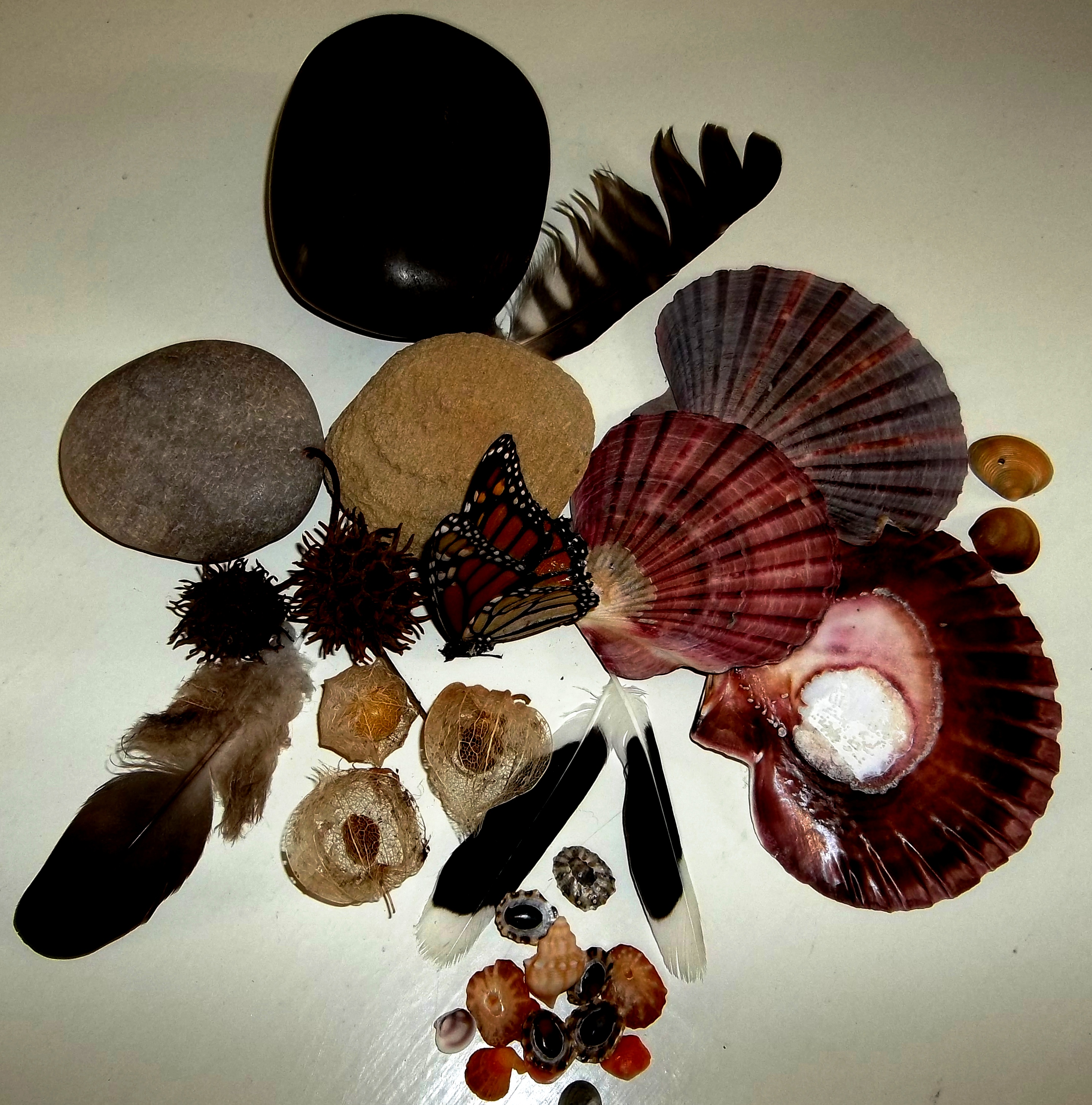
These stones and feathers and shells can tell the story of my life in the last few decades… shells collected with the children on a Northland beach, a black and white feather lying outside the door when I opened it on our first day in a new house –  greeting from a tui… the brown and cream morepork feather found on a long walk around the harbour with the thoughts and dreams of that afternoon threaded through its fronds.

An ancient stone from a river bed in the Blue Mountains of Australia was picked up after a day spent abseiling in abject terror, another from a cold pebbled beach in Devon, the chill of the Atlantic  breakers still embedded in it after all these years, while the polished brown stone came from an underground cave in the central North Island where glow-worms illuminated the roof, and a river flowed through.  These things are the stuff of my life… as they are of every life in which they are valued.

As I looked at them I thought of how other collections can also tell the story of a life. When I renewed my passport recently I found all my old ones, going back to when I was twelve and going to France on my own to learn French. In that passport photo two frightened brown eyes gazed out at the world. I had been so appalled at this picture that I promptly destroyed the evidence.

Which left the rest – a twenty one year old about to go on holiday to Spain, well- groomed hair, immaculate lipstick, and veiled blank eyes… the next, an exhausted mother of two toddlers about to go to Hong Kong, badly cut hair, eyes sad and resigned. And then, a picture of a thirty five year old woman, lots of dark hair piled up confidently, smiling eyes, relaxed smile. Life to be lived now, not endured. In the decades since, the hair has got shorter and then faded, and the last photo was so awful I hoped to be un-recognisable, but the story of a life is told in those passport photos.

Another can tell the story of their life in their jewellery, the coral necklace given at a christening, the charm bracelet for a little girl, pearls for a twenty-first, the engagement ring and the gold band…  a gift to mark the first child,  a clumsy pottery brooch made  at school and proudly presented to a beloved mother… the ring inherited from a grandmother, the eternity ring at a silver wedding…  such precious collections can mark out the steps of a life quite as well as a photograph album.

I wonder if there is even a market these days for photograph albums now all our photos are taken on phones and I-pads. I was never much  of a photographer, so that the photos of my honeymoon were on the same roll of film as the pictures of my first baby. But I did have a memory.

I remember one summer’s afternoon when the children were three and four as they tumbled around on the grass, one wearing a sun-suit in glorious colours of pink and orange and red, the other in matching shirt and orange shorts. As I looked at them, revelling in their laughter, their shining hair, and sparkling eyes, pearly teeth and glowing sun-tanned faces, I thought to myself, I’m going to remember this moment forever.

It was a turning point, because I found I did never forget that moment. So now, I know I can fasten those moments I want to remember with that little intention, and our minds are so obedient that they obey the instructions, and can call up the images whenever they are wanted. On the other hand, I wonder if the ease of communication, the instant photos, the selfies sent from Rome or Khatmandu which reach every member of the family all over the world the same day, make it easy to forget. We don’t have to remember, because it’s all there, on Facebook or in the picture file on the computer.

But for how long? Until the internet crashes? Or some other disaster hits the net? The computer is stolen? Few people will be able to pick up old albums in the future and leaf through them re-living their own lives, or discover the lives of their ancestors. And how will biographers fare in the future? In the past we’ve had portraits and miniatures in pre-photography days; then the wonderful stilted posed photos of the early days of photography, with the expert’s head hidden under a black cloth over a tripod while he captured forever the people and that moment in their time.

Then came the brownie box camera and all the other simple do- it- yourself cameras, and families recorded their events and special moments themselves. Biographies of the famous from the twenties until the sixties are full of revealing snaps, but what will there be for future  writers and historians wanting to illustrate their books about the powerful and famous? Not much, I suspect.

In the past, many anonymous photos turned out to be records of history – impromptu black and white snaps of Battle of Britain pilots ‘scrambling’, shots of families crouched in air –raid shelters from London to Leningrad, soldiers in Africa or Italy taking grainy pictures of each other to send back home… joyful hugs and kisses of victory – all these spontaneous pictures of humanity enduring both the ordeals and the pleasures of the twentieth century, captured in black and white film, are the stuff of history.

But I wonder what history is being preserved today in our somewhat ephemeral records? Will collections of jewellery or stones, in the end be the things to jog people’s memories in the future? Maybe the photos in passports and on driving licenses will the best concrete records we will have… time to get a decent picture taken for these official documents perhaps !


Food for threadbare gourmets

Summer salads don’t always mean lettuce for me… One of my favourites is grated cauliflower, mixed with chopped hard- boiled egg, some chopped Medjuel dates, toasted slivered almonds, and lots of chopped parsley. Then stir in enough good mayonnaise to the consistency you like. Chopped apple or banana is a variation, but actually anything can be added, and it still tastes good. But it can’t sit around, or it turns watery. I eat it on its own, but it’s also good with cold chicken.

Food for thought

And a poet said, Speak to us of Beauty. And he answered: Where shall you seek beauty, and how shall you find her unless she herself  be your way and your guide?  Beauty is not a need but an ecstasy. It is… a heart inflamed and a soul enchanted … a garden forever in bloom and a flock of angels in flight.

‘The Prophet’ by Kahlil Gibran, Lebanese poet, 1883 -1931. ‘The Prophet’ has never been out of print since it was published in 1923.

I

44 Comments

Filed under birds, cookery/recipes, family, food, great days, happiness, history, life/style, love, poetry, The Sound of Water, Thoughts on writing and life, Uncategorized

A summer storm

100_0841 - Copy

It arrived unannounced at roughly eleven- thirty in the morning. Before then it had been a quiet silvery morning, still silver sea, and pale grey sky. The wind built up, the clouds lowered, and rain flew in the wind. By evening it was a fully fledged storm and too good to miss, and I decided this was the day I tackled the hundred and fifty- seven steps up and down to the harbour, a trial of strength I’d avoided for too long since I twisted my ankle.

They led down through a ravine of tangled woods, and at the bottom as I stepped onto the wet sand there was a Buddha-like figure, a girl in a  faded pink jerkin sitting in the lotus position, meditating on the rocks. With this blessing at my back I carried on round the edge of the water, past a few old fishing cottages, now expensive sea-side dwellings.

Being a holiday, most of them had their families snugly tucked inside against the weather. Where they had their lights on in the grey day, I peered inside, approving when I saw walls of book- shelves, and enjoying a family gathered round a table eating their supper. A teenager was sitting on the branch of a pohutakawa leaning over the water, and when I waved, he waved back, his long arm a great wide semi-circle of  greeting.

The path wound round the edge of the harbour, sometimes deep in trees and woodland, and sometimes looking straight over the water with fishing boats at anchor swinging around in the wind and the waves. Promising myself to complete the circuit the next day I retraced my footsteps, and returned to the foot of the staircase leading up to the road.

A young man was now kneeling in front of the meditating girl, and as I approached she gazed at him with a look of such tender love that I flicked my eyes away and hurried up the steps so as not to disturb them.  Not that I could, even in bright red jacket and black trousers I was un-observed.

The hundred and fifty seven steps were not as bad as I feared, and I strode back along the road bent into the gale. Back to my end of the peninsula, where the shelter of the harbour no longer protected us, the great pohutakawa trees ringing the cemetery and leading out onto a little rocky peninsula bucked and swayed in the tempest. It wasn’t even high tide, but huge green waves were surging onto the rocks and white spray flying through the air.

As I looked down onto the rocks, and leant against a tree trunk to avoid being blown off myself, watching the hungry waves hurling themselves against the rocks, and the boiling white water swirling around them, it truly felt like ‘the cruel sea’.

The sound of the water and the trees was deafening, and mesmerising. There was nothing else outside this circle of wind and waves and sound and solitude. Impossible not to be totally present to the wild beauty and magnificence.

Finally the wind became so furious that I felt I had to make a dash between lulls. But there were no lulls, so I made a dash anyway, and  wandered back through the cemetery – which is still full of the stuff of life – one grave –stone facing out to sea inscribed:  “ He loved life and his fellowmen”,  another, saying: ”Sleep on grumpy” and another, telling passersby that this man had left Scotland for this new world, in 1865. His gravestone was at one end of a miniature cricket bowling pitch, with three stumps set in concrete the other end.

Reluctant to leave the aliveness of the storm I stood on the edge of the cliff, and wondered where had all the birds gone – no gulls or pigeons, tuis or doves. Somewhere dozens and dozens of birds were silently riding out the storm in places that no human could see.

We don’t have to worry about ‘those in peril on the sea’ these days. Fishing boats stay at anchor when they get the weather forecast and the big ships can ride out the storms. This storm, unlike so many others around the world, caused no harm or hardship. So savouring the elements is a guilt-free pleasure, and those like me, far from city pavements, are so privileged that we can. But maybe more importantly, this pleasure has a spiritual dimension,  since it’s also an acknowledgement of our beautiful and irreplaceable planet.


Food for threadbare gourmets

I’ve had so many people dropping in for various reasons, that rather than make a cake I’ve been making a succession of scones- fresh out of the oven, melting in the mouth, served with unsalted butter, strawberry jam and cream, they always disappear quicker than the proverbial hot cakes. They’re so simple to make, and I never add sugar, currants, cheese, or chopped anything. They are perfect just as they are.

Put six spoonfuls of self raising flour in a bowl with an ounce to an ounce and a half of softened butter. Rub it in, break an egg into a well in the centre and add half a cup of milk. Just mix it altogether with a knife, adding more milk if needed. It should all come together into a soft dough. I simply press it down on the pastry board, at least an inch thick, and cut it into squares. Half an hour in the fridge, covered is good for them. Bake on a floured or greased tray in a medium to hot oven for ten minutes or until raised and slightly brown. The trick is to serve them at once !


Food for thought

Blessed is the influence of one true, loving human soul on another.

George Eliot  1819 – 1880  Great English novelist

(New Zealand readers might be interested to hear me being interviewed on Kim Hill’s programme on Saturday morning, choosing favourite records and talking in between)

http://www.radionz.co.nz/national/programmes/saturday)


24 Comments

Filed under birds, environment, spiritual, The Sound of Water, Thoughts on writing and life, Uncategorized, village life

A rose is a rose is a hose !

100_0532

This was supposed to be a picture of a rose. When I developed it, it turned out to be a picture of a hose. I was shocked. How could I have been so one-eyed, and not seen what was shouting at me in a loud turquoise voice? I only see what I want to see, and eliminate even the obvious, it seems.

So when I went for my walk in the summer evening, I reminded myself to actually look, and not to assume or to expect. I wanted to see what was there, not what I thought was there. Down near the harbour where I usually turn around I always end up by a bougainvillaea sprawling through the trees, and just out its reach, a queen of the night holding her own. Braving bougainvillaea prickles, I can just reach the greenery-yallery sprigs of tiny flowerheads.

Two nights ago I broke one off and carried it back with me, sniffing the glorious fragrance, and ending up sitting on the warm marble bench in the cemetery at the other end of the peninsula, still smelling the sweet blossoms. I did what I’d never thought of doing before, and took it in and put it in a glass in the bed-room. The scent filled the whole room, and whenever I turned over in my sleep, the scent was drifting past.

The next day the tiny pale green flowers closed up, and the sprig sat nondescriptly on the window- sill all day, before bursting into glorious scent in the evening again. So now I plan to keep a permanent supply of these modest blossoms that don’t look big enough to be able to scent a whole room… The scent lasts for three nights I’ve discovered.

Walking back tonight with a fresh sprig of blossom, I passed a big shrub on the road where it dips and there’s a muddy spring.  Before now I’ve smelt its fragrance, but not given it a passing glance. Its reputation as a deadly poison and hallucinogen had somehow got in the way of me actually seeing this innocent plant. Tonight I looked at it, and ended up gently holding one incredibly beautiful flower-head after another, each one slightly different, gazing at their two layers of frilly white petals, and seeing deep inside the long white tube, white stamens pushing their way up to the light. The pendulous buds are so yellow it’s a surprise that the flowers are so white

The slender pale green calyx was smooth and soft and somehow tender to touch and to hold, and ended where the green- veined white trumpet – shaped flower began. Its ugly official name is brugmansia, but its folk name is angels trumpets. Angels trumpets spread their scent so far that long before I get there I can smell them.

Enchanted now with the idea of white scented flowers, I noticed the exquisite waxy looking candle-shaped buds of the king magnolia further down the road, the dark shiny leaves supporting each smooth creamy bud like a candlestick. Only one flower had opened, but it was enough. The scent of just one flower wafted past me.

I walked down the long drive to some friends’ house, knowing they were not there, but that they wouldn’t mind me visiting the frangipani plant flourishing by their veranda. The scent of frangipani takes me back to Singapore when it was still an eastern city and I was a girl, where all the alleys were hung with long bamboo poles suspended from every window on each floor, drying thin cotton tropical clothes in the brilliant un-ending sunshine.

We were staying in a hotel just around the corner from the famous Raffles Hotel, and the entrance was flanked with rows of frangipani trees.  Their fragrance followed us into the hotel courtyard and drifted in through the big open bedroom windows where we slept with no air conditioners, but beneath draped mosquito nets.

And when the velvet tropical night had fallen promptly at six thirty, every night in the darkness I would look down from the bedroom and see small groups of people squatting on the pavement in a circle. They would have tiny flickering lights and little spirit stoves in their midst to cook their dinner, delicious smells rising tantalisingly through the frangipanis, and I would hear their soft chatter and their laughter.

There were no blossoms on the frangipani growing here in New Zealand… wrong time of year perhaps. Back home, there was one white gardenia open.  I savoured the perfume before bringing it inside and putting it in a shallow bowl, floating on the water. So though no angels trumpets, I have queen of the night, gardenia and creamy honeysuckle from the porch scenting the house – even the names are poetry.

I don’t know whether I did what I intended when I began my walk, or whether I saw what was really there, but just by looking – truly looking at the beautiful angels trumpets – unnoticed before –  the walk turned into something else – a successful quest for white scented flowers. And like all successful quests, that was good enough.

And I wonder if this is how life is… we set off in one direction and find that imperceptibly we’ve drifted down other unsuspected paths; and looking back, we see that it was the perfect journey, and our travelling had a purpose, and was not random at all.


Food for Threadbare Gourmets

Friends for dinner before they left after the summer holiday to go back to the city. On a summer evening cold food seemed appropriate. So we had chicken with curry mayonnaise on rice salad. The cooked chicken chopped and mixed into a bowl of good bought mayonnaise, with about a big tablesp of golden syrup and desert sopn of curry powder to taste… I taste until I like it. Stir through enough cream to make it a soft consistency to stick to the chicken.

Cold basmati rice is jollied up with a vinaigrette dressing with salt, plenty of freshly ground black pepper, mustard, and sugar. Add to the rice generous helpings both of peas and sultanas soaked in boiling water, lots of crunchy chopped almonds lightly toasted in a frying pan, and lots of chopped parsley. Nice with a salad and chilled pinot gris .

In deference to our French connections we now have the cheese course before the pudding! This was some of our plums cooked to Nigella’s lovely recipe in red wine, one star anise, two cloves, teasp of cinnamon and a bay leaf, plus honey to taste. We had them with a mix of plain yogurt, whipped cream and runny honey stirred gently together, and a little shortbread biscuit.


Food for thought

That mighty power that sways the tides and works the million miracles of spring is ranged forever on the side of love.

The writer: known only to God .  Seen on an embroidered sampler hanging over a bedroom fireplace in an English cottage


73 Comments

Filed under cookery/recipes, flowers, food, gardens, great days, happiness, life/style, love, perfume, spiritual, Thoughts on writing and life, Uncategorized

Nuns and their habits

100_0807

I can’t help feeling that nuns are getting a bad press at the moment after seeing the film Philomena, and like everyone else in the cinema, running out of tissues. I thought back to the nuns at my convent… mostly French or Belgian, a couple of English and a few Polish ones. Some were old, some were beautiful, some were wise and some were silly – at least to a bigoted ten year old.

My father didn’t know about my past in which I’d  read all my grandmothers anti-Popish books, which included Westward Ho, and Foxe’s Martyrs, a catalogue of the three hundred people Mary Tudor burned for being Protestant. So sending me to a convent for a good education seemed a good idea to him.

I didn’t discuss it with him, for on our first day with our new parents, I’d been told I had to do exactly as I was told – always – so there didn’t seem to be any room for discussion. So a prejudiced Protestant got to observe the strange Catholic goings-on at her new school!

The nuns all looked wonderful in their no-expense spared rich plum-red gabardine habits, with wide swinging pleated skirts and wide sleeves. They wore a long snowy  white veil over the wimple which framed their faces and had a splendid thick knotted red cord round their waists to which they attached their rosaries.

We had a roller skating rink where we skated most days, and obsessed about how many ball-bearings our skates had. At night when I boarded for a while, and when everyone was supposed to be in bed and asleep, we could look down from the gabled windows, and see the nuns swirling round the rink on our borrowed roller skates,red  habits swinging, veils flying. An unforgettable sight.

The order had been formed by three aristocratic Belgian ladies, and we heard their history interminably when we sat in silence in the refectory at lunch, while tall, serious, severely beautiful Mother John stood at the carved lectern and read it to us during retreats. Retreats and the numerous saints Feast Days were a wonderful way of not doing schoolwork, which my parents disapproved of, since they were paying school fees.

During retreat, for several days we never spoke (which I loved even then), and did nothing but pray, draw holy pictures, tally what good deeds we’d managed to perform each day, using a flower as a symbol (I used a violet), process around the school grounds singing hymns, and if we were Catholic, celebrate mass with a portly priest imported for the job. I couldn’t bear him and the way all the nuns fawned over and spoiled the only man who ever came into their orbit! Apart from no speaking and mass, Feast Days were the same round of prayers and processing.

Mother Michael was our housemistress, a tall bony woman, English, and almost the only nun there who had no charm. She wore thick horn-rimmed spectacles, and I noticed uncharitably that in the chapel at prayers every day after lunch, she twiddled her Bride of Christ gold wedding ring and didn’t seem particularly devout.

I rather enjoyed this lunch-time prayer ritual, it also cut into time for lessons, as we walked in a long crocodile along the corridors on miles of polished linoed floors, passing numerous statues of saints frequently adorned with rosaries or necklaces. I thought most of the statues were ‘soppy’, a word we used then, and actually I think they probably were – mass-produced, sentimental, pastel- coloured and idealised images. I glared at them all like a latter-day Cromwell.

Chapel however, with its scent of incense was a pleasure, and a respite from effort and intrigue. Yes, the convent was a hotbed of intrigue and occasionally swept by gusts of vague hysteria – what convent girls would probably call ‘scharmerei’ – with favourites, crushes and gossip part of the mix.

I was Mother Michael’s favourite for more than a term. It was, in a good Catholic phrase – purgatory – because I was imprisoned every day in the airy second floor cloakroom in the Georgian house which was the home of the junior girls. It was a pleasant sunny room, but it might just as well have been a dungeon because I was chained, as it were, to a chair, and every lunch break Mother Michael undid my long dark brown plaits and spent the rest of the lunch hour break brushing my hair.

Friends came and went, washing their hands and changing their indoor shoes, but I was pinned to my penitential chair with my hair loose. Just before the bell Mother Michael would re-plait it, dragging it round my face like a Victorian orphan, and every day when I got home my stepmother would ask what was going on, and when I told her, say it had to stop. I would have loved it to stop, but I didn’t know how to make it stop.

It went on until Mother Michael found another pair of promising plaits, not as long as mine, but long enough. The new favourite was rather smug to me, but I knew what she was in for, and watched with some pleasure as Barbara found herself nailed to the chair, and like me,  unable to join in the games of skipping and hopscotch, playing five stones and weaving cats cradles going on outside. Mother Michael had seriously interfered with my social life, and I felt no pity for her next victim.

The other nuns were civilised and kind, unbigoted and happy. Unlike the only teacher who wasn’t a nun, and who constantly tried to outdo them in piety and holiness. She was the maths teacher, so it was inevitable that our relationship would founder.

In fact it never recovered from the day when I finally rebelled and tried to speak my mind. As an Irishwoman, her constant theme was the ‘puir’ persecuted Catholics and all the dreadful things Protestants had done to them, including  executing Guy Fawkes and his co-conspirators – we never celebrated Guy Fawkes day at the convent – and ‘puir ‘ St Thomas More, beheaded by Henry VIII.

Baulking at having to pray for the souls of my Protestant parents because they weren’t Catholic – after we’d interrupted long division yet again to recite the Angelus – my stroppy ten-year old self started to tell her about the Inquisition, and Borgia Popes etc.  But I got no further than the Inquisition. “Oh what a pack of Protestant lies!“ she shrieked dramatically, clapping her hands over her ears.

Not only was my relationship soured with Miss Cummins, but it never recovered from the disapproval of all the other Catholics in the room either… I paid the price for this rebellion, and was always left until last to be picked for rounders teams and  netball. I left the convent after a year without regret, and yet looking back I’ve had more fun from my memories of that unique environment than from some of my more conventional schools.

The beautiful High Victorian Gothic building, which housed the foreign nuns so far from their homes in Europe, and generations of schoolgirls, has now been turned into smart flats, surrounded by the glorious trees and grounds where we played so happily, watched by little red squirrels perched in the black branches of bare trees silhouetted against the snow.

I wonder if the skating rink is still there. I think no-one since would have enjoyed it as much as those gentle souls swirling silently around in the dusk, plum coloured habits swaying, veils flying and rosaries swinging. I do hope they bypassed purgatory and skipped straight into heaven.


Food for threadbare gourmets

Going cold turkey day after day post Christmas is not my idea of enjoying food. So after the second day I chop it into small pieces and freeze it. Yesterday we were ready to eat more turkey, so I defrosted it, stirred small pieces into a thick white sauce with plenty of nutmeg, some parsley and plenty of chopped mushrooms fried in butter. Served over savoury rice, it was good. Into the hot basmati rice I stir a chopped fried onion, plus a handful of peas, a handful of sultanas soaked in boiling water to plump them out, and plenty of toasted slivered almonds, salt and pepper plus more parsley. It beats the boredom of cold turkey.

Food for thought

The angels keep their ancient places;

Turn but a stone, and start a wing!

‘Tis ye, ‘tis your estranged faces,

That miss the many splendoured thing

Francis Thompson 1859-1907, great English poet, mystic, vagrant who lived on the streets for most of his drug-addicted life.


49 Comments

Filed under cookery/recipes, happiness, humour, life/style, spiritual, Thoughts on writing and life, Uncategorized

Summer song

100_0751

Walking around the cemetery on New Year’s Eve the sky was still and clear, no silver, almost transparent moon yet, rising above the sea looking like a silver sliver of dried honesty in the pale night sky. Instead there were gulls circling silently and intently overhead, weaving endlessly in and out, never touching or interrupting the arc of another bird.

After a while I chose one single gull, and watched its movements, following its wide circles and trajectories and swoops until finally it headed out to sea in the direction of Little Barrier Island, which hovers, misty indigo, on the horizon.

It felt like a holy silence, the tracery of the gulls’ flight woven like a network of silver filaments overhead, the cemetery a cathedral, silent, sacred and undisturbed. The Universe may have been un-aware that it was New Year’s Eve around Planet Earth, but surely that thought -form which meant we were all conscious of this moment in time, must have created that charged and sacred energy which I was feeling then.

Today it has rained. Things can start growing again, and I can stop watering – for a few days anyway. The countryside has the richness of high summer. The trees are billowing with green foliage, the fields have been cut for hay, and the grass in the meadows is so high that when the calves lie down, their heads just peep out of the tops of grass heads, plantains, buttercups and clover. I thought I saw a flight of big brown butterflies the other day, and it was the tips of their velvet ears reaching out of the pasture. The thrush in the garden sings continuously between pecking at the apple nailed to the top of the fence.

Tonight I was strolling round the cemetery, and the harbour below was the deep dark green of an Arthurian mere. It was as still as a mere too, and the boats at anchor were reflected with perfect clarity. Turning to face out to sea, the ocean was quite colourless with a deep band of blue on the horizon.

I’m constantly re-filling the dogs’ water bowl by the pavement. I hear them slurping away, as people walk past to the beach, thirsty Labradors and dobermans, bitzers and bichon frises, poodles and pointers… even a bulldog.

Earlier today, reading James Lees-Milne’s diaries, listening to the summer rain, I discovered his description of an English summer night in 1946: “the smell of new-mown hay and hedgerows, of eglantine and elder… how I love these long gentle Shakespearean summer evenings…”  Me too. The scent of the queen of the night comes drifting in from the open window at night here. It’s sweet and lovely… but I miss that indefineable atmosphere of those English summer nights.

Those nights throb with nostalgia and a richness. Somehow, it’s as though the layers and layers of lives lived in those parts, the echoes of history stretching back beyond memory and beyond record, the people in the millenniums before Christ, who trod out the ancient paths that still thread across hills and ridges and valleys and fords, can all still be sensed. The voices are silent, but their presence still lingers, as one century after another passes across the meadows and the woods.

The oak and the ash, the hazel and the hawthorn, the holly and the honeysuckle have been growing there since the last ice-age twelve thousand years ago. The smells, the sweet blossom, the new mown hay, the whiff of manure, the fresh rain, the damp leaves, have smelt the same in every age and every summer since. Standing in a quiet English lane on a soft summer night, you can feel those long centuries, and it is very touching.  I haven’t experienced a summer evening for a long time. I’ve always been back in autumn or in winter. But I must savour a June night once more!

Feeling homesick for the English country-side, I got “Far from the Madding Crowd” and “Tess of the D’Urbervilles off the top shelf of the book-case, and had an orgy of Hardy. Tess first, and the sweetness of Talbothays farm, then Bathsheba and her story… I read it differently this time, not so much for the drama of the story, but for the feeling of the country.

So I really took in for the first time, the delicious characters of the farm-folk, and the details of farming life, from the signs of an approaching storm, to the rituals processing through the year of lambing and dipping, and fattening and shearing, to the yearly sheep fair, the shearing supper and the harvest supper.

It was a way of life which had existed for over a thousand years when Laurie Lee in the enchanting ‘Cider with Rosie’, told the story of his childhood, and an archaic way of life  which then vanished forever, with the combine harvester, chemical farming, agri-business and of course the destruction of communities  by the carnage of the First World War.

I’m always struck in Hardy’s books, and in Jane Austen’s letters, by the isolation and “localness” of country life back then. So many people hardly ever left their village, unless they were gentry, and the next village was a foreign country. So when people fell in love in these tiny societies, and lost the object of their affections, through death, departure or rejection, there was often no-one else to love. People literally did grieve and die in different ways, from broken hearts.

Hardy’s description of the hopeless love by the dairy-maids at Talbothays farm for the un-attainable gentleman, Angel Clare, had the unmistakeable ring of truth.  I remembered from closed societies I lived in when I was young, whether in an English village, or a tiny colonial community far away from any other European habitation, how intense relationships were when there were no others. No-one could console themselves before the population explosion, and peripatetic habits of the twentieth century, that there were plenty of other pebbles on the beach. There weren’t.

Yet now, though I live in a tiny village with only four hundred souls, we are no longer prisoners of geography. Not only do people take off to holiday in Alaska and Italy, and their families return from Vancouver and Hanoi, but we all have the world of the internet at our fingertips, to use that well-worn, but accurate cliché in this instance.

It’s eighty- six years since Thomas Hardy died, and in those years our worlds and our lives and maybe our minds have expanded beyond imagining. The world is our village, and the internet is our community. There are pebbles past counting and wherever we direct our vision, we can find the glory of summer somewhere around the globe at the push of our buttons.


Food for threadbare gourmets

Apart from being full of healthy fats, potassium and Vitamin E, avocados are delicious.  I sometimes use them as a dressing over a salad. To one avocado you need  ground coriander – I use a quarter of a teasp, but less is more… the juice of a lime or a lemon, quarter of a teasp of ground cumin, a tblsp of apple cider vinegar, salt, and about half a cup of water. Whizz these ingredients until smooth and creamy, and use straight away.


Food for thought

To write or even speak English is not a science but an art. Whoever writes English is involved in a struggle that never lets up even for a sentence. He is struggling against vagueness, against obscurity, against the lure of the decorative adjective, against the encroachment of Latin and Greek, and, above all, against the worn-out phrases and dead metaphors with which the language is cluttered up.

George Orwell, English writer 1903 -1950.  Wikipedia records that : ‘His work is marked by lucid prose, awareness of social injustice, opposition to totalitarianism, and commitment to democratic socialism.’ Animal Farm and 1984 have continuing relevance.


61 Comments

Filed under birds, books, consciousness, cookery/recipes, culture, food, great days, history, jane austen, literature, love, The Sound of Water, Thoughts on writing and life, Uncategorized, village life

The necessity of beauty

100_0764

Pamela was my lodger. She was living in the third bedroom in my flat for the same reasons that Mr Micawber pronounced the immortal words:”Annual income twenty pounds, annual expenditure nineteen pounds nineteen and six, result happiness. Annual income twenty pounds, annual expenditure twenty pounds nought and six, result misery.”

I’d tried to fill the gap between my meagre salary (women were paid far less than men in the Hongkong I lived in ) and my expenditure, by doing TV quiz shows,  radio programmes, using the children as photographic models and even doing PR for the Anglican church until I could stand being hypocritical no longer. So Pamela was my next attempt at solvency. While she lived with me my life was filled with her dramas, love affairs, crises and disasters.

She arrived with one fiancée, dressed demurely in twinset and pearls, tweed skirt and silk head –scarf. Soon she found a more exciting prospect, and changed her style  to newly fashionable jeans, her hair swung up into dashing styles and lots of makeup. The new fiancée lent her his new VW while he went back to England to sort out his divorce, and hereby hangs the tale. Pamela rolled the car her first night in possession of it, and I was awakened in the middle of the night by a Chinese policeman who couldn’t speak English.

I pieced together that Pamela had had an accident, and was in a Chinese hospital since she had no insurance to cover her for a European one.  The next morning the children, four and five years old, and I, packed up a few things for Pamela and made an expedition to the enormous  building which housed some thousands of sick and penniless Chinese.

We found our way through a maze of corridors to Pamela’s ward, and by the time I reached her bed I was deeply shocked. The ward held eighty women. They were all dressed in faded brown cotton shifts including Pamela. The noise was horrendous. Cantonese is the noisiest language on earth. To hear our amah chatting to another outside the kitchen was deafening. To hear seventy- nine women chatting in a confined space was probably higher than the safe decibel level.

Pamela was bruised and shocked but not injured. After doing our duty, and promising to return that afternoon with more things she wanted, the children and I went home, leaving her with a little bunch of camellias I’d picked. Only six blossoms because that was all that were flowering.

When we returned in the afternoon, something had changed. There was a hush in the ward and a sense of peace, and all eyes were on the gwailo (long- nose) and her children. Being watched was something one accepted as part of life then, but this felt different. And the hush was a sort of reverence. Pamela whispered to me what had happened after I left.

When we walked out of the ward, the women came crowding round her to see the flowers and smell the fragrance. They were ecstatic at this exquisite beauty in their harsh unfriendly environment. Deprived as the women were, of all colour and texture and smell and beauty, the flowers brought something like heaven into their lives.

They didn’t speak English, and Pamela didn’t speak Cantonese, but with the aid of the ward sister’s few words of English, they worked out a roster for the flowers. Each woman would have one camellia by her bed-side in a glass for three hours in every twenty-four. Pamela had one all the time, and the sixth flower which had fallen off its stem, the ward sisters had in their office, floating in a saucer.

Back at the office the next day I rang the dean of the cathedral and several hotels and they agreed to send their flowers to the hospital whenever they changed them. I wonder if they still do.

The great Catholic thinker Monsignor Hildebrand wrote that: ‘the poor need not only bread. The poor also need beauty’. But it’s not just the poor. We all need beauty.

It’s strange to me that Abraham Maslow in his hierarchy of needs didn’t include beauty. Sometimes beauty is the the only thing that keeps us going. As Resistance fighter Odette Churchill was being locked back in her cell after a bout of torture by the Gestapo, she snatched up the skeleton of a leaf being blown in the door with her. The beauty of that leaf sustained her and gave her hope and courage and a belief in goodness that carried her through her  dreadful ordeal.

Quaker writer, Caroline Graveson wrote that: ‘ there is a daily  round for beauty as well as for goodness, a world of flowers and books and cinemas and clothes and manners as well as mountains and masterpieces.’ She talked of beauty: ‘not only in the natural beauty of the earth and sky, but in all fitness of language and rhythm, whether it describe a heavenly vision or a street fight, a Hamlet or a Falstaff, a philosophy or a joke: in all fitness of line and colour and shade, whether seen in the Sistine Madonna or a child’s knitted frock…’

The sad thing is that those deprived Chinese women in that joyless hospital ward, came from a culture, which before the blight of industrialisation and the tyranny of plastic, was incapable of producing anything that wasn’t beautiful – from their baskets to their bowls, to their porcelain and their poetry.  And there was something very beautiful about buying a kati of vegetables in the markets and watching them being skilfully wrapped in a beautifully folded sheet of re-cycled Chinese newspaper, or a large leaf, and tied with a knotted reed.

Perhaps their own sage should have the last word, Confucius said that everything is beautiful, to those who can see it….

Food for Threadbare Gourmets

Salady food feels right in the Antipodean Christmas season.This is one of my favourites. Boil new potatoes for the number of people you have, plus hardboiled eggs. Chop them and mix them with sliced artichoke hearts fresh from the delicatessen or from a jar. Gently toss in a good vinaigrette  dressing, and sprinkle with capers if desired. Delicious on its own with crusty rolls, or with cold chicken or cold salmon.

68 Comments

Filed under colonial life, cookery/recipes, culture, flowers, food, great days, life/style, The Sound of Water, Thoughts on writing and life, Uncategorized

A peculiar Christmas feast and the 4th Wise Man

100_0742Polar explorer Captain Scott and his team celebrated Christmas on their way to the South Pole in 1911. As a foodie, I find their feast a little lacking in… je ne sais quoi …

After his historic Christmas dinner with Wilson and Oates, Bowers and Evans, Scott recorded in his diary what he grandly termed four courses: ” The first, pemmican, full whack, with slices of horse meat flavoured with onion and curry powder and thickened with biscuit; then an arrowroot, cocoa and biscuit hoosh sweetened; then a plum pudding; then cocoa with raisins, and finally a dessert of caramels and ginger.”

Pemmican was the classic polar food, preserved, dried meat and fat… not my idea of gourmet nosh, but Birdie Bowers, and Taff Evans both felt so filled with warmth and human kindness after this extraordinary collection of unpalatable rubbish, that they decided when they got back to England they would: “get hold of all the poor children we can and just stuff them full of nice things,” in bachelor Bowers’ words.

I just feel the polar feast could have been warmed up with a wee dram of whisky perhaps, or even a swig of medicinal brandy. But then, I feel the cold.

Bowers was responsible for this jolly Christmas celebration, having smuggled the food over and above the allowed weights for the journey. Once the recalcitrant and desperate Mongolian ponies – who had suffered so terribly on the sea journey to the Antarctic, and who had then struggled endlessly in appalling weather and conditions with food they couldn’t eat- had been killed, every man carried his own food and equipment on the heavy sleds.

Bowers had always sneaked his night-time biscuit to his pony. On the night before they were all killed, Wilson, St Francis’s man, gave his whole biscuit ration to the poor creatures, like the condemned man’s last meal. This was the only time I cried during the film: ‘Scott of the Antartic’ with John Mills.  I was twelve, and blow the men, it was the ponies I wept for.

Thankfully my Christmases have never been as cold as theirs, though it felt like it in the hall in which we rehearsed for the Nativity Play when I was five. I had no idea what a rehearsal was, or why we had been marched – or straggled would be a better word – to the hall just down the road. Neither did I really understand the story we were acting in. We seemed to stand around for hours in the unheated hall while teachers talked animatedly to each other, and shifted bodies and chairs around the stage.

I just knew that the white nightie thing I was wearing like all the other little girls, was freezing. To cap it all – like the other angels in their nighties – I had a boring triangle to keep chinging on. This was a watershed in my understanding of the world. I understood then for the first time, that boys had all the fun. Not only were they all dressed up as kings and shepherds, but they got to play drums and tambourines, trumpets and recorders.

I felt as aggrieved as I did when I first saw huge Persil ads, in which the dark haired woman had the grubby grey sheets, and a bright blonde had the sparkling Persil washed sheets. Apparently blondes were better than brunettes.

But that’s another story… a year later my grandmother took me to a midnight carol service. I was riveted. A boy sang the first verse to: ‘Once in Royal David’s City’ in an un-earthly soaring treble, and then read the lesson. At one point his clear voice rang out with the words “And Mary pondered these things in her heart”. My heart leapt. I had no idea what the beautiful words meant, but for many years I treasured them and pondered them in my heart too.

The next memorable nativity play was when my daughter was five, and she was playing Mary. I thought she was utterly precious as she gazed at the world with her big brown eyes, her little face framed by a blue head covering, her solemn gaze taking in far more than I ever did. I sat and watched her with tears running down my face and my heart nearly burst with love. And the same when my small son sang the solo so sweetly at his Christmas concert.

Much the same too at all my grandsons’ nativity plays, only not tears, laughter. My heart nearly burst with love then too, and lots of giggles, as the head mistress darted down from her pulpit to drag a little finger from some-one’s little nose, and then he simply used the other finger on the other hand and the other nostril as soon as she was safely back in the pulpit.

None of them were magnificently garbed magi, just lowly shepherds … but we all sang the sombre, beautiful carol, ‘We three kings of Orient are…’ My favourite wise man is the fourth one, and that old Christmas legend telling his story is one of the most beautiful Christmas stories, to my mind…

He had set out with the other three Magi, but on the way, they came upon a traveller who’d had an accident, and the fourth wise man stopped to help him. Seeing he would be a while, he told the other three to carry on with their journey, and he would catch them up. But he never did, for he kept meeting some creature or traveller who needed his help to get them to safety, and by the time he got to Bethlehem the kings had been and gone, and so had the Child he was seeking.

He spent many years following the trail which had always gone cold when he got there, to Egypt and Nazareth and elsewhere. He was constantly delayed by yet another needy person who asked for his help. The gifts he brought and the stock of gold he had carried with him for the journey, dwindled until he had hardly enough left to buy himself food.

And then he heard that Jesus was in Jerusalem. He hurried there, and arrived in time to stand and watch Jesus carry his cross through the streets. He had one final treasure that he was keeping to give to the One he had been seeking, a beautiful sapphire jewel. But just before Jesus passed, a Roman soldier began to assault a young woman. The fourth wise man intervened, and by now, old and frail, was unable to stop the soldier. Finally he offered him his last possession, the precious sapphire, his gift for the Messiah, and the soldier took it and left.

At that moment Jesus reached the fourth wise man, and he knelt and asked Jesus’ forgiveness for having nothing for him because he’d stopped so often on the way to help the hungry or lost or needy. And Jesus looked at him and said: ‘For as much as you have done it unto these, you have done it unto me.’

In other words… we are all one… so a happy Christmas-tide to us all, dear friends around the world of blogging.

Food for threadbare gourmets

When Christmas is here, our little purply-red plums are ripe, and though I gave this recipe last year, I think it’s worth repeating  The plums which are only so-so for eating raw, are delicious when cooked. Every-one who receives a basket of these fruits also gets the recipe I use – borrowed from Nigella Lawson.

To a kilo of plums – more or less, use 300 ml of red wine – more rather than less! Nigella says stone them – I don’t bother, the stones come out quite easily when cooked.

Put the plums in an oven proof dish. In a saucepan boil the wine with two bay leaves, half a teasp of ground cinnamon, two cloves, one star anise, and 200g of honey. Pour over the plums, seal with foil or a lid, and bake for an hour or longer at 160 degrees, until they’re tender. You can keep them in the fridge for three days, and you can freeze them.

Serve with crème fraiche, ice-cream, or custard. I also think they’d be good with rice pudding on a cold day. The aromatic scent while they are cooking is so delectable that I’d love to catch it in a bottle and spray it regularly around the kitchen.

Food for thought

“My idea of Christmas, whether old-fashioned or modern, is very simple: loving others. Come to think of it, why do we have to wait for Christmas to do that?”                                                                                                                                                                                                                                                                               Comedian  extraordinaire, Bob Hope  1903 – 2003 His grandson said that when asked on his deathbed where he wanted to be buried, he characteristically quipped: “ Surprise me .”

63 Comments

Filed under cookery/recipes, food, great days, history, love, philosophy, spiritual, The Sound of Water, Thoughts on writing and life, Uncategorized

The feminine face of God

100_0666

In the last hundred materialistic years I was fascinated to discover that there are 386 recorded instances of Mary appearing to people all over the world from Belgium to Japan, Venezuela  to Burundi and Rwanda. I had always supposed that the visions of Our Lady of Fatima, and at Medjugorje in Yugoslavia were unique one-off events. They are not.

Our Lady of Zeitoun appeared regularly over a church at Zeitoun, a suburb of Cairo for several years between 1968 to 1971, where she blessed the people. Photos of the figure of light with a halo, hovering above the Coptic church of St Demiano appeared in all the Cairo newspapers. Hundreds of thousands flocked to see her, Christians, Jews, and Muslims, even the President Nasser. And there have been more reports of her appearing in Cairo just recently.

But mostly Mary seems to appear privately to women, and children. The most famous, of course, in the 20th century was Our Lady of Fatima, who appeared on the same day for six months in 1916 to three Portuguese children, aged ten, nine and eight, while they were tending goats. After the third month of their visions, when crowds began to follow them the local mayor arrested the children, as he thought the events were so disruptive.

He put them in jail among other prisoners, and threatened to boil the children in oil ( charming! ) if they didn’t tell him the secrets Mary had imparted to them. ( the secrets seem to have been coloured by the children’s perceptions of hell and Catholic teachings) They refused, though the eldest offered to ask Mary if she could tell him. The other prisoners testified that the children consoled them and recited the rosary with them.  Back home, the youngest brother and sister told their parents that Mary had told them they would die soon and meet her in heaven, but their cousin Lucia, the eldest, would live long.

They did die, within a couple of years, of Spanish flu, and Lucia continued to have visions until she died as a very old lady in a convent. The six children who saw Mary at Medjugorje in 1981 have also continued to see her for over thirty years, on the same day of the month. This was her latest message to Mirjana Soldo on 25 November this year:

 “Dear children! Today I call all of you to prayer. Open the doors of your heart profoundly to prayer, little children, to prayer with the heart; and then the Most High will be able to act upon your freedom and conversion will begin. Your faith will become firm so that you will be able to say with all your heart: ‘My God, my all.’ You will comprehend, little children, that here on earth everything is passing. Thank you for having responded to my call.”

The internet being what it is, there are films of Mirjana Soldo receiving her visions, not just in Yugoslavia, but in Austria, Italy and elsewhere. Like the children of Fatima, these children – now adults – were also considered to be ‘disruptive influences’ by the civil authorities

Many phenomena were reported at Medjugorje during the appearances of the Queen of Peace as she is known, such as the sun spinning, dancing in the sky, turning colours, or being surrounded by objects such as hearts or crosses. Onlookers have reported that they have been able to look at the sun during those times without any damage to their eyes; these events are all similar to phenomena seen during the visions at Fatima in 1916. There too, newspaper reports described the sun dancing and spinning in the sky and changing colours. Reputable witnesses saw the solar phenomena forty miles away, while others, including believers, saw nothing.

 Among Mary’s many names are Queen of Heaven, Star of the Sea, The Blessed Virgin. In other places and other times the feminine principle or Divine Mother has been known by many other names… She’s been called Ameratsu and Cannon in Japan,  Kuan Yin in China, Tara in Tibet,  Shakti in India,  Akua’ba in Africa,  Isis in Egypt,  Ishtar and Astarte in the Middle East, Hera and Juno in Greece and Rome,  Freya in Scandinavia,  Spider Woman and Ixchel the Weaver in North America. 

The Divine Mother has a long history in the planet’s consciousness. Archaeology suggests that from approximately 40,000 BC to approximately 5,000 BC the Goddess was worshipped above all, and nearly all the figurines found from this period seem to be female goddesses.

There are other accounts of the feminine principle appearing when called upon. John Blofeld, mystic, scholar, and expert on Asian religions tells the story of a friend in China during the Second World War. He was half Chinese, and had been brought up a Christian. In danger, hungry, lost on a mountain in terrible weather, wondering if he’d survive the night, he called on his patron saint,  St Bernadette, “begging that sweet child to appear and lead me to a place of safety”

And then he saw her standing on a flat rock, her blue robe hardly moving in the fierce wind. She was smiling and around her was a nimbus of light. He felt something unfamiliar in her appearance, and then he realised she was a Chinese Bernadette. ‘Her high-swept hair, the jewelled ornaments clasped about her throat, the white silk trousers peeping through a blue robe slit to the thigh, were those of a noble Chinese maiden many centuries ago.’

She spoke to him in Mandarin and surprised him with her childish voice, much younger than Bernadette. “ Come, Elder Brother”, and she led him to a shallow cave, where he lay down and fell deeply asleep in the bitter cold and on hard rocks, unconscious of any discomfort. For more than a year he thought it was Bernadette who’d rescued him, until he saw by chance a portrait of Kuan Yin with her two attendants. In Ling Nu, the youngest, he recognised the lady who had saved his life. After deep thought, he decided that Kuan Yin had too much delicacy to appear to someone calling on a foreign goddess, so she sent Lung Nu who could be taken for a child saint.

Often in her appearances to children, the lady doesn’t give her name. …” beautiful lady, beautiful lady”, the three small Italian children murmured on their knees at Tre Fontane in April 1947.   St Bernadette, the fourteen year-old un-educated daughter of a miller, only ever referred to her as ‘ That’, or ‘the small young lady” . The children at Medjugorje called her ‘Lady.’

She seems to favour quiet spots far from towns and villages, by streams and grottos and woods, and her visitations come unbidden. The Catholic church is never very happy about Mary’s appearances – or you could say is suspicious – since it considers the last word to have been spoken on the faith after the death of the last apostle. So they don’t want her interfering! Reports of visions of the Lady are rarely greeted with any enthusiasm by church authorities and they have very strict criteria about who they believe.

Out of the 386 visions/ appearances/ apparitions – depending on who is describing the visitations – only eight have been officially approved by the Catholic church. I wonder how many private and unrecorded visions – not just of Mary, but of other figures of spiritual significance – there are among people who have never spoken of them. I’ve heard of several.

Graham Green, the novelist, writing of her, said: ‘There is a common feature in all her appearances, the appeal for prayer and yet more prayer. Her message is as simple as that, and it may seem unimportant unless we have some realisation of the terrible force of prayer, the mysterious untapped power able to move mountains’.


Food for threadbare gourmets

Soup is the answer when I can think of nothing else, and this quick warming tomato soup is a favourite. Gently fry an onion, five cloves of garlic, a small piece of chopped ginger, and a good pinch of coriander in a saucepan until soft. Add a teasp of smoked paprika, two tins of  chopped tomatoes in puree and one tin of whole tomatoes. While it simmers, leave a small bunch of herbs like thyme and marjoram tied together in the mix.

Simmer for ten minutes, remove the herbs and blend until smooth. Re-heat, season with salt, freshly ground black pepper, and stir in some cream… this amount serves six. Sprinkle chopped parsley on top, and freshly cooked croutons made from sour dough bread and fried in olive oil are good too.


Food for thought

 My daughter sent me this prose poem… it’s by that talented poet Anon. We’ve had seventeen dogs – three at a time, mostly rescued…

It came to me that every time I lose a dog they take a piece of my heart with them, and every new dog who comes into my life gifts me with a piece of their heart. If I live long enough all the components of my heart will be dog, and I will become as generous and loving as they are.


49 Comments

Filed under animals/pets, consciousness, cookery/recipes, food, great days, history, life/style, philosophy, spiritual, The Sound of Water, Thoughts on writing and life, Uncategorized

Days of wine and roses

100_0503

It’s been the one of those glorious days when ‘cherubim and seraphim are casting down their golden crowns around the glassy sea.’  Silence… a small white yacht gliding over the still shining water, scarcely leaving a wake, using the engine because there’s no wind for the sails… the islands we never normally see, floating on the horizon, palest purple against a lavender blue sky… an enchanted stillness, the only sound the cooing of the doves in the trees.

When I awoke this morning the sky was just turning pink, so early though it was, I jumped out of bed, dressed, and headed out to watch the rising sun across the sea. The dawn chorus was just beginning, so I turned around and walked by houses with curtains drawn and solitary gardens, thrush and blackbird seeming to pass me on from one song to the next.

Theirs was the longest and sweetest serenade, while the soft incessant cheeping of the sparrows filled the spaces, and the slow crescendo of the doves cooing began. As I retraced my footsteps back along a grassy track, I saw with pleasure that mine were the only footprints in the dewy grass. I never met another soul as I meandered around the sleeping village.

Back home I crossed into the cemetery and disturbed a couple of speckled hens who scurried  fussily back into their own garden next door, clucking agitatedly. I walked across to the end of the peninsula to get my daily fix looking out to sea through the grey gnarled branches of the ancient pohutakawas.

Later, I sat on the veranda feasting my eyes on the glittering water, with breakfast of toast and a boiled egg from the errant chickens. When I had visited their owner Kate the day before, she had given me a handful of newly laid eggs, and the one I ate now was so beautiful I could hardly bear to break the shell. It came from her oldest hen, she said, a black Arakan, a breed which presumably comes from Arakan in Burma, and this little black hen lays eggs of the same pale blue as the sky today.

During the morning I went to the next village to buy a birthday card for a man. No flowers then, and since most men’s cards are covered with the inevitable cars or golf clubs, I did some lateral thinking and came away with a card with a message: “ If you resolve to give up drinking, smoking and loving, you don’t actually live longer: it just seems longer.” My son-in-law will be delighted with this encouragement to enjoy these permitted pleasures.

Stopping off at the garden cafe down a long avenue of poplars, the vivacious young Indonesian proprietor greeted me as usual with: ‘Ah Miss Valerie, are you ready for your coffee today?” Since she always jumps the queue for me, and makes piping hot coffee I can forgive her the spinsterly ‘Miss’. I sat in an ivy- covered alcove framed with late wisteria blossom and white jasmine, their scents wafting over the smell of coffee.

Before getting home, I called in on Friend, to collect various things from yesterday’s rollicking party for 45 oldies who came from far and wide. Others were there too to collect their vases, or napkins or fish slices. “The sun’s over the yard arm”, announced the man of the house, which though it was only lunch-time, gave us the excuse to finish off the champagne from the previous day.

Then, we had sat on the terrace in the sun, looking out over the turquoise sea, the lawn fringed with white iceberg roses in full bloom, and red roses lining the long white table cloths.

We’d enjoyed a four course lunch, starting with a terrine followed by freshly baked ham, salmon and asparagus, the cheese course – big rounds of fresh Brie, fresh strawberries and blueberry tarts – each course accompanied by different wines and champagne –French of course! And finally the birthday cake, a pyramid of moist chocolate brownies and truffles. In other words a feast! And all made by friends.

At the end of the afternoon someone brought out a guitar. We sang ‘Blowing in the wind,’ ‘Michael row the boat,’ ‘Kumbiya, ‘He‘s got the whole world in his hands’… all the old favourites. I sang my heart out, and had to restrain myself from dancing.

But as a somewhat acid -tongued acquaintance observed to me, all the men were glued to their seats – and they all look alike, she said. “They all have white hair, and are wearing the same sort of blue and white checked shirts, most of them have walking sticks and a lot of them have paunches!” The women on the other hand, were younger, sprightlier, beautifully dressed and immaculately groomed.

That evening several of the guests came to dinner, though we couldn’t eat much. We sat on the veranda in the dusk, by the loquat tree covered in golden fruit, with a fat green and white wood pigeon rustling around swallowing them whole. We had wine and laughter and fun, discussed everything irreverently, and enjoyed the party all over again.

Days of wine and roses and golden laughter  …when I returned flushed with champagne from Friend today, I found another generous neighbour had called while I was out, and left a bag full of freshly picked broad beans hanging on the door handle.

They were so delicious that for supper, I simply ate a dish of the tender little green jewels glistening with hot butter, though the old chap had steak with his. And I’ve just returned from the field above the harbour where the two little white goats live. They feasted on the broad bean pods, and seemed to feel the way I do about them.

‘Gather ye rosebuds while ye may’, wrote the poet, ‘Old time is still a-flying’, and I’m dedicated to this advice…. my rosebuds may be different to other people’s ideas of rosebuds, but I’m picking them as fast as I may.

So I sit here on the veranda writing, watching the evening sky turn pink and lilac and pale turquoise over the still, silver water, the scent of sweet peas, a gift from a friend’s garden drifting through the house, and savour my blessings. I began with the words of a hymn, so I’ll end with some. These shining days are filled with rosebuds – moments of pleasure and goodness – friends and fun and flowers, chickens and birdsong and beans, ‘all things bright and beautiful, all creatures great and small’.


Food for threadbare gourmets

The strawberry season means Eton Mess for me! The first time I tasted it was just outside Eton, at a place called Datchett, at a rather grand dinner to entertain some visiting Argentinian polo players who’d been playing on Smith’s Lawn at Windsor. My best friend and I knew we were only there simply because they needed some girls to balance out the chaps. But we gave the food a lot of attention too.

The version I ate then was a variation, because the crushed strawberries and broken meringue were pressed into a big dish of ice-cream, and then re-frozen. Whipped cream was piled on  when it was served, on a huge carving dish. I like doing it this way too, using freshly made local artisan ice-cream. Really, the amounts are up to you… you can’t go wrong. As an added touch I sometimes whizz up a punnet of the fresh strawberries with some sugar, and hand that round in a sauce bowl, to drench the already sumptuous mixture in it! Food for the gods….


Food for Thought

He had picked it up, he said, on a beach; it was a piece of sea-washed wood in the shape of a human head. It was made of hard wood, shaped by the waters of the sea, cleansed by many seasons. He had brought it home and put it on the mantelpiece; he looked at it from time to time and admired what he had done.

One day he put some flowers round it and then it happened every day; he felt uncomfortable if there were not fresh flowers every day and gradually that piece of shaped wood became very important to his life. He would allow no one to touch it except himself; they might desecrate it; he washed his hands before he touched it. It had become holy, sacred, and he alone was the high priest of it; he represented it; it told him of things he could never know by himself. His life was filled with it and he was, he said, unspeakably happy.

From Krishnamurti’s Journal


59 Comments

Filed under birds, environment, flowers, great days, happiness, life/style, philosophy, spiritual, The Sound of Water, Thoughts on writing and life, Uncategorized, village life