Category Archives: family

Pooh Bear has the answers

100_0273

I’ve only been on one teddy bear’s picnic. There were lots of teddy bears, crammed into a little dolls pram, my three year old grand- daughter and me.  We solemnly walked the pram to a tree in the park in Melbourne next to the house where they lived.

There, on a cold, slightly misty winter’s afternoon, we carefully propped a huddle of teddies of different sizes and varying shades from honey to dark brown, around the base of a tree. After careful discussion as to what teddy bears might eat, we had plumped for very small brown bread and honey sandwiches – we thought that arbiter of bear behaviour, Pooh Bear, would have approved, and that was all we needed to know really. We thought bears would probably only have wanted to drink water, so that was easily solved….

I was thrilled that she still remembers this occasion now she’s old enough to be at university. And she remembers too, jumping on our shadows the year before, and learning to sing ‘Kumbaya, my Lord’ when she was even smaller (in an English accent!). These memories may be more precious to me than to my grand-daughter, and most grand-parents will understand just how precious they are.

When I look back to my memories with my grandmother, I marvel at what I learned from her, much more, I suspect than today’s grand children learn from theirs. She taught me to knit and sew and do French knitting, and embroider dozens of stitches I’d forgotten till leafing through an old Mrs Beaton cook book recently – daisy stitch, herringbone stitch, blanket stitch, chain stitch, back stitch, buttonhole stitch, cross stitch. She told me the names of flowers and saints and cousins I’d never seen, the stories of dead great uncles in the war. She taught me prayers and proverbs and songs.

But somehow, once the days of reading aloud Pooh Bear and Dr Seuss and Dear Dinosaur had passed, all my grand-children were so engrossed in their play stations and favourite, regular afternoon TV programmes, that there was rarely a space for the sort of boredom or blank days we used to have in my childhood; those times when for lack of something better to do, we mastered a new skill and learned to knit, or read a book considered too hard or too boring before, and which was now discovered to be a treasure.

It was on those long empty days that I discovered the joys of rambling alone with the dog, or daring to cross the weir by the mill with friends, or digging around the Roman mines, hoping after two thousand years to find a Roman coin; it was when we picked primroses in the woods, and carried catkins and pussy willow home as spring announced itself … As we grew older we made egg sandwiches and took a bottle of ginger pop to picnic on empty beaches with names like Man o’ War Bay and Arish Mell Gap, coming home tired and sunburned.

But my grand-children have done it differently. Today they’re not free to roam alone as we were – instead, they went on exciting holidays, in the tropics or to fishing lodges, or learned to sail or ski. But then they’d come to stay with me, and do ordinary and yet totally absorbing things. Leaving their play stations, they’d feed the eels in the river at the bottom of the garden, spend days making boats out of flax leaves, and floating them down the waterfall, building dams, playing Pooh Sticks.

They could spend an afternoon totally absorbed in throwing stones down into another river, far below, and listening for the plop. Another morning in the city when I took all four of them to a secret spot above the harbour, where old oak trees spread, they spent a whole morning searching for acorns and throwing them down into the water. Not aimlessly, but aiming.

And not a question of little things please little minds, but being ‘in the zone’, alive and  present. Blowing bubbles from my veranda and seeing who could make the biggest one that drifted furthest and lasted longest; or the ritual playing of hunt the thimble with the same silver thimble every time, seemed to give them more fun and shrieks of laughter than watching their Japanese TV serials and videos or war games on the computer. And grandparents have time for long conversations about the size of universe and whether ice-cream is good for you, and what dogs are dreaming about – and about important things – like ethics – which even small children understand in terms of right and wrong, or better still, kind or unkind  …

Sometimes I think that this is one of the few gifts we can give our grand-children in this busy technological age when our grandchildren know more than their grandparents, and learn to teach us, instead of us teaching them. We can give them the time and the space to savour the little things. We can listen to them uncritically.  We can give them unconditional love, because we don’t have to make sure they eat up all their vegetables. And the utter bliss of it is that they give us the same unconditional love too. “I’ve got to, but I’ll still be your darling”, said one when I asked him not to grow up!

It’s that ubiquitous bear, Pooh, that ‘bear of very little brain’, who puts into words what I would say to my precious ones in the future. He says so memorably and so truly: “If ever there is tomorrow when we’re not together… there is something you must always remember. You are braver than you believe, stronger than you seem, and smarter than you think. But the most important thing is, even if we’re apart… I’ll always be with you.”


Food for threadbare gourmets

It’s that wonderful time of year for both birds and people – when the figs are ripe. A friend made the most delicious salad the other day using real lettuce – not mixtures of baby leaves – and tossed them with chopped- not sliced – cucumber, fresh peas, and thinly sliced figs, with a vinaigrette sauce. The sweetness of the figs with the crunchiness of the cucumber and the crispness of the lettuce was delicious with cold lamb and couscous.

Food for thought

…’It often takes great courage to follow intuition. It takes a Viking, who is unafraid to sail in unknown seas…. to live intuitively is to live fourth-dimensionally’…                                           Florence Scovel Shinn, 1871 – 1940   New Thought writer who influenced Louise Hay.
75 Comments

Filed under cookery/recipes, family, great days, happiness, love, spiritual, The Sound of Water, Thoughts on writing and life, Uncategorized

Souvenirs of life

100_0871


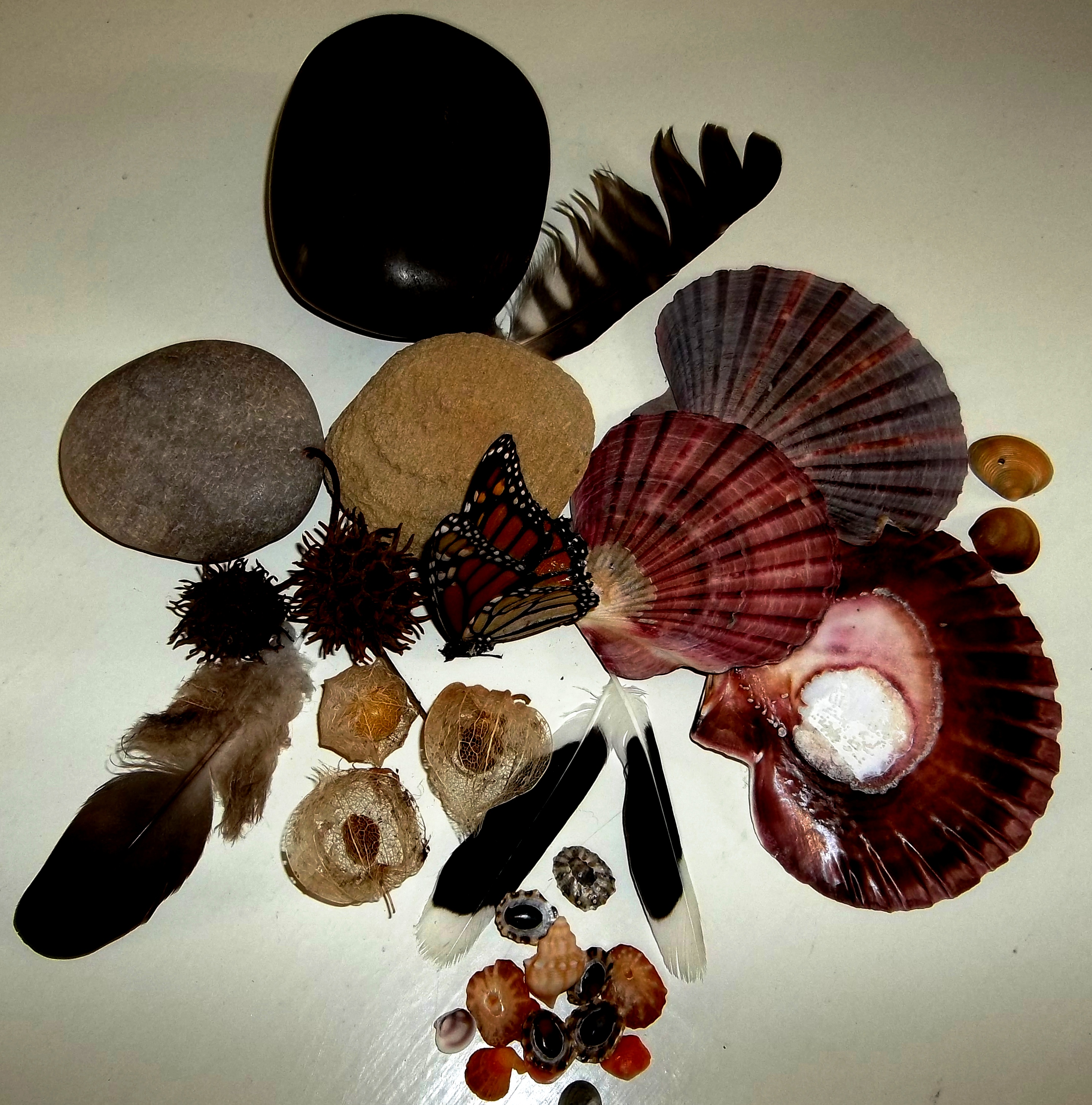
These stones and feathers and shells can tell the story of my life in the last few decades… shells collected with the children on a Northland beach, a black and white feather lying outside the door when I opened it on our first day in a new house –  greeting from a tui… the brown and cream morepork feather found on a long walk around the harbour with the thoughts and dreams of that afternoon threaded through its fronds.

An ancient stone from a river bed in the Blue Mountains of Australia was picked up after a day spent abseiling in abject terror, another from a cold pebbled beach in Devon, the chill of the Atlantic  breakers still embedded in it after all these years, while the polished brown stone came from an underground cave in the central North Island where glow-worms illuminated the roof, and a river flowed through.  These things are the stuff of my life… as they are of every life in which they are valued.

As I looked at them I thought of how other collections can also tell the story of a life. When I renewed my passport recently I found all my old ones, going back to when I was twelve and going to France on my own to learn French. In that passport photo two frightened brown eyes gazed out at the world. I had been so appalled at this picture that I promptly destroyed the evidence.

Which left the rest – a twenty one year old about to go on holiday to Spain, well- groomed hair, immaculate lipstick, and veiled blank eyes… the next, an exhausted mother of two toddlers about to go to Hong Kong, badly cut hair, eyes sad and resigned. And then, a picture of a thirty five year old woman, lots of dark hair piled up confidently, smiling eyes, relaxed smile. Life to be lived now, not endured. In the decades since, the hair has got shorter and then faded, and the last photo was so awful I hoped to be un-recognisable, but the story of a life is told in those passport photos.

Another can tell the story of their life in their jewellery, the coral necklace given at a christening, the charm bracelet for a little girl, pearls for a twenty-first, the engagement ring and the gold band…  a gift to mark the first child,  a clumsy pottery brooch made  at school and proudly presented to a beloved mother… the ring inherited from a grandmother, the eternity ring at a silver wedding…  such precious collections can mark out the steps of a life quite as well as a photograph album.

I wonder if there is even a market these days for photograph albums now all our photos are taken on phones and I-pads. I was never much  of a photographer, so that the photos of my honeymoon were on the same roll of film as the pictures of my first baby. But I did have a memory.

I remember one summer’s afternoon when the children were three and four as they tumbled around on the grass, one wearing a sun-suit in glorious colours of pink and orange and red, the other in matching shirt and orange shorts. As I looked at them, revelling in their laughter, their shining hair, and sparkling eyes, pearly teeth and glowing sun-tanned faces, I thought to myself, I’m going to remember this moment forever.

It was a turning point, because I found I did never forget that moment. So now, I know I can fasten those moments I want to remember with that little intention, and our minds are so obedient that they obey the instructions, and can call up the images whenever they are wanted. On the other hand, I wonder if the ease of communication, the instant photos, the selfies sent from Rome or Khatmandu which reach every member of the family all over the world the same day, make it easy to forget. We don’t have to remember, because it’s all there, on Facebook or in the picture file on the computer.

But for how long? Until the internet crashes? Or some other disaster hits the net? The computer is stolen? Few people will be able to pick up old albums in the future and leaf through them re-living their own lives, or discover the lives of their ancestors. And how will biographers fare in the future? In the past we’ve had portraits and miniatures in pre-photography days; then the wonderful stilted posed photos of the early days of photography, with the expert’s head hidden under a black cloth over a tripod while he captured forever the people and that moment in their time.

Then came the brownie box camera and all the other simple do- it- yourself cameras, and families recorded their events and special moments themselves. Biographies of the famous from the twenties until the sixties are full of revealing snaps, but what will there be for future  writers and historians wanting to illustrate their books about the powerful and famous? Not much, I suspect.

In the past, many anonymous photos turned out to be records of history – impromptu black and white snaps of Battle of Britain pilots ‘scrambling’, shots of families crouched in air –raid shelters from London to Leningrad, soldiers in Africa or Italy taking grainy pictures of each other to send back home… joyful hugs and kisses of victory – all these spontaneous pictures of humanity enduring both the ordeals and the pleasures of the twentieth century, captured in black and white film, are the stuff of history.

But I wonder what history is being preserved today in our somewhat ephemeral records? Will collections of jewellery or stones, in the end be the things to jog people’s memories in the future? Maybe the photos in passports and on driving licenses will the best concrete records we will have… time to get a decent picture taken for these official documents perhaps !


Food for threadbare gourmets

Summer salads don’t always mean lettuce for me… One of my favourites is grated cauliflower, mixed with chopped hard- boiled egg, some chopped Medjuel dates, toasted slivered almonds, and lots of chopped parsley. Then stir in enough good mayonnaise to the consistency you like. Chopped apple or banana is a variation, but actually anything can be added, and it still tastes good. But it can’t sit around, or it turns watery. I eat it on its own, but it’s also good with cold chicken.

Food for thought

And a poet said, Speak to us of Beauty. And he answered: Where shall you seek beauty, and how shall you find her unless she herself  be your way and your guide?  Beauty is not a need but an ecstasy. It is… a heart inflamed and a soul enchanted … a garden forever in bloom and a flock of angels in flight.

‘The Prophet’ by Kahlil Gibran, Lebanese poet, 1883 -1931. ‘The Prophet’ has never been out of print since it was published in 1923.

I

44 Comments

Filed under birds, cookery/recipes, family, food, great days, happiness, history, life/style, love, poetry, The Sound of Water, Thoughts on writing and life, Uncategorized

Poignant symbolism

100_0812

‘Mummy doesn’t like carnations,’  the nine year old told him coldly, her information holding a world of meaning as she correctly assessed that the man at the front door was a suitor.

She was right, and though he persevered on that occasion, he never gave me carnations again. It’s a shame about carnations, but at the time I could only see the sad, scentless etoliated versions wrapped in cheap cellophane and sold on garage fore-courts. They symbolised the  capitalism and commercialism that exploits and corrupts even beauty.

The real thing has a big, heavy deliciously clove- scented head, with a tangle of frilly petals, and was originally used by the Romans for wreaths and garlands, known in Latin as corona. When these flowers first came to England with the legionaries nearly 2000 years ago, their name was coronation, until the word evolved into carnation.

I was just as dismissive about daffodils, when I was presented with a bouquet – or rather some bouquets – which I rather regret now. In my salad days when I was a twenty two year old in the army, and stationed outside a beautiful village in Shakespeare country, I was the only girl in an all male officers’ mess. I had my own little cottage where I lived with the mongrel I’d rescued and dignified by calling him Rupert.

Late one night there was a loud knocking, so I dragged myself from deep sleep, hurried on my pink dressing gown, and stumbled to the door.  Grouped there were all the young officers who had gone to watch a rugby match at Twickenham. It had taken them many hours to get back here, judging by the time – two o’ clock in the morning – and one of the things which had delayed them, apart from merrymaking at every pub on the way back, was that they had also stopped at every roundabout, it seemed, between my cottage and London.

Each roundabout they had stripped of its spring flowers, and here at my door was the result of their labours. Each young man was wearing a proud grin and holding a big bunch of golden daffodils in the moonlight. Sadly, I was not amused, deeply disapproved, and was more intent on getting them to go away, and stopping Rupert from barking and waking senior officers slumbering nearby, than in being grateful for their generosity at the expense of every town council between here and London!

So I did know how my three year old grand- daughter felt when I gave her a disappointing bunch of flowers. I’d chosen a big blowsy thank you bouquet  for her mother, and had as much pleasure in choosing the flowers as my daughter- in –law had in receiving them. My grand-daughter was also ravished by them, so I decided to walk back to the shop through the bitter Melbourne winter’s day and get her the little bunch of flowers I’d refrained from getting on the first visit.

I brought home a posy of exquisite purple violets, the perfect symbol, I thought, for my exquisite flower-like little grand-daughter. She took one look at the dainty flowers and burst into indignant tears, and then threw an uninhibited tantrum in which she expressed her un-utterable disappointment at not having a big grown-up bunch of flowers like her mother’s. Mortified, I could see her point.

Two years later a small posy of white rosebuds with one word ‘Mummy’ on Princess Diana’s coffin reduced half a world to tears.

The symbolism of flowers is far more profound that the sentimental Victorian descriptions of the language of flowers. The flaming red poppy, whose name is now synonymous with the word Flanders, is a poignant reminder still, of every young man who died in the terrible war that my grandmother called The Great War.

And in the next terrible war  flowers softened another battlefield. I remember my father telling me how the hills of Tunisia were smothered in glorious spring flowers as his tank regiment fought their way to join up with Montgomery’s army.

Bruce Chatwin painted an unforgettable image of flowers in that same war, in his book ‘The Songlines’. On the first page he wrote of a Cossack from a village near Rostov on Don, who was seized by the Germans to be carted off for slave labour to Germany. One night, somewhere in the Ukraine, he jumped from the cattle-truck shunting him and other captives away from their homelands and fell into a field of sunflowers.

Soldiers in grey uniforms hunted him up and down the long lines of yellow sunflowers, but somehow he managed to elude them. I can still see in my mind those rows of strong, towering green stalks and leaves,  great, yellow tangled- petalled heads benignly sheltering the fugitive crouched beneath.

I can never forget the endless fields of shimmering purple lupins alive with dancing blue butterflies, stretching along- side thousands of burnt -out tanks near Belsen concentration camp in Germany just after the war.  And I could never bear the pink rose bay willowherb, which grew on every English bomb site… the only plant that seemed to thrive in those derelict tragic places. They came to symbolise for me as a small girl, all the horror and sadness and destruction of the war I didn’t understand.

But perhaps the most powerful flower image of all, is that glorious girl on an American campus in the sixties, walking up to a row of armed, helmeted men, and tremblingly pushing a flower into the barrel of a gun pointed at her, her hand shaking slightly as she dared the outrageous.  A girl and a flower speaking the in-effable language of peace.

Food for threadbare gourmets

Sometimes home-made mayonnaise can seem a bit heavy, but I use a quick and easy French recipe to lighten it up, learned from my French neighbour. After making the mayonnaise, beat the white of an egg until stiff, and then gently beat it into the freshly made mayonnaise. It gives it a lovely creamy texture, and is particularly good with fish like freshly poached salmon. Another variation is to use a clove of garlic when making the mayonnaise and then add finely chopped avocado with the egg- white. This is a good accompaniment to the chicken mousse from the last post.

Food for thought

That is at bottom the only courage that is demanded of us: to have courage for the most strange, the most singular and the most inexplicable that we may encounter. That mankind has in this sense been cowardly has done life endless harm; the experiences that are called ‘visions’, the whole so-called “spirit-world,” death, all those things that are so closely akin to us, have by daily parrying been so crowded out of life that the senses with which we could grasp them are atrophied. To say nothing of God.         Rainer Maria Rilke 1875 – 1926  Austrian mystical poet

45 Comments

Filed under army, cookery/recipes, family, flowers, gardens, great days, history, humour, life/style, philosophy, princess diana, spiritual, The Sound of Water, Thoughts on writing and life, Uncategorized, world war one, world war two

Talking about silence

100_0542

A friend went for a happy break away with distant family, and returned home to find the bliss of silence awaiting her. She shared it with her readers, the deep need for solitude and silence, and how simply being with her plants, communing with her creatures, savouring the long views, the huge skies, and never speaking a word, she felt restored and at ease with herself.

Her readers, a band of like minds, responded that silence and solitude were necessities in their lives too. We discovered that we were not strange, we were not eccentric recluses, but that we were all strangely normal !

I thought about this, and realised that this group of women who had responded had probably reached that point in life when we want to experience our Hestia natures. Hestia was the Greek Goddess of the hearth and in her wonderful book, ‘The Goddesses in Everywoman’, Jean Bolen explores Hestia’s nature, and describes the Hestia archetype as being centred on home and family. She suggests that if Hestia wrote a book about her inner process she would call it Zen and the Art of Housekeeping.

Attention to the household, which includes the plants and animals in our care, is almost a spiritual process for a Hestia person. Women with this archetype find a sense of inner harmony as they cherish their surroundings and they know that this  nurturing of their corner of the planet, is a form of mindfulness. Jean Bolen called this time in which the Hestia archetype is totally absorbed in her  activities: ‘kairos’ time, a lovely Greek word describing that sense of being outside time, and feeling completely fulfilled. It’s also time-Less, we emerge from the ‘Zone’ as some call it, to find that time has flown while we were unconscious of the very word.

It feels like a creative activity, which it is, when we are so immersed in our tasks that time is meaningless. This is psychologically  nourishing, and we feel deeply satisfied and energised, powerful and peaceful when we come out of the ‘Zone’; like a writer feels  on completing a piece, a poet when her poem has emerged, or an artist after an inspired day at the easel.

Hestia women need and seek solitude, and as children they often felt out of kilter with their families, finding refuge in books and withdrawing emotionally. As adults, they need ‘A Room of Their Own’. The late Ardis Whitman, free-lance writer quoted  in ‘The Feminine Face of God’, said that: “…when we are surrounded by people, some of the passion and insight natural to us leaks away through the sieve of small talk. At your most daring moments you believe that what is going on is the ultimate human work – the shaping of a soul. The power of life comes from within: go there. Pray, meditate. Reach for those luminous places in yourself”

The obstacle to taking this time for self is women’s guilt. Too often they feel guilty at making time for themselves, fear they are being selfish, and so give away their vital self-nourishment by trying to please others. With maturity and the confidence of age, they can reclaim the time and space they need, knowing the truth of Rabbi Hillel’s ancient imperative: ‘ If not me –who? If not now – when?’

I have a friend whose stepmother is part Native- American. She was brought up by her Native -American grand-parents, and she told me:  “there was no idle chatter in our house. It was silent. My grandparents believed silence was sacred and should not be broken unless we had something of worth to say” …  Whenever I feel the need for silence at home, I say to my husband (politically incorrectly – sorry chaps!):  Red Indians! He gets the message.

Living in an intimate relationship with one person is so demanding when they no longer go to the office every day, in order to regain the silence and solitude that I need, we have a silent Tuesday, when no words are spoken. The house fills with something more than silence, a full, flowery, beautiful essence, which is only present in that magic space. Sometimes we have a Tuesday on a Thursday or a Sunday… whenever we feel we need it.

It isn’t just women who need solitude… I suspect there are many men too, who need the refreshment of peace and quiet… Thoreau famously wrote that he found it “wholesome to be alone the greater part of the time… I love to be alone”, while one of the early Desert Fathers, Abbas Isias said : ‘Love to be silent rather than to speak. For silence heaps up treasure, while speaking always scatters.’

We’re not talking of the harsh, ascetic, masculine discipline of a Trappist silence, but  respite from continual communication. This respite is more like immersing the self in a deep well of nourishment, from which we emerge refreshed and invigorated. In his book ‘A Time to Keep Silence’, famous travel writer Patrick Leigh Fermor described his stay at a Benedictine monastery in France. The Benedictine order with its gracious silences and routines was a revelation to him, and he went through three stages – depression and despair for a few days, then days of deep exhausted sleep, from which he emerged feeling purified, energised, joyful and peaceful.  When he remarked one day to the Abbott what a blessed relief it was to refrain from talking all day long, the Abbott replied, ‘Yes, in the outside world, speech is gravely abused.”  And even sixty years ago, C.S. Lewis said: “We live… in a world starved for solitude, silence, and privacy.”

I haven’t mentioned the word introverted, as I feel that Jung has no place in this discussion since he felt that spirituality was a masculine quality. Yet the thoughtful, mindful qualities that both men and women develop when they seek silence, which he would define as introversion, does lead to a greater awareness of the spiritual side of life. This inward turning of focus is a path that both men and women are taking more and more in these turbulent times, and if anything women are more likely to take it than men.

I’ve always loved Hestia, the home-loving, feminine personality who is her own woman. Not all women have this side to their personality, but when we deeply focus on our inner life, or give ourselves time to calmly enjoy our household chores – sorting a cupboard or baking a loaf, we are getting in touch with that aspect of ourselves. We all have other archetypes in our natures, from Aphrodite to Athene, Demeter to Hera, the goddesses of love and careers, motherhood and marriage, but as we grow older and wiser it seems that Hestia is more present in our consciousness.

When I was a child we used to buy Vesta matches in red and yellow oblong boxes. I didn’t know then that Vesta was the Roman name for Hestia, the goddess of the hearth, believed to be present in the living flame. Her sacred fire was supposed to provide light, warmth, and heat for food, and her presence to inspire peace,  meaning, and sanctuary for family. These things seem very precious in our tempestuous times…  they are what can sustain us, and make our homes a serene and happy refuge – and not just for ourselves – but for those we love.

Celi’s post ‘The lack of chatter in the box’ at her beautiful blog  http://www.thekitchensgarden.com    inspired this post.

Food for Threadbare Gourmets

The French call them ‘bonne-bouche’, and I needed a little something to start an impromptu supper with friends. To make it fun, I collected together the big pink and maroon shells I’d collected from the beach, lined them with slices of cucumber, arranged on the cucumber four fat prawns lightly sauted in garlicky butter, and dabbed freshly made aoli over them. Sprinkled with finely chopped parsley, they were a hit, eaten with fingers, but served with a paper napkin that matched the rest of the table.

Food for Thought

To everything there is a season and a time to every purpose under heaven… a time to keep silence and a time to speak. Ecclesiastes: chapter 3, verses 1 and 7

73 Comments

Filed under consciousness, cookery/recipes, environment, family, food, great days, happiness, life/style, philosophy, spiritual, The Sound of Water, Thoughts on writing and life, Uncategorized

We’re all born brainy !

100_0108When Catherine Windsor aka Kate Middleton drove away from hospital the other week with her day old baby she did an interesting thing. She waved to the ecstatic crowds with her left hand, but her right hand was resting gently on the baby’s stomach as he lay in his car seat for the first time in his short life. She was so tuned in to her baby that she knew instinctively not to let go physical contact with him, but to re-assure him with her touch. It was rather beautiful, and I wished that all babies could have had that gentle bonding with their parents, meaning I wished that all babies could be secure and happy!

I find it incredible that we all, from day one, possess nearly all the neurons in the brain that we will ever have – nerve cells to you and me – even though most are not yet connected in networks. And this connecting process is so rapid in the first year, that by twelve months, the baby’s brain is close to the adult brain. Sound, sight, touch, taste and smell are the senses through which from birth to one year we learn about the world, usually through playing.

From eighteen months to three years, when the brain is at its most active, children are like sponges, soaking up words, information and new skills. It’s amazing to me that between the ages of eighteen months and three, the toddler’s brain is twice as active as the adult brain.

And this is also when the structures of the brain that are sensitive to language and social-emotional responses develop, while motor development, or physical skills are developing at a rapid pace too.

When we actually look at what babies learn to do in those first few years of life, the range of skills, physical, mental and emotional is awe-inspiring. By the time children reach three to six years, they enter the fastest growth period for the frontal lobe networks, including emotional development, speed of processing, memory and problem solving. By six years, the brain is at ninety per cent of its adult weight.

And at the same time babies are learning how to be people! Modern research has shown that when babies are happy, talked to, sung to, cuddled, included, and have lots of eye contact, what are known in neuropsychology as the “ the hormones of loving connection” nourish the brain and stimulate the growth of connections in the regions of the brain to do with emotions. The simple things that loving parents do with their babies, help them to grow into considerate, loving and confident people from the very beginning.

This nourishment for the emotional centres of the growing brains makes babies feel secure and happy, and means they tend to be more independent, confident, more resilient, empathetic and caring. Babies who are comforted when they’re upset, grow up knowing that nothing is really a disaster, so they are the ones who don’t panic or go into despair when things go wrong.

Because they learned when they were little that everything passes, they can cope. Adults who didn’t get this sort of  supportive parenting tend to re-act to stress with behaviour like flying off the handle, losing their temper, blaming other people, or going into despair and depression -because they grew up with a lot of fear and no faith that life would support them.

Researchers now know that when a baby is left to cry, cortisol levels rise in the brain. If the baby is lovingly comforted after a stressful incident, the body absorbs the excess cortisol. But if the stress happens regularly the cortisol levels remain high and become toxic to the brain cells. Cortisol can cause damage to the emotional centres of the brain, and if this happens regularly children grow up prone to anxiety, anger and depression. The old advice to leave a baby to cry has meant many insecure and sad children, and sometimes, angry violent adults.

Enlightened child experts now feel that this deprivation of loving attention, comfort and understanding of a baby is responsible for many problems in older children – problems ranging from ADHD, depression, panic attacks, phobias, eating disorders, anxiety and substance abuse. So children and young adults with these problems are not innately troublesome or born with a pre-disposition to these problems. They simply didn’t get enough emotional food for the brain – those hormones of loving connection.

I researched this stuff for an article in a parenting magazine I write for. It blew me away to realise what intelligence and potential are already contained within those tiny wizened little day-old babies. It’s so easy to think that just because they can’t talk or communicate with us yet, that they don’t have the thoughts and feelings that research shows us they do. Maybe it’s we who need to work on our communication skills, rather than the babies, who seem to be doing huge amounts of unseen work and learning while we change their nappies and feed them and put them to sleep.

They are so hard-wired to learn and absorb and connect with our world, that as long as we cuddle and talk and sing to them, they seem to do most of the work themselves. Babies are such miracles of complexity and potential, and each single one, wherever it is born in the world, has all this potential and complexity. And yet at this moment we all know too, that only some babies will have the chance to become who they were born to be.

Food for Threadbare Gourmets

When I want to spoil my grandchildren – and that is all the time – I make them their favourite pudding. For one it’s chocolate mousse, for another a family favourite we call pink pudding, and for everyone – a lemon meringue tart.

I usually make the pastry case ahead, so all there is to do later is to squeeze two lemons and make up their juice to half a pint with water. Use some of the liquid to mix with an ounce of cornflour, and boil the rest before stirring it on the cornflour mixture. In a pan, boil it for three minutes, then stir in an ounce of butter, an ounce of sugar and the grated rind from the two lemons. Cool slightly, add three egg yolks and pour this mixture into the tart case. Bake in a moderate oven for about 25 minutes or until set.

Whisk the egg whites until stiff, gently fold in three ounces of castor sugar, and pile onto the lemon tart. Dredge with castor sugar and return to a cool oven until the meringue is set and slightly browned.

 Food for thought

If you have not often felt the joy of doing a kind act, you have neglected much, and most of all yourself.   Anonymous


76 Comments

Filed under babies, consciousness, cookery/recipes, family, great days, happiness, human potential, The Sound of Water, Thoughts on writing and life, Uncategorized

Not Royal but Remarkable

100_0175The attention of the whole country was focussed on a charming country house set amid quiet leafy lanes. Everyone was waiting for the Royal baby to be born. The Royal mother had gone home to her mother to have her first baby, which would be the Queen’s great grandson. And it would be the first time in history that there had been three generations of heirs to the throne. When the baby was born, he and his mother stayed with their grandmother at White Lodge for another six weeks.

 So many people wanted to congratulate Princess May, who later became Queen Mary, that a marquee was set up on the lawn for hundreds of people to sign the visitors’ book. Queen Victoria came over from Windsor to see the baby, bringing her grand-daughter Alex, and her fiancée- soon to become last Tsar and Tsarina of Russia and eventually meet their fate at Ekaterinburg.

 History repeats itself. A hundred and nineteen years later, another mother- to- be and baby are keeping everyone waiting.  Catherine, Duchess of Cambridge is going home to her mother’s country home for six weeks, and her baby is also the third in line to the throne. But her baby is the lucky one, whatever lies ahead. And this baby’s great grandmother, Queen Elizabeth, is also awaiting news of the birth at Windsor.

 The baby born to Princess May was David, better known as Edward V111, the only king to have abdicated. His mother was not a natural mother, and left him to his nanny. She used to pinch the baby before he came into the room in the evening to see his parents, so he entered, crying, and was hastily sent back in disgrace to his nanny. When he was three this woman had a nervous breakdown, and it was discovered that she had not had a day off in three years.

 The next generation was this Queen, and her mother used her own old nanny – Alah, who gave the Queen and Princess Margaret a happy tranquil childhood. This was not the case for the Queens’ children, who had a fierce old dragon to look after them. Like all the Royal children before them, except for Queen Alexandra’s, Charles and his brothers and sisters too only saw their mother for an hour before bed-time, and for a short time in the morning. Someone who knew the Queen well has commented that if she had given her children the same time and attention she had given to her horses, things might have turned out differently.

 We all know that Charles’ wife Diana was a devoted mother. But she was back at work within two months carrying out Royal duties, leaving William in the care of his nanny Barbara Barnes. He adored her, and one day after Diana found him cuddled up in bed in the morning with his nanny, she couldn’t cope with this competition so Barbara Barnes left when he was four…  a huge emotional blow for him.

 So his decision and his wife’s to manage without a nanny is a huge breakthrough in the pattern of Royal maternal and emotional deprivation! Catherine – as she is known in her family rather than the media’s Kate – is the daughter of a devoted hands- on mother. Carol Middleton has endured many slights for her humble background as a working- class builder’s daughter, and as an upwardly mobile air hostess.

 But the slim, elegant figure in pale blue who arrived at Westminster Abbey for her daughter’s wedding is a remarkable woman. When her children went to Marlborough other parents said they just gave up – they couldn’t cope with the care that she gave her children right down the beautifully embroidered and hand sewn Cash’s name-tapes on their clothes. We all had these name tapes in my day, but most people use indelible marking pencils these days. She didn’t just give her own children hampers of tuck food, but also supplied a girl from a broken home with a hamper too.

 When her flamboyant younger brother who she had always mothered, was set up by the press for a drug sting, rather than belabour him for the bad publicity, she rang and apologised that because of their public profile with Kate, he had been targeted. She’s kind, sensible and conscientious.

 And as everyone knows she is the creator and driving force behind the thriving business which supports their now rich life-style. When Catherine was born, her mother devised a little business from her kitchen table so that she could stay at home with the children. From this grew their party-bags empire.

 William spends much time in her home with great enjoyment, savouring the tight-knit family and loving informality he never knew. Carole Middleton sounds as though she’ll be the perfect grandmother – always there, experienced, loving, and well-adjusted. So this baby, born in the green English country-side will have all the good fairies ranged on his/her side, and people watchers and royalty fans will have a new and intriguing family saga to watch.

 And the builder’s daughter born in a council house, brought up by working class parents with the values of hard work, thrift and good manners will be the the most important maker and shaper of a modern king or queen – if the monarchy lasts for another fifty years.

 Walter Bagehot, the Victorian authority on Royalty famously wrote that a ‘Princely marriage is the brilliant edition of a universal fact”, and the birth of a new prince or princess to a couple who we’ve followed with various degrees of interest for years is magnified also. To see Diana’s son emerge from all his childhood traumas to become a father in his own right is of immense interest to many of us, monarchists or not… there’s something irresistible about watching glamour and goodness combined with history, high fashion, drama and domesticity. And this is where Carole Middleton- grandmother- waiting, steps onto the stage to join the other players !


Food for Threadbare Gourmets

 I get bored with bread ! So sometimes I make something else to go with bread and cheese – this is a courgette loaf, good with soft blue cheese, or even just good old Cheddar. Mix two cups of SR flour with one cup of grated courgette/zucchini, half a teasp salt, one teasp mild curry powder, and a cup of grated cheese like Cheddar.  Add a quarter of a cup of oil, one egg and one and three quarters of a cup of milk.

 Lightly mix and tip into a greased loaf tin. Sprinkle the top with grated cheese and bake in a hot oven for forty minutes or so until brown. Switch the oven down after ten to fifteen minutes if it starts to brown too quickly. Serve warm with butter and cheese for a tasty supper…

 Food for Thought

 The feminine principle is the eagerness to collaborate rather than compete, it is the eagerness to relate rather than stand out as an individual, it is the longing for harmony and community and caring and nurturing.

 Lynne Twist –  Global activist, fundraiser, speaker, consultant, coach and author. Dedicated to global initiatives that serve humanity.


52 Comments

Filed under cookery/recipes, family, food, happiness, history, kate and pippa middleton, life/style, princess diana, Queen Elizabeth, Royals, The Sound of Water, Thoughts on writing and life, Uncategorized

Places in the Heart

100_0223The printed word has a lot to answer for and has changed the course of many lives.

On this occasion when it changed mine, I was cursorily scanning the personal columns of the Daily Telegraph looking for somewhere to live. My husband was away with his regiment on manoeuvres or practise camp, and I was filling in the trying gap between the baby’s ten o’clock and two o’clock feed.

We had to find somewhere to live for a year, and this night I found a few lines offering a country house in the right area for nearly the right price – for a year. The next day I rang. The owner was delighted – he was off to Greenwich Naval College and wanted someone to keep his house warm. “Chudor, ya’ know,” he told me, listing the bedrooms… We arranged a time that weekend to inspect the place, and when my husband returned the next day he went off on what he called a recce. He came back looking rather panic-stricken. “It’s bigger than Hampton Court,” he said, “and looks like it too, all red brick.”  Undaunted, I persevered, rather fancying the idea of a stately home. We’d never be able to heat it, he argued, and then I saw the light – with an eighteen month old and a four month old, that mattered.

So I returned to the personal columns, and struck gold a week later. “This one sounds OK”, I said,” right area, right rent, and only five bedrooms” (my ideas had expanded considerably since my brush with Layer Marney Towers the previous week). I rang the owner – same story – wanted someone to live in it for a year, this time while he wound up his boat building business in East Anglia. “You’ll love it,” he said, “there’s the garden bedroom, the oak bedroom, the red bedroom, the four poster bedroom, and the end bedroom…” My husband panicked again.

But a few days later we set off on a light June evening driving through quiet Essex lanes, with honeysuckle and dog roses winding in among the high hazel, hawthorn and elderberry hedges. We found Newney Hall dreaming between fields and hedgerows, a small lake – which in the twilight was almost black, and edged with a tangle of lilacs and shrubs – lying between it and the road. The house, Tudor red brick, and Essex pantiles on the upper floor with casement windows, stretched beyond the lake, reaching into a circular lawn with a cedar in the middle. Beyond that, a walled orchard.

As we walked down the gravel drive I could hear the sounds of music coming from the house. A knock on the door revealed a rather vague looking woman with a viola tucked under one arm, and the bow held in her other, as though she could hardly bear to stop between bars to open the door. “George!” she called imperiously, and the seigneur hurried to welcome us. Within minutes the deal was done, and we moved in a week or so later.

The house had been built in the time of Edward the Sixth, Henry the Eighth’s son, and all the land around had been gifted to Wadham College, Oxford in the same reign, so nothing in the landscape had changed for over four hundred years. The fields and trees, lanes and barns were untouched by time, and since there was no sound of traffic, no jet planes practising, and only occasionally the sound of a distant tractor, the whole place lay wrapped in an almost primeval peace. There was no other house in sight.

Wood pigeons cooed incessantly somewhere in the trees, cocooning us in their summer sounds, the donkey in the next field brayed occasionally, the cows mooed as they shambled past to the milking shed at the farm beyond the house. The old red-tiled barns, grain sheds on staddle stones, and stables were laid out around a square, where the cows sheltered in winter. I walked across to the cow- shed every day with a baby on my hip, my eighteen month old trotting beside me, and carrying a big cream- ware jug to collect my fresh milk. We also went there to pick up new-laid eggs from the farmer.

The house was built from huge beams, and filled in between them with a mixture of mud and straw. They were plastered over, and the walls were about three feet thick, with deep window ledges where I put books and vases of flowers. Two old aunts had been living in the house before expiring and gifting it to George. In the mid-sixties they were over ninety, and the house was unchanged since the days when they had been born back in the 1870’s. So was the dust. When I moved an antique chest of drawers to dust behind it, a thrush disintegrated into fine powder.

I spring cleaned from top to bottom, washed curtains, scrubbed floors, polished Sheraton  tables and dusted Chippendale chairs. It was like living in a time warp. No heating, a gas stove so old I’d never seen one like it, and neither had the serviceman when he came. If it’s working, best leave it, he said, shaking his head. I had a big kitchen with a big square scrubbed table in the middle, red and white checked tile floor which needed scrubbing every week, and a real larder with marble slab. My only gadgets a pop-up toaster and a wooden spoon!

At weekends a stream of friends came through, a childhood friend getting used to having MS, school friends with their babies and husbands, army friends with theirs, a friend of my husband, shell- shocked after being court- martialled – a Polish/ French student who had nowhere to go, a girl who was pregnant and needed somewhere to stay – she moved on, didn’t like my food, I think – cousins, godparents, in-laws, family… and then back to primeval peace during the week.

Once I dumped his steak and kidney pudding and vegetables on my husband’s head. Mistake. Apart from reprisals, lots of cleaning up to do. And later, I lay in the long sweet smelling grass in the orchard, where I’d seen the red fox glide through, and cried my eyes out under the late evening summer sky. At twenty six I thought no-one would ever love me again.

Not long after, we left that beautiful house to go to Hongkong, where the hectic life and chaos of those times obliterated the memories of that year in the country. But for years I have dreamt of it. In my dreams it’s bigger, and there are many more rooms. The furniture is more elegant and the rooms more beautiful. There is one room which is filled with such treasures that I only go into it sometimes… it feels sacred. I have no idea why I dream so often of this house I lived in for a short year so long ago. I don’t know what it symbolizes. I’ve lived in other houses and places just as magical…  no doubt a psychologist would mine some profound Jungian theory from these dreams, delving into the unconscious and maybe coming up with an archetype!

Daphne du Maurier was obsessed with Menabilly the house she immortalised as Manderley in ‘Rebecca’,  and wrote about her dreams of it, while another writer, Elizabeth Bowen, clung to the memories of her ancestral home in Ireland, Bowen House. Evelyn Waugh immortalised Lygon Hall in his book ‘Brideshead Revisited’.  Like du Maurier writing about Manderley, Waugh’s writing about Brideshead breathes love, nostalgia and an ache, a longing to return.

It isn’t just writers who long for these enchanted places from the past. It’s as though the romance of their lost beauty, surrounded by dreaming country-side, grows tendrils into the heart which can never be untangled. …  and this is not just the experience of a few. For some, it’s the house by the sea, for others, the log – hut in the wood… a longing perhaps for memories of happiness and holidays past, innocent times of laughter and love, for the sweet days of years gone by. It rarely seems to be a house in town that arouses these emotions … mostly these lost demesnes are part of an idyllic landscape. As the years go by, these landscapes become almost mythical places of perfection…

And once we’ve left, we can only return in our dreams. Though we have left something of ourselves behind in these special places, it is a different self, a younger self seeing the world as it was then. To return in the physical is to invite dis-illusion or disappointment. Things change, new owners improve on the simplicity that we treasured, the light is harsher, the house smaller, the garden neglected or smartened, trees and shrubs overgrown or cut down, the lake stagnant, and nothing is the same. So memories and dreams are the best we can have. And they are precious, and time cannot warp them or fade them. These are our private, personal paradises – our places in the heart.


Food for Threadbare Gourmets

Friend popped in for a girl’s drink. I still had some delectable rose from lunch together a couple of days before, so she came to help me finish it. Too late to get to the shops, I found I had nothing to nibble… no thin brown bread for smoked salmon and lemon juice, so blinis  were fished out of the deep freeze, but then I had no cream cheese.

So I improvised by hard boiling a couple of eggs, slicing them thinly, and placing a slice on each buttered blini. Next layer was mayonnaise on the eggs, and lastly the salmon with a sprinkling of parsley. I cut the salmon in two pieces for each blini, so it was easy to bite them without wrecking the whole edifice!  They went down a treat, and we had a happy hour laughing at ourselves and the world, before returning to the inescapable task of feeding our always hungry husbands.


Food for Thought

“’One pure act of acceptance is worth more than a hundred thousand exercises of one’s will,’ since it is a state of interior silence and quietude from which at the right time, the right action emerges without any volition.”

From ‘Taoism – The Way of the Mystic’  by Jean C Cooper 1905 – 1999  Born in China to missionaries, she grew up learning about Confucianism, Taoism and Buddhism from her amahs. After studying philosophy at St Andrews, Edinbrugh, and lecturing in comparative religions, she lived with her husband in a remote Cumberland home (the lake district) where she had to generate her own electricity from a stream.


70 Comments

Filed under birds, cookery/recipes, family, great days, happiness, life/style, love, spiritual, The Sound of Water, Thoughts on writing and life, Uncategorized, village life

Precious objects

100_0412I knew what it was as soon as I saw it.  It was unmistakable. The one and only. Its price far above rubies.  And I knew it was irreplaceable. We were standing in Friend’s kitchen making a pot of tea, and my eyes fell on this strange looking knife, with a black bone handle and a short pointed blade that looked as though it had been buried for aeons.

“Is that your special knife? “ I asked. Her soft, be-ringed hand covered it protectively as it lay on the bench.  “Yes”, she replied, her voice throbbing with all the weight of the years of devotion. “I’ve had it since it came out of the house when my first mother- in- law died over fifty years ago. I hide it from Jim so he can’t use it or lose it. I don’t know how old it is, I think the blade may have broken in half, which is why it’s so short. But I use it for everything.”

“You don’t have to explain,” I laughed, “I recognised it straight away. My father had a knife like that.”

He and my stepmother married just after the war when there was nothing to buy in the shops, and couples starting on their married life subsisted on the gifts of family and friends. This knife came from my stepmother’s father. He didn’t value it obviously. But nothing would have wrested it from my father’s hands, the talented cook in the family.

It was just your ordinary bone handled, long bladed knife. Not an actual carving knife, but the sort that was used for carving fowl in the days when people had a different utensil for everything. This meant that the blade was quite slim. But it was known as The Carving Knife.

For all the years of their married life, my father and stepmother used it for everything – peeling vegetables, carving the Sunday joint, cutting the Christmas cake, filleting a sole – they had no truck with dinky little vegetable peelers and fancy little kitchen knives. This was their treasure, versatile and indispensable. As the years went by the blade became more and more curved and thin from sharpening and from constant use, but it never buckled under the pressure.

If it went missing the whole house was in uproar and panic. Frantic searches ensued until the precious object had been found, and peace returned to the kitchen and peace of mind to the drawing room. We children were dispatched to all corners and cupboards in the kitchen- always feeling rather hopeless. I can still see my handsome, moustachioed father bent over the dustbin outside on a dark winter’s night, unwrapping the bundles of rubbish wrapped up in newspaper the way we did back then. He found it too, that time. It was not only well used, but well travelled, accompanying us to and from army quarters, from country to country and into retirement.

Now that they are both dead, and I was far away each time, first in Hong Kong, and then here in New Zealand, I’ve often wondered what became of their most precious possession, whether anyone else remembered and treasured it, or was this cherished hard-working, faithful kitchen help-meet just jettisoned?

My husband will only use the same mug for all his drinks. It’s a blue willow pattern mug, which the children bought for me for Christmas 1974, and has lasted until now. It actually has one chip, but it doesn’t put him off. He will also only use two stainless steel spoons from the kitchen drawer for his breakfast muesli, out of all the spoons in the house. He likes their shape. They are amongst the oldest, ugliest and cheapest in the house. They came out of the top of a large packet of Tide in 1965. Tide was a washing powder we used in the sixties. The spoons were part of a set of knives and forks as well, which were buried in the soap powder in each box – which of course, I used in copious quantities for all those nappies.

And my son, when he was four and five, on being asked what he wanted to eat would always reply: “Toast with melted butter and the crusts cut off and my drink in a rose cup”. Like me he is still addicted to using beautiful things – but not, maybe, as addicted as me…

In her funny and charming little book ‘The Holy Man’, Susan Trott has a chapter called “Fussiness”. The Holy Man noticed that one of his disciples, Henri, always sat in the same place for meals, and always used the same blue plate, and he also noticed that the sleeves of Henri’s robe were always folded back in exactly the same way with three folds.

So the next day the Holy Man sat in Henri’s place. When Henri asked him about this he just pulled down the sleeves of Henri’s robe. The next morning as Henri entered the kitchen, the Holy Man dropped the blue plate, and then swept up the shattered pieces. Later, Henri nabbed the Holy Man – who was called Joe, actually, and said: ‘Okay, you think I’m being fussy,’ but Henri still couldn’t see the problem. In their discussion, Joe pointed out that attachment means suffering, and he also suggested that these attachments meant that Henri was trying to control his environment, which leads to rigidity of thinking.

I often think about this chapter, being an extremely fussy person myself, and try to train myself to let go without suffering when I chip a plate or break a favourite mug. I try to see it as an opportunity to find something new,  just as pretty – which I’m not sure is what Buddha or the Holy Man had in mind!

And as for the kitchen knives – yes, I have one too. No it is not a fetish, but a right hand man.  Over a life-time several of these precious objects have broken or disappeared, but I feel my present general duties, all purpose kitchen knife will last the distance. I found it in the garage when we moved here, seven years ago. It’s the most comfortable of all my knives to hold. The curve of the blade is perfect for everything I want to do, it gets sharper than any of the others, and if it goes missing, there‘s hell to pay. But my better half is oblivious to all this, and uses it as if it were any old knife. So I end up like my father, searching frantically in rubbish bags, over-loaded dishwasher and kitchen drawers for my indispensable partner in the kitchen. Yes, I am shamelessly attached !

Food for Threadbare Gourmets

With a slow-cooked casserole the other day, I decided to skip the mashed potatoes which it cried out for, and do pureed kumara/sweet potato instead. Peeled, and boiled until soft, I tipped them into my new toy, the stick whizzer. First I put a big knob of butter and a good dollop of cream, then the kumara, salt and black pepper and nutmeg to taste. A quick whizz, and there was this melting,  delectable orange puree.

Inspired by this, I decided not to mash the carrots and parsnip together, but to puree them too. This meant cooking the carrots for longer than the soft parsnip. But whizzed again with the butter and cream, they were heavenly too. They soaked up the beautiful sauce of the casserole which had been cooked in spices and pea – nut butter for twelve hours at fifty degrees.  Recipe next time!

Food for Thought

In the morning the ignorant man considers what he will do, while the intelligent man considers what Allah will do with him.

Ibn Ata’illah-Sakandari  Sufi saint, born in Alexandria circa 1240, died in Cairo 1309, where his tomb can still be visited.

37 Comments

Filed under cookery/recipes, family, food, great days, humour, life/style, philosophy, The Sound of Water, Thoughts on writing and life, Uncategorized

A refined conversation

0000534There were six of us sitting at the dining table. The only husband was ‘a former naval person’, in the words of Winston Churchill signing off his telegrams to President Roosevelt. My husband wasn’t well enough to join us, so the rest of us were what some people would call old ladies, but I don’t think it had occurred to any of us.

There was the magnificent matriarch, well into her eighties, now a great grandmother, still jetting around the globe to various children and grand-children, still walking her dogs every day, still wiping the floor with everyone at bowls and golf, still giving lectures on arcane subjects to U3A, the university of the old, still beautiful, slim and elegantly dressed. She was entertaining two of the other ladies in her sea-side house, so I’d suggested they come for lunch.

One of her friends was a gardening devotee, fresh from a tour of the gardens in Melbourne …  sitting beside her, she and I discussed great Australian gardeners like Andrew Pfeiffer and Edna Walling. Magnificent matriarch’s other friend was the titled widow of a distinguished sailor, and a painter, while my other friend, who also painted and had spent her life in France, also sported a title. So you might think that we would generate a decorous and refined level of conversation. I’m not sure what triggered the subject of washing nappies, but this generated more energy, heat, and hysterical laughter than many other subjects before or since around that dining table.

We explored the horrors of scraping and rinsing, the wringing out and pegging on the line outside in freezing cold with frozen fingers. I described my primitive electric boiler on wheels, into which I placed a hose for the water. In it I put the horrid wet smelly nappies and soap powder, and boiled it up, steam filling the kitchen while a particular smell of boiling clothes would penetrate the place. When they’d boiled sufficiently, the heavy boiler had to be rolled to the kitchen sink, the nappies fished out one at a time and swung from the boiler into the sink for rinsing. We all agreed that we used a wooden spoon for this rather than the tongs. By now the kitchen was filled with steam and all the windows misted up.

The sailor’s widow claimed that her lot was worse than the rest of us. She didn’t even have a boiler, but had to fill a bucket and lug it across to boil it on the top of her stove, which then entailed heaving the boiling bucket with stewing nappies back across the kitchen to the sink. The magnificent matriarch reminded us of how the fingers used to swell with all this rubbing and wringing, and I remembered how I’d stopped wearing my wedding and engagement rings as my fingers had swelled so much.

French lady complained about the horror of having a baby sitting on your lap, and the sudden realisation that the bottom of the baby was sodden. Sailor’s widow and I swapped notes on the anguish of getting them dry in a cold climate. Her husband was stationed in Canada then, and mine in England. We carried stiff , square, frozen nappies in from outside, and draped them over a clothes horse or chair in front of the fire to thaw them and dry them. With two babies under two, I was often only one nappy ahead of each baby. No such thing as a dryer back then – a clothes horse in those days was made of wood, with hinges of heavy-duty linen.

We discussed the fine cotton inner nappy and the bulky outer terry towelling nappy, and the great day when plastic outer pants were invented, thus saving us from the trauma of the wet nappy sitting in the lap. Former naval person sitting at the end of the table sat riveted with horror at this refined lunch-time conversation, and rolling his eyes and groaning at intervals, just to remind us he was there.

We happily ploughed on eating our chicken vol- au- vent, and alcoholic dried fruit compote for pudding, his revulsion just giving an added edge to our enjoyment – maybe even revenge for the trials we had all endured. We envied flower expert’s possession of a high-ceilinged old fashioned kitchen which had meant she had room for an airing rack on a pulley to dry everything in the warm air up on the ceiling. French lady boasted that by the time she had her last child, she could order a nappy service in Paris to collect and deliver. We practically jeered at this decadence, sailor’s wife claiming with determination that she had had the worst experience with nappies, and who could argue… buckets, frozen nappies, an’all ?

Our children had it easy, we all agreed, and we had all noticed that our grandchildren never had any problems with nappy rash from their easy disposables. Threat though they are to the environment, this, we agreed was a huge plus, freeing  mothers from the guilt which we experienced if any of our babies  displayed that bright red rash, for which we blamed ourselves for not rinsing the nappies well enough, or not changing them often enough.

This burning subject and un-savoury occupation which kept five intelligent, well-educated  women from prosperous backgrounds fully occupied for years of their lives, would seem utterly trivial to today’s mothers, who not only enjoy disposable nappies, but washing machines and dryers which do the job at the touch of a button.

But today’s women also juggle jobs with housework, children and commuting. I don’t envy them. Though fifties women are considered a joke by most people now-a-days, we actually had time to spend with our children and ourselves. And our trials were very character-forming!

Food for Threadbare Gourmets

Dried fruit compote is one of the easiest luxurious puddings I know. Roughly chop about three cups of dried peaches, prunes, figs and apricots into three cups of cold tea and add rum to taste, plus a cup of brown sugar. Add a stick of cinnamon, six cloves, and two or three star anise and at least a teasp of vanilla essence. Gently heat and simmer until soft, and serve hot or cold with crème fraiche or whipped cream, and maybe a little shortbread biscuit. Peeled sliced apple and tamarilloes are also good in the mix. Add more liquid is needed.

Food for Thought

In Islam, especially among the Sufi orders, siyahat or ‘errance’ – the action or rhythm of walking – was used as a technique for dissolving the attachments of the world and allowing men to lose themselves in God.

Bruce Chatwin,  1940 – 1989  Traveller and writer


58 Comments

Filed under babies, cookery/recipes, family, great days, humour, life/style, sustainability, The Sound of Water, Thoughts on writing and life, Uncategorized, village life, womens issues

Rise up children and be free

100_0314

How to make yourself very, very unpopular!  Years ago I discovered that in the tug of war between the rights of women and the needs of children it can be dangerous to take sides. I gave up writing supportive articles about feminism, since there were already plenty of them, and started to defend the rights of children. It seemed to me then that children’s well – being was in danger of being forgotten in the rush for rights for women in this country.

To my amazement, the very active feminists around me ostracised me – crossed the road rather than acknowledge me if I met them in the street, and carried on a sustained campaign over the years of hostile letters about me and my articles in the local press. Many years later one of the most prominent and talented of these women, by then a mother herself, wrote a book on mothering in which she vindicated my stand, saying I was the only woman in NZ who had stood up for motherhood.

I say this as I gear myself up for what could well be an infuriated response to this blog by people who feel passionately about the rights of women. Because now I’m bothered about motherhood. It’s a fact of life that when women become mothers they have to give up lots of rights – the right to a night of unbroken sleep, the right to go to the loo without an audience, the right to have an un-interrupted conversation with a friend… the list of lost freedoms is a long one. But we all know that babies and children must come first.

So it bothers me to read that women are artificially having babies into their fifties and sixties, or when they don’t have a partner to support them and their child. I know from experience how hard it is to be a single mother, and to try to be both mother and father. And I feel sad for children who lose their elderly mothers to illness or old age before they are even adults. Children are stuck with what sometimes seem to me to be selfish choices and I don’t feel that all women have the right to have a child, if the child’s quality of life is at risk.

But even worse, is to read that in the US, Canada, Australia and Germany, women are not just being being sent on active service, but now to fight as front line soldiers. An enraged man wrote a blog that this was ridiculous as women were not physically strong enough to do what has to be done in the front line and under fire, he felt that men were being endangered, and he’s probably right.

But what bothers me is that many women serving now are also mothers, with their husbands also serving. Surely we all know now that parting a baby or a young child from their parents breaks the bonds of trust. Abandonment sets them up for all sorts of emotional problems and relationship difficulties both in childhood and in later life. And most people now too, surely know that this is one of the traumas that propels hurting teenagers into drugs and alcohol dependency, pregnancies and violence, and too often, broken relationships, marriages and unskilled parenting?

And if the mother is killed on active service – where does this leave the child, growing up feeling that his or her mother chose her career and the thrill of fighting over the commitment of mothering? Do the temporary caregivers love the child, and are they happy to discover that now it’s a lifetime commitment? If it’s elderly grandparents, were they looking forward to a peaceful retirement, or maybe coping with ill health?

For older children the parting from their mothers is just as traumatic. It more than bothers me to think of a child having to say goodbye to their mother, living with care-givers who may or may not love him or her, and going to school every day, either longing for a letter or text from their mother, or wondering if this is the day they’re going to hear that their mother has been wounded or killed.

I was six and a half when my mother walked out of my life forever, and I know how it feels for those children. The trauma was so great that I was forty five and on a personal growth course before I could bring myself to mention my mother again. What anger and grief vulnerable, broken-hearted little boys and traumatised little girls will grow up with, feeling rejected by a mother who left them behind. Little boys rarely receive again that tenderness and gentleness that a mother can give her son, and little girls are lucky if they find a loving stepmother who doesn’t prefer her own children.

We read of worrying numbers of soldiers in Afghanistan and Iraq committing suicide, and the veterans who come home so deeply traumatized by their experiences that they never recover. Some become violent – thirty per cent of returning British soldiers are involved in violence on their return – others are so deeply depressed that they are unable to work, and unable to sustain their relationships.  How will it be for children if their mothers, as well as their fathers, come home in this state? Or so badly wounded that they can’t care for their children?

I wonder if when the policymakers, finding they were running out of men to send on active service, thought – ah, we can send women, and they will approve because they’ll feel they’re now truly equal, and we’ll get some brownie points – I wonder if they ever thought about the children, and the huge social problems they are cooking up for the future? Have they planned any safeguards for the innocent traumatised  children of traumatised parents?

Did they ever stop to consider that children do have rights, even if they’ve never been spelt out?  Though there is no mention of the rights of a child in the Bill of Rights, at least the Universal Declaration of Human Rights says specifically in Article 25 that: “mothers and children are entitled to special care and assistance… and should enjoy… social protection.”  Mothers should be exempt from any service which takes them away from their children, or which infringes on the child’s right to be loved and to feel safe. And for this reason, it bothers me that we imprison mothers… the long term damage to children when parted from their mothers is incalculable.

A boy who’d been adopted at birth, endured a cruel childhood and been returned to the welfare agencies at twelve, bewildered and maimed, was in our car going on an outing, when my little ones began singing a song they’d learned at school, with a haunting tune. The words were “Rise up children and be free… free your brothers, free your sisters, rise up children and be free…”  Sing it again, the boy cried, with a catch in his voice. I realised the words felt like hope for him.

I hope and I wish that mothers could rise up to protect their children, and refuse to be parted from them. Surely all mothers would support them? Yes, women have a voice – but do mothers and children? And is there any good reason why children should be emotionally damaged at home while their mothers are in a foreign country learning how to kill in wars that nobody wants?

Food for Threadbare Gourmets

People are coming tomorrow to inspect the old chap’s collection of Japanese antiques. I’ll have to give them morning coffee and something to nibble. I thought of hot scones, but can’t be bothered juggling with the butter and the strawberry jam and the whipped cream, butter knives and napkins. A cake seems a bit grand, and actually too much trouble for a business encounter, so I’ve decided on flapjacks – nice and chewy, comforting and sustaining.

Melt six oz of butter and stir in six oz of brown sugar, a pinch of salt and eight oz of rolled oats. Mix them thoroughly and press into a well greased tin. Smooth the mix with a knife and bake for about thirty five minutes in a moderate oven. When cooked and golden brown, cut into squares in the tin, and leave in the tin until quite cold. I like a quite thick flapjack, so they are moist and chewy, so I put this amount in a smallish tin. I often double the amounts, and I usually use half sugar to half golden syrup for a stickier flapjack.

It’s easy because you don’t have to worry about it rising, and it doesn’t go stale either.

Food for Thought

Don’t make assumptions. Find the courage to ask questions and to express what you really want. Communicate with others as clearly as you can to avoid misunderstandings, sadness and drama. With just this one agreement you can completely change your life.

Don Miguel Ruiz Mexican teacher and shaman

42 Comments

Filed under army, babies, british soldiers, cookery/recipes, family, great days, life and death, spiritual, The Sound of Water, Thoughts on writing and life, Uncategorized, womens issues