Category Archives: great days

Peace and the heart of blogging

100_0395Part of this has been re-blogged.  Life’s rich pageant, as a comedian used to say, has run me over this week, so I’ve returned to the thoughts in this blog.

I had read a novel by a distinguished prizewinning writer, polished it off in a few hours, turned over and went to sleep. And in the morning I awoke thinking how depressing it was… not one man or woman who was inspirational, kind, or good – everyone ambivalent and self-absorbed. Then I remembered one peripheral historical character, whose real life contribution to the care of the wounded in World War One is one of the more fascinating true stories of that time. He was a man of integrity, compassion and genuine goodness. And as I thought about him, I felt my whole body relaxing, and a smile on my face. I thought to myself how much I love reading about goodness.

I thought about Mildred Norman, the Peace Pilgrim, that amazing woman who for twenty-eight years walked the length and breadth of the States seven times. She carried nothing but a few items in the pockets of her jerkin which was emblazoned with the words: Peace Pilgrim. From 1953 until her death in 1981, she walked to remind people of peace.

She walked through the Korean War, all through the Vietnam War, and on through all the other conflicts, until the day she died. She had no means of sustenance, she ate when she was given food, and slept wherever she was, and usually people recognised her goodness and gave her a bed…” walking until given shelter, fasting until given food”. When she reached 25,000 miles in 1964, she gave up counting.

Wherever she went she talked of peace, saying: “We who work for peace must not falter. We must continue to pray for peace and to act for peace in whatever way we can, we must continue to speak for peace and to live the way of peace; to inspire others, we must continue to think of peace and to know that peace is possible.”

Ironically she was killed in a car crash while being taken to speak to a meeting. But her disciples carry on her message. She was seventy -one, a gentle, silver- haired blue-eyed woman with a tanned complexion.

Then there was Don Ritchie, ‘The Angel of the Gap’. I can’t read about this beautiful man without tears blurring my eyes. He retired as a salesman, and bought a house with a marvellous view of the ocean just outside Sydney, which also overlooked a famous suicide spot. He spent the rest of his life looking out of the window at that famous view. Not to enjoy the view, but – “for a far greater purpose,” as one obituary put it – to rescue those who came to end their lives.

As soon as he saw someone lingering there, he walked across to them smiling, with his hands out, palms up (what a beautiful, instinctive gesture of peace and non-violence). “Is there something I can do to help you?” he asked.  He talked to them until they were ready to pick up their shoes and their wallet and their note, and to come back to his house where his wife had a cup of tea waiting for them.

Sometimes he risked his life struggling with those who were determined to jump. The official count of the lives he saved is a hundred and sixty – four, but those who knew him believe the figure to be nearer five hundred. Bottles of champagne and cards arrived for him for years after from those whose lives he’d saved.

He used to say: “never under-estimate the power of a kind word and a smile”. He died last year at eighty-six, proof that no-one needs special training to serve their world, that love makes a difference, that great goodness is to be found in ‘ordinary’ people ( if indeed they are ordinary) as well as in spiritual mentors…

This goodness is what I’ve found in so many blogs I read. Some I never miss… not witty or intellectual or spiritual, but filled with a sweetness and a simple goodness that lights up my day… they make me think of that haunting little Shaker hymn ‘Simple Gifts’… because their goodness is a gift, and it’s a simple uncomplicated sort of goodness, spontaneous and undemanding. Reading these gentle blogs about ordinary events and everyday lives filled with weather and animals and growing things is like smelling a flower.

In the last few months I’ve come to a deeper appreciation of the world of blogging. I’ve come to see that for many people it is their life-line. There are those who are sick, but never reveal it, who use blogging as their way of meeting and communicating with others. There are those coping with family illness, death and other domestic challenges, who receive kindness and understanding and a listening ear from the blogging world, and who in their turn open our eyes to the depths of life, and teach us truths about the human condition. As they share their ordeal, their pain and questionings, we bloggers also gain from the perceptions and understandings and resolutions they reach. And there are some who use blogging as a comfort and a support as they search for a job, or a purpose, or tackle a new challenge.

And blogging is an education. As it links us all from around the globe, we learn about the lives and countries of other bloggers. More importantly we share their feelings and gain greater understanding of our global village. And in the year or so that I’ve been blogging, my general knowledge has expanded as I’ve read scientific blogs, climate blogs, artistic blogs, literary blogs, mystical blogs…

But the kindness of bloggers is the heart of it all. That’s why I think blogging has a part to play in raising the consciousness of the world. Even the self-imposed conventions of conduct that we observe, never criticise, judge or write anything hurtful … to be supportive and respectful, are habits that can make the world a kinder place. Kindness stimulates the flow of peace and goodwill which is what will in the end, transform the world into a village, where we know and care about each other, and where, in Thich Nhat Hahn’s words: ‘peace is every step.’ The heart of bloggers is becoming a part of the beating pulse of the world… Namaste, my friends.

Food for Threadbare Gourmets

Felled by a gruesome couple of visits to the dentist, I needed something to eat that didn’t need chewing. So I de-frosted 500gm of minced chicken and sauted some chopped onion and some celery in a little oil and some butter. When they were soft, I added a cup of grated carrot, some chopped garlic cloves, chopped thyme and a couple of bay-leaves, a squeeze of Worcestershire sauce (you can leave this out). Add the chicken to the pan to quickly brown, and then tip it all into a casserole with some chicken stock to cook slowly in the oven – less than 150 degrees.

This, eaten with creamed potatoes, and pureed peas was just what was needed, and also passed muster with the other hungry threadbare gourmet in the house. And there was enough for another meal.

Food for Thought

Life has a bright side and a dark side, for the world of relativity is composed of light and shadows.

If you permit your thoughts to dwell on evil, you yourself will become ugly.

Look only for the good in everything, that you absorb the quality of Beauty.

Paramahansa Yogananda 1893 – 1952  Indian guru and author of ‘Autobiography of a Yogi’


62 Comments

Filed under bloggers, cookery/recipes, great days, life and death, love, peace, philosophy, spiritual, The Sound of Water, Thoughts on writing and life, Uncategorized

War and Peace

100_0389

One night in early June, sixty nine years ago, I lay awake in bed and heard the thunder of hundreds of aeroplanes flying over my home, hour after hour, all through the night. I was six years old, and I lay there frozen with terror, thinking that Hitler was coming to get us.

My mother was not home as usual, so it was my job to get my younger sister and the baby downstairs and into the air-raid shelter when I heard the warning siren. On this occasion, there was no air raid siren, which totally baffled me, and I lay there petrified.

Reading Anthony Beevor’s study of D-day recently, I learned from it that that night was June 5, when a great armada flew across the channel ahead of the landings at dawn. Beevor described people all over the southern England in their night clothes, standing out on the warm June night gazing up at the sky, and watching with astonishment this stupendous aerial army, wave after wave, hour after hour, flying overhead. They knew that the long-awaited invasion was beginning.

Only as an adult did I realise what an anxious, nerve-wracking day that was for the whole country. Europe had never been invaded across the Channel and the men who were attempting it were facing a fortress bristling with weapons, skilled warriors and impregnable fortifications. Western civilisation was hanging in the balance, and with it the lives of unknown millions in Europe. As the army mustered in the ships and then stood in the landing craft, some smoked, some prayed, and if they were American, some chewed gum, then an unknown invention in England. Some read the Bible and some officers recited Shakespeare’s words on St Crispian’s day:

He that outlives this day, and comes safe home,
Will stand a tip-toe when this day is nam’d,
And rouse him at the name of Crispian. …
He that shall live this day, and see old age,
Will yearly on the vigil feast his neighbours…

We few, we happy few, we band of brothers;
For he to-day that sheds his blood with me
Shall be my brother; be he ne’er so vile,
This day shall gentle his condition;
And gentlemen in England now-a-bed
Shall think themselves accurs’d they were not here,
And hold their manhoods cheap whiles any speaks
That fought with us upon Saint Crispin‘s day.

Many of these young men had never been in combat before, while the battle- weary British troops who’d been fighting for the previous five years, were now somewhat reluctant heroes. My father told me much later, that he felt his courage had ran out in Italy.

They had breakfast while they sailed into the dawn, the Americans enjoying steak, pork, chicken and ice-cream, the hard-up British, corned beef sandwiches and a tot of rum. On one ship the sailors made sure the Canadian Scottish regiment had two hard boiled eggs and a cheese sandwich to take with them… and thus fortified they all went into battle.

Back in England, every-one was on tenterhooks, knowing what a huge gamble it was. Churchill was in agony, knowing what failure meant, in terms of the dead and their families, with his experience of the carnage of World War One. He was also worried about the French civilians. 15,000 had been killed, 19,000 wounded in the bombings before the Invasion. Roosevelt had rejected his pleas to concentrate on the Luftwaffe. (One wonders if Roosevelt would have been so gung-ho about that number of American women and children dying in their homes. I also wonder if there are memorials to these dead, as well as to the soldiers who died.)

If everyone else was on tenterhooks, I wasn’t. No-one told a small girl what was going on back then. One just snatched at clues, and tried to piece things together. One of my earliest memories was of the Battle of Britain. I remember standing with my mother and a couple of other women, as they gazed up into the cloudless blue sky in the Dorset country-side , saying: “There’s another dog-fight”.  I craned to see these dogs fighting in the sky, but all I could see were silver crosses diving across the blue space with white lines trailing behind them.

I was two then, I couldn’t talk, but I could understand what adults were saying. Later, I remember people promising that in Peace-time we would have sweets, and toys, and clothes. I thought Peace-time must be like Christmas, only better. At Christmas we had an orange at the bottom of our sock, a once a year treat.

I used to peer out of the window looking over the quiet street where we lived, watching the big girls I admired, roller-skating past. I was six and they were twelve. They didn’t know I existed as I peered through the small diamond shapes on the window which was criss-crossed with wide, sticky brown tape to stop the glass shattering if a bomb fell.  This was at Weymouth, and the American soldiers who fought at Omaha left from Weymouth Bay.

As long as I could remember, the beach had been covered in thousands of khaki camouflaged vehicles, surrounded by barbed wire. There was just a tiny corner of the beach where we could use the golden sands. And in the sea were lines of cruel metal spikes sticking out of the waves to stop the Germans coming. I thought all beaches were covered in barbed wire and protected by rows of big black spikes.

And then one day they were all gone – troops, vehicles, barbed wire and spikes. No-one told me why. I was an adult before I managed to piece the story together. Today, every child knows about war. It comes into their homes every night on the TV screens. They must feel that war is normal. But my war was different. It was a monstrous aberration which we all longed to end, everyone hanging out for peace. When it came, nothing much changed for us, rationing went on into the fifties, hardship was part of our daily lives. But at least we thought we had won the peace.

Food for Threadbare Gourmets

A friend gave me this recipe, which she had gleaned from another friend. It’s supposed to be for four lamb shanks, but I used it for four chicken breasts. Brown them, and gently cook a large onion until soft. Put the chicken and onion in a casserole with four chopped spring onions, six tablesp of peanut butter, four slices of  fresh ginger, three cinnamon sticks, three star anise, 80 grams of dark brown sugar or palm sugar, three tablesp of dark soya sauce, three tablesp of Hoisien sauce, and three tablesp of rice wine. ( I didn’t have any rice wine, so used a medium/sweet sherry instead).

I poured three cups of boiling chicken stock over it all, and put it in the oven at 80 degrees for twelve hours. It is melting when it’s ready. I served it with the kumara puree and parsnip and carrot puree.

Food for Thought

There really seems to be only one hope for man: not to change the world and others, but in some degree to change and improve himself. The salvation of the world rests secretly upon those who manage to do so.

Herman Hesse  1877- 1962  German poet and novelist, winner of Nobel Prize for Literature in 1946


81 Comments

Filed under army, british soldiers, cookery/recipes, great days, history, life and death, military history, peace, spiritual, The Sound of Water, Thoughts on writing and life, Uncategorized, world war two

Precious objects

100_0412I knew what it was as soon as I saw it.  It was unmistakable. The one and only. Its price far above rubies.  And I knew it was irreplaceable. We were standing in Friend’s kitchen making a pot of tea, and my eyes fell on this strange looking knife, with a black bone handle and a short pointed blade that looked as though it had been buried for aeons.

“Is that your special knife? “ I asked. Her soft, be-ringed hand covered it protectively as it lay on the bench.  “Yes”, she replied, her voice throbbing with all the weight of the years of devotion. “I’ve had it since it came out of the house when my first mother- in- law died over fifty years ago. I hide it from Jim so he can’t use it or lose it. I don’t know how old it is, I think the blade may have broken in half, which is why it’s so short. But I use it for everything.”

“You don’t have to explain,” I laughed, “I recognised it straight away. My father had a knife like that.”

He and my stepmother married just after the war when there was nothing to buy in the shops, and couples starting on their married life subsisted on the gifts of family and friends. This knife came from my stepmother’s father. He didn’t value it obviously. But nothing would have wrested it from my father’s hands, the talented cook in the family.

It was just your ordinary bone handled, long bladed knife. Not an actual carving knife, but the sort that was used for carving fowl in the days when people had a different utensil for everything. This meant that the blade was quite slim. But it was known as The Carving Knife.

For all the years of their married life, my father and stepmother used it for everything – peeling vegetables, carving the Sunday joint, cutting the Christmas cake, filleting a sole – they had no truck with dinky little vegetable peelers and fancy little kitchen knives. This was their treasure, versatile and indispensable. As the years went by the blade became more and more curved and thin from sharpening and from constant use, but it never buckled under the pressure.

If it went missing the whole house was in uproar and panic. Frantic searches ensued until the precious object had been found, and peace returned to the kitchen and peace of mind to the drawing room. We children were dispatched to all corners and cupboards in the kitchen- always feeling rather hopeless. I can still see my handsome, moustachioed father bent over the dustbin outside on a dark winter’s night, unwrapping the bundles of rubbish wrapped up in newspaper the way we did back then. He found it too, that time. It was not only well used, but well travelled, accompanying us to and from army quarters, from country to country and into retirement.

Now that they are both dead, and I was far away each time, first in Hong Kong, and then here in New Zealand, I’ve often wondered what became of their most precious possession, whether anyone else remembered and treasured it, or was this cherished hard-working, faithful kitchen help-meet just jettisoned?

My husband will only use the same mug for all his drinks. It’s a blue willow pattern mug, which the children bought for me for Christmas 1974, and has lasted until now. It actually has one chip, but it doesn’t put him off. He will also only use two stainless steel spoons from the kitchen drawer for his breakfast muesli, out of all the spoons in the house. He likes their shape. They are amongst the oldest, ugliest and cheapest in the house. They came out of the top of a large packet of Tide in 1965. Tide was a washing powder we used in the sixties. The spoons were part of a set of knives and forks as well, which were buried in the soap powder in each box – which of course, I used in copious quantities for all those nappies.

And my son, when he was four and five, on being asked what he wanted to eat would always reply: “Toast with melted butter and the crusts cut off and my drink in a rose cup”. Like me he is still addicted to using beautiful things – but not, maybe, as addicted as me…

In her funny and charming little book ‘The Holy Man’, Susan Trott has a chapter called “Fussiness”. The Holy Man noticed that one of his disciples, Henri, always sat in the same place for meals, and always used the same blue plate, and he also noticed that the sleeves of Henri’s robe were always folded back in exactly the same way with three folds.

So the next day the Holy Man sat in Henri’s place. When Henri asked him about this he just pulled down the sleeves of Henri’s robe. The next morning as Henri entered the kitchen, the Holy Man dropped the blue plate, and then swept up the shattered pieces. Later, Henri nabbed the Holy Man – who was called Joe, actually, and said: ‘Okay, you think I’m being fussy,’ but Henri still couldn’t see the problem. In their discussion, Joe pointed out that attachment means suffering, and he also suggested that these attachments meant that Henri was trying to control his environment, which leads to rigidity of thinking.

I often think about this chapter, being an extremely fussy person myself, and try to train myself to let go without suffering when I chip a plate or break a favourite mug. I try to see it as an opportunity to find something new,  just as pretty – which I’m not sure is what Buddha or the Holy Man had in mind!

And as for the kitchen knives – yes, I have one too. No it is not a fetish, but a right hand man.  Over a life-time several of these precious objects have broken or disappeared, but I feel my present general duties, all purpose kitchen knife will last the distance. I found it in the garage when we moved here, seven years ago. It’s the most comfortable of all my knives to hold. The curve of the blade is perfect for everything I want to do, it gets sharper than any of the others, and if it goes missing, there‘s hell to pay. But my better half is oblivious to all this, and uses it as if it were any old knife. So I end up like my father, searching frantically in rubbish bags, over-loaded dishwasher and kitchen drawers for my indispensable partner in the kitchen. Yes, I am shamelessly attached !

Food for Threadbare Gourmets

With a slow-cooked casserole the other day, I decided to skip the mashed potatoes which it cried out for, and do pureed kumara/sweet potato instead. Peeled, and boiled until soft, I tipped them into my new toy, the stick whizzer. First I put a big knob of butter and a good dollop of cream, then the kumara, salt and black pepper and nutmeg to taste. A quick whizz, and there was this melting,  delectable orange puree.

Inspired by this, I decided not to mash the carrots and parsnip together, but to puree them too. This meant cooking the carrots for longer than the soft parsnip. But whizzed again with the butter and cream, they were heavenly too. They soaked up the beautiful sauce of the casserole which had been cooked in spices and pea – nut butter for twelve hours at fifty degrees.  Recipe next time!

Food for Thought

In the morning the ignorant man considers what he will do, while the intelligent man considers what Allah will do with him.

Ibn Ata’illah-Sakandari  Sufi saint, born in Alexandria circa 1240, died in Cairo 1309, where his tomb can still be visited.

37 Comments

Filed under cookery/recipes, family, food, great days, humour, life/style, philosophy, The Sound of Water, Thoughts on writing and life, Uncategorized

My Wizard of Oz

100_0347He was a wizard, and he flew from Australia – always known as Oz in Down-under. So of course I called him the Wizard of Oz, even though he was basically an inspired and eccentric architect, and an inscrutable, irascible, metaphysical teacher who couldn’t stand fools. This meant it was tricky asking a question. I had the feeling that if you needed to ask the question, then you weren’t worthy to receive the answer!

His devotees were doctors, including a very illustrious one, teachers, estate agents, salesmen, housewives, seekers. I studied with him for several years at the end of the eighties, ostensibly learning about herbs and nutritional medicine. The herbs were an old idea, the nutritional stuff quite new, much of it channelled. He had studied with other New Age luminaries like Stuart Wilde and Denise Linn in London.

We learned lots of other things besides herbs and supplements – at the time they seemed avant garde, and a bit out of left field, but we now read reports on just what he told us back then – that pouring boiling water on coffee draws the oil out, which is a no-no… so never make coffee with boiling water he told us. So we didn’t. Never drink instant coffee either he said, drawing our attention to the smell of dry cleaning fluid emanating from it. Eat butter, not chemicals was another nugget of wisdom!

He told us that teenagers have their best sleep between seven and eleven a.m. and that they need it. Twenty five years later, one secondary school here doesn’t start lessons until after ten in deference to what is now known about teenagers’ sleep needs. I think of him every morning when I test, using a method like muscle testing, to see what nutrients I need … sometimes I need more calcium, sometimes more amino acids, or niacin… or whatever. This way I almost never have a cold, flu or other health problems. My husband has always called me a New Age Nutter, but the proof is in the pudding.

During the years I worked with the Wizard, we were required to have a thirty minute afternoon nap, he said it was good for the system and kept us young. I still do. Starting off with Reiki, before I know it, I’m deeply asleep, and wake exactly on time.  Our spiritual destiny is to be in the right place at the right time, he mentioned almost as an aside. And since wherever we are, is right place, right time, this was immensely comforting – and practical.

One of the disciplines that he suggested when we were working with him, has now become a way of life for me. The world you live in is not a violent world, he said, so why pollute it by connecting with the fear and violence in other people’s worlds?

Watching fear-based programmes or reading about disasters simply feeds your mind with negativity and unnecessary fear, he said. So I stopped watching the TV news. I had never read the crime pages – why read about people who’ve had dreadful lives making their lives and the lives of others worse, or waste time reading about crooks and crims – I used to say. It felt like voyeurism or schadenfreud. And by avoiding stories that were violent or negative in newspapers or magazines, and having never watched violent thrillers, horror movies or any fear-based plays, films, or TV programmes, my world became very peaceful indeed.

I used to joke that I only watched the weather, there was plenty of action and excitement there – floods and hurricanes, snowstorms and thunder-storms, earthquakes and tornadoes, tsunamis, droughts and forest fires – but without the drug of violence or voyeuristic sex. Now, I don’t even bother to watch the weather, finding it far more interesting to take what comes. If I want to know the weather to plan what to wear for a day away from home, there are plenty of people to ask, from my husband to the shopkeeper in the village. Nearly everyone seems to listen to the news and weather, except me. Some people seem almost addicted to news programmes, as though listening and watching make them feel that they are involved in life and all that’s going on.

But I find that this actually gets in the way of me having my own life and trying to be mindful.  I don’t need to hear about other people’s dramas and traumas, or disasters and scandals to make me feel I’m alive. Sometimes something so horrendous happens that of course I hear about it, and want to send my compassion, but no-one needs my curiosity.

Now though, with all the reading that I do with blogs, another insidious fear has crept up on me. I’ve been aware for the last forty years (who hasn’t) that we don’t treat our planet with the respect and understanding that will keep us and the planet in good health. But in the last year of reading informative and expert evaluations of the various threats to our world – Arctic melting, drilling for oil, fracking, carbon dioxide levels, destruction of forests, GM infiltration, death of bees, polluted oceans, dying species of fish, birds and animals – the list goes on – I’ve become so well informed that I realise I’ve begun to get sucked into anxiety and negativity.

For we rarely hear about the numberless organisations, groups and individuals who in their own way are making a positive difference to their communities, and therefore our world. Sadly, the good news doesn’t sell news or newspapers. And yet there is good news all around us. So now I feel I have to take the Wizard of Oz’s discipline a bit further.  Stop reading all the doom and gloom about climate change, desertification, rhinoceros poachers, Monsanto and the rest, and instead actively seek out the good news.

When I went into my local town yesterday, in each shop I visited I met gentle good people, living gentle good lives. Knowing them as I do, I know they put a hundred per cent into their vocations and work. And then there’s the girl at Tai Chi, who with her husband buys up Christmas trees every year. They take their cars and a trailer each, and go off separately to other towns selling the trees and then give the money to charity.

There’s the fun, wonderful woman working with refugees and indigenous communities, and who started her local branch of the hilarious Red Hat Society; the teachers in the local school who use The Virtues Programme in their schools; the organic farm which teaches sustainability, where people come from all over the world to work there and learn. The local council now takes their advice.

There’s the business man who mentors fatherless boys, and the amazing woman who finds homes for unwanted animals and who secretly rescues battered wives, taking them to hide in her home until they sort out their lives. And Greenpeace have just e-mailed to say that New Zealand will soon become the third market in the world in which all major canned tuna brands have committed to use only tuna that is caught by more sustainable fishing methods.

This is the sort of news I want to know about. This is the sort of information that comforts the soul and inspires hope for the world. And most encouraging of all, is to know children and young people who are growing up fully conscious of all the ills of power and hypocrisy, greed and moral equivocation, and who are evolving their own code of such integrity that the world will be safe in their hands in the future. Our children and grandchildren are up with the play, they are wise and knowing. So no worries then, as they say in this neck of the woods. ‘All is well, and all shall be well, and all manner of things shall be well’…. as long as I monitor my fear and violence intake !

Food for Threadbare Gourmets

Mushrooms were on ‘special’ at the grocer, so I bought a lavish tray of them, and brought them back home to use some for a quick lunch. I used sour dough bread toasted and buttered, and sliced plenty of mushrooms in butter and finely chopped garlic. When they were lightly cooked, I stirred in parsley and enough cream to bubble up and thicken. Poured straight onto the waiting toast, they were filling and delicious. I’ve also used sherry instead of cream in the past, and that’s good too. Shitaake mushrooms are delicious this way too, and any of the big tasty mushrooms are scrumptious – unfortunately they make me ill – so it’s button mushrooms or Shitaake for me.

Food for Thought

This is a postscript to a blog called ‘Voices from the Void’, which I wrote back in February about the ‘Voice ‘ which so many people hear when they are in a dangerous or difficult place. Reading a biography of Queen Victoria last night, I came across this quote from her after the early death of her beloved husband Albert, when she was still a young woman. Writing to her unhappy daughter, the Empress of Germany she said: ”I too wanted once to put an end to my life here, but a Voice told me… no, “Still Endure”.

This made an indelible impression on the Queen, who used “Still Endure” as a motto for the rest of her life.


74 Comments

Filed under cookery/recipes, environment, great days, happiness, life/style, peace, philosophy, pollution, spiritual, sustainability, The Sound of Water, Thoughts on writing and life, Uncategorized

A refined conversation

0000534There were six of us sitting at the dining table. The only husband was ‘a former naval person’, in the words of Winston Churchill signing off his telegrams to President Roosevelt. My husband wasn’t well enough to join us, so the rest of us were what some people would call old ladies, but I don’t think it had occurred to any of us.

There was the magnificent matriarch, well into her eighties, now a great grandmother, still jetting around the globe to various children and grand-children, still walking her dogs every day, still wiping the floor with everyone at bowls and golf, still giving lectures on arcane subjects to U3A, the university of the old, still beautiful, slim and elegantly dressed. She was entertaining two of the other ladies in her sea-side house, so I’d suggested they come for lunch.

One of her friends was a gardening devotee, fresh from a tour of the gardens in Melbourne …  sitting beside her, she and I discussed great Australian gardeners like Andrew Pfeiffer and Edna Walling. Magnificent matriarch’s other friend was the titled widow of a distinguished sailor, and a painter, while my other friend, who also painted and had spent her life in France, also sported a title. So you might think that we would generate a decorous and refined level of conversation. I’m not sure what triggered the subject of washing nappies, but this generated more energy, heat, and hysterical laughter than many other subjects before or since around that dining table.

We explored the horrors of scraping and rinsing, the wringing out and pegging on the line outside in freezing cold with frozen fingers. I described my primitive electric boiler on wheels, into which I placed a hose for the water. In it I put the horrid wet smelly nappies and soap powder, and boiled it up, steam filling the kitchen while a particular smell of boiling clothes would penetrate the place. When they’d boiled sufficiently, the heavy boiler had to be rolled to the kitchen sink, the nappies fished out one at a time and swung from the boiler into the sink for rinsing. We all agreed that we used a wooden spoon for this rather than the tongs. By now the kitchen was filled with steam and all the windows misted up.

The sailor’s widow claimed that her lot was worse than the rest of us. She didn’t even have a boiler, but had to fill a bucket and lug it across to boil it on the top of her stove, which then entailed heaving the boiling bucket with stewing nappies back across the kitchen to the sink. The magnificent matriarch reminded us of how the fingers used to swell with all this rubbing and wringing, and I remembered how I’d stopped wearing my wedding and engagement rings as my fingers had swelled so much.

French lady complained about the horror of having a baby sitting on your lap, and the sudden realisation that the bottom of the baby was sodden. Sailor’s widow and I swapped notes on the anguish of getting them dry in a cold climate. Her husband was stationed in Canada then, and mine in England. We carried stiff , square, frozen nappies in from outside, and draped them over a clothes horse or chair in front of the fire to thaw them and dry them. With two babies under two, I was often only one nappy ahead of each baby. No such thing as a dryer back then – a clothes horse in those days was made of wood, with hinges of heavy-duty linen.

We discussed the fine cotton inner nappy and the bulky outer terry towelling nappy, and the great day when plastic outer pants were invented, thus saving us from the trauma of the wet nappy sitting in the lap. Former naval person sitting at the end of the table sat riveted with horror at this refined lunch-time conversation, and rolling his eyes and groaning at intervals, just to remind us he was there.

We happily ploughed on eating our chicken vol- au- vent, and alcoholic dried fruit compote for pudding, his revulsion just giving an added edge to our enjoyment – maybe even revenge for the trials we had all endured. We envied flower expert’s possession of a high-ceilinged old fashioned kitchen which had meant she had room for an airing rack on a pulley to dry everything in the warm air up on the ceiling. French lady boasted that by the time she had her last child, she could order a nappy service in Paris to collect and deliver. We practically jeered at this decadence, sailor’s wife claiming with determination that she had had the worst experience with nappies, and who could argue… buckets, frozen nappies, an’all ?

Our children had it easy, we all agreed, and we had all noticed that our grandchildren never had any problems with nappy rash from their easy disposables. Threat though they are to the environment, this, we agreed was a huge plus, freeing  mothers from the guilt which we experienced if any of our babies  displayed that bright red rash, for which we blamed ourselves for not rinsing the nappies well enough, or not changing them often enough.

This burning subject and un-savoury occupation which kept five intelligent, well-educated  women from prosperous backgrounds fully occupied for years of their lives, would seem utterly trivial to today’s mothers, who not only enjoy disposable nappies, but washing machines and dryers which do the job at the touch of a button.

But today’s women also juggle jobs with housework, children and commuting. I don’t envy them. Though fifties women are considered a joke by most people now-a-days, we actually had time to spend with our children and ourselves. And our trials were very character-forming!

Food for Threadbare Gourmets

Dried fruit compote is one of the easiest luxurious puddings I know. Roughly chop about three cups of dried peaches, prunes, figs and apricots into three cups of cold tea and add rum to taste, plus a cup of brown sugar. Add a stick of cinnamon, six cloves, and two or three star anise and at least a teasp of vanilla essence. Gently heat and simmer until soft, and serve hot or cold with crème fraiche or whipped cream, and maybe a little shortbread biscuit. Peeled sliced apple and tamarilloes are also good in the mix. Add more liquid is needed.

Food for Thought

In Islam, especially among the Sufi orders, siyahat or ‘errance’ – the action or rhythm of walking – was used as a technique for dissolving the attachments of the world and allowing men to lose themselves in God.

Bruce Chatwin,  1940 – 1989  Traveller and writer


58 Comments

Filed under babies, cookery/recipes, family, great days, humour, life/style, sustainability, The Sound of Water, Thoughts on writing and life, Uncategorized, village life, womens issues

The longest journey

100_0404I’m sitting by the wood fire with the rain falling steadily outside onto the green garden. It’s fragrant with the scent of all the cyclamens I bought this year to put in pots. I hadn’t realised what a beautiful perfume they had. I picked some roses before the rain drenched them, Monteverdi’s exquisite lilting Vespers – trumpets and choirs –  is playing, and I had for lunch a delicious helping of the grocer’s bargain Gorgonzola Dolce with fresh sour dough bread.

And coffee. My coffee tastes entirely different now that I’ve learnt to put the milk in first, thanks to the coffee drinking bloggers who commented on the blog I’d written about tea, and how Milk in First – so frowned upon by the pukka – is actually more delicious than milk poured in after the tea. So I’m now drinking coffee milk in first.

I’ve been watching a blackbird pecking at a red apple nailed to the fence outside the window. The sparrows love their grain in the swinging blue and white bowl suspended from a tree near the bird-bath. As I watched them, I was amazed to see a host of different birds in the garden, so unusual in this country.

There was a wood pigeon sitting in the guava tree in its approved partridge in a pear tree fashion, three pink-breasted grey doves pecking on the grass, a couple of tuis frisking in the bottle brush tree, sparrows in the feeding bowl, fan tails flitting around between plum tree and bird bath, a couple of lime-green and grey wax- eyes flickering among the leaves, and to my astonishment, a gold finch pecking around the green copper with pink cyclamen – the pink and the gold, and the verdigris of the copper a delight.

The tiny wax-eyes or silver -eyes, which are half the size of a sparrow – would top the list of NZ birds I love. Victorian Walter Buller, the earliest NZ authority on birds, called them silver-eyes. They ‘re supposed to have arrived in New Zealand in June 1856. Buller wrote: ‘…in the early part of June of that year, I first heard of its occurrence at Waikanae, a native settlement on the west coast, about forty miles from Wellington. The native mailman brought in word that a new bird had been seen, and that it was a visitor from another land.

‘A week later he brought intelligence that large flocks had appeared, and that the “tau-hou” (stranger) swarmed in the brushwood near the coast; reporting further that they seemed weary after their journey, and that the natives caught many of them alive’. Buller tells us that they were then seen in numbers in Wellington, and greatly welcomed as they ate the aphis known as American Blight which was ruining the settlers’ apple trees. The little silver-eye has flourished here ever since its epic thousand-mile journey across the Tasman.

Why did they come, flocks of them, not just a few blown by the wind? What a great heart in a tiny frame, and what impelled each one to embark on this huge migration across an ocean? Flocks of them sometimes clung exhausted to the masts of ships in mid-ocean. How did they know that a land, New Zealand, was awaiting them at the other side of the trackless sea? And how sad, that at the end of the endless journey, tiny wings beating against the winds, they were so exhausted, that many were caught by hand by Maoris and ended their lives precipitately in the Promised Land.

Whenever I see the tiny green creatures flitting in and out of the birdbath, sipping the honey in the bottle-brush tree, and nibbling the apples I put out in winter, I remember their great journey and noble hearts. Was their quest a search for a better life, like so many of the settlers, who in those same years also sailed across oceans for six months to reach here, surviving perils which included drowning, sickness and starvation?

This quest of men and birds took not just courage but a leap of imagination, and I wonder if these are the times now when we must all also take another leap of imagination and courage to save the dear earth that we know – to take, in Christopher Fry’s words, “the longest stride of soul men ever took”.  Eckhart Tolle has warned that all the structures that we’ve always known will start to crumble, and we are now seeing trusted institutions, organisations, freedom, democracy, justice, free speech, free press, the environment – all under threat.

So this must be the time to take that long stride of soul – to create new ways of living on this planet, salvaging the best, and joining together to share peace and goodwill, as well as food and resources.  The Dalai Lama has said that meditating is not enough – we need to act – and Thich Nhat Hanh has warned us that we can’t go on the way we are doing.

He says otherwise: “there is no doubt that our civilisation will be destroyed. This will require enlightenment, awakening. The Buddha attained individual awakening. Now we need a collective enlightenment to stop this course of destruction.”  So enlightenment, it seems, is a journey which we can’t delay, and however difficult this may seem, and whatever it means to different people – as Lao Tzu so famously said nearly fifteen hundred years ago – a journey of a thousand leagues begins with the first step.


Food for Threadbare Gourmets 

As a threadbare gourmet, I pride myself on getting at least eight meals out of a chicken, so I put the legs into the deep freeze to take out when I wanted them. After de-frosting and taking the skin off, I added them to a pan in which I’d sauted garlic and chopped mushrooms in butter and cream. I also crumbled a chicken cube in a little boiling water and added it to the mix to boil up and thicken. Then I stirred in half a teasp of Dijon mustard, some nutmeg, salt and freshly ground black pepper. Sometimes I serve this on pasta, this time I served it with buttery, creamy mashed potatoes, peas, and carrots.

Food for Thought

Life is an endless struggle full of frustration and challenges, but eventually you find a hair stylist you like!


66 Comments

Filed under birds, cookery/recipes, environment, great days, life/style, peace, philosophy, spiritual, sustainability, The Sound of Water, Thoughts on writing and life, Uncategorized

The magic and the mystery of blogging


100_0360An ikon I’d never seen before popped up on the right hand side! Word Press, bless their little cotton socks, telling me I’ve been blogging for a year.

Really?  A whole year of writing, reading, liking, commenting, enjoying, sighing, worrying, wondering, exulting, agonising, delighting, puzzling, slaving over a hot computer?

A whole year of writing for pleasure, knowing that no-one is going to stab me in the back? This is the amazing gift of blogging. Unlike journalism, where bouquets are few and far between, but angry, argumentative put- down letters are easy to write to a person whose name is in a newspaper, blogging has its own set of conventions.

The best one is that bloggers don’t criticise or judge. They comment, they put another point of view, but they live and let live. When I first veered off the light and trivial and started to write about things I feel deeply about, I used to feel a bit sick when I pressed the Publish button, wondering what I had let myself in for … much the same as I used to feel when I was writing columns in magazines and newspapers, sending them off with trepidation, wondering who would attack me this week.

The first time I did this, and saw the yellow button flash Comment, I opened it nervously, and when I saw the comment, exulted with relief. And so it went with every Like and Comment.  This encouragement and courtesy means that bloggers can write honestly and from their heart, knowing that they won’t be judged and found wanting. If you don’t agree, just press delete, and read another blog and no-one is hurt or discouraged.

This day a year ago, my printer had set up the blog, told me I could see the stats at the top of the page, and talked me through writing a post. He then pushed my boat off into the ocean of bloggers, and I wonder how many other bloggers began their voyage over this great uncharted ocean on that day… I was like someone adrift in a little rowing boat, who knew how to row, but didn’t know where to go or how to get there, how to read the stars or a map or the weather. It was only after about two months that I discovered what Tags were, and that they mattered, nearly five months before I discovered that the yellow light at the top right hand side meant there was a message awaiting the lucky blogger, and I still don’t know what a click or a referrer is.

I puzzle over Stats, and still don’t understand the code… as far as I can see, from trying to do surreptitious checks when I think Word Press isn’t watching, followers don’t show up in Stats – or do they?  And how does someone have 5,000 views and 18,000 followers… I don’t get it. But since I never deciphered  algebra, geometry, logarithms, or even simple arithmetic  at school, it’s not surprising that the intricacies of technology elude me.

I learn that the first blogger was a student writing from Swarthmore College – a Quaker establishment – in 1994, but that blogging really took off in the late 1990’s. I also learn that there’s a whole vocabulary around different types of blogging now, and that in some countries it’s banned or that bloggers have to be registered. Google tells me that Tim O’Reilly, the founder of O’Reilly Media and a supporter of the free software and open source movements, suggested a Blogger’s Code of Conduct.

He and others came up with a list of seven ideas which included: taking responsibility not just for your own words, but for the comments you allow on your blog; lowering your tolerance level for abusive comments; considering eliminating anonymous comments; ignoring the trolls… and if you know someone who is behaving badly, tell them so; don’t say anything online that you wouldn’t say to the person.

My experience of blogging has meant that bloggers practise far more than this basic list of protocols. They share kindness, encouragement, and friendship, they support each other, share helpful information, even love each other, and this sort of community is what makes blogging the experience it is. Investigating blogging has surprised me – apparently more men than women blog – I’d have thought it the other way around – 60 per cent to 40 per cent. Word Press alone has 42,000,000 bloggers – thank you for remembering my anniversary, chaps – and 500,000 posts daily, with 400,000 daily comments – wow.

Blogging is more than this though. In my experience, I’ve become a better writer, without the fear of sub-editors changing my copy, or readers clobbering me. I dare to be true to myself. I constantly learn from other people’s blogs, and this stimulation, I find, is improving my memory, plus the research involved in checking my facts. This means I’m feeling more creative too, and have such a sense of fulfilment every time I press Publish, and then the fun begins and the conversations take off.

Maybe the most incredible thing about blogging is that we are all tapping into the global brain, and contributing to it too. And more importantly, we are also dipping into the global ocean of goodwill and deepening it with our courtesy and kindness, and that maybe, will be the salvation of the world.

Food for Threadbare Gourmets.

With a lovely big bowl of jellied chicken stock from steamed chicken, I had lots of possibilities, but plumped for risotto. Frying onions and garlic until soft, and then chopped mushrooms, I used a cup of Arborio rice, poured into the onion and gently sauting until it became translucent. I added half a glass of good white wine, and when the alcohol had been boiled away, ladled in boiling chicken stock, and two sage leaves. When the rice was almost soft, I added the chicken scraps from the carcass, a handful of frozen peas, salt and pepper,  and a knob of butter and some cream. I covered it for five minutes when cooked, and then served it with freshly grated Parmesan and salad. Yum. Enough for three normal people, or two incredibly greedy people.

Food for Thought

Youth is a gift of nature. Aging is a work of art. Anonymous


120 Comments

Filed under bloggers, cookery/recipes, great days, humour, life/style, technology, The Sound of Water, Thoughts on writing and life, Uncategorized

The noble art of reading in bed


100_0088cropped bedroomWhen I was young and naive, and a novice journalist, I wrote an article in a woman’s magazine which began:’ I got most of my education under the bed-clothes’, and went on to discuss children’s reading. Some wag must have been reading his wife’s copy, and the clipping appeared on the office notice-board amid crude male guffaws. Thank you chaps, I got the message! Not a quick learner, but I got there in the end!

Reading under the bed – clothes was the refuge of a child who was sent to bed at seven o clock every night, and allowed to read for fifteen minutes. Fifteen minutes! When I got older, and had more homework bed was set back to seven thirty, but the fifteen minute reading restriction still applied.  Only a non-reader could have stipulated this ridiculous time limit, so under the bed clothes it was. When I had no torch I knelt for hours, freezing in my night clothes squinting to read by the crack of light under the door from the hall light.

Occasionally I tried the loo or the bathroom, but this was risky, as books aren’t easily hidden by a skinny child under a thin nightie. When I was fourteen I picked up Jane Eyre in the library. It exploded into my consciousness. I felt dazed and obsessed by the strange, compelling self-centred story. I could think of nothing else. I read it over and over again.  I read it under the desk at school, in the bus and on the train, and of course, in bed.

Once the parents had gone to bed, I switched my light on with impunity, and read until I had finished Jane Eyre, and then started  ‘Villette’, by which time it was heading for five o clock in the morning. Since I had to get up at six to cook my breakfast and catch the school bus at seven am, it seemed safer to stay awake, and soldier on. And having done it once, and finding it was possible to keep going without sleep, I quite often sacrificed my sleep for a good book after that.

Boarding school was tricky, but once again, there was always the bathroom. When I left home and became my own master, reading in bed became one of my favourite pastimes. Mostly literature and poetry in those palmy days. And usually then I had a bowl of apples to munch meditatively as the hours went by, or better still, a bar of chocolate. Sometimes decadence overcame me and I had a glass of lemonade. Marriage and motherhood dished all that of course, and reading in bed became a distant remembered pleasure.

But in the last few years since my husband’s snores have become so loud they wake me even when I’m sleeping in another room, we’ve taken a page out of the Royal Family’s domestic habits, and now sleep in separate rooms. This means I can read without disturbing him, and I’ve raised this noble pastime to a fine art.

Usually three books go to bed with me… something that I call mental knitting, a relaxing series like Georgette Heyer, (a much under-rated, very funny, witty and clever writer) or other light-hearted books like the hilarious Adrian Mole Diaries, or ‘The Jane Austen Book Club’. Georgette Heyer is sort of Jane Austen lite – but the  blessed Jane is also a regular companion, along with the Thomas Hardy’s, George Eliot’s, Anthony Trollope’s, to re-read for the sheer pleasure of enjoying their writing again. In theory too, because I know the story, I kid myself I won’t be tempted to read too late. But that is a false premise.  And as CS Lewis said, ‘I can’t imagine a man really enjoying a book and reading it only once.

And then there’s the third category – those which are on the go, sometimes a new novel – Barbara Kingsilver at the moment, but not many of those – a biography, a history, a diary. And for real relaxation I sink into nature journals,  often a classic like Flora Thompson’s: ‘Lark Rise at Candleford’ …  Annie Dillard, Henry Beston or Ronald Lockley…  mostly accounts of gentle, unpolluted country life.

But reading in bed isn’t just books. The bed matters too… preferably by the window… in summer with cool white linen- cotton blend sheets that have a silky feel, in winter comforting coloured flannelette to match the duvet. Pillows – plenty of them, to lean back on and others to support the elbows. Electric blanket a must in cold weather… I use it a bit like the hot tap in the bath… whenever it seems a bit chill, I switch it on until the bed is like toast again, and then prudently switch off again until the next time.

In summer, there’s the bliss of going to bed in day-light, knowing you have hours in front of you before dusk creeps up, before finally switching on the light. In winter, lamps on, curtains pulled, wood fire still burning in the sitting room to keep the house warm for when I emerge to make a cup of tea. And the bed, pyjamas warmed under the bed clothes on the electric blanket, cosy sheets and pillow slips,  red mohair rug edged with wine-red satin, and a stash of peppermints to slowly chew as I turn the pages. No sounds, just the murmur of the soft sea, a distant owl, and occasionally a scuffle on the roof as a possum scrambles across. The sound of rain on the roof is good too.

The art of reading in bed is a silent, sybaritic, solitary joy and has nothing to do with going to sleep. It has everything to do with the pleasure of reading, frequently to the detriment of sleep. So I have to confess, in the words of L.M.Montgomery that : ‘I am simply a ‘book drunkard.’ Books have the same irresistible temptation for me that liquor has for its devotee. I cannot withstand them.’

Food for Threadbare Gourmets

Running out of inspiration, I took an organic free range chicken out of the deep freeze, and after de-frosting it slowly in the fridge for two days, stuffed it with a pierced lemon and put it on to steam. After an hour and three quarters, I placed around it in the steamer, new potatoes, carrots, leeks, small onions and parsnips.

When the chicken is ready so are the vegetables. I usually make a parsley sauce to serve with this, but didn’t feel like a heavy floury sauce, so instead chopped garlic cloves very finely, sauted them in butter, and added a vegetarian oxo cube and cream. I boiled and stirred until it was thickened, and added lots of chopped parsley. It turned out rather well. The bonus of steaming is a wonderful chicken stock, as the chicken juices drip into the boiling water beneath the steamer. More on that next time!

Food for Thought

Those who do not have power over the story that dominates their lives, power to re-tell it, to re-think it, deconstruct it, joke about it and change it as times change, truly are powerless, because they cannot think new thoughts.

Sir Salman Rushdie – famous Indian writer, educated in England, lives in America, and winner of many prizes and honours.


75 Comments

Filed under books, cookery/recipes, culture, food, great days, humour, jane austen, life/style, literature, philosophy, The Sound of Water, Thoughts on writing and life, Uncategorized

Testing, testing, testing !

100_0214When Dr Christian Barnard, world-famous surgeon who invented the first heart transplant, decided to sue me for libel I was both intimidated and exhilarated.

It wasn’t an easy time for us at that point… after eight years of campaigning by my husband for the release of a man wrongly convicted of a double murder, now that  he was pardoned, we were embroiled in a Royal Commission and another battle with the police. In the previous eight years we had had our phones tapped, had our letters intercepted, and I awoke one night to find a plain clothes policeman in a grey suit and a stocking over his face at the foot of our bed, rummaging for stuff in my husband’s suit jacket.

Until then I had never locked the front door – so the children could always find their way in! My husband also had a price on his head, a lucrative contract put out by a worldwide drug ring he had been exposing in his newspaper for the last year. They too had penetrated our home when we were away on holiday, and switched off every appliance in the house, leaving a rotting deep freeze amongst other things, as a message to show us that they knew where we lived – even in remote country.

I had told my husband my car had a funny rattle, and when he checked he found that all the nuts on the front wheels had been loosened, so as to cause an accident. The children were frightened to answer the phone.  Luckily, the drug barons fell out and ended up murdering each other until the survivors were caught and convicted in England.

During this time I’d resigned from my job as women’s editor through ill health, but had continued to write my weekly column in the newspaper and in a magazine read by over half the (tiny) population. (I only mention this because it was significant)

It was an article about vivisection which had activated Christian Barnard. Among other horrors, I’d quoted his boast about making a two-headed dog to show the Russians he was as clever as them, and the heart-rending shrieks of the baboon when Barnard took his mate to use his heart for an operation. This article resurrected the moribund anti -vivisection society here and my husband and I became president and vice president until it was on its feet again.

The medical establishment were furious, because I’d also called into question every student having their own personal rat to kill by smashing it on the lab desk, and then dissect. A meeting was called at the university where the medical council discussed: “what to do about me”, as someone told me later. They felt that with my wide readership I had too much influence. How to shut me up?  They decided to alert Christian Barnard, with the result that he sent writs to my newspaper, Safe (Save Animals From Experimentation), and me.

When I got over the shock of opening this bullying letter demanding a large sum of money (which I didn’t have), or the ordeal of a court case, I was thrilled. Now we could bring vivisection out into the open. Maybe it would become an international scandal, since it involved the world famous surgeon. But to my chagrin, my newspaper paid up and apologised without even discussing it with me, and Safe – by then in other hands – paid up too – all the money going to the Heart Foundation – for more testing on animals, I supposed.

So that left me. I said to the family I’d rather go to prison than pay up if we lost the case. Two big tears oozed from my son’s eyes, as he contemplated his friends at school knowing his mother was in jail….  My solicitor wrote to Barnard’s men and did an unusual thing. He told them what our defence would be – listing Barnard’s boasts as they came straight from a TV interview and his autobiography. We never heard another word. So the vivisection issue just died.

This all happened thirty years ago, and it still goes on all over the world. I refuse to give to cancer appeals as I know that in this country anyway, their research includes testing on animals. I only buy certain brands of make-up – the ones which proclaim that they haven’t been tested on animals. The problem with vivisection is that no so-called scientist is going to talk himself out of a job, so they go on finding fresh ways of researching on animals, and fresh horrible ideas about how to test, and so it never ends.

We know that chimps have roughly ninety eight per cent of the same DNA as us, and we know that animals have a level of intelligence that ranges between that of a two year old and an eight year old – quite apart from their own special intelligences that we know nothing of.

Darwin himself said that animals have all the same emotions as people – they know joy and fear, depression and boredom, pain and happiness. We would never treat a two year old child the way we do animals, we would never think of torturing an eight year old in the name of science. But we have no compunction about doing this to animals.

Peter Singer, the great philosopher and animal rights campaigner who wrote the influential book:  ‘Animal Liberation’, refers to this treatment of animals as ‘speciesism’, like sexism and racism. He, like many of us, hopes that by the next generation this sort of discrimination will be as un-acceptable as those other forms of intolerance. Even today, so many people, especially the young, find this discrimination abhorrent. People for Ethical Treatment of Animals – Peta – is doing a great job of raising people’s awareness about the way we treat other creatures..

But there are, of course, a million other ways that man has devised to kill, maim, exploit, work to death and torture most varieties of creatures on this planet, including cutting off the fins of sharks, thus crippling them, and then dropping them back in the sea to drown; destroying the habitats of hundreds of species so they die out anyway, and perpetrating factory farming to name a few.

If we care, we can ‘put our money where our mouth is’ as they say in this country, and find ways of not using anything which is the result of animal testing. There is plenty of research these days to show that there are other effective ways of testing drugs rather than on animals, which is not fail-safe anyway. Thalidomide famously was tested on rabbits and found to be safe for them. But that didn’t make it safe for humans.

A year or so after my brush with Dr Barnard, a South African newspaper quoted him as saying he had given up vivisection. Asked why, he said he had heard the grief in the cries of a baboon for his mate who he had taken for an operation. There are some limits beyond which no civilised human being can go, he said.

Food for Threadbare Gourmets

This sauce served with vegetables is one of my favourite meals. I thinly slice a selection of vegetables – pumpkin, kumara/sweet potato, red and yellow peppers,  mushrooms, carrots, and either fry them in an electric fry pan, or bake them with olive oil drizzled over them. Meanwhile in a blender I put two cups of good pea-nut butter, a cup of olive oil, two whole lemons, four cloves of garlic , two teasp fish oil, a dessertsp or more of dried thyme, and a tablsp or more of brown sugar, plenty of freshly ground black pepper, and salt.

Whizz everything together, and add more thyme and sugar or salt to taste. If it’s too thick, add some water. I pile the vegetables onto a serving dish, and hand round the sauce. It keeps for a few days in the fridge. It’s delicious with crusty rolls and wine for lunch with the (metaphorical) girls, or for supper for the two of us.

Food for Thought

All of the larger- than-life questions about our presence here on earth and what gifts we have to offer are spiritual questions. To seek answers to these questions is to seek a sacred path.

Lauren Artress, Episcopal priest, counsellor, writer and founder of the Labyrinth spiritual movement. Walking the labyrinth in Chartres Cathedral has led to the building and walking of labyrinths all over the world.

62 Comments

Filed under animals/pets, cookery/recipes, food, great days, philosophy, spiritual, The Sound of Water, Thoughts on writing and life, Uncategorized

The drug we can’t live without

0000621 “Thank God for tea! What would the world do without tea! How did it exist? I am glad I was not born before tea.”  I couldn’t agree more with Sidney Smith, an Anglican clergyman, who died in over a hundred and fifty years ago. And as far as I’m concerned it can’t be any old tea. And certainly not a tea-bag, a monstrous invention that I suspect is just tissue paper filled with tea-dust left in the bottom of the tea chest after my proper tea leaves have been packaged.

And for me the only tea worth drinking is Twining’s Lapsang Souchong. It comes from Fujian Province in China. According to the packet: “the delicious smoky flavour is produced by lying the leaves on bamboo trays, and allowing the smoke from pinewood to permeate through them”. Ah, so … other tea now tastes quite crude to me after years of drinking nothing but this brew.

Though the Twining family may be surprised to hear this, I always feel quite connected to them, as I had a great friend who was a Twining, and my former in-laws had lived in a rose- coloured, brick Georgian house built by Elizabeth Twining down by the River Thames. I spent a lot of time there in that beautiful house, very conscious of Elizabeth. The firm of Twinings has been selling tea for three hundred years from premises in The Strand in London, so when the latest head of the Twining family came out to NZ to talk tea, naturally I heeded his instructions on how to make it.

Always happy to take the least trouble, I was delighted to hear from him (on the radio) that we don’t need to heat the tea-pot –  swishing boiling water around the pot before putting the tea-leaves in. Previously it had been an essential part of the ritual of making a pot of tea. But my tea leaves now go into a cold tea-pot. I missed the rest of his talk so I don’t know whether he addressed the thorny problem of milk. To have or not to have – that is the question. Purists don’t. I’m not a purist. I’m a conservative who has had milk in my tea for more than seventy years.

There‘s a further twist to the milk problem – known as MIF. Legend has it (which is not always reliable) that the Royal family refer to people as MIF’s. But I don’t believe this snobbish canard. MIF means exactly that – milk in first. And this is what the late Nancy Mitford used to funningly call non-U.  (U meant upper class, and non-U the opposite!) Milk in first means you’re probably the sort of person who’d lift the port decanter and push it across the table instead of sliding it along clockwise around the table – horrors – or would say: ‘pleased to meet you,’ instead of:’ how do you do!’ – shudders!  Incredibly, when I grew up these snobbish rituals defined the man – or woman.

So for most of my life, I had put the tea in first. But the worm turned about fifteen years ago, when I discovered that the tea tastes much nicer when you do MIF ! This puts me firmly on the wrong side of the tracks – but the bonus is delicious tea.

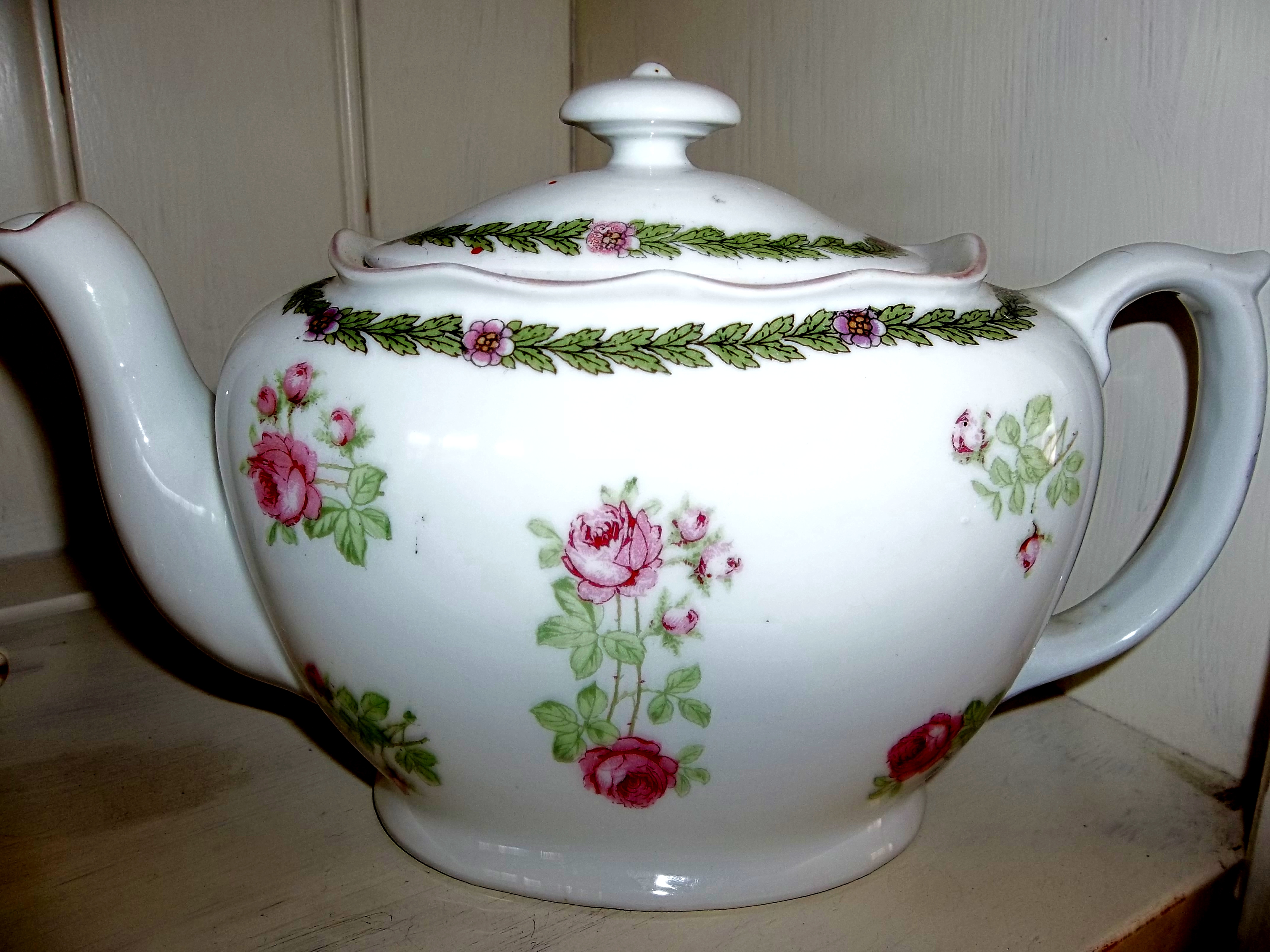
If I’m offered a cup of tea that I know will not meet my impossible standards of taste and strength – other people’s tea is always too strong for me – I add sugar, and then it becomes something else. Tea out of a mug is not the same as tea out of a bone china flowered cup and saucer. I dread the day when I’m plonked in an old people’s home, and will have no lapsang souchong and no bone china tea-cup.

Life without tea is unthinkable. There was no bombing so bad in the Blitz, that you weren’t offered a cup of tea after it; no shortage of water in the Western desert so tight, that there wasn’t always enough for a pot of tea brewed by the tanks; no misery so deep that a cup of tea doesn’t at least give the sufferer a second’s respite; no cold so deep that a cup of hot tea doesn’t warm the innards;  no thirst so terrible in the tropics, that a cup of tea doesn’t quench it, and no morning in the office so boring that a cup of tea doesn’t briefly break the monotony .

I often jokingly use the poet Cowper’s delicious phrase: ‘the cup that cheers but doth not inebriate!’ My grandmother always had a trolley laid for such a cup – on a lace tea-cloth with two tea-cups and saucers, sugar pot and tea-spoons, and the milk jug covered with a crocheted lace doily weighted with coloured beads. (Milk that wasn’t mucked about with didn’t go sour like it does today!)

In her book ‘Urban Shaman’, American writer CE Murphy writes a delicious description of having a cup of tea: “In Ireland, you go to someone’s house, and she asks you if you want a cup of tea. You say no, thank you, you’re really just fine. She asks if you’re sure. You say of course you’re sure, really, you don’t need a thing. Except they pronounce it ting. You don’t need a ting. Well, she says then, I was going to get myself some anyway, so it would be no trouble. Ah, you say, well, if you were going to get yourself some, I wouldn’t mind a spot of tea, at that, so long as it’s no trouble and I can give you a hand in the kitchen. Then you go through the whole thing all over again until you both end up in the kitchen drinking tea and chatting.

“In America, someone asks you if you want a cup of tea, you say no, and then you don’t get any damned tea. I liked the Irish way better.”

She must have forgotten that the American way with tea is simply to toss it into Boston Harbour!

Food for Threadbare Gourmets

This is the perfect cake to have with a cup of tea – if you’re not planning on cucumber sandwiches! It’s the classic French cake with equal quantities of everything. So it’s four eggs, and the same weight of butter, sugar and flour. You can halve the amounts for a smaller cake. Soften the butter, and beat it with the sugar – until it’s almost white and fluffy. Add the eggs whole, one at a time and beat. If it starts to look grainy, add a spoonful of sieved flour. When all the eggs are in, fold in the flour a spoonful at a time, using a metal spoon.

Add enough milk to make a soft smooth mixture which drops off the spoon. Stir in the grated rind of half a lemon. Gently push into a buttered cake tin, the base lined with greaseproof paper, and bake in a moderate oven around 180 degrees. Bake for fifty minutes … if it’s still soft and hissing, cook for another ten minutes.

Leave the cake in the tin for a few minutes, and then tip onto a rack to cool. I make a butter icing for this, soft butter, icing sugar and lemon juice and the other half of the grated lemon rind, all beaten together.
Food for Thought

Development cannot fly in the face of happiness; development should promote human happiness, love and human relati0ns between parents and children and friends. Life is the most important  treasure we have and when we fight, we must fight for human happiness.” Jose Mujica, President of Uruguay at the Rio Conference


.

66 Comments

Filed under cookery/recipes, food, great days, happiness, humour, life/style, philosophy, The Sound of Water, Thoughts on writing and life, Uncategorized