Category Archives: Thoughts on writing and life

Eye witness to history

100_0101
I noticed a report last week that after the Queen left Berlin in a bright yellow outfit, she then changed into a sombre, slate grey coat and hat by the time she reached the concentration camp of Bergen- Belsen.

We just called it Belsen in my day. We had travelled through Hitler’s monument – Post- war Europe – which seemed from the train to be nothing but mountains of bricks and ruined suburbs with a few half houses still standing. They looked like half a doll’s house where you can re-arrange the furniture. In these grotesque rooms, pictures were askew on walls, wardrobe doors hung open, chairs still sat round marooned dining tables and empty fireplaces waited to be lit by ghosts.

I was awed into silence by these gross and hellish scenes. But at nine, I couldn’t even begin to understand the human tragedy, the broken lives, the blasted families, and never realised that maimed and starving people were actually trying to live in these apocalyptic holes and hills of smashed brick and rubble.

At a station where we stopped to disgorge some of the passengers crushed into crammed carriages, thin, white-faced children banged on windows begging for food, and scrabbled at the side of the track looking for odd lumps of coal. We were seated in the restaurant car, eating the first white bread I had ever seen, quite unlike our war-time rations, but the thrill of this exciting food was dulled by the sight of the pale, dust-smeared faces outside the window which didn’t open.

Finally Hanover at midnight. The station was the usual bedlam, the engine hissing and roaring, people calling and shouting and waving, and the lighting so poor that it took longer than usual for everyone to sort them-selves out and find each other, I thought. When all the debarking travellers had trickled off and the train pulled away again, my stepmother and I were the only people still standing waiting to be met. I had assumed that all the people I had seen were in the process of coming or going – now I discovered that they had all settled down for the night again, thousands and thousands of people sleeping on every available inch of floor, draped up and down stairs, lying propped up against walls where there was no room to stretch out.

When we had picked our way over the ragged, hostile bodies to the main entrance of the station to get into a military jeep to take us to a bed for the night, I stood momentarily at the top of the steps. Straight ahead, the moon was shining through a large, gothic-shaped empty window high in the wall of a bombed church. There was no sound of traffic in the ruined city and no street lights, just silence and the un-earthly beauty and light of the silver moon. And then blessed cold fresh air sitting in the open jeep after the foetid atmosphere of the station.

The next day we arrived at the site of the former concentration camp and moved into our new home, the spacious former digs of Josef Kramer, the notorious Beast of Belsen. Hoppenstadt Strasse was the only residential street in the camp, and had been the quarters of the prison guards and their families before the liberation by shocked British soldiers.

We children were not told the history of the place, but it was as though the energies of the past were impregnated in the walls and streets and trees and stones. It felt like living on shifting sands of uncertainty and fear of all the things we didn’t understand and that no one ever explained.

Violence seemed to be the atmosphere we breathed. There were different layers of this violence. One was when I went to collect my best friend for our early morning riding lesson, and couldn’t raise her. Later at school I learned that her single father had shot her and her brother and himself – Mary in the kitchen, her younger brother on his way to the front door. I had nightmares for months about Mary and whether she had gone to heaven or hell, and what her brother’s last moments of terror were like as he fled from his murderous father. I didn’t feel I could discuss this with my new parents, my father just back from ‘abroad’ after seven years overseas, and a new stepmother.

There were hordes of unpredictable Yugoslav guards in navy-blue greatcoats who patrolled the place guarding it, though I never knew what they were guarding it from. They had a reputation for being dangerous, and every now and then one would shoot himself or a comrade. And yet another aspect of the incipient violence was that a single British car on the road at night was such an irresistible target for angry defeated Germans, that my father was run off the road and injured several times travelling between Hanover and Belsen.

Behind our house I played for hours in a pine forest, rich in bilberries, where the hungry Germans would come in autumn to pick this source of food in a starving land and demolish at the same time my little ‘huts’; while a mile down the road was the Displaced Person’s camp, which had previously been a well-appointed Panzer training depot. DP’s, as they were known, were the survivors of Belsen, still waiting for passports or permission to make their way back home across the bomb-blasted continent to find the survivors of their scattered families. To a puzzled child they seemed un-accountably unfriendly when our paths crossed.

One fine summer’s day the DP’s torched the pine forest and our homes were in danger until the fire was checked. They were trying to hurry up the authorities, and it was a desperate gesture to show their frustration. But the Allied authorities were dealing with twenty million people trying to get back to homes and families, and many of the refugees had no homes, families or even countries to return to. The problem grew under our eyes, as German refugees, another two million in the next few years, fled from the eastern sector and the Soviets.

They came straggling down Hoppenstadt Strasse with bundles wrapped in tablecloths, or blankets tied on the end of poles like giant Dick Whittington bundles. Sometimes they were found sleeping in our empty garages, or taking desperately needed clothes off the washing line, and were hurried on or arrested by the implacable Military Police.

These were the times of tension too when Russia began the process of harassing and interfering with traffic to and from Berlin, which finally culminated in the Berlin Airlift with thousands of planes ferrying food into besieged and beleaguered West Berlin. I didn’t understand it, but I felt the anxiety of the grownups. And we had to learn to use new money, which had changed from one set of cardboard to another, I never knew why.

We, the victors, shared the hardships of starving Europe. Our meagre rations were delivered once a fortnight in a cardboard box. I remember my stepmother looking at a small pile of cucumbers, our vegetables for the next two weeks, and asking in despair what we could do with cucumbers for a fortnight. We drank revolting tinned milk, as there was no organised milk supply and no pasteurised herds.

We sat in the dark every night for two hours when the electricity was switched off, and played games like twenty question to while away the pitch black hours. Like everything else, candles were in short supply. We had a puppy who seized the darkness as another opportunity to chew the rubbers that my father used for the Daily Telegraph crossword.

Horses were still an integral part of country life in this part of Germany, and this is where I learned to ride. The British regimental riding stables were run by an aristocratic Prussian officer – not of course using his military rank now- but known merely as Herr Freiser.

I was his star pupil and my father said I was learning to ride like a Prussian officer. Herr Freiser took great pains with me, never guessing that I was terrified of the huge jumps he put me over. Fear runs along the reins, I remembered from reading ‘Black Beauty’, and hoped I was bluffing the far-too-big cavalry horse I rode regularly. A big brushwood jump was one thing, but the fence on the wall was too much, and I came off every time, never knowing what had happened until it was all over.

Herr Freiser’s tall, blonde, classically beautiful Prussian wife regarded me with loathing, as though I was a pet cockroach he was training. I decided she hated all English, and was probably still a Nazi lady.

They lived in the groom’s cottage by the stables and were lucky to have a home and a job in their ruined country, though she obviously didn’t think so. Their gilded furniture, rescued no doubt from their ancestral Prussian schloss, was piled right up to the ceiling in one room, while they lived in the other. Herr Freiser seemed as frightened of her as I was. I realised that he was probably a collaborator with the enemy in her eyes. She would stalk through the stable yard in her immaculate jodhpurs, her glare like a blue flame from her icy blue eyes and thankfully ignored me.

Next week – part two -Belsen – The power of one


Food for threadbare gourmets

Sometimes the pine nuts in pesto are a bridge too far for a tight budget, so I use walnuts instead. Grate half a cup of walnuts in a grater, and then grate half a cup or more of Parmesan. Finely chop about two cups of basil, plus three chopped cloves of garlic, and mix it all together with enough extra virgin olive oil to make the consistency you want- about half a cup. I then add a few table spoons of the hot pasta water help it all amalgamate. I also like this mixture over broccoli.

Food for thought

‘Ruskin had the romantic’s gift for seeing the inanimate world as if it had that moment left the hand of the Creator’.
Oliver van Oss, scholar, man of letters and great headmaster.

27 Comments

Filed under army, british soldiers, consciousness, great days, history, life/style, spiritual, Thoughts on writing and life, uncategorised, world war two

A tearful (sob) tale !

100_0223
If I’m going to cry I want it to be when I’m laughing. I think that may be one of my favourite pleasures, to laugh till I cry… but it’s not something that can be planned… such moments seize us out of the blue, and swoop down without any warning. And then it’s bliss…I love it – having laughed my way not just to good health but to aching sides and streaming eyes.

Tears come more easily to some than others… my tear ducts are the sort that let me down and embarrass me constantly… it was about the only thing I had in common with Princess Diana, being neither blonde, rich, thin, Royal or any of the other things she was…. but she cried easily… she cried waving goodbye to her fiancée when he flew off to NZ for a couple of weeks, she cried, bless her, when the band played God Bless the Prince of Wales on her honeymoon, and she cried among other times, when she was complimented on her work on the day her separation was announced. By contrast her sister-in-law Princess Anne has only gone on record crying once… when she waved farewell to any more cruises on the royal yacht Britannia as it was de-commissioned.

The tough and the strong are sometimes tempted to despise we weaker vessels, and that’s when tears are so humiliating, if we forget that some of the sweetest moments in life, and the most memorable, are those which move us to tears. Tears are one of the things that make us human beings – though I have watched that heart-breaking video when an elephant who had been starved and beaten for fifty years was finally freed, and he wept – rivers of tears slowly trickling down his wrinkled old grey cheeks -and I wept too.

So yes, tears reveal us as feeling human beings… and though times of hormonal change… those teenage years, pregnancy, post-natal months, menopause, depression, even the wrong medical drugs can cause unexpected floods of tears, nevertheless, tears should not be sniffed at. A baby’s tears are his only means of showing his hunger, hurt, fear, anger, discomfort, insecurity and other problems…. but as we grow older and find less direct forms of communication, tears assume a different place in our lives.

They still mark emotions like fear, misery, anger, grief, hurt, but as we grow older – joy too. So why does our culture sneer at tears and try to train children not to cry, with the jeer: ‘cry baby’ or ‘softie’ being an allowed insult in the playground or even worse: ‘don’t be such a girl’.

When I landed in New Zealand in the middle of winter many years ago, my luggage two small children, tears of fright flowed behind my huge black sunglasses in spite of all my efforts at control. And there have been many other moments since when tears marked unforgettable moments of joy and sorrow… including watching first my children, and then my grand-children’s nativity plays… I cried when I watched my tall, skinny thirteen year old son walking away from his childhood into ‘big’ school, head and shoulders above the others his age… at my daughter’s wedding, and my grandchild’s christening… a perfect watering can.

‘Don’t cry when you say goodbye to us’, my eight year old daughter had said before they took off across the world to see their father. So I smiled and waved, and tried to pretend tears weren’t coursing down my cheeks in great rivers. Later, the exquisite voice of Joan Sutherland singing in concert brought tears to my eyes and to many others. Few of us could define what these involuntary tears were triggered by but they were precious, and the moments memorable. I’ve heard other great singers in person including the incomparable Kathleen Battle, but none of them drew that spontaneous tribute.

When my first baby was born the midwife who delivered her did so in floods of tears… she said she always cried when a baby was born. Now, tenderised by life, I know what she means. I only have to see a new born to feel those tears start gushing. It’s hard not feel embarrassed or humiliated by these ever-ready tear ducts.

I am famous in the family for beginning to cry in the cinema at the beginning of a film. As the credits went up on the film ‘The Young Winston’… the traditional ride of the Adjutant on his white horse, up the flight of steps to the library at the end of the Passing- Out Parade at Sandhurst filled me with such nostalgia for my military childhood that I was lost at the first frame.

And I remember lingering in the cinema loo mopping my eyes with my best friend as we tottered out after Disney’s ‘Old Yeller’ (about a Labrador) had ended, ravaged with tears and nearly blinded with clogged mascara. I can go to a funeral of someone I hardly know, as a courtesy to a family member, and become a tearful wreck… not quite sure whether I’m crying in sympathy with those who are really mourning, whether tears are contagious like yawns, or whether I’m touching into old and forgotten griefs.

In the end it’s animals who really pull the heart-strings and have provoked so many gallons of tears I could fill buckets with them … I was ten when I wept over the shooting of the ponies in the film ‘Scott of the Antarctic’… blow the men dying heroically in the snow, it was the ponies I cried over. The deaths of our fifteen or more rescued dogs and a cat was always a tear- streaked nightmare over the years, and it isn’t just me who’s reduced to an emotional wreck by animals.

On one particular personal growth course, a man who had remained unmoved by harrowing moments supposed to break down our innermost defences, went home one night to find his precious bull terrier fighting for her life, and losing it in child birth. The next day, as he told us all about his beloved ‘Maggie’, he dissolved into heart- broken sobs, as did all the women and most of the strong men in the room. Loved animals in distress can make even the toughest weep.

Broken with grief, this man was then able to do the inner work he had come for, the tears had dissolved his emotional barriers, and he became a softer, kinder, warmer person overnight. So in spite of the superiority of those who have well controlled tear ducts, it does seem that weeping is good for the soul, even though it’s terrible for the complexion. Doesn’t seem to matter whether we’re weeping from laughter or weeping from grief, or weeping from any other emotion, tears seem to loosen us up.

Yet mostly, tears don’t seem to come in the moments of great crisis… then the mind is focussed. Shock and intense attention keep us icy cold, functioning unhampered by anguish or emotion… so maybe tears are a bit like Wordsworth’s definition of poetry: emotion recollected in tranquillity, but in the case of tears: emotion when there’s time for it. I rather treasure the words of Kahlil Gibran, who puts tears and laughter into perspective, as ever… that they are both – in the pompous self-mocking phrase of a friend – part of ‘life’s rich pageant’!

Gibran says: “I would not exchange the laughter of my heart for the fortunes of the multitudes; nor would I be content with converting my tears, invited by my agonized self, into calm. It is my fervent hope that my whole life on this earth will ever be tears and laughter.”

So weepers of the world – unite! Hang onto your sodden tissues, and leave off your mascara. Don’t feel intimidated by the stiff upper lips or cold embarrassment of stronger mortals, our ability to cry at the drop of a hat means that we’re living, breathing, sentient beings,
Yours tearfully…


Food for threadbare gourmets

A friend for supper on a cold winter’s night meant that I wanted to spoil her with comfort food, and what more comforting than blackberry and apple crumble?

I had the apples, and a tin of blackberries, though I prefer fresh or frozen, and also often use boysenberries instead. I tipped the cold, cooked sliced apples and the blackberries into a pie dish, with plenty of juice, and sugar to taste; then the crumble was spread on top, baked in a moderate oven for forty minutes, tested with a knitting needle to make sure the crumble was cooked, and served with cream… delicious and she loved it.
The trick is the crumble… eight ounces of flour, four ounces of cold butter, grated and mixed with the flour, six ounces of brown sugar, the grated rind of a lemon, and two ounces of ground almonds. Mixed altogether, it only takes a few minutes to prepare, and not much more to eat!


Food for thought

All children long for recognition and acceptance of their essence – secretly so do most adults. The insistent question inside all of us is: do you see me, not only my body, but my essence; the gifts, potential, needs, wounds, character and quality of soul that shape me individually?
Professor Richard Whitfield

49 Comments

Filed under animals/pets, army, babies, british soldiers, consciousness, cookery/recipes, family, films, food, happiness, humour, love, princess diana, royalty, self knowledge, spiritual, Thoughts on writing and life, uncategorised

The wilder shores of love

100_0542
I’m a sucker for romance, passion, adventure – is there a woman who isn’t? Not the bodice ripper stories of the supermarkets racks but the real thing… the: ’Love is an ever-fixed mark ‘ stuff of life.

I admit I revelled in The Prisoner of Zenda as a teenager, the ‘I did not love thee dear so much, loved I not honour more’, and the red rose delivered once a year to the ravishing queen from her honourable and faithful cavalier, a very English gentleman. And it took me a while to recognise Ashley Wilke’s gutless having his cake and eating it with Melanie and Scarlet, I was so dazzled by his weary elegance and assumption of honour.

But it’s the real thing that hooks me now… the courage to dare and love and think the world well lost in order to follow the heart. So how could I resist Jane Digby? Not her famous descendant, Pamela Digby.

She married the famously un-likeable Randolph Churchill, becoming Winston Churchill’s daughter- in- law, lover of Averill Harriman during the war, mistress of every millionaire, playboy and sex symbol in the post war years… Prince Aly Khan, Marquis de Portago, Fiat heir Gianni Agnelli, Baron Elie de Rothschild, and Stavros Niarchos amongst others. Ed Murrow intended to give up his wife for her, and returned home to fix it, and reneged. She became the fifth wife of impresario Leland Hayward, and finally, when he was eighty-one, snaffled Averill Harriman again, this time in marriage, and became powerful and respectable as US Ambassador to France. No, Pamela Digby’s quest feels like something other than love.

But her beautiful ancestor Jane Digby was something else. Jane was married very young to a man twice her age, who dallied with a servant girl on their honeymoon, and not surprisingly the marriage never took off. Left to her own devices while Lord Ellenborough devoted himself to his political career, she not surprisingly fell in love with a gorgeous playboy, Prince Felix Schwarzenberg, who was besotted with her. Jane, young and naive, never thought of hiding her love, and of course they came to grief.

The Prince was withdrawn from London in the interests of his glittering diplomatic career, Ellenborough divorced Jane – a horrendous and tortuous decision which entailed Jane’s actions being dragged through the House of Lords and the House of Commons and her becoming a pariah – and she followed her lover to Paris where she gave birth to a daughter. Schwarzenberg kept her on a string for some years, and Jane was too blinded by love to see it.

Finally she left and went to Munich, where the King Ludwig, a clever intelligent man became a close and loving friend, and an upright but ultimately boring German aristocrat wooed her for some years before she gave in… and then she fell in love with a handsome Greek count. Her husband Baron Karl von Vennigen fought a duel with Count Spiridion Theotsky… and Jane ended by running off with her glamorous Greek. They enjoyed a lotus- eating life in places like Corfu, before ending up at the court in Athens. Von Vennigen never stopped loving the fascinating Jane and wrote to her until he died.

In Athens her Greek husband became unfaithful so Jane took up with a sixty- year old white mustachioed Pallikari bandit chieftan , Cristos Hadji-Petros.
She entered  into mountain life wholeheartedly, dressing like the peasant women of the tribe, and learning to cook, make feta cheese, sleep in the open air on goats-hair blankets, galloping on horseback around the mountains, drinking retsina and making mad, passionate love with the wicked old bandit.

It all fell to pieces when Jane’s maid told her she having trouble fending off the calculating rough brigand who smelt of garlic and too few baths. Jane and her maid disappeared from Athens, Jane now sad and depressed and nearly fifty… and she decided to explore all the ancient cities and historical sites now under the sway of the latest bandits, Isis.

She negotiated a bodyguard to escort her to the glorious ruins of Palmyra. Even back in 1853, tourists were drawn to the dangerous journey to this fabled city, and the Bedouin tribes competed against each other to guard travellers from other tribes who threatened to rob the Europeans. Sheik Medjuel el Mesrab was the Bedouin chief who commanded Jane’s bodyguard, and by the time they had reached Palmyra, he had proposed to Jane and offered to give up his wife.

She didn’t succumb straightaway, and later had to fend off an offer from another determined Arab sheik. Feeling depressed and lonely she continued travelling before returning to Damascus. But Medjuel had kept tracks on her, and as she approached Damascus he rode out to meet her, with an Arab mare as a gift of welcome, and his wife already sent back to her people with her dowry.

They fell deeply in love and married. Jane spent the last twenty five years of her life living partly in Damascus and partly in the desert whenever her husband had to take his flocks and people to different areas of grazing, or to fight other tribes. Jane rode with him into battle. She was a brilliant horsewoman and broke in many of Medjuel’s Arab thoroughbreds, she spoke nine languages, was a witty conversationalist and a talented artist. Her exquisite manners, gentleness, beauty and charm won over both the reluctant tribe and the disapproving local community.

Jane threw herself into the life of the Bedouins when they camped in the desert, and dyed her long fair hair and eyebrows black as the Arabs felt that fair hair attracted the Evil Eye. She plaited her hair in two long braids which reached to her feet and wore the clothes of the Bedouin women, learning to milk camels, prepare her husband’s food, and stand and wait on him, and wash his hands and hair, face and feet. Medjuel on the other hand, impressed everyone who met him with his refinement, intelligence, and elegance.

In her home in Damascus she had a huge menagerie of creatures and created one of the most famous gardens in a city famous for its gardens. She and Medjuel had a passionate and tempestuous relationship which never lost its intensity in over twenty five years. Nearing seventy four, she wrote in her diary: “it is now a month and twenty days since Medjuel last slept with me. What can be the reason?“ Though younger than Jane, Medjuel was feeling his age by now, and this year stayed close to his wife instead of joining his tribe. Not long after writing these words, she faded away after an attack of dysentery, Medjuel by her side.

The Sheik was persuaded to ride in a closed black carriage to her funeral, until suddenly overcome by grief and needing open space he bolted from the carriage and fled in the opposite direction to the cortege. Everyone was shocked by this breach of funeral etiquette. But as the clergyman was intoning: ‘ashes to ashes’, Medjuel galloped up on his wife’s favourite black Arabian mare. He sat motionless staring down into the grave and no-one moved or spoke. Moments passed as he sat there in anguish and then the Bedouin Chief rode away.

Jane would have loved her husband’s farewell. He returned to the grave once more. He brought a rough slab of Mazoni rock, carved to fit over the base of Jane’s tomb. He carved her name: Madame Digby el Mezrab on it in Arabic and disappeared into the desert.

A missionary who knew her well described her life as: ‘wild, passionate and reckless’, while her devoted friend, the explorer Sir Richard Burton said that her ‘life’s poetry never sank to prose’. Her life is an inspiration to a romantic. By following her heart she finally found the one person in the world, in Truman Capote’s touching words in The Grass Harp:’ … from whom nothing is held back…’ and: ‘to whom everything can be said’.

And those words, it seems to me, are the definition of true love. They mean perfect trust. No co-dependency, neediness or misunderstandings through lack of communication. But trust takes courage, and maybe to paraphrase the words of that haunting song ‘The Rose’, true love is only for the brave … like Jane Digby el Mesrab.


Food for threadbare gourmets

Sometimes I just want a plate of roast vegetables, but also feel I must need some protein. I kid myself that this pea-nut sauce will fill the gap. It’s quite unlike the traditional pea-nut sauce, and was dreamed up in front of me by a chef at a demonstration.
In a stick blender, I spoon a cup or more of pea-nut butter, the skin thinly peeled from a lemon, plus the juice, a good teaspoon or more to taste of dried thyme, a couple of garlic cloves, a tea-spoon of fish sauce, a dessert-spoon or more to taste of brown sugar, plenty of salt and black pepper, and a cup or more of olive oil. Just whizz everything together. And add more olive oil if you need it. It lasts for plenty of time in the fridge, and is good with baked or sauted vegetables for a light meal, and also with baked salmon.


Food for Thought

He either fears his fate too much,
Or his deserts are small,
That puts it not unto the touch
To win or lose it all…
From ‘My dear and only love’, John Graham, Marquis of Montrose


Lesley Blanch who died this year at 103 wrote The Wilder Shores of Love


26 Comments

Filed under cookery/recipes, gardens, great days, happiness, history, life/style, love, Thoughts on writing and life, travel, uncategorised

Could this experiment change the world?

100_0395

Andrea was a Dutch woman who had lived through the German occupation of Holland. Her brother hid in a wardrobe in her bedroom for the whole five years of the war to avoid being carted off as slave labour to Germany. When there were searches by Nazi soldiers she had to fend them off to save her brother.

When the war was over, after a stint as a glamorous air hostess with KLM, she emigrated to this country to put the miserable years of her adolescence and then a failed marriage behind her. Her degree in social science was a passport to nowhere in the early sixties in New Zealand. The only work she could find here was teaching; and the only teaching domestic science, which was called “manual”- which meant cookery and needlework.

Her resourcefulness raised these two domestic chores to an art form. The children didn’t actually learn the boring basics of scones, custard and rock buns like most other unlucky students back then. No, they learned to cook with garlic and herbs and spices, unheard of in the days when the only use for olive oil was for curing earache with a few drops on a dab of cotton wool, and garlic was a wild flower…

Her manual classroom became a mecca for school inspectors when Andrea transformed it with the glorious colours and designs the children created in sewing, and was a source of chagrin to the resident art teacher. Andrea taught both boys and girls, and I still have one of the vivid embroidered hangings they made.

To keep the whole class occupied while she taught them one by one to thread the sewing machine, she tossed a selection of brilliantly coloured wools on the floor, with some square pieces of hessian, and told them to make shapes with the colours and embroider them onto the squares. These wonderful squares still vibrate with colour and spontaneity. Andrea then sewed all the squares onto large sheets of hessian, and had these amazing techni-coloured wall-hangings draped across the drab manual classroom walls.

She taught the children how to thread a sewing machine by giving each step of the process a phrase about an animal – “Catch the fish, watch the bird……” Twenty years later, at the testing station for a warrant of fitness for her car, a tousled head popped up out of the inspection pit beneath the car, and said delightedly: “It’s Mrs Winter, isn’t it ? ” and then proceeded to recite his sewing lesson – “Catch the fish, watch the bird… !”.

These sewing classes were heaven on earth for one little Indian boy, who seemed to have been born as a master tailor. One day, he made a wonderful waistcoat, but there was only enough material for the edges to meet, and he and Andrea were puzzled as to how to fasten it. At the next lesson he told her he had had a dream and had solved the problem.

He then solemnly created frogging and bobbles to loop across and fasten it. When Andrea told this story in the staffroom, everyone was amazed. This child had long since been written off as so dumb that everyone else had given up on him. He sat in class, one of the silent, forgotten army of apparent no-hopers.

So, one by one, each teacher crept into the manual class to silently observe this child, and was blown away by his vivacity and calm confidence, and how all the other children deferred to the “master” of this skill. It changed his life.

I thought of Andrea and her little master tailor who moved from miserable anonymity to confident authority when I read the story of Japanese scientist Professor Masaru Emoto. He’s already famous for his discoveries about water and how it absorbs and reflects both good and negative energies. His latest experiment was with rice.

He put a handful of rice grains into three glass beakers and covered them with water. Placing them on a table, he visited them every day for a month. The first glass he thanked every day. The middle glass he ignored. The third glass he insulted every day.

At the end of the month the rice in the first glass was fermenting gently and emitting a sweet smell. The insulted rice had mouldy patches and didn’t look very good. The ignored rice in the middle glass had rotted and turned black.

What a metaphor for how we treat people, and how we can actually change the world by appreciating everyone. Could we turn around the brutality and pain that rages in places like the Middle East, in ghettoes all around the world, in zoos and in jails if we all stopped judging people and creatures in our minds, stopped writing them off, or ignoring them?

Andrea changed one little boy’s life by acknowledging and thereby encouraging him, and giving him self- respect, and this changed everyone else’s minds about him. What could we do for the sulky hurt person on welfare who feels judged, for the dunce at the bottom of the class who has no-one to encourage him and root for him, for the pining desolate animals in zoos far away from their natural habitat and their fellow creatures. What could we do to heal the ignored and insulted planet by acknowledging and thanking it every day?

If we all sent a different energy to thugs and terrorists of any creed or colour, suspending judgement, anger, condemnation or horror at their actions, could we change our world and help to spare their victims? If parents found new ways of talking to their children and encouraging them instead of criticising them; if they treated their children with the same respect and courtesy as their friends, so that children didn’t lapse into desperate negative attention seeking, could we have a world of happy loving children growing into loving adults?

Utopia has been a dream for centuries, but maybe this simple experiment, showing us that words can make a difference, that the right words can create miracles, and that the wrong words can destroy, could be the breakthrough. This simple experiment shows us that with our words and our feelings we can create the energy of life or death, of happiness or misery: that we can all be responsible for our own world, and we could each make a world in which only goodness and mercy exist and where only love prevails.

It’s like the prayer that Jesus taught – not something to publically parade and talk about, but something we can do privately for the world, and no-one need ever know… Could we change our world? I’m going to have a go… maybe you will too – in private…as I said to a friend – think ‘rice’.

The video on youtube is worth watching https://talesfromthelou.wordpress.com/2015/05/12/can-thoughts-affect-the-environment-masaru-emotos-rice-experiment-120/

Food for threadbare gourmets

Sticking with no sugar, and loving sweet things, I found this cake was delicious. Take two cups of chopped baking dates and gently boil them in half a cup of water… adding more water if they get too dry… they need to be moist and soft. Stir or mash to a mush.
Put them in a bowl and stir in half a cup of oil – I used light olive as I’m suspicious of some other manufactured oils ( the recipe said to use melted butter, but I wanted a dairy free zone too). Grate a courgette, a carrot and 200grams of sweet potato/orange kumara. Stir them all into the date mixture.
Then add four beaten eggs, grated zest of two lemons, three teaspoons of mixed spice, 200 grms of almond meal, a 100 grms of self rising flour, either gluten free or ordinaire, a teasp of baking powder and quarter of a teasp of salt.
Mix everything together with a slotted metal spoon and tip into a prepared greased and lined cake tin. Bake for an hour in 180 degree oven. If it starts to brown, cover the top with tin foil. Leave in the tin for ten minutes before turning out. (I used a loaf tin)
The recipe suggested icing of cream cheese, zest of 2 lemons, two tablsp of lemon juice and three or four tablesp of maple syrup.
Sounds delicious but I decided not to despoil the sugar free zone, contenting myself with a little sprinkling of sugar on top of the cake before it went in the oven just to make it shiny and sweet.
It’s good while still warm and keeps well wrapped in foil in the fridge for several days. I sometimes had a slice spread with butter too.


Food for Thought

“I’ve learned that people will forget what you said, people will forget what you did, but people will never forget how you made them feel.” – Maya Angelou

24 Comments

Filed under consciousness, cookery/recipes, environment, food, great days, happiness, Japan, life and death, love, peace, spiritual, Thoughts on writing and life

A hiatus

100_0584Dear friends and fellow bloggers, the writing gods have withdrawn their inspiration from me, and have made it clear that this is a moment for Hestia, the goddess of peace and replenishment, solitude and silence to make her entrance.

So for now, it is a hiatus – an interruption. I shall follow you all from afar, knowing that you too will come and go in the rhythms of life; and lacking all inspiration myself at the moment, I will share and sign off with words from an inspirational poet, Rabindranath Tagore. It is our golden autumn here in the southern hemisphere, and this is how it was in Bengal a hundred years ago when Tagore was writing:

Autumn
Today the peace of autumn pervades the world.
In the radiant noon, silent and motionless, the wide stillness rests like a tired bird spreading over the deserted fields to all horizons its wings of golden green.
Today the thin thread of the river flows without song, leaving no mark on its sandy banks.
The many distant villages bask in the sun with eyes closed in idle and languid slumber.
In the stillness I hear every blade of grass, in every speck of dust, in every part of my own body, in the visible and invisible worlds, in the planets, the sun, and the stars, the joyous dance of the atoms through endless time – the myriad murmuring waves of Rhythm surrounding Thy throne.

103 Comments

Filed under literature, poetry, Thoughts on writing and life, Uncategorized, writing

The preciousness of people

100_0218
A knock on the door revealed a stranger holding a white enamel colander full of strawberries. We had moved into this house in town the day before, and he introduced himself as a neighbour.

That was a very meagre description of what he was, he was a glorious eccentric who I watched every day cycle slowly past on a very high old fashioned bike with a basket on the front, which gave the impression of being far too big for his small skinny frame, and liable to go out of control at any minute. He was on his way to the docks where he was a dock worker – a somewhat unconventional one I imagine.

Again a meagre description of this blue- eyed, wildly bearded, elderly Irishman, who revealed to us that he was a sort of remittance man, exiled from Ireland by his despairing family to make his somewhat erratic way in the antipodes.

He was a poet, he told us. I believed him though I never saw any of his work. His life was a poem. We went to his house, which was a poky little state house. Inside it gave the impression of being a miniature stately home, along the lines of an Irish demesne… a few good but battered antiques, the odd oil painting and large old-fashioned sofa and chairs covered in old fashioned country house flowered linens.

This splendid impression of stateliness continued into the garden, which was quite big, being on a corner. He had transformed this rocky site into a miniature paradise, grass walks edged with pleached fruit trees, a vegetable patch, a strawberry bed, a tiny terrace and lawn, and best of all, a deep pond edged with large rocks, which he had created by levering the huge rocks day after day over a period of six months, until a deep hole had been carved out of the stony ground.

He was an eccentric, one of the many who, when I look back, have enriched our lives and given us fun and pleasure. There was Mr Macdonald, a direct descendant of Beatrix Potter’s Mr Mcgregor, who was our neighbour in the country, another Irishman. He only wore a pink woollen vest with long sleeves  and braces, all summer and winter, except on Sundays when he looked quite unnatural, shaved and spruced up in a short sleeved shirt in which he looked very ill at ease. Every spring he would arrive at my door in his pink vest, braces and hob-nailed boots, bearing a huge bunch of sweet-smelling narcissi which I had once told him reminded me of spring in England. He never missed a year thereafter.

There was Alf, an Englishman who served in the Malayan Police, and every three years when his leave was due, not having any family he wished to return to, he would sail to the bottom of the Arabian Peninsula. There he would buy a large flock of goats, and then proceed to drive them through the desert, using the goats as food and currency, until he reached Port Said. There he would get a boat to Liverpool, make a quick visit to his sister there, and then return to his tropical home in Kota Bahru.

Here too, lived Mammy, a giant White Russian, over six feet tall, wearing thick pebble specs for her short sighted grey eyes, and wearing the first caftans I ‘d seen over her enormous frame, all in brilliant colours and garish patterns . Mammy ran the local hotel where everyone gathered in Kota Bahru, and was a local joke too. As a seventeen year old I didn’t think she was such a joke. She and her husband had escaped the revolution in Russia, and made it safely to Shanghai like so many other White Russians.

They had survived the rigours of Japanese occupation and then fled Mao’s Communist takeover, ending up in Singapore. There, one afternoon, Mammy’s husband had walked down the road to buy an evening newspaper, and had never returned. No-one knew whether he had run away or was the victim of some crime. And Mammy was now surviving in this rather heartless superficial society in the remotest part of Malaya but creating laughter and fun all around her – actually rather more than a survivor.

Another neighbour was our Dutch friend Andrea, who had an antique shop full of the most exquisite items of a particular sensitivity, many of which I still posses. She was as nutty about animals as I, and far more lawless, striding into a bikie house to steal/rescue weeping puppies with no tails. I revelled in her poetic garden and laughed to see her huge magenta magnolia blossoms each wrapped in a plastic bag to protest them from the wind… not a good look actually!

Her house was beautiful in that glorious Dutch interior way of Pieter de Hooch and Vermeer, her pottery made you want to hold it and stroke it – and I have some – and her paintings were romantic and exquisite, and I have some of them too. I could actually write a book about her…

These memories were prompted by a conversation with a neighbour on my walk this morning. Since some of them read my blog, I cannot reveal what we talked of, or his glorious quirks of personality, but he reminded me of the joy of being with people who allow their personalities to flower, with no thought of what anyone else may think. Eccentricity is simply individuality, unself-consciousness, and the courage to be and do what feels right. When we are in the company of such people it feels as though ‘the waters of life’ are flowing, there are no limitations, and all things are possible.

Martin Buber, the great Jewish philosopher wrote that: ‘Everyone has in him something precious that is in no one else. But this precious something in a man is revealed to him only if he truly perceives his strongest feeling, his central wish, that in him which stirs his inmost being.’

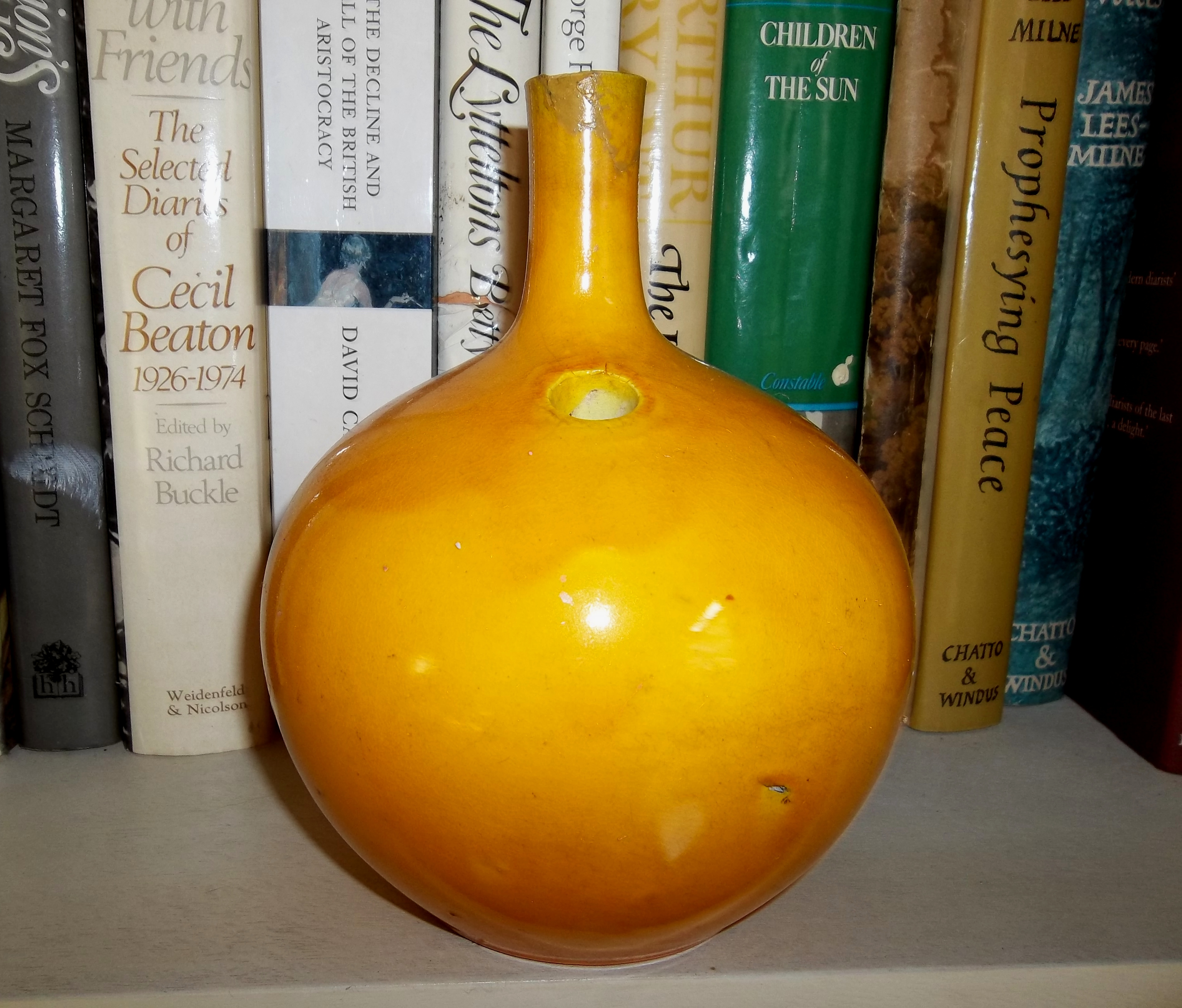
P.S. The picture is of an antique English drinking jar given me by my friend Andrea.

Food for threadbare gourmets

A faithful follower e-mailed me yesterday and asked if I had a recipe for Simnel cake. This is the light fruit cake that’s traditional at Easter, so I told her I’d blog it today. I use Nigella Lawson’s recipe with my own adaptations.

When I make it, I prepare the tin as usual, and then cream 175 g of soft unsalted butter with 175 g of caster sugar. Then mix 225 g of SR flour with half a teasp of cinnamon, a quarter of a teasp of ginger and 25 g of ground almonds. Add one egg with some of the flour mixture to the butter mixture, and mix two more eggs into the rest of the mix in the same way, before adding two tblsp of milk. Finally, fold in 500g of mixed dried fruit, plus some chopped glace cherries if you like them.

At this stage I put half the cake mix in the tin, roll out about 400g of marzipan, cut into a cake sized circle and place on the cake mix, then cover with the rest of the cake. Bake for an hour at 170 C, then turn it down to 150C and cook for another hour and a half. It’s cooked when it’s risen and firm. Let it cool completely on a rack before taking it from the tin.

When cool, paint the top with apricot jam, and roll out another 400g of marzipan and stick it on. With 200g of marzipan, make balls representing the eleven apostles – Judas surplus to requirements here – and stick them on using an egg white – beaten to just frothy. Some people quickly put it under the grill to make it look slightly toasted.

32 Comments

Filed under colonial life, cookery/recipes, culture, food, gardens, great days, life/style, philosophy, spiritual, Thoughts on writing and life, Uncategorized, village life

When is right wrong?

100_0955

It’s always been quite easy to be a pacifist in New Zealand for the last fifty years. Vietnam seemed indefensible to many, and our nuclear free policy made it feasible to take the moral high ground and declare that war is wrong.

I was forced to think about this on reading of the First World War project at Paddington Station in London, where a magnificent and moving statue of an unknown warrior stands. In full battle kit and helmet, he is reading a letter. As part of the commemorations marking the start of World War One, writers have been invited to write a letter to him, and Stephen Fry, wit, comedian and actor was amongst the first to write his, and it caused a sensation.

He wrote it as from a pacifist brother. Though he got historic details wrong – a pacifist would not be sitting at home then, he’d either be in prison or working on a farm, his letter moved many people. I’ve always been firmly behind conscientious objectors – (I like the moral high ground!) but this letter made me think hard about what was the right thing to do then, and how the right thing could very easily seem to be the wrong thing.

I thought about the horrific killings at schools and other places in the last few years, where deranged gun-owners shot numbers of their fellows, and if they didn’t end up shooting themselves, were shot, in order to stop them killing any more innocent victims. These incidents made me think when is it wrong to kill another human being, if there is no other way to stop them killing others. As pacifists do we stand and watch while others are killed, or do we intervene in whatever way we can, to protect the innocent?

This was actually the dilemma in the World Wars. Revisionist historians have said that there was no need for Britain to go to war in 1914. But Britain had informally agreed to support France if she was attacked in order to keep the balance of peace and power in Europe. More importantly, she had signed a pact in 1839 with four other countries of Europe, including Germany, to protect Belgium and allow this war-torn corner of Europe to enjoy being a neutral country, safe for the first time in history from being fought over. It was known as the cock-pit of Europe. It took the British Foreign Secretary, Lord Palmerston, nine years of diplomacy and negotiations to get the five signatories to agree to preserve Belgium, and they included France, Russia and England, and also Germany and Austria.

But Belgium was doomed as soon as the Prussian General Schlieffen began planning a war for German supremacy, because his plans for invading France, took in Belgium first. By then, under Bismarck’s influence, the German nation had become a military one. Invading Belgium didn’t bother them, though it did the honest German ambassador in London, Prince Lichnowsky, whose anguished telegrams begging the Kaiser not to invade, I have read.

In Belgium the Germans did what they did at Lidice in Hungary and Oradour in France in the Second World War, when they blamed the Nazis for these unspeakable atrocities. No Nazis around in the first war, but they still burned villages, hanged one man in ten and sometimes one man in two, and shot women, children and babies, the youngest three weeks old – at Dinant – as reprisals against any Belgians who had attempted to resist. Before the war was four weeks old, towns and villages had been sacked and burned, their people shot, and Louvain, and its ancient library reduced to cinders. So the choice for many Englishmen was clear – stand by and watch as a pacifist, or try to stop what seemed like a barbarian host?

The British soldiers who went to war then, were part of the history of England which had always tried to stop one power dominating and enslaving all of Europe, from Louis the Fourteenth of France to Napoleon. To go to war seemed to many who joined up then, to be a heroic attempt to save civilisation, and even more so in the Second World War, when Hitler was enslaving the civilised world.

The tragedy of resisting a violent and merciless enemy is that too often all the combatants find themselves using the same methods as the aggressor… war. But can we stand by and hang onto our principles of not killing, when all those we love will be destroyed, and not just those we love – our society, our country, and our whole civilisation. This was the choice which thinking people faced in both world wars.

When World War One was declared, England’s army was smaller than Serbia’s – the tiny country where the match had been lit at Sarajevo. So England’s armies were citizen armies, in both wars, made up of peace-loving men called up to defend their country. There’s a lot of research to show that many soldiers when they fired their rifles at the advancing enemy, didn’t actually shoot at the enemy, but aimed to miss, and that even more didn’t shoot at all. They too faced choices on the battle field which are impossible for us to imagine, when like me, we are living in a safe, peace-loving democracy.

So though I believe in peace, and have always supposed I was a pacifist, and attended Quaker meeting, where everyone was a declared pacifist, do I still believe it is possible to be one when the chips are down? I don’t know any more … Aggression turns easy choices upside down, when right – not killing – seems wrong, and wrong – fighting – seems right.

The wonderful story of the American colonel in Iraq, surrounded by an angry mob intent on violence, calling his armed troop to a halt, ordering them to kneel and point their guns to the sky, immediately defused the threat of violence on that occasion. So how do we defuse the violence of would- be psychopathic conquerors who believe that might is right? Maybe only people power can do that – and that can happen – as it did at the Berlin Wall.

Maybe it just needs enough of us to say: “They shall not pass…”
Food for threadbare gourmets

Something to eat with a glass of wine is one of our specialities in this village – among my friends anyway. It’s so easy to share a glass of wine and a nibble on a Friday night, without all the hassle of a dinner party. The latest craze is kumara skins – kumara are the Maori sweet potato that Kiwis pine for when they leave this country, but even ordinary potatoes are good this way.

Boil scrubbed orange and golden kumara until soft, and then cut them into thin wedges, leaving about a cm of flesh. Heat hot oil until it’s just smoking. Dust the kumara with seasoned flour and fry until golden. Drain and sprinkle with sea salt. Eat the skins with sour cream sauce – half a cup of sour cream mixed with a tbsp on mustard, fresh herbs and lemon juice.

Food for thought

There is something that can be found in one place. It is a great treasure, which may be called the fulfilment of existence. The place where this treasure can be found is the place on which one stands.

Martin Buber 1878- 1965  Jewish philosopher


48 Comments

Filed under army, british soldiers, cookery/recipes, history, life and death, military history, peace, philosophy, spiritual, The Sound of Water, Thoughts on writing and life, Uncategorized, world war one, world war two

Dancing to the music of time

100_0440 - Copy
I climbed up the rusty fire escape smothered in trails of blue flowering morning glory and stepped onto the veranda of a very big two- storied, shabby white house built on the side of a volcano. The morning glory swung from trees, twisted up the fire escape, and swathed both house and garden in carpets of greenery and purple trumpet shaped flowers. With pillars, porticoes, verandas and banisters all festooned in drooping creeper, it looked like a romantic, deserted Southern mansion.

Once on the veranda I peered through the windows, and beckoned to my slightly reluctant partner in crime to join me. It was obviously the home of students or alternative life stylers on this floor, the only unusual thing about their chaotic living arrangements being the live rabbits who were hopping about the grubby carpets. Downstairs a motor bike gang who seemed to have wrecked the place, had their bikes parked inside the entrance hall.

Reader – to quote Charlotte Bronte – we bought the house. It took time to track down the owner and persuade him to sell, but we did. The room where the rabbits had bred was forever known as the rabbit room during our years in the house. The occupants moved out, but that was all. It was up to us to break down partitions, rip up revolting carpets, clean, scrub, paint and restore – including dozens of missing banisters – used no doubt for firewood. The bikies had left behind more than indescribable squalor but awful energy as well. But for the first time since its original owner the house had become a family home again, not a collection of shabby flats.

The house had been built in 1875 by a French architect for himself, described on the title as Jean le Bailly Hervei, gentleman. The first thing we did was to rip out a partition and remove a door and two huge cupboards. This revealed Jean’s conception of a huge central hall, twelve feet high, thirty feet long and ten feet wide, stretching down the centre of the house, and looking out over the harbour and then to distant hills beyond. When I stood at the huge French doors and watched the flaming sunsets or the black clouds scudding in from the hills so that I knew what the weather would be like in half an hour, I felt close to Jean le Bailly Hervei.

He designed this splendid roomy house with every French window and door opening towards the sun and these magnificent views, and each room led off from the airy hall on both the top and the bottom floors. The floor of the top hall I painted a rich pumpkin colour which picked up the shades of pumpkin and rose and purple and cream in a long Kelim rug which fitted the space. The bottom hall which matched the top, I painted white, including the floor, and blue and white curtains and matching table cloth over a round table obliterated traces of the former tenants and their bikes. My son painted his bedroom floor lime green to go with his colour scheme.

The children and the little frolicking dogs brought life and fun into the house, and music rang through all the spacious rooms – the children played the piano and their flute and clarinet – me – the stereo –  mostly Bach’s Brandenburg concertos, Beatles, Joan Baez and Cat Stevens.

One day while clearing the garden of morning glory, I found a three foot high, concrete garden gnome hidden under the greenery. We dragged him inside, and since we had friends staying and my birthday feast that night, I invited the gnome to dinner too. He presided in a chair at the head of the table and we had lots of laughter at his expense.

When we moved on, children gone, the psychiatrist who bought the house from us, an hour after it went on the market, asked me six months later at a party, what we had done to remove the brutal vibrations of drugs, alcohol, violence and fear which we had inherited. I was fascinated that a conventional medicine man should acknowledge that old energy, and that he had thought about it.

We brought colour and energy into the house, I said, along with all the books and precious things we’d loved and collected, including tapestry and patchwork cushions and crocheted bedspreads I’d made. We had bowls of pot-pourri and flowers, and often used candle- light. But the two things that must have made the real difference, I told him, were that we all meditated, and there was always music being played. I think more than anything, it was the meditation and the music, I said.

These memories came back to me today when I was reading that world-renowned neuro-scientist Oliver Sacks says that music affects the brain more than any other discipline. It is, he says, the only discipline that actually changes the physical appearance of the brain. We are designed for music, for ‘its complex sonic pattern woven in time, its logic, its momentum, and its unbreakable sequences’

In Australia in a school where they have a Music Excellence programme the students spend many hours playing rehearsing and having music lessons. At prize-givings, eighty percent of the top students receiving awards for academic excellence were also music students.

They mostly spend more than ten hours a week involved in their music and have almost no behaviour problems or any upsetting emotional or social issues even though they come from both rich and poor homes, single parent homes and every the other variation on backgrounds which could spell problems for children.

Do we know whether the music acts as a stress release, or whether it builds such emotional equilibrium and peace of mind that its practitioners can weather all sorts of stresses without problems? Maybe it doesn’t matter. What does matter to us is that we recognise the value of music, and allow ourselves to receive and enjoy its healing and strengthening properties. Some research has shown that people who learn a musical instrument are less likely to suffer from Alzheimer’s.

Music is supposed to teach basic skills such as concentration, counting, listening, and cooperation, help with understanding of language, improve memory, and help learning in all other areas. But actually, it doesn’t matter what the benefits are, it’s the sheer joy of music that enriches our lives. Perhaps it should be compulsory in schools, and be ranked along with writing and arithmetic as one of the necessities of life.

And what I find amazing is that music healed a house. Once it had dissolved the top layers of fear and anger and violence, it seemed to penetrate to other layers of energy and atmosphere… reaching through levels of sadness and regret and loss, until finally the sweetness of the music uncovered all the layers of time, and we reached the gentleness and joy of Jean the Bailly Hervei .

It was a voyage of discovery travelling back into the past and becoming aware of the lives of so many who had lived there before us. Music gathered together threads of sweet feelings from the past, and stitched them into the tapestry of life that we were adding our colours to. And it was the invisible vibrations of music which conducted us gently through those layers of time and feeling so we were able to hand on to the next owners the intangible beauty of a well-loved house. .

Food for threadbare gourmets

For these hot, dry, sunny days of Indian summer, sitting on the veranda, cicadas clattering, I like to make a spinach and salmon quiche which is good hot or cold. After lining a quiche dish or similar with thin short crust pastry – though I have used filo too, I simply pour the filling in and bake in a moderate oven for 40 minutes or until gently firm. For the filling I use 150 gm of chopped smoked salmon, a packet of frozen chopped spinach, defrosted and squeezed dry, 300 to 400mls of thick cream, three large eggs, salt and pepper. Mix everything together, adding the spinach and salmon last, and either a little grated nutmeg or a little parmesan cheese if you fancy, and pour into the partly cooked pastry case. Good with salad of course…

Food for thought

I think the sages are the growing tip of the secret impulse of evolution… I think they embody the very drive of the Kosmos towards greater depths and expanding consciousness. I think they are riding the edge of a light beam, racing towards a rendezvous with God.

From ‘ A Brief History of Everything’, by Ken Wilber, Influential American writer and philosopher.

47 Comments

Filed under animals/pets, cookery/recipes, culture, family, great days, happiness, life/style, love, philosophy, spiritual, The Sound of Water, Thoughts on writing and life

Can bloggers change the world?

100_0944

I’ve been in a situation for the last few weeks where I haven’t seen or read a newspaper, watched TV or listened to the radio.  The only newspaper I’ve seen is the hundred year old front page of The Auckland Star, a now defunct newspaper, and this page was a facsimile, framed, and hanging in odd places in our various homes over the years.

 It was dated 11 February 1913. Two thirds of the page was filled with the main story which had shocked the Empire (there was only one empire back then, and it was British!). The rest of the space was taken up with smaller items, an African revolt in Mozambique, quelled by the Portuguese, the terrible fighting between Serbs and Turks with high casualties, another item in which the Turkish commander of Adrianople on hearing of the proposed neutralisation of the fortress promised ” to take care to put the 40,000 Bulgarians who live here out of the way. I shall confide the women and children to the foreign consuls, turn the guns on all the Bulgarians and then convert Adrianople to a giant rubbish heap”.

 Beneath this was a story about the Turkish Red Cross addressing European sovereigns asking them to recall the law of Christ to stop Christian forces committing the most ghastly outrages and assassinations on Turks witnessed in Europe in modern times. Under this item was the English response to the Australian Cricket Association’s investigation into the behaviour of the team in England, followed by a report from Melbourne on the arrest of two Chinese involved in an enterprise with Hong Kong Chinese to smuggle ‘Chinese persons’ into the Commonwealth.

 A political crisis in Japan had provoked rioting which was put down by the army, and the English House of Lords debated compulsory physical training and elementary military skills to: “lay a foundation … on which a scheme of national defence could be based if unforeseen dangers menaced the country”. At the bottom of the page, an unforeseen menace, the Kaiser, was reported as having unexpectedly addressed the university centenary celebration, and “delivered a fiery panegyric upon German military virtues”.

 And Suffragettes had a smashing time in London, where they broke the windows of the Reform, Carlton, Junior Carlton, Oxford and Cambridge Clubs, and Prince Christian’s house ( what had he done?). “The missiles were of “lead and fireclay balls”.

 The only other news of women was the report of the Kaiser’s daughter’s betrothal to Prince Ernst of Cumberland. Nothing very different there. Serbs killing, refugees being driven from their homes and ‘confided to the care of foreign consuls’, cricketing misdemeanours, African riots, Japanese politics, boat people trying to get into Australia, suffragettes protesting, reports on princelings, are still the stuff of the news today. Substitute Syrians for Serbs, feminists for suffragettes, and it could just as easily be the front page of any newspaper today.

 What made this day in history different was the story which filled the rest of the page and which has grabbed the imagination of the world ever since – the story of a man who failed. First, he failed to achieve his objective, and then he failed to get back safely.

 The main headline reads: “Scott Party Perish”, followed by the next headline: “Five Who Made The Final Dash”, and then another headline: “Lost In A Blizzard.” And then another headline (they made the most of headlines in 1913): “After Reaching The South Pole”. Below, yet another headline: ” A World Wide Sensation”, followed at last by the main story, two sentences, the first saying they’d reached the South Pole on January 18, and perished in a blizzard, the second, listing the five who perished.

 And this story is the only clue to how things really have changed in the last hundred years, even though they may seem to look much the same.  Scott and his men would not have died now – they would have had the latest dietary discoveries to sustain them, they could have gone on tractors or skis, or any of several different ways, and kept in touch with the media and their families with all the different forms of communication we now have at our disposal … they might even have been able to keep us up to date on Facebook, and Twittered their families regularly.

 The marvels of modern communication are what really are changing the world … so that maybe – just maybe – that page of news items may seem very dated in another hundred years.  But the other thing which has changed since that day in 1913 is what we’ve done to our planet in the last hundred years, destruction on a scale that actually threatens the survival of the human race, and prompts some to wonder if it has a future.

 Maybe the biggest change since that day of news in 1913 is the change in our mind-set… we have a United Nations now, which is supposed to help bring peace to troubled hot-spots… at least the intention is there. We have governments who talk about the happiness levels of their people, and maybe best of all, we have the internet to unite us to change things.

 We all know that riots, revolutions and parties can be created with a few text messages, but there’s something deeper and more important happening in the world that we bloggers inhabit. That is the growth of groups and individuals who use this medium to change things for the better.

 The biggest and most successful so far is the group known as Avaaz, which now has millions of members world-wide who create and follow up petitions to governments to rescue women about to be stoned for having been raped, petitions to stop destruction of ancient tribal lands and forests, to tackle Monsanto and their environmental damage, to lobby European countries to stop using pesticides to save our bees.

Their range of concerns cover all the issues of our small world and the more of us who can support them the more likely we are to change this precious world for the better. So far they’ve achieved their aims on many issues both great and small, and saved a few women. And yes – that’s a commercial … and Avaaz is the name!


Food for Threadbare Gourmets

 At last we have some rain, and the autumn mist now hanging over us makes me hope that perhaps we will get some mushrooms springing up in the grass outside our house… some years we do, some we don’t, and I never know why. If we do, and we only have a few, they will go with bacon for my husband. But if we have plenty I’ll cook them in butter with some chopped garlic, add chopped parsley and then some thick cream to bubble up. Poured over toasted sour dough bread, they are tasty and delicious.

Food for thought

When we do dote upon the perfections and beauties of some one creature, we do not love that too much, but all other things too little. Never was anything in this world loved too much, but many things have been loved in a false way; and all in too short a measure.

Thomas Traherne 1636 -1674  English metaphysical poet who remained unpublished for two hundred years.


23 Comments

Filed under cookery/recipes, great days, history, life and death, peace, philosophy, politics, sustainability, The Sound of Water, Thoughts on writing and life, Uncategorized

Heaven’s scent

100_0542

The first time I smelt it was at sea. One of my dearest friends had drowned there a few days before with her baby and two small children. Her husband’s ship, trading between New Zealand and the Islands, had caught fire in a heavy storm just off the coast not far from here, and they had had to take to the life-boats. Their mayday signal was never picked up, and the life-rafts, which are reputed to be safer near the coast, had broken away. So my friend and her children didn’t survive the mountainous waves.

Her heroic and tragic story before this happened, is too long to tell here, but her partner, a French sea captain, did survive. He came to stay with us for the next few days until the body of one child was washed ashore.

We all trekked up to Northland, and after the heart-wrenching funeral, Jean asked us to take all the flowers to a nearby bay. There, a police launch was waiting, and with a few close friends we loaded the flowers into the cabin – then thankfully shut the door on the overpowering scent of freesias, jasmine and other spring flowers, and took off for the bay where my beautiful friend had died.

When we reached the spot where she had slipped from his grasp, Jean stopped the launch, and then, in an old Breton custom, went to toss the flowers into the sea. As the launch stopped, the sun was shining, the blue sea was calm, and the line of golden sand on the shore, still guarded by a watching policeman, lay ahead. Only another mile from here, but a mile too far for my friend.  We sat silently and breathed in the heavenly fragrance wafting around us. Exquisite. Then the door to the cabin was opened and the scent of the flowers inside was entirely different.

When we talked about this to a friend, he told us about the writer Rosamund Lehman, whose daughter had died suddenly – of polio, I think – in Indonesia. A heavenly fragrance permeated the hall outside Rosamund’s flat. People didn’t believe it until they went to visit her, and then were overwhelmed by the perfume.

A few years later, we began to experience the same wafts of flowery perfume in our sitting room. I searched for the source, but it came from none of the flowers in the room. The scent cut through the smell of the coal fire, and every other momentary odour. In the end, we gave up, and just accepted, as a friend said, that we had angels there. After a week of this, one of our cavalier King Charles spaniels was diagnosed with an untreatable disease. We gave ourselves five agonising last days with him, and then took him to the vet for the last time.

When I got back home my nine year old daughter was waiting on the veranda, home with flu. She couldn’t wait to tell me. “The flowers came from that patch on the floor where Sheba used to lie to get cool,” she cried. (Sheba was an afghan who’d died the previous year) “She was warning us about Benedick.”

When we went inside, the fragrance had gone, but later, as I sat by the fire crocheting and wiping stray tears, I suddenly smelt a strong scent of lavender. Knowing well that I hadn’t got any, I still searched my knitting basket for a bottle of lavender. I called through to my daughter in bed – ‘have you spilt some lavender water?’

Then we realised that my son had picked a bunch of lavender and camellias to go with Benedick on his last journey… the scent was a last message from his little dog.

Since then we’ve heard of other instances of these heavenly perfumes. In her beautiful account of a year living in the Blue Mountains, Australian poet Kate Llewellyn, describes sitting next to two nuns on a train, and their gentle simple conversation with her. After they had left, she felt that she could smell violets… “the odour of sanctity,” she called it.

The Catholic Church calls it the ‘odor of sanctity’, but always associates it with the bodies of saints who have died. But these heavenly scents are like a gift sent from who knows where, and have nothing to do with sanctity. Rather, they are like gifts from a benevolent and loving source who for some reason allows these emanations of beauty to visit and to comfort. No-one has to be holy or to deserve them, they are simply a manifestation of another order of beauty and wholeness that we may be conscious of, but can never see or grasp.

They are the moments that we can hold onto in a world where man can create so much pain and misery. Beyond this world created by man is this other level of love. And how exquisite that it’s the fragrance of flowers that delivers this message of hope – that the world doesn’t have to be the way we make it – that there are other worlds of truth and beauty and peace that these fragrances remind us exist.

Rabindranath Tagore talked of the air filling with the perfume of promise… sometimes I wonder if that is what these flowery messages are – both a consolation and a promise.

Food for threadbare gourmets

With a family of gluten free addicts, I’m always looking for recipes without wheat. This is a lovely chocolatey treat. I melt 125 g of butter and 150 of dark cooking chocolate gently in a large saucepan. Stir in half a cup of sugar and a teasp of vanilla. Next, stir in three egg yolks and a cup of ground almonds. Beat the egg whites until peaks form and then beat in two tablsp of sugar.  Using a slotted spoon, gently fold the whites into the chocolate mixture. Line a 20 cm cake tin with a base of cooking paper, and bake at 180 degrees for 25 minutes. The cake will come out soft, and will sink and firm when cool. It’s very rich, so a sprinkling of icing sugar on top is all it needs.

Food for thought

In a rich moonlit garden, flowers open beneath the eyes of entire nations terrified to acknowledge the simplicity of the beauty of peace…

Aberjhani, American historian, novelist, poet and blogger

45 Comments

Filed under animals/pets, cookery/recipes, flowers, great days, life and death, love, peace, perfume, philosophy, poetry, spiritual, Thoughts on writing and life, Uncategorized