Category Archives: Uncategorized

Helicopters, hallucinations and hospital

.It only took two seconds. But since the consequences of those two seconds have dominated my life for the last six months, and promise to do so for some months yet, I feel faintly justified in sharing them.

Stepping blithely onto the back of the sofa to put a book back on the highest shelf, I lost my balance and fell backwards. Lying on the floor in a strange position, I knew without even looking that I had broken my leg and announced this to my love as he came to help me. Luckily the sofa is seven feet long, so he was able to get me onto it so I could lie there in unbelievable agony.

Even in that short time when I looked at my knee it was about ten inches across. I foolishly thought this was just swelling.

Abandoning the idea of driving to our nearest hospital an hour and a half away along a winding, precipitous road above the sea, we rang 111 instead. In half an hour the blessed ambulance arrived, with two angels who pumped me full of morphine, got me onto a special stretcher which didn’t entail lifting me, and decided I had to go by helicopter to the big area hospital.

After the interminable drive down the long winding gravel road during which time they stopped regularly to allow me to be sick, we reached the air strip and the waiting helicopter.

The last words I heard before I even had time to say goodbye to Himself, were: “I’m giving you ketamine for the pain. Some people get hallucinations.” I did.

Suddenly I was hurtling through outer space – tumbling into a vortex between intricate patterns of gold and black, and being sucked into the centre into the black hole. It seemed to go on endlessly. Eventually I said if I’m dying, I’m ready to die, but this didn’t stop the tumbling through space, the diving into the black hole again and again, and the patterns closing in around me. Then suddenly, I was back in the real world, unable to move a limb, totally paralysed, with the blazing sun beating down on my face through the glass about a foot away.

Unable to move or attract attention, I somehow survived this ordeal by sunburn, and arriving on terra firma was immediately surrounded by helpful, efficient people and wheeled away into a white tunnel which is what seems to pass for an X-ray these days apparently.

Then up to the operating theatre, and more blissful unconsciousness while they put on a plaster from thigh to toes, which had to last until the specialist could operate five days later. They told me the top bone was jammed down on the bottom bone, shattering it – a very nasty injury they assured me… not sure what happened to the knee in between, and I never got to ask…

Wheeled into a ward, addled with drugs and shock, I got used to the other drug-crazed, injured people around me! There were six of us and they included a secret smoker in one corner, and a young Maori woman who wore dark glasses all the time so she didn’t have to speak to any of us. The one time she was roused into vehement speech was on my behalf on the third day.

I had drawn what I called the Short Straw, a nurse who was looking after me that day who was so stout, it was a real effort I felt, to keep on her feet all those hours, and deaf too, so I wasn’t sure whether she was a bit dim or whether she just hadn’t heard me. Her ministrations were slow and reluctant, and when I told her I felt sick and she ignored me, I wasn’t sure whether she didn’t think it was worth taking any notice of me, or whether she just hadn’t heard. Seconds later, I called urgently for a receptacle and then filled three large ones with blood. “I wonder what caused that?” she kept saying in a helpless, puzzled way.

Apparently enraged, the Maori girl sat up in bed, took off her dark glasses, and using the odd four letter word, said words to the effect: “what do you expect when you fill her full of F… tramadol. Of course it’s tramadol doing it, you dimwit.” I trust the Short Straw only heard some of this.

The doctors decided it was the infamous drug tramadol too, combined with the rest of my cocktail, so I was downgraded to morphine and daily injections, instead of taking anti-coagulants. The result of this was that I had damaged my stomach, but didn’t know what to eat, so ate nothing but yogurt or mashed potato for some time, since otherwise I felt so ill that the pain of my leg paled into insignificance.

The operation duly took place and I wore a heavy black lycra and metal brace from thigh to foot for the next two months, unable to set foot to the ground. The operation also left me with a numb foot and shin, which I still have, accompanied by nerve pain which means I still enjoy/consume a full cocktail of painkilling drugs, and which makes it hard to walk.

The months were passed in a little cottage hospital where thirty-five of us were all coping with long-term injuries. In our little ward with four of us, we sympathised with each other, listened to each other’s life stories, gossiped about our favourite nurses, and moaned about the rigours of trips by ambulance back to base hospital to see the specialists at regular intervals.

I was humbled by the dedication and commitment of the staff, none of whom ever dawdled but who were on the run all day,   scurrying down long corridors of an old style building, walking between ten and twelve miles a day.

I set myself to be a low maintenance patient, but many of the patients needed help even in getting out of bed, (depending on the injury this was an art in itself), into a shower, dressing or eating, and no nurse ever be-grudged the time they spent with anyone. Two patients died unexpectedly while I was there, and red-eyed nurses showed me how much they cared.

The doctor who visited several times a week knew everyone’s names, joshed us all, and usually ended his visits in the big sitting room, where he sat at the piano and played old favourites for anyone who wanted to listen. One of my favourite nurses was a delicious and beautiful Indian who brought her children and nephews to do Indian dancing for us… exquisite…others brought their dogs, and one jumped straight up on my bed, and cuddled into me – bliss…

Most people were old, and alone at home so they couldn’t manage, and were sheltered safely here until they were ready to cope. I was a rarity with my leg stuck out in front of me in a wheel chair. But what I learned as I observed the others was that I was one of the only lucky ones there.

Though I was older than many, I was almost the only man or woman there with my own teeth, who didn’t have a hearing aid, who didn’t have dementia in some form, and who was strong and active, healthy and able to do yoga and all the other things that kept me young(ish) and flexible. In other words, I had been lucky enough to afford to go to the dentist, to be educated about a healthy diet and life-style, could afford them both, and had enjoyed a life fairly unencumbered and unstressed by money worries.

These frail people brought home to me as never before how life expectancy and/or the enjoyment of good health depends on income, which dictates education, health care, mental health, housing, and everything else we need for a good life.

I listened to the life stories of my companions in pain, and heard how one woman brought up her six children when her husband died when her youngest was five, working at sewing factory uniforms at home from dawn to dusk to make a living and look after the children, and helping in the local shop when she had any spare hours; the lady in the bed across from me who had had two children and adopted two more, shared the trials of coping with deeply disturbed children and then their adult problems; the beautiful, feisty woman in the next bed was going home to look after an alcoholic and bloody-minded, middle-aged son she’d brought up alone, and the severely mentally handicapped sister she also cared for.

And then there were the incidental friendships. A visiting son who had raised thousands of dollars to rescue, doctor and re-home over six thousand feral cats. When he ran out of money and still had thirty-six cats to re-home, he sold his house and he and his wife moved into the country into a smaller house with land where rescued dogs, ducks, ponies, goats, pigeons and every other needy creature came to live with him and be loved. All the cats came and were named and loved until they died. This lovely man worked at night driving a bull-dozer to make enough money, and he also did a lovely tango across the ward to amuse his mother! It was my enthusiastic applause which connected us !

A young woman came with her dog to visit an old neighbour, and she told me she and her sister and her mother, rescue and re-home more dogs than the local animal charity, who often turn to them for help. They used up every penny they earned caring for desperate creatures.

Listening to these stories, and the life-stories of my fellow patients, I felt humble and so grateful for the life I had been able to lead. Even having the time to write and to blog, and to own a computer is something only the fortunate can do.

Breaking my leg, and now hobbling around with my stick, waiting for everything to heal has been a blessing. It has opened my eyes to how so many good, kind women live their whole lives coping with inescapable burdens. That son reminded me of how much hidden goodness there is in the community, and I was shown how much beauty,  compassion and dedication so many women pour into their lives and their careers in the hospitals where they work. I was reminded that women are wonderful.

And I left this wonderful place with a full complement of much needed pain-killers, a walking frame, crutches,  stool for the bathroom and a high stool to sit on in the kitchen. I was offered care at home, plus someone to clean, and free physio for as long as I needed it. I will never grumble about paying taxes again! I give thanks for being fortunate enough to live in a western society where care and compassion for those who need it, is a way of life.

Food for threadbare gourmets

This is the first year of my adult life that I haven’t made my own Christmas mince pies – for obvious reasons (see above !!!). But I found some decent bought ones, prized off their lids and spooned oodles more good mince- meat into them, replacing the lids, and heating them up as required. Before serving I sprinkle them with caster sugar … this IS Christmas isn’t it??

I also like to serve them with a dollop of brandy butter – why keep anything so delicious just for Christmas pudding? I make it by ear as it were, using two ounces of softened butter – preferably unsalted, but not necessarily… and adding icing sugar and brandy… I go on beating with a fork, or a beater, and adding butter and icing sugar and brandy until it tastes the way I want it, and is the right soft consistency. I also add a few drops of vanilla. Once tasted, no mince pie is complete without it… though cream is also good…      A  Merry Christmas… to threadbare gourmets and to all those who are neither gourmets nor threadbare !

Food for thought

Lord, forgive us that we feast while others starve.           Grace before a banquet, said by John Fisher, Bishop of Rochester in the reign of Henry VIII.         Just as appropriate now as then…

50 Comments

Filed under animals/pets, bloggers, cookery/recipes, great days, happiness, human potential, life and death, life/style, The Sound of Water, Thoughts on writing and life, uncategorised, Uncategorized

Our beautiful world

The wind is blowing in the trees. It sounds like the sea. The sun is on the mountain. And outside the house, a pair of nesting quails are foraging among the bird seed that has spilled from the bird table.

When I step outside, I hear the sound of many wings… I have disturbed the green finches feeding, and their flight is like the sound of many muffled hands clapping.

This place is my new home, forty acres of forest, where our little wood cabin looks down a valley and up to a forest covered mountain. Where we hear the sound of our two streams meeting down below long before they join others to make the river. It flows beside the long winding road of blind u-shaped bends and gravel and often mud, which is the only way to reach us. When intrepid travellers finally reach the top of the forested mountain range, on this road famous for its degree of difficulty, and which only the brave or the ignorant attempt, they come to our big iron gates, and the elusive gate code, only available to those who are welcome.

We live several miles further on inside the gate, down a well-tended paved road, over-hung at this moment by the manukau trees frosted with scented white blossom  providing food for bees who make the healing manukau honey. We pass the steep hidden drives of the other occupants of this magic place, a forest which is covenanted and preserved for whatever the future holds for the planet.

There are about twenty-five of us, like-minded people who, on settling here, have agreed not to have  dogs or cats or introduce plants or trees which are not native to this place. So because this podocarp forest is covenanted, and these agreements are in place, the silence is never disturbed by the sound of a barking dog, and the only man-made sound is the distant hum of a car snaking slowly along the road.

And yet it is never silent. Tuis flute their glorious song during the day, the shining cuckoo sings its melody, while green finches cheep, and sometimes flights of red, blue, green and yellow rosellas come chattering by. A kingfisher, making his sharp repetitive call, sits on a dead branch a few yards away from the cabin, and dives into the long grass to snatch up in his sharp beak a grasshopper or other insect which his beady eyes have detected.

At night, a morepork – the New Zealand owl, so named because his call sounds like those words – perches on the same branch and hoots softly across the valley from where answering calls return. When birds are silent in the heat of the day, the all- pervasive buzzing of bees and flies and other insects fill the space, and then there is the glory of cricket and cicada each in their appointed time sending out their nostalgic rasping, warning us that summer does not last forever.

I listen to try to hear the moment when cricket takes over from cicada, but am never mindful enough. We have now watched the sun move across the horizon opposite for one whole year, and know that when it reaches the point of the ridge on midsummer’s day, it will begin once again to move inexorably back to the dip in the ridge halfway across the other side, towards the shortest darkest day. And we have watched the moon now for a whole year, as it rises in the sky to the side of the cabin, and then shines over the mountain and the trees, shedding gold light and mystery over the silent forest.

When it rains we gaze across the misty view which echoes a Chinese painting, and the beauty catches our breath. A myriad of different species of trees inhabit this unspoiled place, the different greens and shapes sprawling like a huge tapestry over the hills. When I gaze at them in the sunshine they  shine, almost as though they were lit up with the lights that stopped Xerxes, King of Kings in his tracks, when his great army rolled across the dusty plains of Asia. Transfixed by a mystical, shining sycamore tree he remained there for two days to the puzzlement of his soldiers.

And here, as the sun moves across the sky, shadows deepen the colours of towering trees, and reveal deep folds of green hills and gorges, and one mountain crowding another. Hidden deep beneath the canopy are rare and cherished species of trees and ferns and also exquisitely camouflaged frogs and lizards, moths and insects, one lizard so rare that only twelve others have been sighted in the rest of the world.

We had the privilege of seeing such a lizard when a neighbour found her with her tail gone and a blood-shot eye. She was rushed to the zoo several hours drive away, and there nurtured back to health. When healed a few weeks later, she was returned to her home grounds, and a group of residents gathered to inspect the precious creature – about four inches long – to witness her return to the wild. This shared concern makes a warm community hard to find anywhere else, particularly when that concern is cemented with good wine and cheese to fortify us before returning to our own native habitats!

We achieved brief fame on the estate when we discovered an Archey’s frog, another endangered species, down our drive. These finds are logged and we have to provide the time of day, the weather, the habitat and many other tiny details to enlarge the knowledge of environmentalists. Since then others have been found, and we realise that this place has become a haven for endangered species.

Are we an endangered species? Sometimes it feels like it. Knowing as we do that the world is changing, that climate change is a fact, whatever climate-deniers, big business and flat-earthers think, that ice caps are melting, our oceans depleted and polluted, that bees are dying from strange viruses and pesticides, and trying to get our heads around the fact that people are still killing the great animals which ensure our survival on the planet – the future of mankind seems as misty as our cloud covered hills.

There is something deeply awe-full and dread-full about the words ‘the Sixth Great Extinction’ which we are now living through according to scientists. So grasping at small straws of comfort can help us to come to terms with this extraordinary time in the history of the world. Living here in this precious piece of preserved forest and rare species has made us much more aware of other safe places and of so many other people dedicated to nurturing the planet.

So wonderful Bill Gates and the other billionaire philanthropists who are devoting huge sums of their money to work on long term alternative green energy sources make me feel hopeful. And I read today that Catholic priests have been instructed by the Vatican to preach about the environment, climate change and preserving the world. It’s what used to be called ‘spreading the word’.

It’s about each of us doing what we can, where we are. I have a friend who never goes anywhere without a plastic bag folded in her pocket. Whether on a walk on the beach with her, or on an overseas trip, staying in a rubbish strewn camp ground, she fills her bag. Single handed she can’t clear all the rubbish, but she does her bit.

Yes, on our own we cannot save our world, but like my friend we can all find ways, however small, of mitigating the damage. I know everyone who reads this blog is already committed to preserving life on earth, so I’m merely sharing one aspect of my new life, which is all about the environment. Tell you more next time!!!!

Food for Threadbare Gourmets

Having broken my leg badly six months ago and due to side effects still having difficulty walking, I’m actually listening to my doctor for once. She gave me a leaflet full of calcium – rich recipes, and one of them has transformed my idea of breakfast. It’s delicious as well as nutritious.

Leave quarter of a cup of oats soaking in quarter of a cup of hot water overnight if possible, but for at least four hours. Peel and grate an apple and mix into the oats with a tablespoon of lemon juice. Stir in two tablespoons of cream, quarter of a cup of natural sweetened yogurt and a tablespoon of honey – I use the healing manukau honey.

Fruit if desired… it’s a filling and satisfying breakfast, especially when topped off with a freshly brewed cup of lapsang souchong, the favourite drop of the cup that cheers but doth not in-ebriate !

And a PS… many months ago my computer collapsed, taking blog, addresses, etc, etc. Before I had a chance to rehabilitate myself and come to terms with a new computer and the dreaded Windows 10, disaster struck, and I disappeared into hospital for two and a half months. Still rusty trying to climb back on the computer deck, and still clambering  clumsily around trying to master the new technology . So please excuse any infelicities you detect!

Food for Thought

I don’t know who wrote this, but I like it:

dawdling,
not doubting,
intrepid all the way,
walk toward clarity
with keen eye,
With sharpened sword
clear cut the path
to the lucent surprise
of enlightenment.
At every crossroad
be prepared to bump into wonder

50 Comments

Filed under birds, bloggers, consciousness, cookery/recipes, environment, food, happiness, life/style, pollution, sustainability, Thoughts on writing and life, uncategorised, Uncategorized

Pit-stop for blogging

100_0809

The vicissitudes of the life, the overwhelming winter, the pressures of people – friendly or otherwise, have caused me to go into overload, to take my eye off the ball, or in this case, my focus off the blog. Like the notice in the door of our village shop occasionally, this is a coded one reading ‘ back in five mins’, or ’gone for lunch,’ or ‘bak sun’.

But since this blog is like an opportunity shop, with a ragbag of ideas and opinions strewn around ( probably second-hand), I invite any readers who stray into the op-shop to feel free to rifle through the shelves of old or pre-loved blogs if they have nothing better to do …

In Auckland in the late sixties, early seventies there was a Love Shop. One of my first assignments on arriving here in NZ, was to cover the closing down of the Love Shop. Queues of people lined the pavement outside to take for free, or in exchange for a metaphorical song, the odds and ends cluttering the shelves.  Similarly, if anyone strays into this little op-shop, they too are welcome to the pre-loved blogs lining the shelves of the archives…

Among my favourites were: ‘Precious Objects’, ‘Places in the Heart’ and ‘Storms of Delight’… though a real delight is when sometimes people write and tell me they’ve re-read an old blog.

So I will leave any stray readers/ shoppers who pop in, to roam through shelves of blogs from the past if they wish, while I hang up my notice – Bak (quite) Sun.


Food for thought

..” It is in our idleness, in our dreams, that the submerged truth sometimes comes to the top”…    Virginia Woolf

13 Comments

Filed under bloggers, humour, life/style, love, The Sound of Water, Thoughts on writing and life, Uncategorized, village life

Waving not drowning

100_0190

I’m slowly sinking beneath the tide – not drowning but waving – to bowdlerise Stevie Smith’s poem.
And not a watery tide either. My whole garden seems to be subsiding beneath a sea of flaming leaves. Years ago I planted a row of liquid ambers, and sought out the brightest, most vivid species of autumn leaves, and it has proved true to its promise.

The colours, orange and purple, deep red and gold never fail to thrill me.
But now with the end of the golden weather, and autumn sliding into winter, these trees are revealing the bone structure hidden all summer under their luxuriant foliage.

Today, with pouring rain and cold blasts of wind I look out of the window at these grey skeletons and savour the fag end of autumn and the idea of winter settling in – and I love it… the fire’s lit, a pile of logs sitting smugly on the hearth, soup on the menu for lunch, and the pleasure of wearing a bright red wool jumper.

In my other life, the other side of the world, May and June in the northern hemisphere meant the opposite. I loved them then for may blossom and blackbird song, honey- suckle beginning to bloom in the hedgerows along with pale pink dog roses, and the pale translucent green leaves of beech trees with the sun shining through them… and a full moon shining over a loved wych elm on the sky-line. As the days grew warmer, the cooing of wood pigeons in the woods and the murmuring of innumerable bees in lime trees announced those hazy lazy days of summer.

In this country these months mean returning to those well loved clothes which never wear out, the wools and coats of winter, with the rich colouring and textures that summer clothes rarely possess… the sybaritic pleasure of a piping hot electric blanket on a cold wet night, and the glowing starlit sky of a frosty one.

So now I love these months for different things. I savour the bare hard look of ploughed fields, and stripped trees for silver trunks and shades of bark never noticed when the leaves were green. Mole said it best in ‘The Wind in the Willows’: “It was a cold still afternoon with a hard steely sky overhead…

“The country lay bare and entirely leafless around him and he thought he had never seen so far and intimately into the insides of things …Copses , dells, quarries and all hidden places which had been mysterious mines for exploration in leafy summer, now exposed themselves… He was glad that he liked the country undecorated, hard and stripped of its finery. He had got down to the bare bones of it, and they were fine and strong and simple…”

And in his diary for December 12, 1874, The Rev Frances Kilvert described: “… a beauty in the trees peculiar to winter, when their fair delicate slender tracery unveiled by leaves and showing clearly against the skies rises bending with a lofty arc or weeps gracefully drooping.

“The crossing and interlacing of the limbs, the smaller boughs and tender twigs make an exquisitely fine network which has something of the severe beauty of sculpture while the tree in summer in its full pride and splendour and colour of foliage represents the loveliness of painting.

“The deciduous trees which seem to me most graceful and elegant in winter are the birches, limes, beeches”.

The rhythm of the seasons is felt less in the gentle micro- climate where I live, than in the colder regions of the country, but I still revel in them. When I lived in the tropics for years, I ached for the regular changing of the seasons, for cold and bleak or warm and balmy. The lack of variety of perpetual warmth, perpetual sun, perpetual foliage, flowers and fruit, unchanging as the months went by, were in the end, utterly boring to a westerner born and bred to the rhythm of the seasons.

Subtle Screwtape, the senior Devil, writing to his nephew Wormwood puts it better in CS Lewis’s ‘The Screwtape Letters’: “He (God )has balanced the love of change in them by a love of permanence. He has contrived to gratify both tastes together in the very world He has made, by that union of change and permanence which we call Rhythm.

“He gives them the seasons, each season different yet every year the same, so that spring is felt as a novelty yet always as an immemorial theme… men will be transported by the mixed novelty and familiarity of snowdrops this January, sunrise this morning, plum pudding this Christmas…”

Yes. The devil is right, it’s the constantly changing seasons, the beauty we cannot grasp and keep, and at the same time the pleasure of doing what we did last year and the year before which gives life a richness and satisfaction. Children feel it as keenly as adults – who is as insistent as a child that we do the same as we did last year, especially at Christmas?

What the elderly devil Screwtape didn’t mention to his nephew Wormwood, who he was teaching to capture souls, was an even more regular pattern of rhythm – the poetry of the waxing and waning of the moon, and also the moods and feelings which are so often influenced by those rhythms. So often in the swings between euphoria and despair it’s easy to lose the way, and forget that these highs and lows are also part of the rhythm of life and of the human soul.

Yet ataraxia, which is an arcane word for: “ a state of freedom from emotional disturbance and anxiety “, coming from a Greek word meaning impassive, really sounds rather boring I commented to my dearest friend as we laughed over this definition. Who would want to be in a permanent state of valium-like tranquillity and never experience all the excitement of living, never to enjoy anticipation, exhilaration, or spontaneous joy. Without the rhythm of our emotional ups and downs, the waxing and waning of feelings and fun, life would lose its zest.

That isn’t to say I actually enjoy the downers… and usually I realise I’m using the left side of my brain when I’m depressed so I can do something to rise again. The left brain is the one that presses logical solutions and sensible brakes on hope and enthusiasm and joy. The voice that says you may not be able to do this – it’s too difficult – you’re not up to it…

Maybe that’s where Screwtape and his ilk gain their footholds on the human soul. The antidote to all this is the shift across to the right brain, the seat of intuition and inner knowing and the accepting and optimistic view of oneself and the world. And so back up into the rhythm of light and dark, warmth and cold, summer and winter, and savouring the joy of them all. The sun and the moon, the movement of the stars, the tides and the winds, the leaves budding and opening and falling, all swing us along through the seasons, and somehow, for me, as each season comes round again, it seems as safe an anchorage as home itself.

Food for threadbare gourmets

When I want a quick sustaining lunch, this is one of my favourites. I grate a medium sized potato, mix it with an egg, season generously with salt and freshly ground black pepper, and tip the whole lot into a frying pan with hot olive oil. I turn it like a pancake when the under- side is done. While it’s cooking I grill a couple of rashers of free range bacon, and… quick, tasty and satisfying.

Food for thought

Even as our few remaining wilderness areas are threatened, each day more of us venture into these beautiful landscapes to experience the energy for ourselves. And, immersed in the natural rhythms of the earth and the wind and the sky, our minds relax and we view our lives with quiet perspective. We can see our paths and can recognise the synchronicity that has guided our footsteps.
James Redfield from The Tenth Insight

22 Comments

Filed under Uncategorized

Mme Luba Ruperti, uncommon woman – uncommon heroism

 
Warning – this is a long but true detective story about an extraordinary woman.

Back then, cloudless skies were silent, roads empty, white beaches fringed with thick belts of filmy foliage of casuarina trees. Gay painted fishing sampans were lined up at the top of the sands, sailed by fishermen who looked like story book pirates. They wore brightly coloured turbans round their heads, and were lean and handsome.

The women, recipients of both a Thai and a Malayan heritage up there on the border, had the fine sculptured features of the Thais, and the soft voluptuousness of the Malays. They were famed for their beauty, and like their men folk wore richly coloured clothes – sarongs in bright batik patterns of red and turquoise, and orange and cobalt blue, unlike the drab browns of other Malayan batiks.

We lived not far from that long empty beach, one of many in this part of Kelantan, the most famous called: ’beach of passionate love’. (I know the Malayan name, but am not sure how it’s spelled) Our pink stucco house sat on the edge of the river, the river up which the Japanese had sailed in their motor boats early on the morning of 6 December, an hour before they attacked Pearl Harbour. Modern communications might have altered the events which took place on that fateful day, but in this remote corner of Malaya the invading Japanese were able then, unmolested, to rake the house with machine gun fire as they chugged inland.

The line of bullet holes was still there twelve years later when we lived there. We looked across to a small kampong, where a handful of wooden houses thatched with palm, were raised on stilts beneath the coconut palms, and where the grandfather sat motionless all day fishing, and his granddaughters bathed in the green river at sunset every night without taking off their bright sarongs.

Not far from this scene of primeval beauty, was the sleepy town of Kota Bharu, and it was here that the woman I called Mammy ran the newly built Palm Court Hotel. I wrote in a blog in April last year: ” Here too, lived Mammy, a giant White Russian, over six feet tall, wearing thick pebble specs for her short sighted grey eyes, and wearing the first caftans I ‘d seen over her enormous frame, all in brilliant colours and garish patterns . Mammy ran the local hotel where everyone gathered in Kota Bharu, and was a local joke too. As a seventeen year old I didn’t think she was such a joke. She and her husband had escaped the revolution in Russia … and so on …..

Eight months later, I had an e-mail from a man who wanted to know if I knew more about her. He told me she was Madame Luba Ruperti, and had been on not just one, but two ships crammed with women and children sunk by the Japanese as they escaped from Singapore and she was a very important link in the unrecorded story of what had actually happened on those hellish days just after the fall of Singapore.

He sent me all the information he had about her, and from his lists, and delving into the internet and other sources, I pieced together the remarkable story of this unusual woman. Luba Ruperti was a White Russian born in 1896. She fled with her parents from the Bolshevik Revolution in 1918 via Shanghai to the safety of British Singapore, after her sister had been killed by a revolutionary mob.

In 1925, when she was nearly thirty, she married another White Russian, Alexander Ruperti, formerly a Lt Commander in the Imperial Russian Navy, but three years later, newspaper reports show him becoming bankrupt, and he disappeared. Luba, now alone, became a fixture of the social scene attending parties and dances, and opened a hat and dress shop to make her living.

In those years before the war, Luba would have felt safe in this seemingly impregnable British colony. But some weeks after their grim appearance in Kelantan, the Genghis Khan-like hordes of murdering Japanese ( no exaggeration – among their atrocities was tying British soldiers together with barbed wire and setting them alight) reached Singapore. Here they invaded from the unprotected landward side.

It was in that mayhem of murder and bombings, killing of patients in hospital beds, raping of nurses etc. that somehow Luba got to the dock and managed to board SS Kuala, an overloaded ship with five hundred or so other women, children and babies, including a number of Australian and New Zealand nurses.

The next day the Japanese sank the ship, setting it on fire and mothers threw their children overboard trying to get them into the rafts below. As women and children struggled in the sea, wounded, drowning, trying to hold onto rafts and floating debris, they were machine-gunned in the water. Those who survived terrible thirst, hunger, horrendous wounds, madness and burning sun to make it to shore several days later, were machine gunned in the water and as they staggered over rocks and up the beach into the shelter of the trees. They had reached Pom Pong Island which had no food, and only a tiny source of water.

A few days later the SS Tandjong Pinang arrived from Rengat in Sumatra to rescue the small band of between a hundred and a hundred and fifty survivors from the original five hundred, but hardly had they embarked than the Japanese were back, and sank this ship too. Luba was one of only handful of survivors of this second disaster.

The few the Japanese captured on shore ended up suffering and usually dying in the terrible conditions of internment. Luba got away, and ended up somehow or other in India, via Ceylon. Here in February 1943, nearly a year later, she gave her great gift to all those who had died, suffered or survived. She had compiled a long list of the names of the people who had boarded the SS Kuala at Singapore and who had survived to board the SS Tandjong Pindang.

In the chaos and panic during the bombing of the docks in Singapore as frantic passengers tried to board the ship, no records had been taken. No-one knew who had boarded, who had escaped, or who had survived. Families would never have known if their loved ones were still alive in some corner of the world. Luba must have started compiling her lists during their terrible ordeal on Pom Pong island, as there was no way otherwise that she could have known so comprehensively who was there, the names and the children.

It was an act not just of heroism in those hellish days, but of responsibility and altruism in conditions when it could very well have been everyone for himself. Her act of witnessing and recording rescued both the dead and the living from oblivion, and told their story – a story that no one else was able to share with the world for another three years, when the war ended and a pitifully small handful of survivors could then bear witness to their sufferings.

Typically, the next we hear of the resourceful and penniless forty-seven year old Luba is as manageress of the Woodland Hotel, an army hostel in New Delhi, (the rundown hotel is still there) and it was here that she gave her vital and historic list to the military authorities. When the war ended, Luba gave up her secure and safe employment in India and returned to Singapore … where she had several unsuccessful business ventures. When I came across her, as an ignorant seventeen year old in 1955, she was running the newly- built smart Palm Hotel in Kota Bahru, where all the Europeans and rich Chinese went for their fun.

She was over six foot tall, frizzy-haired and be-spectacled and wearing caftans before they’d been invented. She was irrepressible, jolly and welcoming… she may have felt it came with the job. In an archival story I found a reference to her later being back in Singapore by 1958, and by the mid-1960’s nearing seventy, she was: “utterly dependent for her living by making and selling exquisite dolls dressed in the costumes of old Russia, complete with tiny earrings, bracelets and rings on the dolly fingers,” according to quotes from a story in the Singapore Straits Times. The same archival entry comments that: “she appears at this stage of her life to have been still the exuberant woman who had lived through so much fear, chaos and loss without losing her innate spirit”.

I found a mention absolutely characteristic of her when I came across an obscure story about the food Jews created for their festivals in various remote outposts of the world. The story included the celebration of the seder festival in New Delhi, and on the menu was a dish created for them by Madame Luba Ruperti – Boeuf Strogonoff of course – what else from a White Russian … Luba, still in the thick of things, still making a difference to her world with her generosity and commitment to life.

There are many families who may not even know their great debt to this feisty open-hearted woman… who never seemed to be defeated by the perils and tragedies of her extraordinary odyssey from Czarist Russia to post- Colonial Malaya, via Shanghai, Singapore, Indonesia, India and back to Singapore, surviving abandonment and poverty, loneliness, bombings, torpedoed ships and dangerous journeys. I like to think that more than half a century later, some of us will remember her and revel in the thought of her undaunted courage, resourcefulness, intelligence, and joie de vivre, and marvel at the human spirit.

Food for threadbare gourmets

Leafing through piles of old clippings I came across the infallible strawberry jam recipe I thought I’d lost. As I read it I decided to start making this delectable treat again. If one is going to sin with sugar, it might as well be in the most delicious way.
To four pounds of freshly picked strawberries, you need six pounds of sugar (horrendous I know), one and a half teaspoons of butter and an ounce of tartaric acid. Mash half the fruit in a buttered preserving pan and add all the sugar. Add the rest of the hulled strawberries, bring to the boil and boil hard for six minutes. Add the tartaric acid and boil for another six minutes. Remove from the heat and let stand for twenty minutes, stirring occasionally. Bottle in sterilised jars and cover. This makes nine one pound jars, so you could halve the ingredients and just make a small amount. It stays a lovely bright red.

Food for thought

I don’t know who wrote this but I like it.
If a person is living out his destiny, he knows everything he needs to know. There is only one thing that makes a dream impossible to achieve: the fear of failure.

PS if anyone can tell me how to stop word press closing up my paragraphs, I’d be eternally grateful, Valerie

39 Comments

Filed under Uncategorized

A hiatus

100_0584Dear friends and fellow bloggers, the writing gods have withdrawn their inspiration from me, and have made it clear that this is a moment for Hestia, the goddess of peace and replenishment, solitude and silence to make her entrance.

So for now, it is a hiatus – an interruption. I shall follow you all from afar, knowing that you too will come and go in the rhythms of life; and lacking all inspiration myself at the moment, I will share and sign off with words from an inspirational poet, Rabindranath Tagore. It is our golden autumn here in the southern hemisphere, and this is how it was in Bengal a hundred years ago when Tagore was writing:

Autumn
Today the peace of autumn pervades the world.
In the radiant noon, silent and motionless, the wide stillness rests like a tired bird spreading over the deserted fields to all horizons its wings of golden green.
Today the thin thread of the river flows without song, leaving no mark on its sandy banks.
The many distant villages bask in the sun with eyes closed in idle and languid slumber.
In the stillness I hear every blade of grass, in every speck of dust, in every part of my own body, in the visible and invisible worlds, in the planets, the sun, and the stars, the joyous dance of the atoms through endless time – the myriad murmuring waves of Rhythm surrounding Thy throne.

103 Comments

Filed under literature, poetry, Thoughts on writing and life, Uncategorized, writing

The preciousness of people

100_0218
A knock on the door revealed a stranger holding a white enamel colander full of strawberries. We had moved into this house in town the day before, and he introduced himself as a neighbour.

That was a very meagre description of what he was, he was a glorious eccentric who I watched every day cycle slowly past on a very high old fashioned bike with a basket on the front, which gave the impression of being far too big for his small skinny frame, and liable to go out of control at any minute. He was on his way to the docks where he was a dock worker – a somewhat unconventional one I imagine.

Again a meagre description of this blue- eyed, wildly bearded, elderly Irishman, who revealed to us that he was a sort of remittance man, exiled from Ireland by his despairing family to make his somewhat erratic way in the antipodes.

He was a poet, he told us. I believed him though I never saw any of his work. His life was a poem. We went to his house, which was a poky little state house. Inside it gave the impression of being a miniature stately home, along the lines of an Irish demesne… a few good but battered antiques, the odd oil painting and large old-fashioned sofa and chairs covered in old fashioned country house flowered linens.

This splendid impression of stateliness continued into the garden, which was quite big, being on a corner. He had transformed this rocky site into a miniature paradise, grass walks edged with pleached fruit trees, a vegetable patch, a strawberry bed, a tiny terrace and lawn, and best of all, a deep pond edged with large rocks, which he had created by levering the huge rocks day after day over a period of six months, until a deep hole had been carved out of the stony ground.

He was an eccentric, one of the many who, when I look back, have enriched our lives and given us fun and pleasure. There was Mr Macdonald, a direct descendant of Beatrix Potter’s Mr Mcgregor, who was our neighbour in the country, another Irishman. He only wore a pink woollen vest with long sleeves  and braces, all summer and winter, except on Sundays when he looked quite unnatural, shaved and spruced up in a short sleeved shirt in which he looked very ill at ease. Every spring he would arrive at my door in his pink vest, braces and hob-nailed boots, bearing a huge bunch of sweet-smelling narcissi which I had once told him reminded me of spring in England. He never missed a year thereafter.

There was Alf, an Englishman who served in the Malayan Police, and every three years when his leave was due, not having any family he wished to return to, he would sail to the bottom of the Arabian Peninsula. There he would buy a large flock of goats, and then proceed to drive them through the desert, using the goats as food and currency, until he reached Port Said. There he would get a boat to Liverpool, make a quick visit to his sister there, and then return to his tropical home in Kota Bahru.

Here too, lived Mammy, a giant White Russian, over six feet tall, wearing thick pebble specs for her short sighted grey eyes, and wearing the first caftans I ‘d seen over her enormous frame, all in brilliant colours and garish patterns . Mammy ran the local hotel where everyone gathered in Kota Bahru, and was a local joke too. As a seventeen year old I didn’t think she was such a joke. She and her husband had escaped the revolution in Russia, and made it safely to Shanghai like so many other White Russians.

They had survived the rigours of Japanese occupation and then fled Mao’s Communist takeover, ending up in Singapore. There, one afternoon, Mammy’s husband had walked down the road to buy an evening newspaper, and had never returned. No-one knew whether he had run away or was the victim of some crime. And Mammy was now surviving in this rather heartless superficial society in the remotest part of Malaya but creating laughter and fun all around her – actually rather more than a survivor.

Another neighbour was our Dutch friend Andrea, who had an antique shop full of the most exquisite items of a particular sensitivity, many of which I still posses. She was as nutty about animals as I, and far more lawless, striding into a bikie house to steal/rescue weeping puppies with no tails. I revelled in her poetic garden and laughed to see her huge magenta magnolia blossoms each wrapped in a plastic bag to protest them from the wind… not a good look actually!

Her house was beautiful in that glorious Dutch interior way of Pieter de Hooch and Vermeer, her pottery made you want to hold it and stroke it – and I have some – and her paintings were romantic and exquisite, and I have some of them too. I could actually write a book about her…

These memories were prompted by a conversation with a neighbour on my walk this morning. Since some of them read my blog, I cannot reveal what we talked of, or his glorious quirks of personality, but he reminded me of the joy of being with people who allow their personalities to flower, with no thought of what anyone else may think. Eccentricity is simply individuality, unself-consciousness, and the courage to be and do what feels right. When we are in the company of such people it feels as though ‘the waters of life’ are flowing, there are no limitations, and all things are possible.

Martin Buber, the great Jewish philosopher wrote that: ‘Everyone has in him something precious that is in no one else. But this precious something in a man is revealed to him only if he truly perceives his strongest feeling, his central wish, that in him which stirs his inmost being.’

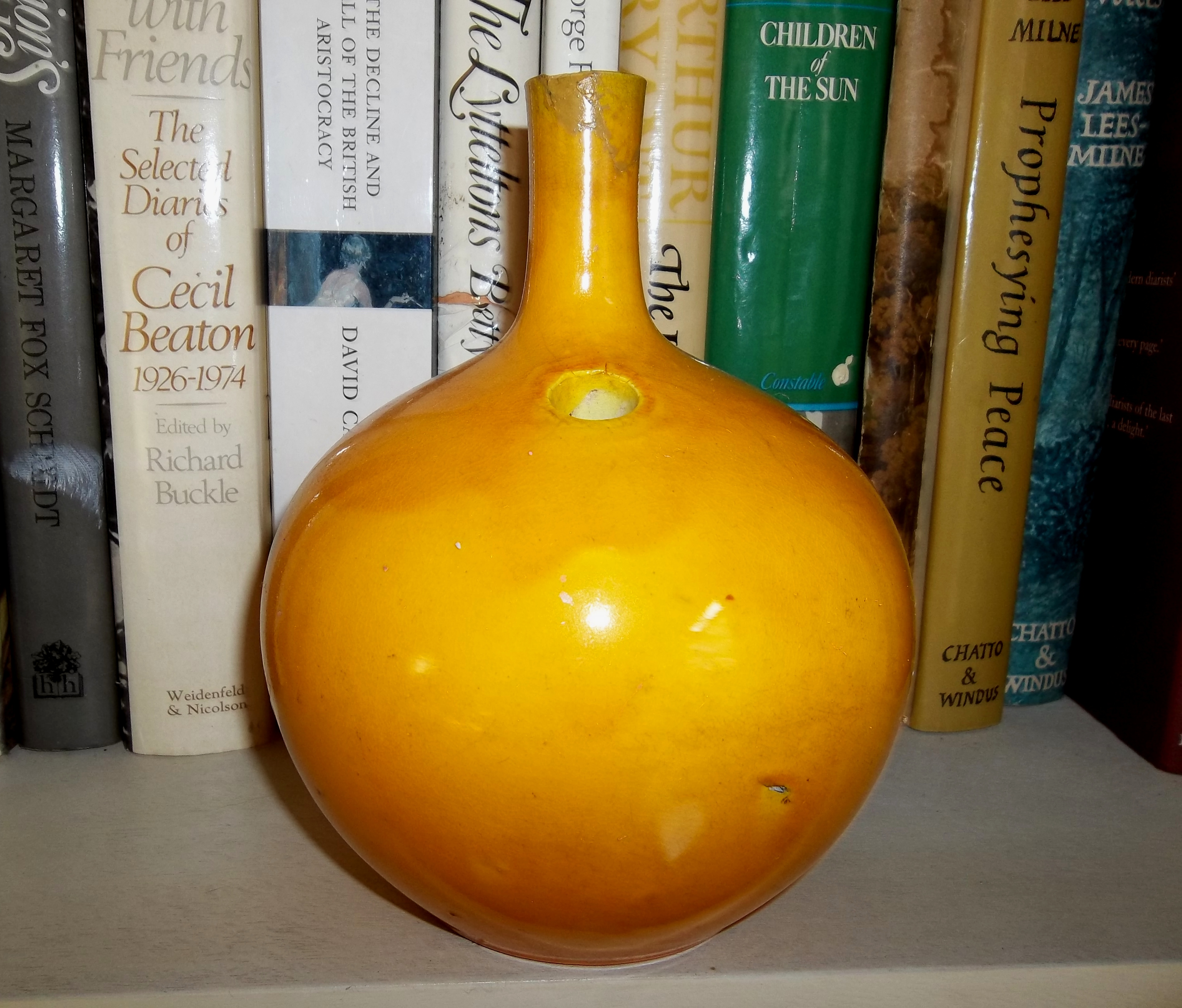
P.S. The picture is of an antique English drinking jar given me by my friend Andrea.

Food for threadbare gourmets

A faithful follower e-mailed me yesterday and asked if I had a recipe for Simnel cake. This is the light fruit cake that’s traditional at Easter, so I told her I’d blog it today. I use Nigella Lawson’s recipe with my own adaptations.

When I make it, I prepare the tin as usual, and then cream 175 g of soft unsalted butter with 175 g of caster sugar. Then mix 225 g of SR flour with half a teasp of cinnamon, a quarter of a teasp of ginger and 25 g of ground almonds. Add one egg with some of the flour mixture to the butter mixture, and mix two more eggs into the rest of the mix in the same way, before adding two tblsp of milk. Finally, fold in 500g of mixed dried fruit, plus some chopped glace cherries if you like them.

At this stage I put half the cake mix in the tin, roll out about 400g of marzipan, cut into a cake sized circle and place on the cake mix, then cover with the rest of the cake. Bake for an hour at 170 C, then turn it down to 150C and cook for another hour and a half. It’s cooked when it’s risen and firm. Let it cool completely on a rack before taking it from the tin.

When cool, paint the top with apricot jam, and roll out another 400g of marzipan and stick it on. With 200g of marzipan, make balls representing the eleven apostles – Judas surplus to requirements here – and stick them on using an egg white – beaten to just frothy. Some people quickly put it under the grill to make it look slightly toasted.

32 Comments

Filed under colonial life, cookery/recipes, culture, food, gardens, great days, life/style, philosophy, spiritual, Thoughts on writing and life, Uncategorized, village life

When is right wrong?

100_0955

It’s always been quite easy to be a pacifist in New Zealand for the last fifty years. Vietnam seemed indefensible to many, and our nuclear free policy made it feasible to take the moral high ground and declare that war is wrong.

I was forced to think about this on reading of the First World War project at Paddington Station in London, where a magnificent and moving statue of an unknown warrior stands. In full battle kit and helmet, he is reading a letter. As part of the commemorations marking the start of World War One, writers have been invited to write a letter to him, and Stephen Fry, wit, comedian and actor was amongst the first to write his, and it caused a sensation.

He wrote it as from a pacifist brother. Though he got historic details wrong – a pacifist would not be sitting at home then, he’d either be in prison or working on a farm, his letter moved many people. I’ve always been firmly behind conscientious objectors – (I like the moral high ground!) but this letter made me think hard about what was the right thing to do then, and how the right thing could very easily seem to be the wrong thing.

I thought about the horrific killings at schools and other places in the last few years, where deranged gun-owners shot numbers of their fellows, and if they didn’t end up shooting themselves, were shot, in order to stop them killing any more innocent victims. These incidents made me think when is it wrong to kill another human being, if there is no other way to stop them killing others. As pacifists do we stand and watch while others are killed, or do we intervene in whatever way we can, to protect the innocent?

This was actually the dilemma in the World Wars. Revisionist historians have said that there was no need for Britain to go to war in 1914. But Britain had informally agreed to support France if she was attacked in order to keep the balance of peace and power in Europe. More importantly, she had signed a pact in 1839 with four other countries of Europe, including Germany, to protect Belgium and allow this war-torn corner of Europe to enjoy being a neutral country, safe for the first time in history from being fought over. It was known as the cock-pit of Europe. It took the British Foreign Secretary, Lord Palmerston, nine years of diplomacy and negotiations to get the five signatories to agree to preserve Belgium, and they included France, Russia and England, and also Germany and Austria.

But Belgium was doomed as soon as the Prussian General Schlieffen began planning a war for German supremacy, because his plans for invading France, took in Belgium first. By then, under Bismarck’s influence, the German nation had become a military one. Invading Belgium didn’t bother them, though it did the honest German ambassador in London, Prince Lichnowsky, whose anguished telegrams begging the Kaiser not to invade, I have read.

In Belgium the Germans did what they did at Lidice in Hungary and Oradour in France in the Second World War, when they blamed the Nazis for these unspeakable atrocities. No Nazis around in the first war, but they still burned villages, hanged one man in ten and sometimes one man in two, and shot women, children and babies, the youngest three weeks old – at Dinant – as reprisals against any Belgians who had attempted to resist. Before the war was four weeks old, towns and villages had been sacked and burned, their people shot, and Louvain, and its ancient library reduced to cinders. So the choice for many Englishmen was clear – stand by and watch as a pacifist, or try to stop what seemed like a barbarian host?

The British soldiers who went to war then, were part of the history of England which had always tried to stop one power dominating and enslaving all of Europe, from Louis the Fourteenth of France to Napoleon. To go to war seemed to many who joined up then, to be a heroic attempt to save civilisation, and even more so in the Second World War, when Hitler was enslaving the civilised world.

The tragedy of resisting a violent and merciless enemy is that too often all the combatants find themselves using the same methods as the aggressor… war. But can we stand by and hang onto our principles of not killing, when all those we love will be destroyed, and not just those we love – our society, our country, and our whole civilisation. This was the choice which thinking people faced in both world wars.

When World War One was declared, England’s army was smaller than Serbia’s – the tiny country where the match had been lit at Sarajevo. So England’s armies were citizen armies, in both wars, made up of peace-loving men called up to defend their country. There’s a lot of research to show that many soldiers when they fired their rifles at the advancing enemy, didn’t actually shoot at the enemy, but aimed to miss, and that even more didn’t shoot at all. They too faced choices on the battle field which are impossible for us to imagine, when like me, we are living in a safe, peace-loving democracy.

So though I believe in peace, and have always supposed I was a pacifist, and attended Quaker meeting, where everyone was a declared pacifist, do I still believe it is possible to be one when the chips are down? I don’t know any more … Aggression turns easy choices upside down, when right – not killing – seems wrong, and wrong – fighting – seems right.

The wonderful story of the American colonel in Iraq, surrounded by an angry mob intent on violence, calling his armed troop to a halt, ordering them to kneel and point their guns to the sky, immediately defused the threat of violence on that occasion. So how do we defuse the violence of would- be psychopathic conquerors who believe that might is right? Maybe only people power can do that – and that can happen – as it did at the Berlin Wall.

Maybe it just needs enough of us to say: “They shall not pass…”
Food for threadbare gourmets

Something to eat with a glass of wine is one of our specialities in this village – among my friends anyway. It’s so easy to share a glass of wine and a nibble on a Friday night, without all the hassle of a dinner party. The latest craze is kumara skins – kumara are the Maori sweet potato that Kiwis pine for when they leave this country, but even ordinary potatoes are good this way.

Boil scrubbed orange and golden kumara until soft, and then cut them into thin wedges, leaving about a cm of flesh. Heat hot oil until it’s just smoking. Dust the kumara with seasoned flour and fry until golden. Drain and sprinkle with sea salt. Eat the skins with sour cream sauce – half a cup of sour cream mixed with a tbsp on mustard, fresh herbs and lemon juice.

Food for thought

There is something that can be found in one place. It is a great treasure, which may be called the fulfilment of existence. The place where this treasure can be found is the place on which one stands.

Martin Buber 1878- 1965  Jewish philosopher


48 Comments

Filed under army, british soldiers, cookery/recipes, history, life and death, military history, peace, philosophy, spiritual, The Sound of Water, Thoughts on writing and life, Uncategorized, world war one, world war two

Can bloggers change the world?

100_0944

I’ve been in a situation for the last few weeks where I haven’t seen or read a newspaper, watched TV or listened to the radio.  The only newspaper I’ve seen is the hundred year old front page of The Auckland Star, a now defunct newspaper, and this page was a facsimile, framed, and hanging in odd places in our various homes over the years.

 It was dated 11 February 1913. Two thirds of the page was filled with the main story which had shocked the Empire (there was only one empire back then, and it was British!). The rest of the space was taken up with smaller items, an African revolt in Mozambique, quelled by the Portuguese, the terrible fighting between Serbs and Turks with high casualties, another item in which the Turkish commander of Adrianople on hearing of the proposed neutralisation of the fortress promised ” to take care to put the 40,000 Bulgarians who live here out of the way. I shall confide the women and children to the foreign consuls, turn the guns on all the Bulgarians and then convert Adrianople to a giant rubbish heap”.

 Beneath this was a story about the Turkish Red Cross addressing European sovereigns asking them to recall the law of Christ to stop Christian forces committing the most ghastly outrages and assassinations on Turks witnessed in Europe in modern times. Under this item was the English response to the Australian Cricket Association’s investigation into the behaviour of the team in England, followed by a report from Melbourne on the arrest of two Chinese involved in an enterprise with Hong Kong Chinese to smuggle ‘Chinese persons’ into the Commonwealth.

 A political crisis in Japan had provoked rioting which was put down by the army, and the English House of Lords debated compulsory physical training and elementary military skills to: “lay a foundation … on which a scheme of national defence could be based if unforeseen dangers menaced the country”. At the bottom of the page, an unforeseen menace, the Kaiser, was reported as having unexpectedly addressed the university centenary celebration, and “delivered a fiery panegyric upon German military virtues”.

 And Suffragettes had a smashing time in London, where they broke the windows of the Reform, Carlton, Junior Carlton, Oxford and Cambridge Clubs, and Prince Christian’s house ( what had he done?). “The missiles were of “lead and fireclay balls”.

 The only other news of women was the report of the Kaiser’s daughter’s betrothal to Prince Ernst of Cumberland. Nothing very different there. Serbs killing, refugees being driven from their homes and ‘confided to the care of foreign consuls’, cricketing misdemeanours, African riots, Japanese politics, boat people trying to get into Australia, suffragettes protesting, reports on princelings, are still the stuff of the news today. Substitute Syrians for Serbs, feminists for suffragettes, and it could just as easily be the front page of any newspaper today.

 What made this day in history different was the story which filled the rest of the page and which has grabbed the imagination of the world ever since – the story of a man who failed. First, he failed to achieve his objective, and then he failed to get back safely.

 The main headline reads: “Scott Party Perish”, followed by the next headline: “Five Who Made The Final Dash”, and then another headline: “Lost In A Blizzard.” And then another headline (they made the most of headlines in 1913): “After Reaching The South Pole”. Below, yet another headline: ” A World Wide Sensation”, followed at last by the main story, two sentences, the first saying they’d reached the South Pole on January 18, and perished in a blizzard, the second, listing the five who perished.

 And this story is the only clue to how things really have changed in the last hundred years, even though they may seem to look much the same.  Scott and his men would not have died now – they would have had the latest dietary discoveries to sustain them, they could have gone on tractors or skis, or any of several different ways, and kept in touch with the media and their families with all the different forms of communication we now have at our disposal … they might even have been able to keep us up to date on Facebook, and Twittered their families regularly.

 The marvels of modern communication are what really are changing the world … so that maybe – just maybe – that page of news items may seem very dated in another hundred years.  But the other thing which has changed since that day in 1913 is what we’ve done to our planet in the last hundred years, destruction on a scale that actually threatens the survival of the human race, and prompts some to wonder if it has a future.

 Maybe the biggest change since that day of news in 1913 is the change in our mind-set… we have a United Nations now, which is supposed to help bring peace to troubled hot-spots… at least the intention is there. We have governments who talk about the happiness levels of their people, and maybe best of all, we have the internet to unite us to change things.

 We all know that riots, revolutions and parties can be created with a few text messages, but there’s something deeper and more important happening in the world that we bloggers inhabit. That is the growth of groups and individuals who use this medium to change things for the better.

 The biggest and most successful so far is the group known as Avaaz, which now has millions of members world-wide who create and follow up petitions to governments to rescue women about to be stoned for having been raped, petitions to stop destruction of ancient tribal lands and forests, to tackle Monsanto and their environmental damage, to lobby European countries to stop using pesticides to save our bees.

Their range of concerns cover all the issues of our small world and the more of us who can support them the more likely we are to change this precious world for the better. So far they’ve achieved their aims on many issues both great and small, and saved a few women. And yes – that’s a commercial … and Avaaz is the name!


Food for Threadbare Gourmets

 At last we have some rain, and the autumn mist now hanging over us makes me hope that perhaps we will get some mushrooms springing up in the grass outside our house… some years we do, some we don’t, and I never know why. If we do, and we only have a few, they will go with bacon for my husband. But if we have plenty I’ll cook them in butter with some chopped garlic, add chopped parsley and then some thick cream to bubble up. Poured over toasted sour dough bread, they are tasty and delicious.

Food for thought

When we do dote upon the perfections and beauties of some one creature, we do not love that too much, but all other things too little. Never was anything in this world loved too much, but many things have been loved in a false way; and all in too short a measure.

Thomas Traherne 1636 -1674  English metaphysical poet who remained unpublished for two hundred years.


23 Comments

Filed under cookery/recipes, great days, history, life and death, peace, philosophy, politics, sustainability, The Sound of Water, Thoughts on writing and life, Uncategorized

Heaven’s scent

100_0542

The first time I smelt it was at sea. One of my dearest friends had drowned there a few days before with her baby and two small children. Her husband’s ship, trading between New Zealand and the Islands, had caught fire in a heavy storm just off the coast not far from here, and they had had to take to the life-boats. Their mayday signal was never picked up, and the life-rafts, which are reputed to be safer near the coast, had broken away. So my friend and her children didn’t survive the mountainous waves.

Her heroic and tragic story before this happened, is too long to tell here, but her partner, a French sea captain, did survive. He came to stay with us for the next few days until the body of one child was washed ashore.

We all trekked up to Northland, and after the heart-wrenching funeral, Jean asked us to take all the flowers to a nearby bay. There, a police launch was waiting, and with a few close friends we loaded the flowers into the cabin – then thankfully shut the door on the overpowering scent of freesias, jasmine and other spring flowers, and took off for the bay where my beautiful friend had died.

When we reached the spot where she had slipped from his grasp, Jean stopped the launch, and then, in an old Breton custom, went to toss the flowers into the sea. As the launch stopped, the sun was shining, the blue sea was calm, and the line of golden sand on the shore, still guarded by a watching policeman, lay ahead. Only another mile from here, but a mile too far for my friend.  We sat silently and breathed in the heavenly fragrance wafting around us. Exquisite. Then the door to the cabin was opened and the scent of the flowers inside was entirely different.

When we talked about this to a friend, he told us about the writer Rosamund Lehman, whose daughter had died suddenly – of polio, I think – in Indonesia. A heavenly fragrance permeated the hall outside Rosamund’s flat. People didn’t believe it until they went to visit her, and then were overwhelmed by the perfume.

A few years later, we began to experience the same wafts of flowery perfume in our sitting room. I searched for the source, but it came from none of the flowers in the room. The scent cut through the smell of the coal fire, and every other momentary odour. In the end, we gave up, and just accepted, as a friend said, that we had angels there. After a week of this, one of our cavalier King Charles spaniels was diagnosed with an untreatable disease. We gave ourselves five agonising last days with him, and then took him to the vet for the last time.

When I got back home my nine year old daughter was waiting on the veranda, home with flu. She couldn’t wait to tell me. “The flowers came from that patch on the floor where Sheba used to lie to get cool,” she cried. (Sheba was an afghan who’d died the previous year) “She was warning us about Benedick.”

When we went inside, the fragrance had gone, but later, as I sat by the fire crocheting and wiping stray tears, I suddenly smelt a strong scent of lavender. Knowing well that I hadn’t got any, I still searched my knitting basket for a bottle of lavender. I called through to my daughter in bed – ‘have you spilt some lavender water?’

Then we realised that my son had picked a bunch of lavender and camellias to go with Benedick on his last journey… the scent was a last message from his little dog.

Since then we’ve heard of other instances of these heavenly perfumes. In her beautiful account of a year living in the Blue Mountains, Australian poet Kate Llewellyn, describes sitting next to two nuns on a train, and their gentle simple conversation with her. After they had left, she felt that she could smell violets… “the odour of sanctity,” she called it.

The Catholic Church calls it the ‘odor of sanctity’, but always associates it with the bodies of saints who have died. But these heavenly scents are like a gift sent from who knows where, and have nothing to do with sanctity. Rather, they are like gifts from a benevolent and loving source who for some reason allows these emanations of beauty to visit and to comfort. No-one has to be holy or to deserve them, they are simply a manifestation of another order of beauty and wholeness that we may be conscious of, but can never see or grasp.

They are the moments that we can hold onto in a world where man can create so much pain and misery. Beyond this world created by man is this other level of love. And how exquisite that it’s the fragrance of flowers that delivers this message of hope – that the world doesn’t have to be the way we make it – that there are other worlds of truth and beauty and peace that these fragrances remind us exist.

Rabindranath Tagore talked of the air filling with the perfume of promise… sometimes I wonder if that is what these flowery messages are – both a consolation and a promise.

Food for threadbare gourmets

With a family of gluten free addicts, I’m always looking for recipes without wheat. This is a lovely chocolatey treat. I melt 125 g of butter and 150 of dark cooking chocolate gently in a large saucepan. Stir in half a cup of sugar and a teasp of vanilla. Next, stir in three egg yolks and a cup of ground almonds. Beat the egg whites until peaks form and then beat in two tablsp of sugar.  Using a slotted spoon, gently fold the whites into the chocolate mixture. Line a 20 cm cake tin with a base of cooking paper, and bake at 180 degrees for 25 minutes. The cake will come out soft, and will sink and firm when cool. It’s very rich, so a sprinkling of icing sugar on top is all it needs.

Food for thought

In a rich moonlit garden, flowers open beneath the eyes of entire nations terrified to acknowledge the simplicity of the beauty of peace…

Aberjhani, American historian, novelist, poet and blogger

45 Comments

Filed under animals/pets, cookery/recipes, flowers, great days, life and death, love, peace, perfume, philosophy, poetry, spiritual, Thoughts on writing and life, Uncategorized