Ant or grasshopper?

100_0809

The weather forecasters are calling it an Indian summer. This appals me – sitting here looking out of the French windows, watching butterflies flitting over the hydrangeas, I thought we were still gently making our way through an antipodean summer. Has the time flown so fast that we are in that gap between high summer and early autumn? The din of the cicadas should have warned me, as should the scattered pink blossoms on the plum tree. This bewildered specimen flowers every autumn – fruitlessly – before doing its spring burst of glory.

Driving along the roads to town, the verges are blooming with the autumn flowering of scarlet mombretia which have spread through the long golden grass. White oxe-eye daisies grow in clumps among the mombretias, and there are still some red- hot pokers and a few roses flowering as I drive past unkempt hedge-rows bright with a heavy harvest of red hawthorn berries.

 If it was the northern hemisphere I would repeat to myself the old country lore that we must be going to have a hard winter, and nature is providing for the hungry birds. But we never have hard winters where I live, so I just savour the bounty with no fear for the future. Instead we long for rain.

Every year now we have a drought, and it becomes a struggle to keep the garden alive;  I use up our precious water to save the white Japanese anenomes for their burst of autumn flowering, and to stop the roses wilting. The purple salvia looks after itself. Glorious scented Jean Ducher, and bright mutabilis keep the cycle of roses going all the year round. And littered around the garden are the shallow plant holders filled with water for thirsty hedgehogs to drink, and where I also see wasps sipping and even a pair of snails making their way together down to the water in a deep bowl.

When I looked out of the bedroom window this morning at silent dawn, the sea looked like wet aluminium, the curve of bay on the distant horizon was steel grey, and the clouds overhead, silver- grey. But by the time I drove into town for shopping, the sun had come out.  The fields are so dry they are burned to a pale gold, and the pennyroyal is now flowering, making a carpet of purple.

That rich purple carpet always reminds me of when I was in France, staying in an ivy- turreted, moated chateau in deepest Vienne as a twelve year old… my best friend there, Josephine, invited me to go mushrooming with her and her maid, so equipped with baskets we set off to find “champignons”, chattering in fractured French and broken English.

Two little girls dressed in flowery cotton summer dresses made their way through long wet grass and dewy paths lined on either side with blackberry bushes heavy with fat juicy fruit as big as grapes.

 We walked through early morning mist, and it suddenly cleared. There in the bright sun-shine in front of us, stretched a shimmering field of tiny pale purple-blue flowers, with hundreds of miniature, deep blue butterflies hovering and fluttering above them. That world was alive with birds and butterflies.

Farmers here are feeding out to the cows already, and I fear for the thirsty birds and hedgehogs. As I drove past the agistement fields outside the village, I saw all eight mares spread out round the field in a circle, with their heads thrust deep into bright red plastic buckets; and by the side of each one, their long-legged foal stood patiently,  waiting for mother to finish.

At lunch with friends was a person I’d never met, who used to be a dressage and eventing rider. She told a fascinating story of when she was part of the NZ team at the Olympics when Mark Todd won his first gold medal. The New Zealand team were in third place when their last rider came on. This person did the round without a fault, but so slowly that the team lost forty points and slipped right down the order. Mark Todd, beside himself, strode up to the rider, and exploded; “Why did you do it?”

“I was saving the horse,” was the reply, to which Todd cried despairingly: “What for?” I have used this thought constantly since, so every time I go to save something, I ask myself, what for, and mentally come back to the present, and seize the day!

On my own the other day, I decided to lay my lunch on a tray and take it out to the veranda where I look down to the sea through the gnarled branches of spreading pohutakawa trees. It’s shaded from the mid-day sun by dappled light filtered through leaves of the white wisteria. Suddenly I thought – why not use my precious antique green French plates – and green wine glasses – and the best silver – what am I saving them for? This is not seizing the day, I chided myself.

This thought has spread into other parts of my consciousness… I’m raiding my store-cupboard – if not now – when ? Why not eat these goodies now?  Time to start emptying the deep freeze – what am I saving all this food for? Those pretty shoes – why not wear them today, even if I’m not going anywhere?

Maybe I’m becoming a grasshopper – singing the summer through, taking no heed for the morrow – and the prudent ant in me is having a hard job trying to make itself heard. But being a grasshopper seems to mean feeling much satisfaction, joy and being right here in the present. If not now – when? Saving it  – what for?  Two phrases which are life-changing, ring with truth, and which mean that other cliché – seize the day. So I’ve come to terms with the Indian summer, and revel in these days of softer sun and autumn flowers and golden trees.


Food for threadbare gourmets

It’s the time of year for the apple harvest. One of my favourite ways to use them for pudding when we have friends is to allow one apple per person. Take out the cores, and fill the hollow with brown sugar and sultanas, or as I usually do, with left-over Christmas mincemeat.

Put them either in an enamel dish or other oven-proof dish, but I love the homely look of an old-fashioned enamel dish for this. Pour cream and whisky over them to come up to about half an inch in the dish. Cover and bake until soft. They’re delicious served on their own or with a crisp biscuit, or for something filling, with a creamy rice pudding.

 Food for thought

“If we do not contest the violation of the fundamental right of free people to be left unmolested in their thoughts, associations, and communications–to be free from suspicion without cause–we will have lost the foundation of our thinking society. The defence of this fundamental freedom is the challenge of our generation,”

Edward Snowden NSA whistleblower and hero.


55 Comments

Filed under cookery/recipes, environment, flowers, gardens, great days, happiness, life/style, philosophy, The Sound of Water, Thoughts on writing and life, Uncategorized, village life

Our best friends

100_0816

100_0818 - Copy

This magnificent creature was making the most of the water in the dog’s bowl at my gate. He could have been Captain Scott’s dog Osman, the wonderful husky who saved so many dog’s lives when the team fell into a deep icy crevasse. Gallant Osman hung on at the brink, taking the whole weight of the dogs and the sleds until they were rescued. This hero survived Scott’s disastrous Antarctic expedition, and ended his days here in New Zealand.

If I’m reading history, it isn’t the dates and the battles that stick in my mind but the children and the animals, and I hate to read in the news that a head of state has donated two Russian wolf-hounds, or a splendid race horse on a state visit. The poor creatures are torn away from their homes and given to uninterested strangers speaking a foreign language.

To this day, I sorrow for Mary, Queen of Scots’ little Skye terrier who came with her to the block, hidden in her long skirts. When the Queen’s head had been severed, the faithful creature rushed out and stood howling between the body and the head. Nothing would entice the little dog away from the remains of the person she was devoted to. Finally, when the Queen’s body was removed the little dog was repeatedly washed by her grieving ladies to remove the blood and the smell, but she refused to eat, and died shortly after of a broken heart.

Marie Antoinette’s pet- dog who shared her solitary confinement, was left behind when the white-haired, dignified Queen was hustled out to the guillotine, and was adopted by the prison governor – we don’t know for how long that little dog pined.

And Joy, the Russian Tsarevich’s spaniel, was found in the deserted house in Ekaterinberg, eight days after the massacre of the Russian Royal family, when an army of White Russians took the city and a group of officers rushed to the Ipatiev house where the family had been imprisoned. The little dog was starving and wandering around looking for his master. History does not put my mind at rest as to the fate of this little dog. (It also seems to suggest that being the beloved of royalty is a dangerous destiny.)

But just as bad was the fate of Joseph Banks’ dogs. Banks was the naturalist who sailed with Captain Cook on his first great voyage in 1768. Besides cluttering up the tiny ship with four servants, Banks also brought his two pet greyhounds with him.

After two years voyaging, still at sea, the Endeavour called at Savu Island, and after a drunken night dining with the local Rajah who wanted an English sheep and an English dog, Cook gave him the last sheep on board, and Banks gave him one of his greyhounds. What the sensitive greyhound went through pining and parted from his life-time companion, and the men who he knew and loved, to be abandoned on a tropical island among people who had no idea of what a dog or a sheep was, doesn’t bear thinking of – not by me at any rate.

And at Matavai Bay, Tahiti, ten years later, the captain of another English ship, the Mercury, reported that an English pointer left behind by a previous ship: “singled them out, showing its joy by every action the poor animal was capable of.” Which tells us that the dog was capable of distinguishing between races, and was homesick, and was probably hoping to go back to its old familiar home across the sea when it recognised the sailors. I wish I knew that the sailors had taken it back home, but I fear they didn’t.

Then there was Mackenzie, from New Zealand’s South Canterbury, a cattle rustler. His dog was brought into Lyttleton court as a witness. She slipped her chain and ran over to the dock, scratching and whining, trying to get in and join her master. The red- bearded rustler, who’d refused to speak a word until then, began to weep. He begged to keep the dog and take any punishment the court meted out.

“I ‘ll make your roads, I’ll break your stones… only let me keep her.” They didn’t let him keep her of course, being men of stone themselves, and the little black dog was sold to a farmer who she refused to work for, only knowing commands in Gaelic. We don’t know the end of either her or her master.

But what we do know is that too often it’s only their owners who care about their dogs. Once the person who loved them is no longer there, a dog’s life is an uncertain one. Which is why I love the wonderful people – and many of them are bloggers – who rescue and adopt the dogs who have been left behind. And in my experience there is no dog as devoted as one who has been rescued. I used to have three at a time, and wherever I walked, from kitchen to garden, from bedroom to study, fourteen feet moved

The gratitude of a rescued dog never ends. They know that all their happiness is the gift of love from a stranger who becomes their beloved.Last year, when his mistress died, Lochi, a rescued German shepherd, a beautiful silvery creature, went to mass every day at the church of San Donaci in Italy as soon as he heard the bells ringing. He sat where his owner last lay in her coffin. He died two months after her of a broken heart. (wonderfully, so as not to disturb him, the local priest served mass down in the church instead of at the altar.)

If only people had hearts as big and loving as dogs we wouldn’t have places like Syria and Palestine, Ukraine and Afghanistan and all the other broken hearts in the world. There is a mantra : let only love prevail…


Food for threadbare gourmets

Still lotus-eating at the end of the long dry summer, I sat in a bower in my dearest friend’s green garden, enjoying a long talk and a simple lunch with her. Just a delicious glass of chilled rose, a slice of salmon on a bed of brown rice with goodies in it, and a salad of green leaves, translucent slices of ripe pear, and parmesan flakes mixed through with the vinaigrette, followed by coffee and a chocolate truffle… what more could one desire… love and lotus –eating !

The brown rice had been cooked and then marinated in soya sauce. Sun flowers seeds, sultanas soaked until plump, chopped apricots,  spring onions, and walnuts then mixed through. Delicious with the salmon, but just as good with warm lamb or chicken I suspect…


Food for thought

You might quiet the whole world for a second if you pray.       And if you love, if you really love,      our guns will wilt.

St John of the Cross, translated by Daniel Ladinsky


60 Comments

Filed under animals/pets, bloggers, cookery/recipes, food, great days, history, love, royalty, The Sound of Water, Thoughts on writing and life, Uncategorized

Pooh Bear has the answers

100_0273

I’ve only been on one teddy bear’s picnic. There were lots of teddy bears, crammed into a little dolls pram, my three year old grand- daughter and me.  We solemnly walked the pram to a tree in the park in Melbourne next to the house where they lived.

There, on a cold, slightly misty winter’s afternoon, we carefully propped a huddle of teddies of different sizes and varying shades from honey to dark brown, around the base of a tree. After careful discussion as to what teddy bears might eat, we had plumped for very small brown bread and honey sandwiches – we thought that arbiter of bear behaviour, Pooh Bear, would have approved, and that was all we needed to know really. We thought bears would probably only have wanted to drink water, so that was easily solved….

I was thrilled that she still remembers this occasion now she’s old enough to be at university. And she remembers too, jumping on our shadows the year before, and learning to sing ‘Kumbaya, my Lord’ when she was even smaller (in an English accent!). These memories may be more precious to me than to my grand-daughter, and most grand-parents will understand just how precious they are.

When I look back to my memories with my grandmother, I marvel at what I learned from her, much more, I suspect than today’s grand children learn from theirs. She taught me to knit and sew and do French knitting, and embroider dozens of stitches I’d forgotten till leafing through an old Mrs Beaton cook book recently – daisy stitch, herringbone stitch, blanket stitch, chain stitch, back stitch, buttonhole stitch, cross stitch. She told me the names of flowers and saints and cousins I’d never seen, the stories of dead great uncles in the war. She taught me prayers and proverbs and songs.

But somehow, once the days of reading aloud Pooh Bear and Dr Seuss and Dear Dinosaur had passed, all my grand-children were so engrossed in their play stations and favourite, regular afternoon TV programmes, that there was rarely a space for the sort of boredom or blank days we used to have in my childhood; those times when for lack of something better to do, we mastered a new skill and learned to knit, or read a book considered too hard or too boring before, and which was now discovered to be a treasure.

It was on those long empty days that I discovered the joys of rambling alone with the dog, or daring to cross the weir by the mill with friends, or digging around the Roman mines, hoping after two thousand years to find a Roman coin; it was when we picked primroses in the woods, and carried catkins and pussy willow home as spring announced itself … As we grew older we made egg sandwiches and took a bottle of ginger pop to picnic on empty beaches with names like Man o’ War Bay and Arish Mell Gap, coming home tired and sunburned.

But my grand-children have done it differently. Today they’re not free to roam alone as we were – instead, they went on exciting holidays, in the tropics or to fishing lodges, or learned to sail or ski. But then they’d come to stay with me, and do ordinary and yet totally absorbing things. Leaving their play stations, they’d feed the eels in the river at the bottom of the garden, spend days making boats out of flax leaves, and floating them down the waterfall, building dams, playing Pooh Sticks.

They could spend an afternoon totally absorbed in throwing stones down into another river, far below, and listening for the plop. Another morning in the city when I took all four of them to a secret spot above the harbour, where old oak trees spread, they spent a whole morning searching for acorns and throwing them down into the water. Not aimlessly, but aiming.

And not a question of little things please little minds, but being ‘in the zone’, alive and  present. Blowing bubbles from my veranda and seeing who could make the biggest one that drifted furthest and lasted longest; or the ritual playing of hunt the thimble with the same silver thimble every time, seemed to give them more fun and shrieks of laughter than watching their Japanese TV serials and videos or war games on the computer. And grandparents have time for long conversations about the size of universe and whether ice-cream is good for you, and what dogs are dreaming about – and about important things – like ethics – which even small children understand in terms of right and wrong, or better still, kind or unkind  …

Sometimes I think that this is one of the few gifts we can give our grand-children in this busy technological age when our grandchildren know more than their grandparents, and learn to teach us, instead of us teaching them. We can give them the time and the space to savour the little things. We can listen to them uncritically.  We can give them unconditional love, because we don’t have to make sure they eat up all their vegetables. And the utter bliss of it is that they give us the same unconditional love too. “I’ve got to, but I’ll still be your darling”, said one when I asked him not to grow up!

It’s that ubiquitous bear, Pooh, that ‘bear of very little brain’, who puts into words what I would say to my precious ones in the future. He says so memorably and so truly: “If ever there is tomorrow when we’re not together… there is something you must always remember. You are braver than you believe, stronger than you seem, and smarter than you think. But the most important thing is, even if we’re apart… I’ll always be with you.”


Food for threadbare gourmets

It’s that wonderful time of year for both birds and people – when the figs are ripe. A friend made the most delicious salad the other day using real lettuce – not mixtures of baby leaves – and tossed them with chopped- not sliced – cucumber, fresh peas, and thinly sliced figs, with a vinaigrette sauce. The sweetness of the figs with the crunchiness of the cucumber and the crispness of the lettuce was delicious with cold lamb and couscous.

Food for thought

…’It often takes great courage to follow intuition. It takes a Viking, who is unafraid to sail in unknown seas…. to live intuitively is to live fourth-dimensionally’…                                           Florence Scovel Shinn, 1871 – 1940   New Thought writer who influenced Louise Hay.

75 Comments

Filed under cookery/recipes, family, great days, happiness, love, spiritual, The Sound of Water, Thoughts on writing and life, Uncategorized

Very gallant gentlemen

100_0758

It was like a large black diamond, about two inches across and each of its seven or eight facets had been carved and smoothed by aeons of icy wind and weather. It looked and felt like a precious stone. It was. It had been smuggled out from the Antartic, where no one is allowed to take anything from that pristine wilderness.

A friend had brought it out for us. For years I carried it from house to house, and on the last move it disappeared. I regret it more than anything else that I’ve ever lost or broken or damaged. Eight years later, I still feel sad to no longer have that irreplaceable, potent black stone sitting on my table among other treasures. It was the treasure of treasures.

But I still have my shelves of books on that mysterious continent, and the extraordinary men who couldn’t stay away from it. Captain Scott’s expedition is the one that still reverberates among the English… a bit like Dunkirk, his heroic failure somehow thrilled them more than if he had achieved his goal of getting to the South Pole first. Poor Amundsen who did, is hardly rated by Scott afficionadoes. He made it look easy, while Scott and his men laboured mightily.

Yet men who were quite ordinary have become legends since their snowy deaths back then – men like Captain Oates stepping outside the tent into a blizzard with his :’ I am just going outside and may be some time’, and heading off to die… his portrait entitled: “A very gallant gentleman” still proudly hangs in his old cavalry regiment’s mess. He knew his frostbitten feet were going to make the difference between Scott and the  other two getting back to safety, or being held up by him and never making it. But it was too late by then anyway, with the unexpectedly terrible weather making impossible the last few miles of the journey to safety.

Oates, who in spite of being taciturn, was a potent presence and a penetrating observer, was unimpressed by Captain Scott, and spent a great deal of his time before the expedition started, trying to cosset his Mongolian ponies, crouching with them in their freezing stalls, coaxing them to eat their in-edible rations, or rescuing harness, headstalls and any other object which the bored and ravenous animals were tempted to devour.

His cronies who shared one side of the cramped hut which was their home while wintering at Cape Evans, consisted of Bowers, Cherry-Garrard, Atkinson and Meares, who were known as The Tenement Dwellers, anti-feminist, anti-scientist, conservative and spartan – and, one has to add, narrow-minded and philistine.

The other side of the twenty-five foot wide hut were the scientists, who made a dainty attempt at home-making, mocked by Oates who called their space The Opium Den. They draped a curtain, scrounged from photographer Ponting, across their bunks to give themselves privacy. One added a branch acetylene light, another stained everything stainable with Condy’s fluid, making it a uniform red brown, the Norwegian, Gran, put red borders made from photographers’ material on their shelves, and another adorned his bunk with a piece of dark blue material which had started life as part of a Sunday altar cloth.

Yet all sixteen men relied on each other for company and comfort, succour and safety. They knew that their survival depended on each other, and perhaps in this way discovered for themselves the truth of the ideal society in which all life and all things and all men are connected to each other. No-one is separate from the whole, a truth which our civilisation as a whole, seems to have forgotten.

Writing of the expedition to Cape Crozier he made with Bowers and Wilson on their ‘worst journey in the world’, (the title of his book) Cherry Garrard said: ‘ And we DID stick it… we did not forget the Please and Thank you, which mean much in such circumstances, and all the little links with decent civilisation which we could still keep going. I’ll swear there was still a grace about us as we staggered in. And we kept our tempers – even with God.’ A bond of mysticism carried these three men through.

Tactful Dr Bill Wilson, secret disciple of St Francis, and known as Uncle Bill, was the advisor, peace-maker and comforter in this tiny society. Birdie Bowers, bachelor, tiger for punishment, endlessly strong and tireless long after everyone else was fainting with exhaustion, was the other closet mystic in the party – ” The purpose of life,” he wrote “… is to make a great decision – to choose between the material and the spiritual, and if we choose the spiritual we must work out our choice, and then it will run like a silver thread through the material… nothing that happens to our bodies really matters.”

And it’s this which is what makes Scott’s expedition so continuously fascinating, that they were people, who at the extremity of their strength, dying of starvation, continued to be kind and considerate to each other, and never did forget the pleases and thank you’s, the courtesies and the deeper meanings of  civilisation. Because they cared about their animals they didn’t kill and eat their dogs like Amundsen did, and Scott also refused to eat the ponies on their journey, which ultimately sealed their fate.

So though they failed to achieve their purpose, they remain inspirational.  They were ordinary men stretched to the limits of their endurance, and they never lost their decency, and goodness and humanity. This is why their story is so enduring. They were true to themselves and to their code of honour. They remind me that simple human decencies are actually what make men and women great and that these qualities are the bedrock of our civilisation.


Food for Threadbare Gourmets

A weekend lunch party at a friend’s house, seated on her veranda overlooking a turquoise sea, and embellished with sunshine, laughter, lots of rose to drink and delicious food, ending with summer pudding – what else on a perfect summer’s day? Here’s how to make this delicious and easy classic English pudding.

You need about two pounds of a mix of summer fruit and berries.  Keep strawberries separate from the rest. In a pan melt 175 gms of sugar with three tblspns of water. Then add the prepared fruit except the strawberries. Gently cook for a few minutes to soften. Line a pudding bowl with thinly cut slices of bread, no crusts, all fitted and slotted into each other so there are no cracks.

Pour the fruit into a sieve to strain off the juice. Fill the bowl with the fruit, adding the strawberries if you have them, in different layers. Soak slices of bread in some of the juice, and fit them over the top.  Weight the top with a plate and some heavy tins, and leave in the fridge overnight for at least six to seven hours. Turn out this wonderful looking pink pudding, and serve with lots of cream to eight delighted people.


Food for Thought

Always do your best: Your best is going to change from moment to moment; it will be different when you are healthy as opposed to sick. Under any circumstances, simply do your best, and you will avoid self-judgement, self-abuse, and regret.

Don Miguel Ruiz. ‘The Four Agreements’


38 Comments

Filed under cookery/recipes, great days, human potential, life and death, philosophy, The Sound of Water, Thoughts on writing and life, Uncategorized

Souvenirs of life

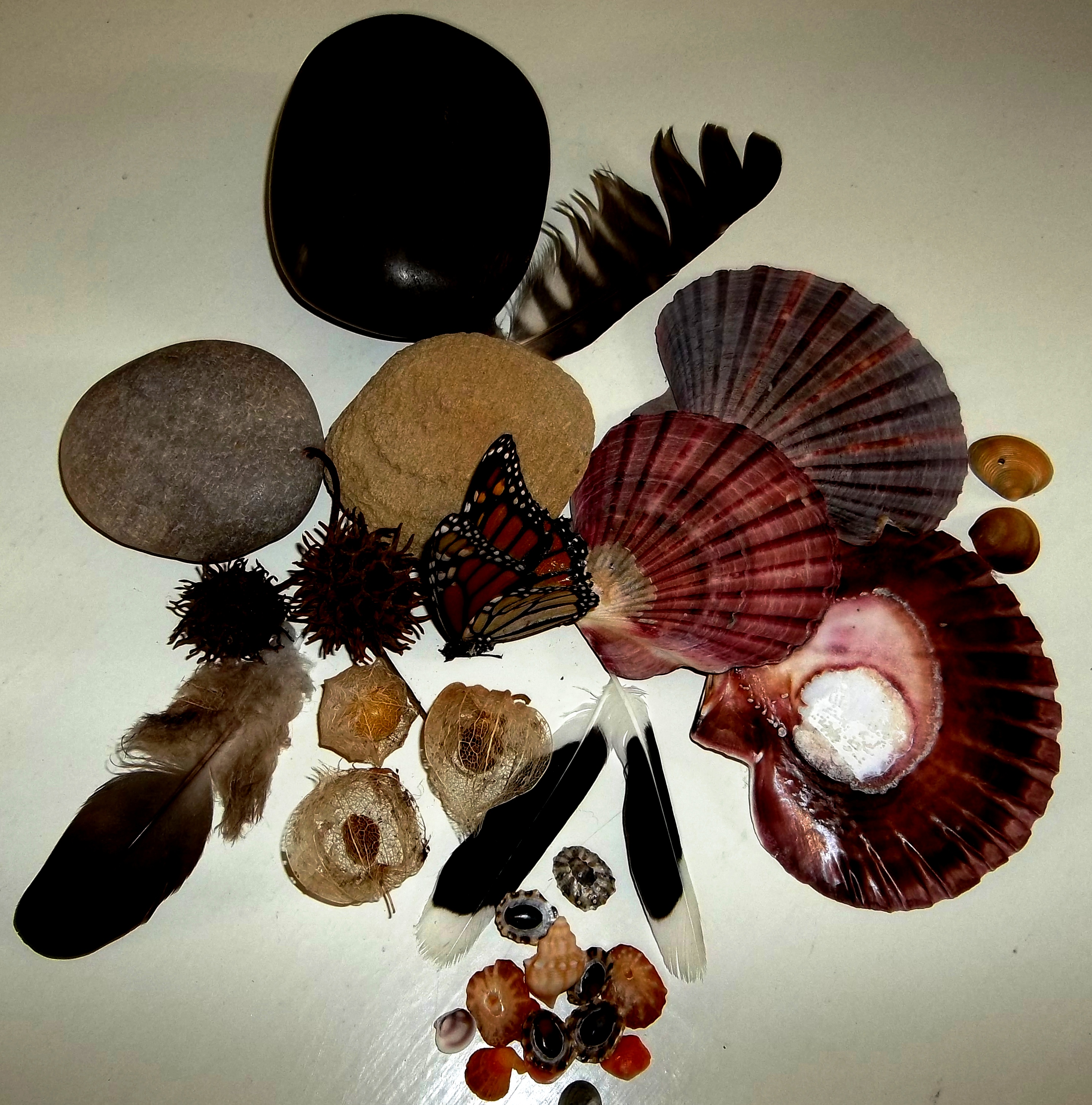
100_0871


These stones and feathers and shells can tell the story of my life in the last few decades… shells collected with the children on a Northland beach, a black and white feather lying outside the door when I opened it on our first day in a new house –  greeting from a tui… the brown and cream morepork feather found on a long walk around the harbour with the thoughts and dreams of that afternoon threaded through its fronds.

An ancient stone from a river bed in the Blue Mountains of Australia was picked up after a day spent abseiling in abject terror, another from a cold pebbled beach in Devon, the chill of the Atlantic  breakers still embedded in it after all these years, while the polished brown stone came from an underground cave in the central North Island where glow-worms illuminated the roof, and a river flowed through.  These things are the stuff of my life… as they are of every life in which they are valued.

As I looked at them I thought of how other collections can also tell the story of a life. When I renewed my passport recently I found all my old ones, going back to when I was twelve and going to France on my own to learn French. In that passport photo two frightened brown eyes gazed out at the world. I had been so appalled at this picture that I promptly destroyed the evidence.

Which left the rest – a twenty one year old about to go on holiday to Spain, well- groomed hair, immaculate lipstick, and veiled blank eyes… the next, an exhausted mother of two toddlers about to go to Hong Kong, badly cut hair, eyes sad and resigned. And then, a picture of a thirty five year old woman, lots of dark hair piled up confidently, smiling eyes, relaxed smile. Life to be lived now, not endured. In the decades since, the hair has got shorter and then faded, and the last photo was so awful I hoped to be un-recognisable, but the story of a life is told in those passport photos.

Another can tell the story of their life in their jewellery, the coral necklace given at a christening, the charm bracelet for a little girl, pearls for a twenty-first, the engagement ring and the gold band…  a gift to mark the first child,  a clumsy pottery brooch made  at school and proudly presented to a beloved mother… the ring inherited from a grandmother, the eternity ring at a silver wedding…  such precious collections can mark out the steps of a life quite as well as a photograph album.

I wonder if there is even a market these days for photograph albums now all our photos are taken on phones and I-pads. I was never much  of a photographer, so that the photos of my honeymoon were on the same roll of film as the pictures of my first baby. But I did have a memory.

I remember one summer’s afternoon when the children were three and four as they tumbled around on the grass, one wearing a sun-suit in glorious colours of pink and orange and red, the other in matching shirt and orange shorts. As I looked at them, revelling in their laughter, their shining hair, and sparkling eyes, pearly teeth and glowing sun-tanned faces, I thought to myself, I’m going to remember this moment forever.

It was a turning point, because I found I did never forget that moment. So now, I know I can fasten those moments I want to remember with that little intention, and our minds are so obedient that they obey the instructions, and can call up the images whenever they are wanted. On the other hand, I wonder if the ease of communication, the instant photos, the selfies sent from Rome or Khatmandu which reach every member of the family all over the world the same day, make it easy to forget. We don’t have to remember, because it’s all there, on Facebook or in the picture file on the computer.

But for how long? Until the internet crashes? Or some other disaster hits the net? The computer is stolen? Few people will be able to pick up old albums in the future and leaf through them re-living their own lives, or discover the lives of their ancestors. And how will biographers fare in the future? In the past we’ve had portraits and miniatures in pre-photography days; then the wonderful stilted posed photos of the early days of photography, with the expert’s head hidden under a black cloth over a tripod while he captured forever the people and that moment in their time.

Then came the brownie box camera and all the other simple do- it- yourself cameras, and families recorded their events and special moments themselves. Biographies of the famous from the twenties until the sixties are full of revealing snaps, but what will there be for future  writers and historians wanting to illustrate their books about the powerful and famous? Not much, I suspect.

In the past, many anonymous photos turned out to be records of history – impromptu black and white snaps of Battle of Britain pilots ‘scrambling’, shots of families crouched in air –raid shelters from London to Leningrad, soldiers in Africa or Italy taking grainy pictures of each other to send back home… joyful hugs and kisses of victory – all these spontaneous pictures of humanity enduring both the ordeals and the pleasures of the twentieth century, captured in black and white film, are the stuff of history.

But I wonder what history is being preserved today in our somewhat ephemeral records? Will collections of jewellery or stones, in the end be the things to jog people’s memories in the future? Maybe the photos in passports and on driving licenses will the best concrete records we will have… time to get a decent picture taken for these official documents perhaps !


Food for threadbare gourmets

Summer salads don’t always mean lettuce for me… One of my favourites is grated cauliflower, mixed with chopped hard- boiled egg, some chopped Medjuel dates, toasted slivered almonds, and lots of chopped parsley. Then stir in enough good mayonnaise to the consistency you like. Chopped apple or banana is a variation, but actually anything can be added, and it still tastes good. But it can’t sit around, or it turns watery. I eat it on its own, but it’s also good with cold chicken.

Food for thought

And a poet said, Speak to us of Beauty. And he answered: Where shall you seek beauty, and how shall you find her unless she herself  be your way and your guide?  Beauty is not a need but an ecstasy. It is… a heart inflamed and a soul enchanted … a garden forever in bloom and a flock of angels in flight.

‘The Prophet’ by Kahlil Gibran, Lebanese poet, 1883 -1931. ‘The Prophet’ has never been out of print since it was published in 1923.

I

44 Comments

Filed under birds, cookery/recipes, family, food, great days, happiness, history, life/style, love, poetry, The Sound of Water, Thoughts on writing and life, Uncategorized

Radio, music and me

My daughter has instructed me to make her proud, and is checking  up on me, to see that I have written this post to all my New Zealand  readers, and anyone else who might be interested.
I’m finding this hard, it’s so much easier to write a blog than blow a trumpet. 
She tells me I have to say that Kim Hill, one of Radio NZ’s  most respected and stimulating personalities is interviewing me and playing my favourite music on Saturday morning.. Should be fun. So this is the link:

82 Comments

Filed under Uncategorized

A summer storm

100_0841 - Copy

It arrived unannounced at roughly eleven- thirty in the morning. Before then it had been a quiet silvery morning, still silver sea, and pale grey sky. The wind built up, the clouds lowered, and rain flew in the wind. By evening it was a fully fledged storm and too good to miss, and I decided this was the day I tackled the hundred and fifty- seven steps up and down to the harbour, a trial of strength I’d avoided for too long since I twisted my ankle.

They led down through a ravine of tangled woods, and at the bottom as I stepped onto the wet sand there was a Buddha-like figure, a girl in a  faded pink jerkin sitting in the lotus position, meditating on the rocks. With this blessing at my back I carried on round the edge of the water, past a few old fishing cottages, now expensive sea-side dwellings.

Being a holiday, most of them had their families snugly tucked inside against the weather. Where they had their lights on in the grey day, I peered inside, approving when I saw walls of book- shelves, and enjoying a family gathered round a table eating their supper. A teenager was sitting on the branch of a pohutakawa leaning over the water, and when I waved, he waved back, his long arm a great wide semi-circle of  greeting.

The path wound round the edge of the harbour, sometimes deep in trees and woodland, and sometimes looking straight over the water with fishing boats at anchor swinging around in the wind and the waves. Promising myself to complete the circuit the next day I retraced my footsteps, and returned to the foot of the staircase leading up to the road.

A young man was now kneeling in front of the meditating girl, and as I approached she gazed at him with a look of such tender love that I flicked my eyes away and hurried up the steps so as not to disturb them.  Not that I could, even in bright red jacket and black trousers I was un-observed.

The hundred and fifty seven steps were not as bad as I feared, and I strode back along the road bent into the gale. Back to my end of the peninsula, where the shelter of the harbour no longer protected us, the great pohutakawa trees ringing the cemetery and leading out onto a little rocky peninsula bucked and swayed in the tempest. It wasn’t even high tide, but huge green waves were surging onto the rocks and white spray flying through the air.

As I looked down onto the rocks, and leant against a tree trunk to avoid being blown off myself, watching the hungry waves hurling themselves against the rocks, and the boiling white water swirling around them, it truly felt like ‘the cruel sea’.

The sound of the water and the trees was deafening, and mesmerising. There was nothing else outside this circle of wind and waves and sound and solitude. Impossible not to be totally present to the wild beauty and magnificence.

Finally the wind became so furious that I felt I had to make a dash between lulls. But there were no lulls, so I made a dash anyway, and  wandered back through the cemetery – which is still full of the stuff of life – one grave –stone facing out to sea inscribed:  “ He loved life and his fellowmen”,  another, saying: ”Sleep on grumpy” and another, telling passersby that this man had left Scotland for this new world, in 1865. His gravestone was at one end of a miniature cricket bowling pitch, with three stumps set in concrete the other end.

Reluctant to leave the aliveness of the storm I stood on the edge of the cliff, and wondered where had all the birds gone – no gulls or pigeons, tuis or doves. Somewhere dozens and dozens of birds were silently riding out the storm in places that no human could see.

We don’t have to worry about ‘those in peril on the sea’ these days. Fishing boats stay at anchor when they get the weather forecast and the big ships can ride out the storms. This storm, unlike so many others around the world, caused no harm or hardship. So savouring the elements is a guilt-free pleasure, and those like me, far from city pavements, are so privileged that we can. But maybe more importantly, this pleasure has a spiritual dimension,  since it’s also an acknowledgement of our beautiful and irreplaceable planet.


Food for threadbare gourmets

I’ve had so many people dropping in for various reasons, that rather than make a cake I’ve been making a succession of scones- fresh out of the oven, melting in the mouth, served with unsalted butter, strawberry jam and cream, they always disappear quicker than the proverbial hot cakes. They’re so simple to make, and I never add sugar, currants, cheese, or chopped anything. They are perfect just as they are.

Put six spoonfuls of self raising flour in a bowl with an ounce to an ounce and a half of softened butter. Rub it in, break an egg into a well in the centre and add half a cup of milk. Just mix it altogether with a knife, adding more milk if needed. It should all come together into a soft dough. I simply press it down on the pastry board, at least an inch thick, and cut it into squares. Half an hour in the fridge, covered is good for them. Bake on a floured or greased tray in a medium to hot oven for ten minutes or until raised and slightly brown. The trick is to serve them at once !


Food for thought

Blessed is the influence of one true, loving human soul on another.

George Eliot  1819 – 1880  Great English novelist

(New Zealand readers might be interested to hear me being interviewed on Kim Hill’s programme on Saturday morning, choosing favourite records and talking in between)

http://www.radionz.co.nz/national/programmes/saturday)


24 Comments

Filed under birds, environment, spiritual, The Sound of Water, Thoughts on writing and life, Uncategorized, village life

The birds in our hands

100_0510

Every morning the pink breasted doves are waiting for me and their breakfast at the top of the steps, cooing like pigeons, and many mornings their cooing makes me think of Cher Ami.

Cher Ami, a black checker cock, was one of six hundred homing pigeons British bird fanciers had given to the American Army when they arrived to fight in the last six months of World War One. Trained pigeons were an indispensable part of warfare then. Cher Ami won fame when he became the last of the pigeons left with a doomed battalion fighting in the Argonne forest. Their commander, a hero named Whittlesey, had warned that the plan was a disaster before they began, but no-one was game to take on General Pershing and argue it with him. So as Whittlesey had feared, the battalion was surrounded by the Germans. When he sent a pigeon bringing their position to HQ,  US artillery came to their rescue and began pounding the Germans surrounding the trapped men. Disaster – they were actually shelling the trapped men.

Whittlesey had one pigeon, Cher Ami, left out of the eight he’d started with, so he sent a message: “Our own artillery is dropping barrages directly on us. For heaven’s sake stop it”. After a few false starts, Cher Ami took off, and the Germans tried to shoot him down. He circled overhead before setting off through a storm of German shrapnel. Once he staggered and fluttered helplessly before gathering himself together and continuing his flight. One leg was shot off, but he continued on. Somehow he got back to HQ, dropping like a stone onto his left breast. He staggered on one bloody leg to the trainer who caught him. The capsule bearing the precious message hung by the ligaments of the wounded leg, and he had been shot through the breast bone as well.

Thanks to him, the artillery barrage was lifted and lives saved, though the heroes in the pocket still had several more dreadful days trapped, until un-aided by their own side, a handful of survivors made it safely out. Heroic Cher Ami lived for another year, was stuffed and now resides at the Smithsonian museum.

Human beings (not homo sapiens) have used pigeons for their purposes for some thousands of years. By crossing breeds, they’ve evolved fast pigeons who can do roughly 60 miles per hour, fast ones up to 110 miles per hour. Paul Reuter of the famous news agency used them, a pigeon took the news of Waterloo from Brussels to Britain, and even in the eighties, pigeons were being used to carry blood samples to and fro from two Southern English hospitals. Here in New Zealand an enterprising Kiwi founded a pigeon- post from Great Barrier Island to Auckland back in 1897.

Though people assume it’s just instinct that gets them back home, during World War One, while the French were pushing back the Germans from the Marne, they took the pigeon lofts forward with them, yet when the birds returned from Paris they always managed to find their lofts, even though they had been moved… intelligent too…

Pigeons are not the only birds men have used for their purposes. Here in NZ  the Maoris used to catch the male birds and trim the brush-like growth at the end of their tongues so they could train them to speak. They taught tuis chants as long as fifty words, keeping them imprisoned in the dark in a tiny cage till they were trained. Each poor prisoner, when able to do all the Maori cries and chants, was then imprisoned for the rest of his life in a cage, shaped rather like a Maori eel-pot, fifteen inches wide at the bottom, and thirteen inches high. The bird-cage was often hung at the entrance to a marae. This reminds me of the old Chinese men in long grey or brown robes, in Hongkong, who would solemnly take their caged birds for a walk in the parks, still in their cages.

Parrots too have always had a raw deal locked up in cages with their wings clipped. In Japan recently one escaped and a few days later ended up at the local police station. With a captive audience the intelligent bird told them his name and address and telephone number. His relieved owner then came to fetch him.

When Time magazine ran an article discussing the intelligence of animals and other creatures, they ended by quoting the example of a pet parrot being taken to the vet and having to stay behind for treatment. The bird understood he was being left, and began begging his owners not to leave him, promising to be a good boy. This is the exact pattern of small children left in hospital, and attributing the horror of it to what seems like punishment for their own misdeeds. The parrot had responded with the same emotional pattern as a human toddler, but the researchers described him as ‘mimicking human behaviour’.  This did not prove that birds and animals had feelings, the article ended.

I gave away a book on birds in disgust a few weeks ago. It was a detailed account of how they hear see, fly, etc etc. The book opened with a vignette of a white goose waiting by the side of an icy road beside its dead mate, somewhere in the frozen north. Three weeks later it was still there, still waiting, still grieving for its lost mate. The book closed by returning to this grief-stricken creature, and said, just like that  Time article, that neither this behaviour, nor that of the birds they had observed mating for life, returning year after year to each other, flying around each other, greeting and calling ecstatically when they’d been parted, proved that birds had emotions like us. So how do these heartless researchers explain what birds are doing when fluttering around the body of their mate killed on the road, hiding from cats in the garden, protecting their young, showing fear?

Scientists seem terrified to admit that other species have emotions like us. They call it anthropomorphism and think those of us who practise it are mistaken and merely sentimental. And though St Francis was allowed to acknowledge the feelings of all creatures, the rest of us are still supposed to accept Descartes’s malign thinking that since animals and other creatures don’t have feelings and don’t feel pain, they can be used for any purposes (there are still scientists who argue for this).

Descartes’s theories have influenced our society since the so-called Age of Enlightenment.  But if only we really had been enlightened! If we were, would we all be anthropomorphists? I suppose it depends on whether we come from our head or our heart.


Food for threadbare gourmets

Reverting to an ancient English tradition, we had roast lamb for Sunday lunch! I never do it with mint sauce, since originally the idea of the vinegar and mint was to disguise the taint of meat that wasn’t fresh, but I do like the mint, so I chop it up and stir it into the gravy. (When my seven year old son first encountered mint sauce at a friend’s house, he told me the meat was covered in: “yucky black tea-leaves!”). When putting the lamb in the oven, I rub the skin with salt to make it crisp.

I also make an onion sauce, which I suppose is some sort of throwback to the capers in white sauce that used to be served with mutton- a meat no-one seems to encounter in the west these days. I boil a large chopped onion, and drain the onion water, using it to make a white sauce which is then enriched with milk or cream and a good tasting of nutmeg. Then stir in the chopped onion – delicious with the lamb.


Food for thought

Accuracy is not a virtue; it is a duty.

AE Housman, 20th century English poet and brilliant classicist, best known for his poems in ‘A Shropshire Lad’.


57 Comments

Filed under animals/pets, army, birds, cookery/recipes, food, great days, history, military history, philosophy, The Sound of Water, Thoughts on writing and life, Uncategorized, world war one

Poignant symbolism

100_0812

‘Mummy doesn’t like carnations,’  the nine year old told him coldly, her information holding a world of meaning as she correctly assessed that the man at the front door was a suitor.

She was right, and though he persevered on that occasion, he never gave me carnations again. It’s a shame about carnations, but at the time I could only see the sad, scentless etoliated versions wrapped in cheap cellophane and sold on garage fore-courts. They symbolised the  capitalism and commercialism that exploits and corrupts even beauty.

The real thing has a big, heavy deliciously clove- scented head, with a tangle of frilly petals, and was originally used by the Romans for wreaths and garlands, known in Latin as corona. When these flowers first came to England with the legionaries nearly 2000 years ago, their name was coronation, until the word evolved into carnation.

I was just as dismissive about daffodils, when I was presented with a bouquet – or rather some bouquets – which I rather regret now. In my salad days when I was a twenty two year old in the army, and stationed outside a beautiful village in Shakespeare country, I was the only girl in an all male officers’ mess. I had my own little cottage where I lived with the mongrel I’d rescued and dignified by calling him Rupert.

Late one night there was a loud knocking, so I dragged myself from deep sleep, hurried on my pink dressing gown, and stumbled to the door.  Grouped there were all the young officers who had gone to watch a rugby match at Twickenham. It had taken them many hours to get back here, judging by the time – two o’ clock in the morning – and one of the things which had delayed them, apart from merrymaking at every pub on the way back, was that they had also stopped at every roundabout, it seemed, between my cottage and London.

Each roundabout they had stripped of its spring flowers, and here at my door was the result of their labours. Each young man was wearing a proud grin and holding a big bunch of golden daffodils in the moonlight. Sadly, I was not amused, deeply disapproved, and was more intent on getting them to go away, and stopping Rupert from barking and waking senior officers slumbering nearby, than in being grateful for their generosity at the expense of every town council between here and London!

So I did know how my three year old grand- daughter felt when I gave her a disappointing bunch of flowers. I’d chosen a big blowsy thank you bouquet  for her mother, and had as much pleasure in choosing the flowers as my daughter- in –law had in receiving them. My grand-daughter was also ravished by them, so I decided to walk back to the shop through the bitter Melbourne winter’s day and get her the little bunch of flowers I’d refrained from getting on the first visit.

I brought home a posy of exquisite purple violets, the perfect symbol, I thought, for my exquisite flower-like little grand-daughter. She took one look at the dainty flowers and burst into indignant tears, and then threw an uninhibited tantrum in which she expressed her un-utterable disappointment at not having a big grown-up bunch of flowers like her mother’s. Mortified, I could see her point.

Two years later a small posy of white rosebuds with one word ‘Mummy’ on Princess Diana’s coffin reduced half a world to tears.

The symbolism of flowers is far more profound that the sentimental Victorian descriptions of the language of flowers. The flaming red poppy, whose name is now synonymous with the word Flanders, is a poignant reminder still, of every young man who died in the terrible war that my grandmother called The Great War.

And in the next terrible war  flowers softened another battlefield. I remember my father telling me how the hills of Tunisia were smothered in glorious spring flowers as his tank regiment fought their way to join up with Montgomery’s army.

Bruce Chatwin painted an unforgettable image of flowers in that same war, in his book ‘The Songlines’. On the first page he wrote of a Cossack from a village near Rostov on Don, who was seized by the Germans to be carted off for slave labour to Germany. One night, somewhere in the Ukraine, he jumped from the cattle-truck shunting him and other captives away from their homelands and fell into a field of sunflowers.

Soldiers in grey uniforms hunted him up and down the long lines of yellow sunflowers, but somehow he managed to elude them. I can still see in my mind those rows of strong, towering green stalks and leaves,  great, yellow tangled- petalled heads benignly sheltering the fugitive crouched beneath.

I can never forget the endless fields of shimmering purple lupins alive with dancing blue butterflies, stretching along- side thousands of burnt -out tanks near Belsen concentration camp in Germany just after the war.  And I could never bear the pink rose bay willowherb, which grew on every English bomb site… the only plant that seemed to thrive in those derelict tragic places. They came to symbolise for me as a small girl, all the horror and sadness and destruction of the war I didn’t understand.

But perhaps the most powerful flower image of all, is that glorious girl on an American campus in the sixties, walking up to a row of armed, helmeted men, and tremblingly pushing a flower into the barrel of a gun pointed at her, her hand shaking slightly as she dared the outrageous.  A girl and a flower speaking the in-effable language of peace.

Food for threadbare gourmets

Sometimes home-made mayonnaise can seem a bit heavy, but I use a quick and easy French recipe to lighten it up, learned from my French neighbour. After making the mayonnaise, beat the white of an egg until stiff, and then gently beat it into the freshly made mayonnaise. It gives it a lovely creamy texture, and is particularly good with fish like freshly poached salmon. Another variation is to use a clove of garlic when making the mayonnaise and then add finely chopped avocado with the egg- white. This is a good accompaniment to the chicken mousse from the last post.

Food for thought

That is at bottom the only courage that is demanded of us: to have courage for the most strange, the most singular and the most inexplicable that we may encounter. That mankind has in this sense been cowardly has done life endless harm; the experiences that are called ‘visions’, the whole so-called “spirit-world,” death, all those things that are so closely akin to us, have by daily parrying been so crowded out of life that the senses with which we could grasp them are atrophied. To say nothing of God.         Rainer Maria Rilke 1875 – 1926  Austrian mystical poet

45 Comments

Filed under army, cookery/recipes, family, flowers, gardens, great days, history, humour, life/style, philosophy, princess diana, spiritual, The Sound of Water, Thoughts on writing and life, Uncategorized, world war one, world war two

Blogging – antidote to writers’ heartbreak

100_0221

“Writers don’t go to hell”, said Anthony Howard, an English writer, “they have such hell on earth with their publishers, that when they die, they go straight to heaven.”

As a mere journalist at the time who didn’t dare call myself a writer, I shuddered at what abysses of despair that remark revealed, and  thanked my lucky stars that my fate would never be to agonise over a publisher.

Times change, and I’ve discovered what he meant… the anguish of  clumsy editors who think they understand the English language better than you do, seems to be the fate of too many writers. I remember my husband writing his umpteenth book, and on receiving the proofs, finding his manuscript had been improved by a feminist editor who’d replaced words like ‘ mankind’ with ‘personkind’, and’ brotherhood’ with ‘personhood.’

I, on the other hand, was once gifted with an editor who had just started at the publishing house, and bright- eyed and bushy-tailed, wanted to prove her worth to her new employers. After she’d completely re-written my first chapter, I suggested she might as well write the rest of the book, and they could dispense with me. They found another editor!

When asked to edit a book or an article, I use the lightest of pencils, knowing well the lacerated feelings of an author whose copy has been ‘improved’, the rhythm of sentences destroyed, words replaced, or others inserted.  And I am living proof that editors often don’t have any understanding of the book they’re working on.

I was once asked to edit a gold- plated leather- bound copy of The World Book of Rugby. My husband swears he actually saw my jaw drop when an emissary from the publisher called in and asked me to take the job on, as their previous editor had just crashed out (probably with boredom).

Conscious of the angst of all writers whose precious words are deemed  unsuitable by an insensitive know-all who has probably never written a book, I  only really checked the spellings of names and teams, grammar and punctuation – not a strong point with sports writers – or me either -and tried to master rugby terms like loosies, flankers, dropped goals and the like – which are different in the two hemispheres..

My finest hour was when I was groaning over the teams for South Africa and Australia at an important test match, and the computer that is our mind clicked into place. There were two players, Jason Small and James Little, and when I looked at the teams, something told me their names had been transposed. They were both playing in the same positions but on the wrong sides. Looking up the records I was right – a huge blunder but an easy mistake.

And that’s what proof-readers and editors are for, to my mind. They are not there to re-write the copy. How people like Dylan Thomas and James Joyce got their eccentric words, constructions and sentences past the eyes of people who think they can write better prose than the writer submitting his precious baby to them I don’t know. So there are obviously some wonderful publishers too… but it’s getting to them that’s the challenge…

So often writers wrestle with language (especially the English language), puzzle over plot and construction, assemble their research and marshal their facts, and then day after day, or night after night, write and re-write and eliminate and polish and check and then re-write and re-think, and finally offer up the fruit of this silent, dedicated labour and joy to someone who doesn’t seem to give a damn for their exquisite prose and potential masterpiece!

And then there are the reviewers and critics. When a craftsman makes a beautiful chest, people don’t look at it and say: ‘did you think of using the grain a different way?’… or: ‘ were you conscious that that leg isn’t quite straight?’  They don’t say to a painter: ‘did you really feel that composition was quite satisfying? … ‘had you really thought through that colour palette?’ or: ‘I just feel that brush-stroke there is a bit clumsy’.

A composer can write his song or his symphony without someone suggesting it would sound better in B minor instead of C minor, or that that crescendo seemed a little over the top in the context of the slow movement.  But it seems as though writing is fair game for everyone who thinks they’ve got a degree in English – or not.

The only other artists who have to endure the pain of their sensitive souls being bruised like ours, are actors and singers. And my heart bleeds for them when pundits pull their performance apart and mention that the soprano cracked on a high D, or the bass is over the hill and past his best.

And this is where blogging is saving the souls of frustrated writers. We can write and experiment and develop our style and stretch our talents without anyone cutting us down to size. Other bloggers are supportive, understanding, and discriminating, but not judgemental.

So writers who blog may now begin to savour what heaven is – writing because you have no choice but to write – and writing knowing that the fear of those precious words being mangled and misunderstood, improved or deleted, is no longer our fate. Blogging allows us to climb out of the pits of despair, rejection and criticism into the sunshine of writing for the joy of it. The gods are not crazy after all.


Food for threadbare gourmets

Chicken mousse is a lovely summer dish and it doesn’t need gelatine, which I never use. Just melt two oz of butter in a basin over a pan of boiling water. Add 3oz of breadcrumbs, half a pint of cream, salt and a good punch of nutmeg. Stir for about five minutes until it thickens. Add three eggs and three table spoons of dry sherry, beat them together and then stir in eight oz of chopped chicken. Pour the mixture into a buttered soufflé dish or similar, cover with foil and bake in a moderate oven until firm – about half an hour. When cool, serve with a creamy mayonnaise with a chopped avocado in it. Delicious.


Food for thought

… Man’s real home is not a house, but the Road and… life itself is a journey to be walked on foot…              Bruce Chatwin  1940- 1989.  From his Book ‘What am I doing here”.

Life is a bridge. Cross over it, but build no house upon it.        Indian proverb

64 Comments

Filed under books, cookery/recipes, great days, life/style, literature, philosophy, The Sound of Water, Thoughts on writing and life, Uncategorized, writing