Tag Archives: beauty

Souvenirs of life

100_0871


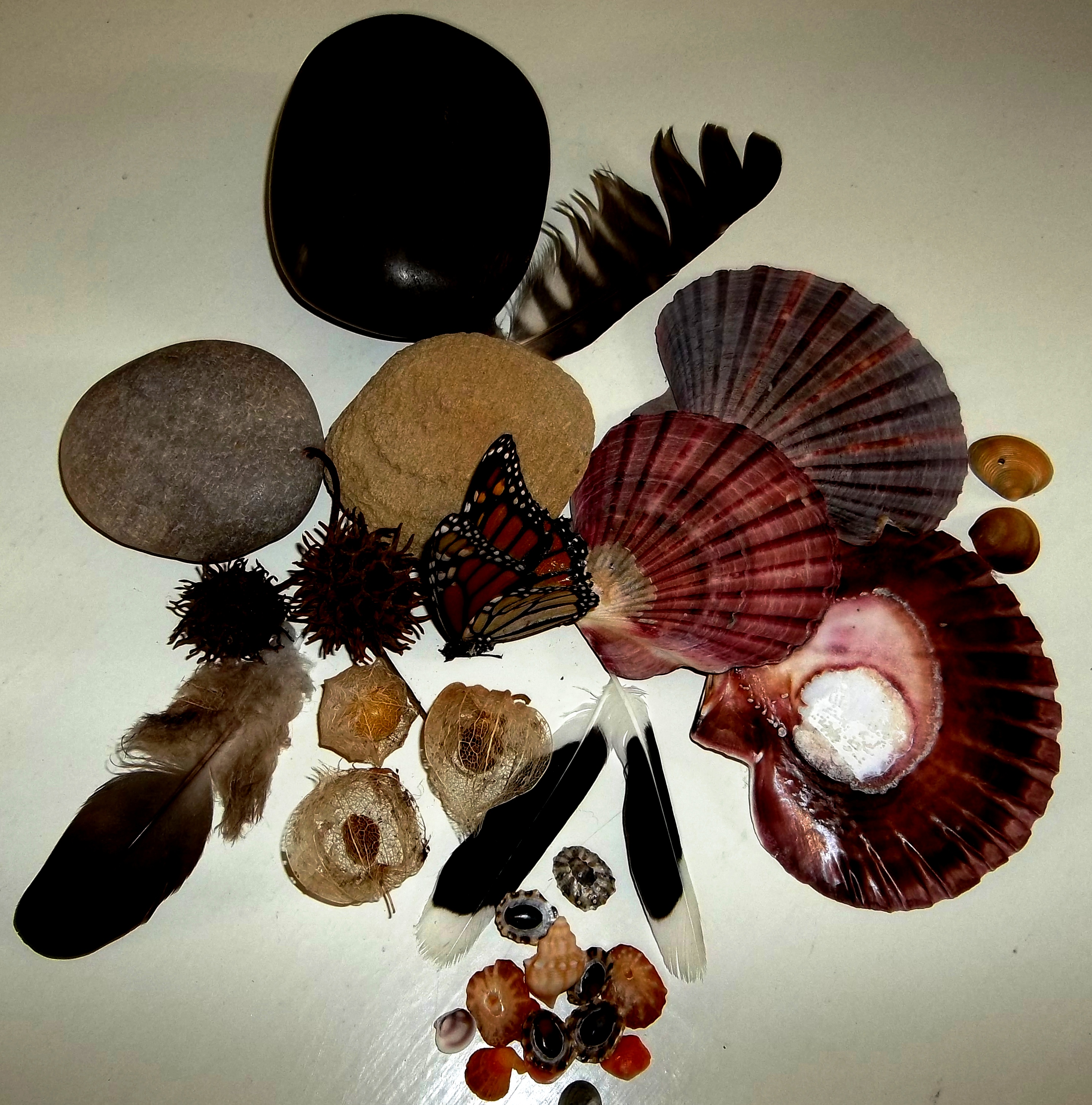
These stones and feathers and shells can tell the story of my life in the last few decades… shells collected with the children on a Northland beach, a black and white feather lying outside the door when I opened it on our first day in a new house –  greeting from a tui… the brown and cream morepork feather found on a long walk around the harbour with the thoughts and dreams of that afternoon threaded through its fronds.

An ancient stone from a river bed in the Blue Mountains of Australia was picked up after a day spent abseiling in abject terror, another from a cold pebbled beach in Devon, the chill of the Atlantic  breakers still embedded in it after all these years, while the polished brown stone came from an underground cave in the central North Island where glow-worms illuminated the roof, and a river flowed through.  These things are the stuff of my life… as they are of every life in which they are valued.

As I looked at them I thought of how other collections can also tell the story of a life. When I renewed my passport recently I found all my old ones, going back to when I was twelve and going to France on my own to learn French. In that passport photo two frightened brown eyes gazed out at the world. I had been so appalled at this picture that I promptly destroyed the evidence.

Which left the rest – a twenty one year old about to go on holiday to Spain, well- groomed hair, immaculate lipstick, and veiled blank eyes… the next, an exhausted mother of two toddlers about to go to Hong Kong, badly cut hair, eyes sad and resigned. And then, a picture of a thirty five year old woman, lots of dark hair piled up confidently, smiling eyes, relaxed smile. Life to be lived now, not endured. In the decades since, the hair has got shorter and then faded, and the last photo was so awful I hoped to be un-recognisable, but the story of a life is told in those passport photos.

Another can tell the story of their life in their jewellery, the coral necklace given at a christening, the charm bracelet for a little girl, pearls for a twenty-first, the engagement ring and the gold band…  a gift to mark the first child,  a clumsy pottery brooch made  at school and proudly presented to a beloved mother… the ring inherited from a grandmother, the eternity ring at a silver wedding…  such precious collections can mark out the steps of a life quite as well as a photograph album.

I wonder if there is even a market these days for photograph albums now all our photos are taken on phones and I-pads. I was never much  of a photographer, so that the photos of my honeymoon were on the same roll of film as the pictures of my first baby. But I did have a memory.

I remember one summer’s afternoon when the children were three and four as they tumbled around on the grass, one wearing a sun-suit in glorious colours of pink and orange and red, the other in matching shirt and orange shorts. As I looked at them, revelling in their laughter, their shining hair, and sparkling eyes, pearly teeth and glowing sun-tanned faces, I thought to myself, I’m going to remember this moment forever.

It was a turning point, because I found I did never forget that moment. So now, I know I can fasten those moments I want to remember with that little intention, and our minds are so obedient that they obey the instructions, and can call up the images whenever they are wanted. On the other hand, I wonder if the ease of communication, the instant photos, the selfies sent from Rome or Khatmandu which reach every member of the family all over the world the same day, make it easy to forget. We don’t have to remember, because it’s all there, on Facebook or in the picture file on the computer.

But for how long? Until the internet crashes? Or some other disaster hits the net? The computer is stolen? Few people will be able to pick up old albums in the future and leaf through them re-living their own lives, or discover the lives of their ancestors. And how will biographers fare in the future? In the past we’ve had portraits and miniatures in pre-photography days; then the wonderful stilted posed photos of the early days of photography, with the expert’s head hidden under a black cloth over a tripod while he captured forever the people and that moment in their time.

Then came the brownie box camera and all the other simple do- it- yourself cameras, and families recorded their events and special moments themselves. Biographies of the famous from the twenties until the sixties are full of revealing snaps, but what will there be for future  writers and historians wanting to illustrate their books about the powerful and famous? Not much, I suspect.

In the past, many anonymous photos turned out to be records of history – impromptu black and white snaps of Battle of Britain pilots ‘scrambling’, shots of families crouched in air –raid shelters from London to Leningrad, soldiers in Africa or Italy taking grainy pictures of each other to send back home… joyful hugs and kisses of victory – all these spontaneous pictures of humanity enduring both the ordeals and the pleasures of the twentieth century, captured in black and white film, are the stuff of history.

But I wonder what history is being preserved today in our somewhat ephemeral records? Will collections of jewellery or stones, in the end be the things to jog people’s memories in the future? Maybe the photos in passports and on driving licenses will the best concrete records we will have… time to get a decent picture taken for these official documents perhaps !


Food for threadbare gourmets

Summer salads don’t always mean lettuce for me… One of my favourites is grated cauliflower, mixed with chopped hard- boiled egg, some chopped Medjuel dates, toasted slivered almonds, and lots of chopped parsley. Then stir in enough good mayonnaise to the consistency you like. Chopped apple or banana is a variation, but actually anything can be added, and it still tastes good. But it can’t sit around, or it turns watery. I eat it on its own, but it’s also good with cold chicken.

Food for thought

And a poet said, Speak to us of Beauty. And he answered: Where shall you seek beauty, and how shall you find her unless she herself  be your way and your guide?  Beauty is not a need but an ecstasy. It is… a heart inflamed and a soul enchanted … a garden forever in bloom and a flock of angels in flight.

‘The Prophet’ by Kahlil Gibran, Lebanese poet, 1883 -1931. ‘The Prophet’ has never been out of print since it was published in 1923.

I

44 Comments

Filed under birds, cookery/recipes, family, food, great days, happiness, history, life/style, love, poetry, The Sound of Water, Thoughts on writing and life, Uncategorized

Summer song

100_0751

Walking around the cemetery on New Year’s Eve the sky was still and clear, no silver, almost transparent moon yet, rising above the sea looking like a silver sliver of dried honesty in the pale night sky. Instead there were gulls circling silently and intently overhead, weaving endlessly in and out, never touching or interrupting the arc of another bird.

After a while I chose one single gull, and watched its movements, following its wide circles and trajectories and swoops until finally it headed out to sea in the direction of Little Barrier Island, which hovers, misty indigo, on the horizon.

It felt like a holy silence, the tracery of the gulls’ flight woven like a network of silver filaments overhead, the cemetery a cathedral, silent, sacred and undisturbed. The Universe may have been un-aware that it was New Year’s Eve around Planet Earth, but surely that thought -form which meant we were all conscious of this moment in time, must have created that charged and sacred energy which I was feeling then.

Today it has rained. Things can start growing again, and I can stop watering – for a few days anyway. The countryside has the richness of high summer. The trees are billowing with green foliage, the fields have been cut for hay, and the grass in the meadows is so high that when the calves lie down, their heads just peep out of the tops of grass heads, plantains, buttercups and clover. I thought I saw a flight of big brown butterflies the other day, and it was the tips of their velvet ears reaching out of the pasture. The thrush in the garden sings continuously between pecking at the apple nailed to the top of the fence.

Tonight I was strolling round the cemetery, and the harbour below was the deep dark green of an Arthurian mere. It was as still as a mere too, and the boats at anchor were reflected with perfect clarity. Turning to face out to sea, the ocean was quite colourless with a deep band of blue on the horizon.

I’m constantly re-filling the dogs’ water bowl by the pavement. I hear them slurping away, as people walk past to the beach, thirsty Labradors and dobermans, bitzers and bichon frises, poodles and pointers… even a bulldog.

Earlier today, reading James Lees-Milne’s diaries, listening to the summer rain, I discovered his description of an English summer night in 1946: “the smell of new-mown hay and hedgerows, of eglantine and elder… how I love these long gentle Shakespearean summer evenings…”  Me too. The scent of the queen of the night comes drifting in from the open window at night here. It’s sweet and lovely… but I miss that indefineable atmosphere of those English summer nights.

Those nights throb with nostalgia and a richness. Somehow, it’s as though the layers and layers of lives lived in those parts, the echoes of history stretching back beyond memory and beyond record, the people in the millenniums before Christ, who trod out the ancient paths that still thread across hills and ridges and valleys and fords, can all still be sensed. The voices are silent, but their presence still lingers, as one century after another passes across the meadows and the woods.

The oak and the ash, the hazel and the hawthorn, the holly and the honeysuckle have been growing there since the last ice-age twelve thousand years ago. The smells, the sweet blossom, the new mown hay, the whiff of manure, the fresh rain, the damp leaves, have smelt the same in every age and every summer since. Standing in a quiet English lane on a soft summer night, you can feel those long centuries, and it is very touching.  I haven’t experienced a summer evening for a long time. I’ve always been back in autumn or in winter. But I must savour a June night once more!

Feeling homesick for the English country-side, I got “Far from the Madding Crowd” and “Tess of the D’Urbervilles off the top shelf of the book-case, and had an orgy of Hardy. Tess first, and the sweetness of Talbothays farm, then Bathsheba and her story… I read it differently this time, not so much for the drama of the story, but for the feeling of the country.

So I really took in for the first time, the delicious characters of the farm-folk, and the details of farming life, from the signs of an approaching storm, to the rituals processing through the year of lambing and dipping, and fattening and shearing, to the yearly sheep fair, the shearing supper and the harvest supper.

It was a way of life which had existed for over a thousand years when Laurie Lee in the enchanting ‘Cider with Rosie’, told the story of his childhood, and an archaic way of life  which then vanished forever, with the combine harvester, chemical farming, agri-business and of course the destruction of communities  by the carnage of the First World War.

I’m always struck in Hardy’s books, and in Jane Austen’s letters, by the isolation and “localness” of country life back then. So many people hardly ever left their village, unless they were gentry, and the next village was a foreign country. So when people fell in love in these tiny societies, and lost the object of their affections, through death, departure or rejection, there was often no-one else to love. People literally did grieve and die in different ways, from broken hearts.

Hardy’s description of the hopeless love by the dairy-maids at Talbothays farm for the un-attainable gentleman, Angel Clare, had the unmistakeable ring of truth.  I remembered from closed societies I lived in when I was young, whether in an English village, or a tiny colonial community far away from any other European habitation, how intense relationships were when there were no others. No-one could console themselves before the population explosion, and peripatetic habits of the twentieth century, that there were plenty of other pebbles on the beach. There weren’t.

Yet now, though I live in a tiny village with only four hundred souls, we are no longer prisoners of geography. Not only do people take off to holiday in Alaska and Italy, and their families return from Vancouver and Hanoi, but we all have the world of the internet at our fingertips, to use that well-worn, but accurate cliché in this instance.

It’s eighty- six years since Thomas Hardy died, and in those years our worlds and our lives and maybe our minds have expanded beyond imagining. The world is our village, and the internet is our community. There are pebbles past counting and wherever we direct our vision, we can find the glory of summer somewhere around the globe at the push of our buttons.


Food for threadbare gourmets

Apart from being full of healthy fats, potassium and Vitamin E, avocados are delicious.  I sometimes use them as a dressing over a salad. To one avocado you need  ground coriander – I use a quarter of a teasp, but less is more… the juice of a lime or a lemon, quarter of a teasp of ground cumin, a tblsp of apple cider vinegar, salt, and about half a cup of water. Whizz these ingredients until smooth and creamy, and use straight away.


Food for thought

To write or even speak English is not a science but an art. Whoever writes English is involved in a struggle that never lets up even for a sentence. He is struggling against vagueness, against obscurity, against the lure of the decorative adjective, against the encroachment of Latin and Greek, and, above all, against the worn-out phrases and dead metaphors with which the language is cluttered up.

George Orwell, English writer 1903 -1950.  Wikipedia records that : ‘His work is marked by lucid prose, awareness of social injustice, opposition to totalitarianism, and commitment to democratic socialism.’ Animal Farm and 1984 have continuing relevance.


61 Comments

Filed under birds, books, consciousness, cookery/recipes, culture, food, great days, history, jane austen, literature, love, The Sound of Water, Thoughts on writing and life, Uncategorized, village life

The necessity of beauty

100_0764

Pamela was my lodger. She was living in the third bedroom in my flat for the same reasons that Mr Micawber pronounced the immortal words:”Annual income twenty pounds, annual expenditure nineteen pounds nineteen and six, result happiness. Annual income twenty pounds, annual expenditure twenty pounds nought and six, result misery.”

I’d tried to fill the gap between my meagre salary (women were paid far less than men in the Hongkong I lived in ) and my expenditure, by doing TV quiz shows,  radio programmes, using the children as photographic models and even doing PR for the Anglican church until I could stand being hypocritical no longer. So Pamela was my next attempt at solvency. While she lived with me my life was filled with her dramas, love affairs, crises and disasters.

She arrived with one fiancée, dressed demurely in twinset and pearls, tweed skirt and silk head –scarf. Soon she found a more exciting prospect, and changed her style  to newly fashionable jeans, her hair swung up into dashing styles and lots of makeup. The new fiancée lent her his new VW while he went back to England to sort out his divorce, and hereby hangs the tale. Pamela rolled the car her first night in possession of it, and I was awakened in the middle of the night by a Chinese policeman who couldn’t speak English.

I pieced together that Pamela had had an accident, and was in a Chinese hospital since she had no insurance to cover her for a European one.  The next morning the children, four and five years old, and I, packed up a few things for Pamela and made an expedition to the enormous  building which housed some thousands of sick and penniless Chinese.

We found our way through a maze of corridors to Pamela’s ward, and by the time I reached her bed I was deeply shocked. The ward held eighty women. They were all dressed in faded brown cotton shifts including Pamela. The noise was horrendous. Cantonese is the noisiest language on earth. To hear our amah chatting to another outside the kitchen was deafening. To hear seventy- nine women chatting in a confined space was probably higher than the safe decibel level.

Pamela was bruised and shocked but not injured. After doing our duty, and promising to return that afternoon with more things she wanted, the children and I went home, leaving her with a little bunch of camellias I’d picked. Only six blossoms because that was all that were flowering.

When we returned in the afternoon, something had changed. There was a hush in the ward and a sense of peace, and all eyes were on the gwailo (long- nose) and her children. Being watched was something one accepted as part of life then, but this felt different. And the hush was a sort of reverence. Pamela whispered to me what had happened after I left.

When we walked out of the ward, the women came crowding round her to see the flowers and smell the fragrance. They were ecstatic at this exquisite beauty in their harsh unfriendly environment. Deprived as the women were, of all colour and texture and smell and beauty, the flowers brought something like heaven into their lives.

They didn’t speak English, and Pamela didn’t speak Cantonese, but with the aid of the ward sister’s few words of English, they worked out a roster for the flowers. Each woman would have one camellia by her bed-side in a glass for three hours in every twenty-four. Pamela had one all the time, and the sixth flower which had fallen off its stem, the ward sisters had in their office, floating in a saucer.

Back at the office the next day I rang the dean of the cathedral and several hotels and they agreed to send their flowers to the hospital whenever they changed them. I wonder if they still do.

The great Catholic thinker Monsignor Hildebrand wrote that: ‘the poor need not only bread. The poor also need beauty’. But it’s not just the poor. We all need beauty.

It’s strange to me that Abraham Maslow in his hierarchy of needs didn’t include beauty. Sometimes beauty is the the only thing that keeps us going. As Resistance fighter Odette Churchill was being locked back in her cell after a bout of torture by the Gestapo, she snatched up the skeleton of a leaf being blown in the door with her. The beauty of that leaf sustained her and gave her hope and courage and a belief in goodness that carried her through her  dreadful ordeal.

Quaker writer, Caroline Graveson wrote that: ‘ there is a daily  round for beauty as well as for goodness, a world of flowers and books and cinemas and clothes and manners as well as mountains and masterpieces.’ She talked of beauty: ‘not only in the natural beauty of the earth and sky, but in all fitness of language and rhythm, whether it describe a heavenly vision or a street fight, a Hamlet or a Falstaff, a philosophy or a joke: in all fitness of line and colour and shade, whether seen in the Sistine Madonna or a child’s knitted frock…’

The sad thing is that those deprived Chinese women in that joyless hospital ward, came from a culture, which before the blight of industrialisation and the tyranny of plastic, was incapable of producing anything that wasn’t beautiful – from their baskets to their bowls, to their porcelain and their poetry.  And there was something very beautiful about buying a kati of vegetables in the markets and watching them being skilfully wrapped in a beautifully folded sheet of re-cycled Chinese newspaper, or a large leaf, and tied with a knotted reed.

Perhaps their own sage should have the last word, Confucius said that everything is beautiful, to those who can see it….

Food for Threadbare Gourmets

Salady food feels right in the Antipodean Christmas season.This is one of my favourites. Boil new potatoes for the number of people you have, plus hardboiled eggs. Chop them and mix them with sliced artichoke hearts fresh from the delicatessen or from a jar. Gently toss in a good vinaigrette  dressing, and sprinkle with capers if desired. Delicious on its own with crusty rolls, or with cold chicken or cold salmon.

68 Comments

Filed under colonial life, cookery/recipes, culture, flowers, food, great days, life/style, The Sound of Water, Thoughts on writing and life, Uncategorized

The fun of fashion

100_0175

What to wear has occupied many happy  hours and years of my thinking life. So though some research has claimed that little girls and boys are conditioned to be male and female… pink versus blue…  I’m not convinced!

I don’t think any little boy could have felt the bliss that I did at three when I finally got to wear a sun-suit that had been too big for me. I remember the day I was allowed to wear it, I shall never forget the pattern of navy, pink, yellow and blue tiny flowers all over it. It was linen, it had tiny buttons down the front, and was the most beautiful thing I’d ever worn. I remember the glory of running to catch up the big girls next door, skipping through long fine grass that grew beneath the pine trees, and the shafts of sun-light beaming down between the rough trunks. And above all, the rapture of knowing that I was wearing such a wonderful thing.

Not quite the same rapture over my white petticoats trimmed with broderie anglaise, and the smocked pink dress and the blue dress, made of ninon – a fine muslin type fabric with soft little bobbles sprinkled all over it – but I still enjoyed them. A year older, and winter, I revelled in the Fair Isle berets and matching gloves my mother bought me and my sister.

I stood and watched with some disapproval as she preened herself in the two new coats she had just bought, one a black fluffy material with gold buttons, the other a smooth jade green wool with green and gold buttons. She had said she couldn’t resist them. I remember precociously thinking that there would be no more clothes coupons left for us.  I was five, and in war-time we had an allowance of coupons for the year, which once used, meant no new clothes until the following year.

School uniform was a treat then too, with beautiful quality velour hats with big brims and a wide ribbon round it for winter, and a Panama hat the same shape with another big ribbon round it for summer.

When my Victorian grandmother came to care for us after my mother had gone, she dressed me according to her firmly held notions. I went to school one day in an anguish of embarrassment, wearing soft leather full- length gaiters right up my legs with hundreds of tiny leather buttons. We needed a button hook to do them all up.  But I couldn’t get them off for PT (Physical Training), so she abandoned those, thank goodness. She spent hours at her treadle sewing machine making me pink satin, lace- trimmed dresses and the like, and sent me off to church in a new brown tweed coat which was agony every time I sat down. It turned out she had sewed up the scissors into the deep hem.

Worst of all were the bright purple fluffy mittens she got hold of – warm – but hideous. It lacerated my fashion- conscious soul every time I put them on. At my best friend’s seventh birthday party I left them behind at her house, hoping that that would be the end of them. But further humiliation ensued when my grandmother made me go back to get them, and so then every-one knew that these frightful objects were mine.

Bundled off to my new parents at nine and a half, they threw away all the clothes my grandmother had lovingly made me, and took us shopping in London, where we were equipped with little tweed velvet- collared coats and matching berets, pretty dresses, and best of all, check shirts and shorts, just like the girls wore in Enid Blyton’s books. Fine feathers indeed.

But they had to last… that was the last time we enjoyed such largesse. When I grew out of them, there were no replacements, and I had to manage on various hand-me-downs, and odd birthday presents. So when I started earning, the best thing about it was never again having to wear clothes that embarassed me. But though I wanted fine feathers, I had also learned the lesson we all did on reading ‘Little Women.’

The scene in which Meg, also humiliated by her worn clothes, allows her frivolous friends to turn her into a fashion plate for a party, and overhears some older women commenting, what a pity that that pretty modest girl had spoiled her appearance with frills and flounces, and crimped curls, had struck deep. Meg feels overcome with shame for not being true to herself.  So I wanted fine feathers, but not fashion overkill!

Oh, the lovely cut of winter clothes, the fabrics, the wool and tweed, the gabardine and mohair, the lambs-wool and cashmere, the knits and jersey, velvet and corduroy; the colours, rich plum reds and pine greens, the russet tones, and mustards, the navy blues and chocolate browns – breathes there a woman with soul so dead – to paraphrase Sir Walter Scott – whose heart doesn’t leap when confronted with these riches?

And for summer, we had linens and cottons and seersuckers and silk, the muslins and tulle, taffetas and brocades for evening. We’d never heard of denim then, and nylon was something for parachutes and stockings. Fashion for a teenager earning money at last, meant a circular felt skirt, a wide elastic waspie to nip in our waists, over a frilly starched cotton slip and worn with  a Marilyn Monroe sweater and flat pumps. In this get-up, we twirled and swooped, dancing to rock and roll, and skiffle, though we could still waltz and do Scottish dances at formal balls, in long romantic evening dresses accessorised with long white gloves. And then there was the mini!

But times have changed of course. I’ve just read a survey which claims that women’s waists now are seven inches bigger than they were in nineteen-fifty. The average woman’s waist then, they claimed, was twenty- seven- inches, and it’s now thirty-four. I think they’ve got it wrong – my waist was twenty-five then, and I envied the possessors of twenty-four inch waists. The research also says that women are square and waistless now, and that the old hour-glass figure has gone. I had noticed how waists are disappearing, and have wondered how anyone could wear a waspie any more, while circular skirts would not do much for expanded hips these days.

So it seems to me that women are not so much the slaves of fashion, as that fashion is the slave of women’s diet. And now that spartan war-time food, not just in England and Europe but probably in other parts of the world too, is no longer on the menu,  fast food and tampered- with food, and Too much of everything, seem to have re-shaped the female figure. And fashion in the shape of towering platforms and spiked heels seems to have hobbled women quite as successfully as bound feet in China.

So give me beautiful clothes, but not haute couture, fine feathers but not high fashion… and I will probably still be planning what to wear when I’m on my death-bed – maybe I should write a book about clothes – what to wear from the cradle to the grave. And I haven’t even mentioned hats!

Food for Threadbare Gourmets

That apple cake! It was scrumptious, but so crumbly that we needed a fork to eat it with. So maybe a bit less apple and a bit more flour would hold it together. And whipped cream lifts it to another level!

Tonight, roast lamb, which rarely crosses this threshold, but it’s a special occasion. So along with all the usual trimmings, I’m making onions in white sauce. Peel and chop several onions, and boil with salt and pepper until cooked. In another saucepan melt two ounces of butter, and add enough flour to make a stiff roux. I pour in about a cup of milk, and then a cup of the onion- flavoured water, and stir briskly. Put it back on the heat and bring to the boil, stirring all the time until thick. Add nutmeg to taste, salt and pepper and the onion. You might need more milk, though I like the sauce quite thick. I usually add a dollop of cream…

Food for Thought

Beauty is a choir of singers, a chorus of dreamers, a concert of aspirations, an orchestra of goals, a symphony of ambition and a ballet of productions.

Glenda Green  Born 1945. Artist and author of ‘Love without end. Jesus Speaks’

56 Comments

Filed under cookery/recipes, fashion, food, great days, happiness, life/style, The Sound of Water, Thoughts on writing and life, Uncategorized

Diana

Diana died on 31 August fifteen years ago. Those old enough to remember, know where they were at the moment when they heard that John Kennedy had died, taking with him the hopes and idealism of people all around the world.

And most of us I think, also know where we were when we heard of the death of Diana – there’s only one Diana. Her death left a huge hole in the consciousness of the world. For fifteen years we had gloated over her clothes, admired her beauty, shared her children, followed her travels, marvelled over her commitment to others,  felt her pain at her failing marriage, hated her rival, regretted her lapses of judgement in men and other things, and always loved her.

Who can forget the pictures of her kneeling at the feet of an old blind lady just after her engagement – no Royal had ever knelt to their adoring audience before? Who doesn’t remember those pictures of her on her knees again, arms open wide, love blazing from her face as she greeted the sons she hadn’t seen for a few days? Can anyone forget that picture of her mastering her fear and courageously walking through a minefield to show the world what wars do to women and children?

Do people remember those pictures of her holding the hands of a leper, and another of her sitting with an Aids patient with his hands in hers? These pictures flashed a message around the world – no-one should ever be an outcast. We should include the old and the sick and the pariahs.

And then there were those unforgettable ones of her in a Bosnian cemetery where she came on a grieving mother, and with no common language between them Diana put her arms round this stranger and held her. Being available to her grief, no words necessary. And the shots of her carrying a little Black American girl in her arms to take her for a ride in her limousine, the one wish the little girl had expressed.

There were other pictures – the woman who went to hospital to collect her husband with his broken arm in a sling – the same husband who then, unbeknown to the world at the time, took his mistress up to Scotland to convalesce with his grandmother. Meanwhile, Diana continued to visit the young man she’d befriended in that hospital, and then to visit his family when he got back home.

She went to a childrens’ hospital every few days to paint a little girl’s finger nails pink. She wrote so many comforting handwritten letters to people, that after she died, and the stories were told, people could only marvel.

She did so many kind things in private, and as her marriage broke down, some foolish things in public. But in many ways she lived out all the archetypes of women, and maybe that’s why some people loved her, and some didn’t- if they were repelled by the archetype. So she personified Persephone, the shy goddess of springtime, who in her dark moments refused to eat; she personified Ceres, the mother and good friend, with compassion for all; Hera, the angry, vindictive, jealous and rejected wife of Zeus; Minerva, the career woman who was meticulously briefed and organised in contrast to her husband’s chaotic office, and all the other goddesses. (I wrote of this in depths in my book ‘The Sound of Water’).

She also had that much misused word – charisma – hardened journalists felt her presence, watched her love in action, and melted. She was down to earth- talking to a mayor on an official visit, she had him eating out of her hand when she asked him how much money he gave his children for pocket money!

She had courage. As a shy twenty-one year old on her first tour – in New Zealand – she emerged from a hall to greet the waiting crowds, and was met by a barrage of placards and yelling protestors shouting about Ireland. For a moment she stopped, shocked, and then stepped straight up to the other people standing in front of the protestors and greeted them, all the while enduring the barrage of insults. That took grit. She had courtesy, refusing to shelter from the rain under an umbrella, unless the mayor’s wife standing with her shared it too, the mayor’s wife told me.

In psychological terms, the first relationships people have with their parents shape their later lives. Diana, as the third daughter, was initially rejected at birth by her father who wanted an heir. That sort of emotional shock would have stayed in her psyche, and projected an unconscious fear that she would be rejected by the men she loved. So she was. Her husband rejected her, and then the Pakistani surgeon who she loved for two years and hoped to marry – until he couldn’t face the hullabaloo which surrounded her.

Her last fling on the rebound was unlikely to have lasted. Dodi Fayed simply didn’t have the intellectual and emotional depths that Diana would have needed. She called herself as thick as a plank, because she had failed her school exams. But it’s a given that strife at home blocks children’s progress at school. They can’t concentrate on their lessons when they have emotional trauma going on, and Diana was always torn between her warring parents. On the other hand, people who knew Diana encountered a lively mind and wit, a phenomenal memory, and a musical talent that meant she was able to plunge into the notoriously difficult Rachmaninoff’s Second Piano Concerto without any music, when asked to play.

Like all un-integrated people she had many flaws. Who does n’t? That’s no reason to denigrate her, as it’s become fashionable to do in the years since the world wide grief at her death. Her gifts to the world outweighed her private problems. And what were those gifts, apart from her two sons? She left us with a memory of a beautiful soul who wasn’t afraid to love and act spontaneously; who gave compassion- and acceptance – to all who crossed her path, and whose example has given others the courage to open their own hearts and express their feelings.

Her motto was ‘compassion in another’s troubles, courage in your own’. Her acts of random kindness were legion. Her life, her mothering, and her work were an inspiration, while fashion has never been the same since she went to Paris and died. I, like many, still miss Diana’s presence on this earth, and wish I had seen her grow into the magnificent mature woman which was her potential. She was only thirty-six when she died.

Food for Threadbare Gourmets

A friend recovering from a major operation came for supper last night, so I made a bit of an effort. Whole chicken legs, slashed at intervals and the slashes stuffed with chopped garlic and grated lemon rind and juice, marinated for some hours before hand. Before popping into the oven, I sprinkled them with flour mixed with ginger, salt and pepper, and sprinkled with some olive oil. Then into a hot oven for about an hour or until cooked. The skin is crisp and tasty. I’d made some of the cream potatoes from the recipe other day, and we had them with Brussels sprouts and little spring carrots.

Not bad. I experimented with a pear and almond tart for pudding – the pastry a wonderful quick easy recipe for another day – the frangipane didn’t taste as almondy as I would have liked… so a bit of jiggling to do there.

Food for Thought

So precious is a person’s faith in God… never should we harm that.

Because He gave birth to all religions.            St Francis of Assisi 1182 -1226

44 Comments

Filed under cookery/recipes, fashion, food, great days, life/style, love, princess diana, royalty, spiritual, The Sound of Water, Thoughts on writing and life