Category Archives: culture

Following your bliss

100_0510

Follow your bliss, urged the great Joseph Campbell – this used to sound like heaven. Just doing everything you wanted!

Later – just slightly wiser- I supposed this heaven was probably self-actualization – which always sounded like one step below enlightenment, both impossible goals for the likes of me. But then I discovered that self-actualisation was not quite the Everest I had thought.

It was the need to be good, to be fully alive and to find meaning in life – according to Abraham Maslow, one of the grandfathers of personal growth. And yet according to him, all other needs like food, love etc had to be fulfilled before achieving the nirvana of being a free person – another ringing phrase of personal growth.

Research suggests that when people live lives which are different from their true nature and capabilities, they are less likely to be happy than those whose goals and lives match. So pursuing the elusive goal of this self-realisation means we feel more creative and happier, more ‘fully alive’, and ‘find meaning in life’.

And yet it seems to me that happiness isn’t the whole story, and fulfilling our needs isn’t either. Great souls like Nelson Mandela and Victor Frankl have been called self-actualising, and yet their needs can hardly be said to have been met in prison or concentration camp. But their capacity for living, love and forgiveness, wisdom and insight seem more saintly and more profound than the stories of many saints.

They both, like other so- called self-actualisers, had accepted who they were and where they were, and made the best of it, in giant, heroic terms. But self- actualising isn’t just for the heroic and the saintly, I discover, but can be for all of us. Maslow described the fulfilment of following such a path and as I understand it, his description of life as a fully- realised person would be something like this:
We would experience life like a child, with full absorption and concentration and joy and we’d try new things instead of sticking to safe paths; we’d listen to our feelings and inner voice instead being victim to habit and the voice of tradition, authority or the majority.

We’d dare to be ourselves – authentic, in Maslow’s word- and avoid pretence (‘game playing’). And we’d have the courage be unpopular if we didn’t agree with the views of the majority.

We’d take responsibility and work hard; and try to identify our ego defences and be brave enough to give them up, meaning to be honest with ourselves. This also means being vulnerable, which I don’t think Maslow mentions, but this to me, means having the courage to be tender and open hearted and to develop the capacity to feel deeply.

Apart from knowing that we are following our spiritual destiny in becoming the whole person we can be, the rewards seem to be a deeper enjoyment and engagement in life, a profound appreciation of the goodness of life, and therefore less stress and anxiety, and a genuine trust, in Mother Julian’s words, that all will be well.

It sounds like something we could all do, though when we have commitments to children, those duties have to be honoured first … otherwise becoming self – realised can seem more like self-centredness! Hindus recognise this stage of life as ‘householder’, before seeking their own ‘liberation’.

Those making this pilgrimage towards wholeness and authenticity often find that the path to freedom is not an easy one. That road less travelled may be pitted with puddles and pain-filled treks. And the person who’s throwing off the shackles of duty and listening to their inner voice may often be misunderstood or misinterpreted.

The stars that kept me on track as I have tried to walk this way were actually words from the sages and poets – and I have clung to them. From Ibsen’s belief in our ‘sacred duty’ to ourselves, to T.S. Eliot’s dictum that it is not our business what other people think of us, the words of literature – the logbook of the human race as one writer put it – pointed the way.

Trying to become a free person, letting go old self-defeating patterns of doubt and distrust, old fears – those critical inner voices that don’t serve us – means changing many things in our lives and in ourselves … and it’s not always obvious where this is taking us. Werner Erhard once said confusion led to a higher state of consciousness, a belief I have clung to, hoping it to be true!

These transitions take trust and courage and a belief in the goodness of Life. And I am learning that we have to listen to the voice of life and not be tempted by the easy way out – and never settle for less. To reach the end of our days and to realise that we had settled for less, for the sake of pleasing others or making life easier for ourselves, would be the ultimate betrayal of the gift of life.

Loyal, loving friends support us – where would we be without our friends? But in those dark moments which we all have to endure alone when we try to walk this path, the words of Oriah Mountain Dreamer can sustain us.

She wrote: “I want to know if you can disappoint another to be true to yourself. If you can bear the accusation of betrayal and not betray your own soul. If you can be faithless and therefore trustworthy.” (Warning : this hurts !) One friend said to me: “I feel stripped”, as she picked her painful way along the path. And it’s only by staying fully conscious and hanging on to all our reserves of courage that we can reach the end of this road victoriously.

When we strike out, off the beaten track, it can push the buttons of others, living safe conventional lives, sticking to conservative values, and maybe not wanting to tread any but the known way – and maybe feeling uncomfortable when confronted with uncertainty or risk.

But to be free is to stride fearlessly into and through a cloud of unknowing – as the beautiful, extraordinary and self – actualised Helen Keller amazingly said: ‘If life is not an adventure then it is nothing at all’. So like so many others, I have had to step out of my constricted and uncomfortable comfort zone in order to be free. And just as Eliot said it’s not our business what others think of us, so he might also have said that we cannot expect to be understood either.

The words of another poet, Montrose, encourage travellers to find the courage to take what seem like huge steps into the unknown with his words:
He either fears his fate too much,
Or his deserts are small,
That puts it not unto the touch
To win or lose it all…

And so though while we are in process, we may think we have lost all to win all – or maybe in the words of the Spanish proverb – have taken what we wanted and paid for it – freedom is worth the price. It’s freedom from self-limiting beliefs and doubts and from compromising with our own truth and inner knowing. It’s daring to open our hearts, do the unthinkable, find new ways of being, connect with the beating heart of the world and know that when we take these terrible risks, somehow the universe supports us.

So yes, such a life is an adventure, and also laughter and love and truth and beauty, friends and fun. And now I think this is what Joseph Campbell may have meant when he said follow your bliss.

Food for threadbare gourmets

I’ve sometimes thought I could/should write a cookery book called a million ways with chicken – an exaggeration perhaps – but not far off!
I love chicken recipes, and this one I acquired over forty years ago from Clement Freud (yes, Sigmund’s grandson) when he was in his heyday.
It’s a cold mousse, and you need eight ounces of cooked, chopped chicken, two ounces of butter, three eggs, three ounces of fresh white breadcrumbs, three table spoons of dry sherry, quarter of a pint of single cream, salt and nutmeg.
Melt the butter in a large basin over a pan of boiling water. Pour in the cream and breadcrumbs, salt and a good pinch of nutmeg and stir for about five minutes until the mixture thickens. Beat the eggs and sherry together, and add to the basin, followed by the chopped chicken.
Pour this mixture into a buttered soufflé dish, cover with foil and bake in a moderate oven until firm – about half an hour. Let it cool before serving. Freud recommends serving it with a slightly garlicky mayonnaise with mashed avocado added, and for a really creamy texture stirring in a stiffly beaten egg-white.
It’s all rather delicate and delicious.


Food for thought

“Nobody can give you the meaning of your life.
It is your life, the meaning has also to be yours.
Nobody except you can come upon it.
It is your life and it is only accessible to you.
Only in living will the mystery be revealed to you.”
-Rajneesh

35 Comments

Filed under consciousness, cookery/recipes, culture, happiness, human potential, literature, love, philosophy, self knowledge, spiritual, The Sound of Water, Thoughts on writing and life, uncategorised

Behind every great….

100_0087‘Behind every great man stands a great woman’, one of my dearest friends declared, a propos Winston Churchill and the love of his life, his wife Clementine, and of Franklin Roosevelt and Eleanor. We were lunching at the latest fashionable eatery for ladies who lunch, and I rather lowered the tone by quipping that behind every great man is a woman with nothing to wear!

As I sort through years of accumulation in this house, ready to take my next steps forward, I thought of this conversation, and thought of a much ignored and rather valiant woman who stood behind a great man. Her influence over a hundred years later is behind the room I sit in.

I looked around at this white room, white walls and cream curtains, white French furniture and if not white, then painted white and distressed by me, the guts of the rooms being created by the richness of books, and the colour of china. Only three pieces of furniture are the exception to the reigning white – the pine dresser in the dining area, and the antique round Dutch rosewood table laden with piles of books, and a battered old French bench painted in soft grey and cream.

After years of blue rooms, red rooms and yellow rooms this pale restful room is how I want to live these days. Syrie Maugham, Somerset Maugham’s ex-wife, is usually credited with inventing all-white rooms in the thirties. She bleached and pickled and painted furniture and floors, had carpets specially woven in white, and white on white became all the rage.

But the first white rooms in interior decorative history were Mrs Oscar Wilde’s drawing room and dining room in Tite Street, Chelsea.

The poet W. B Yeats described: ” a white drawing room… with white panels, and a dining room all white, chairs, walls, mantel-pieces, carpets…” The Wildes were leaders of fashion, and the much under-rated Constance Wilde edited the Rational Dress Society’s Gazette, often detailing accidents which had befallen women owing to the restrictions or impracticality of their dress.

Her white dining room may have been impractical, but she was an unusual Victorian parent who allowed her two sons to romp and play in its pristine whiteness – and they also scandalised some – as their unconventional mother allowed them to do this naked.

Though not as talented as the wickedly brilliant Oscar, (arriving in America and being asked what he had to declare, he replied, ‘Nothing but my genius!’) she more than held her own, collaborating with him in many of his projects, writing books for children, as well as writing in, and editing her magazine, while creating the artistic and aesthetic environment which had such an influence on their circle and their times.

Constance was also interested in the spiritual life, and became involved with the famous metaphysical and mystical society The Order of The Golden Dawn, where amongst others, well known personalities like WB Yeats, Maud Gonne, famous mystic Evelyn Underhill and even wicked Aleister Crowley before his fall, used to meet.

After the difficult birth of their second son the Wilde’s sexual relationship dwindled, and it was then that Oscar became involved with the love life (what his lover famously described as ‘the love that dare not speak its name ‘) that ended his career and the happiness of them all.

It’s only recently that it’s been understood that the mysterious and crippling illness which blighted Constance’s life, and probably their marriage in the five years before Oscar’s downfall, was the onset of multiple scelerosis. It was a condition which had only been recognised a few years before, and which Constance’s doctors were obviously not aware of.

This too, must have made a huge difference to the quality of the Wilde’s marriage, though they both obviously loved each other. Constance continued to support Oscar’s achievements after his disgrace and was the first to praise the poignant ‘Ballad of Reading Gaol’. But his inability to keep at a distance the beautiful but destructive and heartless “Bosie” Douglas, the other half in the scandal, finally drove husband and wife apart.

Constance took her two boys to Italy to escape the scandal, and died there a couple of years later from the dangerous quack treatment she sought for her increasingly debilitating illness.

There’s been much sympathy and rightly so, for Oscar Wilde and his trials and tragedy, but Constance is often the forgotten one in this tribulation which affected them all. Not only does a fine woman stand behind most great men, but behind every disgraced man stands a humiliated and heartbroken wife…

Since I learned her story many years ago, Constance Wilde has always had a place in my heart… I can never resist women who make the best of things, however bad the things … and as Eleanor Roosevelt so memorably said: “A woman is like a tea bag – you never know how strong she is until she gets in hot water.”

Food for threadbare gourmets
After my grandsons had been for lunch and I had made gallons – as it were – of chocolate sauce, I wondered what to do with all the sauce left over. Luckily I had a friend for supper a few days later, and decided to put the chocolate sauce to good use.

I gently stewed some peeled and cored pears in hot water with maple syrup, ginger wine, a few cloves, star anise and a bay leaf added. When soft I left them to steep in this juice, and later, boiled it away until it was thick and syrupy.

Served with whipped cream, re-heated chocolate sauce, and a little shortbread biscuit, it was wickedly delicious to one who has renounced sugar!

Food for thought

There is that which has always been there,
Which has never left your side,
Which has always been present,
Whatever the feeling, the circumstance.
When you turn your attention to trusting that,
You surrender to yourself.
Anon

31 Comments

Filed under cookery/recipes, culture, fashion, history, life/style, literature, love, The Sound of Water, Thoughts on writing and life, uncategorised, womens issues, writing

Living takes up all my time

100_0389
As I drove home this morning I wondered how often I had driven along that same country road with all its winds and curves and hills and one way bridges… ruminating about this, I went back randomly to my diary six years ago to see what has changed… this is what I found:

“ I had the house to myself today – the solitude I’ve always wanted. In his early diaries, Thomas Merton moaned on about not having solitude and silence. I know how he feels, but how could these things be missing in a Trappist monastery? And it’s a lot easier to be alone in a crowd surely, than one in a one-on-one relationship! Silence is easier than solitude. I never have the radio on, rarely the TV, and sometimes go for weeks without playing any music.

‘The days have seemed calm and beautiful. Ken Wilber’s understanding of how to ground the insights of the spiritual life, reminded me of Brother Laurence’s practise of the Presence of God.
It was reported of him that, ‘in the greatest hurry of business in the kitchen he still preserved his recollections and heavenly-mindedness. He was never hasty nor loitering, but did each thing in its season, with an even uninterrupted composure and tranquillity of spirit…’  mindfulness then…

‘I had made a cake from a recipe on the last page of Nigella Lawson’s book ‘Feasts’. This was a funeral cake, but the beautiful loaf in its tin with a long sprig of rosemary for remembrance on top inspired me. It was absolutely delicious, and has entered my repertoire with a fanfare. So yesterday, I got up in good time to make another rosemary cake for morning tea with Kate and Jocelyn. This time I used twice the amount of cooked apple and lemon, more sugar and added vanilla.

‘It was a triumph. The big, tender, golden loaf with a sugary top, infused with the taste of lemon and rosemary, and with the rosemary sprig down the centre, was a culinary poem just to look at. It had a pure, classic feeling, qualities which can be applied to things other than music or sculpture! We all felt it was a work of art, which didn’t stop us devouring it in large moist chunks, and Jocelyn took the recipe.

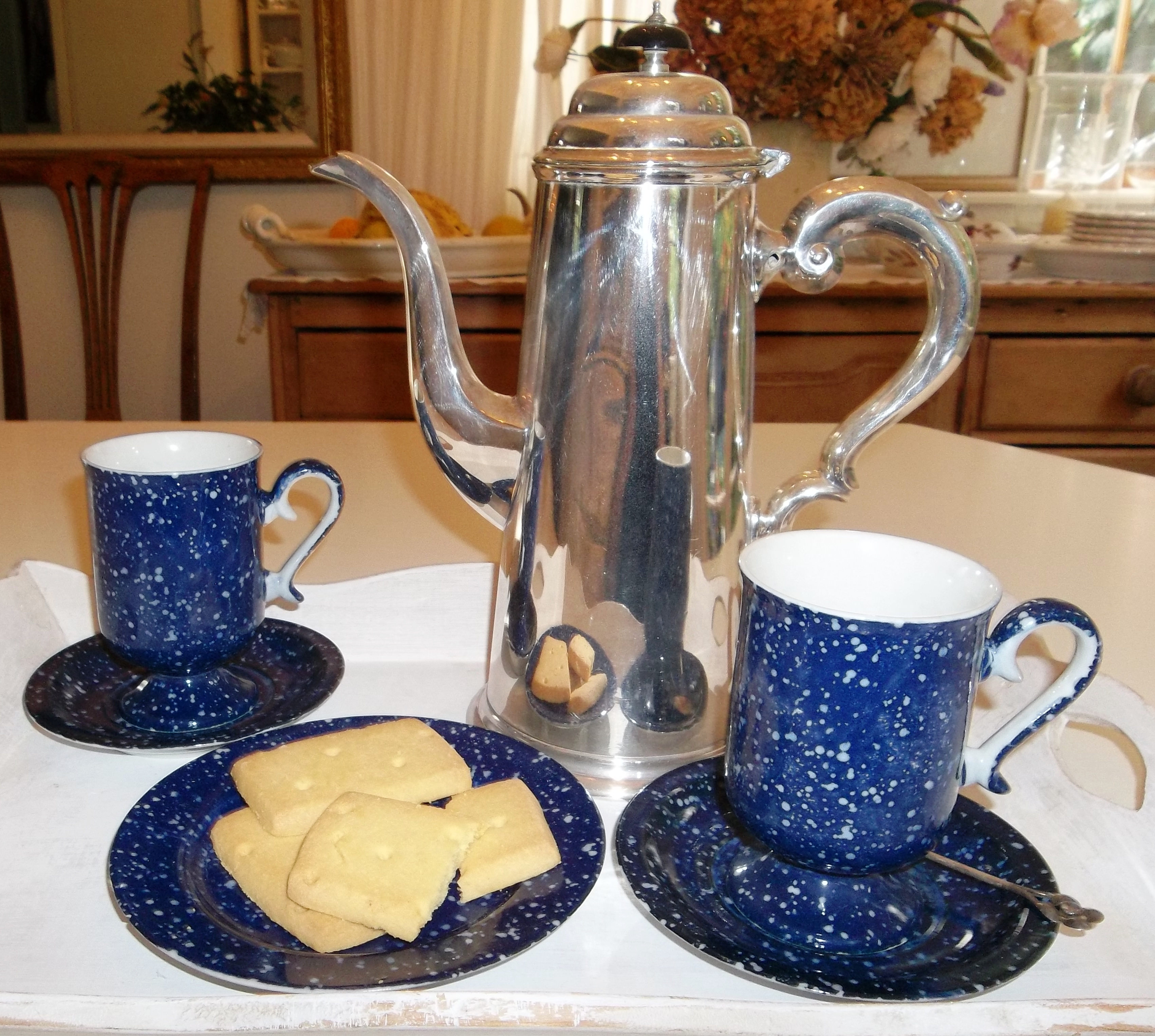
‘ Both girls very pure, so we had apple tea instead of coffee, (I didn’t realise it was solid sugar) and we talked for hours, until nearly one o’ clock. Jocelyn brought a jar of her fig and ginger jam, Kate, a fragrant bouquet of herbs and pink and violet flowers. I had laid a table with a linen cloth with a heavy crochet lace border, and with the curving regency-style silver tea-pot, the bone china rosebud sprigged cups and saucers edged with gold, silver king’s pattern cake-knives, white lace and linen napkins, it looked like one of those romantic magazine photographs. I left it, cake, crumbs, rosemary sprigs and all, untouched all day long to savour.

Today, I fell off the wagon. Went shopping and doing errands in town, and I never seemed to get into my stride. Going into the spare bedroom to work out where I would start doing paint touch-ups, I found a book left there by the last occupant, Alexander McCall Smith’s, ‘The Sunday Philosophy Club’, which I read till I had finished. Charming, erudite and civilised – art, music, ethics – all merging seamlessly. But apart from meditating, I hadn’t been present all day, just for the sake of blobbing out with a book, going absent without leave as it were. So no mindfulness then…

Thank heavens for Rumi, who I turned to this morning and his wonderful:
Come, come, come, whoever you are! Wanderer,
Worshipper, lover of learning
This is not a caravan of despair.
It doesn’t matter if you’ve
Broken your vow a thousand times
Still and yet again
Come!’

Driving home through the bay, I saw a mother duck shepherding her family of tiny brown fluffy babies along the footpath, while she calmly brought up the rear. There must have been at least a dozen, and one hadn’t managed to make it up onto the low step-up of the pavement, and was now trying to keep up, anxiously scurrying along in the gutter!

Cara (the cat) is still asleep on the unmade bed, a flat, black semi-circle. She slept all night stretched up against me, seeming to be purring every time I awoke. Maybe she was making amends for a dreadful incident last night in the cemetery. As I strolled towards the look-out where I habitually inspect the flat rock far below with waves splashing over it at high tide, a cock pheasant ran across and into the undergrowth on the edge of the cliff.

Cara was a long way behind, and hadn’t seen it, so I thought all was well. But when she reached me, she stood and sensed the area. She could have been a pointer, the way she sussed out the presence of the bird. Ignoring my peremptory calls, she purposefully plunged down the cliff. I attempted to grab her, but it was too dangerous. Occasionally, as I peered into the undergrowth, I would catch sight of her blackness skulking through the bushes. I went home with my arms full of pohutukawa twigs as usual, to use as firewood, and then came back in the hope of tracking her.

She turned out to be sitting behind a grave-stone, and when she attempted to escape me again I grabbed her by a foreleg, and carried her firmly home, where I made sure she stayed. I hope it’s not the breeding season. ‘

Reading this, I realised that much has changed in six years … though I still fall off the wagon regularly, but the beloved cat has gone to a soft cushion in the sky, I am now alone, and have also given up eating sugar… so fewer delicious cakes. But the rhythm of the seasons continues, the full moon still shines across the water as I stand at the cliff’s edge, the mother ducks are still moving majestically across the road shepherding their broods… some friends have moved on, new friends have changed my life in many ways, and life is often a baffling adventure.

But whatever hidden meaning there may be in it, I remember Montaigne’s words: “Alas, I have done nothing this day !”
“What? Have you not lived? It is not only the fundamental but the noblest of your occupations”. So be it. I live.


Food for Threadbare gourmets
Here’s that delicious cake by Nigella Lawson with my wild additions. (I belong to that abandoned school of thought that feels if one thing is delicious, twice as much must be twice as delicious ! I also subscribe to the Hebrew saying that we will be held accountable for all the permitted pleasures we failed to enjoy).

So, first you cook until soft a sliced eating apple with a teaspoon of caster sugar, zest and juice of half a lemon, a teaspoon of butter and a small sprig of fresh rosemary. Fish out the rosemary, leave the apple to cool, and then mash or blitz to a pulp. Line a one pound loaf tin with greased baking paper.

To the pulped apple add 225 grams melted butter, 150 grams of sugar, 3 large eggs and 300 grams of flour. I use self raising, and also double the apple mixture and add a scant teaspoon of vanilla. Mix it quickly to a smooth batter, and pour into the tin. Dredge the top generously with caster sugar, and then lay a long sprig of fresh rosemary down the middle of the cake top. The oil from the herb scents the cake deliciously as it cooks – oven 170C or 325 F, for approximately fifty minutes. Let it cool etc. before cutting and devouring with abandon!


Food for thought
The unexamined life is not worth living.     Socrates died 399 BC

29 Comments

Filed under animals/pets, birds, books, consciousness, cookery/recipes, culture, great days, happiness, life/style, literature, love, philosophy, spiritual, Thoughts on writing and life, uncategorised

My drug of choice

0000621
“I thought I’d make a cup of tea”, were the last murmured words of the mother of Janet Frame, NZ writer, as she died in her husband’s arms in the kitchen. They could well be mine… tea for me marks waking up and going to bed, a break mid-morning and that indispensable cup in the afternoon, the cup that cheers when a friend calls, or the one that sustains after a shock or a long day’s retail therapy.

I felt the would-be murderess Mrs McWilliams who shot her enemy Mrs Dick in the Tudor Tea Rooms in Christchurch NZ was a kindred spirit. When she was disarmed after her pot- shot she retorted: “Oh, give me a cup of tea, that’s what I came here for.”
When told that her victim was not dead or even much hurt the redoubtable Mrs McWilliams replied, “Oh isn’t she, what a pity.” (She got seven years jail for her failed attempt to eliminate her enemy)

We can sheet back this country’s addiction to tea to our discoverer Captain Cook, who concocted the first brews from leaves of the manuka tree, which he called, and many still do, the tea tree. He experimented with it in 1769, brewing the leaves in the hope of preventing scurvy, and wrote in his journal ( men write journals – women are downgraded to writing diaries): “The leaves were used by many of us as tea which has a very agreeable bitter scent and flavour when they are recent…. when the infusion was made strong it proved emetic to some in the same manner as green tea.”

In some ways, tea was the answer to coffee… men had gathered to gossip in coffee houses in London and elsewhere, for several centuries, while women had nowhere acceptable to congregate. The first tea-rooms opened in Glasgow in the 1870’s and tea-rooms quickly became as important to women as coffee houses to men in previous centuries.

Afternoon tea at home also became an institution… it was a relaxed time when women took off their corsets before changing into finery for dinner, and wore soft floating tea gowns. The great French food philosopher Brillat-Savarin called afternoon tea: “an extraordinary meal … in that, being offered to persons that have already dined well, it supposes neither appetite nor thirst, and has no object but distraction, no basis but delicate enjoyment…”

I’ll say – and not just for tea but for chocolate cake and shortbread, meringues and cucumber sandwiches. I used to think tea was an occasion just for ladies to enjoy… I couldn’t imagine inviting a man to tea… but then I remembered the delicate courtships conducted over silver tea- pots by the fireside in Edwardian times, and realised what pleasures we have forfeited in our nine to five world. I also wondered if this was the raison d’etre for those loose floating tea gowns… easier for making love?

Portly philanderer, Edward the Seventh used to visit his lady loves for afternoon tea, arriving in an elegant black carriage with his coat of arms on the door. Inside, his inamoratas awaited him. They could be the ravishing Lily Langtry, the Jersey Lily, as famous for her beauty which adorned postcards, as Kim Kardashian is today; or others, like Winston Churchill’s gorgeous mother Jennie, or even Camilla Parker Bowles’, (aka Prince Charles’ second wife) great-grandmother, Mrs Alice Keppel. She was Edward’s mistress for twelve years and was invited to his death-bed by his generous wife, Queen Alexandra.

Afternoon tea for me has never been graced by the presence of king, prince, or even lover… my most un-forgettable afternoon tea was at a Catholic convent in Ipoh, Malaya. The Chinese nuns in this little convent had been accredited to examine children taking GCE, the Cambridge University secondary schools exam, in oral French. So accordingly, I and nine classmates, embarked on the day- long journey in stifling armoured vehicles (to protect us from lurking Chinese bandits) and then by train, from the Cameron Highlands down to Ipoh.

Arriving in the early evening after travelling all day, we went to sleep in a dormitory with other Chinese teenagers who all, to our amazement, managed to get undressed and shower without showing an inch of flesh. This proved quite a challenge to us less inhibited girls trying to do in Rome as the Romans did. The next day we hung around until afternoon in the steamy convent grounds, and then I was first in alphabetical order for the exam.

I was shown into a little room, where a bowing, smiling, gentle little Chinese nun in heavy black horn-rimmed spectacles and starched veil awaited me. It would have been bad enough trying to understand a Chinese person’s French, spoken by someone who had never been to France or met a French person, but worse was to come. She made a cup of tea and offered me a cake, baked especially for us all, she explained in broken English.

So there we were, an Asian nun, performing, not the tea ceremony of her culture, but an adulterated version of a western ritual, and speaking a foreign language to a person who couldn’t make out a word she was saying, and who knew that shortly an even greater ordeal awaited, in which two people who already couldn’t understand each other, were about to embark on a conversation in a language foreign to them both.

But it was the preliminary that almost silenced me. I bit into the cake, and discovered with horror that the nuns knew no more about baking English cakes than they did about speaking French. They had obviously used sawdust held together, not with butter and eggs, but with some sort of inedible glue. With the first bite drying out my mouth and clogging my throat, I realised that now I had to struggle through the whole of this un-eatable culinary disaster, as well as bluff my way through the exam. Each bite nearly choked me, and I still had to look as though it was delicious.

Somehow I got to end of this terrible experience, and there seemed to be an unspoken agreement that if I ate the cake, she would find my school girl French understandable and acceptable to her Chinese ears. I left with us both bowing and smiling, with great good humour, and walked into my classmate waiting to go in. She raised her eye-brows questioningly, and I smiled maliciously, which she optimistically took for re-assurance… later our profane school- girlish post mortems and accusations would have curled the ears of these innocent kindly nuns.

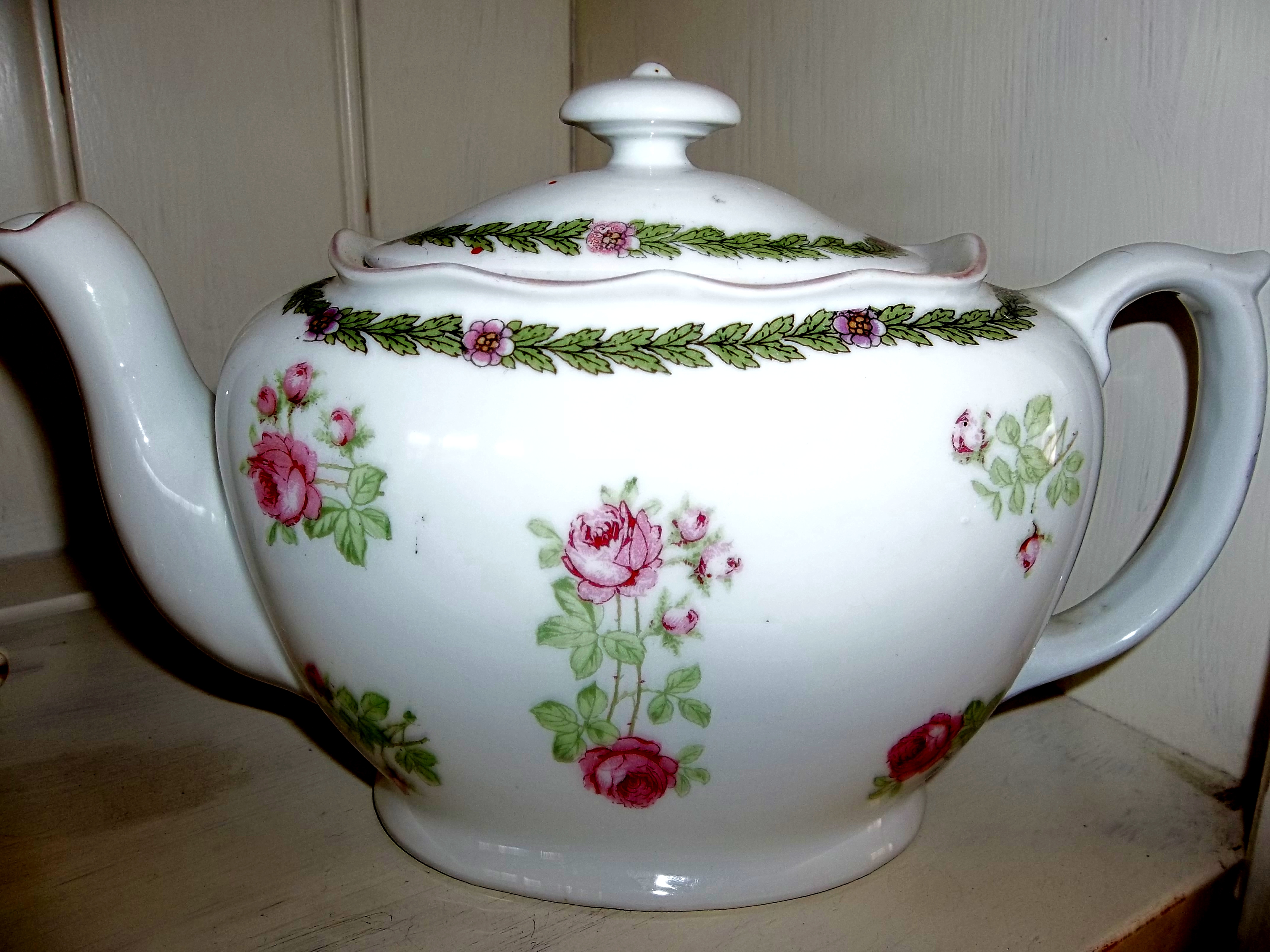
Other teas, with silver teapots, even a white-capped maid, tiers of scrumptious cakes, and lace napkins have never blotted out the memory of this ordeal. And now, a law unto myself, I break all the rules of the English ritual afternoon tea, which is a very different thing to tea ceremonies in parts of the world where tea drinking originated. My most daring break with convention is to put the milk in first, considered so vulgar by generations of tea drinking aficionados.

And having discovered that tea tastes much nicer when the milk goes in first, I have now also discovered that science supports my taste buds. According to research carried out by the Royal Society of Chemistry in 2003,”… if milk is poured into hot tea, individual drops separate from the bulk of the milk and come into contact with the high temperatures of the tea for enough time for significant denaturation or degradation of the milk to occur.” There you go, as they say in this country…

I have n’t space to touch on one of the most thrilling aspects of drinking tea, which used to be illegal in this country, and provoked fiery debate by male Members of Parliament; and now since 1981, it’s become illegal again ( MEN !!!). I refer to the innocent pastime of reading the tea leaves… but that is too vast and esoteric a subject for this little blog to tackle!


Food for threadbare gourmets

Cucumber sandwiches are de rigueur for the ritual English afternoon tea, and very dull they can be too. These I served for a friend’s birthday party, and we gobbled them up… with relish….
Apart from white bread sliced as thinly as possible – even supermarket sliced does the job… you need peeled and thinly sliced cucumber, eight ounces of softened cream cheese, quarter of a cup of mayonnaise, a good sprinkling of onion powder, garlic powder and a pinch of lemon pepper if you have it.
Mix everything except the bread and cucumber, spread the mix on the bread, and arrange the cucumber on top. Cover with another slice of bread also spread with the mixture. Press down firmly, and cut into dainty bite-sized sandwiches. Irresistible.

Food for thought

By experts in poverty I do not mean sociologists, but poor men.
GK Chesterton

35 Comments

Filed under addictions, colonial life, cookery/recipes, culture, great days, humour, life/style, love, The Sound of Water, Thoughts on writing and life, uncategorised

Saying yes to beauty

100_0559
Sitting on the sofa, sipping my afternoon cup of tea, I craned to watch a sooty blackbird. It was pecking with its orange beak at the apple nailed to the fence outside the window. Beyond the fence is a wild gully, where I’ve encouraged blue and white agapanthus and arum lilies, pink impatiens and orange nasturtiums to spread. I planted flax for the tuis to feed on their flowers, and encouraged thickets of swan plants or milkweed as they’re also known, to feed the monarch butterflies.

Dominating the gully is an oak tree, grown from an acorn by my grandsons and I. It’s flourished and become a large tree in the years we’ve been here, and I love it for all that it symbolizes about those happy years of my grand-children’s childhood.

As I watched the blackbird, two smoky black tuis arrived, the iridescent sheen of their dark turquoise tail feathers gleaming in the clear winter sun. They hovered to swoop on another apple further up the fence, the little curl of white feathers on the front of their neck quivering – the early settlers here called them the parson birds because of the likeness to the white neck frill and black clothes of a missionary.

Then I noticed movement the other side of the gully. It was a cock pheasant, flaunting his long, gorgeous tail and his bright blue and red and russet colouring stalking through the long grass. I was ridiculously thrilled… I haven’t seen him for several years… is it the same cock pheasant I’ve gloated over before, or one of his descendants? How long do they live?

Lonely Roman soldiers shivering in the icy Northern wastes, guarding Hadrian’s Wall back in around 200 AD brought pheasants from Georgia, near- Asia, to England as pets. They came from a place called Phasis, hence their name pheasants. When the Romans left after four centuries, pheasants were well established all over the British Isles and shooting them became a favourite pastime of the rich and heartless. They have spread all over the world in the centuries since the Romans. But here at least in this hidden gully, this one is safe from being hunted and shot.

And as I watched, a little flock of half a dozen tiny, green silver-eyes descended on the apple halves. They’re smaller than a baby sparrow, with soft grey breasts, and rosy pink markings either side. Their velvety green feathered wings make them look like little balls of soft green moss, and they have bright eyes ringed in white.
The ancestors of these tiny birds which flit rather than fly, did actually fly the thousand miles across the Tasman Sea from Australia to get to this Land of the Long White Cloud, back in 1856… why, I wonder, did a whole species set off across a huge waste of ocean, clinging exhaustedly to the masts of any ships they encountered, and finally making it ashore to these islands.

After the attentions of all these sharp little beaks, the two apple halves are simply a rosy translucent bowl, the core a skeleton in the middle. I watched the scene without feeling any guilt at spending so much time just gazing out of the window. Savouring the beauty and the wonder of the world seems more important these days than any apparently more productive activity.

Whenever I gaze fondly at my oak tree, I think of savage and sensitive Xerxes, King of Kings, back in the fourth century BC, halting his great armies as they rolled across the empty Asiatic plains, so that he could revel in the sight of a single sycamore tree. He stayed there for several days in a state of ecstasy, while his puzzled warriors camped around the dusty desert, and he even commanded a goldsmith to strike a gold medallion to commemorate the moment and the tree.(goldsmiths were obviously essential to the well being of conquering heroes in ancient times!)

John Constable, the English landscape painter was another who loved trees. His friend and biographer described him admiring: ‘a fine tree with an ecstasy of delight like that with which he would catch up a beautiful child in his arms’. He particularly loved elms, the great trees which were such a distinctive feature of the English countryside for millenniums, and which all died of Dutch elm disease back in the seventies after a shipment of rock elm logs brought the elm bark beetle from the US.

In times past, elms were planted as sentinels to mark the old ways, the drovers ‘ roads, so that they could be followed in mist… the elms were way-finders, map-markers, so majestically tall that they towered above the bands of English mist… Elms are still trying to survive in hedgerows, but as soon as they grow beyond twelve feet, they become infected… perhaps in times to come they will recover and enhance the landscape again with their once well-loved silhouettes.

Here in New Zealand we are trying to discover why the great kauri trees – some a thousand years old or more – are mysteriously dying. At least with the elms they knew why… in New Zealand we are still puzzling over the slow death of the fabled kauris, whose trunks can grow to a diameter of forty feet or more.

These were my thoughts as I sipped my tea, and watched the beauty of the birds clustered around the red-skinned apples on the fence. And then I remembered an unforgettable vignette in Robert Byron’s book ‘The Road to Oxiana’. He wrote:
‘There was no furniture in the room. In the middle of the floor stood a tall brass lamp, casting a cold white blaze over the red carpets and bare white walls. It stood between two pewter bowls, one filled with branches of pink fruit blossom, the other with a posy of big yellow jonquils wrapped round a bunch of violets.’ By the jonquils sat the Governor… by the blossom sat his young son, whose oval face, black eyes and curving lashes were the ideal beauty of the Persian miniaturist. They had nothing to occupy them, neither book nor pen, nor food. Father and son were lost in the sight and smell of spring.’

Beauty on beauty on beauty, the scene, the meaning and the telling. It reminded me that no time is ever wasted when we are enjoying beauty. Caroline Graveson, a Quaker, wrote: ‘there is a daily round for beauty, as for goodness, a world of flowers and books and cinemas and clothes and manners as well as mountains and masterpieces’.

Yes, beauty is as necessary to the well-being of the spirit as bread is to the body.
Yet beauty doesn’t make us good or better people … even Hitler and Goering collected glorious art … it’s just that beauty is necessary to us all, and beauty just is. A world without beauty would be dead, so nourishing it and revelling in it is life… so – yes to beauty and to life.

Food for threadbare gourmets

I’m continuing my love affair with the crock pot, and made a very satisfying French onion soup the other day. Just tip plenty of finely chopped onions – a pound to two pounds – into the pot with two tablespoons of unsalted butter and two of olive oil, lots of freshly ground black pepper, and salt.
Leave it in the crock pot on low for twelve hours, or over-night which is what I did.

By then the onions will have caramelised into a thick jammy mixture, so I then added 2 tablespoons of balsamic vinegar, lots of stock – depending how much you want to make, and a nice slurp of brandy… about three tablespoons.

Leave it on low for six hours to eight hours or more… the flavour intensifies the longer you leave it.
Then if you wish, you can do the toasted slice of sour dough thing with cheese on top and grilled, to place in the bowls of piping hot soup… I just served it with hot rolls and grated cheese on top.

Food for thought
A loving person lives in a loving world. A hostile person lives in a hostile world. Everyone you meet is your mirror. Ken Keyes

30 Comments

Filed under birds, consciousness, cookery/recipes, culture, great days, happiness, history, life/style, philosophy, spiritual, The Sound of Water, Thoughts on writing and life, uncategorised

That two -letter word

100_0503

Over the years I’ve worked hard to banish some words from my thoughts and vocabulary, words like must and mustn’t, ought to and oughtn’t, should and shouldn’t… learning to ignore the inner voice that has bullied me from childhood. I’ve also worked even harder to introduce a two letter word into my voice and into my life. That wonderful little word ‘no.

Granted I heard plenty of it as a child but it wasn’t a word I often used myself. Brought up to be a good girl and do as I was told, it would never have occurred to me to say ‘no’ to just about anything. And now, it’s a freeing experience to say no, and not follow it up with excuses and reasons why I’m not being ‘nice’ or ‘good’. I might sometimes add: ‘I don’t think so,’ to take away a little of the baldness of a straight’ no’. But there it is, a neat little addition to my tools for living, a power tool you could say.

But there’s another two- letter word that bothers me, that I try not to use, and which always bothers me too when I hear others using it. It’s when some- one refers to ‘My’ people,’ my’ church, ‘my party, ‘my god’, ‘my’ country…. I even used to object to the man in my life saying ‘my lawns’ or ‘my car’… ‘they’re the lawns, or it’s the car’, I’d say… and it was always the children, not ‘my’ children.

As soon as the word ‘my’ is uttered, those who are not mine, are other – different, on the other side. When someone says my country, my people, my party, they are implying loyalty to those groups, and loyalty often leads to division, hostility, and sometimes war, it seems to me. The great spiritual teacher Krishnamurti was once asked how we could stop wars. And he replied that we should not join anything – a political party, a religion, any group, implying that as soon as we are committed to a set of beliefs that commit us to sticking with them, defending that point of view closes our minds to other possibilities and ideas.

‘My’ country right or wrong used to have a fine ring to it… but now that we are a global village and after the shock of 9/11 which contributed to that understanding, we can’t afford to indulge in that mindless patriotism. We now know we are all so interlinked, that when Japan suffers an earthquake, a tsunami and a nuclear disaster, it affects the ocean, and thus the whole world. When Russia’ s nuclear meltdown at Chernobyl happened, it affected farmers and their sheep as far away as Wales, and poisoned the whole crop of camomile right across Europe for starters…. so it’s getting harder to just be a patriot, now that we are citizens of the world.

‘My people,’ whether it’s a Maori elder, or a Catholic priest speaking, refers only to those who can claim to be part of that tribe or religion. The implication always seems to be that the others are less, different, not worth as much as those who are ‘mine’. We only have to look at the despair in the Middle East to see what happens when we belong to a group or a country or a religion.

Israel feels comfortable oppressing people who are not Jewish, and now, like Muslims is discriminating against women, Sunni Muslims despise and exterminate Shia Muslims and vice versa… Kurds or Yazidis, Druze or Maronite, Christians or Ba’hai are in constant danger – whenever anyone belongs to a sect or nationality it exposes them to hate or oppression by those who belong to a different religion, creed or nationality. And I haven’t even mentioned different genders…

And ‘my’ is the word that breaks up families and small communities even in so called peaceful places. Disputes between neighbours over a right- of way which runs over ‘my land’, or the rows about fishing on ‘my river’, are so often caused by that little two- letter pronoun ‘my’, while the word ‘my’ in front of money is often the reason for not sharing with those who have none… and the excuse by giant corporations for exploiting both people and oceans, wildernesses, forests and rivers.

My dog, my children, my family… as soon as we use that description, so often it becomes the unspoken reason for not caring about other children, other dogs, all families.

I sometimes feel that ‘my’ is a word that blocks love… if we thought of our children, our dog, our world, our dying oceans, our disappearing elephants, perhaps we would be able to change our mind set and work with each other to save lives, share happiness, and even save our world from the sixth great extinction which scientists fear is imminent.

The Pope’s call to act to rescue our planet from impending disaster actually means giving up the word ‘my’ and beginning to think in terms of us and our. It could even mean giving up loyalty to deeply held beliefs, letting go our loyalties to race or colour or creed, and opening our hearts to other minds and other ideas. We might even discover that no-one is right, no-one is wrong, that we are all coming Buddhas, and that that little two -letter word ‘my’ was irrelevant. That would be a world on track towards a great leap in consciousness…’we are the world’…

Food for threadbare gourmets

This is the first recipe I shared in my first blog back in 2012. There may be readers who would like it now, so here it is, comfort food with just three ingredients – a simple potato hotpot:
Peel and slice some potatoes, chop some onions, and chop up some bacon – the more you can afford, the better. Make plenty of white sauce, using butter and if you add a little cream, all the better. Then layer the potatoes, onions and bacon in a casserole or oven-proof dish, finishing with a layer of potatoes.

Pour the white sauce over it, letting it seep down through the layers. Cook in a moderate oven for one and a half to two hours, testing to see the potatoes are soft. Eat with some green vegetables or a green salad. Cheap as, delicious, and filling.
Adding anything like cheese utterly spoils the taste… it’s one of those simple things that is perfect without any so-called improvements.

Food for thought

I allow myself to say ‘my’ birthday! A friend sent me this prayer for my birthday yesterday.
May I have the courage today
To live the life that I would love
to postpone my dream no longer
but to do at last what I came here for and waste my heart on fear no more !
John O’Donohue

46 Comments

Filed under consciousness, cookery/recipes, culture, environment, family

The preciousness of people

100_0218
A knock on the door revealed a stranger holding a white enamel colander full of strawberries. We had moved into this house in town the day before, and he introduced himself as a neighbour.

That was a very meagre description of what he was, he was a glorious eccentric who I watched every day cycle slowly past on a very high old fashioned bike with a basket on the front, which gave the impression of being far too big for his small skinny frame, and liable to go out of control at any minute. He was on his way to the docks where he was a dock worker – a somewhat unconventional one I imagine.

Again a meagre description of this blue- eyed, wildly bearded, elderly Irishman, who revealed to us that he was a sort of remittance man, exiled from Ireland by his despairing family to make his somewhat erratic way in the antipodes.

He was a poet, he told us. I believed him though I never saw any of his work. His life was a poem. We went to his house, which was a poky little state house. Inside it gave the impression of being a miniature stately home, along the lines of an Irish demesne… a few good but battered antiques, the odd oil painting and large old-fashioned sofa and chairs covered in old fashioned country house flowered linens.

This splendid impression of stateliness continued into the garden, which was quite big, being on a corner. He had transformed this rocky site into a miniature paradise, grass walks edged with pleached fruit trees, a vegetable patch, a strawberry bed, a tiny terrace and lawn, and best of all, a deep pond edged with large rocks, which he had created by levering the huge rocks day after day over a period of six months, until a deep hole had been carved out of the stony ground.

He was an eccentric, one of the many who, when I look back, have enriched our lives and given us fun and pleasure. There was Mr Macdonald, a direct descendant of Beatrix Potter’s Mr Mcgregor, who was our neighbour in the country, another Irishman. He only wore a pink woollen vest with long sleeves  and braces, all summer and winter, except on Sundays when he looked quite unnatural, shaved and spruced up in a short sleeved shirt in which he looked very ill at ease. Every spring he would arrive at my door in his pink vest, braces and hob-nailed boots, bearing a huge bunch of sweet-smelling narcissi which I had once told him reminded me of spring in England. He never missed a year thereafter.

There was Alf, an Englishman who served in the Malayan Police, and every three years when his leave was due, not having any family he wished to return to, he would sail to the bottom of the Arabian Peninsula. There he would buy a large flock of goats, and then proceed to drive them through the desert, using the goats as food and currency, until he reached Port Said. There he would get a boat to Liverpool, make a quick visit to his sister there, and then return to his tropical home in Kota Bahru.

Here too, lived Mammy, a giant White Russian, over six feet tall, wearing thick pebble specs for her short sighted grey eyes, and wearing the first caftans I ‘d seen over her enormous frame, all in brilliant colours and garish patterns . Mammy ran the local hotel where everyone gathered in Kota Bahru, and was a local joke too. As a seventeen year old I didn’t think she was such a joke. She and her husband had escaped the revolution in Russia, and made it safely to Shanghai like so many other White Russians.

They had survived the rigours of Japanese occupation and then fled Mao’s Communist takeover, ending up in Singapore. There, one afternoon, Mammy’s husband had walked down the road to buy an evening newspaper, and had never returned. No-one knew whether he had run away or was the victim of some crime. And Mammy was now surviving in this rather heartless superficial society in the remotest part of Malaya but creating laughter and fun all around her – actually rather more than a survivor.

Another neighbour was our Dutch friend Andrea, who had an antique shop full of the most exquisite items of a particular sensitivity, many of which I still posses. She was as nutty about animals as I, and far more lawless, striding into a bikie house to steal/rescue weeping puppies with no tails. I revelled in her poetic garden and laughed to see her huge magenta magnolia blossoms each wrapped in a plastic bag to protest them from the wind… not a good look actually!

Her house was beautiful in that glorious Dutch interior way of Pieter de Hooch and Vermeer, her pottery made you want to hold it and stroke it – and I have some – and her paintings were romantic and exquisite, and I have some of them too. I could actually write a book about her…

These memories were prompted by a conversation with a neighbour on my walk this morning. Since some of them read my blog, I cannot reveal what we talked of, or his glorious quirks of personality, but he reminded me of the joy of being with people who allow their personalities to flower, with no thought of what anyone else may think. Eccentricity is simply individuality, unself-consciousness, and the courage to be and do what feels right. When we are in the company of such people it feels as though ‘the waters of life’ are flowing, there are no limitations, and all things are possible.

Martin Buber, the great Jewish philosopher wrote that: ‘Everyone has in him something precious that is in no one else. But this precious something in a man is revealed to him only if he truly perceives his strongest feeling, his central wish, that in him which stirs his inmost being.’

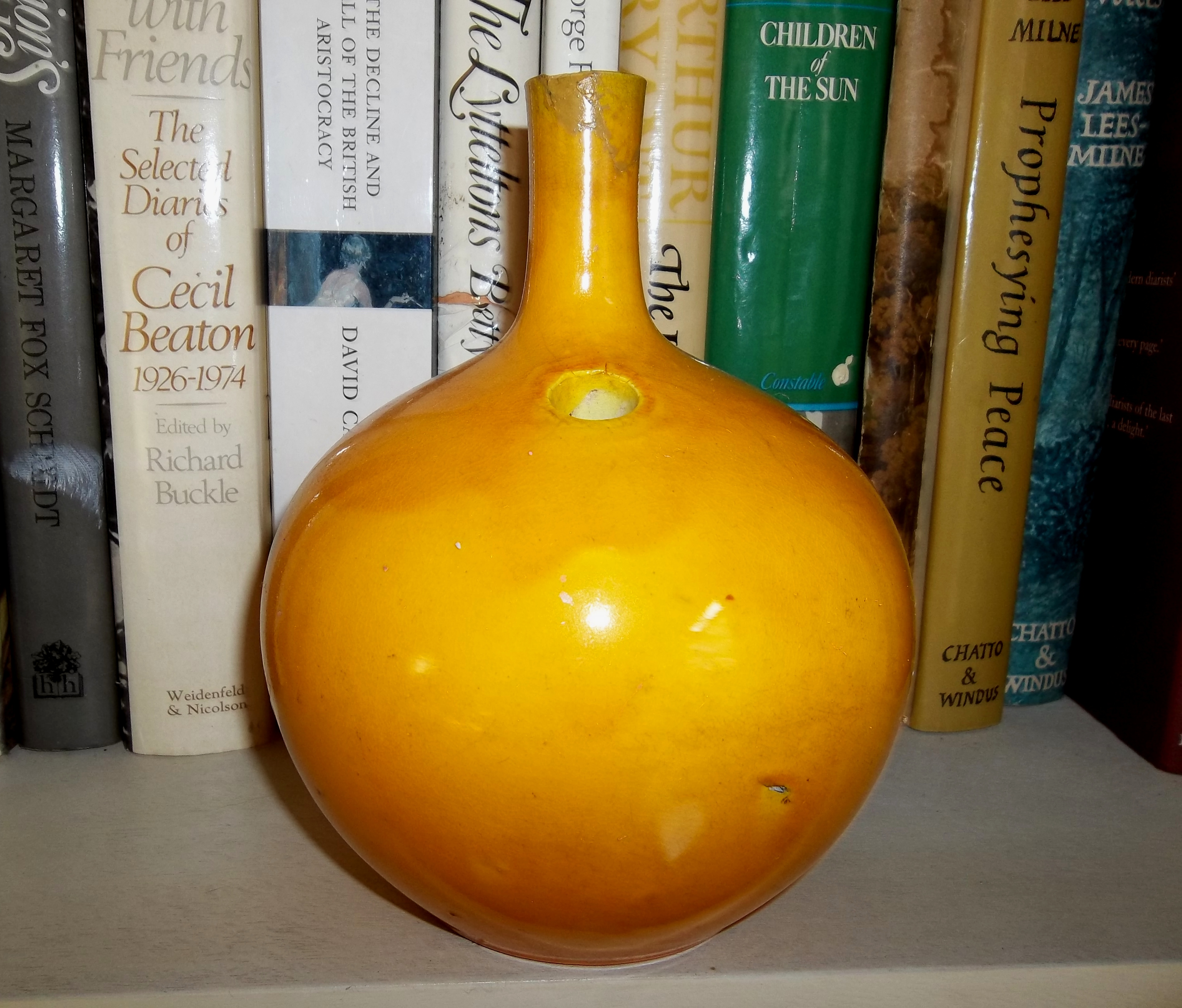
P.S. The picture is of an antique English drinking jar given me by my friend Andrea.

Food for threadbare gourmets

A faithful follower e-mailed me yesterday and asked if I had a recipe for Simnel cake. This is the light fruit cake that’s traditional at Easter, so I told her I’d blog it today. I use Nigella Lawson’s recipe with my own adaptations.

When I make it, I prepare the tin as usual, and then cream 175 g of soft unsalted butter with 175 g of caster sugar. Then mix 225 g of SR flour with half a teasp of cinnamon, a quarter of a teasp of ginger and 25 g of ground almonds. Add one egg with some of the flour mixture to the butter mixture, and mix two more eggs into the rest of the mix in the same way, before adding two tblsp of milk. Finally, fold in 500g of mixed dried fruit, plus some chopped glace cherries if you like them.

At this stage I put half the cake mix in the tin, roll out about 400g of marzipan, cut into a cake sized circle and place on the cake mix, then cover with the rest of the cake. Bake for an hour at 170 C, then turn it down to 150C and cook for another hour and a half. It’s cooked when it’s risen and firm. Let it cool completely on a rack before taking it from the tin.

When cool, paint the top with apricot jam, and roll out another 400g of marzipan and stick it on. With 200g of marzipan, make balls representing the eleven apostles – Judas surplus to requirements here – and stick them on using an egg white – beaten to just frothy. Some people quickly put it under the grill to make it look slightly toasted.

32 Comments

Filed under colonial life, cookery/recipes, culture, food, gardens, great days, life/style, philosophy, spiritual, Thoughts on writing and life, Uncategorized, village life

Dancing to the music of time

100_0440 - Copy
I climbed up the rusty fire escape smothered in trails of blue flowering morning glory and stepped onto the veranda of a very big two- storied, shabby white house built on the side of a volcano. The morning glory swung from trees, twisted up the fire escape, and swathed both house and garden in carpets of greenery and purple trumpet shaped flowers. With pillars, porticoes, verandas and banisters all festooned in drooping creeper, it looked like a romantic, deserted Southern mansion.

Once on the veranda I peered through the windows, and beckoned to my slightly reluctant partner in crime to join me. It was obviously the home of students or alternative life stylers on this floor, the only unusual thing about their chaotic living arrangements being the live rabbits who were hopping about the grubby carpets. Downstairs a motor bike gang who seemed to have wrecked the place, had their bikes parked inside the entrance hall.

Reader – to quote Charlotte Bronte – we bought the house. It took time to track down the owner and persuade him to sell, but we did. The room where the rabbits had bred was forever known as the rabbit room during our years in the house. The occupants moved out, but that was all. It was up to us to break down partitions, rip up revolting carpets, clean, scrub, paint and restore – including dozens of missing banisters – used no doubt for firewood. The bikies had left behind more than indescribable squalor but awful energy as well. But for the first time since its original owner the house had become a family home again, not a collection of shabby flats.

The house had been built in 1875 by a French architect for himself, described on the title as Jean le Bailly Hervei, gentleman. The first thing we did was to rip out a partition and remove a door and two huge cupboards. This revealed Jean’s conception of a huge central hall, twelve feet high, thirty feet long and ten feet wide, stretching down the centre of the house, and looking out over the harbour and then to distant hills beyond. When I stood at the huge French doors and watched the flaming sunsets or the black clouds scudding in from the hills so that I knew what the weather would be like in half an hour, I felt close to Jean le Bailly Hervei.

He designed this splendid roomy house with every French window and door opening towards the sun and these magnificent views, and each room led off from the airy hall on both the top and the bottom floors. The floor of the top hall I painted a rich pumpkin colour which picked up the shades of pumpkin and rose and purple and cream in a long Kelim rug which fitted the space. The bottom hall which matched the top, I painted white, including the floor, and blue and white curtains and matching table cloth over a round table obliterated traces of the former tenants and their bikes. My son painted his bedroom floor lime green to go with his colour scheme.

The children and the little frolicking dogs brought life and fun into the house, and music rang through all the spacious rooms – the children played the piano and their flute and clarinet – me – the stereo –  mostly Bach’s Brandenburg concertos, Beatles, Joan Baez and Cat Stevens.

One day while clearing the garden of morning glory, I found a three foot high, concrete garden gnome hidden under the greenery. We dragged him inside, and since we had friends staying and my birthday feast that night, I invited the gnome to dinner too. He presided in a chair at the head of the table and we had lots of laughter at his expense.

When we moved on, children gone, the psychiatrist who bought the house from us, an hour after it went on the market, asked me six months later at a party, what we had done to remove the brutal vibrations of drugs, alcohol, violence and fear which we had inherited. I was fascinated that a conventional medicine man should acknowledge that old energy, and that he had thought about it.

We brought colour and energy into the house, I said, along with all the books and precious things we’d loved and collected, including tapestry and patchwork cushions and crocheted bedspreads I’d made. We had bowls of pot-pourri and flowers, and often used candle- light. But the two things that must have made the real difference, I told him, were that we all meditated, and there was always music being played. I think more than anything, it was the meditation and the music, I said.

These memories came back to me today when I was reading that world-renowned neuro-scientist Oliver Sacks says that music affects the brain more than any other discipline. It is, he says, the only discipline that actually changes the physical appearance of the brain. We are designed for music, for ‘its complex sonic pattern woven in time, its logic, its momentum, and its unbreakable sequences’

In Australia in a school where they have a Music Excellence programme the students spend many hours playing rehearsing and having music lessons. At prize-givings, eighty percent of the top students receiving awards for academic excellence were also music students.

They mostly spend more than ten hours a week involved in their music and have almost no behaviour problems or any upsetting emotional or social issues even though they come from both rich and poor homes, single parent homes and every the other variation on backgrounds which could spell problems for children.

Do we know whether the music acts as a stress release, or whether it builds such emotional equilibrium and peace of mind that its practitioners can weather all sorts of stresses without problems? Maybe it doesn’t matter. What does matter to us is that we recognise the value of music, and allow ourselves to receive and enjoy its healing and strengthening properties. Some research has shown that people who learn a musical instrument are less likely to suffer from Alzheimer’s.

Music is supposed to teach basic skills such as concentration, counting, listening, and cooperation, help with understanding of language, improve memory, and help learning in all other areas. But actually, it doesn’t matter what the benefits are, it’s the sheer joy of music that enriches our lives. Perhaps it should be compulsory in schools, and be ranked along with writing and arithmetic as one of the necessities of life.

And what I find amazing is that music healed a house. Once it had dissolved the top layers of fear and anger and violence, it seemed to penetrate to other layers of energy and atmosphere… reaching through levels of sadness and regret and loss, until finally the sweetness of the music uncovered all the layers of time, and we reached the gentleness and joy of Jean the Bailly Hervei .

It was a voyage of discovery travelling back into the past and becoming aware of the lives of so many who had lived there before us. Music gathered together threads of sweet feelings from the past, and stitched them into the tapestry of life that we were adding our colours to. And it was the invisible vibrations of music which conducted us gently through those layers of time and feeling so we were able to hand on to the next owners the intangible beauty of a well-loved house. .

Food for threadbare gourmets

For these hot, dry, sunny days of Indian summer, sitting on the veranda, cicadas clattering, I like to make a spinach and salmon quiche which is good hot or cold. After lining a quiche dish or similar with thin short crust pastry – though I have used filo too, I simply pour the filling in and bake in a moderate oven for 40 minutes or until gently firm. For the filling I use 150 gm of chopped smoked salmon, a packet of frozen chopped spinach, defrosted and squeezed dry, 300 to 400mls of thick cream, three large eggs, salt and pepper. Mix everything together, adding the spinach and salmon last, and either a little grated nutmeg or a little parmesan cheese if you fancy, and pour into the partly cooked pastry case. Good with salad of course…

Food for thought

I think the sages are the growing tip of the secret impulse of evolution… I think they embody the very drive of the Kosmos towards greater depths and expanding consciousness. I think they are riding the edge of a light beam, racing towards a rendezvous with God.

From ‘ A Brief History of Everything’, by Ken Wilber, Influential American writer and philosopher.

47 Comments

Filed under animals/pets, cookery/recipes, culture, family, great days, happiness, life/style, love, philosophy, spiritual, The Sound of Water, Thoughts on writing and life

The eternal search – for the perfect coffee

100_0834

I lost my wallet the other day. Going to pay for the dry cleaning, I found my big red Guy Laroche wallet given to me by my generous daughter had disappeared. Panic. The last place I’d had it was at the garden centre a mile away. And since I’d paid for the plants, the wallet must still be sitting in the trolley. More panic.

I ran through the things that mattered in my mind… credit cards … but ‘they’ wouldn’t know my pin number. Pain to have to cancel… forget them for now. Money? Who cared. But oh, my photographs of the grandchildren and moments caught in time that I wanted to remember… they were irreplaceable… and the two little love letters with terrible spelling and seven year old scrawls from them … one which I had found written in the diary they always used to keep when they came to stay with me… on this occasion they had decided that they would stay permanently and be home-schooled by me:

‘Five time a week I have fun. It can be so wonderful. I will like to say that I am writing this because it came from my hart and I kodn’t get it out of my hed….I hope that we can stay heer for homeschool it will be so fun and it will asol be fun because I love my granny so much it can be fun every day but I love staying heer and I like feeding the eels’… how could I replace a letter like that? My heart curled over at the thought of such a loss…

What else?  Oh … my collection of coffee cards. Each one stamped for every coffee I’d had, and nearly ready for a free coffee. The restaurant down by the river, the cafe in the garden where they make pottery, the lovely place where they also make hand-made chocolates, my stopping off place in town…

Zipping up my stiff upper lip I hurried back to the garden centre, and there was the red wallet, waiting for me at the office. (gardeners are good  people!) “It was my coffee cards I was worried about,” I explained when I picked it up, and everyone laughed because they knew how I felt.

I have travelled the length and breadth of one country, which shall remain nameless for fear of hurting millions of people’s feelings, looking for a decent cup of coffee. I finally found one in a far-flung cathedral crypt cafe.  I will drive for miles for the sake of that elusive perfect cup.

I know as soon as it’s put in front of me if it’s going to be a good one. The cream will be thick and won’t just dwindle into a thin froth when stirred. It will be smooth and not too creamy and not too strong. The most memorable coffee I’ve ever had was in an Italian restaurant in Melbourne.

Creating this ambrosia obviously came naturally to the maker… and in that search for the perfect cup, I’ve discovered that the maker actually matters. Yes, I know the machine has to be properly cleaned so the coffee doesn’t taste bitter, and the milk the right temperature, but there’s more to it than that. And the deciding factor in the quality of a cup of coffee for me, seems to be the person.

Everyone makes the coffee the same way on the same sort of machines I’m assured, but it doesn’t work out like that. Every barista is different and so is their coffee. A grumpy barista does not produce a good cup of coffee. A good cup of coffee is hand-crafted and a work of love, so I know if it’s going to be delicious by the quality of the barista’s smile. A nice person makes great coffee! They even do lovely patterns in the froth, like a Christmas tree at Christmas time, or a flower or smiley face at other times!

And what despair and thwarted desire when I arrive at a favourite coffee place to find a new member of staff, or the nice coffee person has taken off overseas, and we have to start all over again, with a learner driver as it were!  Or the tantalising times when the best coffee maker is busy cutting cake or sorting spoons, and not at her post, and I have to make do with a cup which I know won’t be as good as hers.  C’est la vie, but coffee is so much more than beans, milk and water!

And when the perfect coffee arrives, what sybaritic pleasure – the delicate sinking of the spoon into the froth, and a gentle stirring. Sometimes a fragrant teaspoon of coffee crystals for the sheer pleasure of stirring and dissolving them in the glorious liquid. And then a sip, and a contented settling into satisfaction as I slowly savour one of civilisation’s minor works of art.

Sadly the second cup never reaches the same level of pleasure as the first. And I’ve even read that scientific research has proved this to be true. No wonder it matters that that first cup is as good as it can get!


Food for Threadbare Gourmets

One of my favourite coffee places serves gingerbread with their coffee. I love it. To make it myself, I use two eggs, a cup of sugar, a cup of milk and a cup of golden syrup (the cup rinsed out with oil before measuring the syrup). Beat them together. Melt 225g butter. Mix two cups SR flour, two teasp or more of ground ginger, a teasp each of mixed spice and of cinnamon, and a teasp of baking soda into the egg mixture and then stir in the melted butter.

Pour into a loaf tin with the base lined with baking paper. Bake at 180 degrees for an hour. If you’re using a fan-bake oven test after 45 minutes. Let it cool in the tin for 30 minutes before turning out. You can ice it, but I like it cut into slices and spread with a little butter.

Food for Thought

“The artist’s task is to save the soul of mankind; and anything less is a dithering while Rome burns. If artists cannot find the way, then the way cannot be found.”
Terence McKenna  (1946 –  2000) was an American philosopher, ethnobotanist, lecturer, writer and author of several books.. He was also the creator of a mathematical theory of time based on patterns found in the I Ching which he termed novelty theory.[1]


65 Comments

Filed under cookery/recipes, culture, great days, happiness, humour, life/style, love, philosophy, The Sound of Water, Thoughts on writing and life

Summer song

100_0751

Walking around the cemetery on New Year’s Eve the sky was still and clear, no silver, almost transparent moon yet, rising above the sea looking like a silver sliver of dried honesty in the pale night sky. Instead there were gulls circling silently and intently overhead, weaving endlessly in and out, never touching or interrupting the arc of another bird.

After a while I chose one single gull, and watched its movements, following its wide circles and trajectories and swoops until finally it headed out to sea in the direction of Little Barrier Island, which hovers, misty indigo, on the horizon.

It felt like a holy silence, the tracery of the gulls’ flight woven like a network of silver filaments overhead, the cemetery a cathedral, silent, sacred and undisturbed. The Universe may have been un-aware that it was New Year’s Eve around Planet Earth, but surely that thought -form which meant we were all conscious of this moment in time, must have created that charged and sacred energy which I was feeling then.

Today it has rained. Things can start growing again, and I can stop watering – for a few days anyway. The countryside has the richness of high summer. The trees are billowing with green foliage, the fields have been cut for hay, and the grass in the meadows is so high that when the calves lie down, their heads just peep out of the tops of grass heads, plantains, buttercups and clover. I thought I saw a flight of big brown butterflies the other day, and it was the tips of their velvet ears reaching out of the pasture. The thrush in the garden sings continuously between pecking at the apple nailed to the top of the fence.

Tonight I was strolling round the cemetery, and the harbour below was the deep dark green of an Arthurian mere. It was as still as a mere too, and the boats at anchor were reflected with perfect clarity. Turning to face out to sea, the ocean was quite colourless with a deep band of blue on the horizon.

I’m constantly re-filling the dogs’ water bowl by the pavement. I hear them slurping away, as people walk past to the beach, thirsty Labradors and dobermans, bitzers and bichon frises, poodles and pointers… even a bulldog.

Earlier today, reading James Lees-Milne’s diaries, listening to the summer rain, I discovered his description of an English summer night in 1946: “the smell of new-mown hay and hedgerows, of eglantine and elder… how I love these long gentle Shakespearean summer evenings…”  Me too. The scent of the queen of the night comes drifting in from the open window at night here. It’s sweet and lovely… but I miss that indefineable atmosphere of those English summer nights.

Those nights throb with nostalgia and a richness. Somehow, it’s as though the layers and layers of lives lived in those parts, the echoes of history stretching back beyond memory and beyond record, the people in the millenniums before Christ, who trod out the ancient paths that still thread across hills and ridges and valleys and fords, can all still be sensed. The voices are silent, but their presence still lingers, as one century after another passes across the meadows and the woods.

The oak and the ash, the hazel and the hawthorn, the holly and the honeysuckle have been growing there since the last ice-age twelve thousand years ago. The smells, the sweet blossom, the new mown hay, the whiff of manure, the fresh rain, the damp leaves, have smelt the same in every age and every summer since. Standing in a quiet English lane on a soft summer night, you can feel those long centuries, and it is very touching.  I haven’t experienced a summer evening for a long time. I’ve always been back in autumn or in winter. But I must savour a June night once more!

Feeling homesick for the English country-side, I got “Far from the Madding Crowd” and “Tess of the D’Urbervilles off the top shelf of the book-case, and had an orgy of Hardy. Tess first, and the sweetness of Talbothays farm, then Bathsheba and her story… I read it differently this time, not so much for the drama of the story, but for the feeling of the country.

So I really took in for the first time, the delicious characters of the farm-folk, and the details of farming life, from the signs of an approaching storm, to the rituals processing through the year of lambing and dipping, and fattening and shearing, to the yearly sheep fair, the shearing supper and the harvest supper.

It was a way of life which had existed for over a thousand years when Laurie Lee in the enchanting ‘Cider with Rosie’, told the story of his childhood, and an archaic way of life  which then vanished forever, with the combine harvester, chemical farming, agri-business and of course the destruction of communities  by the carnage of the First World War.

I’m always struck in Hardy’s books, and in Jane Austen’s letters, by the isolation and “localness” of country life back then. So many people hardly ever left their village, unless they were gentry, and the next village was a foreign country. So when people fell in love in these tiny societies, and lost the object of their affections, through death, departure or rejection, there was often no-one else to love. People literally did grieve and die in different ways, from broken hearts.

Hardy’s description of the hopeless love by the dairy-maids at Talbothays farm for the un-attainable gentleman, Angel Clare, had the unmistakeable ring of truth.  I remembered from closed societies I lived in when I was young, whether in an English village, or a tiny colonial community far away from any other European habitation, how intense relationships were when there were no others. No-one could console themselves before the population explosion, and peripatetic habits of the twentieth century, that there were plenty of other pebbles on the beach. There weren’t.

Yet now, though I live in a tiny village with only four hundred souls, we are no longer prisoners of geography. Not only do people take off to holiday in Alaska and Italy, and their families return from Vancouver and Hanoi, but we all have the world of the internet at our fingertips, to use that well-worn, but accurate cliché in this instance.

It’s eighty- six years since Thomas Hardy died, and in those years our worlds and our lives and maybe our minds have expanded beyond imagining. The world is our village, and the internet is our community. There are pebbles past counting and wherever we direct our vision, we can find the glory of summer somewhere around the globe at the push of our buttons.


Food for threadbare gourmets

Apart from being full of healthy fats, potassium and Vitamin E, avocados are delicious.  I sometimes use them as a dressing over a salad. To one avocado you need  ground coriander – I use a quarter of a teasp, but less is more… the juice of a lime or a lemon, quarter of a teasp of ground cumin, a tblsp of apple cider vinegar, salt, and about half a cup of water. Whizz these ingredients until smooth and creamy, and use straight away.


Food for thought

To write or even speak English is not a science but an art. Whoever writes English is involved in a struggle that never lets up even for a sentence. He is struggling against vagueness, against obscurity, against the lure of the decorative adjective, against the encroachment of Latin and Greek, and, above all, against the worn-out phrases and dead metaphors with which the language is cluttered up.

George Orwell, English writer 1903 -1950.  Wikipedia records that : ‘His work is marked by lucid prose, awareness of social injustice, opposition to totalitarianism, and commitment to democratic socialism.’ Animal Farm and 1984 have continuing relevance.


61 Comments

Filed under birds, books, consciousness, cookery/recipes, culture, food, great days, history, jane austen, literature, love, The Sound of Water, Thoughts on writing and life, Uncategorized, village life