Category Archives: environment

Days of wine and roses

100_0503

It’s been the one of those glorious days when ‘cherubim and seraphim are casting down their golden crowns around the glassy sea.’  Silence… a small white yacht gliding over the still shining water, scarcely leaving a wake, using the engine because there’s no wind for the sails… the islands we never normally see, floating on the horizon, palest purple against a lavender blue sky… an enchanted stillness, the only sound the cooing of the doves in the trees.

When I awoke this morning the sky was just turning pink, so early though it was, I jumped out of bed, dressed, and headed out to watch the rising sun across the sea. The dawn chorus was just beginning, so I turned around and walked by houses with curtains drawn and solitary gardens, thrush and blackbird seeming to pass me on from one song to the next.

Theirs was the longest and sweetest serenade, while the soft incessant cheeping of the sparrows filled the spaces, and the slow crescendo of the doves cooing began. As I retraced my footsteps back along a grassy track, I saw with pleasure that mine were the only footprints in the dewy grass. I never met another soul as I meandered around the sleeping village.

Back home I crossed into the cemetery and disturbed a couple of speckled hens who scurried  fussily back into their own garden next door, clucking agitatedly. I walked across to the end of the peninsula to get my daily fix looking out to sea through the grey gnarled branches of the ancient pohutakawas.

Later, I sat on the veranda feasting my eyes on the glittering water, with breakfast of toast and a boiled egg from the errant chickens. When I had visited their owner Kate the day before, she had given me a handful of newly laid eggs, and the one I ate now was so beautiful I could hardly bear to break the shell. It came from her oldest hen, she said, a black Arakan, a breed which presumably comes from Arakan in Burma, and this little black hen lays eggs of the same pale blue as the sky today.

During the morning I went to the next village to buy a birthday card for a man. No flowers then, and since most men’s cards are covered with the inevitable cars or golf clubs, I did some lateral thinking and came away with a card with a message: “ If you resolve to give up drinking, smoking and loving, you don’t actually live longer: it just seems longer.” My son-in-law will be delighted with this encouragement to enjoy these permitted pleasures.

Stopping off at the garden cafe down a long avenue of poplars, the vivacious young Indonesian proprietor greeted me as usual with: ‘Ah Miss Valerie, are you ready for your coffee today?” Since she always jumps the queue for me, and makes piping hot coffee I can forgive her the spinsterly ‘Miss’. I sat in an ivy- covered alcove framed with late wisteria blossom and white jasmine, their scents wafting over the smell of coffee.

Before getting home, I called in on Friend, to collect various things from yesterday’s rollicking party for 45 oldies who came from far and wide. Others were there too to collect their vases, or napkins or fish slices. “The sun’s over the yard arm”, announced the man of the house, which though it was only lunch-time, gave us the excuse to finish off the champagne from the previous day.

Then, we had sat on the terrace in the sun, looking out over the turquoise sea, the lawn fringed with white iceberg roses in full bloom, and red roses lining the long white table cloths.

We’d enjoyed a four course lunch, starting with a terrine followed by freshly baked ham, salmon and asparagus, the cheese course – big rounds of fresh Brie, fresh strawberries and blueberry tarts – each course accompanied by different wines and champagne –French of course! And finally the birthday cake, a pyramid of moist chocolate brownies and truffles. In other words a feast! And all made by friends.

At the end of the afternoon someone brought out a guitar. We sang ‘Blowing in the wind,’ ‘Michael row the boat,’ ‘Kumbiya, ‘He‘s got the whole world in his hands’… all the old favourites. I sang my heart out, and had to restrain myself from dancing.

But as a somewhat acid -tongued acquaintance observed to me, all the men were glued to their seats – and they all look alike, she said. “They all have white hair, and are wearing the same sort of blue and white checked shirts, most of them have walking sticks and a lot of them have paunches!” The women on the other hand, were younger, sprightlier, beautifully dressed and immaculately groomed.

That evening several of the guests came to dinner, though we couldn’t eat much. We sat on the veranda in the dusk, by the loquat tree covered in golden fruit, with a fat green and white wood pigeon rustling around swallowing them whole. We had wine and laughter and fun, discussed everything irreverently, and enjoyed the party all over again.

Days of wine and roses and golden laughter  …when I returned flushed with champagne from Friend today, I found another generous neighbour had called while I was out, and left a bag full of freshly picked broad beans hanging on the door handle.

They were so delicious that for supper, I simply ate a dish of the tender little green jewels glistening with hot butter, though the old chap had steak with his. And I’ve just returned from the field above the harbour where the two little white goats live. They feasted on the broad bean pods, and seemed to feel the way I do about them.

‘Gather ye rosebuds while ye may’, wrote the poet, ‘Old time is still a-flying’, and I’m dedicated to this advice…. my rosebuds may be different to other people’s ideas of rosebuds, but I’m picking them as fast as I may.

So I sit here on the veranda writing, watching the evening sky turn pink and lilac and pale turquoise over the still, silver water, the scent of sweet peas, a gift from a friend’s garden drifting through the house, and savour my blessings. I began with the words of a hymn, so I’ll end with some. These shining days are filled with rosebuds – moments of pleasure and goodness – friends and fun and flowers, chickens and birdsong and beans, ‘all things bright and beautiful, all creatures great and small’.


Food for threadbare gourmets

The strawberry season means Eton Mess for me! The first time I tasted it was just outside Eton, at a place called Datchett, at a rather grand dinner to entertain some visiting Argentinian polo players who’d been playing on Smith’s Lawn at Windsor. My best friend and I knew we were only there simply because they needed some girls to balance out the chaps. But we gave the food a lot of attention too.

The version I ate then was a variation, because the crushed strawberries and broken meringue were pressed into a big dish of ice-cream, and then re-frozen. Whipped cream was piled on  when it was served, on a huge carving dish. I like doing it this way too, using freshly made local artisan ice-cream. Really, the amounts are up to you… you can’t go wrong. As an added touch I sometimes whizz up a punnet of the fresh strawberries with some sugar, and hand that round in a sauce bowl, to drench the already sumptuous mixture in it! Food for the gods….


Food for Thought

He had picked it up, he said, on a beach; it was a piece of sea-washed wood in the shape of a human head. It was made of hard wood, shaped by the waters of the sea, cleansed by many seasons. He had brought it home and put it on the mantelpiece; he looked at it from time to time and admired what he had done.

One day he put some flowers round it and then it happened every day; he felt uncomfortable if there were not fresh flowers every day and gradually that piece of shaped wood became very important to his life. He would allow no one to touch it except himself; they might desecrate it; he washed his hands before he touched it. It had become holy, sacred, and he alone was the high priest of it; he represented it; it told him of things he could never know by himself. His life was filled with it and he was, he said, unspeakably happy.

From Krishnamurti’s Journal


59 Comments

Filed under birds, environment, flowers, great days, happiness, life/style, philosophy, spiritual, The Sound of Water, Thoughts on writing and life, Uncategorized, village life

Talking about silence

100_0542

A friend went for a happy break away with distant family, and returned home to find the bliss of silence awaiting her. She shared it with her readers, the deep need for solitude and silence, and how simply being with her plants, communing with her creatures, savouring the long views, the huge skies, and never speaking a word, she felt restored and at ease with herself.

Her readers, a band of like minds, responded that silence and solitude were necessities in their lives too. We discovered that we were not strange, we were not eccentric recluses, but that we were all strangely normal !

I thought about this, and realised that this group of women who had responded had probably reached that point in life when we want to experience our Hestia natures. Hestia was the Greek Goddess of the hearth and in her wonderful book, ‘The Goddesses in Everywoman’, Jean Bolen explores Hestia’s nature, and describes the Hestia archetype as being centred on home and family. She suggests that if Hestia wrote a book about her inner process she would call it Zen and the Art of Housekeeping.

Attention to the household, which includes the plants and animals in our care, is almost a spiritual process for a Hestia person. Women with this archetype find a sense of inner harmony as they cherish their surroundings and they know that this  nurturing of their corner of the planet, is a form of mindfulness. Jean Bolen called this time in which the Hestia archetype is totally absorbed in her  activities: ‘kairos’ time, a lovely Greek word describing that sense of being outside time, and feeling completely fulfilled. It’s also time-Less, we emerge from the ‘Zone’ as some call it, to find that time has flown while we were unconscious of the very word.

It feels like a creative activity, which it is, when we are so immersed in our tasks that time is meaningless. This is psychologically  nourishing, and we feel deeply satisfied and energised, powerful and peaceful when we come out of the ‘Zone’; like a writer feels  on completing a piece, a poet when her poem has emerged, or an artist after an inspired day at the easel.

Hestia women need and seek solitude, and as children they often felt out of kilter with their families, finding refuge in books and withdrawing emotionally. As adults, they need ‘A Room of Their Own’. The late Ardis Whitman, free-lance writer quoted  in ‘The Feminine Face of God’, said that: “…when we are surrounded by people, some of the passion and insight natural to us leaks away through the sieve of small talk. At your most daring moments you believe that what is going on is the ultimate human work – the shaping of a soul. The power of life comes from within: go there. Pray, meditate. Reach for those luminous places in yourself”

The obstacle to taking this time for self is women’s guilt. Too often they feel guilty at making time for themselves, fear they are being selfish, and so give away their vital self-nourishment by trying to please others. With maturity and the confidence of age, they can reclaim the time and space they need, knowing the truth of Rabbi Hillel’s ancient imperative: ‘ If not me –who? If not now – when?’

I have a friend whose stepmother is part Native- American. She was brought up by her Native -American grand-parents, and she told me:  “there was no idle chatter in our house. It was silent. My grandparents believed silence was sacred and should not be broken unless we had something of worth to say” …  Whenever I feel the need for silence at home, I say to my husband (politically incorrectly – sorry chaps!):  Red Indians! He gets the message.

Living in an intimate relationship with one person is so demanding when they no longer go to the office every day, in order to regain the silence and solitude that I need, we have a silent Tuesday, when no words are spoken. The house fills with something more than silence, a full, flowery, beautiful essence, which is only present in that magic space. Sometimes we have a Tuesday on a Thursday or a Sunday… whenever we feel we need it.

It isn’t just women who need solitude… I suspect there are many men too, who need the refreshment of peace and quiet… Thoreau famously wrote that he found it “wholesome to be alone the greater part of the time… I love to be alone”, while one of the early Desert Fathers, Abbas Isias said : ‘Love to be silent rather than to speak. For silence heaps up treasure, while speaking always scatters.’

We’re not talking of the harsh, ascetic, masculine discipline of a Trappist silence, but  respite from continual communication. This respite is more like immersing the self in a deep well of nourishment, from which we emerge refreshed and invigorated. In his book ‘A Time to Keep Silence’, famous travel writer Patrick Leigh Fermor described his stay at a Benedictine monastery in France. The Benedictine order with its gracious silences and routines was a revelation to him, and he went through three stages – depression and despair for a few days, then days of deep exhausted sleep, from which he emerged feeling purified, energised, joyful and peaceful.  When he remarked one day to the Abbott what a blessed relief it was to refrain from talking all day long, the Abbott replied, ‘Yes, in the outside world, speech is gravely abused.”  And even sixty years ago, C.S. Lewis said: “We live… in a world starved for solitude, silence, and privacy.”

I haven’t mentioned the word introverted, as I feel that Jung has no place in this discussion since he felt that spirituality was a masculine quality. Yet the thoughtful, mindful qualities that both men and women develop when they seek silence, which he would define as introversion, does lead to a greater awareness of the spiritual side of life. This inward turning of focus is a path that both men and women are taking more and more in these turbulent times, and if anything women are more likely to take it than men.

I’ve always loved Hestia, the home-loving, feminine personality who is her own woman. Not all women have this side to their personality, but when we deeply focus on our inner life, or give ourselves time to calmly enjoy our household chores – sorting a cupboard or baking a loaf, we are getting in touch with that aspect of ourselves. We all have other archetypes in our natures, from Aphrodite to Athene, Demeter to Hera, the goddesses of love and careers, motherhood and marriage, but as we grow older and wiser it seems that Hestia is more present in our consciousness.

When I was a child we used to buy Vesta matches in red and yellow oblong boxes. I didn’t know then that Vesta was the Roman name for Hestia, the goddess of the hearth, believed to be present in the living flame. Her sacred fire was supposed to provide light, warmth, and heat for food, and her presence to inspire peace,  meaning, and sanctuary for family. These things seem very precious in our tempestuous times…  they are what can sustain us, and make our homes a serene and happy refuge – and not just for ourselves – but for those we love.

Celi’s post ‘The lack of chatter in the box’ at her beautiful blog  http://www.thekitchensgarden.com    inspired this post.

Food for Threadbare Gourmets

The French call them ‘bonne-bouche’, and I needed a little something to start an impromptu supper with friends. To make it fun, I collected together the big pink and maroon shells I’d collected from the beach, lined them with slices of cucumber, arranged on the cucumber four fat prawns lightly sauted in garlicky butter, and dabbed freshly made aoli over them. Sprinkled with finely chopped parsley, they were a hit, eaten with fingers, but served with a paper napkin that matched the rest of the table.

Food for Thought

To everything there is a season and a time to every purpose under heaven… a time to keep silence and a time to speak. Ecclesiastes: chapter 3, verses 1 and 7

73 Comments

Filed under consciousness, cookery/recipes, environment, family, food, great days, happiness, life/style, philosophy, spiritual, The Sound of Water, Thoughts on writing and life, Uncategorized

Paradise is not lost

100_0559 In this country the sun is reputed to shine twice as often as it does in England, and it shines with especial clarity on Coromandel, so called when a ship of that name anchored where the township is now. The Coromandel peninsula is a rugged line of purple ranges and deep ravines where clear bright streams and rivers rush over rocks to the sea. Once the peaks of Coromandel were clothed in primeval kauri forests, and once too, those peaks hid seams of ancient gold. But now these two sources of gold have long been mined, the hills are covered in secondary growth, and the mine shafts are empty.

It’s always been a place of passion and politics, where potters and painters, poets  and philosophers have fought to defend their way of life in these empty, unpolluted and un-peopled places. Ringing this neck of land, pohutakawa trees flaunt their red flowers along the rocky coast-line, and distant blue horizons beckon to unexplored peaks and impenetrable bush.

Our house on the side of a narrow valley leading down to the water’s edge, looked up to the steep foot hills of the Coromandel ranges behind us. And we faced the Firth of Thames, where the light on the water had a mystic quality in the winter sunshine; where the line of Miranda beach on the opposite shore could just be glimpsed; and where flights of godwits gathering for their heroic autumn journey to Siberia, could be imagined.

Further down the coast was the place where Captain Cook first came ashore in this country.  Young Nick, the cabin boy who sighted land, gave his name to Young Nick’s Head, and where Captain Cook observed the transit of Mercury, he called the bay where they anchored, Mercury Bay.

When the Endeavour came sailing into Mercury Bay it was watched by a nine year old boy. Eighty-three years later the magnificent old man told his story. As he watched the great canoe with huge white sails skimming towards them, he was amazed when the ship’s crew then rowed ashore in the time-honoured fashion with their backs in the direction in which they were going.

“Yes, it is so,” said the old people watching with him, “these people are goblins, their eyes are in the back of their heads.” Eventually Horeta Te Taniwha, as he was called, gathered the courage to climb on board the ship with the older people.

“I and my two companions did not walk about on board the ship – we were afraid lest we be bewitched by the goblins; and we sat still and looked at everything at the home of these goblins… the chief goblin… came up on deck again to where I and my boy-companions were, and patted our head with his hand, and he put out his hand towards me and spoke to us at the same time, holding the nail out to us.

“My companions were afraid and sat in silence; but I laughed, and he gave the nail to me. I took it in my hand and said “Ka-pai” (very good), and he repeated my words, and again patted our heads with his hand, and went away.

“My companions said: “This is the leader of the ship, which is proved by his kindness to us; and also he is very fond of children. A noble man – one of noble birth – cannot be lost in a crowd”

“I took my nail and kept it with great care, and carried it wherever I went, and made it fit to the point of my spear, and also used it to makes holes in the side-boards of the canoe, to bind them onto the canoe. I kept this nail until one day I was in a canoe and she capsized in the sea and my god (the nail) was lost to me…”

The descriptions of the pristine land that Cook discovered in 1769, sound as fragrant and unspoiled as the descriptions of Roanoke in 1584. I ache to have seen Auckland harbour as it was then–the first accounts tell of the silence and the sunshine, the flaming pohutakawa trees bending over the still, clear water as the first white men glided spell-bound up the harbour in their sailing ships – it was a magical, mysterious country which seemed like the most exquisite place on earth to those early explorers. On the other side of the coast, where the other great harbour of Manukau lies, they found forests teeming with strange birds, great trees of more than ten metres in girth towering to the skies, cloudy waterfalls, black sand beaches  and steep jagged cliffs facing the turbulent Tasman..

 Songbirds fluted in the dense forests. Sir Joseph Banks, the great naturalist on board the Endeavour with Cook, wrote at Queen Charlotte Sound: “ the ship lay at a distance of somewhat less than a quarter of a mile from the shore, and in the morning we were awakened by the singing of the birds: the number was incredible. And they seemed to strain their throats in emulation of each other. This wild melody was infinitely superior to any that we had ever heard of the same kind: it seemed to be like small bells most exquisitely tuned.”

Civilisation has made life easier and more comfortable at one level, dentists, drains, and all the rest, and destroyed the planet in the process. And we all know it and yearn for the original untouched Garden of Eden. To have been alive then, and to have savoured this untouched land… it makes me feel homesick just to think of it. So-called civilisation of course, has changed so much of this. From 1840 onwards, the settlers did their best to destroy the forests, using the giant kauris for ships masts, and building wooden homes, wood being the quickest material to use to build a home in a new country. On the newly barren hills they planted grass for the millions of sheep which have brought prosperity to this country, and now erosion means that in some places, the rivers are no longer clear, but sluggish muddy currents.

They took the gold, and now they want the oil. Yet so many of us still want keep this country as unpolluted and unspoiled as possible; so we try to save the native birds, we enclose huge national parks,  we preserve the swathes of native bush and forest still here, and we oppose the multi-national oil companies. And nothing can change or spoil the silent, snow-capped mountains and wild waterfalls, the great lakes and endless miles of solitary beaches in an empty land the size of England, which is home to only four million people.

I now live an hour’s drive north of Auckland, looking out on green fields one side, and blue sea the other; and I walk the long deserted stretches of yellow sands, and can only hear larks singing high above the dunes, and the waves breaking on the shore. In a crowded world, where solitude and silence are hard to find, this place still seems like paradise – last, loneliest, loveliest – as Rudyard Kipling once described Auckland.


Food for threadbare gourmets

I love vegetable dishes. This fennel dish I can eat as a meal, and my husband can have it with his steak, though it also goes well with lamb and pork. Allow a fennel bulb for each person, though if I’m having it as a meal, I usually have two. Cut the fennel in half from root to stalk and blanch in boiling salted water and drain well. Cut the fennel again, into quarters, and lay them in a well- buttered baking dish… it doesn’t matter if they break up. Scatter pieces of fried and chopped bacon over the fennel along with a finely chopped garlic clove. Whisk a teasp of flour into 250 ml of cream and pour over the fennel. Bake for about 25 minutes in an oven set at 190 degrees. Check it’s soft with a sharp knife. Eaten with a crusty roll or wholemeal bread, it’s very satisfying.

Food for thought

It may be hard for an egg to turn into a bird: it would be a jolly sight harder for it to learn to fly while remaining an egg. We are like eggs at present. And you cannot go on indefinitely being just an ordinary, decent egg. We must be hatched or go bad.

CS Lewis, 1898 – 1963 English novelist, poet, medievalist and literary critic. Best known for his books ‘The Screwtape Letters’ and ‘Chronicles of Narnia’.


59 Comments

Filed under birds, colonial life, cookery/recipes, environment, great days, history, life/style, philosophy, pollution, Thoughts on writing and life, Uncategorized

A perfumed garden and an old gardener

100_0497The white wisteria wafts its scent across the veranda. I can smell it as I sit here writing with the French doors open. The pale purple blossoms of the melia tree, sometimes called the Persian lilac, are scenting the night air too, this tree being the nearest we can get to the real thing in this too temperate climate. Lilac is my favourite shrub, I keep meaning to order a root from afar – actually the South Island – and pile ice around it in winter to fool it into thinking it’s living in a cold climate. I miss not having any lilac.

The cabbage tree- not an attractive name – puts out long stems of blossom at this time of year covered with the sweetest smelling tiny flowers, which turn a creamy brown when dried, with black stems; like the melia tree the scent seems strongest in the evening. Sweet alyssum wafts its fragrance in sunshine, and best of all, my precious Reine de Violette rose in the pot by the front door is now blooming.

I’ve carried it in a big square terracotta pot from garden to garden, and its scent pervades the little courtyard by the door for the month that its deep pinky-purple tightly layered petalled heads bloom. So many petals – between 50 and 75 – according to the official description, and bred in France in 1860. Grown from a cutting given by a friend.  Later in the summer, the blue petunias in pots will send their sweet smell through the garden, also strongest at night. My summer garden would be incomplete if I didn’t have masses of foaming pale blue petunias in pots – Cambridge blue is their description. And in midsummer we’ll have the strong, night scent of queen of the night, and the datura tree growing in the wilderness part of the garden which spreads its pervasive sweetness when the sun is going down.

In a few weeks fragrant star jasmine will be blooming, it’s crawling up the walls below the veranda, sprawling over the arch with pink Albertine roses and ivy, and growing outside the bathroom window. And I’ve topiary-ed it so it billows out of two big blue pots the same blue as the petunias, just outside the French doors. The scent will drift everywhere… I’d love to have the exquisite perfume of sweet peas in the garden, but alas, I’ve never been able to grow them successfully.

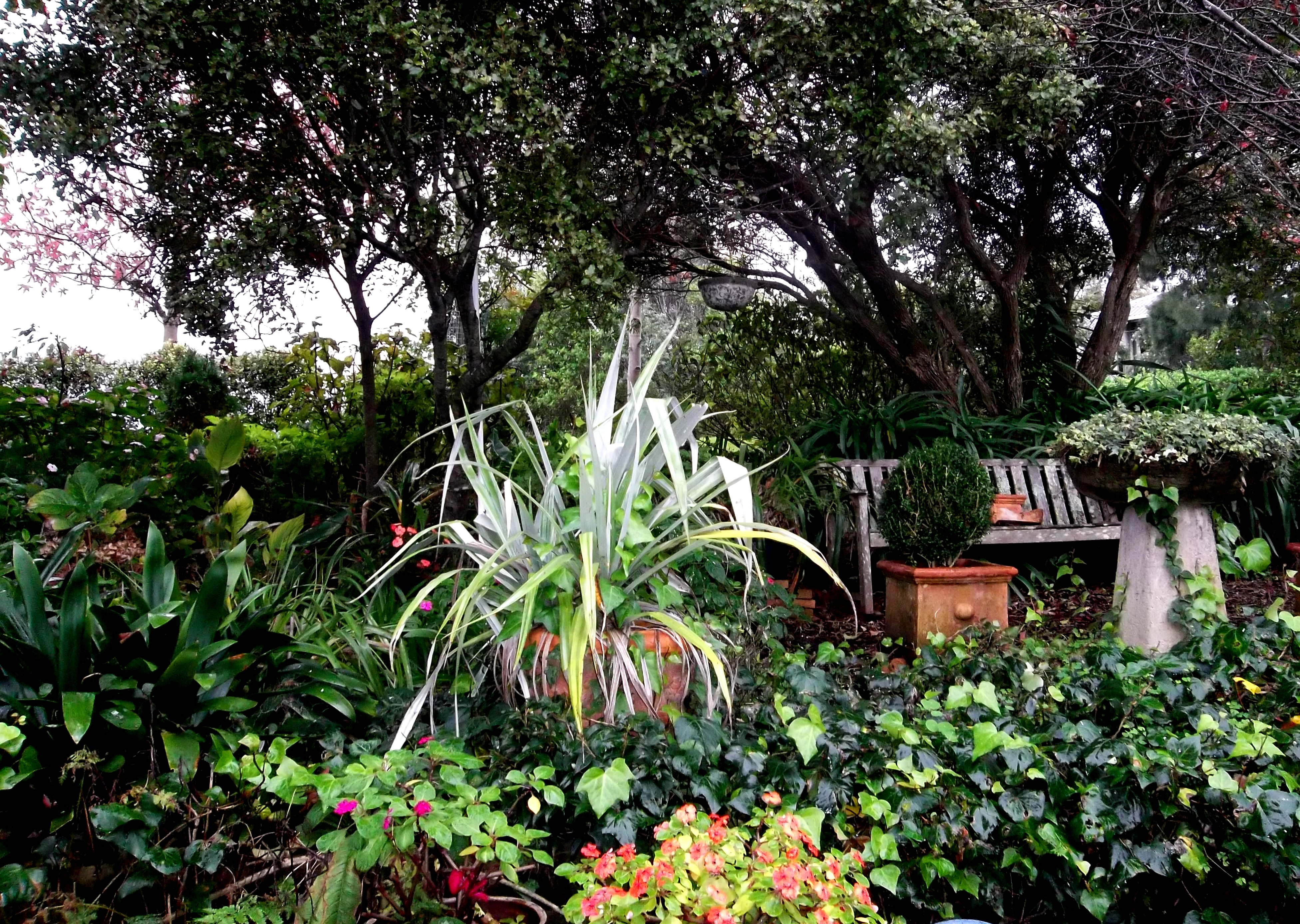
As I’ve grown older, I’ve whittled down the elements I want in my garden, and top of the list is fragrance, closely followed by white flowers which show up in the dusk. So apart from my blue petunias and pink roses, there are always plenty of white lilies, white geraniums, Shasta daisies, fragrant syringa, white Japanese anemones, marguerites, self-seeded valerian, white agapanthus as well as blue, and my favourite white climbing rose Alberic Barbier. That isn’t to say that there aren’t blue hydrangeas shimmering under the trees, a glorious pale gold rose called Crepuscule clambering up a telegraph pole out on the road,( see above) or pink beauties like Jean Ducher which bloom palely all the year. And then there’s Mutatibilis rose which looks like a bush covered in deep pink butterflies about to take flight.

There are two other requirements for my garden – masses of green – so ivy everywhere, box plants and acanthus, and I also ask my long-suffering plants to be undemanding and easy-care, though I contract to water them through the droughts. It’s not a tidy or orderly garden, but an exuberant, prolific little plot, with wilful self-seeded plants welcomed wherever they choose to settle, and every chosen flower and shrub scrambling into its neighbours, cosying up, sharing their space, flaunting their freedom.

Rampant growers like honeysuckle and ivy are allowed to enjoy themselves, instead of wilting under the criticism of real gardeners who despise them for being so invasive. Wandering flaming red and orange nasturtiums have even turned themselves into climbers and threaded themselves through the climbing rose up to the roof, and entangled themselves in an orgy of colour among the pinks and blues of ageratum and lavatera down below in the garden. If it grows, it’s welcome… so though I’m not a discriminating gardener, I am a grateful one!

I learned about flowers from our appropriately named gardener called Mr Appleby.  I was nine, and we were living in a rambling Tudor house in Yorkshire while waiting to go to post-war Germany. It had been a monastery before Henry VIII’s Dissolution, and behind it stretched a high walled garden,  built of weathered rose-coloured bricks. On either side of the lawn were deep herbaceous beds, the fashion of those times, and indeed, since Edwardian times. At the end, sheltered by the high wall was the vegetable garden, and after we had been to see Bertram Mills circus and I had fallen in love with the trapeze artist, Lady Elizabeth, I tried to practise my rudimentary trapeze skills on top of this wall, unseen from the house.

The end of the lawn was dominated by a big pear tree, where we sat in striped deckchairs in its shade having afternoon tea, and where my step-grandfather would sit on summer evenings reading the Times while he smoked a cigar, it’s rich aroma  reaching my bedroom window as I peeped out.

I didn’t go to school while we lived there, and had lessons in the afternoon. In the morning it was my job to arrange the flowers in every room throughout the beautiful old house, and keep them freshly topped up and watered. It was bliss. I had carte blanche to pick flowers! Mr Appleby tended to guard his glorious peonies from me, but let me have enough to keep the vases looking quite ravishing. He taught me the names of his precious plants, and became a great buddy. From his big saggy pockets, he would drag out for me giant gooseberries from his garden, pinkish with long soft hairs all over them, his biggest strawberries, juicy, golden William’s pears, yellow-fleshed purple Victoria plums and red russet apples. I used to hide in the pear tree so as not to have to share these treats.

He told me the names of the tall, smoky blue delphiniums, rosy hollyhocks, pink foxgloves, serried ranks of pastel coloured lupins, and golden rod. They were massed at the back of the borders. Then there were the middling sized flowers, lavender, peonies, pink and white and deep red, dahlias, (I didn’t pick them, too many earwigs crawling around inside) purple irises, stocks and phlox and larkspurs, day lilies in deep maroon, snapdragons massed in mixed jewel colours, delicate grannies bonnets, scented sweet Williams; in the front of the borders were clusters of cat-mint, the soft, furry sage-coloured leaves and pink flowers of lambs lugs,(the country term for ears), yellow cotton lavender and clumps of pinks, the fluffy ones with a gorgeous pepperminty smell.

Then there was purple ajuga and harebell-blue campanula, and snow-in-summer nestling in crevices among the stone flags of the terrace. The names felt like poetry. And smothering the trellis which hid the dustbins outside the kitchen door were pink Dorothy Perkins roses.

Mr Appleby was a weather-beaten, wiry little Yorkshire-man, who wore battered old trousers and an unbuttoned jacket which in novels would be called rusty black, with a grubby white shirt with no collar – in those days you changed the collar, not the shirt, using collar studs, front and back. On his head he wore a flat cap, and he had bright, beady black eyes. He spoke with a broad Yorkshire accent that was hard to understand. Sometimes he took me on walks around the countryside where I learned the North country lingo of becks and scars and fells, which I later learned were the ancient Viking words for stream and cliff and moor. Once he showed me a tiny field mouse peeping out of its miniature nest which was a round grass ball, slung between the top of the stems of two cornstalks growing amidst a forest of other golden stalks, blue cornflowers and red poppies.

Those things I learned from Mr Appleby one summer nearly sixty five years ago have never been forgotten. Who knows what we ourselves unwittingly leave in the memory of the children we encounter? What words, what thoughts, unconscious sharing of experience, spontaneous gifts given without intent, moments that lingered down the years… what imperishable knowledge that helped to lighten ignorance and enlarge understanding, what fragments of fact that sparked a child’s consciousness ?  To be the person behind those memories  … that must be a very special sort of immortality.


Food for threadbare gourmets

This is a filling meal I make for my husband when I can’t think of anything to give him! Dr de Pomiane, the French-Polish food writer adapted it from a French peasant dish, and this recipe is a much dollied up version of his solid peasant dish. Remove the skin and pips from a medium sized tomato (soaking the tomato in boiling water loosens the skin).

Toast two thick slices of sour dough bread on one side. Spread the untoasted sides with Dijon mustard, grate two ounces of cheese – Gruyere is recommended for purists – I usually use cheddar which is in the fridge – and pile the cheese mixed with the tomato on the mustard side of the bread.  Grill until the cheese goes golden, then lay a couple of rashers of streaky bacon on the cheese mixture. Grill until the bacon starts to brown, and serve with black pepper. (De Pomiane didn’t use bacon or tomato – instead when thick slices of cheese had been grilled, he put butter ON the melted cheese!)


Food for thought

“The characteristics of the English are largely unsensational, and since they do not readily fire the imagination they easily slip the memory, but they are nevertheless fundamental and formidable. A love of law and order and a respect for government by consent. A belief in honest administration. A dislike of hurting people and if a hurt be done a great effort to put it right. A tolerant people, offering a hand to victims of intolerance. Skill in devising ways of improving the lot of mankind but a dreadful inability to follow those ideas through. A sweet countryside, but appalling ways of cooking what that countryside produces.”

President Truman describing the English, on being honoured with an honorary degree at Oxford after his retirement.    Dreadfully honest, I suppose you could call this somewhat measured and restrained tribute !


54 Comments

Filed under british soldiers, cookery/recipes, culture, environment, food, great days, life/style, perfume, The Sound of Water, Thoughts on writing and life, Uncategorized

Birds of a feather

100_0479My heart was in my mouth. I was sitting at the traffic junction in our small town where six roads meet and compete for the lights.  Would the traffic stop? A duck was slowly waddling across the road with a clutch of tiny ducklings in tow. They made it to the pavement which would lead them along to the river in the middle of town, with just one hiccup over two slow ducklings who stopped to drink from a puddle, and which an impatient woman nearly cleaned up as she got tired of waiting.

This is the duck season. We become very conscious of them as they shepherd their progeny across busy roads, oblivious of the killing machines skidding to a halt yards from them.

A friend told me how in the middle of the busy village street, he stopped to let a mother pass while her babies all scuttled to safety on the pavement, but she wouldn’t move from the middle of the road. As he wondered how long she was going to obstinately stand there, suddenly two recalcitrant toddlers made a dash from the other side to catch up with their mother and siblings. Ducks can count!

The same thrush (I think) who made life difficult for us last year, by nesting in the honeysuckle by the side door of the garage has returned, and I in-advertently uncovered this year’s nest as I began to trim the overhanging ivy on the arch into the garden from the garage. I saw with horror a beautiful blue egg in the exquisitely woven little nest, and hastily covered it with strands of the trimmed ivy.

I blocked the arch with a rake and a hoe and a plank of wood across the top of the steps to stop anyone using it, so now everyone has to go the long way round from the garage. (see pic above!) I tiptoed up the next day, to check if the bird had returned, and as I stood peering intently into the tangle of ivy leaves, I suddenly realised that a beady yellow- rimmed eye was staring at me. I backed away very slowly, apologising softly for my intrusion.

A grey heron unexpectedly circled in front of my car as I drove between spring- green trees and hawthorn hedges encrusted with white blossom this morning; and I noticed that the striking paradise ducks with black, white and sherry coloured plumage who mate for life, seem to have disappeared from their usual haunts – to tend their nests too, I presume.

Driving home in the dusk a few nights ago, I saw what I thought were burrs on the road in front of me, but they were moving. As I swerved, I realised that the tiny balls of black fluff rolling to the side of the road were probably paradise duck babies. They all start off as balls of fluff, and then the brown mallards develop tiny yellow legs and webbed feet that scurry frantically across the road, beautiful little creatures with not an ugly duckling among them.

Years ago as we walked down the lane by our house, being towed by two shaggy afghan hounds and a cavalier King Charles spaniel, I was consoling the children about the village fete, and their spurned handicraft entries.  “The thing is,” said my ten year old daughter, “other mothers think their ugly ducklings will grow into swans, but you think we’re swans already!”

Not surprising when I thought about it… swans had been part of my life as a child. We lived close to a lake called the Backwater. It had once been a tidal inlet, until the local authorities had built a bridge which blocked the flow from Weymouth Harbour. Until then the tide had washed up and down this long channel, where there’s evidence that the Romans once had a small port at the end of the inlet where we lived. There’s a legend that later, when the Vikings made their first raid on England at Portland just round the corner, they also pushed their way up the Backwater in AD 787.  Later the Saxons settled around here among local British tribes who‘d been inhabiting the area since Mesolithic times – 12,500 BC. (Genetic experiments have shown that a significant segment of the modern population here are descended from those original Mesolithic inhabitants.)

 When I knew the Backwater, neither  Stone Age coracle nor Viking long-boat could have rowed up the now tide-less water, for thick beds of reeds had spread to give safe cover for the big, white mute swans to build their nests and hide their cygnets. I used to walk my dolls pram down to the edge of the lake and throw them bits of bread. On the grass the other side of the road edging the water, the Americans had had all their tanks and armoured vehicles lined up row on row before they left for D-day, thus reversing the ancient pattern of invasion, and taking fire and sword back to the mainland.

There are so many legends and folk tales about swans, the commonest being that their nearly ten foot wide wing span can break a man’s arm. This is one of the long-running jokes in Sue Townsend’s gloriously funny book, ‘Adrian Mole and the Weapons of Mass Destruction.’ Adrian buys a trendy flat in a disused warehouse alongside the river, and discovers too late that a posse of swans consider this place to be their territory. Everyone who visits the hapless Adrian ends up warning him, “A swan can break a man’s arm, you know”.

They mate for life too, and I love the names of the different species: as well as the mute swans, there are trumpeter swans, whooper swans, tundra swans, and the Bewick, a sub-tribe of the tundra clan. The biggest populations of wild swans live in Russia, and it’s believed that the only reason swans didn’t become extinct in England un medieval times – since they were good eating – was that though everyone cut a notch in the feet of their own swans, birds without the notch were considered to be the sovereign’s property and protected by a royal swan herdsman. This preserved the native species. And as for cygnets, who can forget the all male corps de ballet who performed at Covent Garden, and then made their breath-taking and tantalisingly  brief appearance in the film ‘Billy Eliot?’

We only have the non-native black swan here, immigrants from Australia who now populate various lakes around the North Island in great numbers. I remember my disbelief when I saw the one black swan on the lake at Kew Gardens as a little girl. I love them now. The evil black swan queen in Swan Lake gives black swans an undeserved bad name – they are elegant, peace-loving family-oriented birds, loyal to each other, male and female raising their families of cygnets together year after year. 

It seems appropriate that all our swans here are black, when I consider that New Zealand’s  national colour is black… the All-Blacks play rugby, the NZ cricket team wears black, as does our Olympic team, the America’s Cup yachtsmen  and all other sports teams. And statuesque Maori women look magnificent in their black mourning with wreaths of green leaves around their heads, as they perform the ancient karakia or grieving  chants with their graceful waving arm movements. Black is indeed Beautiful in this country !


Food for threadbare gourmets

A green-thumbed – or is it green fingered –  neighbour generously left a bag of goodies outside the door the other day. Among them were delicious, tender young leeks and green cauliflower. They deserved a dish of their own so I used a recipe I’d just found. Steam enough cauliflower to fill a cup when mashed. Cut the leeks into rounds, and sauté in butter until tender. (I always put a little oil in too, so the butter doesn’t burn) Mix the cauliflower and tender leeks with an egg, a good quarter of a cup of flour, two tablesp of parsley and one of chopped dill, a good grinding of black pepper and half a teasp of salt. Form the mixture into patties and fry on both sides. I sprinkled them with plenty of Parmesan, but I would think crumbled goats cheese would be good too. Next time I try them I shall use coriander, and mix in some crumbled goats cheese.


Food for thought

From Midrashim: Proverbs 6.6

Go to the ant, you sluggard,

and watch it lug an object

forward single file

with no short breaks for

coffee, gossip, a croissant,

And no stopping to apostrophize

blossom, by-passed because

pollen is not its job,

no pause for trampled companions:

consider her ways – and be content.

David Curzon, born 1951 – poet, essayist, translator and United Nations official retiring in 2001.


83 Comments

Filed under ballet, birds, cookery/recipes, environment, great days, history, poetry, The Sound of Water, Thoughts on writing and life, Uncategorized

Storms of Delight

100_0377I awoke to the roaring of a savage sea hurling itself onto the rocks below. The window is always open so that I can hear the sea.

Looking out, it was a grey wolf sea, with a steel-grey haze obliterating the islands that hover on the horizon. White capped rollers raced in across cruel grey and glacier- green water, and when the waves hit the rocks spilled over in sheets of white foam blowing high in the air. Low tide is almost more spectacular than high tide, because the water hits the rocks instead of flowing over most of them.

 Later, I put on a hood and jacket and walked out into the storm. The wind was thrashing the trees and making much the same sound as the roaring sea. First I walked to the garden of some friends overlooking the little harbour. It’s usually like a shining green jewel set deep in high rock and forested walls. It was calm, the only sign of the storm being the muddy-looking water.

 These friends own the goats and are away overseas for some weeks, so I pocketed the lemons lying under the tree. It was only a little tree, but had been so nurtured and well fed, that where one lemon would normally hang, between five and ten weighted down each fragile branch. The scent of the blossom still growing swirled round the tree before flying in the wind.

 As I walked down their long drive, between two rows of palm trees, three little speckled red hens came running out of a nearby garden, and solemnly picked their way behind me in single file. I felt like turning round to stroke them, but they weren’t keen on this. The way they followed me reminded me of Konrad Lorenz’s imprinted geese, and I hoped these little hens weren’t busy imprinting themselves on me. They gave up in the end, and returned home to where their supper was awaiting them in the hands of a pretty girl in a cream poncho.

 Strolling back in the flying rain I walked down the cul de sac to say hello to the three goats, and give them a little leafy, twiggy treat. Robert, the grumpy old billy- goat, would keep dropping his mouthful in order to snatch the little darlings’ twigs from their mouths. So I had to do a dodgy dance to try to fend him off while the babies managed an uninterrupted munch for a few minutes.

 As I turned round to come home, I heard a piteous whine. It was Zeb, the black and white pointer who lives opposite the goats, and sometimes escapes to come and see me. She had her head to the fence, hoping I’d come and say hello to her too. Of course I did, and while I was doing so, Kate, her owner, came out and asked if I’d like some new-laid eggs. Would I? So when Zeb and I had finished our tete- a- tete, I returned home the delighted carrier of six fresh eggs.

 I laid them carefully with the glowing yellow lemons on the garden seat at the top of the steps, and continued my wander in the storm. We live on a tiny peninsula sticking out into the sea, our house facing one way, and on the other side of the little neck of land, the old village graveyard faces out to sea in the other direction. Beneath spreading trees, it holds the graves of the earliest settlers in this place, and the latest inhabitants.

 I walked on the wet grass between the graves, heading for the end of the cemetery where it ends in a deep crevasse where the sea throws itself against this neck of land. Here I look down on a flat rock fifty feet below. The seas crash over it in rough weather, or lap against the sides on calm days, revealing tempting still green depths and white rock below the waterline, where I’d love to swim if I could get down there. Today it was almost invisible beneath thick sheets of green water swirling over it and spumes of foam flying through the air.

As I stood looking down here, as I so often do, I realised that every time I come here, I think of Pincher Martin, and William Golding’s description of hell. Pincher Martin scrabbling desperately to escape the raging seas, and clinging onto the slippery rock and slipping back down again into the tormenting cauldron of murderous waves… over and over again … not a pleasant remembrance, and one I try to banish, but it always comes back … just as I never see the spire of Salisbury Cathedral, in the flesh or in pictures, without thinking of Golding’s ‘The Spire’ and his painful story of spiritual disintegration. Thank goodness I’ve avoided reading ‘The Lord of the Flies’, as I know I would be tormented by that too.

Today, the wind crashing through the old pohutakawa trees – which were probably growing here when my hero, Captain James Cook sailed past in 1769 – was bringing down lots of small twigs and gnarly broken branches. When they’re dry they’re wonderful to start the fire with, and the peasant in me can’t resist gathering bundles. This was a successful foray and I returned home with a big armful of wet branches and twigs to dry out in the garage. Pohutakawa trees grow to the size of a good oak tree, and have dark green, hard, crunchy leaves all the year round. They’re sometimes called the New Zealand Christmas tree because at Christmas they’re smothered in flaming red blossom, and here, where the whole coast is ringed with them, they are a unique sight.

 And so back home to a blazing log fire, with the haunting and tender sounds of Handel’s opera Julius Caesar still ringing through my head. I went to see it for the second time in three days yesterday, five hours of it, and would see it again – and again, if it was available. Today I Googled Caesar and Cleopatra, since I only knew of Anthony and Cleopatra. And yes, Handel hadn’t messed around with history, Caesar and Cleopatra had had a love affair, she had borne his only son, and she stayed with him in Rome until his assassination.

 So well before her alliance with Mark Anthony, she had loved Caesar, and he her.Knowing this made the exquisite songs of their love affair in opera seem even more poignant.Cleopatra inveigled her way into Caesar’s presence rolled up in a carpet, and in the opera sang a song of enchantment for him. I read somewhere that Cleopatra’s glorious song to Caesar:  “v’adoro pupille” (I adore you, eyes,) is the most seductive love song ever written. I can believe it. In Natalie Dessay’s version she didn’t seduce, she poured out her heart. It was beautiful.

 And this life seems so beautiful too, with all its gifts and grace notes, allusive thoughts and memories, the stormy seas and wild winds, the hens and the goats, the centuries of music and aeons of love, the lemons, the eggs and the firewood!


Food for Threadbare Gourmets

 The pantry was bare. So I made a treat I haven’t made for years – cheese aigrettes. All I needed were things like eggs, flour, and grated Parmesan which I always have in the deep freeze. So into a saucepan went two oz butter and half a pint of water. When boiling I added 4 oz flour and stirred hard until the whole mixture was coming away from the sides of the saucepan, leaving it clean.

 Off the heat I mixed in 3oz Parmesan and two egg yolks, beating them in separately. Add salt and pepper, and then fold in the stiffly whisked egg whites.That’s the easy part. When the mixture is cold, drop small rough pieces, about a teasp size or bigger, into hot fat. Don’t fry too quickly or the outside will brown before it’s cooked inside. But if the fat is too cold, the aigrettes will become greasy. It takes about four minutes for  each batch to cook.

Fish them out with a slotted spoon onto some kitchen paper to drain, and serve with grated parmesan sprinkled over, and a dash of cayenne pepper. With salad, they’re crunchy, filling and delicious.

 Food for Thought

 Life, for all its agonies of despair and loss and guilt, is exciting and beautiful, amusing and artful and endearing, full of liking, and of love, at times a poem and a high adventure, at times noble and at times very gay; and whatever (if anything) is to come after it, we shall not have this life again.

From Towers of Trebizond by Rose Macaulay English novelist 1881 – 1958


81 Comments

Filed under books, cookery/recipes, culture, environment, great days, happiness, life/style, literature, love, spiritual, The Sound of Water, Thoughts on writing and life, Uncategorized, village life

Serendipity and the Private Life of Rabbits

100_0379I don’t know what made me ask. Serendipity. A visiting friend had said his wife hadn’t come with him to see us because they had guests from overseas – a palaeontologist and partner.

Out popped the words, “Not Ronald Lockley’s son?”  I’d once been told that his son was a palaeontologist. It was, and he came, and we were a mutual admiration group for his father. Synchronistically I had just been re-reading his father’s autobiographical book ‘Orielton’. Mostly because I wanted to refresh my mind about rabbits!

Ronald Lockley was the brilliant naturalist who did the research on rabbits which was the basis for Richard Adams’ famous book: ‘Watership Down’. Richard Adams made millions out of this book which has never been out of print, while Ronald wrote over sixty five books to keep the wolf from his door!

But in ‘Orielton’ he tells not only how he organised his amazing research into the life and domestic habits of wild rabbits, but how he also gained an insight into rabbit psychology, when he adopted an injured baby rabbit. His son – the one who came to talk – helped to keep it alive overnight and then That Rabbit, or TR as she was called, became part of the household.

The household lived in a remote and rambling beautiful Georgian manor surrounded by parkland of lakes, woodland, farms and gardens in Wales. A succession of other famous naturalists, Spanish domestics and would-be students and helpers passed through it, and the family and its animals lived a rich and lively life. Ronald’s interests and observation ranged over the private life of the large spiders inhabiting his home, to the badgers, birds, bats, rabbits, hares, and stoats, otters, ants and bees ranging the estate. This house which had rung with laughter, music, wit and brilliance from the likes of Ronald and Julian Huxley and Ludwig Koch, he finally handed over to the Field Studies Council, before leaving England.

Ronald was already well known among naturalists before he published his four year study of “The Private Life of the Rabbit”, having lived on, and written about the uninhabited island of Stokkum, off the Welsh Coast. Here  from 1928, he pioneered studies of migratory birds, established the first British bird observatory in 1933, and carried out extensive pioneering research on breeding Manx Shearwaters, Atlantic Puffins and European Storm-petrels – wonderful names… In the thirties he had made an Oscar winning film on gannets with Julian Huxley, but here at Orielton it was rabbits that took up most of his attention.

That Rabbit – TR – slept in the cat basket by the fireside, and when she was awake was “excessively playful” according to Ronald. She invented a version of hide and seek which she played on the stairs with anyone who would join in, and would chew through the string of s cotton reel Ronald used to roll around for her, seize the reel in her mouth and rush off dodging through the furniture as though playing rugby, enticing Ronald to chase her. If he was busy, she’d chew through his slippers, wreck his socks, and if all else failed, leap onto his type writer and push her face into his to get his attention.

After an unfortunate incident with a stoat, Ronald devised a system of In and Out doors which closed behind TR so the stoat couldn’t chase her inside. She learned immediately how to work this system, just as she had instantly worked out how to organise her toiletry, and never messed inside.

For afternoon tea in the garden with the rest of the family, she enjoyed weak tea with milk and a little sugar … and as time went by, Ronald realised that if he had not had this relationship with TR, he would never, as he said, have understood the soul of a rabbit. Even as an adult, TR sought out his company and showed a deep attachment to him.

The end of the story came when on one of their walks together, TR encountered a young buck rabbit… and then again. She left home and set up house with one of her own kind. But this was not the end of the story.

One night when everyone was sitting round the fire they heard the In-door, and TR came hopping through. She went straight to the cat basket, and grabbed in her teeth the dolls blanket which she used to cuddle up in, and then made a dash for the Out- door.

She had remembered as she prepared her burrow for her first litter of babies, that soft warm rug by the fire-side that she had always used!

Ronald had given me ‘Orielton’, with several others of his books, and I was such an ungrateful insensitive person in my younger days that I’d never got round to reading them. Natural history just didn’t do it for me then, and I was too wrapped up in my teenagers and complicated life generally.

I used to meet him when I was delivering my weekly column to the newspaper, and Ronald was delivering his naturalist column. (no e-mail copy then!) He had come to this country to live, because he felt that the UK was not committed to looking after the environment. We loved each other, and yet when I left Auckland to live in the country, we lost touch. It makes me sad now, Ronald was never really appreciated in this country – no-one really knew or recognised  his work back then in the seventies and eighties.

But as usual he made his mark on the place. He was involved in setting up the bird sanctuary at Miranda where every year, hundreds of thousands of godwits gather to begin their stupendous flight to the other side of the world – Siberia – to breed. He also created a little protected reserve around the house on the cliff where he lived, overlooking the sea on the edge of Auckland. I still have the book he gave me about his life in that: “House Above The Sea”, as it was called.

If fame means having an obituary in the New York Times, an entry in Wikipaedia and in various biographical tomes, Ronald does have fame. But I actually feel that the words from Ecclesiasticus describe him best: “and some there be which have no memorial…. these were merciful men, whose righteousness has not been forgotten.”

Richard Adams, who made a fortune out of Ronald’s research – which he acknowledged – said of Ronald that he was a “sensitive and clear-sighted lover of this beautiful earth.” The gentle humorous man I knew was also a lover of all beauty. He died in 2000 at ninety-six, and as I wrote this, these words came into my mind: “Swim with the dolphins deep in the sea, Soar in the sky with the birds and be free…”


Food for Threadbare Gourmets

I needed a cake in a hurry the other day, and it was serendipitous too, because there was enough left for coffee when my expected visitors arrived the next day to talk of Ronald Lockley.

For this easy lemon cake you need 225 g each of soft butter, caster sugar and SR flour, four eggs and a lemon. Just beat the butter, sugar, eggs and grated lemon rind. When creamy, add the flour and beat gently. When blended pour into a medium sized greased and floured loaf tin and bake for fifty minutes at 160 deg C. I make a glaze of the juice of the lemon, a tablesp of caster sugar, and a teasp of butter. Melt and stir together and brush over the loaf when cooked.


Food for Thought

In a Bath Teashop

“Let us not speak, for the love we bear one another –

Let us hold hands and look.”

She, such a very ordinary little woman;

He, such a thumping crook;

But both, for a moment, little lower than the angels

In the teashop’s ingle-nook.

John Betjeman  1906 -1984  Much loved and much read Poet Laureate, and eccentric. As an under-graduate he took his teddy-bear Archibald Ormsby-Gore to Oxford with him, which was immortalised in the book: ‘ Brideshead Revisited’  by Evelyn Waugh.


64 Comments

Filed under animals/pets, birds, books, cookery/recipes, environment, great days, life/style, poetry, Thoughts on writing and life, Uncategorized, wild life

My Wizard of Oz

100_0347He was a wizard, and he flew from Australia – always known as Oz in Down-under. So of course I called him the Wizard of Oz, even though he was basically an inspired and eccentric architect, and an inscrutable, irascible, metaphysical teacher who couldn’t stand fools. This meant it was tricky asking a question. I had the feeling that if you needed to ask the question, then you weren’t worthy to receive the answer!

His devotees were doctors, including a very illustrious one, teachers, estate agents, salesmen, housewives, seekers. I studied with him for several years at the end of the eighties, ostensibly learning about herbs and nutritional medicine. The herbs were an old idea, the nutritional stuff quite new, much of it channelled. He had studied with other New Age luminaries like Stuart Wilde and Denise Linn in London.

We learned lots of other things besides herbs and supplements – at the time they seemed avant garde, and a bit out of left field, but we now read reports on just what he told us back then – that pouring boiling water on coffee draws the oil out, which is a no-no… so never make coffee with boiling water he told us. So we didn’t. Never drink instant coffee either he said, drawing our attention to the smell of dry cleaning fluid emanating from it. Eat butter, not chemicals was another nugget of wisdom!

He told us that teenagers have their best sleep between seven and eleven a.m. and that they need it. Twenty five years later, one secondary school here doesn’t start lessons until after ten in deference to what is now known about teenagers’ sleep needs. I think of him every morning when I test, using a method like muscle testing, to see what nutrients I need … sometimes I need more calcium, sometimes more amino acids, or niacin… or whatever. This way I almost never have a cold, flu or other health problems. My husband has always called me a New Age Nutter, but the proof is in the pudding.

During the years I worked with the Wizard, we were required to have a thirty minute afternoon nap, he said it was good for the system and kept us young. I still do. Starting off with Reiki, before I know it, I’m deeply asleep, and wake exactly on time.  Our spiritual destiny is to be in the right place at the right time, he mentioned almost as an aside. And since wherever we are, is right place, right time, this was immensely comforting – and practical.

One of the disciplines that he suggested when we were working with him, has now become a way of life for me. The world you live in is not a violent world, he said, so why pollute it by connecting with the fear and violence in other people’s worlds?

Watching fear-based programmes or reading about disasters simply feeds your mind with negativity and unnecessary fear, he said. So I stopped watching the TV news. I had never read the crime pages – why read about people who’ve had dreadful lives making their lives and the lives of others worse, or waste time reading about crooks and crims – I used to say. It felt like voyeurism or schadenfreud. And by avoiding stories that were violent or negative in newspapers or magazines, and having never watched violent thrillers, horror movies or any fear-based plays, films, or TV programmes, my world became very peaceful indeed.

I used to joke that I only watched the weather, there was plenty of action and excitement there – floods and hurricanes, snowstorms and thunder-storms, earthquakes and tornadoes, tsunamis, droughts and forest fires – but without the drug of violence or voyeuristic sex. Now, I don’t even bother to watch the weather, finding it far more interesting to take what comes. If I want to know the weather to plan what to wear for a day away from home, there are plenty of people to ask, from my husband to the shopkeeper in the village. Nearly everyone seems to listen to the news and weather, except me. Some people seem almost addicted to news programmes, as though listening and watching make them feel that they are involved in life and all that’s going on.

But I find that this actually gets in the way of me having my own life and trying to be mindful.  I don’t need to hear about other people’s dramas and traumas, or disasters and scandals to make me feel I’m alive. Sometimes something so horrendous happens that of course I hear about it, and want to send my compassion, but no-one needs my curiosity.

Now though, with all the reading that I do with blogs, another insidious fear has crept up on me. I’ve been aware for the last forty years (who hasn’t) that we don’t treat our planet with the respect and understanding that will keep us and the planet in good health. But in the last year of reading informative and expert evaluations of the various threats to our world – Arctic melting, drilling for oil, fracking, carbon dioxide levels, destruction of forests, GM infiltration, death of bees, polluted oceans, dying species of fish, birds and animals – the list goes on – I’ve become so well informed that I realise I’ve begun to get sucked into anxiety and negativity.

For we rarely hear about the numberless organisations, groups and individuals who in their own way are making a positive difference to their communities, and therefore our world. Sadly, the good news doesn’t sell news or newspapers. And yet there is good news all around us. So now I feel I have to take the Wizard of Oz’s discipline a bit further.  Stop reading all the doom and gloom about climate change, desertification, rhinoceros poachers, Monsanto and the rest, and instead actively seek out the good news.

When I went into my local town yesterday, in each shop I visited I met gentle good people, living gentle good lives. Knowing them as I do, I know they put a hundred per cent into their vocations and work. And then there’s the girl at Tai Chi, who with her husband buys up Christmas trees every year. They take their cars and a trailer each, and go off separately to other towns selling the trees and then give the money to charity.

There’s the fun, wonderful woman working with refugees and indigenous communities, and who started her local branch of the hilarious Red Hat Society; the teachers in the local school who use The Virtues Programme in their schools; the organic farm which teaches sustainability, where people come from all over the world to work there and learn. The local council now takes their advice.

There’s the business man who mentors fatherless boys, and the amazing woman who finds homes for unwanted animals and who secretly rescues battered wives, taking them to hide in her home until they sort out their lives. And Greenpeace have just e-mailed to say that New Zealand will soon become the third market in the world in which all major canned tuna brands have committed to use only tuna that is caught by more sustainable fishing methods.

This is the sort of news I want to know about. This is the sort of information that comforts the soul and inspires hope for the world. And most encouraging of all, is to know children and young people who are growing up fully conscious of all the ills of power and hypocrisy, greed and moral equivocation, and who are evolving their own code of such integrity that the world will be safe in their hands in the future. Our children and grandchildren are up with the play, they are wise and knowing. So no worries then, as they say in this neck of the woods. ‘All is well, and all shall be well, and all manner of things shall be well’…. as long as I monitor my fear and violence intake !

Food for Threadbare Gourmets

Mushrooms were on ‘special’ at the grocer, so I bought a lavish tray of them, and brought them back home to use some for a quick lunch. I used sour dough bread toasted and buttered, and sliced plenty of mushrooms in butter and finely chopped garlic. When they were lightly cooked, I stirred in parsley and enough cream to bubble up and thicken. Poured straight onto the waiting toast, they were filling and delicious. I’ve also used sherry instead of cream in the past, and that’s good too. Shitaake mushrooms are delicious this way too, and any of the big tasty mushrooms are scrumptious – unfortunately they make me ill – so it’s button mushrooms or Shitaake for me.

Food for Thought

This is a postscript to a blog called ‘Voices from the Void’, which I wrote back in February about the ‘Voice ‘ which so many people hear when they are in a dangerous or difficult place. Reading a biography of Queen Victoria last night, I came across this quote from her after the early death of her beloved husband Albert, when she was still a young woman. Writing to her unhappy daughter, the Empress of Germany she said: ”I too wanted once to put an end to my life here, but a Voice told me… no, “Still Endure”.

This made an indelible impression on the Queen, who used “Still Endure” as a motto for the rest of her life.


74 Comments

Filed under cookery/recipes, environment, great days, happiness, life/style, peace, philosophy, pollution, spiritual, sustainability, The Sound of Water, Thoughts on writing and life, Uncategorized

The longest journey

100_0404I’m sitting by the wood fire with the rain falling steadily outside onto the green garden. It’s fragrant with the scent of all the cyclamens I bought this year to put in pots. I hadn’t realised what a beautiful perfume they had. I picked some roses before the rain drenched them, Monteverdi’s exquisite lilting Vespers – trumpets and choirs –  is playing, and I had for lunch a delicious helping of the grocer’s bargain Gorgonzola Dolce with fresh sour dough bread.

And coffee. My coffee tastes entirely different now that I’ve learnt to put the milk in first, thanks to the coffee drinking bloggers who commented on the blog I’d written about tea, and how Milk in First – so frowned upon by the pukka – is actually more delicious than milk poured in after the tea. So I’m now drinking coffee milk in first.

I’ve been watching a blackbird pecking at a red apple nailed to the fence outside the window. The sparrows love their grain in the swinging blue and white bowl suspended from a tree near the bird-bath. As I watched them, I was amazed to see a host of different birds in the garden, so unusual in this country.

There was a wood pigeon sitting in the guava tree in its approved partridge in a pear tree fashion, three pink-breasted grey doves pecking on the grass, a couple of tuis frisking in the bottle brush tree, sparrows in the feeding bowl, fan tails flitting around between plum tree and bird bath, a couple of lime-green and grey wax- eyes flickering among the leaves, and to my astonishment, a gold finch pecking around the green copper with pink cyclamen – the pink and the gold, and the verdigris of the copper a delight.

The tiny wax-eyes or silver -eyes, which are half the size of a sparrow – would top the list of NZ birds I love. Victorian Walter Buller, the earliest NZ authority on birds, called them silver-eyes. They ‘re supposed to have arrived in New Zealand in June 1856. Buller wrote: ‘…in the early part of June of that year, I first heard of its occurrence at Waikanae, a native settlement on the west coast, about forty miles from Wellington. The native mailman brought in word that a new bird had been seen, and that it was a visitor from another land.

‘A week later he brought intelligence that large flocks had appeared, and that the “tau-hou” (stranger) swarmed in the brushwood near the coast; reporting further that they seemed weary after their journey, and that the natives caught many of them alive’. Buller tells us that they were then seen in numbers in Wellington, and greatly welcomed as they ate the aphis known as American Blight which was ruining the settlers’ apple trees. The little silver-eye has flourished here ever since its epic thousand-mile journey across the Tasman.

Why did they come, flocks of them, not just a few blown by the wind? What a great heart in a tiny frame, and what impelled each one to embark on this huge migration across an ocean? Flocks of them sometimes clung exhausted to the masts of ships in mid-ocean. How did they know that a land, New Zealand, was awaiting them at the other side of the trackless sea? And how sad, that at the end of the endless journey, tiny wings beating against the winds, they were so exhausted, that many were caught by hand by Maoris and ended their lives precipitately in the Promised Land.

Whenever I see the tiny green creatures flitting in and out of the birdbath, sipping the honey in the bottle-brush tree, and nibbling the apples I put out in winter, I remember their great journey and noble hearts. Was their quest a search for a better life, like so many of the settlers, who in those same years also sailed across oceans for six months to reach here, surviving perils which included drowning, sickness and starvation?

This quest of men and birds took not just courage but a leap of imagination, and I wonder if these are the times now when we must all also take another leap of imagination and courage to save the dear earth that we know – to take, in Christopher Fry’s words, “the longest stride of soul men ever took”.  Eckhart Tolle has warned that all the structures that we’ve always known will start to crumble, and we are now seeing trusted institutions, organisations, freedom, democracy, justice, free speech, free press, the environment – all under threat.

So this must be the time to take that long stride of soul – to create new ways of living on this planet, salvaging the best, and joining together to share peace and goodwill, as well as food and resources.  The Dalai Lama has said that meditating is not enough – we need to act – and Thich Nhat Hanh has warned us that we can’t go on the way we are doing.

He says otherwise: “there is no doubt that our civilisation will be destroyed. This will require enlightenment, awakening. The Buddha attained individual awakening. Now we need a collective enlightenment to stop this course of destruction.”  So enlightenment, it seems, is a journey which we can’t delay, and however difficult this may seem, and whatever it means to different people – as Lao Tzu so famously said nearly fifteen hundred years ago – a journey of a thousand leagues begins with the first step.


Food for Threadbare Gourmets 

As a threadbare gourmet, I pride myself on getting at least eight meals out of a chicken, so I put the legs into the deep freeze to take out when I wanted them. After de-frosting and taking the skin off, I added them to a pan in which I’d sauted garlic and chopped mushrooms in butter and cream. I also crumbled a chicken cube in a little boiling water and added it to the mix to boil up and thicken. Then I stirred in half a teasp of Dijon mustard, some nutmeg, salt and freshly ground black pepper. Sometimes I serve this on pasta, this time I served it with buttery, creamy mashed potatoes, peas, and carrots.

Food for Thought

Life is an endless struggle full of frustration and challenges, but eventually you find a hair stylist you like!


66 Comments

Filed under birds, cookery/recipes, environment, great days, life/style, peace, philosophy, spiritual, sustainability, The Sound of Water, Thoughts on writing and life, Uncategorized

Zen and the Art of House Maintenance

100_0218

I think house maintenance has a better ring to it than boring old housework… this way, instead of being a housewife I could even be called a house maintenance executive, or a house maintenance CEO.

But dressing it up in fancy names doesn’t get me away from the essential boringness of cleaning the bath, vacuuming the house, dusting picture frames and the rest. A recent survey in the UK reported that women spend a year and a half doing housework, men half that. This amounted to four and a half hours a week housework… pea-nuts… In my incarnation as a fifties- type housewife, I did at least two hours housework a day, not including the washing, ironing, cooking and baby care.

When I was first married in 1963, I did it all automatically, every day, and without thinking. Brought up by a dedicated exponent of house maintenance who when I was a child made me strip the bed to the mattress every day, and leave it to ‘air’ before being allowed to make it again, conditioned me to being a domestic automaton. It was a habit I found hard to break as an adult. But becoming a single mother and working full time put the brakes on vacuuming and dusting every day. And later the entry of duvets into our lives changed mine!

I once read that the late Jean Muir, an English fashion designer with a perfectionist ethic, had been taught to make her bed by the nuns at her school somewhere in the West Indies. She said it was then and there that she learned about perfectionism and attention to detail. I have this vision in my mind of a long, high-ceilinged, calm, white convent dormitory with a white robed nun, watching the creation of these little works of art – a perfectly made bed with a white counterpane – and making each child re-make their bed until it really was the best they could do.

I can imagine the atmosphere in a room like that, where everyone was putting their hundred per cent into what they were doing… when something like that happens in a room, it affects the atmosphere. When I did a series of personal growth courses for seven years, one of the things we had to learn to do on a gruelling two week residential course, was to ‘Zen’ our rooms. It was the same thing that the nuns were teaching the children.

We had to leave our room in the most perfect state of cleanliness and harmony possible. Few of us managed to achieve this state of indefinable perfection… and most of us were still mystified or defeated by the concept at the end of the course. But over the years it’s something I’ve come to understand and treasure, and it lifts mere housework or house maintenance into another sphere.

When I was a helper on another of these residential courses, and we were packing up to go after all the course participants had left, someone came in while we were having lunch, and said: “Have you seen Hut Number Ten’s woodshed? We all piled out, and one by one stood in the doorway, and experienced an indefinable sweetness… the wood was piled around the shed, and the shed was spotless… but no more spotless than anyone else’s wood shed. I decided that what made the difference was the love and commitment that had gone into stacking the wood and this left the woodshed in a perfect state of equilibrium. Nothing you could see or describe, but something you feel.

These days that’s how I feel about housework/ house maintenance. I want the place to feel ‘Zenned’, as we used to say. That’s difficult with my amount of clutter, but I know it has more to do with the way I feel about cleaning the house than what’s in it. Though there is also a sense of rightness about the things that are in the room… maybe a touch of William Morris’s dictum, “ have nothing in your house that is not beautiful or useful”.

Sometimes I move and do everything at half speed, which means that I have to stay totally present and conscious, and though I’m doing it slowly, somehow everything gets done in good time, and in far better shape than if I’d just done a quick tidy-up.

Sometimes I just do it with my whole heart, not cutting any corners, doing it as thoroughly as I can. And I find when I’m doing this, I don’t find it boring. Something about paying attention to the detail and doing it without resistance, changes the whole equation. If I do the vacuuming grudgingly, it’s a chore. But if I can make that leap of will and give up the resistance to it, it’s a different experience.

More than that, I find chaos or dusty rooms depressing. And sometimes I want my home to feel like sacred space. Needless to say I’m not consistent in my efforts. In fact sometimes I feel like Sisyphus forever pushing his stone uphill before it rolls down again… this is because though children, grandchildren, seventeen dogs and one cat can make a mess, none of them can compare with a husband.

Robert Pirsig in his  ‘Zen and the Art of Motorcycle Maintenance’ wrote that: “Peace of mind produces right values, right values produce right thoughts. Right thoughts produce right actions and right actions produce work which will be a material reflection for others to see of the serenity at the centre of it all.” But I wonder if you work backwards if the same applies… by doing the right actions, do we discover peace of mind and all the steps in between?

And the right action seems to have a lot to do with detail. I remember our teacher on one of these courses saying how he had travelled from the US to Japan to do an advanced  course with Zen monks, and he was thrown off it on the first day… he had failed for not paying attention to detail… as I’ve grown older and fractionally wiser I can understand this.

God is in the details, and it’s in the details that the satisfaction and the perfection resides. I was reading Celi at www.thekitchensgarden.com  and her blow by blow description of feeding lambs and the best milk mix and best timing for their well-being was a most moving testament to the beauty in the detail.

This every moment of the twenty- four- hour – seven- days- a- week commitment to keeping the lambs alive and thriving, warm in their coats, and cherished in their sheltered corner of the barn, was a demonstration of how attention to detail becomes a labour of love – and maybe not even a labour – but a journey of love.

Unless Celi did this marathon task with love, I wonder if she’d even be able to keep it up, with feeds every few hours day and night, trips to and fro through the snow and the dark between house and barn, heating the milk- not in the easy micro- wave but in hot water – giving the four lambs colostrum from her cow which she milks, and keeping them hydrated through the day with endless sips. But when we do a task with love in our hearts, the love gives us the energy to do it.

It feels as though by paying attention to the detail, we are actually being a channel for love. And this is what can carry me through the washing up and the bed-making. It certainly carries me through the three meals a day routine of feeding an always hungry husband. I do find it impossible to cut corners and give him an overcooked fried egg, or a soup bowl with a splash on it. And though I don’t manage to keep up a constant commitment to Zen and house maintenance, at least I know the recipe for making it less of a chore and more of a commitment to beauty…. which somehow must make a difference to the world, since we are all connected.


Food for Threadbare Gourmets

Chicken mince was on special at the grocer- cum- delicatessen in the nearest village so I took some home for supper. Mixed with chopped onion, garlic  and celery, grated carrot, mixed herbs, salt and pepper, and fried in little patties, they’re good either hot or cold. We ate them with new potatoes and smashed peas, one of our favourites. Fry a chopped onion and some garlic. When soft, add lots of thyme, frozen peas and enough chicken stock ( I used a chicken stock cube) just to cover the peas. Boil until the peas are soft, and the stock almost disappeared. I used to just mash them with a potato – masher, now I whizz them in my new stock blender. Any left over goes into a green soup.


Food for Thought

“Men occasionally stumble over the truth, but most of them pick themselves up and hurry off as if nothing ever happened.”
Sir Winston Churchill 1874 – 1965 Leader of the free world against Hitler until the US and USSR joined in two years later.

He also said:” I like pigs. Dogs look up to us. Cats look down on us. Pigs treat us as equals.”


47 Comments

Filed under cookery/recipes, environment, great days, life/style, love, philosophy, spiritual, The Sound of Water, Thoughts on writing and life, Uncategorized