Category Archives: Thoughts on writing and life

Was I a snowflake?

Image result for radipole weymouth dorset
A life – part four


When we occasionally walked past what was known as the elementary school in those days, I used to shudder. The grim Victorian building, the concrete playground and iron railings, the noise and roughness of it horrified me. I was so grateful, even as a small child, that I went to my sheltered little school.

Unlike most prep schools one reads about in that period my private school was neither cruel, sadistic or frightening – perhaps because it was owned by a woman and all our teachers were women, except for the wonderful history teacher.

Miss MacFarlane-Watts, owner and head mistress, was a tall commanding woman with thick, grey hair cut almost as short as a man’s. She wore white shirts with a tie, heavy pleated skirts, tweed jackets, thick stockings and flat lace- up shoes. Without ever having heard the word lesbian or even a discussion about genders, I knew she was different… and we all accepted her as such. School was a large Edwardian house set in tree- ringed grounds and lawns, not far from where we lived.

As a fashionista even at that age, I rather enjoyed our school uniform… white blouses and navy blue pleated tunics with a braid belt for the girls, and grey shorts and jumpers for the boys. Our hats were my real pride and joy, a big brimmed, deep crowned navy- blue, thick, velour hat for winter with a striped ribbon with the school colours, and a wide-brimmed Panama hat for summer – they were so big that we little girls must have looked like mushrooms beneath them, and it was amazing that items of such quality were still available at this point in the war. We kept these expensive hats from flying off in a wind with a piece of elastic which went under our chins. Even our gabardine macintoshes were the finest quality.

Clothes had always figured largely in my life even as a toddler, when I remember the broiderie anglais edging my white petticoat, and relished my delicate little smocked ninon dresses, one in pink, the other in blue… does anyone even know what ninon is today … a fine net covered in tiny balls of fluff is my recollection.

My grandmother inevitably had somewhat old- fashioned ideas about clothes, one of which was to kit us out in liberty bodices… a sort of cotton layer worn on top of a vest and under a jumper, with buttons round the waist to hook a skirt on. They weren’t too bad, but I shrivelled with embarrassment when she sent me to school in antique leather gaiters to keep warm. They stretched the length of my leg, and the tiny buttons running that whole length had to be prized open with a button hook to get them off… this experiment was abandoned when I couldn’t cope with getting them off for physical education!

The day we arrived at this school, the infant mistress – who seemed  enormous to me – swung my tiny blonde  sister up in the air, looked into  her big blue eyes fringed with impossibly long black lashes, and said  “Oh, what a little Topsy!”  She didn’t take to me… children always know… and a few days later, she said to my bewildered little sister: “If your sister put her head in a bucket of water, you would too, wouldn’t you?” To which my sister baldly replied “Yes”.

It was a kind environment. A few years later, when I was eight and one of the big girls, my brother started school. He was so frightened by the experience that he was sent up to my classroom, and was allowed to sit by my side at my desk for days until he was ready to cope on his own.

Lessons were archaic. We learned to write copperplate, often using badly crossed nibs to write rows of letters over and over again until we got the right angle and shape of each letter. On handwriting days, the ink monitor – (never me – I was such an introvert that no-one even knew if I could cope with such responsibility, and I was happy to be overlooked) brought the tray of inkwells in, and they were passed along the rows of desks… then the pens… inevitably there would be spills – usually by a hapless boy.

Each day began with chanting boring times tables, while we sat with our arms folded, and I sometimes think the ritual may have been a calming meditative exercise too, for we never had any rowdiness or fuss to disturb the quiet orderliness of the classroom.

Art lessons nearly broke my heart. I was so excited when it was announced that we were now old enough to begin art lessons. But it was a huge let-down. We had to learn to draw a straight line, making short feathery strokes with our pencils. After a couple of lessons when we had mastered this arcane skill, we graduated to drawing a rectangular box and tackling perspective. With this accomplishment behind us we were now ready to be introduced to colour ! Hurray! We were instructed to bring a laurel leaf with red berry attached to the stalk to school the next day. Alas, our laurel hedge had no berries, so no lovely red for me, just boring green and yellow spotted leaves.

No computers then, so we competed with pencil cases, and collections of hard-to- come- by coloured pencils. We marked our pencils by slicing off a sliver of wood to make a flat surface at the top and then inked our name on it. Indelible pencils were much sought after… you licked the lead, and this made the writing indelible… as for rubbers (erasers if you’re American) – if you lost one, or broke it in half by using it too strenuously, war-time replacements were scarce… whispers criss-crossed the classroom – “can I borrow your rubber”, “can you lend me your red pencil?”

At Christmas we were all dragooned into the Nativity play. I had no idea what it was we were doing… which was not unusual… I spent so much time dreaming that I often missed important information. On this occasion, we all trooped down to the hall nearby, and I found I was an angel along with the other small girls. I was given a triangle to ching on at various not very obvious intervals to me.

The boys seemed to have all the best parts as wise men, wicked kings, shepherds – and of course, Joseph. They also had all the best musical instruments – tambourines, and trumpets, drums and the rest- this was the moment I realised somewhat bitterly that boys/ men had advantages that we girls did not seem to have. And while we stood around in our angel nightgowns in the freezing hall, the teachers seemed to endlessly move rows of chairs around. It was all a complete enigma to me then.

The next year we passed on the nativity play as we’d lost the use of the hall to the American soldiers who used it as their dining hall. They seemed noisy and enormous – wore fur-trimmed jackets – air crew I learned later – and since our back garden abutted onto the back of this hall, showered us with chewing gum, wrapped cubes of sugar – much prized – and sometimes bars of chocolate.

My grandmother gave us three pence pocket money every week, and with this I bought a bar of chocolate every Friday from Mr Duscherer, the German grocer just up the road on the corner. Everyone knew he was German, but I never once heard a word of disparagement about him. He was a big kindly man and I used to watch with pleasure as he prized a wire through a big round of cheese when you ordered a quarter of a pound or whatever the ration was then.

He had a huge machine that cut bacon the way you wanted it – smoky, thick or thin, streaky or back… he would weigh half a pound of biscuits out from big Peak and Frean biscuit tins into brown paper bags – did biscuits not get soggy then, I’ve often wondered, as I try to break into thick layers of cellophane to get into a biscuit packet these days. He sold stamps, posted parcels – usually wrapped in scarce and re-used brown paper, tied with re-used string and sealed with red sealing wax- no ubiquitous cellotape then, and he also stocked Sunny Stories, Enid Blyton’s weekly magazine for children with the long running serial The Faraway Tree in it.

Life seemed simple and safe and satisfying, especially after my grandmother bought me a little blue bicycle, and I no longer needed to make sure that all my dolls were safely tucked up in their cot and had been kissed good night, a ritual which I needed to do when my mother was still with us, and I now recognise as psychological transference.

And with the end of the war it was all about to change dramatically.

To be continued.

 Food for threadbare gourmets

Today, I had one duck leg left over after a little feast yesterday, using a tin my son had given me, so I made a duck risotto. It was delicious. Did the usual, onions, cooked half a dozen finely chopped mushrooms, fried the rice in butter, threw in a glass of good white wine to evaporate, and then added hot stock and a good pinch of dried thyme. When it was nearly cooked, added a generous dollop of cream, some green peas, and the duck meat which shredded beautifully. And then, with duck and orange in mind, added the grated rind of an orange and the orange juice.

When ready, I covered it for ten minutes to sit and mature, then stirred in a big knob of butter and some parmesan. Served with more parmesan, green salad and glass of chilled Riesling, it was rather good.

Food for thought

It is never too late to be what you might have been.      George Eliot, great Victorian woman novelist


26 Comments

Filed under cookery/recipes, culture, family, great days, happiness, The Sound of Water, Thoughts on writing and life, uncategorised, Uncategorized, village life

The passing of an era

Image result for victorian interiors

A life – part three

My grandmother was my favourite person. Whereas I had always felt responsible for my baby brother and younger sister, when she came to look after us when my mother left, I felt I could hand over the burden.

When she moved in to pick up the reins, she brought all her Victorian past with her. Up went the heavy, red velvet curtains in the bay window in the front room where my sister and I had watched the big girls playing on their roller skates across the road, peering through the brown sticky paper, taped across the windows in diamond shapes, to stop the glass shattering in a bombing raid.

I loved the texture and the colour and richness of the velvet. I loved the shiny brass rods with the rings that clanked when the curtains were pulled, and the big brass knobs at each end. I loved the aspidistra in its brass pot standing on its tall, spindly, three -legged table. On the other hand, I hated the Staffordshire figures which were her great pride. I thought them ugly and clumsy – and still do, for that matter, though I did like her Meissen angels.

Upstairs in the bedrooms, our little utility divans were replaced with deep feather mattresses into which we sank in blissful security. The dark mahogany and rosewood wardrobes and dressing tables filled my senses with deep satisfaction. The sheen, the grain, and their generous size were comforting and solid in a world which in my experience had been bleak and insecure, able to be blown away by a bomb in the red sky of night.

I remember the pleasure of sitting at the oak dining table as I dreamily chewed my bread and jam, and gazing at her knick-knacks on the oak sideboard the other side of the room – deep, blue Wedgwood biscuit barrel for chocolate biscuits, silver- bound oak biscuit barrel for plain Vienna biscuits, and the silver stag standing at bay on a writing tray which held all her letters and bills. Brass candle sticks stood each side of the biscuit barrels. The tall, wooden, barley-sugar twisted ones on the kitchen mantelpiece over the coal range now stand on my dining table.

She boiled the kettle for afternoon tea in winter on a little cast-iron stand which hooked onto the side of the grate in the dining room fire. And there was the bliss of making toast over that fire with a long brass toasting fork. It tended to taste of flames and soot, but was warm and crisp and a great treat. The thick red and blue patterned turkey rug in front of that fire was my favourite place. Kneeling with my elbows on the rug I would bury myself in a book while I was supposed to be watching the butter soften by the fireside.

Deep in my book and oblivious to butter, duty or anything else, I would be discovered crouched by the saucer of swimming, melted, precious, rationed butter. But if I was reading I was excused. No-one ever got into trouble for reading in her house. Until the day she died she was encouraging her great-grandchildren to read, as she had always encouraged me.

Not that I needed it. I longed passionately to be able to read grownup books. My mother had already taught me to read when I finally started school at five and a half, having stayed home to keep my sister company until she was old enough to start school with me. I was forever bored as the class limped along the wall friezes which said things like ‘A for apple, ‘B’ for bat’. The teacher didn’t know I could read, and it never occurred to me to tell her. I was so shy I rarely spoke at all. I read every textbook as soon as they gave it to us, a habit I took into secondary school, so I already knew all the answers in class.

Books for children were scarce, presumably because few were printed during the war. So, when my grandmother arrived with her box loads of books, it seemed like treasure. The children’s books were my father’s First World War and Edwardian boys’ books, the plots mostly centred on some pious crisis of conscience, but which I read nonetheless. I was particularly fond of my grandmother’s bound volumes of Victorian ladies’ journals, rows of red leather binding and gold tooling, with pictures as well as stories inside.

They tended to be about Evangelical but highborn young men who possessed crisp, fair curls, and wore boaters and striped blazers, and often went punting, and they also featured swooning young women, often orphaned, but in truth, of noble blood!! I learned a lot about mourning from these tomes, and the fact that ladies wore lots of black crepe – whatever that was – and black jet jewellery for such occasions. Not that I had the faintest idea what mourning was, except that it made people cry.

My grandmother also pressed on me her books from her  Victorian childhood. ‘Froggie’s Little Brother’ was the most memorably painful, about a family living and dying in various stages of starvation and violence in the East End of London (my brother and I laughed years later that we were probably the last two people in the world to read this grim novel). There were The Wide Wide World’, ‘The Lamplighter’ and ‘Behind the Scenes’, all tales about orphans. I wept buckets over them. When I had surfaced from these agonies, there was’ A Crown of Thorns’, a suitable tale for a seven -year -old about Dutch Protestants being buried alive by the Spanish Inquisition during the time of Elizabeth 1.

I baulked at ‘Pilgrim’s Progress’. My grandmother’s big volume with the original illustrations, with Christian stuck in the Slough of Despond, and the depravities of Vanity Fair and all the rest, depressed me more than any of her other books which included ‘Foxe’s Book of Martyrs’…

Editions of Mallory and tales of Arthur, Merlin and Morgan Ie Fay in Arts and Crafts bindings, and Pre-Raphaelite illustrations with art nouveau drawings educated my eye as well as my mind. I laboriously read Defoe’s ‘Robinson Crusoe’ in one of the original editions – which my grandmother collected – another large leather-bound tome with engravings protected by tissue paper, like ‘Pilgrim’s Progress ‘and Foxe’s ‘Martyrs.’ I still remember the terrible shock when Crusoe and I found Man Friday’s footsteps on the beach!

And I read Swift’s account of ‘Gulliver’s Travels’, and later found the children’s watered-down version pallid and boring. My favourite book then is still one of my favourites, ‘John Halifax, Gentleman’. When I re- read it as an adult, I recognised many of the ethical imperatives in the novel as having influenced my thinking ever since, while ‘Uncle Tom’s Cabin’ introduced me to the concept of slavery and abolition.

Later when I unguardedly revealed to my recently returned father and his new wife  that I enjoyed ‘Little Lord Fauntleroy,’ and they laughed themselves silly over its Victorian sentiment, I feared the rest of my reading was also material for mockery, and buried its existence in the back of my mind. And since my new parents did not want to be bored with tales of our past, I never discussed these books, and much else, so was never able to put them in context.

Even the green and gold Tate and Lyle golden syrup tin which sat on the table at breakfast to use instead of rationed sugar, was worth reading and squinting at as I spooned the treacle over my porridge…’ out of the strength cometh forth sweetness’ it proclaimed. My grandmother was very pleased with me for taking her injunctions about reading so literally, and boasted to her friends about it. So whenever I was due for a present they dug into their shelves for a book suitable for a seven- year- old bookworm, with the result that I had more copies of Aesop’s fables than any other child in history, I would imagine.

She introduced me to gardening. She gave us a small plot of our own, and we went to the news-agent where they sold seeds as well as sweets, newspapers and bread, and chose the seeds we wanted to grow. I loved the name Love-in-a-mist, and since they were also blue, my favourite colour, I took several packets. Every day for the next three weeks I rushed outside in the morning to peer at my little plot of earth until the glorious dawn when I detected a faint green haze – the first sign of the green mist through which the blue flowers were going to emerge.

Like many gardeners, my grandmother couldn’t resist breaking off twigs and cuttings wherever she was, if the opportunity presented itself with dignity. But once her scruples were nearly undone by a hidden fern we passed regularly when we all walked down to the beach with my brother in his push chair. Every time my grandmother passed this wire fence with the little fern nestling there, unloved, and unseen by the people whose garden it was, she fantasised about bringing a trowel one day, and leaning over to dig it up. Finally, she couldn’t trust herself any more, and to my great relief removed herself from temptation, by going the long way round.

She was deeply religious and never missed a Sunday at the Salvation Army, which she had joined in its early days when she was a girl at the turn of the century. She told me tales of marching through the squalor of the East End being pelted with tomatoes, and trying to give the ‘War Cry ‘ to drunks outside pubs. Because the rest of the family disapproved of her ties to the Salvation Army, she sent us to a church Sunday School near us, and made sure we were as regular as she was. Consequently, I became immersed in religion. She and I were never ones to skim over a thing lightly, so I read more Bibles and Bible stories than most children of my generation.

She was obviously a highly intelligent woman who had been frustrated for most of her life – clever, feisty, quick-tempered and even in her eighties – a rebel. She could add a column of figures faster than anyone else, and her memory was phenomenal. I inherited the memory, somewhat watered down, but not the ability with figures. While her elder sister Lizzie, who was famous for being bossy, trained as a nurse, became matron of a hospital in Leeds, and shockingly for those times, lived happily with a married man, Mabel, my grandmother, married young, and unhappily. With her religious beliefs, it was a great shame to her that she was divorced.

Her memories of her late Victorian childhood fascinated me and stretched my imagination. Most important of all her stories was not her grandfather captaining the first paddle steamer up the Thames and receiving the Freedom of London when he stepped ashore, but her description of the night Woolwich Arsenal blew up.

She and her sister Jessica were in their bedroom and the windows blew out, the dressing table mirror was shattered, and the sky was red and filled with flames.’We threw ourselves down on the floor and prayed’, she said ‘We thought the end of the world had come’.

Not having the faintest idea what Woolwich Arsenal was, I was instead riveted by the phrase ‘the end of the world’. The possibility had never occurred to me, and it teased my mind with the same horror as the Victorian bogeyman she threatened to call on, who apparently had a similar facility for descending chimneys as Father Christmas.

She taught me to knit and sew and do French knitting, and embroider dozens of stitches I’d forgotten till leafing through an old Mrs Beaton cook book recently – daisy stitch, herringbone stitch, blanket stitch, chain stitch, back stitch, buttonhole stitch, cross stitch. She told me the names of flowers and saints and cousins I’d never seen, the stories of dead great uncles, of people who lived in our street – like the woman detective who went to meet the SS Montrose when it docked – to arrest the famous murderer, Dr Crippen and his mistress Ethel le Neve, who was disguised as a boy. She gave me a wealth of information and taught me prayers and proverbs and family history. Her love for me and mine for her was one of the rocks at the base of my life.

I never really knew my grandfather, her husband, and met him only a few times. He had loved another woman for seven years before my grandmother finally gave in, and they settled for divorce. The other woman’s husband was so incensed that he threw acid in her face, disfiguring her for life. My one memory of her as a four- year- old was a gentle woman with a pink blob for a face, which I had to kiss. My grandfather loved her till the day she died, some years before he did.

And since he had willed their house to her, thinking she would outlast him by years, she unwittingly made him homeless when a distant nephew inherited the house from her and turned the old man out.

To be continued.

Food for threadbare gourmets

It’s too hot to cook a meal at midday, so we’re having salady wraps instead. He has wholemeal and I have spinach, and I spread them with either mayonnaise or Caesar salad dressing. Torn crunchy iceberg lettuce leaves are spread over this, and then chopped ham, grated cheese and green peppers for him are arranged, and the whole thing rolled up and held in place with tooth-picks. I have hard- boiled egg moistened with a little vinaigrette dressing, and then chopped tomato, and grated carrot along with the lettuce and tooth-picks… filling and refreshing on a hot day. We’ll have chicken tomorrow, pastrami for him and an assortment of vegetables including cucumber, avocadoes and thinly sliced red onion…

Food for thought

When we re-examine what we really want, we realize that everything that happens in our lives – every misfortune, every slight, every loss, and also every joy, every surprise, every happy accident – is a teacher, and life is a giant classroom.   Arianna Huffington


42 Comments

Filed under books, cookery/recipes, culture, environment, family, gardens, great days, happiness, history, Thoughts on writing and life, uncategorised, Uncategorized

Bombs and a baby

 Valerie6.jpg
 A Life – Part two

We are familie-e-e-e-ee

I was staying with my grandmother when I was three. She must have had her hands full, looking after me, nursing her sister Jessie who was dying from kidney disease in the big bedroom, and coping with her maverick younger son, who was staying with her before embarking for the Western desert, to join the maverick Long Range Desert Group – a match made in heaven!

My uncle, who was unmarried, childless, and in his early twenties, spoiled me the way everyone did since I was the eldest of only two grandchildren. So now he said he would take me with him when he went to say his last goodbyes to the other side of the family. It would be an opportunity for me to meet my great-grandmother for the first time too.

We crossed London by double decker bus, and arrived at a house filled, it seemed to me, with lots of old people in dreary black and dark clothes. I was made to kiss all these tall elderly people towering over me (they were probably not more than forty!) and then we sat down to tea round a big oval table laden with cake-stands on the lace table-cloth.

The grownups got on with their conversation, and my great-grandmother, a fearsome little lady, grey and wizened, but sharp as a button, leaned down from the head of the table with a plate of small cakes, and offered me one. I reached out to take one, then drew back, realising they had currants in them. “No thank you,” I said politely.

“Why don’t you want one?” My ancient relative asked sharply.

“I don’t like currants,” I replied.

“You’ll have one,” she snapped, “I made them myself.”

So I took one obediently, and sat quietly picking out the currants so I could eat the cake parts, while the conversation flowed around me.

Suddenly a stick landed hard on my knuckles, and I cried out in pain. My great-grandmother was leaning down the tea table and had hit me with her walking stick. I pushed back my chair, slid off it, and fled into the kitchen where I buried my head in some-one’s lap (a maid?) who was sitting there, and cried my heart out. Before long, my uncle came in and I was hustled out of the house in disgrace.

When we caught the bus, with my uncle still be-rating me for my naughtiness, I was so upset, I jumped off the open double decker, and rolled into the road. I wasn’t hurt, but everyone on the bus seemed to be very angry with my poor uncle for upsetting a little girl so much that she did something so drastic to get away from him!

Back at my grandmother’s, the poor young man related the whole sorry saga to my disbelieving grandparent. “But she’s always so good”, she kept repeating as he tried to get her to understand how unfortunate the afternoon had been. My grandmother just cuddled me, and he was miffed.

Later she came to stay with us in Dorset, and I repaid her kindness by flinging myself into her lap to give her a hug, and knocking her spectacles off her nose, and smashing them. It was difficult to get anything repaired with everyone concentrated on the war effort, but she returned a few months later, and stepped down from the train smiling, wearing her repaired specs. I leapt rapturously into her arms, and knocked them off again. They lay shattered on the station paving. And she forgave me again.

When I stayed with her in London, while my brother was born back in Dorset, she taught me proverbs and rhymes and skipping games. I learned to skip down in the disused cobbled stable-yard, happily singing and chanting these traditional rhymes to myself. But I hurried inside from the garden in the dusk, fearful that Germans might be hiding behind the laurel bushes.

They might get me if I strayed too far from the big Edwardian house in which she had a flat, and I never lingered near the head- stones and graves for dead dogs, because there were so many places where the Germans might be hiding. When she visited her friends and took me with her, I overheard their conversations about where the bombs had been falling and realised that the world was a very dangerous place.

I was just four when my father came to stay before returning to North Africa after being commissioned. But then he and my mother had a row, and he packed his suitcase and strode out of the door. My mother stood weeping in the doorway, watching him go, and then she sent me after him. I ran down the lane, and he stopped, put down his suitcase, kissed me, and came home. But then it happened all over again, and this time when my mother stood in the doorway weeping, and sent me after him, he was angry, and sent me back crying.

I stood in the door with my mother and watched him go back to the war, and my heart was like a stone. I cried because he hadn’t loved me enough to come back, and I cried because I had failed my mother. There were other memories. The songs my mother sang me. She loved singing. She sang ‘Cherry ripe’, and ‘ Where the bee sucks, there suck I, and ‘One fine day’, from Madame Butterfly as lullabies…

Nine months after my father had disappeared back to the war, my baby brother was born, and we moved to a red brick villa on the outskirts of Weymouth. She used to sing the words of a pop-song then: ” You are my sunshine, my only sunshine, you make me happy when skies are grey…” It was many years before I heard those songs again, and nearly fifty years before I could bear to hear ‘you are my sunshine.’ My mother disappeared a little over a year after we moved to Weymouth. The skies had often seemed grey before she left.

After the baby was born she seemed to have lost interest in us. She had always been somewhat erratic even to a small watching child, but now she would read a book at meal-times so we couldn’t talk to her. She was often out, and we would be so hungry with no food in the house, and I felt so despairing, that I used to look for comfort at a picture in a hymnbook my grandmother had given me. It was a painting of Jesus floating on a cloud, and underneath were the words from a hymn: ‘There’s a friend for little children above the bright blue sky’.

I learned to mash Farley’s rusks with milk to feed the baby, and can remember when we had been away for the weekend with our mother, rushing in to rescue the abandoned baby in his cot, change his nappy, and make scrambled egg for the starving child. When I stood on a chair at the ironing board to iron our school uniform for the expensive private school we attended, she laughed, and said, “you’re my little slave, aren’t you – but don’t tell anyone I said that”.

The worst times were at night. If I woke I would creep along to her bedroom and very quietly open the door to see if she was there. If she was, she smacked me hard, but I didn’t mind, because she was home. If she was out, when the air raid siren screamed, I had to get my younger sister and the baby downstairs and into the air raid shelter. One night as we lay on a mattress in the shelter, my nose began to bleed heavily. I couldn’t stop it, and finally must have slipped into unconsciousness, because the next thing I knew, I was wrapped in a blanket, with my mother holding me and fire blazing in the hearth.

The worst night of all was when I lay awake for hours frozen with fear, hearing planes flying over endlessly, and certain that this was Hitler come to get us. It was only recently that I realised that this was the night of D-Day, when people all over the South of England were standing outside in their night clothes watching this great armada flying to the invasion. It was round about this time that my mother disappeared, and my grandmother left her home and friends to come and care for us – a six- year- old, a five-year- old and a traumatised fourteen- month-old baby. The next few years were the good ones.

To be continued

Food for threadbare gourmets

Having read a blog about not wasting food I felt challenged… I don’t think I do, but to be on the safe side, I used up left-overs today. I had a good serving of cooked rice, so decided to make kedgeree. Did my normal thing now of cooking the onion in the microwave before adding it to the frying pan, sprinkled a heaped teaspoon of curry powder, half a teasp each of cumin, coriander and turmeric, plenty of garlic and let them cook with the onion for a few minutes.

Having soaked half a cup of frozen peas and sultanas in boiling water, I added them to the mix to absorb the curry flavours, and then stirred in the cold cooked long grain rice. I had no smoked salmon left after making blinis endlessly for all the celebrations we’ve been attending, so opened a tin of shrimps, and stirred them in. Tasting it, I added some more curry powder, and salt. I didn’t have any fresh parsley to chop, but with a chopped hard- boiled egg each, it was a good lunch.

Food for thought

Intuition, not intellect, is the ‘open sesame’ of yourself. Albert Einstein


36 Comments

Filed under cookery/recipes, family, history, life and death, The Sound of Water, Thoughts on writing and life, uncategorised, Uncategorized, world war two

Christmas in Antarctica

Image result for antarctica


The lady in the cancer book shop where I regularly search the shelves for a good bargain as well as a good read, told me she was spending Christmas in the Antarctic. ‘Very expensive,’ she murmured. ‘Really?’ I replied, naive and astonished, thinking of a tough Christmas in Scott’s hut. ‘Surely not? Do you stay in a B and B?” I asked incredulously. “No, no,” she laughed, “a cruise ship.”

This I find fascinating… just over a hundred years after Scott’s dreadful journey and death, we now go to spend holidays in the big chill. Expensive… yes, I bet – with a grand Christmas dinner – turkey and roast potatoes, Christmas pudding and a full complement of wines thrown in on board the warm floating hotel.

On the other hand, I shudder to think of Captain Robert Falcon Scott’s Christmas dinner with Wilson and Oates and Bowers and Evans at the South Pole. Scott recorded what he grandly termed four courses. ” The first, pemmican, full whack, with slices of horse meat flavoured with onion and curry powder and thickened with biscuit; then an arrowroot, cocoa and biscuit hoosh sweetened; then a plum pudding; then cocoa with raisins, and finally a dessert of caramels and ginger.”

(Pemmican was the classic polar food – preserved and dried meat) Birdie Bowers, and Taff Evans (there were two E. Evans on the expedition) both felt so filled with warmth and human kindness after this extraordinary collection of unpalatable rubbish, that they decided that when they got back to England they would “get hold of all the poor children we can and just stuff them full of nice things, ” in bachelor Bowers’ words. Sadly there are even more ‘poor’ hungry children today in a world of affluence…

Bowers was responsible for the Christmas celebration, having smuggled the food over and above the allowed weights for the journey. Once the recalcitrant and desperate Mongolian ponies – who had suffered so terribly on the sea journey to the Antarctic, and who had then struggled endlessly in appalling weather and conditions on food they couldn’t eat – had been killed, every man carried his own food and equipment on the heavy sleds. Bowers had always sneaked his night-time biscuit to his pony. On the night before they were all killed, Wilson, St Francis’s man, gave his whole biscuit ration to the poor creatures, like the condemned man’s last meal.

Scott’s men unwittingly starved to death. For most of the journey they suffered from hunger, and spent long reveries dreaming about food as they trudged through the snow and icy winds, watching each other like hawks as the pan of hoosh was handed round at night. There was no variety. Every night the same, pemmican, cocoa and biscuit. The cocoa was cooked in the same pan as the pemmican, so it tasted of pemmican anyway. Though they had planned their rations according to known standards of nutrition at the time, they failed to take into account the human body’s needs for vitamins.

The more I learned about this historic expedition which has stayed in the collective memory of the world, the more Scott’s society seemed like a bees’ tight-knit society, Scott himself being queen-bee. As in the bee-hive, there was no crime in Scott’s world, and very little discord – restraint kept most grievances tightly bottled up… Scott was king, as well as queen bee, distant, demanding, admired, respected, deferred to – to their disadvantage, sometimes. Oates wanted to take some of the weaker ponies as far south along their route as possible, to kill and leave to eat on the long Polar return journey, but Scott vetoed this idea. It could have saved their lives.

They kept themselves amused through the endless black polar days and nights with a variety of imaginative ploys…Apsley Cherry-Garrard was the editor of the South Polar Times, a publication typically initiated by Shackleton on Scott’s first expedition, and revived in 1911, type-written with illustrations consisting of line drawings and coloured sketches by Wilson. It carried, among other things, a flourishing letters to the editor page.

There was also a piano and a wind-up gramophone to amuse the lads, donated by HMV before they left. They read – Laurie Oates, nicknamed ‘Titus’ after the notorious seventeenth century conspirator of the same name, read ‘Napier’s History of the Peninsula Wars, Cherry -Garrard, the complete Kipling, Day devoured Dickens, while others read Victorian poets and popular novels. They played chess and backgammon and cards. Significantly Scott was always beaten at chess by Nelson, so took to playing with Atkinson, a man he could beat. Scott also organised lectures to occupy the sixteen – strong company, a diverse group ranging from a non- English-speaking Russian groom, to the scientists, sailors and adventurers. They were English, Norwegian, Canadian and Australian.

Cavalryman Captain Oates, who in spite of being taciturn, was a very potent presence and a penetrating observer, unimpressed by Captain Scott, spent a great deal of time trying to cosset his ponies, and many hours crouching with them in their freezing stalls, coaxing them to eat their in-edible rations, or rescuing harness, headstalls and any other object which the bored and ravenous animals were tempted to devour. Oates’s cronies who shared one side of the cramped hut while wintering at Cape Evans, consisted of Bowers, Cherry-Garrard, Atkinson and Meares, who were known as The Tenement Dwellers, anti- feminist, anti-scientist, conservative and spartan – and, one has to add – narrow-minded and philistine.

The other side of the twenty-five- foot wide hut were the scientists, who made a dainty attempt at home-making, mocked by Oates who called their space The Opium Den. They draped a curtain, scrounged from photographer Ponting, across their bunks to give themselves privacy. One added a branch acetylene light, another stained everything stainable with Condy’s fluid, making it a uniform red brown, the Norwegian, Gran, put red borders made from photographers’ material on their shelves, while another adorned his bunk with a piece of dark blue material which had started life as part of a Sunday altar cloth.

With all this, they danced together (the fiendishly difficult Lancers), sang together (at church services), reminisced together, and confided in each other (typically Oates’s confidences were about his old nanny in Yorkshire, and his commanding officer in India – Douglas Haig, soon to command the armies on the Western Front in WW1). Each man had his own duties, and shared the rest with every-one else. They were usually busy, or exhausted. No-one shirked or dodged. They looked out for each other. They too, were busy as bees, and the devil never found any idle hands. Each man knew his place in the scheme of things, and the hierarchy was as rigid and unchanging as that in the bee-hive.

Understatement was the preferred mode of communication. When they’re fighting for their lives and baling endlessly during terrible storms they use code words like “interesting ” and “exciting” to cope with their fear and their feelings. Oates writes to his mother about the Antarctic before he gets there: ” the climate is very healthy although inclined to be cold”. No-one ever seems to get cross or impatient, according to Scott, who records his own assessments of members of the expedition in his diary.

They relied on each other for company and comfort, succour and safety. They knew that their survival depended on each other, and perhaps in this way discovered for themselves the truth of the ideal society in which all life and all things and all men are connected to each other. No-one is separate from the whole, a truth civilisation has forgotten.

Writing in his book ‘The Worst Journey in the World’ of the expedition to Cape Crozier he made with Bowers and Wilson to collect Emperor penguin eggs, Cherry Garrard said ‘ And we DID stick it… We did not forget the Please and Thank you, which mean much in such circumstances, and all the little links with decent civilisation which we could still keep going. I’ll swear there was still a grace about us as we staggered in. And we kept our tempers – even with God.’ A bond of mysticism carried these three men through.

Tactful Dr Bill Wilson, secret disciple of St Francis, and known as Uncle Bill, was the advisor, peace-maker and comforter in the tiny Polar society. Birdie Bowers, bachelor, tiger for punishment, endlessly strong and tireless long after everyone else was fainting with exhaustion was the other closet mystic in the party – ” The purpose of life” he wrote, “… is to make a great decision – to choose between the material and the spiritual, and if we choose the spiritual we must work out our choice, and then it will run like a silver thread through the material… nothing that happens to our bodies really matters…

In spite of their failure to be the first to reach the South Pole – Amundsen beat them to it in a race they hadn’t bargained for – the triumph of their spirits over the terrible adversities they faced, has made their journey unforgettable. Scott’s biographer, Crane goes further, saying Scott’s “ letters, diary and last message extend our sense of what it is to be human. No one else could have written them; no one else, at the point of defeat and dissolution, could have so vividly articulated a sense of human possibilities that transcend both.” And in spite of their deaths, Scott’s scientific measurements, researches and discoveries were of enduring value to later explorers.

So at the edge of the world, on the edge of starvation, at the end of their tethers and at the end of their lives all four of the returning four Pole team members manifested courage, courtesy, kindness, decency and transcendent humanity … including heroic Oates limping out into the blizzard to die so his fellows might save themselves. These qualities are sometimes felt to be out of date in our modern times, but they are the qualities fostered by the Christian faith which is what Christmas celebrates, something sometimes forgotten in the general feasting, shopping, partying, gift giving and receiving.  I wonder how the Christian festival will be remembered on that passenger liner in the Antarctic – and how Scott and his men will be remembered too…

Food for threadbare gourmets

I’d made an extra pastry quiche shell, so I tried a new recipe, using pumpkin and kumara/sweet potato. Take a chunk of pumpkin weighing between four and five hundred grams, and grate. Grate a kumara, and mix them together in a largish bowl. Stir in half a cup of flour, and two cups of grated cheese. Beat six eggs with three quarters of a cup of cream, and stir into the mix, along with a tablespoon of mild curry powder and cumin each. Salt and pepper to taste, spread in a deep pastry shell and bake in a moderate oven for roughly 45 minutes. I served it with green beans and a few rashers of bacon for the resident carnivore! It was good cold too.

Food for thought

We are all visitors to this time, this place. We are just passing through. Our purpose here is to observe, to learn, to grow, to love… and then we return home.                           Australian Indigenous people’s proverb


,


47 Comments

Filed under cookery/recipes, environment, history, human potential, life/style, spiritual, Thoughts on writing and life, uncategorised, Uncategorized

Dancing to the music of time

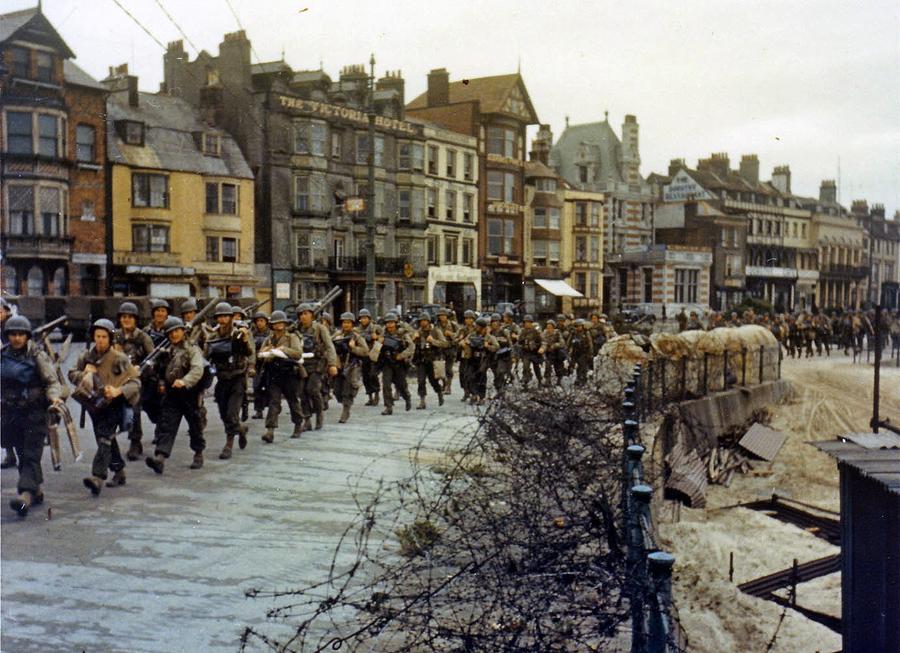
Image result for world war two photos of us soldiers marching to the docks before d day

I was born in 1938, and have always been fascinated by what was happening in the world at that point in time when I was conceived and born, because the atmosphere and events of those times would have had huge and unknown emotional pressures on the people who bore me.

My father was an army reservist and had been re-called to the army by the time I was ten months. He didn’t return home until I was nearly nine, and when he did, came with a new step-mother. It was like being adopted by strange people who didn’t know me. My own mother had disappeared when I was six.

And in that time of first emerging into this world –  my world, and the world of everyone else – was convulsed by war. That world was on fire and I didn’t know it. Battles raged in the sky overhead, warships ranged the sea a few miles away, the country-side and the towns prepared for siege. And I didn’t know it.

So I have tried to track what was happening when I lived in this world, but was unconscious of it, and have read so many diaries which tell me far more than official histories…  I’ve read the inner stories of housewives and politicians, pacifists and generals, and have a shelf of books telling how it was for those who lived through the mayhem.

I’ve just finished reading the diaries of Sir Alec Cadogan, who was Permanent Under-Secretary at the Foreign Office from the last two years of Appeasement, and then during, and after the war. I learned so much from him that isn’t in the history books.  I’d first come across him, when Churchill was wrestling with Stalin over the Russian plans for that tragic country, Poland. His advice, based on the fact that Britain had gone to war to defend Poland, put the moral viewpoint un-erringly.

And the tragedy was that Britain was in no position to risk a third world war by defying Stalin, supported as Stalin was at that time, by Roosevelt. The Free Poles had been based in London throughout the war, and Churchill, Eden, Cadogan and company had had to placate, comfort, and put up with – what I hadn’t realised until reading Cadogan’s diary – the Poles, nagging away all the time, plus fending off the aggressive resident Russians at the Russian Embassy.

The British were also juggling de Gaulle and the internecine rivalries of the resident Free French, plus the touchy Dutch, the slippery Turks, trying to keep them neutral, the belligerent Yugoslavs, the Americans and their suspicions of the English, as well as of de Gaulle, (Roosevelt and his advisers preferred the Vichy government),  the Spanish and problems over them supplying the Germans with wolfram, the Portuguese and negotiations to use the Azores, and the Greeks and their Communists, to mention only a few of Cadogan’s continuing diplomatic challenges. And then there were all the floating kings and queens who had fled Europe, been deposed, or abdicated. London must have been a fascinating place to be then.

Reading of the sixteen hours a day spent in cabinet meetings and conferences, puzzling over how best to handle Hitler during the last period of Appeasement was a revelation to me. Appeasement has been seen as so shameful, but as Cadogan kept advising his political masters, they just didn’t have the military muscle to do anything But negotiate. While they had only ten out of fifteen battleships with the other five in dry dock, the navy was impotent, as was the non-existent air force, and the tiny ill-equipped army, still managing on World War One weapons. On the other hand, Germany, after breaking the Versailles agreements, had built up a modern army and air force equipped with the latest weapons.

To read the endless agonising over the exact words of a telegram to Hitler, trying to gauge the impact of each word, whether it would conciliate, offend, alienate, deter, appease, buy time to re-arm, while at the same time juggling with Roosevelt’s imperious interference, even though at the time he had no intention of becoming involved, left me awed and admiring at the brilliance, industry, patience, and implacable integrity of Cadogan.

He was a direct descendant of the first Earl Cadogan who had been the principal Staff Officer and Director of Intelligence in ten campaigns for the Duke of Marlborough, Churchill’s famous ancestor. On the eve of a battle in Flanders in 1702, Marlborough reconnoitred the positions. He threw down his glove, and harshly told Cadogan to pick it up, which he did. That night, when Marlborough said he wanted the main battery set up at the place where he dropped his glove, Cadogan was able to say that it was already in place. His intuition was so finely tuned to his chief, that he had understood immediately the purpose of the supposed insult.

On 13 June 1940, Churchill took his Cadogan with him to Tours when he flew over to try to stiffen the collapsing French Government.  Seeing them together as “they listened to the agonising tale at Tours”, Sir Edward Spears, who was interpreting, wrote: “ here were the descendants of the two great leaders, brought together as their forebears had been by virtue of the services their Houses have rendered, generation after generation, to the country…. I thought how fortunate England has been to be served through the centuries by such men, and by others imbued with the same transcendent loyalty, though bearing lesser names… at that moment… the old story of the Flanders battlefield… flashed in my mind… as I watched the two men in that small room at Tours.”

It was Cadogan who framed the formulae at Dumbarton Oaks which became the basis of the UN Charter. And at San Franscisco, Cadogan, who was the permanent British representative, despaired over the obstructions of the Russians. I particularly enjoyed the story of the UN being broadcast all around America, and as a particularly verbose bore got up to speak, Cadogan could be heard groaning to himself in his clipped English tones, “Oh God!”

I finished the book last night, and regretted doing so. I read it slowly over about three weeks, all seven hundred pages or more. He would go down to Kew Gardens in London like we used to do, to see the magnolias out, or the bluebells, or the autumn trees. He never failed to notice the first crocuses of spring, and watched with approval the progress of the tulips and the wall flowers in the gardens as he paced through Green Park and St James on his way to his office in Whitehall. His idea of relaxation at the end of a tough week, if he wasn’t painting, was to dig over a garden bed, and plant it. This book was a good two dollars- worth from Trademe, and worth ten times the price.

More than any of the books I’ve read as I’ve tried to piece together the world as it was when I entered it, this one filled in many blanks and felt like a logbook of human experience. And more than that, while I was reading it, it gave me the experience of living with someone of the utmost integrity and unself-conscious goodness. In a world still convulsed with problems of an immensity that mankind seems to feel powerless to solve, goodness is precious and inspiring.

Fifteen-year-old Anne Frank, who was destroyed by the world I grew into, wrote these indestructible words back then: ‘In spite of everything I still believe that people are really good at heart. I simply can’t build up my hopes on a foundation consisting of confusion, misery, and death. I see the world gradually being turned into a wilderness, I hear the ever- approaching thunder, which will destroy us too, I can feel the sufferings of millions and yet, if I look up into the heavens, I think that it will all come right, that this cruelty too will end, and that peace and tranquillity will return again.’

This is the sort of goodness and optimism that we needed then and we still need now too.

The picture is of US troops marching to the docks to embark for D-Day… It looks like Weymouth where I spent the war years.

Food for threadbare gourmets

I want to eat masses of vegetables at the moment, and cook meals consisting of nothing else some days… wilted greens, a mix of broccolini, spinach, grated or sliced courgettes or asparagus lightly steamed, is one of my favourite combinations at the moment, and is good with meat or eaten on its own. Lightly cook the broccolini and asparagus, gently fry the courgettes in a little butter and then add the torn spinach leaves. When all these vegetables are lightly cooked, toss them together in a little dijon mustard. In a separate bowl mix together a table spoon of horseradish sauce, quarter of a cup of sour cream, and a few table spoons of cream, pour over the vegetables and boil up quickly. I sometimes slice cooked new potatoes into this mix too, and it’s satisfying and filling. It’s good with grilled chicken.

Food for thought

We are each made for goodness, love and compassion. Our lives are transformed as much as the world when we live these truths.

Archbishop Edmund Tutu


29 Comments

Filed under army, books, british soldiers, cookery/recipes, history, life and death, military history, Thoughts on writing and life, uncategorised, Uncategorized, world war two

A composer, a journalist and an activist

Image result for welles hangen


A composer, a journalist and an activist.  One of the great boons of technology is the ability to find about people I’m curious about, have known in the past, or want to know about now!.

I was looking up on Google to find out more about the Polish priest, Jerzy Popieluszko, hideously martyred during the struggle for Solidarity in Poland. In the text I found the name of Andrzej Panufnik, who had written a piece of music commemorating Popieluszko, so I followed this up, discovering that he was a much more interesting person than the  rather weary, elegant, middle-aged composer I had met on Christmas evening at Twickenham Vicarage, my in-law’s house, back in 1964.

He had refused a Christmas mince pie then, thinking that we crude Anglo-Saxons were eating beef mince pies, after all the previous Christmas feasting earlier in the day. I felt he had not been entirely convinced even after having it explained in very simple English.” Too much food, too much food”, he kept murmuring.  (My problem on meeting him was that I was young, unhappy, ignorant and probably crass).

His life, surviving in war-time Warsaw, composing and playing music at cafes – the only way Poles could hear live music since the Germans had forbidden public meetings – and then escaping with his mother just before the Warsaw Uprising, sounded harrowing in the extreme. When he returned to bury his brother and collect his music manuscripts, he found they had all been destroyed, including his ‘Songs for the Underground Resistance’. It got worse. Under Communism, he was required to reflect in his music ‘the realities of socialist life’, and even his symphonies for peace were considered politically unsafe, while his links with other great, but suspect composers, like Shostakovich and Khatchaturian in Russia, were also unhelpful. He was criticised for ‘Formalism’!

In the end he managed to defect. Visiting Switzerland in 1954 to conduct a specially arranged concert, organised so that he could defect, he ended up in a chase in a Zurich taxi, escaping from the pursuing Polish Secret Police.  Reaching England, he was supported by other sympathetic composers, including Vaughan Williams, until he established himself. At the same time he was declared a traitor and a non-person by the Communists after his much-publicised flight from Poland.

Eventually he married his second wife, Camilla, an heiress, photographer, and efficient organiser, who lived in a beautiful old house on the banks of the Thames, near my in-laws. From then on he pursued a tranquil and distinguished career, composing and conducting, and was knighted by the Queen. Yehudi Menuhin commissioned a violin concerto from him and Rostropovich, a cello concerto. Compositions streamed out of him, including a ‘Paean” written for the Queen Mother’s eightieth birthday. England, happy marriage, prosperity and professional success, must have seemed like heaven after the perils and dangers of Poland, during and after the war. His obituaries described him as one of the most ‘potent voices in music in the twentieth century’.

Still playing on Google, I found Welles Hangen, head of the NBC Bureau in Hong Kong when I was there. He had disappeared in Cambodia in 1970. I had lost touch with Pat, his wife, one of my close friends when I first came here. I felt she had no energy for anything but the search for Welles. I had spent the last day in Hong Kong with her, the children playing together for the last time. She gave me some delicate dark green jade earrings, with a gold setting in Chinese characters meaning happiness and good fortune, to take with me on my terrifying expedition into the unknown – New Zealand. Welles had given them to her.

In the stories about Welles on Google, I found an account of the Christmas party I went to in their palatial white house with walls of windows, looking down over the harbour from the Peak. A woman who was a war-correspondent, just arrived in Vietnam, had written it. Her description of the fabled party was totally unlike my perception of it. I saw no glamorous Chinese courtesans in exotic cheongsams, circling the room looking for “foreign devils” to subsidise them, nor even any CIA agents, or any other conspirators.

I just saw a sea of middle-aged Yankees – many of whose stout, slightly boring wives I had met at the American Women’s Association lunches, talks and fairs that Pat always took me to. And I was stuck at one of the little round tables with a handful of them, eating dinner with a group of people talking their own private language of acquaintances and domestic doings, which I could hardly hear anyway, above the din of conversation all round. I left early.

When I arrived, wearing an Edwardian-style turquoise crepe blouse, and a quilted silk, darker turquoise ankle-length skirt, my long dark hair piled up into a Japanese geisha chignon, I climbed the steps to the terrace behind Robert Elegant, the English writer and correspondent and his wife, who had had a reputation as a beauty. Welles greeted them at the top of the steps, and then turned to me, took my hands in his, and paid me a glowing compliment. Mrs Elegant swung round and glared at me. For the first time I understood the chagrin of growing older, when I saw it written in her face.

The next morning, party over, Welles left at five am to return to the chaos in Cambodia. Pat, their adopted children, a son, four year old Dana, and Claire, the plump little blue- eyed blonde toddler they’d brought back from the States the previous year, celebrated Christmas without him. A few weeks later, Pat showed me the elegant writing desk she had had designed by an architect, to give to Welles for his 40th birthday when he returned. It was waiting in his study, standing on one of the oriental rugs he’d brought home, literally loaded over his shoulders, when they lived in the Middle East. The desk was simply two elegant rosewood trestles and a sheet of black glass suspended over them.

Welles never saw it. The last news Pat had of him was that he and his camera-man had been captured. She went into a frenzy of effort, ringing and writing, and answering the phones endlessly, and even – in this night-mare – collaborating with “the underground”. Actually, Quakers, who were equipping a ship with medical supplies to sail to the stricken North Vietnam. Previously scornful of pacifists, now, if helping the enemy would help Welles, Pat would help them. She bought up stocks of bandages, quinine, and everything else she thought could be useful from all the chemists in Hong Kong, hoping that somehow a good deed to the North Vietnamese would ricochet into better treatment for Welles, wherever he was.

Later, and shortly after I arrived in New Zealand, I had a dream of Welles. He came to me and asked me to tell Pat that he was alive, but that he was also dead. He was very insistent that I let her know this, so she would stop waiting for him. But in the cold light of morning I didn’t dare write such a letter to Pat, to rob her of the hope which was her equilibrium. Hope was what was keeping her going, and capable of continuing to mother the children, a role which never came easily to her, much as she loved them.

She was the most unhandy and clueless mother I ever knew. She had collected Dana from the New York orphanage the night of the huge power black-out in New York, and had been stuck in a strange unlit house with a hungry crying baby she didn’t even know how to feed. She was in her forties, and had a busy life, so Dana, and then Claire, spent much time with a rather bored, unprepossessing Chinese amah. Which was why Pat loved my children coming to play with hers. I always felt I had let Welles down by not doing as he asked.

I learned from Google that Pat and the children stayed on in Hong Kong for another two and a half years, before returning to family in San Francisco. And there too, was the story of Welles’s end, and the discovery of his remains, in 1993, when the Americans were finally allowed back into Cambodia to investigate, twenty-three years after his disappearance. According to a local peasant, Welles and the others had been captured by the Viet Cong and Khymer Rouge, taken to a hut, kept for a few days, then marched to the riverbed and beaten to death.

Investigations revealed the four bodies, which were identified, and then Pat attended a ceremony at Arlington National Cemetery, where Welles’ ashes were interred. Two years later Pat was laid to rest beside him. Earlier, at Arlington Cemetery, she had said she would have preferred to go on hoping, but at least now she had finality.

And then there was Cheryl. I didn’t need to google her, she was a friend and  back from her world-wide conference in Melbourne. She told me of a woman from a remote community in the Arctic Circle. The woman lives in a village of two-hundred-and- seventy-eight souls, and they depend on fish and caribou for their food. The fish, they know are now contaminated by the poisons we flush into the world’s oceans. So this year, conscious of dwindling fish stocks world-wide, and in the interests of responsible conservation, they agreed to limit themselves to catching two-hundred-and-twenty fish this season. They caught eight.

And because the summer had been so warm, the snow had melted on the caribou’s feeding grounds. When winter came the tundra froze over, and the caribou cannot break through the ice with their hooves to get to their food below the surface. So the caribou were starving.

Cheryl is an interesting person. I know she is highly distinguished, and even has a papal knighthood, but when she talked of her Journey at a meeting of souls, I couldn’t fathom where this exceptionality was hidden in her. But the more I have met her, the more I see what deep wisdom she has. She must have – she understands the concepts I’m talking of, when no-one else does!!! At each encounter, she says something that illuminates, and I think about it for days.

This time, after her story about the Inuit village, we were talking of summer, and how we have both planted queen of the night for its scent. She mentioned how she listens for that moment during each day, when the rasping of the cicadas turns into the clicking of the crickets. I was fascinated, and realised that I had never even thought about it. I shall now. And I shall listen. Among many of her activities, she seeks out and shows films about the planet and global warming to her community, and has started a local chapter of the Red Hat Society (that is a story in itself))

These are some of the rare people I treasure having encountered, or having loved in my life… yes, there are so many more, because every person is so unique – a uniqueness that shines through in every blog I read. So vive all our differences and specialness and uniqueness… there is no-one else like us and never will be – everyone who reads these words is not just unusual but a one-off – what a thought!

Food for threadbare gourmets

I needed a quick, quick meal – we were starving. Chopped mushrooms and chopped bacon quickly fried. At the same time a packet each of instant noodles was soaking in boiling water. Salt, pepper and some cream tipped into the mushroom mixture and boiled up to reduce slightly. Noodles drained, mixture tipped over, and a sprinkling of grated parmesan from the deep freeze. Supper ready in five minutes!

Food for thought

Those who do not have power over the story that dominates their lives, power to re-tell it, to re-think it, deconstruct it, joke about it, and change it as times change, truly are powerless, because they cannot think new thoughts.      Salman Rushdie, novelist.


12 Comments

Filed under bloggers, cookery/recipes, culture, history, human potential, life and death, technology, Thoughts on writing and life, uncategorised, Uncategorized

The present needs the past

100_0624

I began sorting through drawer loads of recipes collected since the early sixties. I’ve dragged them around more twenty- six homes and three countries, and frequently can’t find the one I want; and though I try to keep my favourites altogether, they still stray into other collections of ‘intending to try’, and ‘must try’. After hours spent sorting them into piles, and several rubbish bags filled with the unwanted trimmings of yellowing newsprint and magazine borders, I realised that this truly was what is called a back-breaking job. I hadn’t even handled a quarter of the clippings.

Method: sort through the whole lot, putting them into cake, pudding, pasta, rice, chicken, fish piles, soups, salads, suppers, savouries, sauces and so on. Then sort the piles, throw out the duplicates, and trim yet again, to fit into scrapbooks, and stick them in. The cake book was huge, almond, fruit, lemon, plum, rhubarb, apple, madeira, chocolate, coffee, the whole nine yards. It has taken me days to get this far.

The interesting thing is that I recognise most of the recipes, know where we were living then, and even remember with many of them, how and when I tore or cut them out, right back to 1964, when we were living in a country house called  Newney Hall in the hidden country-side of Essex.

I can remember many of the dinner parties and the people who were there and the menus. Crocenbouche in the height of a Hongkong summer, with no air-conditioning in the kitchen, dripping with sweat, as I baked choux pastry balls, whipped up cream with cointreau, and made the caramel to dribble over the pyramid of puff pastry balls. Biskotten torte, a Danish coffee and walnut confection which could be made a week beforehand, given to me when I was engaged, by my stepmother’s best friend, staying with them in Shrewsbury; vol-au-vent, one of my father’s favourites, and mint and orange salad, a Robert Carrier special from the then new Sunday Times colour supplement.

Then there were the handwritten ones, salmon slice from Jenny, fruit cake from some people who read my columns, and who delivered a cake personally – then a recipe which the children still hanker after – a vegetarian meat loaf, made principally from pea-nuts, garlic, carrots and herbs, this sent by a reader in Tauranga, after a column on vegetarianism – Marianne’s beetroot relish, Frances’s apple cake, Evelyn’s strawberry jam. So the whole exercise raked over old memories, stretching back for fifty years. Many of the favourites had greasy or jammy finger-marks all over them, splotches of grease, or wine-stains!

I now have three thick scrapbooks catalogued into easily discovered sections, and decorated with beautiful pictures of food, fruit or vegetables cut out from magazines, and when I need a new idea for a meal, I go to leaf through them, and find something to inspire me.

In another day and age, I would have bequeathed them to my daughter, and they would have become family heirlooms like the treasured notebooks in browning spidery hand-writing of previous generations. But alas, already, even I now go to the internet for a quick fix on how to cook asparagus in the micro wave, and when I asked my daughter for a recipe for hot cheese scones we’d had for lunch, she sent me the internet reference.

I have shelves of cookbooks I used to love reading, but which I rarely ever open these days… apart from Elizabeth Luard’s book on family life which includes a number of my favourite recipes, and I can’t cut them out and ruin the book, so there they stay.

So it seems to me that my recipe scrapbooks are as obsolete as the family photograph albums. As with cookbooks, I have a shelf groaning with photograph albums. Not many from my early years, I have to admit – not much photographing went on in our family during the war, with my father overseas for seven years at the war, and my mother gone. But some from schooldays as a teenager, a precious few of previous generations – when taking a photo was serious stuff – and dozens and dozens of pictures of my children and grand- children. They and I used to pore over them when they were little, and reminisce about their childhoods. Maybe one day they would have been interested, not just in the records of their childhoods, but in the older family photos too, the records as it were, of their ancestors.

But it’s been many years since I received any up to date physical photos of my family to insert into an album. Lots yes, on the internet, but will they still be there in twenty years? Will this generation and succeeding ones have any of the family records that we, and previous generations have had since the camera was invented by Frenchman Louis Daguerre in1838 and Englishman William Fox- Talbot in 1839? Even before then, portraits, miniatures, sketches, silhouettes provided some family records.

But today, we seem to have lost something precious, something perhaps that we only appreciate as we get older. Young people are too busy taking their selfies, and posting on Facebook and all the other social media outlets to realise that the impermanence of this new technology has its drawbacks.

Then, I think to myself, is it just me that sees it this way? And then another inner voice stoutly proclaims that honouring the past, recognising the lives and achievements of our ancestors matters; knowing where we come from gives us a standard to live by, a knowledge that our forbears have faced and overcome great challenges in their lives, and therefore, so can we.

Even the trivial recognitions as we peer at good-looking Great-Aunt Jessie and recognise our nose, our eyes, and realise that we are part of a long chain of lives and family, gives us a sense of rootedness, and a feeling of permanence. Seeing faded pictures of poor Great – Uncle Arthur and remembering that he died on HMS Vanguard which un-explainedly exploded in Scapa Flow in 1917 taking him and another 799 sailors to the bottom, puts us in touch with history; learning about valiant Great-Aunt Violet who overcame childhood polio, lived with painful irons on her legs all her life with no complaint, and brought up a happy family, can inspire us to believe that we too have profound inner strengths with which to face the challenges of our own lives.

So yes, in some ways, as I look at my proud achievement of those gathered recipes into thick scrapbooks, I feel sad, as they symbolize so many other facets of life absent in this brave new world of convenience and technology. And yes, I know too, that there is no turning back, so that like my ancestors I must make the best of it, suspecting that my descendants have no idea of what they might have lost!

As wave is driven by wave
And each, pursued, pursues the wave ahead,
So time flies on and follows, flies, and follows,
Always, for ever and new. What was before
Is left behind; what never was is now;
And every passing moment is renewed.”
Ovid wrote this sometime before the birth of Christ… he also wrote that everything changes and nothing perishes – his words are my conundrum, my lesson and my answer.


Food for threadbare gourmets

My daughter gave me delicious hot cheese and bacon scones when I dropped in at lunch time. “Only three ingredients,” she boasted, “apart from the bacon which I added”.  I couldn’t wait to try them myself! Annabel Langbein, a NZ  cookery writer invented them: two  and a half cups of SR flour, two and a half cups  of grated cheddar cheese, and two cups of Greek yogurt, plus salt and pepper. Mix them all together, drop spoon-fuls onto a greased tray, and cook in a moderate oven for ten to fifteen minutes. Mine took a bit longer than the stated time to cook because I simply put the whole lot on the tray in one piece and cut it into triangular segments. But they were good. Next time I’ll add some chopped cooked bacon, and might add some Parmesan too.

PS I experimented with last week’s recipe for broad beans etc, and found that by leaving out the garlic, and using nutmeg instead, it was subtler and to my taste, more delicious…

Food for thought

The more faithfully you listen to the voice within you, the better you will hear what is happening outside. And only she who listens can speak.

Dag Hammarskjold Swedish Secretary-General of the UN for eight years. He died in a mysterious plane crash in Africa in 1961 at the age of forty-seven, and JFK described him as one of the greatest statesmen of our time.


35 Comments

Filed under cookery/recipes, family, history, life and death, life/style, The Sound of Water, Thoughts on writing and life, uncategorised, Uncategorized, world war one, world war two

All people great and small

 dresser
 He wrote to a ninety-one- year old woman begging to be allowed to be a footman in her household, even if it was just for a day. Her secretary wrote back to the young Fijian and said yes, this could be arranged.

So a few weeks later, when the Queen entered a state room to meet an assortment of ambassadors, governors and other Very Important People, the young Fijian was in attendance, resplendent in his Royal household footman’s uniform. She saw him straight away and ignoring all the Very Important People waiting to exchange a few pallid jokes and platitudes with her, she walked straight across the room to talk to her newest recruit. The guests probably assumed he was an even more important person then they were….

I love such little vignettes which give an unexpected insight into character. On this occasion, the Queen’s humanity would have meant an unforgettable experience for the young man from the Commonwealth and the other side of the world.

I think of the story I read in a blog, when a South African blogger I used to follow was taking her dying daughter for a specialist appointment. While they were waiting outside the lift, the daughter sitting in her wheelchair, the doors opened, and out stepped a tall African. On seeing the mother and daughter, he walked over to them, and bent down and had a few gentle words with the dying woman, before smiling at her mother and continuing on his way… another act of kindness and connectedness – from Nelson Mandela who could well have just continued on his busy way.

I loved reading about Albert Schweitzer, the famous doctor, musician and founder of the hospital at Lambarene in Africa, standing on a train platform in the US where he had been invited. One minute the old man was talking to his group, the next, he was nowhere to be seen. And then someone saw him down at the end of the platform, carrying the suitcases of an old woman, helping her onto the train.

The Queen’s mother was famous for these sort of spontaneous kindly deeds, though one of my favourite stories was of her as a young woman… she had a sweet tooth even then and was happily chewing a caramel as she drove through Liverpool… she caught the eye of a young policeman, and tossed him a caramel, which he caught! Did he chew it too, or keep it in a glass cabinet as an unlikely relic?

A shopkeeper whose shop was on her route to Cheltenham races once wrote to her to say he would like to present her with a bunch of flowers when she drove past on her annual visit. She replied, and for the next eighteen years, until she stopped attending the race meeting, she stopped to talk to him on her way. By then, a crowd was always waiting too, and she never failed to stop and chat with her faithful admirer.

Her grandson’s wife, Diana, not one of her favourites, also had this gift. Few people know of the time when she was visiting this country as a twenty-one -year old. She came out of a reception in Wellington, the country’s capital, and a noisy group of IRA sympathisers was waiting for her with hostile banners and angry shouts. Gathering her courage so as not to disappoint the other people who were waiting to see her, this brave young woman walked over to them, and ignoring the heckling of the Irish, talked to the others. That took real character.

And later, in Auckland, she came out of a banquet late at night, and seeing a little girl standing in a knot of spectators, crossed the road in the pouring rain, red shoes and white tulle dress getting soaked, and bent down to talk to her and take the posy being offered.

General de Gaulle has never been one of my favourite people. Hating the British who sheltered him, gave him offices, staff, aeroplanes, money to support him throughout the war, he could rudely say to Mr and Mrs Churchill while lunching with them at Number 10, and discussing how to handle the French fleet in North Africa, he said it would give the French great satisfaction to turn their guns  onto the British. This, of course, was the man who was able to write a history of the French Army without ever mentioning Waterloo.

But many years later, sitting next to Churchill’s youngest daughter Mary, when she was the wife of the British ambassador, he asked how she passed her time. She blurted out, ‘walking my dog’, and was deeply touched that he spent the rest of the lunch discussing the best places to do this. Even de Gaulle had a heart! He showed it again, writing a tender and touching letter to Lady Churchill on the first anniversary of Churchill’s death.

And talking of animals James Herriott the Yorkshire vet who wrote the popular series ‘All Creatures Great and Small’, was the vet to some of my closest friends. He lived up to his reputation. Anthony told me that when they first moved to Yorkshire and signed up with Herriott, then just an unknown country vet, their cat seemed unwell. It was Sunday but they rang their vet anyway. Herriott was enjoying Sunday drinks before lunch at a friend’s home, but he dropped everything and came to the house to treat Anthony’s cat.

These are not great acts of heroism, but little random acts of goodness, kindness or humanity, spontaneous responses in circumstances where pomp and ceremony were often the order of the day… and that’s why they are so revealing… they demonstrate character and connectedness. And there are many people who are not public figures who also respond to everyday situations with spontaneity and kindness, and we never hear of them… let us now praise famous men, as the psalmist wrote… and some there be which have no memorial.

When I listed all the beautiful gifts a friend had given me over the years, and all her acts of kindness and imagination towards me, my love said why don’t you write and tell her. I said I have and I do…. But I made a mental note to tell all my other friends too, how much their friendship and love have meant to me over many years.

I thought about all the wonderful things people tell about their loved ones at their funerals. I always hope the spirits of the dead may be hovering to hear these words of love and appreciation. But how much more they would have enjoyed these tributes during their lifetimes. So one of my resolutions for the rest of my life-time is to make sure those I know and love also Know how much they are loved and valued… not just for their deeds or gifts but for the essence of who they are. Seeing a person’s essence is to recognise their soul. There can be nothing more satisfying than to know you have been Seen, that you have been recognised for who you are, and that who you are is precious, beautiful and utterly loveable.

This is a priceless gift which should be the birthright of every child, and this is my daily prayer: that the parents of all children may see and love the essence of each child, so they grow up undiminished by self- doubt. Then they can feel, and are, whole and happy and loving themselves. A world of loving souls would be a world without fear, and a world of peace, the sort of world we all long for – where peace and goodwill to all men would obliterate the divisions of race, religion and other limiting ideas which separate and divide us. For, as Thich Nhat Hahn says: ‘We are here to awaken from the illusion of separateness.’


Food for threadbare gourmets

The picture is my kitchen dresser groaning with summer produce. We’ve had lots of fresh asparagus this spring, but I had reached satiety with asparagus with melted butter, asparagus with vinaigrette dressing, and asparagus with a complicated Japanese dressing. So when I was the grateful recipient of a harvest of fresh broad beans from my daughter-in law’s garden, I decided to try something else. This is it!.

Wrap enough asparagus stalks for two in a sheet of kitchen paper, putting the join underneath so it doesn’t blow open. Sprinkle the paper with water, and cook the asparagus for just over a minute in the micro-wave. At the same time, chop and fry in a little butter a small piece of good thick ham, then pour in cream, a capful of brandy, a couple of chopped garlic cloves, (I used chopped garlic from a jar!) and half a teaspoon of Dijon mustard. Boil it all up until it thickens.

Blanch the broad beans -enough for two. Cook in boiling water until tender – I used small fresh ones, so didn’t need to pop then out of their outer skin. Then cut the asparagus stalks in two, and add them and the broad beans to the ham and cream mix. Eat with good bread to mop up the delicious juices – and I had a glass of champagne too, to enhance the feeling of well-being!

Food for thought

Until he extends his circle of compassion to include all living things, man will not himself find peace.  Albert Schweitzer


‘.


27 Comments

Filed under cookery/recipes, human potential, kindness intelligence, life and death, life/style, love, princess diana, Queen Elizabeth, The Sound of Water, Thoughts on writing and life, uncategorised, Uncategorized

Chickens coming home to roost

Nobel prize-winner Malala Yousafzai

I’ve wondered why I’ve been so fascinated by it. I normally never read the news, especially salacious negative or destructive items, but I’ve been rivetted to the Harvey Weinstein story.

As I finished the washing up after lunch today, I realised why, and what I’ve been trying not to remember… all those times it was happening every day and as part of life when I was growing up.

I thought of the maths teacher when I was fourteen. When I started this school, my new friends warned me that when he called me out to his desk to go over some maths problem, he would run his hand up under my gym slip, and massage my thigh. Whether the massaging was more than that and my friends couldn’t bring themselves to say, I don’t know, because I was a very immature, slow developer, and he never tried it on me.

I remembered joining the army when I was eighteen, and being measured for my uniform by the regimental tailor. Afterwards when we compared notes back in the barrack room, we all found we’d had the same experience of him feeling our breasts as he took our measurements.  And I thought of a night at cadet school a few months later, when eleven of us were sitting around late at night over a cup of hot chocolate, and we discovered that nine out of the eleven of us had had the experience of a man exposing his hairy genitals to us as a child.

The following year one of us who had been to a wedding in Scotland, was raped in the sleeper on the train back from Edinburgh.  Jo – as I’ll call her – a gentle sweet-natured girl, was so intimidated by the notice which said the fine was five pounds for pulling the emergency chain un-necessarily, that she didn’t dare reach over to pull it and save herself.

There were plenty of us who felt intimidated like that back in the fifties and sixties. When I worked on the South China Morning Post in Hongkong supporting my children on my meagre pay, the managers brought in a time and motion expert from the UK to assess whose job was necessary or financially worthwhile. The expert took a fancy to me, and I was over a barrel between trying to avoid him by fleeing the office and inventing interviews, and being seen conscientiously bending over my type-writer justifying my existence and my salary.

It became a joke on the women’s page that  he was always asking where I was, but it was no joke to me. Finally, I could avoid having dinner with this married man having a bit of fun while he was away from his family no longer, and at the end of the evening, feeling completely powerless, I ended up on the sofa at his flat. I escaped as he undid his zipper, and then had the anguish for weeks of wondering if, when he wrote his report, I would still have a job.

I’ve often wondered since why I didn’t just say no thank you when he pressed me to go up to his flat after dinner, replying:’ I have to get my children up for school in the morning, and get to the office on time!’ End of story. But I was too fearful then of men’s power as I battled for custody of my children, and struggled to keep my job.

Just as when the editor sent me to interview a friend of his a few weeks later, and the blonde handsome Swede behaved as though I was a call girl. Once again, as I escaped his clutches, I knew it was no use complaining to the editor about his influential friend… I would just have been a trouble maker, who couldn’t take it. I wasn’t just trying to get a job like the Hollywood stars I’ve been reading about, I was trying to keep a job which paid me half what a man was paid, in order to house and feed my children.

The choices are just as bad for so many women even now… there are Filipino maids all over the world putting up with all sorts of forms of exploitation and wicked treatment because their families are relying on the money they send home. I read that it is now illegal for men in India to rape their teenage or child wives. But how many child brides know their rights, and how many would dare to offend a strong powerful man who had total power over her life?

There are women and children both in Africa and England and everywhere in between, who endure the horrors of Sharia law, which often includes genital mutilation. There are states in a western country like the US where it’s legal for a husband to beat his wife, while both fundamental Muslims as well as fundamental Christians also claim this right. And many women stay in abusive relationships in order to protect their children and try to bring them up, while leaving a violent marriage simply isn’t a financial possibility for too many other women.

So-called honour killings – when a woman or a girl has been raped – means that in many Muslim countries, it is the woman who is punished for the crime – often with death by stoning or barbaric whipping. That old joke, a woman’s place is in the wrong, is no joke in those countries. Yazidi women raped by Isis, school girls captured by Boko Haram soldiers, women forced to hide behind, and under, curtains of black material invented by men to deny their uniqueness, are up against something much worse than the harassment of Hollywood actresses and their fear for their careers that we’ve been reading about.

Nobel peace prize-winner Malala Yousafzai was a school-girl when she was shot by Taliban in Pakistan for advocating education for women. Since then, she’s recovered from her dreadful wounds, though she’s lost the hearing in one ear. She went to England for medical treatment and to be educated safely away from the murderous men who wanted her dead, and now she’s just started her degree studies at Oxford. She has never given up her cause, and says: “I raise up my voice – not so I can shout but so that those without a voice can be heard…we cannot succeed when half of us are held back.”

There are unheard voices all over the world, and if this scandal about harassed actresses can remind us of those other unseen, unheard women, it will be a service to them all. Because I’m human it feels good to know that one bully is being held to account for his actions, but the other part of me wants to feel that something good  can also come out of this story of human frailty.

When truth is revealed it can be the catalyst for change. I hope this story is big news everywhere, so that people everywhere get the message that it’s not okay to misuse power and terrify or deprive women; that they learn that women do have the right to all the freedoms and goodness in the world that men enjoy too.  Let’s hope that this change of heart and mind can work its way into the consciousness of all men everywhere because of the public downfall of one powerful man.

Not into the consciousness of the many good men who do care about women, but into the hearts and minds of men whose cultures have taught them that it’s okay or even de rigeuer to oppress and suppress the feminine – whether it’s their wives or daughters or other women, or the feminine in their own natures.  The qualities of the feminine – gentleness, nurturing, empathy, creativity, are the things that most of us want in our homes and families, and societies, as well as the masculine qualities of strength and power. Balance, wholeness, the middle way, are what makes for health in people and in societies and honouring both sides of our natures is the way to this balance and goodness.

A tacky scandal in the western world of entertainment may seem trivial when set against the appalling suffering of so many silenced women all over the rest of the world. But good can come out of this saga of silence if it causes a change of heart and mind beyond the homes and habitats of Hollywood and its power brokers. I do so hope so.

Food for threadbare gourmets

Spring is coming to this end of the world and I feel like different food. With cold chicken the other day I used a favourite way with avocado. To half a cup each of chopped avocado and cucumber, use three quarters of a cup of cream, a quarter of a cup of lemon juice, one finely chopped onion, two cloves of chopped garlic, salt and black pepper, and put it all in a blender. Whizz until smooth. I love this with raw or cooked vegetables as well as with chicken, cold turkey or ham.

Food for thought

Feminism has never been about getting a job for one woman. It’s about making life more fair for women everywhere. It’s not about a piece of the existing pie; there are too many of us for that. It’s about baking a new pie.” Gloria Steinem


38 Comments

Filed under army, consciousness, cookery/recipes, culture, family, life/style, Thoughts on writing and life, uncategorised, Uncategorized, womens issues

Earth’s greatest treasure

Lot18again
In this place, I look up to the stars at night and there is nothing apart from the clouds to hide them from my gaze… the Milky Way seems an infinite cloud of light, the Southern Cross pointing as it has guided centuries of sailors, Orion’s Belt clear and bright.

I watch the moon from a fingernail of light right through to the fullness of it, and the delicious phase we call a gibbous moon. I see the sun move across the horizon with the months and then at the farthest point of winter, see it begin its journey back to the sunlit mountain behind which it sets in summer. We are halfway across as I write this and the sun sets behind ‘our mountain’.

Though we live here and bought the acres of forest we technically own, we have no sense of ownership… we are simply the fortunate tenants of this beautiful podocarp forest, teeming with species of tree and plant life.

Here are hidden species of frogs and lizards and fungi, almost extinct in the rest of the world, and rare butterflies are still seen here. Fungi in colours that are psychedelic, brilliant blue and purple and orange, green and red grow in the dense green canopy which shelters them from the brilliant New Zealand sun-shine.

Because it is spring, on distant vistas there are patches of white to be seen scrambling up to the tops of tall trees and the sun-light – the fragrant white clematis. It grows too, on some of the ancient trees surrounding our little home in the woods. The birds we feed are gathering as spring advances, and we hear the sound of the tuis bell-like call, the heavy flapping of the wood pigeon’s wings as they circle  our valley, the harsh call of the quails who visit us to enjoy the bird seed we dispense, and the soft hooting of the moreporks – the New Zealand owl – connecting with each other across the dark forest through the night. We watch the kingfisher perching on the branch where the moreporks also sit, and see him dive like lightning into the grass to grab a morsel of food – be it grasshopper or beetle.

Those tend to be the only sounds we hear, just occasionally the drone of a distant aircraft and the rushing water of our stream after heavy rain. We feel the wind on our faces, and hear it in the trees, we savour the soft spring rain filling our water tank, and keeping the forest moist and green.  We feel the springy ground beneath our feet, centuries of humus which have accumulated undisturbed.

We feel the mysterious life around us, knowing that beneath the surface the trees are connected and communicate with each other through their root systems; that the abundant life of bees and beetles, moths and grasshoppers, birds and tiny ancient species of reptile are part of a vital chain of life which has existed millennia before homo sapiens conquered the planet. We sit in the sun, and feel the warmth on our faces, and hold smooth sun-warmed stones, and feel a connectedness with the earth and with the natural life that many people who live amid concrete, steel and glass cities, can lose.

Technology has tamed the cold and the heat with air conditioning and central heating; we have tamed the seasons, with imported food bringing us fruit and vegetables from all over the globe, regardless of whether it’s summer or autumn or winter. We may even have become unconscious of the rhythm of our own bodies, of the way we once responded to the passing of the seasons and of the years, as our culture devotes itself to prolonging youthful bodies and a belief that we can conquer the ravages of age and the vagaries of climate – until a hurricane or earthquake shatter some of these illusions.

It seems to me that when we lose this sense of connection with the life which throbs around us, with the rhythms of the sun and the moon and the movements of the starry sky, and the dance of joy in a greater whole, we may lose something very precious… and that in the end, we may in Cardinal Newman’s words: ‘choke up all the avenues of the soul through which the light and breath of heaven may come to us.’

We know that we do not own these acres that we live on and look out across. We call it our mountain but we know that that is just our figure of speech. We are simply the present guardians of this patch of our precious planet. We’ve signed a covenant that we will not disturb the forest, cut down any trees, or despoil any part of it. We cherish its silent solitude, and share the seasons with it. Does this place know or feel how sacred, cherished and unpolluted it is, I wonder?

Robert Macfarlane writes in his wonderful book ‘The Wild Places’, that even on the beaches of the Isle of Skye in the remote north of Scotland, the beaches were littered with: “milk bottle crates, pitted cubical chunks of furniture foam cigarette butts, bottle caps, aerosol canisters…”

Here in this empty place we have escaped that blight of the so- called civilised world. Even the beaches on this remote peninsula are unsullied and unspoiled. We are the fortunate ones, I know, and my heart aches at the knowledge of the poisoned polluted oceans devoid of the teeming fish and life Thor Heyerdahl wrote of during the Kon Tiki Expedition, seventy years ago this year.

John Aspinall was a successful gambler, who, while stripping rich men of their money in London during the sixties and seventies, used his ill-gotten gains to establish two zoos, which are now famous for being animal refuges where he successfully bred species and returned them to the wild, a policy his son Damian is still pursuing (you can follow his work on Youtube)

Before he died, John Aspinall wrote his creed: “I believe in Jus Animalium, the Rights of Beasts, and Jus Herbarum, the Rights of Plants. The right to exist as they have always existed, to live and let live. I believe in the Buddhist concept of Ahimsa – justice for all animate things. I believe in the greatest happiness for the greatest number of species of fauna and flora that the Earth can sustain without resultant deterioration of habitat and depletion of natural resources.

“I believe in the sanctity of the life systems, not in the sanctity of human life alone. The concept of sanctity of human life is the most damaging sophism that philosophy has ever propagated – it has rooted well. Its corollary – a belief in the insanctity of species other than man – is the cause of that damage. The destruction of this idea is a prerequisite for survival.

“I believe that wilderness is Earth’s greatest treasure. Wilderness is the bank on which all cheques are drawn. I believe our debt to nature is total, our willingness to pay anything back on account, barely discernible. I believe that unless we recognise this debt and renegotiate it, we write our own epitaph.

“I believe that there is an outside chance to save the earth and most of its tenants. This outside chance must be grasped with gambler’s hands.

“I believe that terrible risks must be taken and terrible passions aroused before these ends can hope to be accomplished. If a system is facing extreme pressures, only extreme counter-pressures are relevant, let alone likely to prove effective.

“I believe that all who subscribe to these testaments must act now; stand up and be counted. What friends Nature has, Nature needs.”

In the twenty-first century, in the face of overpopulation, pollution and climate change, his words remind us of the urgency of the task. It still isn’t too late to stand up and be counted. And I feel that Lao Tzu’s words written two and a half thousand years ago, can still point the way for us all:

If there is to be peace in the world,
There must be peace in the nations.

If there is to be peace in the nations,
There must be peace in the cities.

If there is to be peace in the cities,
There must be peace between neighbours.

If there is to be peace between neighbours,
There must be peace in the home.

If there is to be peace in the home,
There must be peace in the heart.

The picture is our house in the forest


Food for threadbare gourmets

The cupboard was bare so imagination was needed. Pasta did the trick…  with a couple of rashers of bacon chopped and fried with sliced mushrooms while the pasta was cooking. I added cream to the bacon mix, boiled it up to thicken it, added a grated courgette, chopped parsley, a small dollop of mustard, and a sprinkling of nutmeg, salt and pepper. This mixture was poured over the cooked pasta, and then sprinkled with grated parmesan. It went down well !


47 Comments

Filed under birds, consciousness, cookery/recipes, environment, life/style, philosophy, pollution, technology, Thoughts on writing and life, uncategorised, Uncategorized