Tag Archives: environment

Little happinesses and big happiness


Image result for rowland hilder paintings


I love Autumn… I loved it in England, those early morning mists burnt off by the morning sun… the scents of bonfires and blackberries, picking hazel-nuts from the hedgerows, finding silky, shining conkers and kicking up the rustling leaves, crackling them under my shoes… freshly ploughed fields, and that sense of gentle melancholy, a poetic nostalgia for the last pale days of sunshine before winter crept in…

Later in Hongkong, the end of summer came quite suddenly overnight, when the light changed, and for a month or six weeks a light pervaded the harsh hectic city, and turned the island into a place of surpassing beauty.  I waited for those weeks every year. The gleaming days and shining waters of the harbour seemed rapturous for no particular reason, and those who noticed this magical transformation said the light was like the light of the Greek isles.

And now in the antipodes, autumn is the best season of the year – soft, golden days and crisp, starry nights.
We live in a covenanted podocarp forest of evergreen trees which stretches across high peaks and shadowed gorges. Some days we wake to find the sun shining on our mountain, and then see the gold light move down the slopes until the whole forest shines. Other mornings mist shrouds the peaks, and hovers in the valleys… last night the high wind blasted the last leaves of autumn from the trees along the roads, leaving just the fretted gold leaves of the gingko trees.

So today it feels as though autumn has passed, and winter is setting in. With deep pleasure, I get out the warm winter clothes, and start to think about winter food, hot and comforting, snug evenings with the curtains pulled, and warm sheets on the bed. These are ‘small happinesses’, a phrase my daughter introduced me to a few months ago.

This morning when I put the kettle on for my early morning cup of tea, the sun was on the mountain, a small happiness. Taking the tray back to bed, I checked my e-mails, gloating over the beauty of the latest photos sent from France by my daughter… yesterday Chartres, today Monet’s garden at Givernay, tomorrow Mont St Michel… Then I found a poem by Mark Nepo, sent by a dear friend, with phrases that gave me more small happinesses…

Each person is born with an unencumbered spot…

… an umbilical spot of grace… the last lines were: the incorruptible spot of grace resting at our core.

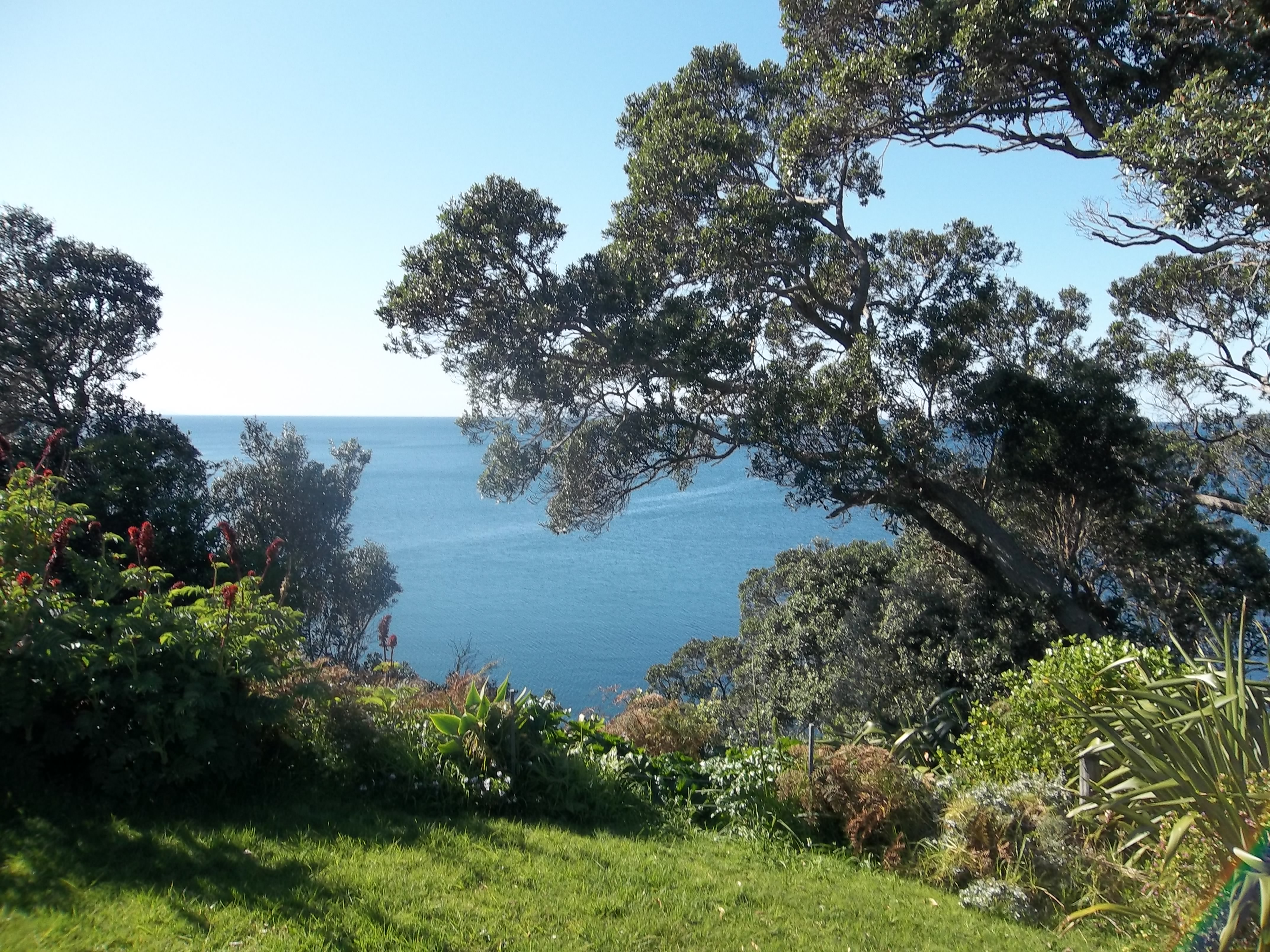
Holding these words in my mind, my love and I went shopping to a small town an hour and a quarter away. Every mile we travelled past weathered crags, misty mountains and green fields was beautiful. Finally, we reached the narrow coast road, where pohutakawa trees arched overhead, their roots clinging to the side of the cliff.

The wide silver stretch of still water, shimmering with light, lay alongside, and I watched birds dive for food in a small feeding frenzy, marvelled at the shag colony, where up in the pohutakawa trees, the big white breasted birds sat erect on their great nests concocted from twigs, while a gull flew overhead at 35 miles an hour. We passed the curving sandy bay black with hosts of black oyster catchers standing patiently on the shores of the estuary, white breasts and sharp, orange beaks facing the high tide, waiting for the water to recede and their food to return.

We did our shopping – small, kind, cheery encounters that are the building blocks of the goodness of life. A visit to the re-cycle centre yielded a satisfying bargain and a small happiness … two pretty pressed glass Victorian dishes for a dollar each, and then the building re-cycling yard had more treasures, including the perfect windows for our building project.

Feeling contented we relaxed in our favourite café, with hot chocolate and a blueberry muffin. We sat in the courtyard under the pollarded plane trees and watched a small flock of sparrows fall on each table as it emptied, diving into cake crumbs and pulling at a rasher of left-over bacon. A speckle- breasted thrush sat in an olive tree growing in a large pot, and pecked at the clusters of pale green olives. The sage green leaves were silhouetted against a rosy brick wall and the sinuous curves of branches and leaves looked like William Morris’s famous willow pattern.

I must keep a diary again, I exclaimed, I want to remember these moments of beauty. But writing this blog is the closest I get to it at the moment. This day was like all our days living in this remote place where we are the guardians of the forest, where species of plants and creatures that are almost extinct elsewhere, still live their tranquil lives hidden deep beneath the green canopy. I once said to my love that I knew people who were living quiet, mystical lives of love and beauty, and we agreed that we would make it happen for us.

Occasionally a note of discord strikes when a person who has other agendas intrudes into our peace, but since I take Don Miguel Ruiz’s Third Agreement seriously, and try never to take anything personally, our peace of mind is rarely perturbed. I also remember a meme which says: ‘negativity can only affect you if you’re on the same frequency – vibrate higher.’ So we try.

We forget to play music because the silence is so full of sound, the wind in the trees, the birdsong, the stream rushing down below. Living in this place, it’s easy to believe in that “incorruptible spot of grace” resting at our core. It’s easy to believe too, that the mystery of love and truth and beauty do still exist, in spite of what often seems like suffering and chaos in the outer world, but which, hidden from our limited understanding, may have a larger purpose. We only have to believe in love and truth and beauty, to see them – in people, in nature, in the universe, and in the deep silent mystery of the life unfolding around us.

So the roots of the trees in this forest grow deep in the earth, sustained by creatures of the dark, the snails, slugs, earthworms, flatworms and nematodes that degrade organic matter. The rain and the sun sustain them. Tiny frogs and rare lizards hide deep in their secret habitats, bees push into the flowers of the manukau trees, butterflies hover above the flowers, birds sing, the kingfisher plunges down into the grass for a morsel, morepork owls hoot across our valley in the moonlight, and nature continues to sustain them all, and the planet, and us too… what a big happiness!!!

PS   The picture is by Rowland Hilder who specialised in  painting nostalgic autumn and winter scenes.


Food for threadbare gourmets

I needed a pudding for a gluten- intolerant friend, so fell back on our tried and true chocolate mousse… just eggs, butter and good dark chocolate… though I can never resist tweaking the simple recipe.

So after separating the eggs, melt a knob of butter in a saucepan, and I add a table spoon of brandy or strong black coffee or even sherry, and break the chocolate in. For every egg, use six squares of plain chocolate, and a little bit more butter.

Stirring the mix until the chocolate melts, take it off the heat before it goes grainy. Whip the whites of eggs until peaks form, and at this stage I often add one or two tablespoons of icing sugar and whip again until stiff. Stir the yolks into the chocolate mixture, and then gently fold this into the egg whites. Pour the mix into small individual bowls, chill in the fridge for at least six hours, and serve with cream.

I gave this to my children often when we were vegetarian, as it was an easy way to make sure they had enough protein.


Food for thought

“The best and most beautiful things in this world cannot be seen or even heard, but must be felt with the heart.”

Helen Keller, who overcame the handicaps of being deaf, blind and dumb to gain a degree and live a life of service to others.


20 Comments

Filed under birds, consciousness, cookery/recipes, environment, great days, happiness, life/style, love, poetry, sustainability, The Sound of Water, Thoughts on writing and life, uncategorised, Uncategorized

Our beautiful world

The wind is blowing in the trees. It sounds like the sea. The sun is on the mountain. And outside the house, a pair of nesting quails are foraging among the bird seed that has spilled from the bird table.

When I step outside, I hear the sound of many wings… I have disturbed the green finches feeding, and their flight is like the sound of many muffled hands clapping.

This place is my new home, forty acres of forest, where our little wood cabin looks down a valley and up to a forest covered mountain. Where we hear the sound of our two streams meeting down below long before they join others to make the river. It flows beside the long winding road of blind u-shaped bends and gravel and often mud, which is the only way to reach us. When intrepid travellers finally reach the top of the forested mountain range, on this road famous for its degree of difficulty, and which only the brave or the ignorant attempt, they come to our big iron gates, and the elusive gate code, only available to those who are welcome.

We live several miles further on inside the gate, down a well-tended paved road, over-hung at this moment by the manukau trees frosted with scented white blossom  providing food for bees who make the healing manukau honey. We pass the steep hidden drives of the other occupants of this magic place, a forest which is covenanted and preserved for whatever the future holds for the planet.

There are about twenty-five of us, like-minded people who, on settling here, have agreed not to have  dogs or cats or introduce plants or trees which are not native to this place. So because this podocarp forest is covenanted, and these agreements are in place, the silence is never disturbed by the sound of a barking dog, and the only man-made sound is the distant hum of a car snaking slowly along the road.

And yet it is never silent. Tuis flute their glorious song during the day, the shining cuckoo sings its melody, while green finches cheep, and sometimes flights of red, blue, green and yellow rosellas come chattering by. A kingfisher, making his sharp repetitive call, sits on a dead branch a few yards away from the cabin, and dives into the long grass to snatch up in his sharp beak a grasshopper or other insect which his beady eyes have detected.

At night, a morepork – the New Zealand owl, so named because his call sounds like those words – perches on the same branch and hoots softly across the valley from where answering calls return. When birds are silent in the heat of the day, the all- pervasive buzzing of bees and flies and other insects fill the space, and then there is the glory of cricket and cicada each in their appointed time sending out their nostalgic rasping, warning us that summer does not last forever.

I listen to try to hear the moment when cricket takes over from cicada, but am never mindful enough. We have now watched the sun move across the horizon opposite for one whole year, and know that when it reaches the point of the ridge on midsummer’s day, it will begin once again to move inexorably back to the dip in the ridge halfway across the other side, towards the shortest darkest day. And we have watched the moon now for a whole year, as it rises in the sky to the side of the cabin, and then shines over the mountain and the trees, shedding gold light and mystery over the silent forest.

When it rains we gaze across the misty view which echoes a Chinese painting, and the beauty catches our breath. A myriad of different species of trees inhabit this unspoiled place, the different greens and shapes sprawling like a huge tapestry over the hills. When I gaze at them in the sunshine they  shine, almost as though they were lit up with the lights that stopped Xerxes, King of Kings in his tracks, when his great army rolled across the dusty plains of Asia. Transfixed by a mystical, shining sycamore tree he remained there for two days to the puzzlement of his soldiers.

And here, as the sun moves across the sky, shadows deepen the colours of towering trees, and reveal deep folds of green hills and gorges, and one mountain crowding another. Hidden deep beneath the canopy are rare and cherished species of trees and ferns and also exquisitely camouflaged frogs and lizards, moths and insects, one lizard so rare that only twelve others have been sighted in the rest of the world.

We had the privilege of seeing such a lizard when a neighbour found her with her tail gone and a blood-shot eye. She was rushed to the zoo several hours drive away, and there nurtured back to health. When healed a few weeks later, she was returned to her home grounds, and a group of residents gathered to inspect the precious creature – about four inches long – to witness her return to the wild. This shared concern makes a warm community hard to find anywhere else, particularly when that concern is cemented with good wine and cheese to fortify us before returning to our own native habitats!

We achieved brief fame on the estate when we discovered an Archey’s frog, another endangered species, down our drive. These finds are logged and we have to provide the time of day, the weather, the habitat and many other tiny details to enlarge the knowledge of environmentalists. Since then others have been found, and we realise that this place has become a haven for endangered species.

Are we an endangered species? Sometimes it feels like it. Knowing as we do that the world is changing, that climate change is a fact, whatever climate-deniers, big business and flat-earthers think, that ice caps are melting, our oceans depleted and polluted, that bees are dying from strange viruses and pesticides, and trying to get our heads around the fact that people are still killing the great animals which ensure our survival on the planet – the future of mankind seems as misty as our cloud covered hills.

There is something deeply awe-full and dread-full about the words ‘the Sixth Great Extinction’ which we are now living through according to scientists. So grasping at small straws of comfort can help us to come to terms with this extraordinary time in the history of the world. Living here in this precious piece of preserved forest and rare species has made us much more aware of other safe places and of so many other people dedicated to nurturing the planet.

So wonderful Bill Gates and the other billionaire philanthropists who are devoting huge sums of their money to work on long term alternative green energy sources make me feel hopeful. And I read today that Catholic priests have been instructed by the Vatican to preach about the environment, climate change and preserving the world. It’s what used to be called ‘spreading the word’.

It’s about each of us doing what we can, where we are. I have a friend who never goes anywhere without a plastic bag folded in her pocket. Whether on a walk on the beach with her, or on an overseas trip, staying in a rubbish strewn camp ground, she fills her bag. Single handed she can’t clear all the rubbish, but she does her bit.

Yes, on our own we cannot save our world, but like my friend we can all find ways, however small, of mitigating the damage. I know everyone who reads this blog is already committed to preserving life on earth, so I’m merely sharing one aspect of my new life, which is all about the environment. Tell you more next time!!!!

Food for Threadbare Gourmets

Having broken my leg badly six months ago and due to side effects still having difficulty walking, I’m actually listening to my doctor for once. She gave me a leaflet full of calcium – rich recipes, and one of them has transformed my idea of breakfast. It’s delicious as well as nutritious.

Leave quarter of a cup of oats soaking in quarter of a cup of hot water overnight if possible, but for at least four hours. Peel and grate an apple and mix into the oats with a tablespoon of lemon juice. Stir in two tablespoons of cream, quarter of a cup of natural sweetened yogurt and a tablespoon of honey – I use the healing manukau honey.

Fruit if desired… it’s a filling and satisfying breakfast, especially when topped off with a freshly brewed cup of lapsang souchong, the favourite drop of the cup that cheers but doth not in-ebriate !

And a PS… many months ago my computer collapsed, taking blog, addresses, etc, etc. Before I had a chance to rehabilitate myself and come to terms with a new computer and the dreaded Windows 10, disaster struck, and I disappeared into hospital for two and a half months. Still rusty trying to climb back on the computer deck, and still clambering  clumsily around trying to master the new technology . So please excuse any infelicities you detect!

Food for Thought

I don’t know who wrote this, but I like it:

dawdling,
not doubting,
intrepid all the way,
walk toward clarity
with keen eye,
With sharpened sword
clear cut the path
to the lucent surprise
of enlightenment.
At every crossroad
be prepared to bump into wonder

50 Comments

Filed under birds, bloggers, consciousness, cookery/recipes, environment, food, happiness, life/style, pollution, sustainability, Thoughts on writing and life, uncategorised, Uncategorized

That two -letter word

100_0503

Over the years I’ve worked hard to banish some words from my thoughts and vocabulary, words like must and mustn’t, ought to and oughtn’t, should and shouldn’t… learning to ignore the inner voice that has bullied me from childhood. I’ve also worked even harder to introduce a two letter word into my voice and into my life. That wonderful little word ‘no.

Granted I heard plenty of it as a child but it wasn’t a word I often used myself. Brought up to be a good girl and do as I was told, it would never have occurred to me to say ‘no’ to just about anything. And now, it’s a freeing experience to say no, and not follow it up with excuses and reasons why I’m not being ‘nice’ or ‘good’. I might sometimes add: ‘I don’t think so,’ to take away a little of the baldness of a straight’ no’. But there it is, a neat little addition to my tools for living, a power tool you could say.

But there’s another two- letter word that bothers me, that I try not to use, and which always bothers me too when I hear others using it. It’s when some- one refers to ‘My’ people,’ my’ church, ‘my party, ‘my god’, ‘my’ country…. I even used to object to the man in my life saying ‘my lawns’ or ‘my car’… ‘they’re the lawns, or it’s the car’, I’d say… and it was always the children, not ‘my’ children.

As soon as the word ‘my’ is uttered, those who are not mine, are other – different, on the other side. When someone says my country, my people, my party, they are implying loyalty to those groups, and loyalty often leads to division, hostility, and sometimes war, it seems to me. The great spiritual teacher Krishnamurti was once asked how we could stop wars. And he replied that we should not join anything – a political party, a religion, any group, implying that as soon as we are committed to a set of beliefs that commit us to sticking with them, defending that point of view closes our minds to other possibilities and ideas.

‘My’ country right or wrong used to have a fine ring to it… but now that we are a global village and after the shock of 9/11 which contributed to that understanding, we can’t afford to indulge in that mindless patriotism. We now know we are all so interlinked, that when Japan suffers an earthquake, a tsunami and a nuclear disaster, it affects the ocean, and thus the whole world. When Russia’ s nuclear meltdown at Chernobyl happened, it affected farmers and their sheep as far away as Wales, and poisoned the whole crop of camomile right across Europe for starters…. so it’s getting harder to just be a patriot, now that we are citizens of the world.

‘My people,’ whether it’s a Maori elder, or a Catholic priest speaking, refers only to those who can claim to be part of that tribe or religion. The implication always seems to be that the others are less, different, not worth as much as those who are ‘mine’. We only have to look at the despair in the Middle East to see what happens when we belong to a group or a country or a religion.

Israel feels comfortable oppressing people who are not Jewish, and now, like Muslims is discriminating against women, Sunni Muslims despise and exterminate Shia Muslims and vice versa… Kurds or Yazidis, Druze or Maronite, Christians or Ba’hai are in constant danger – whenever anyone belongs to a sect or nationality it exposes them to hate or oppression by those who belong to a different religion, creed or nationality. And I haven’t even mentioned different genders…

And ‘my’ is the word that breaks up families and small communities even in so called peaceful places. Disputes between neighbours over a right- of way which runs over ‘my land’, or the rows about fishing on ‘my river’, are so often caused by that little two- letter pronoun ‘my’, while the word ‘my’ in front of money is often the reason for not sharing with those who have none… and the excuse by giant corporations for exploiting both people and oceans, wildernesses, forests and rivers.

My dog, my children, my family… as soon as we use that description, so often it becomes the unspoken reason for not caring about other children, other dogs, all families.

I sometimes feel that ‘my’ is a word that blocks love… if we thought of our children, our dog, our world, our dying oceans, our disappearing elephants, perhaps we would be able to change our mind set and work with each other to save lives, share happiness, and even save our world from the sixth great extinction which scientists fear is imminent.

The Pope’s call to act to rescue our planet from impending disaster actually means giving up the word ‘my’ and beginning to think in terms of us and our. It could even mean giving up loyalty to deeply held beliefs, letting go our loyalties to race or colour or creed, and opening our hearts to other minds and other ideas. We might even discover that no-one is right, no-one is wrong, that we are all coming Buddhas, and that that little two -letter word ‘my’ was irrelevant. That would be a world on track towards a great leap in consciousness…’we are the world’…

Food for threadbare gourmets

This is the first recipe I shared in my first blog back in 2012. There may be readers who would like it now, so here it is, comfort food with just three ingredients – a simple potato hotpot:
Peel and slice some potatoes, chop some onions, and chop up some bacon – the more you can afford, the better. Make plenty of white sauce, using butter and if you add a little cream, all the better. Then layer the potatoes, onions and bacon in a casserole or oven-proof dish, finishing with a layer of potatoes.

Pour the white sauce over it, letting it seep down through the layers. Cook in a moderate oven for one and a half to two hours, testing to see the potatoes are soft. Eat with some green vegetables or a green salad. Cheap as, delicious, and filling.
Adding anything like cheese utterly spoils the taste… it’s one of those simple things that is perfect without any so-called improvements.

Food for thought

I allow myself to say ‘my’ birthday! A friend sent me this prayer for my birthday yesterday.
May I have the courage today
To live the life that I would love
to postpone my dream no longer
but to do at last what I came here for and waste my heart on fear no more !
John O’Donohue

46 Comments

Filed under consciousness, cookery/recipes, culture, environment, family

Can bloggers change the world?

100_0944

I’ve been in a situation for the last few weeks where I haven’t seen or read a newspaper, watched TV or listened to the radio.  The only newspaper I’ve seen is the hundred year old front page of The Auckland Star, a now defunct newspaper, and this page was a facsimile, framed, and hanging in odd places in our various homes over the years.

 It was dated 11 February 1913. Two thirds of the page was filled with the main story which had shocked the Empire (there was only one empire back then, and it was British!). The rest of the space was taken up with smaller items, an African revolt in Mozambique, quelled by the Portuguese, the terrible fighting between Serbs and Turks with high casualties, another item in which the Turkish commander of Adrianople on hearing of the proposed neutralisation of the fortress promised ” to take care to put the 40,000 Bulgarians who live here out of the way. I shall confide the women and children to the foreign consuls, turn the guns on all the Bulgarians and then convert Adrianople to a giant rubbish heap”.

 Beneath this was a story about the Turkish Red Cross addressing European sovereigns asking them to recall the law of Christ to stop Christian forces committing the most ghastly outrages and assassinations on Turks witnessed in Europe in modern times. Under this item was the English response to the Australian Cricket Association’s investigation into the behaviour of the team in England, followed by a report from Melbourne on the arrest of two Chinese involved in an enterprise with Hong Kong Chinese to smuggle ‘Chinese persons’ into the Commonwealth.

 A political crisis in Japan had provoked rioting which was put down by the army, and the English House of Lords debated compulsory physical training and elementary military skills to: “lay a foundation … on which a scheme of national defence could be based if unforeseen dangers menaced the country”. At the bottom of the page, an unforeseen menace, the Kaiser, was reported as having unexpectedly addressed the university centenary celebration, and “delivered a fiery panegyric upon German military virtues”.

 And Suffragettes had a smashing time in London, where they broke the windows of the Reform, Carlton, Junior Carlton, Oxford and Cambridge Clubs, and Prince Christian’s house ( what had he done?). “The missiles were of “lead and fireclay balls”.

 The only other news of women was the report of the Kaiser’s daughter’s betrothal to Prince Ernst of Cumberland. Nothing very different there. Serbs killing, refugees being driven from their homes and ‘confided to the care of foreign consuls’, cricketing misdemeanours, African riots, Japanese politics, boat people trying to get into Australia, suffragettes protesting, reports on princelings, are still the stuff of the news today. Substitute Syrians for Serbs, feminists for suffragettes, and it could just as easily be the front page of any newspaper today.

 What made this day in history different was the story which filled the rest of the page and which has grabbed the imagination of the world ever since – the story of a man who failed. First, he failed to achieve his objective, and then he failed to get back safely.

 The main headline reads: “Scott Party Perish”, followed by the next headline: “Five Who Made The Final Dash”, and then another headline: “Lost In A Blizzard.” And then another headline (they made the most of headlines in 1913): “After Reaching The South Pole”. Below, yet another headline: ” A World Wide Sensation”, followed at last by the main story, two sentences, the first saying they’d reached the South Pole on January 18, and perished in a blizzard, the second, listing the five who perished.

 And this story is the only clue to how things really have changed in the last hundred years, even though they may seem to look much the same.  Scott and his men would not have died now – they would have had the latest dietary discoveries to sustain them, they could have gone on tractors or skis, or any of several different ways, and kept in touch with the media and their families with all the different forms of communication we now have at our disposal … they might even have been able to keep us up to date on Facebook, and Twittered their families regularly.

 The marvels of modern communication are what really are changing the world … so that maybe – just maybe – that page of news items may seem very dated in another hundred years.  But the other thing which has changed since that day in 1913 is what we’ve done to our planet in the last hundred years, destruction on a scale that actually threatens the survival of the human race, and prompts some to wonder if it has a future.

 Maybe the biggest change since that day of news in 1913 is the change in our mind-set… we have a United Nations now, which is supposed to help bring peace to troubled hot-spots… at least the intention is there. We have governments who talk about the happiness levels of their people, and maybe best of all, we have the internet to unite us to change things.

 We all know that riots, revolutions and parties can be created with a few text messages, but there’s something deeper and more important happening in the world that we bloggers inhabit. That is the growth of groups and individuals who use this medium to change things for the better.

 The biggest and most successful so far is the group known as Avaaz, which now has millions of members world-wide who create and follow up petitions to governments to rescue women about to be stoned for having been raped, petitions to stop destruction of ancient tribal lands and forests, to tackle Monsanto and their environmental damage, to lobby European countries to stop using pesticides to save our bees.

Their range of concerns cover all the issues of our small world and the more of us who can support them the more likely we are to change this precious world for the better. So far they’ve achieved their aims on many issues both great and small, and saved a few women. And yes – that’s a commercial … and Avaaz is the name!


Food for Threadbare Gourmets

 At last we have some rain, and the autumn mist now hanging over us makes me hope that perhaps we will get some mushrooms springing up in the grass outside our house… some years we do, some we don’t, and I never know why. If we do, and we only have a few, they will go with bacon for my husband. But if we have plenty I’ll cook them in butter with some chopped garlic, add chopped parsley and then some thick cream to bubble up. Poured over toasted sour dough bread, they are tasty and delicious.

Food for thought

When we do dote upon the perfections and beauties of some one creature, we do not love that too much, but all other things too little. Never was anything in this world loved too much, but many things have been loved in a false way; and all in too short a measure.

Thomas Traherne 1636 -1674  English metaphysical poet who remained unpublished for two hundred years.


23 Comments

Filed under cookery/recipes, great days, history, life and death, peace, philosophy, politics, sustainability, The Sound of Water, Thoughts on writing and life, Uncategorized

A summer storm

100_0841 - Copy

It arrived unannounced at roughly eleven- thirty in the morning. Before then it had been a quiet silvery morning, still silver sea, and pale grey sky. The wind built up, the clouds lowered, and rain flew in the wind. By evening it was a fully fledged storm and too good to miss, and I decided this was the day I tackled the hundred and fifty- seven steps up and down to the harbour, a trial of strength I’d avoided for too long since I twisted my ankle.

They led down through a ravine of tangled woods, and at the bottom as I stepped onto the wet sand there was a Buddha-like figure, a girl in a  faded pink jerkin sitting in the lotus position, meditating on the rocks. With this blessing at my back I carried on round the edge of the water, past a few old fishing cottages, now expensive sea-side dwellings.

Being a holiday, most of them had their families snugly tucked inside against the weather. Where they had their lights on in the grey day, I peered inside, approving when I saw walls of book- shelves, and enjoying a family gathered round a table eating their supper. A teenager was sitting on the branch of a pohutakawa leaning over the water, and when I waved, he waved back, his long arm a great wide semi-circle of  greeting.

The path wound round the edge of the harbour, sometimes deep in trees and woodland, and sometimes looking straight over the water with fishing boats at anchor swinging around in the wind and the waves. Promising myself to complete the circuit the next day I retraced my footsteps, and returned to the foot of the staircase leading up to the road.

A young man was now kneeling in front of the meditating girl, and as I approached she gazed at him with a look of such tender love that I flicked my eyes away and hurried up the steps so as not to disturb them.  Not that I could, even in bright red jacket and black trousers I was un-observed.

The hundred and fifty seven steps were not as bad as I feared, and I strode back along the road bent into the gale. Back to my end of the peninsula, where the shelter of the harbour no longer protected us, the great pohutakawa trees ringing the cemetery and leading out onto a little rocky peninsula bucked and swayed in the tempest. It wasn’t even high tide, but huge green waves were surging onto the rocks and white spray flying through the air.

As I looked down onto the rocks, and leant against a tree trunk to avoid being blown off myself, watching the hungry waves hurling themselves against the rocks, and the boiling white water swirling around them, it truly felt like ‘the cruel sea’.

The sound of the water and the trees was deafening, and mesmerising. There was nothing else outside this circle of wind and waves and sound and solitude. Impossible not to be totally present to the wild beauty and magnificence.

Finally the wind became so furious that I felt I had to make a dash between lulls. But there were no lulls, so I made a dash anyway, and  wandered back through the cemetery – which is still full of the stuff of life – one grave –stone facing out to sea inscribed:  “ He loved life and his fellowmen”,  another, saying: ”Sleep on grumpy” and another, telling passersby that this man had left Scotland for this new world, in 1865. His gravestone was at one end of a miniature cricket bowling pitch, with three stumps set in concrete the other end.

Reluctant to leave the aliveness of the storm I stood on the edge of the cliff, and wondered where had all the birds gone – no gulls or pigeons, tuis or doves. Somewhere dozens and dozens of birds were silently riding out the storm in places that no human could see.

We don’t have to worry about ‘those in peril on the sea’ these days. Fishing boats stay at anchor when they get the weather forecast and the big ships can ride out the storms. This storm, unlike so many others around the world, caused no harm or hardship. So savouring the elements is a guilt-free pleasure, and those like me, far from city pavements, are so privileged that we can. But maybe more importantly, this pleasure has a spiritual dimension,  since it’s also an acknowledgement of our beautiful and irreplaceable planet.


Food for threadbare gourmets

I’ve had so many people dropping in for various reasons, that rather than make a cake I’ve been making a succession of scones- fresh out of the oven, melting in the mouth, served with unsalted butter, strawberry jam and cream, they always disappear quicker than the proverbial hot cakes. They’re so simple to make, and I never add sugar, currants, cheese, or chopped anything. They are perfect just as they are.

Put six spoonfuls of self raising flour in a bowl with an ounce to an ounce and a half of softened butter. Rub it in, break an egg into a well in the centre and add half a cup of milk. Just mix it altogether with a knife, adding more milk if needed. It should all come together into a soft dough. I simply press it down on the pastry board, at least an inch thick, and cut it into squares. Half an hour in the fridge, covered is good for them. Bake on a floured or greased tray in a medium to hot oven for ten minutes or until raised and slightly brown. The trick is to serve them at once !


Food for thought

Blessed is the influence of one true, loving human soul on another.

George Eliot  1819 – 1880  Great English novelist

(New Zealand readers might be interested to hear me being interviewed on Kim Hill’s programme on Saturday morning, choosing favourite records and talking in between)

http://www.radionz.co.nz/national/programmes/saturday)


24 Comments

Filed under birds, environment, spiritual, The Sound of Water, Thoughts on writing and life, Uncategorized, village life

The mystery of other lives

 
100_0207

Not a picture of hear no evil, see no evil and speak no evil, but a picture of the three fat wood pigeons sitting on the power line outside our house yesterday.

They used to be plentiful, but between the Maoris and the settlers they nearly became extinct. They’re now protected, and their numbers are increasing. The Maoris call them kereru, we call them wood pigeons. They are precious to us.

This morning, waiting for the kettle to boil while I made a cup of tea to take back to bed, I stood at the bench looking out of the kitchen window, and watched one of these pigeons in the guava tree. As he swallowed the guavas whole, they travelled down his throat and then the lump disappeared into his white curving bosom.

I was fascinated to see how this big heavy unwieldy bird kept his balance on the thin frail branches. He moved from fruit to fruit, gobbling them up, without ever looking or checking to see where his feet/ claws were going to find a secure foothold. The feet moved with an intelligence of their own. Once, the twig bent so much, the bird keeled over, and his wings flapped open to hold him, as his feet found a better foothold. Enough being enough, he whirred heavily out of the little tree shortly after, and lumbered off. The tangy red guava berries are small and sour this year, with no rain to swell them, so I’m leaving them all for the birds.

I took the tea-tray back to bed, and lay back on the pillows looking out of the window on the other side of the house. The loquat tree, just beyond the window, which is covered in blossom, was rustling and shuddering. A turquoise and black tui was enjoying the blossom, seeking the honey, long beak pushing aggressively into the flowers, and plunging from one bough to another, with the same sure-footedness as the wood pigeon.

As I watched this bird, with his bright white bobble of feathers jiggling at his throat, which caused the early settlers to call him the parson – bird, I felt I was watching something familiar, and then I remembered. As the tui sucked the honey, his tail waggled back and forth in an ecstasy of concentration, just like the tails of lambs when they are suckling their mothers in the fields.

During the nightas I turned over in my sleep, I heard a morepork, the New Zealand owl calling, very close; later, the huffing of a possum in the loquat tree, which sounds like the hissing of a python and what I feared were rats rustling in the roof above. I hoped the hedgehog I found yesterday was on the move in the garden drinking, eating and making merry by the ivy. I seemed to be inhabiting a corner of the universe where other creatures were getting on with their lives oblivious of homo sapiens.

When I drove through the little hamlet at the edge of the sea on my way to shop the other day, I slowed down when I saw a couple of ducks crossing the road. I stopped a good fifty yards away from them, so they wouldn’t feel hassled, and was tickled to find them being followed by at least another twenty waddling, feathered bodies. When I slowly drove past the drive where they had all disappeared, I saw there was a feijoa tree hanging over the fence, and the ground was covered in the fallen green fruit.

The ducks were feasting… how did they know the fruit was there, that this drive was the only way to get at it, and that this is the time of year for fallen fruits? Their intelligence is of a different order to ours, and it works for them. It being the beginning of the duck shooting season in a few more weeks, they will soon all congregate on ponds they know are safe from hunters, in city parks like the duck pond in the Auckland Domain….

And on the way home I dodged a quail family scuttling along the side of the road with half a dozen speckled brown babies. In our last house, I once looked out of the window and saw a veritable army of quails advancing down the drive… eleven to be precise, four adults and seven tiny powder puffs on wheels. They all scattered over the lawn, while the four adults stood one at each corner, with their backs to their babies, guarding them.. When the babies had finished, the adults marshalled them, and moved off, with one adult bringing up the rear, and keeping the stragglers in order. An exquisite example of responsibility, co-operation and parental love.

Henry Beston wrote in ‘The Outermost House’:  ‘We patronise them for their incompleteness, for their tragic fate in having taken form so far below ourselves. And therein we err, and greatly err. For the animal shall not be measured by man. In a world older and more complete than ours they move finished and complete, gifted with extension of the senses we have lost or never attained, living by voices we shall never hear. They are not brethren; they are not underlings: they are other nations, caught with ourselves in the net of life and time, fellow prisoners of the splendour and travail of the earth.’

And philosopher Ken Wilbur writes that: ‘Every single thing you perceive is the radiance of Spirit itself, so much so that Spirit is not seen apart from that thing: the robin sings, and just that is it, nothing else…’

And so as I catch in a glass the bumble bee which has just blundered into the house, and is buzzing angrily at the window, I release it outside, sending it on its way with a blessing, knowing that we are all fellow travellers and all connected by Spirit.

 Food for thought

This prayer of St Francis is dedicated to America with love – and to the world – since we are all one…

Lord, make me an instrument of your peace.

Where there is hatred, let me sow love;

where there is injury, pardon;
where there is doubt, faith;
where there is despair, hope;
where there is darkness, light;
and where there is sadness, joy.

O Divine Master, grant that I may not so much seek
to be consoled as to console;
to be understood as to understand;
to be loved as to love.
For it is in giving that we receive;
it is in pardoning that we are pardoned;
and it is in dying that we are born to eternal life.

St Francis is the patron saint of animals. He lived from  ADe l,ived fromH1181 to AD1226

52 Comments

Filed under animals/pets, birds, cookery/recipes, great days, life/style, philosophy, The Sound of Water, Thoughts on writing and life, Uncategorized, wild life

Bullied by the birds

100_0117

It’s two months since I wrote a blog about the drought called Summer days and thirsty hedgehogs, and since that time we have had no rain.

The country is split between those who live in towns- and so many NZ towns and cities are on the coast – and those who live in the country. The townies, as country dwellers call them, are loving every moment of the long hot summer, revelling in long days at the beach, splashing in swimming pools, lolling around in their gardens, and sitting outside at cafes and restaurants enjoying leisurely meals in the soft twilit evenings.

Families take off at weekends with their tents and boats and kayaks for old fashioned summer camping days by the sea, in the certain knowledge that there will be no rain. At the same time country folk are measuring how many inches of water are left in their water-tanks, or joining the two or three week long queues to have water delivered. I see trees and hedges dying, and my heart aches.

Farmers are selling their stock since they can’t afford to feed them, for there is no growth in the dry brown paddocks: drying off their milking herds, and worrying about hay for the winter. Gardeners like me, are carting buckets of water from their baths to moisten around trees, watering roses and hydrangeas and salvias all struggling to stay alive in the baking heat, and trying to coax dahlias and Japanese anenomes, usually the splendour of the garden at this time of year, to open their stunted blossoms.

I fill the bowls of water around the garden regularly throughout the day, and anyone foolish enough to knock on my door with census papers, Jehovah’s Witness leaflets, or to fix the faulty electric plug for me, all get their ears bashed to put out water for birds and thirsty creatures. I’ve rung the local rag, and got my daughter to Twitter, and hope the SPCA will remember my message about ringing radio stations to remind their listeners.

But one person cannot defeat climate change! This is our third drought in four years, and in the worst one four years ago, we lost so many birds and creatures. The native pigeon population was decimated, as young birds had no water, and people talked of seeing pigeons drop from the sky, dead from de-hydration. The kiwis who dig their long sharp beaks into the ground for bugs and worms starved because the ground was so hard they couldn’t break into it, and when they did, the worms and other food had retreated deep down to damper layers of soil.

This year, another native bird, the kokako, is not breeding at all – for fascinating reasons – the females can see that there are none of the berries on the rimu trees which they normally eat, and are therefore refusing to mate, knowing there’s no sustenance for their offspring. And hedgehogs are dying of thirst.

I’m thinking I’m going to have to start feeding the birds again. I used to feed the handful of sparrows and a chaffinch couple who lived around here – under a tree a little way from the house, and where I could see from the sitting room window.I also fed the dozen or so mynahs, a little way down from the tree so they wouldn’t frighten off the smaller birds. Moist wholemeal bread for the mynahs, wheat and birdseed, and when I ran out, porridge flakes for the others. They loved it all. They told their friends. Within a couple of weeks I had at least a hundred sparrows, four or five doves, some itinerant blackbirds,  chaffinches and an occasional thrush.

They had also worked out from whence this largesse came . They waited in the plum tree outside the kitchen window and watched me until I came out with their breakfast. And for a couple of hours they sat and barracked me from the plum tree and the garage roof in the afternoon, until I sallied forth with afternoon tea – theirs.

A great whoosh of wings accompanied me to the tree. Then I had to make sure that the neighbour’s ancient lonely dog was not hovering in hope of a dog biscuit. If she was, I had to return with the bird food, and dig out a biscuit and walk her down the road with it, away from the bird food which she would have gobbled up. Dog distracted, back to the birds.

If I was out, they would be waiting for me at the bottom of the road. They recognised my white car, and swooped from telegraph pole to telegraph pole all the way down the road with the car. They’d then hover round the garage yelling “she’s back, she’s back” till I came out. If I went for a walk, they’d fly down the road with me, and wait on the corner.

Finally the worm turned. There were so many birds I couldn’t keep up with them, and was buying a large sack of wheat from the farmers shop each week, as well as extra bread for the big greedy mynahs – money I could ill-afford. The garden was becoming white with droppings, and I was back to the chaos of when I’d had a bird table. The sparrows could probably have made a pot of tea themselves, they’d watched me so intently through the kitchen window for so long.

A short holiday in Melbourne solved the problem. They gave up waiting. I felt guilty but relieved. They didn’t need the food out here in the country. It was just my hobby which had got out of hand. But now, with a hearty respect for the intelligence of bird brains, I think I’m going to have to soften my heart and help them out in this emergency.

That heart sinks at the thought of being bullied by them all again. I’ve done a lot of inner work over the years about letting go of being victim, and preserving myself from being bullied any more, but I’m not sure I can handle being bullied by the birds. It may be a step too far for my fragile self esteem, and feeding the birds may be my last big challenge!


Food for Threadbare Gourmets

We had some lovely summer pears from a neighbour which cried out to be transformed into pear and almond tart. I used the wonderful recipe for pastry which doesn’t involve rubbing the flour into the butter. Instead I melt and cool the butter and just stir it into the other ingredients. The resulting dough doesn’t need rolling, but is just pressed gently into a shallow greased tart dish. It doesn’t need pricking or weighting. Just pre-cook for ten minutes in a moderate oven. You then add the frangipane and the sliced pears and cook for three quarters of an hour or more until the frangipane is just firm.

The pastry takes 125 gm butter, melted and cooled, a generous 100 gms of sugar, pinch of salt, half a teasp each of almond essence, and vanilla essence, two generous tablesp of ground almonds and 180 gms of flour. I love frangipane, and will give the recipe in the next post. It’s the perfect base for pears, plums, apricots, peaches, and I love the sound of the word… it sounds…fragrant!


Food for Thought

An old pond  –  a frog tumbles in  –  the splash of water

One of the most famous haiku  by the most famous haiku master, Matsuo Basha  1644 -1694 He spent much of his life wandering through Japan, like the medieval troubadours and minnesingers of Europe, three hundred years earlier.


65 Comments

Filed under birds, cookery/recipes, environment, food, great days, humour, life/style, poetry, The Sound of Water, Thoughts on writing and life, Uncategorized, village life, wild life

Snails Have Feelings Too!

Not exactly breakfast at Tiffany’s but breakfast at the river cafe. And not exactly breakfast either – I preferred a freshly baked friand and two cups of coffee – my way.

I sat in the spring sunshine and watched the ducks, bottoms up, having their breakfast. The sparrows hopped so close that I could see the tiny inky black dots like a bib in front of the male birds’ necks. As I walked up the steps to the grocer, the scent of the miniature lemon bushes flanking the water-slide bisecting the flight of steps wafted past. The cherry trees were in that delicate stage of fading blossom with a faint green haze of leaf buds emerging. Altogether, so enjoyable that I decided to take my time going home.

Turning down a country road with a few houses at scattered intervals, I slowly drove down peering up long drives trying to see the houses at the end. One long and infinite drive was lined with poplars, the translucent apricot- coloured spring leaves just uncurling, shiny and shimmering with the sun striking through them, and their bunches of pale green catkins wriggling in the breeze.. On one side of the road was a meadow snowy with daisies, and a little further down, was another one sparkling with gold buttercups.

They wouldn’t gladden a modern farmer’s heart, but they did mine. Cows no longer browse on all the herbs and grasses that their system needs, they just get cultivated grass of one variety which feeds them: but this doesn’t give them the balance of minerals and herbs they instinctively seek out when left in organic fields with all these nutrients available to them.

I only know this from a farming friend whose cows needed copper injections, but when someone left the gate open, they rushed out and began browsing in the mixed grasses along the roadside. When their health improved immediately, he was converted there and then to organic farming. I also heard a radio programme last week in which an organic farmer said his vet’s bills dropped from over two thousand dollars a month, to a hundred and eighty a month when he switched over to organic.

Further down the road some horses were grazing contentedly in the sun, one beautiful palamino stretched out on his side soaking up the warmth. I hastily drew up at this curve in the road, for a big clump of deep blue Norfolk Island forget-me-nots had self-seeded and were sprawling along the verge. I snapped off two sprays which had gone to seed and put them carefully on the front seat so I could see if any seeds fell off.

Heading back I detoured to a tiny wharf on the edge of the estuary. The first settlers who came here in 1850 had landed their goods from Auckland here, and by 1880 this little wharf had been built. All the traffic into this region came up from Auckland and was decanted ashore here. A few years later, an enterprising local man built a shop out over the water next to the wharf, so that fresh goods could be taken straight off the boats, and this tiny space between cliff and sea became the hub of the area.

Now, only the restored wharf remains, and I stood there in the sunny silence watching the tide flow up the river, clear and blue. There were some huge shells down on the mud, so I climbed down the steep steps to gather a handful, magenta and maroon and plum colours merging into sherry and then cream. Big curved shells, and flat fluted ones, with not a chip or a mark on them.

As I stepped towards them, my black patent shoes sank deep into the mud, and I had a moment’s panic. But then thought, well you can always wash patent leather. I gathered a handful of shells, and then wiping the soles of my shoes in the grass, stopped in another bay with a tiny boat building industry, before driving home.

I put the forget-me-not stalks in a flower bed to dry and seed, but when I put the shells to dry in the sun, I found I’d inadvertently brought a muddy looking snail shell home too. I could see there was a live sea-snail inside, so put it carefully out of the sun to take back. It was only about an inch wide.

I was going to take it to the harbour, but then thought that was a bit unfair. If I’d been abducted accidentally by giants or aliens, I’d want to be dropped back home, so I did the same for the snail or crab.

Many people think it fanciful to attribute human feelings to other species, but since they can show fear and joy and all the other human emotions, why not credit them with other responses too? Some Christian authorities describe it as anthropomorphism, and use the term patronisingly and derogatively – okay for St Francis, but not for the rest of us!

But since we know that even a snail’s brain contains between 5,000 and 100,000 giant neurons, and they know when they’re being carted to market in a basket, and have lifted the lid in a concerted effort, broken out and escaped in recorded instances, can we really assume that any creature has no feelings or intelligence?

Elisabeth Tova Bailey wrote an exquisite book called ‘The Sound of a Wild Snail Eating’, a story about her companionship with a snail that came into her sickroom in a potted cyclamen. Snails, she discovered, lay eggs in different places, and visit them all regularly until their babies are hatched. So snails are maternal. The secret life of snails we can only guess at!

After reading her book I’ve been unable to put out snail bait in the garden. I either grow plants they don’t like, do companion planting, or in the case of petunias, put out some lettuce leaves by them at night, and they obligingly eat the lettuce leaves instead of the petunias. I know of a couple who go out late at night and gently gather up all the snails in their garden and taken them to a wild place where they can do no harm to a garden.

We don’t know what place snails occupy in the great chain of creation, but what we Are learning is that every creature seems to have a purpose. We are learning that now GM plants are bred with pesticides in them that kill off pests, good insects are also dying, and bumble bees who ingest pesticides, lose their sense of direction. In Africa where pesticides are widely used, not only are they polluting the lakes and rivers causing fish to die, and fishermen to lose their livelihoods, but the animals and birds that feed on creatures that have absorbed pesticides are also dying.

So it seems to me that every little snail and spider and insect may just matter more than we realise. That to tinker with the ecological chain, is as destructive to our planet as drilling for oil in the seas, burning down forests, clubbing baby seals to death, and all the other hostile acts that we perpetrate on our world. So I was happy to return my little captive to its home in this world – which is also our home – and the only one we will ever have.


Food for Threadbare Gourmets

There was plenty of risotto left over from the day before, so before putting it into the fridge that night I had fashioned it into patties. The next day they had set so firmly I didn’t bother to roll them in flour, but just put them straight into some hot olive oil and butter, and fried both sides. The crispy outside, and soft tasty inside were delicious, and sprinkled with parmesan, I almost felt the leftovers were better than the original dish.

Food for Thought

Man is so made that he can carry the weight of twenty four hours – no more. Directly he weighs down with the years behind and the days ahead, his back breaks. I have promised to help you with … today only; the past I have taken from you …

From God Calling written by Two Listeners in the thirties. You can Google it and find the messages for each day. The language is slightly dated after 70 years, but the messages are still timely.

52 Comments

Filed under animals/pets, cookery/recipes, environment, environment, food, great days, life/style, philosophy, spiritual, sustainability, The Sound of Water, Thoughts on writing and life, Uncategorized, wild life

Acorns Oaks and Art

Spring, and the oak tree we planted in the gully beyond the sitting room window has suddenly shimmered into leaf.

I treasure these first days when the young fretted edge of the bright leaves are still frilly, and brilliant green and translucent. They’ll weather into darker green,  leathery- looking foliage as the summer months go by, but this is spring, and the word is verdant. This particular oak belongs to a group known as marcescent , which means they keep their brown leaves until spring, so it’s gone from brown to green in the space of a few weeks.

One of my toddler grandsons and I grew it from an acorn which had rooted itself in one of my pots. Every time we moved house I carefully lugged it along, and every time the grandson came to stay, or visit, he inspected ‘his’ tree. Once I planted it, and it flourished for three years in a corner where it would bug no-one else by taking their light or stealing their space. But then after another heart scare for my husband, we left that three level house to squeeze ourselves into this little cottage by the sea next door to my daughter’s holiday home.

I couldn’t leave the oak behind. It was like one of my grand-children and had enjoyed nearly as much feeding and nurturing as them. So we dug it up, and re-instated it here. It’s not even on our land, but on a paper road, which legend has it was mapped out by a surveyor in England in the nineteenth century, and thus he didn’t realise he’d planned it to run straight down into the sea. So the road will never be activated, and this is a safe space for my tree.

It doesn’t spoil anyone else’s view, and there’s plenty of room for it to spread its branches. It’s grown so much in the six years we’ve been here, that it now hides the neighbouring house across the reserve, and gives me shade in summer, and lets the sun into the sitting room in winter.,

All in all, an ideal tree! I was reading the wonderful American writer Annie Dillard the other day, and she describes communing with a sycamore. She goes on to describe Xerxes, King of Persia – who on one of his marches through Asia Minor with his huge army – came upon a single exquisite plane tree, the same family as a sycamore. He was so ravished by its beauty that he halted his army and stayed there for several days in contemplation of this work of nature. She imagines his army halted, puzzled, thirsty and weary, waiting on the hot and treeless plain. And after a few days, still rapt with the glory of creation, Xerxes, warlord, invader, builder of monstrous palaces which are now lost demesnes, orders a goldsmith to be rooted out of the tents, to come and forge a medal to preserve that moment forever.

But though the Xerxes and his goldsmith couldn’t really manage to embalm that moment in time, the great composer Handel did. Written over two thousand years after Xerxes died, Handel’s opera Serse, opens with the king singing “Tender and beautiful fronds of my beloved plane tree”, from the famous largo: ’Ombre mai fu’, one of the best known pieces of classical music

However, loving beauty didn’t make Xerxes a nice person – it doesn’t, it seems… murderous Nazis like Hermann Goering collected beauty, but it didn’t rub off on them! Xerxes was the man who had the Hellespont whipped with three hundred strokes and chains dumped in it when a storm destroyed his fleet!  We won’t go into what Goering did.

But my oak, unlike Xerxes’ plane tree, is a stranger in a strange land – what is known as an exotic tree in New Zealand, where it is not a native. In its native land – England – it’s host to 284 plants, insects, birds and animals, compared with five in a chestnut, and one in a plane tree. Like my oak here, they are both alien species in England.

So in England, my oak would be hosting birds, plants, insects and creatures, from the oak bush crickets which browse in its crown, to the roe and fallow deer which seek its shade. There are bugs that feed on oak flowers, beetles that eat the bark, and caterpillars that eat the young leaves. The insects attract birds – nuthatch, tree creeper, pied flycatcher, wood warbler, (wonderful names) while the great spotted woodpecker nests in holes drilled in rotten branches.

Acorns feed jays and squirrels,  and all the wild life attracts predators like weasels and sparrowhawks.  Indigenous wildflowers grow at its roots, bluebells, primroses and wood anemones. Lichens and fungus grow on it, and mistletoe, of course, famously grows on the oak for the use of both Druids and Christmas revellers. Though the acorns are poisonous to other domestic animals, pigs thrive on them.

Yet here in New Zealand, I look out on an empty oak, which actually makes me sad. No bugs or beetles, or birds. I have to treasure it for its changing beauty alone, in a country where nearly all the trees are evergreen, and which never change with the seasons. Neither will it last for an age like ancient English oaks planted in the time of Elizabeth the First. My tree has catapulted skywards, and like the other oaks here, will reach its prime in a hundred years, and then slowly decay for the next fifty years.

So like Xerxes and his goldsmith, I just have an impression of an oak. I don’t have the essence of an oak, supporting dozens and dozens of tiny lives and plant growth, but just have to make the most of what the tree and I share – mutual love and memories of all the places we’ve lived in together. Xerxes had his tree immortalised  by Handel’s genius, so perhaps I can lay claim on Handel too, and celebrate my oak tree with  his lovely song from another opera, Semele: ‘Where e’er you walk, cool gales shall fan the breeze, trees where you sit shall cast into a shade’.


PS  You can listen to both Handel’s songs on Youtube, both food for the soul. Enjoy beautiful Kathleen Battle or exquisite Andreas Scholl singing ‘Ombre mai fu’, and the matchless Kathleen Ferrier or legendary Leontyne Price singing ‘Where’er you walk’. I hope you love them too.


Food for Threadbare Gourmets

Morning tea with friends in their airy house overlooking the harbour, all the windows open in the sunshine on the first day after we put the clocks forward for summer. Amongst other goodies we had coffee and gingerbread, and my friend gave me the recipe.

Melt 250 gm butter with a firmly packed cup of molasses or dark cane sugar, stirring to mix. Take off the heat, and add half a cup of dark rum, three quarters of a cup of full cream milk, half a cup of ginger marmalade, two large eggs and the grated rind of three oranges. Meanwhile, in a large bowl sift three cups of SR flour, two teasp baking soda, two tablesp of ground ginger, two teasp of cinnamon, one teasp each of ground nutmeg and cardamom, half a teasp of ground cloves and make a well in the centre.

Pour in the melted mixture stirring to form a smooth batter. Beat in about 120 gm of chopped crystallised ginger. Pour into a greased lined tin 23 cm square according to this recipe. Bake at 180 degrees for an hour and a half until well risen and firm to the touch. Cool in the tin. It’s better kept for two days wrapped in an air tight container before eating, and butter when you cut into slices. The recipe used marmalade instead of ginger marmalade, but I don’t like orange marmalade, and it also suggested the grated rind of two limes and lemons as well as the oranges. I wouldn’t. But I can’t wait to try my bowdlerised version, and I think I’d sprinkle some sugar on the top before baking.


Food for Thought.

Life beats down and crushes the soul, and art reminds you that you have one.

Stella Adler  1901 – 1992 Actress, and founder of the Stella Adler Studio of Acting in NY, and Stella Adler Academy of Acting in Los Angeles. Her students included Marlon Brando, Judy Garland, Warren Beatty, Martin Sheen, Robert de Niro, Melanie Griffiths, Harvey Keitel and others.

43 Comments

Filed under cookery/recipes, culture, environment, environment, great days, history, life/style, literature, philosophy, The Sound of Water, Thoughts on writing and life

I’m Crazy for Power

Yesterday afternoon I was thrown out of the cinema. Friend and I had gone to see our favourite film before it went off. Quarter of an hour into the familiar dialogue, chuckling at the jokes we’d laughed at before, the film disappeared and a weak little light appeared at the top of the stairs. We waited for them to fix the tape, but instead a girl appeared and said it was a power cut. Great gnashing of teeth. I was thankful for the feeble light by the stairs, imagining what it would have been like to have been plunged into total darkness, and a stampede for the only exit at the bottom of the stairs.

Sitting around outside, they finally told us to go home. Couldn’t give us a refund, because the till wouldn’t open without electricity. So they gave us another ticket.

Before going home, I said I’d just get some tomatoes for my husband’s supper – cold – since I was going to Tai Chi. The grocery was in flat panic. Dark, with no lights, blinds down over the open chilled shelves. I asked to give them some money for the tomatoes, but they had to go to the back and find the key to manually open the till. Then they didn’t know how much they were, because the price would have come up on the till… so off they went to the office to find the list of stock prices, and finally I managed to buy the tomatoes. Thank heavens I didn’t need any petrol. The whole little town was buzzing in despair and panic, no-one could even go to the loo.

Back home, I thought about The Great Storm of four years ago. Most of the country had been blacked out, but power was restored over a few days. In our neck of the woods however, where concrete power poles had been crumbled all over the road  like biscuit crumbs, and a tree had come down over the generator across the road from us, we were powerless for five days.

A different world opens up. We catch rainwater on the roof, store it in a huge tank, and pump it into the house. But no electricity equals no pump, equals no water. No water for drinking, washing, washing clothes, washing dishes, flushing the loo. No power meant no cooking, no lighting, and no TV or stereo. Luckily we could open our garage manually, but some friends had no other way of getting into their garages, and were marooned with their car behind the immoveable garage door.

So I boiled water on a camp fire and on the wood burning heater, fried eggs and bacon, and boiled soup. Didn’t dare open the deep freeze for fear of losing the still frozen contents, and resented opening the fridge for butter, milk and the like. The village store was in darkness, their fridges going on a generator, the garage was closed. No help at the fish and chip shop. Unwashed dishes piled up. Unwashed clothes accumulated. We had to get used to unwashed bodies. Some people cooked on their barbecues, some people had no form of heating except electricity, and froze.

After a couple of days we began to gingerly adjust. I drove to a nearby town which had the power on, and bought water and lots of extra pairs of underpants and panties. My husband thought of using buckets of water from the swimming pool next door – my daughter’s holiday home – to flush the loo. I never got used to not having my electric blanket, but at least we had a hot water bottle. Candles made the house look and feel beautiful, but the light wasn’t good enough to read by at night. Some neighbours used miners’ lamps, clipping them round their heads to go to bed and read. It worked apart from the large circle in the middle of their foreheads from the pressure.

I read today that the Blessed Bill Gates has offered a prize for a loo that works without water, electricity or a septic tank – all components of our system here – a loo that costs only five cents a day to run, preferably captures energy, and discharges no pollutants. A number of brilliant solutions have been invented. And the idea is to provide safe sanitation for the 2.5 billion people around the world who don’t have it.

I think we should all be able to buy these loos. Our over-crowded world desperately needs sustainable solutions like these for everything. We need alternatives to electricity, oil and coal … we need a dozen more Bill Gates’s to find solutions that involve the sun’s sustainable energy, the wind, the waves. For a few days, we in our village experienced a few temporary discomforts when power was unavailable, but were able to get outside help from places that did have power.

But there will surely come a time when there won’t be enough of anything. The world’s population is estimated to grow to between nine and ten billion within forty years – the lifetime of our grand-children. Two hundred years ago the population of England and Wales was eight million, compared with 56 million now, and it’s the same sort of increase  all over the world. So we urgently need more solutions like Bill Gates’s loos.

This is not cause for despair, for all is not lost. Mankind is brilliant at creating marvellous inventions, and resolving problems when it wants to. I’m reading a book called ‘The Great Disruption’ by Paul Gilding about how you and I can do something to help resolve these problems. Watch this space – I’ll let you know!

Food for Threadbare Gourmets

Having had lunch with a friend in her bay window overlooking a long, white, empty beach nearby, and then afternoon tea with a couple of friends to swap books, I hadn’t really thought about what to feed us in the evening. Something quick was wanted, so I fell back on my old standby, my un-orthodox version of kedgeree, made with a tin of salmon – cheap too.

A cup of long grain rice on the boil, two eggs on the boil, half a cup each of sultanas and frozen peas soaking in boiling water, and I was ready to begin. After gently frying a chopped onion in oil until soft, I added a couple of cloves of garlic and a chopped up knob of fresh ginger (you can always use powdered, but fresh is nicer).

When the garlic is soft, sprinkle a teaspoon of powdered cumin, turmeric and a bit less of coriander into the pan, and let them cook gently. I sometimes also use some made up curry powder as well, and vary the amounts of the spices depending on how hot I want it. Better to start with less, and increase it, than find it’s burning the roof off your mouth (I have been known to add some brown sugar to take the edge off a too hot curry).

Now open the tin of salmon and drain, and add it to the mix in the frying pan. Drain the peas and sultanas and stir them in. Add a knob of butter if it needs lubricating. Drain the rice, and add this, gently stirring with lots of chopped parsley. I always find that adding another generous knob of butter improves the taste. Pile onto the plates and chop a hardboiled egg over each helping. Usual caveat – serves two greedy people generously, and three to four well-behaved people – add an egg for each person.

Food for Thought

Lead me from death to life, from falsehood to truth.

Lead me from despair to hope, from fear to trust.

Lead me from hate to love, from war to peace.

Let peace fill our hearts, our world, our universe.

No, not the prayer of St Francis of Assisi, but a translation from the Upanishads by Satish Kumar  Born 1937.  Jain monk, nuclear disarmament campaigner, founder of Schumacher College, in Devon, England which teaches green values and sustainability, and present editor of Resurgence magazine

24 Comments

Filed under cookery/recipes, environment, environment, food, great days, life/style, philosophy, spiritual, sustainability, technology, The Sound of Water, Thoughts on writing and life, village life