Category Archives: history

Souvenirs of life

100_0871


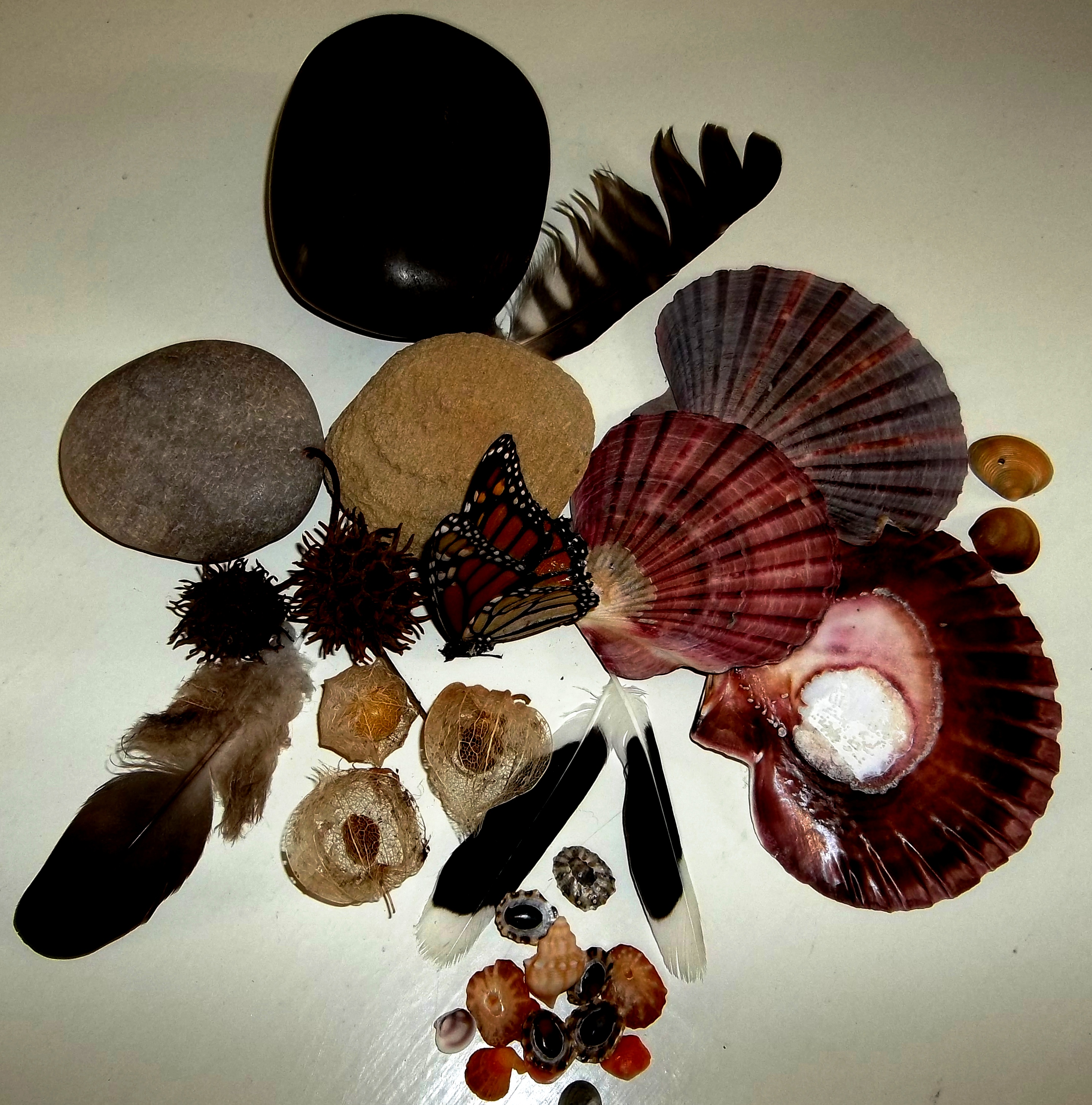
These stones and feathers and shells can tell the story of my life in the last few decades… shells collected with the children on a Northland beach, a black and white feather lying outside the door when I opened it on our first day in a new house –  greeting from a tui… the brown and cream morepork feather found on a long walk around the harbour with the thoughts and dreams of that afternoon threaded through its fronds.

An ancient stone from a river bed in the Blue Mountains of Australia was picked up after a day spent abseiling in abject terror, another from a cold pebbled beach in Devon, the chill of the Atlantic  breakers still embedded in it after all these years, while the polished brown stone came from an underground cave in the central North Island where glow-worms illuminated the roof, and a river flowed through.  These things are the stuff of my life… as they are of every life in which they are valued.

As I looked at them I thought of how other collections can also tell the story of a life. When I renewed my passport recently I found all my old ones, going back to when I was twelve and going to France on my own to learn French. In that passport photo two frightened brown eyes gazed out at the world. I had been so appalled at this picture that I promptly destroyed the evidence.

Which left the rest – a twenty one year old about to go on holiday to Spain, well- groomed hair, immaculate lipstick, and veiled blank eyes… the next, an exhausted mother of two toddlers about to go to Hong Kong, badly cut hair, eyes sad and resigned. And then, a picture of a thirty five year old woman, lots of dark hair piled up confidently, smiling eyes, relaxed smile. Life to be lived now, not endured. In the decades since, the hair has got shorter and then faded, and the last photo was so awful I hoped to be un-recognisable, but the story of a life is told in those passport photos.

Another can tell the story of their life in their jewellery, the coral necklace given at a christening, the charm bracelet for a little girl, pearls for a twenty-first, the engagement ring and the gold band…  a gift to mark the first child,  a clumsy pottery brooch made  at school and proudly presented to a beloved mother… the ring inherited from a grandmother, the eternity ring at a silver wedding…  such precious collections can mark out the steps of a life quite as well as a photograph album.

I wonder if there is even a market these days for photograph albums now all our photos are taken on phones and I-pads. I was never much  of a photographer, so that the photos of my honeymoon were on the same roll of film as the pictures of my first baby. But I did have a memory.

I remember one summer’s afternoon when the children were three and four as they tumbled around on the grass, one wearing a sun-suit in glorious colours of pink and orange and red, the other in matching shirt and orange shorts. As I looked at them, revelling in their laughter, their shining hair, and sparkling eyes, pearly teeth and glowing sun-tanned faces, I thought to myself, I’m going to remember this moment forever.

It was a turning point, because I found I did never forget that moment. So now, I know I can fasten those moments I want to remember with that little intention, and our minds are so obedient that they obey the instructions, and can call up the images whenever they are wanted. On the other hand, I wonder if the ease of communication, the instant photos, the selfies sent from Rome or Khatmandu which reach every member of the family all over the world the same day, make it easy to forget. We don’t have to remember, because it’s all there, on Facebook or in the picture file on the computer.

But for how long? Until the internet crashes? Or some other disaster hits the net? The computer is stolen? Few people will be able to pick up old albums in the future and leaf through them re-living their own lives, or discover the lives of their ancestors. And how will biographers fare in the future? In the past we’ve had portraits and miniatures in pre-photography days; then the wonderful stilted posed photos of the early days of photography, with the expert’s head hidden under a black cloth over a tripod while he captured forever the people and that moment in their time.

Then came the brownie box camera and all the other simple do- it- yourself cameras, and families recorded their events and special moments themselves. Biographies of the famous from the twenties until the sixties are full of revealing snaps, but what will there be for future  writers and historians wanting to illustrate their books about the powerful and famous? Not much, I suspect.

In the past, many anonymous photos turned out to be records of history – impromptu black and white snaps of Battle of Britain pilots ‘scrambling’, shots of families crouched in air –raid shelters from London to Leningrad, soldiers in Africa or Italy taking grainy pictures of each other to send back home… joyful hugs and kisses of victory – all these spontaneous pictures of humanity enduring both the ordeals and the pleasures of the twentieth century, captured in black and white film, are the stuff of history.

But I wonder what history is being preserved today in our somewhat ephemeral records? Will collections of jewellery or stones, in the end be the things to jog people’s memories in the future? Maybe the photos in passports and on driving licenses will the best concrete records we will have… time to get a decent picture taken for these official documents perhaps !


Food for threadbare gourmets

Summer salads don’t always mean lettuce for me… One of my favourites is grated cauliflower, mixed with chopped hard- boiled egg, some chopped Medjuel dates, toasted slivered almonds, and lots of chopped parsley. Then stir in enough good mayonnaise to the consistency you like. Chopped apple or banana is a variation, but actually anything can be added, and it still tastes good. But it can’t sit around, or it turns watery. I eat it on its own, but it’s also good with cold chicken.

Food for thought

And a poet said, Speak to us of Beauty. And he answered: Where shall you seek beauty, and how shall you find her unless she herself  be your way and your guide?  Beauty is not a need but an ecstasy. It is… a heart inflamed and a soul enchanted … a garden forever in bloom and a flock of angels in flight.

‘The Prophet’ by Kahlil Gibran, Lebanese poet, 1883 -1931. ‘The Prophet’ has never been out of print since it was published in 1923.

I

44 Comments

Filed under birds, cookery/recipes, family, food, great days, happiness, history, life/style, love, poetry, The Sound of Water, Thoughts on writing and life, Uncategorized

The birds in our hands

100_0510

Every morning the pink breasted doves are waiting for me and their breakfast at the top of the steps, cooing like pigeons, and many mornings their cooing makes me think of Cher Ami.

Cher Ami, a black checker cock, was one of six hundred homing pigeons British bird fanciers had given to the American Army when they arrived to fight in the last six months of World War One. Trained pigeons were an indispensable part of warfare then. Cher Ami won fame when he became the last of the pigeons left with a doomed battalion fighting in the Argonne forest. Their commander, a hero named Whittlesey, had warned that the plan was a disaster before they began, but no-one was game to take on General Pershing and argue it with him. So as Whittlesey had feared, the battalion was surrounded by the Germans. When he sent a pigeon bringing their position to HQ,  US artillery came to their rescue and began pounding the Germans surrounding the trapped men. Disaster – they were actually shelling the trapped men.

Whittlesey had one pigeon, Cher Ami, left out of the eight he’d started with, so he sent a message: “Our own artillery is dropping barrages directly on us. For heaven’s sake stop it”. After a few false starts, Cher Ami took off, and the Germans tried to shoot him down. He circled overhead before setting off through a storm of German shrapnel. Once he staggered and fluttered helplessly before gathering himself together and continuing his flight. One leg was shot off, but he continued on. Somehow he got back to HQ, dropping like a stone onto his left breast. He staggered on one bloody leg to the trainer who caught him. The capsule bearing the precious message hung by the ligaments of the wounded leg, and he had been shot through the breast bone as well.

Thanks to him, the artillery barrage was lifted and lives saved, though the heroes in the pocket still had several more dreadful days trapped, until un-aided by their own side, a handful of survivors made it safely out. Heroic Cher Ami lived for another year, was stuffed and now resides at the Smithsonian museum.

Human beings (not homo sapiens) have used pigeons for their purposes for some thousands of years. By crossing breeds, they’ve evolved fast pigeons who can do roughly 60 miles per hour, fast ones up to 110 miles per hour. Paul Reuter of the famous news agency used them, a pigeon took the news of Waterloo from Brussels to Britain, and even in the eighties, pigeons were being used to carry blood samples to and fro from two Southern English hospitals. Here in New Zealand an enterprising Kiwi founded a pigeon- post from Great Barrier Island to Auckland back in 1897.

Though people assume it’s just instinct that gets them back home, during World War One, while the French were pushing back the Germans from the Marne, they took the pigeon lofts forward with them, yet when the birds returned from Paris they always managed to find their lofts, even though they had been moved… intelligent too…

Pigeons are not the only birds men have used for their purposes. Here in NZ  the Maoris used to catch the male birds and trim the brush-like growth at the end of their tongues so they could train them to speak. They taught tuis chants as long as fifty words, keeping them imprisoned in the dark in a tiny cage till they were trained. Each poor prisoner, when able to do all the Maori cries and chants, was then imprisoned for the rest of his life in a cage, shaped rather like a Maori eel-pot, fifteen inches wide at the bottom, and thirteen inches high. The bird-cage was often hung at the entrance to a marae. This reminds me of the old Chinese men in long grey or brown robes, in Hongkong, who would solemnly take their caged birds for a walk in the parks, still in their cages.

Parrots too have always had a raw deal locked up in cages with their wings clipped. In Japan recently one escaped and a few days later ended up at the local police station. With a captive audience the intelligent bird told them his name and address and telephone number. His relieved owner then came to fetch him.

When Time magazine ran an article discussing the intelligence of animals and other creatures, they ended by quoting the example of a pet parrot being taken to the vet and having to stay behind for treatment. The bird understood he was being left, and began begging his owners not to leave him, promising to be a good boy. This is the exact pattern of small children left in hospital, and attributing the horror of it to what seems like punishment for their own misdeeds. The parrot had responded with the same emotional pattern as a human toddler, but the researchers described him as ‘mimicking human behaviour’.  This did not prove that birds and animals had feelings, the article ended.

I gave away a book on birds in disgust a few weeks ago. It was a detailed account of how they hear see, fly, etc etc. The book opened with a vignette of a white goose waiting by the side of an icy road beside its dead mate, somewhere in the frozen north. Three weeks later it was still there, still waiting, still grieving for its lost mate. The book closed by returning to this grief-stricken creature, and said, just like that  Time article, that neither this behaviour, nor that of the birds they had observed mating for life, returning year after year to each other, flying around each other, greeting and calling ecstatically when they’d been parted, proved that birds had emotions like us. So how do these heartless researchers explain what birds are doing when fluttering around the body of their mate killed on the road, hiding from cats in the garden, protecting their young, showing fear?

Scientists seem terrified to admit that other species have emotions like us. They call it anthropomorphism and think those of us who practise it are mistaken and merely sentimental. And though St Francis was allowed to acknowledge the feelings of all creatures, the rest of us are still supposed to accept Descartes’s malign thinking that since animals and other creatures don’t have feelings and don’t feel pain, they can be used for any purposes (there are still scientists who argue for this).

Descartes’s theories have influenced our society since the so-called Age of Enlightenment.  But if only we really had been enlightened! If we were, would we all be anthropomorphists? I suppose it depends on whether we come from our head or our heart.


Food for threadbare gourmets

Reverting to an ancient English tradition, we had roast lamb for Sunday lunch! I never do it with mint sauce, since originally the idea of the vinegar and mint was to disguise the taint of meat that wasn’t fresh, but I do like the mint, so I chop it up and stir it into the gravy. (When my seven year old son first encountered mint sauce at a friend’s house, he told me the meat was covered in: “yucky black tea-leaves!”). When putting the lamb in the oven, I rub the skin with salt to make it crisp.

I also make an onion sauce, which I suppose is some sort of throwback to the capers in white sauce that used to be served with mutton- a meat no-one seems to encounter in the west these days. I boil a large chopped onion, and drain the onion water, using it to make a white sauce which is then enriched with milk or cream and a good tasting of nutmeg. Then stir in the chopped onion – delicious with the lamb.


Food for thought

Accuracy is not a virtue; it is a duty.

AE Housman, 20th century English poet and brilliant classicist, best known for his poems in ‘A Shropshire Lad’.


57 Comments

Filed under animals/pets, army, birds, cookery/recipes, food, great days, history, military history, philosophy, The Sound of Water, Thoughts on writing and life, Uncategorized, world war one

Poignant symbolism

100_0812

‘Mummy doesn’t like carnations,’  the nine year old told him coldly, her information holding a world of meaning as she correctly assessed that the man at the front door was a suitor.

She was right, and though he persevered on that occasion, he never gave me carnations again. It’s a shame about carnations, but at the time I could only see the sad, scentless etoliated versions wrapped in cheap cellophane and sold on garage fore-courts. They symbolised the  capitalism and commercialism that exploits and corrupts even beauty.

The real thing has a big, heavy deliciously clove- scented head, with a tangle of frilly petals, and was originally used by the Romans for wreaths and garlands, known in Latin as corona. When these flowers first came to England with the legionaries nearly 2000 years ago, their name was coronation, until the word evolved into carnation.

I was just as dismissive about daffodils, when I was presented with a bouquet – or rather some bouquets – which I rather regret now. In my salad days when I was a twenty two year old in the army, and stationed outside a beautiful village in Shakespeare country, I was the only girl in an all male officers’ mess. I had my own little cottage where I lived with the mongrel I’d rescued and dignified by calling him Rupert.

Late one night there was a loud knocking, so I dragged myself from deep sleep, hurried on my pink dressing gown, and stumbled to the door.  Grouped there were all the young officers who had gone to watch a rugby match at Twickenham. It had taken them many hours to get back here, judging by the time – two o’ clock in the morning – and one of the things which had delayed them, apart from merrymaking at every pub on the way back, was that they had also stopped at every roundabout, it seemed, between my cottage and London.

Each roundabout they had stripped of its spring flowers, and here at my door was the result of their labours. Each young man was wearing a proud grin and holding a big bunch of golden daffodils in the moonlight. Sadly, I was not amused, deeply disapproved, and was more intent on getting them to go away, and stopping Rupert from barking and waking senior officers slumbering nearby, than in being grateful for their generosity at the expense of every town council between here and London!

So I did know how my three year old grand- daughter felt when I gave her a disappointing bunch of flowers. I’d chosen a big blowsy thank you bouquet  for her mother, and had as much pleasure in choosing the flowers as my daughter- in –law had in receiving them. My grand-daughter was also ravished by them, so I decided to walk back to the shop through the bitter Melbourne winter’s day and get her the little bunch of flowers I’d refrained from getting on the first visit.

I brought home a posy of exquisite purple violets, the perfect symbol, I thought, for my exquisite flower-like little grand-daughter. She took one look at the dainty flowers and burst into indignant tears, and then threw an uninhibited tantrum in which she expressed her un-utterable disappointment at not having a big grown-up bunch of flowers like her mother’s. Mortified, I could see her point.

Two years later a small posy of white rosebuds with one word ‘Mummy’ on Princess Diana’s coffin reduced half a world to tears.

The symbolism of flowers is far more profound that the sentimental Victorian descriptions of the language of flowers. The flaming red poppy, whose name is now synonymous with the word Flanders, is a poignant reminder still, of every young man who died in the terrible war that my grandmother called The Great War.

And in the next terrible war  flowers softened another battlefield. I remember my father telling me how the hills of Tunisia were smothered in glorious spring flowers as his tank regiment fought their way to join up with Montgomery’s army.

Bruce Chatwin painted an unforgettable image of flowers in that same war, in his book ‘The Songlines’. On the first page he wrote of a Cossack from a village near Rostov on Don, who was seized by the Germans to be carted off for slave labour to Germany. One night, somewhere in the Ukraine, he jumped from the cattle-truck shunting him and other captives away from their homelands and fell into a field of sunflowers.

Soldiers in grey uniforms hunted him up and down the long lines of yellow sunflowers, but somehow he managed to elude them. I can still see in my mind those rows of strong, towering green stalks and leaves,  great, yellow tangled- petalled heads benignly sheltering the fugitive crouched beneath.

I can never forget the endless fields of shimmering purple lupins alive with dancing blue butterflies, stretching along- side thousands of burnt -out tanks near Belsen concentration camp in Germany just after the war.  And I could never bear the pink rose bay willowherb, which grew on every English bomb site… the only plant that seemed to thrive in those derelict tragic places. They came to symbolise for me as a small girl, all the horror and sadness and destruction of the war I didn’t understand.

But perhaps the most powerful flower image of all, is that glorious girl on an American campus in the sixties, walking up to a row of armed, helmeted men, and tremblingly pushing a flower into the barrel of a gun pointed at her, her hand shaking slightly as she dared the outrageous.  A girl and a flower speaking the in-effable language of peace.

Food for threadbare gourmets

Sometimes home-made mayonnaise can seem a bit heavy, but I use a quick and easy French recipe to lighten it up, learned from my French neighbour. After making the mayonnaise, beat the white of an egg until stiff, and then gently beat it into the freshly made mayonnaise. It gives it a lovely creamy texture, and is particularly good with fish like freshly poached salmon. Another variation is to use a clove of garlic when making the mayonnaise and then add finely chopped avocado with the egg- white. This is a good accompaniment to the chicken mousse from the last post.

Food for thought

That is at bottom the only courage that is demanded of us: to have courage for the most strange, the most singular and the most inexplicable that we may encounter. That mankind has in this sense been cowardly has done life endless harm; the experiences that are called ‘visions’, the whole so-called “spirit-world,” death, all those things that are so closely akin to us, have by daily parrying been so crowded out of life that the senses with which we could grasp them are atrophied. To say nothing of God.         Rainer Maria Rilke 1875 – 1926  Austrian mystical poet

45 Comments

Filed under army, cookery/recipes, family, flowers, gardens, great days, history, humour, life/style, philosophy, princess diana, spiritual, The Sound of Water, Thoughts on writing and life, Uncategorized, world war one, world war two

Summer song

100_0751

Walking around the cemetery on New Year’s Eve the sky was still and clear, no silver, almost transparent moon yet, rising above the sea looking like a silver sliver of dried honesty in the pale night sky. Instead there were gulls circling silently and intently overhead, weaving endlessly in and out, never touching or interrupting the arc of another bird.

After a while I chose one single gull, and watched its movements, following its wide circles and trajectories and swoops until finally it headed out to sea in the direction of Little Barrier Island, which hovers, misty indigo, on the horizon.

It felt like a holy silence, the tracery of the gulls’ flight woven like a network of silver filaments overhead, the cemetery a cathedral, silent, sacred and undisturbed. The Universe may have been un-aware that it was New Year’s Eve around Planet Earth, but surely that thought -form which meant we were all conscious of this moment in time, must have created that charged and sacred energy which I was feeling then.

Today it has rained. Things can start growing again, and I can stop watering – for a few days anyway. The countryside has the richness of high summer. The trees are billowing with green foliage, the fields have been cut for hay, and the grass in the meadows is so high that when the calves lie down, their heads just peep out of the tops of grass heads, plantains, buttercups and clover. I thought I saw a flight of big brown butterflies the other day, and it was the tips of their velvet ears reaching out of the pasture. The thrush in the garden sings continuously between pecking at the apple nailed to the top of the fence.

Tonight I was strolling round the cemetery, and the harbour below was the deep dark green of an Arthurian mere. It was as still as a mere too, and the boats at anchor were reflected with perfect clarity. Turning to face out to sea, the ocean was quite colourless with a deep band of blue on the horizon.

I’m constantly re-filling the dogs’ water bowl by the pavement. I hear them slurping away, as people walk past to the beach, thirsty Labradors and dobermans, bitzers and bichon frises, poodles and pointers… even a bulldog.

Earlier today, reading James Lees-Milne’s diaries, listening to the summer rain, I discovered his description of an English summer night in 1946: “the smell of new-mown hay and hedgerows, of eglantine and elder… how I love these long gentle Shakespearean summer evenings…”  Me too. The scent of the queen of the night comes drifting in from the open window at night here. It’s sweet and lovely… but I miss that indefineable atmosphere of those English summer nights.

Those nights throb with nostalgia and a richness. Somehow, it’s as though the layers and layers of lives lived in those parts, the echoes of history stretching back beyond memory and beyond record, the people in the millenniums before Christ, who trod out the ancient paths that still thread across hills and ridges and valleys and fords, can all still be sensed. The voices are silent, but their presence still lingers, as one century after another passes across the meadows and the woods.

The oak and the ash, the hazel and the hawthorn, the holly and the honeysuckle have been growing there since the last ice-age twelve thousand years ago. The smells, the sweet blossom, the new mown hay, the whiff of manure, the fresh rain, the damp leaves, have smelt the same in every age and every summer since. Standing in a quiet English lane on a soft summer night, you can feel those long centuries, and it is very touching.  I haven’t experienced a summer evening for a long time. I’ve always been back in autumn or in winter. But I must savour a June night once more!

Feeling homesick for the English country-side, I got “Far from the Madding Crowd” and “Tess of the D’Urbervilles off the top shelf of the book-case, and had an orgy of Hardy. Tess first, and the sweetness of Talbothays farm, then Bathsheba and her story… I read it differently this time, not so much for the drama of the story, but for the feeling of the country.

So I really took in for the first time, the delicious characters of the farm-folk, and the details of farming life, from the signs of an approaching storm, to the rituals processing through the year of lambing and dipping, and fattening and shearing, to the yearly sheep fair, the shearing supper and the harvest supper.

It was a way of life which had existed for over a thousand years when Laurie Lee in the enchanting ‘Cider with Rosie’, told the story of his childhood, and an archaic way of life  which then vanished forever, with the combine harvester, chemical farming, agri-business and of course the destruction of communities  by the carnage of the First World War.

I’m always struck in Hardy’s books, and in Jane Austen’s letters, by the isolation and “localness” of country life back then. So many people hardly ever left their village, unless they were gentry, and the next village was a foreign country. So when people fell in love in these tiny societies, and lost the object of their affections, through death, departure or rejection, there was often no-one else to love. People literally did grieve and die in different ways, from broken hearts.

Hardy’s description of the hopeless love by the dairy-maids at Talbothays farm for the un-attainable gentleman, Angel Clare, had the unmistakeable ring of truth.  I remembered from closed societies I lived in when I was young, whether in an English village, or a tiny colonial community far away from any other European habitation, how intense relationships were when there were no others. No-one could console themselves before the population explosion, and peripatetic habits of the twentieth century, that there were plenty of other pebbles on the beach. There weren’t.

Yet now, though I live in a tiny village with only four hundred souls, we are no longer prisoners of geography. Not only do people take off to holiday in Alaska and Italy, and their families return from Vancouver and Hanoi, but we all have the world of the internet at our fingertips, to use that well-worn, but accurate cliché in this instance.

It’s eighty- six years since Thomas Hardy died, and in those years our worlds and our lives and maybe our minds have expanded beyond imagining. The world is our village, and the internet is our community. There are pebbles past counting and wherever we direct our vision, we can find the glory of summer somewhere around the globe at the push of our buttons.


Food for threadbare gourmets

Apart from being full of healthy fats, potassium and Vitamin E, avocados are delicious.  I sometimes use them as a dressing over a salad. To one avocado you need  ground coriander – I use a quarter of a teasp, but less is more… the juice of a lime or a lemon, quarter of a teasp of ground cumin, a tblsp of apple cider vinegar, salt, and about half a cup of water. Whizz these ingredients until smooth and creamy, and use straight away.


Food for thought

To write or even speak English is not a science but an art. Whoever writes English is involved in a struggle that never lets up even for a sentence. He is struggling against vagueness, against obscurity, against the lure of the decorative adjective, against the encroachment of Latin and Greek, and, above all, against the worn-out phrases and dead metaphors with which the language is cluttered up.

George Orwell, English writer 1903 -1950.  Wikipedia records that : ‘His work is marked by lucid prose, awareness of social injustice, opposition to totalitarianism, and commitment to democratic socialism.’ Animal Farm and 1984 have continuing relevance.


61 Comments

Filed under birds, books, consciousness, cookery/recipes, culture, food, great days, history, jane austen, literature, love, The Sound of Water, Thoughts on writing and life, Uncategorized, village life

A peculiar Christmas feast and the 4th Wise Man

100_0742Polar explorer Captain Scott and his team celebrated Christmas on their way to the South Pole in 1911. As a foodie, I find their feast a little lacking in… je ne sais quoi …

After his historic Christmas dinner with Wilson and Oates, Bowers and Evans, Scott recorded in his diary what he grandly termed four courses: ” The first, pemmican, full whack, with slices of horse meat flavoured with onion and curry powder and thickened with biscuit; then an arrowroot, cocoa and biscuit hoosh sweetened; then a plum pudding; then cocoa with raisins, and finally a dessert of caramels and ginger.”

Pemmican was the classic polar food, preserved, dried meat and fat… not my idea of gourmet nosh, but Birdie Bowers, and Taff Evans both felt so filled with warmth and human kindness after this extraordinary collection of unpalatable rubbish, that they decided when they got back to England they would: “get hold of all the poor children we can and just stuff them full of nice things,” in bachelor Bowers’ words.

I just feel the polar feast could have been warmed up with a wee dram of whisky perhaps, or even a swig of medicinal brandy. But then, I feel the cold.

Bowers was responsible for this jolly Christmas celebration, having smuggled the food over and above the allowed weights for the journey. Once the recalcitrant and desperate Mongolian ponies – who had suffered so terribly on the sea journey to the Antarctic, and who had then struggled endlessly in appalling weather and conditions with food they couldn’t eat- had been killed, every man carried his own food and equipment on the heavy sleds.

Bowers had always sneaked his night-time biscuit to his pony. On the night before they were all killed, Wilson, St Francis’s man, gave his whole biscuit ration to the poor creatures, like the condemned man’s last meal. This was the only time I cried during the film: ‘Scott of the Antartic’ with John Mills.  I was twelve, and blow the men, it was the ponies I wept for.

Thankfully my Christmases have never been as cold as theirs, though it felt like it in the hall in which we rehearsed for the Nativity Play when I was five. I had no idea what a rehearsal was, or why we had been marched – or straggled would be a better word – to the hall just down the road. Neither did I really understand the story we were acting in. We seemed to stand around for hours in the unheated hall while teachers talked animatedly to each other, and shifted bodies and chairs around the stage.

I just knew that the white nightie thing I was wearing like all the other little girls, was freezing. To cap it all – like the other angels in their nighties – I had a boring triangle to keep chinging on. This was a watershed in my understanding of the world. I understood then for the first time, that boys had all the fun. Not only were they all dressed up as kings and shepherds, but they got to play drums and tambourines, trumpets and recorders.

I felt as aggrieved as I did when I first saw huge Persil ads, in which the dark haired woman had the grubby grey sheets, and a bright blonde had the sparkling Persil washed sheets. Apparently blondes were better than brunettes.

But that’s another story… a year later my grandmother took me to a midnight carol service. I was riveted. A boy sang the first verse to: ‘Once in Royal David’s City’ in an un-earthly soaring treble, and then read the lesson. At one point his clear voice rang out with the words “And Mary pondered these things in her heart”. My heart leapt. I had no idea what the beautiful words meant, but for many years I treasured them and pondered them in my heart too.

The next memorable nativity play was when my daughter was five, and she was playing Mary. I thought she was utterly precious as she gazed at the world with her big brown eyes, her little face framed by a blue head covering, her solemn gaze taking in far more than I ever did. I sat and watched her with tears running down my face and my heart nearly burst with love. And the same when my small son sang the solo so sweetly at his Christmas concert.

Much the same too at all my grandsons’ nativity plays, only not tears, laughter. My heart nearly burst with love then too, and lots of giggles, as the head mistress darted down from her pulpit to drag a little finger from some-one’s little nose, and then he simply used the other finger on the other hand and the other nostril as soon as she was safely back in the pulpit.

None of them were magnificently garbed magi, just lowly shepherds … but we all sang the sombre, beautiful carol, ‘We three kings of Orient are…’ My favourite wise man is the fourth one, and that old Christmas legend telling his story is one of the most beautiful Christmas stories, to my mind…

He had set out with the other three Magi, but on the way, they came upon a traveller who’d had an accident, and the fourth wise man stopped to help him. Seeing he would be a while, he told the other three to carry on with their journey, and he would catch them up. But he never did, for he kept meeting some creature or traveller who needed his help to get them to safety, and by the time he got to Bethlehem the kings had been and gone, and so had the Child he was seeking.

He spent many years following the trail which had always gone cold when he got there, to Egypt and Nazareth and elsewhere. He was constantly delayed by yet another needy person who asked for his help. The gifts he brought and the stock of gold he had carried with him for the journey, dwindled until he had hardly enough left to buy himself food.

And then he heard that Jesus was in Jerusalem. He hurried there, and arrived in time to stand and watch Jesus carry his cross through the streets. He had one final treasure that he was keeping to give to the One he had been seeking, a beautiful sapphire jewel. But just before Jesus passed, a Roman soldier began to assault a young woman. The fourth wise man intervened, and by now, old and frail, was unable to stop the soldier. Finally he offered him his last possession, the precious sapphire, his gift for the Messiah, and the soldier took it and left.

At that moment Jesus reached the fourth wise man, and he knelt and asked Jesus’ forgiveness for having nothing for him because he’d stopped so often on the way to help the hungry or lost or needy. And Jesus looked at him and said: ‘For as much as you have done it unto these, you have done it unto me.’

In other words… we are all one… so a happy Christmas-tide to us all, dear friends around the world of blogging.

Food for threadbare gourmets

When Christmas is here, our little purply-red plums are ripe, and though I gave this recipe last year, I think it’s worth repeating  The plums which are only so-so for eating raw, are delicious when cooked. Every-one who receives a basket of these fruits also gets the recipe I use – borrowed from Nigella Lawson.

To a kilo of plums – more or less, use 300 ml of red wine – more rather than less! Nigella says stone them – I don’t bother, the stones come out quite easily when cooked.

Put the plums in an oven proof dish. In a saucepan boil the wine with two bay leaves, half a teasp of ground cinnamon, two cloves, one star anise, and 200g of honey. Pour over the plums, seal with foil or a lid, and bake for an hour or longer at 160 degrees, until they’re tender. You can keep them in the fridge for three days, and you can freeze them.

Serve with crème fraiche, ice-cream, or custard. I also think they’d be good with rice pudding on a cold day. The aromatic scent while they are cooking is so delectable that I’d love to catch it in a bottle and spray it regularly around the kitchen.

Food for thought

“My idea of Christmas, whether old-fashioned or modern, is very simple: loving others. Come to think of it, why do we have to wait for Christmas to do that?”                                                                                                                                                                                                                                                                               Comedian  extraordinaire, Bob Hope  1903 – 2003 His grandson said that when asked on his deathbed where he wanted to be buried, he characteristically quipped: “ Surprise me .”

63 Comments

Filed under cookery/recipes, food, great days, history, love, philosophy, spiritual, The Sound of Water, Thoughts on writing and life, Uncategorized

The feminine face of God

100_0666

In the last hundred materialistic years I was fascinated to discover that there are 386 recorded instances of Mary appearing to people all over the world from Belgium to Japan, Venezuela  to Burundi and Rwanda. I had always supposed that the visions of Our Lady of Fatima, and at Medjugorje in Yugoslavia were unique one-off events. They are not.

Our Lady of Zeitoun appeared regularly over a church at Zeitoun, a suburb of Cairo for several years between 1968 to 1971, where she blessed the people. Photos of the figure of light with a halo, hovering above the Coptic church of St Demiano appeared in all the Cairo newspapers. Hundreds of thousands flocked to see her, Christians, Jews, and Muslims, even the President Nasser. And there have been more reports of her appearing in Cairo just recently.

But mostly Mary seems to appear privately to women, and children. The most famous, of course, in the 20th century was Our Lady of Fatima, who appeared on the same day for six months in 1916 to three Portuguese children, aged ten, nine and eight, while they were tending goats. After the third month of their visions, when crowds began to follow them the local mayor arrested the children, as he thought the events were so disruptive.

He put them in jail among other prisoners, and threatened to boil the children in oil ( charming! ) if they didn’t tell him the secrets Mary had imparted to them. ( the secrets seem to have been coloured by the children’s perceptions of hell and Catholic teachings) They refused, though the eldest offered to ask Mary if she could tell him. The other prisoners testified that the children consoled them and recited the rosary with them.  Back home, the youngest brother and sister told their parents that Mary had told them they would die soon and meet her in heaven, but their cousin Lucia, the eldest, would live long.

They did die, within a couple of years, of Spanish flu, and Lucia continued to have visions until she died as a very old lady in a convent. The six children who saw Mary at Medjugorje in 1981 have also continued to see her for over thirty years, on the same day of the month. This was her latest message to Mirjana Soldo on 25 November this year:

 “Dear children! Today I call all of you to prayer. Open the doors of your heart profoundly to prayer, little children, to prayer with the heart; and then the Most High will be able to act upon your freedom and conversion will begin. Your faith will become firm so that you will be able to say with all your heart: ‘My God, my all.’ You will comprehend, little children, that here on earth everything is passing. Thank you for having responded to my call.”

The internet being what it is, there are films of Mirjana Soldo receiving her visions, not just in Yugoslavia, but in Austria, Italy and elsewhere. Like the children of Fatima, these children – now adults – were also considered to be ‘disruptive influences’ by the civil authorities

Many phenomena were reported at Medjugorje during the appearances of the Queen of Peace as she is known, such as the sun spinning, dancing in the sky, turning colours, or being surrounded by objects such as hearts or crosses. Onlookers have reported that they have been able to look at the sun during those times without any damage to their eyes; these events are all similar to phenomena seen during the visions at Fatima in 1916. There too, newspaper reports described the sun dancing and spinning in the sky and changing colours. Reputable witnesses saw the solar phenomena forty miles away, while others, including believers, saw nothing.

 Among Mary’s many names are Queen of Heaven, Star of the Sea, The Blessed Virgin. In other places and other times the feminine principle or Divine Mother has been known by many other names… She’s been called Ameratsu and Cannon in Japan,  Kuan Yin in China, Tara in Tibet,  Shakti in India,  Akua’ba in Africa,  Isis in Egypt,  Ishtar and Astarte in the Middle East, Hera and Juno in Greece and Rome,  Freya in Scandinavia,  Spider Woman and Ixchel the Weaver in North America. 

The Divine Mother has a long history in the planet’s consciousness. Archaeology suggests that from approximately 40,000 BC to approximately 5,000 BC the Goddess was worshipped above all, and nearly all the figurines found from this period seem to be female goddesses.

There are other accounts of the feminine principle appearing when called upon. John Blofeld, mystic, scholar, and expert on Asian religions tells the story of a friend in China during the Second World War. He was half Chinese, and had been brought up a Christian. In danger, hungry, lost on a mountain in terrible weather, wondering if he’d survive the night, he called on his patron saint,  St Bernadette, “begging that sweet child to appear and lead me to a place of safety”

And then he saw her standing on a flat rock, her blue robe hardly moving in the fierce wind. She was smiling and around her was a nimbus of light. He felt something unfamiliar in her appearance, and then he realised she was a Chinese Bernadette. ‘Her high-swept hair, the jewelled ornaments clasped about her throat, the white silk trousers peeping through a blue robe slit to the thigh, were those of a noble Chinese maiden many centuries ago.’

She spoke to him in Mandarin and surprised him with her childish voice, much younger than Bernadette. “ Come, Elder Brother”, and she led him to a shallow cave, where he lay down and fell deeply asleep in the bitter cold and on hard rocks, unconscious of any discomfort. For more than a year he thought it was Bernadette who’d rescued him, until he saw by chance a portrait of Kuan Yin with her two attendants. In Ling Nu, the youngest, he recognised the lady who had saved his life. After deep thought, he decided that Kuan Yin had too much delicacy to appear to someone calling on a foreign goddess, so she sent Lung Nu who could be taken for a child saint.

Often in her appearances to children, the lady doesn’t give her name. …” beautiful lady, beautiful lady”, the three small Italian children murmured on their knees at Tre Fontane in April 1947.   St Bernadette, the fourteen year-old un-educated daughter of a miller, only ever referred to her as ‘ That’, or ‘the small young lady” . The children at Medjugorje called her ‘Lady.’

She seems to favour quiet spots far from towns and villages, by streams and grottos and woods, and her visitations come unbidden. The Catholic church is never very happy about Mary’s appearances – or you could say is suspicious – since it considers the last word to have been spoken on the faith after the death of the last apostle. So they don’t want her interfering! Reports of visions of the Lady are rarely greeted with any enthusiasm by church authorities and they have very strict criteria about who they believe.

Out of the 386 visions/ appearances/ apparitions – depending on who is describing the visitations – only eight have been officially approved by the Catholic church. I wonder how many private and unrecorded visions – not just of Mary, but of other figures of spiritual significance – there are among people who have never spoken of them. I’ve heard of several.

Graham Green, the novelist, writing of her, said: ‘There is a common feature in all her appearances, the appeal for prayer and yet more prayer. Her message is as simple as that, and it may seem unimportant unless we have some realisation of the terrible force of prayer, the mysterious untapped power able to move mountains’.


Food for threadbare gourmets

Soup is the answer when I can think of nothing else, and this quick warming tomato soup is a favourite. Gently fry an onion, five cloves of garlic, a small piece of chopped ginger, and a good pinch of coriander in a saucepan until soft. Add a teasp of smoked paprika, two tins of  chopped tomatoes in puree and one tin of whole tomatoes. While it simmers, leave a small bunch of herbs like thyme and marjoram tied together in the mix.

Simmer for ten minutes, remove the herbs and blend until smooth. Re-heat, season with salt, freshly ground black pepper, and stir in some cream… this amount serves six. Sprinkle chopped parsley on top, and freshly cooked croutons made from sour dough bread and fried in olive oil are good too.


Food for thought

 My daughter sent me this prose poem… it’s by that talented poet Anon. We’ve had seventeen dogs – three at a time, mostly rescued…

It came to me that every time I lose a dog they take a piece of my heart with them, and every new dog who comes into my life gifts me with a piece of their heart. If I live long enough all the components of my heart will be dog, and I will become as generous and loving as they are.


49 Comments

Filed under animals/pets, consciousness, cookery/recipes, food, great days, history, life/style, philosophy, spiritual, The Sound of Water, Thoughts on writing and life, Uncategorized

Am I not a man and a brother?

100_0550

My husband took one look at my ravaged face, and retreated to his study. I had just returned from seeing the film ‘The Butler.’ Instead of the gracious meander through history at the White House that I’d expected from the trailer, I had watched another episode of the American Civil War which I thought had ended in 1856.

Too appalled even for tears, at the end of the film was I shell – shocked to hear that many of the freedoms fought for in that bitter sixties campaign I’d just watched, had later been repealed, replaced or blocked by President Reagan. ( I’d like to think that information was wrong )

It’s hard to get my head round this long-running disaster for humanity. Having grown up in a country where people joyously belt out: “Britons never, never, never shall be slaves”, in their annual singing orgy at the Albert Hall on the Last Night of the Proms, slavery under its many names had been something I grew up thinking  had disappeared from the civilised world,

It ended in England before the founding of the US, when in 1772 the Chief Justice, Lord Mansfield, decreed that anyone who set foot in England was automatically a free man. By this act he initiated the beginning of the abolition movement, led by William Wilberforce, and his supporters who included Quakers and Evangelicals. (Quakers on both sides of the Atlantic had been agitating for emancipation in the ‘Citty upon a Hill’ since George Fox, founder of Quakerism, visited the States, and preached against it in 1672)

Though a sick man, who took opium for most of his life to alleviate his pain, the heroic and persistent Wilberforce brought his anti – slavery bills before Parliament for over twenty years, until finally, Parliament voted against the slave trade in 1807. In 1808 the US also voted to end it, but not slavery itself, and so slaves were still bought and sold in the States. As a result of the British vote, the British Navy created the West Africa Squadron to patrol the African shores to prevent slave trading. The navy patrolled for sixty years, and at times, one sixth of the navy’s ships were at sea on this mission. Freed slaves were taken to Freetown in British Sierra Leone where they were safe from being re-captured. Over 150,000 Africans were freed in this way.

By 1834, England- as personified by Parliament – had come round to the idea of emancipation, and slaves were freed in most of the British colonies, including Canada and South Africa, and slave owners compensated at huge expense to the government. It meant that 800,000 slaves were gradually freed, and it also meant that many imports into England now cost a lot more. In the sometimes unhappy history of the British Empire this is one brownie point.

When Harriet Beecher Stowe wrote Uncle Tom’s Cabin, it had bigger sales in England than America, and as one of her readers, as well as being an afficionado of the American Civil War, I had thought all had ended well for the slaves when the South was defeated. ‘Gone With The Wind’ did incalculable damage to the thinking of ignorant people like me.

The picture it painted of a noble, benevolent society with happy, contented slaves living in harmony with masters they loved, was a travesty of truth, I discovered –  no hint of anyone being bought and sold, families destroyed, and later, lynch mobs, Klu Klux Klan or Billie Holiday’s song ‘ Bitter Fruit’- which came out in the same year as the film. The rude way black people were spoken to and humiliated, even in benign films like ‘Driving Miss Daisy’, shocked me. As did the true story of Hadley Hemingway losing all Hemingway’s manuscripts, and when she was too shattered to tell him, he finally confronted her with the thing he dreaded most: “You’ve been sleeping with a Negro.”

Twenty years ago when  Ken Burns’ moving films introduced me to the Civil War, I also read a fascinating and horrifying series of reports which jobless students were commissioned to write during the Depression. They interviewed and recorded the memories of the slaves who were still alive in the thirties, and those memories were harrowing, whether before or after Emancipation. Singer and actress, Hattie McDaniels, who played Mammy in ‘Gone With The Wind’ was the daughter of slaves, and her lot was not much better.

She was asked not to attend the opening night of the film in Atlanta in 1939, and when she won Best Supporting Actress at the Oscars, had to sit alone in specially segregated seating. She was also not allowed to be buried in the Hollywood Cemetery which even practised segregation in death! When I learned this, I was still not aware of how the South had been gradually winning the Civil War with Jim Crow laws, and especially in the twenties and thirties, suppressing black civil rights, expanding segregation, and passing laws like the ‘one drop of negro blood’ in 1924, which condemned innocent people to a ‘shadow’ existence.

‘Shadow’ families were those like Thomas Jefferson’s children, born to a slave, Sally Hemings. She was herself more than half white, and thanks to the exploitation of slave women then, was also an aunt of Jefferson’s legitimate daughter through Jefferson’s wife.  Jefferson’s and Sally’s children were seven- eighths white. If they hadn’t already disappeared into white society back before the Civil War, they would have been trapped by these creeping race rulings.

A friend whose ancestor was General Pettigrew, the other general who led Pickett’s Charge at Gettysburg, gave me a biography of the general which had been published recently. As I read it I became increasingly puzzled, for the general was such a heroic paragon , who apparently embodied all the chivalric qualities of a noble cavalier, that even his predilection for quarrelling and the resultant duels were held to be virtues, and typical of his aristocratic society.

The barbarians of the North, inhospitable, dour, materialistic Protestants, had destroyed both this magnificent young man and the civilisation of the ‘old South’ that he represented, according to the writer. In the end, I Googled him, and light dawned. He was still fighting the Civil War! Not only was this writer a man of great reputation in the South, but he had founded a league of Southern gentlemen, which some people – like me – would feel that in the light of Southern men’s record, was an oxymoron.

There’s another film due to come out about slavery, the true story of a free black American living in the North who was kidnapped, and sold into slavery in the South. His horrendous ordeal lasted for twelve years, and when he escaped he wrote his story, which has gradually been forgotten.

Two black Englishmen have produced this film, and I won’t be watching it. I know enough. I already believe in the cause of freedom, and I’m too much of a coward to watch the cruelties and inhumanities that I saw in the trailer. The title to this blog comes from a medallion struck in 1787 by Josiah Wedgewood, the great potter, and  supporter of Wilberforce’s abolition campaign. The words go straight into my heart.

Food for Threadbare Gourmets

I had a big bunch of watercress, and decided to make soup with it. Mrs Beeton, who I consulted, had three recipes for it, and this was the one I fancied. The fiddliest bit was taking the leaves off the stalks, as I have a feeling the stalks taste bitter. Gently sauté the leaves in butter for a couple of minutes, then remove from heat. Mix about a dessertspoonful of cornflour with some milk, whisk it into chicken stock, and add the cress. I leave a few leaves aside, and then whisk everything with my stick whizzer. Quickly re-heat and add cream to taste, and a pinch of cayenne. The rest of the cress leaves float greenly on the top. The amount of stock depends on how much cress you have, and it’s easy to gauge.

Food for Thought

 “The opposite of love is not hate, it’s indifference. The opposite of art is not ugliness, it’s indifference. The opposite of faith is not heresy, it’s indifference. And the opposite of life is not death, it’s indifference”                                                                                          Elie Wiesel- born1928.  Writer and survivor of Auschwitz and Buchenwald. When he was awarded the Nobel Peace Prize in 1986, the Norwegian Nobel Committee called him a “messenger of peace”.

46 Comments

Filed under cookery/recipes, gettysburg, great days, history, slavery, spiritual, The Sound of Water, the sxities, Thoughts on writing and life, Uncategorized

Paradise is not lost

100_0559 In this country the sun is reputed to shine twice as often as it does in England, and it shines with especial clarity on Coromandel, so called when a ship of that name anchored where the township is now. The Coromandel peninsula is a rugged line of purple ranges and deep ravines where clear bright streams and rivers rush over rocks to the sea. Once the peaks of Coromandel were clothed in primeval kauri forests, and once too, those peaks hid seams of ancient gold. But now these two sources of gold have long been mined, the hills are covered in secondary growth, and the mine shafts are empty.

It’s always been a place of passion and politics, where potters and painters, poets  and philosophers have fought to defend their way of life in these empty, unpolluted and un-peopled places. Ringing this neck of land, pohutakawa trees flaunt their red flowers along the rocky coast-line, and distant blue horizons beckon to unexplored peaks and impenetrable bush.

Our house on the side of a narrow valley leading down to the water’s edge, looked up to the steep foot hills of the Coromandel ranges behind us. And we faced the Firth of Thames, where the light on the water had a mystic quality in the winter sunshine; where the line of Miranda beach on the opposite shore could just be glimpsed; and where flights of godwits gathering for their heroic autumn journey to Siberia, could be imagined.

Further down the coast was the place where Captain Cook first came ashore in this country.  Young Nick, the cabin boy who sighted land, gave his name to Young Nick’s Head, and where Captain Cook observed the transit of Mercury, he called the bay where they anchored, Mercury Bay.

When the Endeavour came sailing into Mercury Bay it was watched by a nine year old boy. Eighty-three years later the magnificent old man told his story. As he watched the great canoe with huge white sails skimming towards them, he was amazed when the ship’s crew then rowed ashore in the time-honoured fashion with their backs in the direction in which they were going.

“Yes, it is so,” said the old people watching with him, “these people are goblins, their eyes are in the back of their heads.” Eventually Horeta Te Taniwha, as he was called, gathered the courage to climb on board the ship with the older people.

“I and my two companions did not walk about on board the ship – we were afraid lest we be bewitched by the goblins; and we sat still and looked at everything at the home of these goblins… the chief goblin… came up on deck again to where I and my boy-companions were, and patted our head with his hand, and he put out his hand towards me and spoke to us at the same time, holding the nail out to us.

“My companions were afraid and sat in silence; but I laughed, and he gave the nail to me. I took it in my hand and said “Ka-pai” (very good), and he repeated my words, and again patted our heads with his hand, and went away.

“My companions said: “This is the leader of the ship, which is proved by his kindness to us; and also he is very fond of children. A noble man – one of noble birth – cannot be lost in a crowd”

“I took my nail and kept it with great care, and carried it wherever I went, and made it fit to the point of my spear, and also used it to makes holes in the side-boards of the canoe, to bind them onto the canoe. I kept this nail until one day I was in a canoe and she capsized in the sea and my god (the nail) was lost to me…”

The descriptions of the pristine land that Cook discovered in 1769, sound as fragrant and unspoiled as the descriptions of Roanoke in 1584. I ache to have seen Auckland harbour as it was then–the first accounts tell of the silence and the sunshine, the flaming pohutakawa trees bending over the still, clear water as the first white men glided spell-bound up the harbour in their sailing ships – it was a magical, mysterious country which seemed like the most exquisite place on earth to those early explorers. On the other side of the coast, where the other great harbour of Manukau lies, they found forests teeming with strange birds, great trees of more than ten metres in girth towering to the skies, cloudy waterfalls, black sand beaches  and steep jagged cliffs facing the turbulent Tasman..

 Songbirds fluted in the dense forests. Sir Joseph Banks, the great naturalist on board the Endeavour with Cook, wrote at Queen Charlotte Sound: “ the ship lay at a distance of somewhat less than a quarter of a mile from the shore, and in the morning we were awakened by the singing of the birds: the number was incredible. And they seemed to strain their throats in emulation of each other. This wild melody was infinitely superior to any that we had ever heard of the same kind: it seemed to be like small bells most exquisitely tuned.”

Civilisation has made life easier and more comfortable at one level, dentists, drains, and all the rest, and destroyed the planet in the process. And we all know it and yearn for the original untouched Garden of Eden. To have been alive then, and to have savoured this untouched land… it makes me feel homesick just to think of it. So-called civilisation of course, has changed so much of this. From 1840 onwards, the settlers did their best to destroy the forests, using the giant kauris for ships masts, and building wooden homes, wood being the quickest material to use to build a home in a new country. On the newly barren hills they planted grass for the millions of sheep which have brought prosperity to this country, and now erosion means that in some places, the rivers are no longer clear, but sluggish muddy currents.

They took the gold, and now they want the oil. Yet so many of us still want keep this country as unpolluted and unspoiled as possible; so we try to save the native birds, we enclose huge national parks,  we preserve the swathes of native bush and forest still here, and we oppose the multi-national oil companies. And nothing can change or spoil the silent, snow-capped mountains and wild waterfalls, the great lakes and endless miles of solitary beaches in an empty land the size of England, which is home to only four million people.

I now live an hour’s drive north of Auckland, looking out on green fields one side, and blue sea the other; and I walk the long deserted stretches of yellow sands, and can only hear larks singing high above the dunes, and the waves breaking on the shore. In a crowded world, where solitude and silence are hard to find, this place still seems like paradise – last, loneliest, loveliest – as Rudyard Kipling once described Auckland.


Food for threadbare gourmets

I love vegetable dishes. This fennel dish I can eat as a meal, and my husband can have it with his steak, though it also goes well with lamb and pork. Allow a fennel bulb for each person, though if I’m having it as a meal, I usually have two. Cut the fennel in half from root to stalk and blanch in boiling salted water and drain well. Cut the fennel again, into quarters, and lay them in a well- buttered baking dish… it doesn’t matter if they break up. Scatter pieces of fried and chopped bacon over the fennel along with a finely chopped garlic clove. Whisk a teasp of flour into 250 ml of cream and pour over the fennel. Bake for about 25 minutes in an oven set at 190 degrees. Check it’s soft with a sharp knife. Eaten with a crusty roll or wholemeal bread, it’s very satisfying.

Food for thought

It may be hard for an egg to turn into a bird: it would be a jolly sight harder for it to learn to fly while remaining an egg. We are like eggs at present. And you cannot go on indefinitely being just an ordinary, decent egg. We must be hatched or go bad.

CS Lewis, 1898 – 1963 English novelist, poet, medievalist and literary critic. Best known for his books ‘The Screwtape Letters’ and ‘Chronicles of Narnia’.


59 Comments

Filed under birds, colonial life, cookery/recipes, environment, great days, history, life/style, philosophy, pollution, Thoughts on writing and life, Uncategorized

A great-grandfather

100_0500While those who were interested in the christening at St James Palace were focused on his famous great- grandmother, I was more interested in the baby’s great-grandfather. The Queen’s husband was a year older than HRH Prince George of Cambridge when he escaped with his life, lying in a hastily improvised cradle which was actually a drawer from a chest of drawers.

His father, Prince Andrew of Greece and Denmark, had been arrested in a Greek revolution in 1922, five years after the Bolshevik revolution in Russia. His mother, Princess Alice, Queen Victoria’s great-grand-daughter, once known as the prettiest princess in Europe, was the niece of the deposed and dead Russian Tsarina Alexandra.

One of Victoria’ numerous grandchildren, King George V of England was cousin both to Tsar Nicholas of Russia – in fact they looked so alike it was hard to tell them apart –  and also to Tsarina Alexandra, and he had refused them refuge in 1917, for fear of provoking revolution in England. So his cousins and their children, the four ravishing archduchesses, and the haemophiliac Tsarevitch were murdered in the cellar at Ekaterinberg.

It was this dreadful memory which spurred George V into sending a battleship to rescue his Greek relatives, taking off Philip’s father from Greece, and then picking up Philip, his mother and sisters who were living under surveillance in Corfu. They were all decanted at Malta. The family went to Paris, where it dissolved. Prince Andrew retired to Monte Carlo to become a playboy, Philip’s mother who was born deaf, though she had learned to lip-read in three languages, retired to a sanatorium in Switzerland with schizophrenia, and the sisters married German princelings, one of them at sixteen. The little boy Philip was shuttled between boarding school in England, his sisters in Germany, and his grandmother in England, another of Queen Victoria’s grandchildren, and his uncles, one of whom was Lord Mountbatten, later murdered by the IRA with members of his family. Philip rarely saw his mother.

When his close sister Cecile, perished in a plane crash on her way to a wedding with her husband, two children and other family members, Philip, by then seventeen, walked in her funeral procession, just as he walked with his grandson William in his mother Diana’s funeral procession sixty years later. In between he’d attended Salem School which aimed to: ‘Build up the imagination of the boy of decision and the will-power of the dreamer, so that in future wise men will have the nerve to lead the way they have shown, and men of action will have the vision to imagine the consequences of their decisions.’  Kurt Hahn, the headmaster, fiercely scrutinised the strength of character of any child admitted to the school. So even though his sister and her idealistic husband subsidised the school, Philip was put through the hoops to prove his worth, and with those values, no wonder the Nazis closed in on Hahn, forcing him to flee to Scotland where he founded Gordonstoun School, and where Philip ended up too.

When war came, Philip joined the Royal Navy, and so for seven years was cut off from his sisters in Germany. Now he camped with his grandmother and an uncle until they both died, and then moved in with Lord Mountbatten – not an easy childhood, with absent parents and no home. Yet the combination of heredity (and there’s no room here to go into his fascinating forbears), environment, set-backs and an active enquiring intelligence resulted in an interesting man of many parts. He was also one of the handsomest young men in the world, as a quick glance at his wedding photos show.

No snob either – at his wedding in Westminster Abbey where everyone brought out their jewels and furs for the first time since the war began, he wore his shabby well-worn naval uniform, disdaining to wangle clothing coupons in order to re-place it. But he had changed his name from Schleswig- Holstein – Sonderburg – Glucksburg to Mountbatten – well you would, wouldn’t you?

He had made a love match with the young Princess Elizabeth, and though they knew what the future held, they didn’t envisage her father dying at 54 and thus changing their lives forever. Philip was devastated, as it meant leaving his naval career. While the Queen is always the soul of discretion, the Duke of Edinburgh, as he became, has always been famous for being outspoken, direct, and frequently controversial. But he’s always brought humour and humanity to the boring protocols of Royalty. When he met Malala at Buckingham Palace recently, he said to her – accurately – “in this country, parents send their children to school to get them out of the house”, causing Malala to break into laughter, and clap her hand over her mouth, and her father to laugh out loud too.

Unlike the consort of Dutch Queen Juliana, he has never caused a huge scandal over dishonest corporate dealings, and unlike Queen Margaretha of Denmark’s husband, he’s never stomped off in a hissy fit and disappeared for days at a big Royal wedding, because he felt he wasn’t getting the respect he deserved. Unlike the Spanish King, he hasn’t gone off on African safari shooting elephants with a well-established mistress, and unlike the King of Sweden he’s never had a string of other women either. He enjoys the company of women – with four sisters that’s a given, but though Fleet Street has tried very hard, it’s never been able to pin anything on him.

If Prince George’s parents are sensible, they’ll go to him for advice, as well as to Mrs Middleton. Though the Queen is famous for indulging her children and not reprimanding them, Philip was the head of their family and his philosophy for bringing up children was wise and kind.

Talking of teenagers he told one biographer “Children go through enormous changes. For a time they’re in phase with life around them, then they go out of phase and become unliveable with, and everything they do is wrong and cross-grained and maddening – and then suddenly it all comes right for a bit – then they go off on another tack…

“It’s no good saying do this, do that, don’t do this, don’t do that. You can warn them about certain things, that’s about the most you can do, or you can say , this is the situation you’re in, these are the choices, on balance it looks as though this is the sensible one, go away and think it over, and come back and let me know what you think.”

Philip said he felt that his children’s feelings never went unconsidered or that reasonable requests were denied:

“It’s very easy when children want to do something, to say no immediately. I think it’s quite important not to give an unequivocal answer at once. Much better to think it over. Then if you eventually say no I think they really accept it. If you start by saying no, and they persist in the argument  until you realise you could perfectly well have said yes, you get into a situation where they won’t ask you any more, or you find you’re stopping them doing things which in fact it would be perfectly reasonable for them to do.”

He’s used his position to further and encourage innovation in industry, and championed the environment and preserving wildlife before anyone else was green. Some would think that the luxury and splendour in which he has lived since becoming the Queen’s consort is a good swap for the normal life he was so reluctant to give up, his career in the navy and his privacy. But for an intelligent man of action, who doesn’t suffer fools gladly, it must have been a tough life, always one step behind his wife. He has often been misunderstood, and often doesn’t  get the credit for his indispensable common sense,  for his fortitude, and the deep loyalty and love   he’s always given his family –  Queen and country have been lucky to have him, and so is his great-grandson George.


Food for Threadbare Gourmets

The asparagus season is just beginning, and though it’s hard to go past lightly steamed asparagus and melted butter, I also enjoy it placed on some silver foil, sprinkled with olive oil, salt and pepper, covered and baked for 15 minutes or so in a medium oven. Or steamed, blanched, and eaten with a Japanese dressing of one teasp dried mustard, one teasp hot water, one egg yolk, one tablesp dark soy sauce, one teasp freshly chopped ginger or half of dried, and salt to taste. Mix the mustard with the water, add the other ingredients, and pour over the asparagus. Eat within three hours.

Food for thought

We have enough people who tell it like it is – now we could use a few who tell it like it can be.                  Robert Orben, American comedy writer and Gerald Ford’s speech-writer.


42 Comments

Filed under cookery/recipes, history, Royals, royalty, The Sound of Water, Thoughts on writing and life, Uncategorized

Birds of a feather

100_0479My heart was in my mouth. I was sitting at the traffic junction in our small town where six roads meet and compete for the lights.  Would the traffic stop? A duck was slowly waddling across the road with a clutch of tiny ducklings in tow. They made it to the pavement which would lead them along to the river in the middle of town, with just one hiccup over two slow ducklings who stopped to drink from a puddle, and which an impatient woman nearly cleaned up as she got tired of waiting.

This is the duck season. We become very conscious of them as they shepherd their progeny across busy roads, oblivious of the killing machines skidding to a halt yards from them.

A friend told me how in the middle of the busy village street, he stopped to let a mother pass while her babies all scuttled to safety on the pavement, but she wouldn’t move from the middle of the road. As he wondered how long she was going to obstinately stand there, suddenly two recalcitrant toddlers made a dash from the other side to catch up with their mother and siblings. Ducks can count!

The same thrush (I think) who made life difficult for us last year, by nesting in the honeysuckle by the side door of the garage has returned, and I in-advertently uncovered this year’s nest as I began to trim the overhanging ivy on the arch into the garden from the garage. I saw with horror a beautiful blue egg in the exquisitely woven little nest, and hastily covered it with strands of the trimmed ivy.

I blocked the arch with a rake and a hoe and a plank of wood across the top of the steps to stop anyone using it, so now everyone has to go the long way round from the garage. (see pic above!) I tiptoed up the next day, to check if the bird had returned, and as I stood peering intently into the tangle of ivy leaves, I suddenly realised that a beady yellow- rimmed eye was staring at me. I backed away very slowly, apologising softly for my intrusion.

A grey heron unexpectedly circled in front of my car as I drove between spring- green trees and hawthorn hedges encrusted with white blossom this morning; and I noticed that the striking paradise ducks with black, white and sherry coloured plumage who mate for life, seem to have disappeared from their usual haunts – to tend their nests too, I presume.

Driving home in the dusk a few nights ago, I saw what I thought were burrs on the road in front of me, but they were moving. As I swerved, I realised that the tiny balls of black fluff rolling to the side of the road were probably paradise duck babies. They all start off as balls of fluff, and then the brown mallards develop tiny yellow legs and webbed feet that scurry frantically across the road, beautiful little creatures with not an ugly duckling among them.

Years ago as we walked down the lane by our house, being towed by two shaggy afghan hounds and a cavalier King Charles spaniel, I was consoling the children about the village fete, and their spurned handicraft entries.  “The thing is,” said my ten year old daughter, “other mothers think their ugly ducklings will grow into swans, but you think we’re swans already!”

Not surprising when I thought about it… swans had been part of my life as a child. We lived close to a lake called the Backwater. It had once been a tidal inlet, until the local authorities had built a bridge which blocked the flow from Weymouth Harbour. Until then the tide had washed up and down this long channel, where there’s evidence that the Romans once had a small port at the end of the inlet where we lived. There’s a legend that later, when the Vikings made their first raid on England at Portland just round the corner, they also pushed their way up the Backwater in AD 787.  Later the Saxons settled around here among local British tribes who‘d been inhabiting the area since Mesolithic times – 12,500 BC. (Genetic experiments have shown that a significant segment of the modern population here are descended from those original Mesolithic inhabitants.)

 When I knew the Backwater, neither  Stone Age coracle nor Viking long-boat could have rowed up the now tide-less water, for thick beds of reeds had spread to give safe cover for the big, white mute swans to build their nests and hide their cygnets. I used to walk my dolls pram down to the edge of the lake and throw them bits of bread. On the grass the other side of the road edging the water, the Americans had had all their tanks and armoured vehicles lined up row on row before they left for D-day, thus reversing the ancient pattern of invasion, and taking fire and sword back to the mainland.

There are so many legends and folk tales about swans, the commonest being that their nearly ten foot wide wing span can break a man’s arm. This is one of the long-running jokes in Sue Townsend’s gloriously funny book, ‘Adrian Mole and the Weapons of Mass Destruction.’ Adrian buys a trendy flat in a disused warehouse alongside the river, and discovers too late that a posse of swans consider this place to be their territory. Everyone who visits the hapless Adrian ends up warning him, “A swan can break a man’s arm, you know”.

They mate for life too, and I love the names of the different species: as well as the mute swans, there are trumpeter swans, whooper swans, tundra swans, and the Bewick, a sub-tribe of the tundra clan. The biggest populations of wild swans live in Russia, and it’s believed that the only reason swans didn’t become extinct in England un medieval times – since they were good eating – was that though everyone cut a notch in the feet of their own swans, birds without the notch were considered to be the sovereign’s property and protected by a royal swan herdsman. This preserved the native species. And as for cygnets, who can forget the all male corps de ballet who performed at Covent Garden, and then made their breath-taking and tantalisingly  brief appearance in the film ‘Billy Eliot?’

We only have the non-native black swan here, immigrants from Australia who now populate various lakes around the North Island in great numbers. I remember my disbelief when I saw the one black swan on the lake at Kew Gardens as a little girl. I love them now. The evil black swan queen in Swan Lake gives black swans an undeserved bad name – they are elegant, peace-loving family-oriented birds, loyal to each other, male and female raising their families of cygnets together year after year. 

It seems appropriate that all our swans here are black, when I consider that New Zealand’s  national colour is black… the All-Blacks play rugby, the NZ cricket team wears black, as does our Olympic team, the America’s Cup yachtsmen  and all other sports teams. And statuesque Maori women look magnificent in their black mourning with wreaths of green leaves around their heads, as they perform the ancient karakia or grieving  chants with their graceful waving arm movements. Black is indeed Beautiful in this country !


Food for threadbare gourmets

A green-thumbed – or is it green fingered –  neighbour generously left a bag of goodies outside the door the other day. Among them were delicious, tender young leeks and green cauliflower. They deserved a dish of their own so I used a recipe I’d just found. Steam enough cauliflower to fill a cup when mashed. Cut the leeks into rounds, and sauté in butter until tender. (I always put a little oil in too, so the butter doesn’t burn) Mix the cauliflower and tender leeks with an egg, a good quarter of a cup of flour, two tablesp of parsley and one of chopped dill, a good grinding of black pepper and half a teasp of salt. Form the mixture into patties and fry on both sides. I sprinkled them with plenty of Parmesan, but I would think crumbled goats cheese would be good too. Next time I try them I shall use coriander, and mix in some crumbled goats cheese.


Food for thought

From Midrashim: Proverbs 6.6

Go to the ant, you sluggard,

and watch it lug an object

forward single file

with no short breaks for

coffee, gossip, a croissant,

And no stopping to apostrophize

blossom, by-passed because

pollen is not its job,

no pause for trampled companions:

consider her ways – and be content.

David Curzon, born 1951 – poet, essayist, translator and United Nations official retiring in 2001.


83 Comments

Filed under ballet, birds, cookery/recipes, environment, great days, history, poetry, The Sound of Water, Thoughts on writing and life, Uncategorized