Category Archives: village life

Pit-stop for blogging

100_0809

The vicissitudes of the life, the overwhelming winter, the pressures of people – friendly or otherwise, have caused me to go into overload, to take my eye off the ball, or in this case, my focus off the blog. Like the notice in the door of our village shop occasionally, this is a coded one reading ‘ back in five mins’, or ’gone for lunch,’ or ‘bak sun’.

But since this blog is like an opportunity shop, with a ragbag of ideas and opinions strewn around ( probably second-hand), I invite any readers who stray into the op-shop to feel free to rifle through the shelves of old or pre-loved blogs if they have nothing better to do …

In Auckland in the late sixties, early seventies there was a Love Shop. One of my first assignments on arriving here in NZ, was to cover the closing down of the Love Shop. Queues of people lined the pavement outside to take for free, or in exchange for a metaphorical song, the odds and ends cluttering the shelves.  Similarly, if anyone strays into this little op-shop, they too are welcome to the pre-loved blogs lining the shelves of the archives…

Among my favourites were: ‘Precious Objects’, ‘Places in the Heart’ and ‘Storms of Delight’… though a real delight is when sometimes people write and tell me they’ve re-read an old blog.

So I will leave any stray readers/ shoppers who pop in, to roam through shelves of blogs from the past if they wish, while I hang up my notice – Bak (quite) Sun.


Food for thought

..” It is in our idleness, in our dreams, that the submerged truth sometimes comes to the top”…    Virginia Woolf

13 Comments

Filed under bloggers, humour, life/style, love, The Sound of Water, Thoughts on writing and life, Uncategorized, village life

The preciousness of people

100_0218
A knock on the door revealed a stranger holding a white enamel colander full of strawberries. We had moved into this house in town the day before, and he introduced himself as a neighbour.

That was a very meagre description of what he was, he was a glorious eccentric who I watched every day cycle slowly past on a very high old fashioned bike with a basket on the front, which gave the impression of being far too big for his small skinny frame, and liable to go out of control at any minute. He was on his way to the docks where he was a dock worker – a somewhat unconventional one I imagine.

Again a meagre description of this blue- eyed, wildly bearded, elderly Irishman, who revealed to us that he was a sort of remittance man, exiled from Ireland by his despairing family to make his somewhat erratic way in the antipodes.

He was a poet, he told us. I believed him though I never saw any of his work. His life was a poem. We went to his house, which was a poky little state house. Inside it gave the impression of being a miniature stately home, along the lines of an Irish demesne… a few good but battered antiques, the odd oil painting and large old-fashioned sofa and chairs covered in old fashioned country house flowered linens.

This splendid impression of stateliness continued into the garden, which was quite big, being on a corner. He had transformed this rocky site into a miniature paradise, grass walks edged with pleached fruit trees, a vegetable patch, a strawberry bed, a tiny terrace and lawn, and best of all, a deep pond edged with large rocks, which he had created by levering the huge rocks day after day over a period of six months, until a deep hole had been carved out of the stony ground.

He was an eccentric, one of the many who, when I look back, have enriched our lives and given us fun and pleasure. There was Mr Macdonald, a direct descendant of Beatrix Potter’s Mr Mcgregor, who was our neighbour in the country, another Irishman. He only wore a pink woollen vest with long sleeves  and braces, all summer and winter, except on Sundays when he looked quite unnatural, shaved and spruced up in a short sleeved shirt in which he looked very ill at ease. Every spring he would arrive at my door in his pink vest, braces and hob-nailed boots, bearing a huge bunch of sweet-smelling narcissi which I had once told him reminded me of spring in England. He never missed a year thereafter.

There was Alf, an Englishman who served in the Malayan Police, and every three years when his leave was due, not having any family he wished to return to, he would sail to the bottom of the Arabian Peninsula. There he would buy a large flock of goats, and then proceed to drive them through the desert, using the goats as food and currency, until he reached Port Said. There he would get a boat to Liverpool, make a quick visit to his sister there, and then return to his tropical home in Kota Bahru.

Here too, lived Mammy, a giant White Russian, over six feet tall, wearing thick pebble specs for her short sighted grey eyes, and wearing the first caftans I ‘d seen over her enormous frame, all in brilliant colours and garish patterns . Mammy ran the local hotel where everyone gathered in Kota Bahru, and was a local joke too. As a seventeen year old I didn’t think she was such a joke. She and her husband had escaped the revolution in Russia, and made it safely to Shanghai like so many other White Russians.

They had survived the rigours of Japanese occupation and then fled Mao’s Communist takeover, ending up in Singapore. There, one afternoon, Mammy’s husband had walked down the road to buy an evening newspaper, and had never returned. No-one knew whether he had run away or was the victim of some crime. And Mammy was now surviving in this rather heartless superficial society in the remotest part of Malaya but creating laughter and fun all around her – actually rather more than a survivor.

Another neighbour was our Dutch friend Andrea, who had an antique shop full of the most exquisite items of a particular sensitivity, many of which I still posses. She was as nutty about animals as I, and far more lawless, striding into a bikie house to steal/rescue weeping puppies with no tails. I revelled in her poetic garden and laughed to see her huge magenta magnolia blossoms each wrapped in a plastic bag to protest them from the wind… not a good look actually!

Her house was beautiful in that glorious Dutch interior way of Pieter de Hooch and Vermeer, her pottery made you want to hold it and stroke it – and I have some – and her paintings were romantic and exquisite, and I have some of them too. I could actually write a book about her…

These memories were prompted by a conversation with a neighbour on my walk this morning. Since some of them read my blog, I cannot reveal what we talked of, or his glorious quirks of personality, but he reminded me of the joy of being with people who allow their personalities to flower, with no thought of what anyone else may think. Eccentricity is simply individuality, unself-consciousness, and the courage to be and do what feels right. When we are in the company of such people it feels as though ‘the waters of life’ are flowing, there are no limitations, and all things are possible.

Martin Buber, the great Jewish philosopher wrote that: ‘Everyone has in him something precious that is in no one else. But this precious something in a man is revealed to him only if he truly perceives his strongest feeling, his central wish, that in him which stirs his inmost being.’

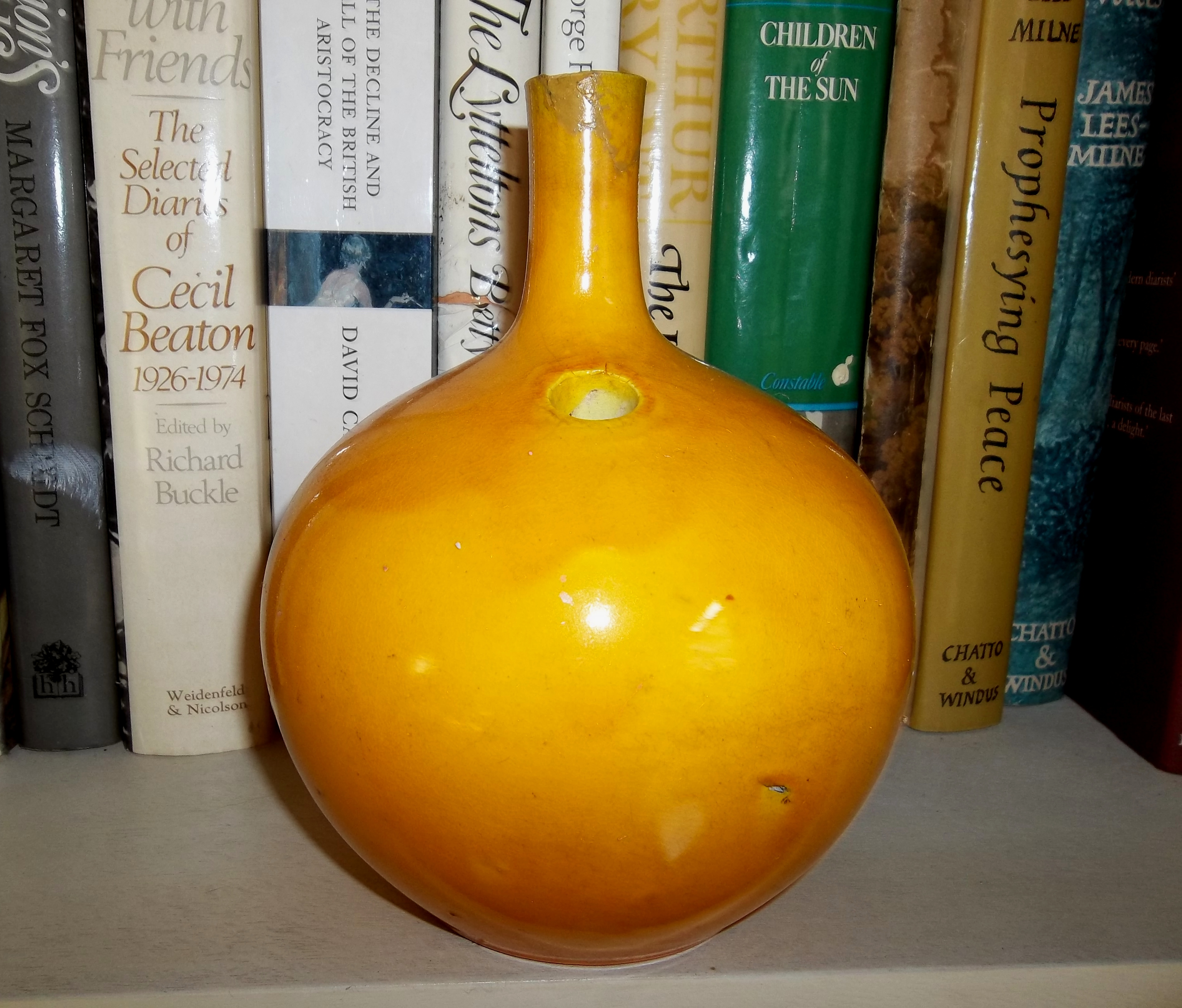
P.S. The picture is of an antique English drinking jar given me by my friend Andrea.

Food for threadbare gourmets

A faithful follower e-mailed me yesterday and asked if I had a recipe for Simnel cake. This is the light fruit cake that’s traditional at Easter, so I told her I’d blog it today. I use Nigella Lawson’s recipe with my own adaptations.

When I make it, I prepare the tin as usual, and then cream 175 g of soft unsalted butter with 175 g of caster sugar. Then mix 225 g of SR flour with half a teasp of cinnamon, a quarter of a teasp of ginger and 25 g of ground almonds. Add one egg with some of the flour mixture to the butter mixture, and mix two more eggs into the rest of the mix in the same way, before adding two tblsp of milk. Finally, fold in 500g of mixed dried fruit, plus some chopped glace cherries if you like them.

At this stage I put half the cake mix in the tin, roll out about 400g of marzipan, cut into a cake sized circle and place on the cake mix, then cover with the rest of the cake. Bake for an hour at 170 C, then turn it down to 150C and cook for another hour and a half. It’s cooked when it’s risen and firm. Let it cool completely on a rack before taking it from the tin.

When cool, paint the top with apricot jam, and roll out another 400g of marzipan and stick it on. With 200g of marzipan, make balls representing the eleven apostles – Judas surplus to requirements here – and stick them on using an egg white – beaten to just frothy. Some people quickly put it under the grill to make it look slightly toasted.

32 Comments

Filed under colonial life, cookery/recipes, culture, food, gardens, great days, life/style, philosophy, spiritual, Thoughts on writing and life, Uncategorized, village life

Ant or grasshopper?

100_0809

The weather forecasters are calling it an Indian summer. This appals me – sitting here looking out of the French windows, watching butterflies flitting over the hydrangeas, I thought we were still gently making our way through an antipodean summer. Has the time flown so fast that we are in that gap between high summer and early autumn? The din of the cicadas should have warned me, as should the scattered pink blossoms on the plum tree. This bewildered specimen flowers every autumn – fruitlessly – before doing its spring burst of glory.

Driving along the roads to town, the verges are blooming with the autumn flowering of scarlet mombretia which have spread through the long golden grass. White oxe-eye daisies grow in clumps among the mombretias, and there are still some red- hot pokers and a few roses flowering as I drive past unkempt hedge-rows bright with a heavy harvest of red hawthorn berries.

 If it was the northern hemisphere I would repeat to myself the old country lore that we must be going to have a hard winter, and nature is providing for the hungry birds. But we never have hard winters where I live, so I just savour the bounty with no fear for the future. Instead we long for rain.

Every year now we have a drought, and it becomes a struggle to keep the garden alive;  I use up our precious water to save the white Japanese anenomes for their burst of autumn flowering, and to stop the roses wilting. The purple salvia looks after itself. Glorious scented Jean Ducher, and bright mutabilis keep the cycle of roses going all the year round. And littered around the garden are the shallow plant holders filled with water for thirsty hedgehogs to drink, and where I also see wasps sipping and even a pair of snails making their way together down to the water in a deep bowl.

When I looked out of the bedroom window this morning at silent dawn, the sea looked like wet aluminium, the curve of bay on the distant horizon was steel grey, and the clouds overhead, silver- grey. But by the time I drove into town for shopping, the sun had come out.  The fields are so dry they are burned to a pale gold, and the pennyroyal is now flowering, making a carpet of purple.

That rich purple carpet always reminds me of when I was in France, staying in an ivy- turreted, moated chateau in deepest Vienne as a twelve year old… my best friend there, Josephine, invited me to go mushrooming with her and her maid, so equipped with baskets we set off to find “champignons”, chattering in fractured French and broken English.

Two little girls dressed in flowery cotton summer dresses made their way through long wet grass and dewy paths lined on either side with blackberry bushes heavy with fat juicy fruit as big as grapes.

 We walked through early morning mist, and it suddenly cleared. There in the bright sun-shine in front of us, stretched a shimmering field of tiny pale purple-blue flowers, with hundreds of miniature, deep blue butterflies hovering and fluttering above them. That world was alive with birds and butterflies.

Farmers here are feeding out to the cows already, and I fear for the thirsty birds and hedgehogs. As I drove past the agistement fields outside the village, I saw all eight mares spread out round the field in a circle, with their heads thrust deep into bright red plastic buckets; and by the side of each one, their long-legged foal stood patiently,  waiting for mother to finish.

At lunch with friends was a person I’d never met, who used to be a dressage and eventing rider. She told a fascinating story of when she was part of the NZ team at the Olympics when Mark Todd won his first gold medal. The New Zealand team were in third place when their last rider came on. This person did the round without a fault, but so slowly that the team lost forty points and slipped right down the order. Mark Todd, beside himself, strode up to the rider, and exploded; “Why did you do it?”

“I was saving the horse,” was the reply, to which Todd cried despairingly: “What for?” I have used this thought constantly since, so every time I go to save something, I ask myself, what for, and mentally come back to the present, and seize the day!

On my own the other day, I decided to lay my lunch on a tray and take it out to the veranda where I look down to the sea through the gnarled branches of spreading pohutakawa trees. It’s shaded from the mid-day sun by dappled light filtered through leaves of the white wisteria. Suddenly I thought – why not use my precious antique green French plates – and green wine glasses – and the best silver – what am I saving them for? This is not seizing the day, I chided myself.

This thought has spread into other parts of my consciousness… I’m raiding my store-cupboard – if not now – when ? Why not eat these goodies now?  Time to start emptying the deep freeze – what am I saving all this food for? Those pretty shoes – why not wear them today, even if I’m not going anywhere?

Maybe I’m becoming a grasshopper – singing the summer through, taking no heed for the morrow – and the prudent ant in me is having a hard job trying to make itself heard. But being a grasshopper seems to mean feeling much satisfaction, joy and being right here in the present. If not now – when? Saving it  – what for?  Two phrases which are life-changing, ring with truth, and which mean that other cliché – seize the day. So I’ve come to terms with the Indian summer, and revel in these days of softer sun and autumn flowers and golden trees.


Food for threadbare gourmets

It’s the time of year for the apple harvest. One of my favourite ways to use them for pudding when we have friends is to allow one apple per person. Take out the cores, and fill the hollow with brown sugar and sultanas, or as I usually do, with left-over Christmas mincemeat.

Put them either in an enamel dish or other oven-proof dish, but I love the homely look of an old-fashioned enamel dish for this. Pour cream and whisky over them to come up to about half an inch in the dish. Cover and bake until soft. They’re delicious served on their own or with a crisp biscuit, or for something filling, with a creamy rice pudding.

 Food for thought

“If we do not contest the violation of the fundamental right of free people to be left unmolested in their thoughts, associations, and communications–to be free from suspicion without cause–we will have lost the foundation of our thinking society. The defence of this fundamental freedom is the challenge of our generation,”

Edward Snowden NSA whistleblower and hero.


55 Comments

Filed under cookery/recipes, environment, flowers, gardens, great days, happiness, life/style, philosophy, The Sound of Water, Thoughts on writing and life, Uncategorized, village life

A summer storm

100_0841 - Copy

It arrived unannounced at roughly eleven- thirty in the morning. Before then it had been a quiet silvery morning, still silver sea, and pale grey sky. The wind built up, the clouds lowered, and rain flew in the wind. By evening it was a fully fledged storm and too good to miss, and I decided this was the day I tackled the hundred and fifty- seven steps up and down to the harbour, a trial of strength I’d avoided for too long since I twisted my ankle.

They led down through a ravine of tangled woods, and at the bottom as I stepped onto the wet sand there was a Buddha-like figure, a girl in a  faded pink jerkin sitting in the lotus position, meditating on the rocks. With this blessing at my back I carried on round the edge of the water, past a few old fishing cottages, now expensive sea-side dwellings.

Being a holiday, most of them had their families snugly tucked inside against the weather. Where they had their lights on in the grey day, I peered inside, approving when I saw walls of book- shelves, and enjoying a family gathered round a table eating their supper. A teenager was sitting on the branch of a pohutakawa leaning over the water, and when I waved, he waved back, his long arm a great wide semi-circle of  greeting.

The path wound round the edge of the harbour, sometimes deep in trees and woodland, and sometimes looking straight over the water with fishing boats at anchor swinging around in the wind and the waves. Promising myself to complete the circuit the next day I retraced my footsteps, and returned to the foot of the staircase leading up to the road.

A young man was now kneeling in front of the meditating girl, and as I approached she gazed at him with a look of such tender love that I flicked my eyes away and hurried up the steps so as not to disturb them.  Not that I could, even in bright red jacket and black trousers I was un-observed.

The hundred and fifty seven steps were not as bad as I feared, and I strode back along the road bent into the gale. Back to my end of the peninsula, where the shelter of the harbour no longer protected us, the great pohutakawa trees ringing the cemetery and leading out onto a little rocky peninsula bucked and swayed in the tempest. It wasn’t even high tide, but huge green waves were surging onto the rocks and white spray flying through the air.

As I looked down onto the rocks, and leant against a tree trunk to avoid being blown off myself, watching the hungry waves hurling themselves against the rocks, and the boiling white water swirling around them, it truly felt like ‘the cruel sea’.

The sound of the water and the trees was deafening, and mesmerising. There was nothing else outside this circle of wind and waves and sound and solitude. Impossible not to be totally present to the wild beauty and magnificence.

Finally the wind became so furious that I felt I had to make a dash between lulls. But there were no lulls, so I made a dash anyway, and  wandered back through the cemetery – which is still full of the stuff of life – one grave –stone facing out to sea inscribed:  “ He loved life and his fellowmen”,  another, saying: ”Sleep on grumpy” and another, telling passersby that this man had left Scotland for this new world, in 1865. His gravestone was at one end of a miniature cricket bowling pitch, with three stumps set in concrete the other end.

Reluctant to leave the aliveness of the storm I stood on the edge of the cliff, and wondered where had all the birds gone – no gulls or pigeons, tuis or doves. Somewhere dozens and dozens of birds were silently riding out the storm in places that no human could see.

We don’t have to worry about ‘those in peril on the sea’ these days. Fishing boats stay at anchor when they get the weather forecast and the big ships can ride out the storms. This storm, unlike so many others around the world, caused no harm or hardship. So savouring the elements is a guilt-free pleasure, and those like me, far from city pavements, are so privileged that we can. But maybe more importantly, this pleasure has a spiritual dimension,  since it’s also an acknowledgement of our beautiful and irreplaceable planet.


Food for threadbare gourmets

I’ve had so many people dropping in for various reasons, that rather than make a cake I’ve been making a succession of scones- fresh out of the oven, melting in the mouth, served with unsalted butter, strawberry jam and cream, they always disappear quicker than the proverbial hot cakes. They’re so simple to make, and I never add sugar, currants, cheese, or chopped anything. They are perfect just as they are.

Put six spoonfuls of self raising flour in a bowl with an ounce to an ounce and a half of softened butter. Rub it in, break an egg into a well in the centre and add half a cup of milk. Just mix it altogether with a knife, adding more milk if needed. It should all come together into a soft dough. I simply press it down on the pastry board, at least an inch thick, and cut it into squares. Half an hour in the fridge, covered is good for them. Bake on a floured or greased tray in a medium to hot oven for ten minutes or until raised and slightly brown. The trick is to serve them at once !


Food for thought

Blessed is the influence of one true, loving human soul on another.

George Eliot  1819 – 1880  Great English novelist

(New Zealand readers might be interested to hear me being interviewed on Kim Hill’s programme on Saturday morning, choosing favourite records and talking in between)

http://www.radionz.co.nz/national/programmes/saturday)


24 Comments

Filed under birds, environment, spiritual, The Sound of Water, Thoughts on writing and life, Uncategorized, village life

Summer song

100_0751

Walking around the cemetery on New Year’s Eve the sky was still and clear, no silver, almost transparent moon yet, rising above the sea looking like a silver sliver of dried honesty in the pale night sky. Instead there were gulls circling silently and intently overhead, weaving endlessly in and out, never touching or interrupting the arc of another bird.

After a while I chose one single gull, and watched its movements, following its wide circles and trajectories and swoops until finally it headed out to sea in the direction of Little Barrier Island, which hovers, misty indigo, on the horizon.

It felt like a holy silence, the tracery of the gulls’ flight woven like a network of silver filaments overhead, the cemetery a cathedral, silent, sacred and undisturbed. The Universe may have been un-aware that it was New Year’s Eve around Planet Earth, but surely that thought -form which meant we were all conscious of this moment in time, must have created that charged and sacred energy which I was feeling then.

Today it has rained. Things can start growing again, and I can stop watering – for a few days anyway. The countryside has the richness of high summer. The trees are billowing with green foliage, the fields have been cut for hay, and the grass in the meadows is so high that when the calves lie down, their heads just peep out of the tops of grass heads, plantains, buttercups and clover. I thought I saw a flight of big brown butterflies the other day, and it was the tips of their velvet ears reaching out of the pasture. The thrush in the garden sings continuously between pecking at the apple nailed to the top of the fence.

Tonight I was strolling round the cemetery, and the harbour below was the deep dark green of an Arthurian mere. It was as still as a mere too, and the boats at anchor were reflected with perfect clarity. Turning to face out to sea, the ocean was quite colourless with a deep band of blue on the horizon.

I’m constantly re-filling the dogs’ water bowl by the pavement. I hear them slurping away, as people walk past to the beach, thirsty Labradors and dobermans, bitzers and bichon frises, poodles and pointers… even a bulldog.

Earlier today, reading James Lees-Milne’s diaries, listening to the summer rain, I discovered his description of an English summer night in 1946: “the smell of new-mown hay and hedgerows, of eglantine and elder… how I love these long gentle Shakespearean summer evenings…”  Me too. The scent of the queen of the night comes drifting in from the open window at night here. It’s sweet and lovely… but I miss that indefineable atmosphere of those English summer nights.

Those nights throb with nostalgia and a richness. Somehow, it’s as though the layers and layers of lives lived in those parts, the echoes of history stretching back beyond memory and beyond record, the people in the millenniums before Christ, who trod out the ancient paths that still thread across hills and ridges and valleys and fords, can all still be sensed. The voices are silent, but their presence still lingers, as one century after another passes across the meadows and the woods.

The oak and the ash, the hazel and the hawthorn, the holly and the honeysuckle have been growing there since the last ice-age twelve thousand years ago. The smells, the sweet blossom, the new mown hay, the whiff of manure, the fresh rain, the damp leaves, have smelt the same in every age and every summer since. Standing in a quiet English lane on a soft summer night, you can feel those long centuries, and it is very touching.  I haven’t experienced a summer evening for a long time. I’ve always been back in autumn or in winter. But I must savour a June night once more!

Feeling homesick for the English country-side, I got “Far from the Madding Crowd” and “Tess of the D’Urbervilles off the top shelf of the book-case, and had an orgy of Hardy. Tess first, and the sweetness of Talbothays farm, then Bathsheba and her story… I read it differently this time, not so much for the drama of the story, but for the feeling of the country.

So I really took in for the first time, the delicious characters of the farm-folk, and the details of farming life, from the signs of an approaching storm, to the rituals processing through the year of lambing and dipping, and fattening and shearing, to the yearly sheep fair, the shearing supper and the harvest supper.

It was a way of life which had existed for over a thousand years when Laurie Lee in the enchanting ‘Cider with Rosie’, told the story of his childhood, and an archaic way of life  which then vanished forever, with the combine harvester, chemical farming, agri-business and of course the destruction of communities  by the carnage of the First World War.

I’m always struck in Hardy’s books, and in Jane Austen’s letters, by the isolation and “localness” of country life back then. So many people hardly ever left their village, unless they were gentry, and the next village was a foreign country. So when people fell in love in these tiny societies, and lost the object of their affections, through death, departure or rejection, there was often no-one else to love. People literally did grieve and die in different ways, from broken hearts.

Hardy’s description of the hopeless love by the dairy-maids at Talbothays farm for the un-attainable gentleman, Angel Clare, had the unmistakeable ring of truth.  I remembered from closed societies I lived in when I was young, whether in an English village, or a tiny colonial community far away from any other European habitation, how intense relationships were when there were no others. No-one could console themselves before the population explosion, and peripatetic habits of the twentieth century, that there were plenty of other pebbles on the beach. There weren’t.

Yet now, though I live in a tiny village with only four hundred souls, we are no longer prisoners of geography. Not only do people take off to holiday in Alaska and Italy, and their families return from Vancouver and Hanoi, but we all have the world of the internet at our fingertips, to use that well-worn, but accurate cliché in this instance.

It’s eighty- six years since Thomas Hardy died, and in those years our worlds and our lives and maybe our minds have expanded beyond imagining. The world is our village, and the internet is our community. There are pebbles past counting and wherever we direct our vision, we can find the glory of summer somewhere around the globe at the push of our buttons.


Food for threadbare gourmets

Apart from being full of healthy fats, potassium and Vitamin E, avocados are delicious.  I sometimes use them as a dressing over a salad. To one avocado you need  ground coriander – I use a quarter of a teasp, but less is more… the juice of a lime or a lemon, quarter of a teasp of ground cumin, a tblsp of apple cider vinegar, salt, and about half a cup of water. Whizz these ingredients until smooth and creamy, and use straight away.


Food for thought

To write or even speak English is not a science but an art. Whoever writes English is involved in a struggle that never lets up even for a sentence. He is struggling against vagueness, against obscurity, against the lure of the decorative adjective, against the encroachment of Latin and Greek, and, above all, against the worn-out phrases and dead metaphors with which the language is cluttered up.

George Orwell, English writer 1903 -1950.  Wikipedia records that : ‘His work is marked by lucid prose, awareness of social injustice, opposition to totalitarianism, and commitment to democratic socialism.’ Animal Farm and 1984 have continuing relevance.


61 Comments

Filed under birds, books, consciousness, cookery/recipes, culture, food, great days, history, jane austen, literature, love, The Sound of Water, Thoughts on writing and life, Uncategorized, village life

Midsummer Christmas, dawn to dusk


100_0758100_0650100_0760100_0624100_0772100_0584100_0767100_0730It would be good to find some quiet inlet where the waters were still enough for reflection. where one might sense the joy of the moment, rather than plan breathlessly for a few dozen mingled treats in the future…
Kathleen Norris

50 Comments

Filed under environment, flowers, food, great days, happiness, life/style, philosophy, Thoughts on writing and life, Uncategorized, village life

Days of wine and roses

100_0503

It’s been the one of those glorious days when ‘cherubim and seraphim are casting down their golden crowns around the glassy sea.’  Silence… a small white yacht gliding over the still shining water, scarcely leaving a wake, using the engine because there’s no wind for the sails… the islands we never normally see, floating on the horizon, palest purple against a lavender blue sky… an enchanted stillness, the only sound the cooing of the doves in the trees.

When I awoke this morning the sky was just turning pink, so early though it was, I jumped out of bed, dressed, and headed out to watch the rising sun across the sea. The dawn chorus was just beginning, so I turned around and walked by houses with curtains drawn and solitary gardens, thrush and blackbird seeming to pass me on from one song to the next.

Theirs was the longest and sweetest serenade, while the soft incessant cheeping of the sparrows filled the spaces, and the slow crescendo of the doves cooing began. As I retraced my footsteps back along a grassy track, I saw with pleasure that mine were the only footprints in the dewy grass. I never met another soul as I meandered around the sleeping village.

Back home I crossed into the cemetery and disturbed a couple of speckled hens who scurried  fussily back into their own garden next door, clucking agitatedly. I walked across to the end of the peninsula to get my daily fix looking out to sea through the grey gnarled branches of the ancient pohutakawas.

Later, I sat on the veranda feasting my eyes on the glittering water, with breakfast of toast and a boiled egg from the errant chickens. When I had visited their owner Kate the day before, she had given me a handful of newly laid eggs, and the one I ate now was so beautiful I could hardly bear to break the shell. It came from her oldest hen, she said, a black Arakan, a breed which presumably comes from Arakan in Burma, and this little black hen lays eggs of the same pale blue as the sky today.

During the morning I went to the next village to buy a birthday card for a man. No flowers then, and since most men’s cards are covered with the inevitable cars or golf clubs, I did some lateral thinking and came away with a card with a message: “ If you resolve to give up drinking, smoking and loving, you don’t actually live longer: it just seems longer.” My son-in-law will be delighted with this encouragement to enjoy these permitted pleasures.

Stopping off at the garden cafe down a long avenue of poplars, the vivacious young Indonesian proprietor greeted me as usual with: ‘Ah Miss Valerie, are you ready for your coffee today?” Since she always jumps the queue for me, and makes piping hot coffee I can forgive her the spinsterly ‘Miss’. I sat in an ivy- covered alcove framed with late wisteria blossom and white jasmine, their scents wafting over the smell of coffee.

Before getting home, I called in on Friend, to collect various things from yesterday’s rollicking party for 45 oldies who came from far and wide. Others were there too to collect their vases, or napkins or fish slices. “The sun’s over the yard arm”, announced the man of the house, which though it was only lunch-time, gave us the excuse to finish off the champagne from the previous day.

Then, we had sat on the terrace in the sun, looking out over the turquoise sea, the lawn fringed with white iceberg roses in full bloom, and red roses lining the long white table cloths.

We’d enjoyed a four course lunch, starting with a terrine followed by freshly baked ham, salmon and asparagus, the cheese course – big rounds of fresh Brie, fresh strawberries and blueberry tarts – each course accompanied by different wines and champagne –French of course! And finally the birthday cake, a pyramid of moist chocolate brownies and truffles. In other words a feast! And all made by friends.

At the end of the afternoon someone brought out a guitar. We sang ‘Blowing in the wind,’ ‘Michael row the boat,’ ‘Kumbiya, ‘He‘s got the whole world in his hands’… all the old favourites. I sang my heart out, and had to restrain myself from dancing.

But as a somewhat acid -tongued acquaintance observed to me, all the men were glued to their seats – and they all look alike, she said. “They all have white hair, and are wearing the same sort of blue and white checked shirts, most of them have walking sticks and a lot of them have paunches!” The women on the other hand, were younger, sprightlier, beautifully dressed and immaculately groomed.

That evening several of the guests came to dinner, though we couldn’t eat much. We sat on the veranda in the dusk, by the loquat tree covered in golden fruit, with a fat green and white wood pigeon rustling around swallowing them whole. We had wine and laughter and fun, discussed everything irreverently, and enjoyed the party all over again.

Days of wine and roses and golden laughter  …when I returned flushed with champagne from Friend today, I found another generous neighbour had called while I was out, and left a bag full of freshly picked broad beans hanging on the door handle.

They were so delicious that for supper, I simply ate a dish of the tender little green jewels glistening with hot butter, though the old chap had steak with his. And I’ve just returned from the field above the harbour where the two little white goats live. They feasted on the broad bean pods, and seemed to feel the way I do about them.

‘Gather ye rosebuds while ye may’, wrote the poet, ‘Old time is still a-flying’, and I’m dedicated to this advice…. my rosebuds may be different to other people’s ideas of rosebuds, but I’m picking them as fast as I may.

So I sit here on the veranda writing, watching the evening sky turn pink and lilac and pale turquoise over the still, silver water, the scent of sweet peas, a gift from a friend’s garden drifting through the house, and savour my blessings. I began with the words of a hymn, so I’ll end with some. These shining days are filled with rosebuds – moments of pleasure and goodness – friends and fun and flowers, chickens and birdsong and beans, ‘all things bright and beautiful, all creatures great and small’.


Food for threadbare gourmets

The strawberry season means Eton Mess for me! The first time I tasted it was just outside Eton, at a place called Datchett, at a rather grand dinner to entertain some visiting Argentinian polo players who’d been playing on Smith’s Lawn at Windsor. My best friend and I knew we were only there simply because they needed some girls to balance out the chaps. But we gave the food a lot of attention too.

The version I ate then was a variation, because the crushed strawberries and broken meringue were pressed into a big dish of ice-cream, and then re-frozen. Whipped cream was piled on  when it was served, on a huge carving dish. I like doing it this way too, using freshly made local artisan ice-cream. Really, the amounts are up to you… you can’t go wrong. As an added touch I sometimes whizz up a punnet of the fresh strawberries with some sugar, and hand that round in a sauce bowl, to drench the already sumptuous mixture in it! Food for the gods….


Food for Thought

He had picked it up, he said, on a beach; it was a piece of sea-washed wood in the shape of a human head. It was made of hard wood, shaped by the waters of the sea, cleansed by many seasons. He had brought it home and put it on the mantelpiece; he looked at it from time to time and admired what he had done.

One day he put some flowers round it and then it happened every day; he felt uncomfortable if there were not fresh flowers every day and gradually that piece of shaped wood became very important to his life. He would allow no one to touch it except himself; they might desecrate it; he washed his hands before he touched it. It had become holy, sacred, and he alone was the high priest of it; he represented it; it told him of things he could never know by himself. His life was filled with it and he was, he said, unspeakably happy.

From Krishnamurti’s Journal


59 Comments

Filed under birds, environment, flowers, great days, happiness, life/style, philosophy, spiritual, The Sound of Water, Thoughts on writing and life, Uncategorized, village life

Ancient Rituals and a Modern Valkyrie

100_0117As I write I can hear soft rain falling, punctuated by the larger sounds of drips from overloaded leaves, and the swishing of the sea on the rocks below. The pink-breasted doves are cooing contentedly, bringing a sense of peace– all eleven of them,  who now enjoy two free meals a day. It feels as though the village is in rest and recovery.

 A few days ago a man died just beyond our village boundaries. He was the Maori chief and landowner for this area, and had great mana. He was a noble, handsome man respected by everyone, and had a striking, beautiful Pakeha (European) wife, whose dignity and courage matched his. Their marriage was a triumph; she accepted and lived by the local Maori customs, as well as keeping her own integrity, and creating a life of art and culture, warmth, and hospitality. She introduced visitors to the long, empty, pale gold beaches on their land, edged by the rolling blue Pacific; and she kept a herd of nearly a hundred horses, for tourists and locals to ride. She worked hard the way only those whose lives are committed to the wellbeing of horses will know.

 The chief was buried at the Maori marae, which lies across the harbour from where we live. The marae is the spiritual centre of Maori life, and the tangihanga – the funeral – is the most important ceremonial that takes place there, taking precedence over every other activity. The body lies on the marae for at least two days before the day of the funeral, and is rarely left alone. Friends, family and members of the tribe come from near and far, dressed in black, and the women often wearing green leaves in mourning wreathes around their heads. They look wonderful. They will talk and sing to the person lying there, recalling both good and bad things about them, laughing, joking – all expressions of grief are encouraged and accepted.

 The person who has passéd is commanded to return to the ancestral homelands, Hawaiki,  by way of ‘the spirit’s journey’ –  te rerenga wairua . Close kin do not speak. On the last night, the ‘night of ending’, the pō whakamutunga, the mourners hold a vigil and the coffin is closed. Then either at night or dawn on the third day, the funeral service is conducted, and when the burial rites are complete, a hakati – feast – is served. Everyone who attends brings their share, or gifts called koha.

 And when it’s over, the home of the dead one is ritually cleansed with songs, chants and prayers called a karakia and desanctified with food and drink, in a ceremony called takahi whare – ‘trampling the house’. That night, the pō whakangahau  – ‘night of entertainment’ – is a night of relaxation and rest. And after these powerful and therapeutic rituals  the widow or widower is not left alone for several nights following.

 So when our chiefly neighbour died, mourners travelled from all over the country, including the famous and powerful, to participate in the tangi. The ceremonies on the last day took from ten in the morning to four in the afternoon. At the same time, another villager died. He too was a distinguished man, a Pakeha, but he had no children and no family. He wanted no ceremony or funeral. ‘So we can’t say goodbye,’ sorrowed an old, old friend…

 While this has been going on, I’ve joined for the first time, the annual village winter ritual of having the flu, and as the second week dragged on found myself irritated that I couldn’t even have flu to myself, but had to start nursing my husband as well. Late last night after a second bad fall, I couldn’t move him, so called out the Volunteer Fire Brigade, the local version of guardian angels. It took three of them to get him off the floor, and I then began a chase after the ambulance to hospital an hour’s drive away. Leaving him to be diagnosed and pumped full of drugs, I drove home to bed at three thirty in the morning.

As I made the most of this drama to the statuesque and very beautiful young woman who comes to clean, I asked how her week had gone. Not as exciting as yours, she disclaimed modestly, before regaling me with the story of her horses. She has two. This particular night she had joined friends at a farewell fancy dress party, and worn, she told me, a glittering sequinned body stocking for the first time in her life, accessorised with a net skirt covered in sequins. As the party raged, she received a text saying her horses were loose, and had last been seen galloping in the sea at a nearby village.

After several nerve-racking hours, with reports of them all over the place, she finally ran them to earth in another bay. Abandoning her car, she rode bare – back on one, leading the other by a halter, body stocking glowing in the moonlight, sequins glinting, and net skirt billowing in the wind. ‘I was just glad no police ever clapped eyes on me,’ she said, ‘they’d have thought I was high on something!’

I wish I’d seen her, a magnificent, glowing Valkyrie beneath the shifting clouds and silver moon. As we laughed there was a knock on the door, and there was one of the firemen from last night come to see how I was, one of many others , family, friends, neighbours who’d rung or enquired how we all were.

Life and death, laughter and rain… the village is breathing, the rhythm of the sea encircles us, the in-breath and the out-breath of the universe continues, the heart-beat of life and death still pulses. The ancient rituals ease the transitions, the soft rain cleanses and refreshes; we are in rest and recovery, and the unknown road still stretches mistily ahead for us all. ‘We may not be taken up and transported to our journey’s end, but must travel thither on foot, traversing the whole distance…’ And in this small world we live in, we know we are in good company.

 Food for Threadbare Gourmets

Wanting something light and easy, I found an old recipe for ten minute cheese soufflés. Separate the eggs and yolks of two eggs, and mix the yolks with salt, pepper, a pinch of cayenne and a little mustard. Mix in two dessertsps of grated cheddar cheese, and then fold in gently the whipped egg whites. Fill two thirds of well greased individual soufflé or ovenproof dishes, and bake in a hot oven for six to eight minutes until well risen and golden brown. Serve at once. This amount makes three to four small soufflés. I’m thinking they’d be a nice easy first course for dinner with friends.

Food for Thought

I loved this foodie thought from writer Lawrence Durrell ( 1912 -1990): ‘The whole Mediterranean.. all of it seems to rise in the sour pungent smell of these black olives between the teeth. A taste older than meat, older than wine. A taste as old as cold water.’             Just reading these words makes me feel the heat, smell the scent of thyme and rosemary, and long to savour some strong red local wine beside a lapis lazuli sea….

53 Comments

Filed under cookery/recipes, culture, great days, life and death, life/style, love, The Sound of Water, Thoughts on writing and life, Uncategorized, village life

Places in the Heart

100_0223The printed word has a lot to answer for and has changed the course of many lives.

On this occasion when it changed mine, I was cursorily scanning the personal columns of the Daily Telegraph looking for somewhere to live. My husband was away with his regiment on manoeuvres or practise camp, and I was filling in the trying gap between the baby’s ten o’clock and two o’clock feed.

We had to find somewhere to live for a year, and this night I found a few lines offering a country house in the right area for nearly the right price – for a year. The next day I rang. The owner was delighted – he was off to Greenwich Naval College and wanted someone to keep his house warm. “Chudor, ya’ know,” he told me, listing the bedrooms… We arranged a time that weekend to inspect the place, and when my husband returned the next day he went off on what he called a recce. He came back looking rather panic-stricken. “It’s bigger than Hampton Court,” he said, “and looks like it too, all red brick.”  Undaunted, I persevered, rather fancying the idea of a stately home. We’d never be able to heat it, he argued, and then I saw the light – with an eighteen month old and a four month old, that mattered.

So I returned to the personal columns, and struck gold a week later. “This one sounds OK”, I said,” right area, right rent, and only five bedrooms” (my ideas had expanded considerably since my brush with Layer Marney Towers the previous week). I rang the owner – same story – wanted someone to live in it for a year, this time while he wound up his boat building business in East Anglia. “You’ll love it,” he said, “there’s the garden bedroom, the oak bedroom, the red bedroom, the four poster bedroom, and the end bedroom…” My husband panicked again.

But a few days later we set off on a light June evening driving through quiet Essex lanes, with honeysuckle and dog roses winding in among the high hazel, hawthorn and elderberry hedges. We found Newney Hall dreaming between fields and hedgerows, a small lake – which in the twilight was almost black, and edged with a tangle of lilacs and shrubs – lying between it and the road. The house, Tudor red brick, and Essex pantiles on the upper floor with casement windows, stretched beyond the lake, reaching into a circular lawn with a cedar in the middle. Beyond that, a walled orchard.

As we walked down the gravel drive I could hear the sounds of music coming from the house. A knock on the door revealed a rather vague looking woman with a viola tucked under one arm, and the bow held in her other, as though she could hardly bear to stop between bars to open the door. “George!” she called imperiously, and the seigneur hurried to welcome us. Within minutes the deal was done, and we moved in a week or so later.

The house had been built in the time of Edward the Sixth, Henry the Eighth’s son, and all the land around had been gifted to Wadham College, Oxford in the same reign, so nothing in the landscape had changed for over four hundred years. The fields and trees, lanes and barns were untouched by time, and since there was no sound of traffic, no jet planes practising, and only occasionally the sound of a distant tractor, the whole place lay wrapped in an almost primeval peace. There was no other house in sight.

Wood pigeons cooed incessantly somewhere in the trees, cocooning us in their summer sounds, the donkey in the next field brayed occasionally, the cows mooed as they shambled past to the milking shed at the farm beyond the house. The old red-tiled barns, grain sheds on staddle stones, and stables were laid out around a square, where the cows sheltered in winter. I walked across to the cow- shed every day with a baby on my hip, my eighteen month old trotting beside me, and carrying a big cream- ware jug to collect my fresh milk. We also went there to pick up new-laid eggs from the farmer.

The house was built from huge beams, and filled in between them with a mixture of mud and straw. They were plastered over, and the walls were about three feet thick, with deep window ledges where I put books and vases of flowers. Two old aunts had been living in the house before expiring and gifting it to George. In the mid-sixties they were over ninety, and the house was unchanged since the days when they had been born back in the 1870’s. So was the dust. When I moved an antique chest of drawers to dust behind it, a thrush disintegrated into fine powder.

I spring cleaned from top to bottom, washed curtains, scrubbed floors, polished Sheraton  tables and dusted Chippendale chairs. It was like living in a time warp. No heating, a gas stove so old I’d never seen one like it, and neither had the serviceman when he came. If it’s working, best leave it, he said, shaking his head. I had a big kitchen with a big square scrubbed table in the middle, red and white checked tile floor which needed scrubbing every week, and a real larder with marble slab. My only gadgets a pop-up toaster and a wooden spoon!

At weekends a stream of friends came through, a childhood friend getting used to having MS, school friends with their babies and husbands, army friends with theirs, a friend of my husband, shell- shocked after being court- martialled – a Polish/ French student who had nowhere to go, a girl who was pregnant and needed somewhere to stay – she moved on, didn’t like my food, I think – cousins, godparents, in-laws, family… and then back to primeval peace during the week.

Once I dumped his steak and kidney pudding and vegetables on my husband’s head. Mistake. Apart from reprisals, lots of cleaning up to do. And later, I lay in the long sweet smelling grass in the orchard, where I’d seen the red fox glide through, and cried my eyes out under the late evening summer sky. At twenty six I thought no-one would ever love me again.

Not long after, we left that beautiful house to go to Hongkong, where the hectic life and chaos of those times obliterated the memories of that year in the country. But for years I have dreamt of it. In my dreams it’s bigger, and there are many more rooms. The furniture is more elegant and the rooms more beautiful. There is one room which is filled with such treasures that I only go into it sometimes… it feels sacred. I have no idea why I dream so often of this house I lived in for a short year so long ago. I don’t know what it symbolizes. I’ve lived in other houses and places just as magical…  no doubt a psychologist would mine some profound Jungian theory from these dreams, delving into the unconscious and maybe coming up with an archetype!

Daphne du Maurier was obsessed with Menabilly the house she immortalised as Manderley in ‘Rebecca’,  and wrote about her dreams of it, while another writer, Elizabeth Bowen, clung to the memories of her ancestral home in Ireland, Bowen House. Evelyn Waugh immortalised Lygon Hall in his book ‘Brideshead Revisited’.  Like du Maurier writing about Manderley, Waugh’s writing about Brideshead breathes love, nostalgia and an ache, a longing to return.

It isn’t just writers who long for these enchanted places from the past. It’s as though the romance of their lost beauty, surrounded by dreaming country-side, grows tendrils into the heart which can never be untangled. …  and this is not just the experience of a few. For some, it’s the house by the sea, for others, the log – hut in the wood… a longing perhaps for memories of happiness and holidays past, innocent times of laughter and love, for the sweet days of years gone by. It rarely seems to be a house in town that arouses these emotions … mostly these lost demesnes are part of an idyllic landscape. As the years go by, these landscapes become almost mythical places of perfection…

And once we’ve left, we can only return in our dreams. Though we have left something of ourselves behind in these special places, it is a different self, a younger self seeing the world as it was then. To return in the physical is to invite dis-illusion or disappointment. Things change, new owners improve on the simplicity that we treasured, the light is harsher, the house smaller, the garden neglected or smartened, trees and shrubs overgrown or cut down, the lake stagnant, and nothing is the same. So memories and dreams are the best we can have. And they are precious, and time cannot warp them or fade them. These are our private, personal paradises – our places in the heart.


Food for Threadbare Gourmets

Friend popped in for a girl’s drink. I still had some delectable rose from lunch together a couple of days before, so she came to help me finish it. Too late to get to the shops, I found I had nothing to nibble… no thin brown bread for smoked salmon and lemon juice, so blinis  were fished out of the deep freeze, but then I had no cream cheese.

So I improvised by hard boiling a couple of eggs, slicing them thinly, and placing a slice on each buttered blini. Next layer was mayonnaise on the eggs, and lastly the salmon with a sprinkling of parsley. I cut the salmon in two pieces for each blini, so it was easy to bite them without wrecking the whole edifice!  They went down a treat, and we had a happy hour laughing at ourselves and the world, before returning to the inescapable task of feeding our always hungry husbands.


Food for Thought

“’One pure act of acceptance is worth more than a hundred thousand exercises of one’s will,’ since it is a state of interior silence and quietude from which at the right time, the right action emerges without any volition.”

From ‘Taoism – The Way of the Mystic’  by Jean C Cooper 1905 – 1999  Born in China to missionaries, she grew up learning about Confucianism, Taoism and Buddhism from her amahs. After studying philosophy at St Andrews, Edinbrugh, and lecturing in comparative religions, she lived with her husband in a remote Cumberland home (the lake district) where she had to generate her own electricity from a stream.


70 Comments

Filed under birds, cookery/recipes, family, great days, happiness, life/style, love, spiritual, The Sound of Water, Thoughts on writing and life, Uncategorized, village life

Storms of Delight

100_0377I awoke to the roaring of a savage sea hurling itself onto the rocks below. The window is always open so that I can hear the sea.

Looking out, it was a grey wolf sea, with a steel-grey haze obliterating the islands that hover on the horizon. White capped rollers raced in across cruel grey and glacier- green water, and when the waves hit the rocks spilled over in sheets of white foam blowing high in the air. Low tide is almost more spectacular than high tide, because the water hits the rocks instead of flowing over most of them.

 Later, I put on a hood and jacket and walked out into the storm. The wind was thrashing the trees and making much the same sound as the roaring sea. First I walked to the garden of some friends overlooking the little harbour. It’s usually like a shining green jewel set deep in high rock and forested walls. It was calm, the only sign of the storm being the muddy-looking water.

 These friends own the goats and are away overseas for some weeks, so I pocketed the lemons lying under the tree. It was only a little tree, but had been so nurtured and well fed, that where one lemon would normally hang, between five and ten weighted down each fragile branch. The scent of the blossom still growing swirled round the tree before flying in the wind.

 As I walked down their long drive, between two rows of palm trees, three little speckled red hens came running out of a nearby garden, and solemnly picked their way behind me in single file. I felt like turning round to stroke them, but they weren’t keen on this. The way they followed me reminded me of Konrad Lorenz’s imprinted geese, and I hoped these little hens weren’t busy imprinting themselves on me. They gave up in the end, and returned home to where their supper was awaiting them in the hands of a pretty girl in a cream poncho.

 Strolling back in the flying rain I walked down the cul de sac to say hello to the three goats, and give them a little leafy, twiggy treat. Robert, the grumpy old billy- goat, would keep dropping his mouthful in order to snatch the little darlings’ twigs from their mouths. So I had to do a dodgy dance to try to fend him off while the babies managed an uninterrupted munch for a few minutes.

 As I turned round to come home, I heard a piteous whine. It was Zeb, the black and white pointer who lives opposite the goats, and sometimes escapes to come and see me. She had her head to the fence, hoping I’d come and say hello to her too. Of course I did, and while I was doing so, Kate, her owner, came out and asked if I’d like some new-laid eggs. Would I? So when Zeb and I had finished our tete- a- tete, I returned home the delighted carrier of six fresh eggs.

 I laid them carefully with the glowing yellow lemons on the garden seat at the top of the steps, and continued my wander in the storm. We live on a tiny peninsula sticking out into the sea, our house facing one way, and on the other side of the little neck of land, the old village graveyard faces out to sea in the other direction. Beneath spreading trees, it holds the graves of the earliest settlers in this place, and the latest inhabitants.

 I walked on the wet grass between the graves, heading for the end of the cemetery where it ends in a deep crevasse where the sea throws itself against this neck of land. Here I look down on a flat rock fifty feet below. The seas crash over it in rough weather, or lap against the sides on calm days, revealing tempting still green depths and white rock below the waterline, where I’d love to swim if I could get down there. Today it was almost invisible beneath thick sheets of green water swirling over it and spumes of foam flying through the air.

As I stood looking down here, as I so often do, I realised that every time I come here, I think of Pincher Martin, and William Golding’s description of hell. Pincher Martin scrabbling desperately to escape the raging seas, and clinging onto the slippery rock and slipping back down again into the tormenting cauldron of murderous waves… over and over again … not a pleasant remembrance, and one I try to banish, but it always comes back … just as I never see the spire of Salisbury Cathedral, in the flesh or in pictures, without thinking of Golding’s ‘The Spire’ and his painful story of spiritual disintegration. Thank goodness I’ve avoided reading ‘The Lord of the Flies’, as I know I would be tormented by that too.

Today, the wind crashing through the old pohutakawa trees – which were probably growing here when my hero, Captain James Cook sailed past in 1769 – was bringing down lots of small twigs and gnarly broken branches. When they’re dry they’re wonderful to start the fire with, and the peasant in me can’t resist gathering bundles. This was a successful foray and I returned home with a big armful of wet branches and twigs to dry out in the garage. Pohutakawa trees grow to the size of a good oak tree, and have dark green, hard, crunchy leaves all the year round. They’re sometimes called the New Zealand Christmas tree because at Christmas they’re smothered in flaming red blossom, and here, where the whole coast is ringed with them, they are a unique sight.

 And so back home to a blazing log fire, with the haunting and tender sounds of Handel’s opera Julius Caesar still ringing through my head. I went to see it for the second time in three days yesterday, five hours of it, and would see it again – and again, if it was available. Today I Googled Caesar and Cleopatra, since I only knew of Anthony and Cleopatra. And yes, Handel hadn’t messed around with history, Caesar and Cleopatra had had a love affair, she had borne his only son, and she stayed with him in Rome until his assassination.

 So well before her alliance with Mark Anthony, she had loved Caesar, and he her.Knowing this made the exquisite songs of their love affair in opera seem even more poignant.Cleopatra inveigled her way into Caesar’s presence rolled up in a carpet, and in the opera sang a song of enchantment for him. I read somewhere that Cleopatra’s glorious song to Caesar:  “v’adoro pupille” (I adore you, eyes,) is the most seductive love song ever written. I can believe it. In Natalie Dessay’s version she didn’t seduce, she poured out her heart. It was beautiful.

 And this life seems so beautiful too, with all its gifts and grace notes, allusive thoughts and memories, the stormy seas and wild winds, the hens and the goats, the centuries of music and aeons of love, the lemons, the eggs and the firewood!


Food for Threadbare Gourmets

 The pantry was bare. So I made a treat I haven’t made for years – cheese aigrettes. All I needed were things like eggs, flour, and grated Parmesan which I always have in the deep freeze. So into a saucepan went two oz butter and half a pint of water. When boiling I added 4 oz flour and stirred hard until the whole mixture was coming away from the sides of the saucepan, leaving it clean.

 Off the heat I mixed in 3oz Parmesan and two egg yolks, beating them in separately. Add salt and pepper, and then fold in the stiffly whisked egg whites.That’s the easy part. When the mixture is cold, drop small rough pieces, about a teasp size or bigger, into hot fat. Don’t fry too quickly or the outside will brown before it’s cooked inside. But if the fat is too cold, the aigrettes will become greasy. It takes about four minutes for  each batch to cook.

Fish them out with a slotted spoon onto some kitchen paper to drain, and serve with grated parmesan sprinkled over, and a dash of cayenne pepper. With salad, they’re crunchy, filling and delicious.

 Food for Thought

 Life, for all its agonies of despair and loss and guilt, is exciting and beautiful, amusing and artful and endearing, full of liking, and of love, at times a poem and a high adventure, at times noble and at times very gay; and whatever (if anything) is to come after it, we shall not have this life again.

From Towers of Trebizond by Rose Macaulay English novelist 1881 – 1958


81 Comments

Filed under books, cookery/recipes, culture, environment, great days, happiness, life/style, literature, love, spiritual, The Sound of Water, Thoughts on writing and life, Uncategorized, village life