Category Archives: sustainability

What IS so wicked about knitting?

0000674Knitting was for old ladies or dowdy ones when I was a child. My stepmother and her friends, or anyone with pretensions to chic would not have been seen dead with a pair of knitting needles in their hands… tapestry, petit- point, yes, but not knitting needles… while as for a crochet hook… that belonged to the dark ages along with that funny little thing even older ladies used for tatting.

But knitting has become a deliciously domestically subversive activity these days, the latest yarn storming being perpetrated by a wonderful group of women, who are using knitting as their medium of protest… knitting against racism and sexism… which just about covers most problems of the western world, since these words are an umbrella for any number of ills, from poverty, lack of equal pay, discrimination etc etc.

This group of imaginative and courageous women meet at a coffeehouse on the south side of St Louis, where they discuss how to knit, purl and dismantle white supremacy. They are The Yarn Mission, a collective formed in October 2014 in response to the violence and police brutality in nearby Ferguson, Missouri.

They aim to “use yarn to promote action and change to eradicate racism, sexism, and other systems of oppression”. Founded by CheyOnna Sewell, a PhD student in criminology, the group seeks to spark conversation about race and police brutality by engaging with curious passersby as they knit, all the while providing a comforting activity for beleaguered activists.

Their courage and their cause reminds me of the women of the Black Sash in South Africa… who though not knitters, wore a black sash to protest against apartheid for over twenty years, and who still work for the disadvantaged in their country. When meeting in groups was banned, these brave women stood alone with their banners and placards, lone figures of courage and conscience in a cruel world.

More recently, the KNAGs have evolved their own unique women’s protest. KNAG stands for Knitting Nanas against Gas, and they, through their knitting and demos are trying to preserve their Australian countryside against gas drilling and other threats to the land, the air and the water of their regions. Knitting grannies – against big business and environmental destruction – mothers and matriarchs – are the conscience of the country.

Over thirty years ago the very name of a Welsh group who called themselves Women for Life on Earth, gave me comfort when I felt isolated and as though I was mad in a farming community where hard- hearted practises towards animals and the earth were accepted as normal.

These women were the start of another unique women’s protest.
Women for Life on Earth evolved into the great woman’s peace protest at Greenham Common. In 1981, thirty six women and mothers protested against the US nuclear missile base at Greenham Common and were inevitably arrested. The following year, 30,000 women gathered to demonstrate peacefully against nuclear war, holding hands around the perimeter of the base. And the next year, 1983, 70,000 women came to hold hands along the fourteen- mile stretch of road between Greenham Common, the Aldermaston Nuclear site and Burghfield, the ordnance factory.

This peaceful women’s protest lasted for nineteen years, and during that time many women camped there for years… and were often arrested and frequently maligned in the media, parliament and everywhere else… Many mothers brought their baby’s booties and tied them on the wire around the camp. The tiny flower-like knitted baby shoes hanging on the wire symbolised that this was a protest by mothers, who wanted to protect their children and make the world safe for them.

It made me cry when I read about it. It was a very feminine protest, in that it evoked so many of the deepest feelings of women and of men who oppose violence… emotions like tenderness, sharing, caring, peacefulness , acceptance, and a deep connection to the planet being pillaged by the masculine energies of the world.

And when they weren’t linking hands around perimeter of cruise missile sites or getting arrested, what were these women doing? Knitting of course – a very centre-ing and meditative occupation when alone, and a very social one when in company. So it was fitting that a couple of years ago when a fourteen mile memorial march was made from Greenham Common past Aldermaston nuclear energy site to the ordnance factory site at Burghfield, it was marked by knitting.

For a year beforehand, knitters of the world, people from all over the globe had been knitting metre- long strips in pink wool, and on the day these strips were joined up the whole length of the march. Pink – the most gentle, peaceful colour in the spectrum, symbolising caring, feminine maternal energy.

In this subversive feminine warfare, wool against weapons, the colour pink has always played a role. In May 2006 in Copenhagen’s main square, a World War II tank was covered from cannon to caterpillar tracks with more than 4,000 pink squares, woven together from the handiwork of hundreds of knitters as a symbolic act of protest against Denmark’s involvement in the Iraq war, along with everyone else. Passersby stopped and helped sew the squares and cover the tank.

Knitting has had a long history of subversion… we all know about the fearsome Madame Defarge from ‘A Tale of Two Cities”, but in 1914 knitting also played a part in that war. Belgian officials encouraged elderly women to help in the war effort against the invading Germans.

BBC Radio 4 reported, “they would contact little old ladies who sat in their houses that happened to have windows that overlooked railway marshalling yards, and they would do their knitting and they’d drop one for a troop train, purl one for an artillery train and so and so on…” Because of this the official US and UK censors banned posted knitting patterns in the Second World War, in case they contained coded messages.

Even in my remote neck of the woods, we have our own yarn bombers, and even though their knitted graffiti is only fun, the fun police do their best to stamp it out. One Christmas, they knitted big red and white trimmed Santa hats for the two giant carved faces symbolising the sexes for the swept- up new public loos, only to have them whipped away the following day. But undeterred, the knitting subversives tried again, and this time their fun lasted a bit longer.

I caused raised eyebrows thirty years ago when I took my crochet into a long drawn out Royal Commission of Enquiry. I was using up scraps of wool, not on crochet squares but on one square which got bigger and bigger as the months went by. I watched with furtive amusement the veiled horror on the faces of the three judges on the first day as I sat among grave police and scientific experts, flaunting my coloured wools, and plying my crochet hook, and knew that most of the men were itching to tell me to take it away… they never dared try !

I was intrigued to discover a traditional knitting pattern in the English Guardian newspaper, entitled,’ Knit your own purse grenade’. At the end of the bona fide instructions it tells the knitter how to assemble the pieces, ending with: “you are now ready to throw your grenade”.

So knitting is not all it seems – it is much more than it seems, and a wonderful, wickedly mischievous way of making a stand. It’s a potent protest against all the ills that plague us; perhaps most satisfyingly of all, it annoys the politically correct… because the subversive quality of knitting is so hard to pin down. What IS so wicked about knitting?

PS An ironic tail piece. My subversive uncle and aunt used to set up a soup stall and sell soup to the CND anti- nuclear disarmament marchers whose annual protest march passed their door. Over the years with the money they earned, they were able to subsidise a new women’s wing at the local hospital, which the Queen Mother opened, and unwittingly congratulated my aunt on her fund-raising.

Food for threadbare gourmets

Two beloved grandsons with hollow legs for lunch today. Not having much time to prepare I did a quick and easy pudding… ice-cream with hot chocolate sauce. I couldn’t lay my hands on my Mrs Beeton cook book recipe with my infallible hot choc sauce, so I improvised with this hot chocolate fudge sauce.

Place in a heavy- bottomed saucepan two ounces or so of butter, four heaped tablespoons of brown sugar and about half a cup of cream. Bring this to the boil and add two chopped up Mars Bar, or squares of black chocolate, a teaspoon of vanilla, and boil stirring all the time until the chocolate is melted. Let it boil a little longer stirring all the time and just re-heat when you want it… easy-peasy! I’ve also used Toblerone bars for this… just as good, and I would think some rum would be good for the right audience!

Food for thought
Our spiritual destiny is to be in the Right place at the Right time. Anon

30 Comments

Filed under consciousness, cookery/recipes, environment, history, life and death, life/style, politics, sustainability, Thoughts on writing and life, uncategorised, womens issues, world war one

The wrong lion?

The man who killed Cecil the lion, seems to be contrite about killing the wrong lion. He is reported as saying that he hadn’t realised he was hunting a protected one. But killing any lion (and all the other precious endangered species he’s slaughtered) in a world where we are now beginning to realise that animals have a different consciousness to ours, and have gifts that are a closed book to our different intelligences, seems not just wrong, but cruel and crass.

Yet I discover that in this country too, as in South Africa, and presumably other places, gangs of rich white men fly in to shoot animals penned up in enclosures … all for the fun of killing a captive lion or deer, or whatever. I read that an Englishman, also run to earth for his killing of these great creatures on safari, refuses to comment, saying it’s a private matter. But it isn’t of course.

These creatures are dying out because these men are killing them, and our planet and our children and grand-children will be deprived of a vital source of life as well as beauty. Scientists say that our survival depends on the survival of the large animals. So we ARE all involved in this killing by rich white men, as well as poor poachers, even if we think we aren’t.

Let’s hope Cecil’s death helps to change humankind’s thinking about our place on this planet… for we are not so much homo sapiens as homo murderous.

Avaaz has a petition we can sign in an effort to stop the hunting of lions. Perhaps it would be a start to stop calling these magnificent creatures ‘big-game’, and to stop calling the killing ‘trophy hunting’. There are other more appropriate names for this destruction of life on earth .

Google  Avaaz, RIP Cecil if you want to help.

31 Comments

Filed under animals/pets, bloggers, consciousness, environment, life and death, sustainability, Thoughts on writing and life, uncategorised, wild life

Can bloggers change the world?

100_0944

I’ve been in a situation for the last few weeks where I haven’t seen or read a newspaper, watched TV or listened to the radio.  The only newspaper I’ve seen is the hundred year old front page of The Auckland Star, a now defunct newspaper, and this page was a facsimile, framed, and hanging in odd places in our various homes over the years.

 It was dated 11 February 1913. Two thirds of the page was filled with the main story which had shocked the Empire (there was only one empire back then, and it was British!). The rest of the space was taken up with smaller items, an African revolt in Mozambique, quelled by the Portuguese, the terrible fighting between Serbs and Turks with high casualties, another item in which the Turkish commander of Adrianople on hearing of the proposed neutralisation of the fortress promised ” to take care to put the 40,000 Bulgarians who live here out of the way. I shall confide the women and children to the foreign consuls, turn the guns on all the Bulgarians and then convert Adrianople to a giant rubbish heap”.

 Beneath this was a story about the Turkish Red Cross addressing European sovereigns asking them to recall the law of Christ to stop Christian forces committing the most ghastly outrages and assassinations on Turks witnessed in Europe in modern times. Under this item was the English response to the Australian Cricket Association’s investigation into the behaviour of the team in England, followed by a report from Melbourne on the arrest of two Chinese involved in an enterprise with Hong Kong Chinese to smuggle ‘Chinese persons’ into the Commonwealth.

 A political crisis in Japan had provoked rioting which was put down by the army, and the English House of Lords debated compulsory physical training and elementary military skills to: “lay a foundation … on which a scheme of national defence could be based if unforeseen dangers menaced the country”. At the bottom of the page, an unforeseen menace, the Kaiser, was reported as having unexpectedly addressed the university centenary celebration, and “delivered a fiery panegyric upon German military virtues”.

 And Suffragettes had a smashing time in London, where they broke the windows of the Reform, Carlton, Junior Carlton, Oxford and Cambridge Clubs, and Prince Christian’s house ( what had he done?). “The missiles were of “lead and fireclay balls”.

 The only other news of women was the report of the Kaiser’s daughter’s betrothal to Prince Ernst of Cumberland. Nothing very different there. Serbs killing, refugees being driven from their homes and ‘confided to the care of foreign consuls’, cricketing misdemeanours, African riots, Japanese politics, boat people trying to get into Australia, suffragettes protesting, reports on princelings, are still the stuff of the news today. Substitute Syrians for Serbs, feminists for suffragettes, and it could just as easily be the front page of any newspaper today.

 What made this day in history different was the story which filled the rest of the page and which has grabbed the imagination of the world ever since – the story of a man who failed. First, he failed to achieve his objective, and then he failed to get back safely.

 The main headline reads: “Scott Party Perish”, followed by the next headline: “Five Who Made The Final Dash”, and then another headline: “Lost In A Blizzard.” And then another headline (they made the most of headlines in 1913): “After Reaching The South Pole”. Below, yet another headline: ” A World Wide Sensation”, followed at last by the main story, two sentences, the first saying they’d reached the South Pole on January 18, and perished in a blizzard, the second, listing the five who perished.

 And this story is the only clue to how things really have changed in the last hundred years, even though they may seem to look much the same.  Scott and his men would not have died now – they would have had the latest dietary discoveries to sustain them, they could have gone on tractors or skis, or any of several different ways, and kept in touch with the media and their families with all the different forms of communication we now have at our disposal … they might even have been able to keep us up to date on Facebook, and Twittered their families regularly.

 The marvels of modern communication are what really are changing the world … so that maybe – just maybe – that page of news items may seem very dated in another hundred years.  But the other thing which has changed since that day in 1913 is what we’ve done to our planet in the last hundred years, destruction on a scale that actually threatens the survival of the human race, and prompts some to wonder if it has a future.

 Maybe the biggest change since that day of news in 1913 is the change in our mind-set… we have a United Nations now, which is supposed to help bring peace to troubled hot-spots… at least the intention is there. We have governments who talk about the happiness levels of their people, and maybe best of all, we have the internet to unite us to change things.

 We all know that riots, revolutions and parties can be created with a few text messages, but there’s something deeper and more important happening in the world that we bloggers inhabit. That is the growth of groups and individuals who use this medium to change things for the better.

 The biggest and most successful so far is the group known as Avaaz, which now has millions of members world-wide who create and follow up petitions to governments to rescue women about to be stoned for having been raped, petitions to stop destruction of ancient tribal lands and forests, to tackle Monsanto and their environmental damage, to lobby European countries to stop using pesticides to save our bees.

Their range of concerns cover all the issues of our small world and the more of us who can support them the more likely we are to change this precious world for the better. So far they’ve achieved their aims on many issues both great and small, and saved a few women. And yes – that’s a commercial … and Avaaz is the name!


Food for Threadbare Gourmets

 At last we have some rain, and the autumn mist now hanging over us makes me hope that perhaps we will get some mushrooms springing up in the grass outside our house… some years we do, some we don’t, and I never know why. If we do, and we only have a few, they will go with bacon for my husband. But if we have plenty I’ll cook them in butter with some chopped garlic, add chopped parsley and then some thick cream to bubble up. Poured over toasted sour dough bread, they are tasty and delicious.

Food for thought

When we do dote upon the perfections and beauties of some one creature, we do not love that too much, but all other things too little. Never was anything in this world loved too much, but many things have been loved in a false way; and all in too short a measure.

Thomas Traherne 1636 -1674  English metaphysical poet who remained unpublished for two hundred years.


23 Comments

Filed under cookery/recipes, great days, history, life and death, peace, philosophy, politics, sustainability, The Sound of Water, Thoughts on writing and life, Uncategorized

My Wizard of Oz

100_0347He was a wizard, and he flew from Australia – always known as Oz in Down-under. So of course I called him the Wizard of Oz, even though he was basically an inspired and eccentric architect, and an inscrutable, irascible, metaphysical teacher who couldn’t stand fools. This meant it was tricky asking a question. I had the feeling that if you needed to ask the question, then you weren’t worthy to receive the answer!

His devotees were doctors, including a very illustrious one, teachers, estate agents, salesmen, housewives, seekers. I studied with him for several years at the end of the eighties, ostensibly learning about herbs and nutritional medicine. The herbs were an old idea, the nutritional stuff quite new, much of it channelled. He had studied with other New Age luminaries like Stuart Wilde and Denise Linn in London.

We learned lots of other things besides herbs and supplements – at the time they seemed avant garde, and a bit out of left field, but we now read reports on just what he told us back then – that pouring boiling water on coffee draws the oil out, which is a no-no… so never make coffee with boiling water he told us. So we didn’t. Never drink instant coffee either he said, drawing our attention to the smell of dry cleaning fluid emanating from it. Eat butter, not chemicals was another nugget of wisdom!

He told us that teenagers have their best sleep between seven and eleven a.m. and that they need it. Twenty five years later, one secondary school here doesn’t start lessons until after ten in deference to what is now known about teenagers’ sleep needs. I think of him every morning when I test, using a method like muscle testing, to see what nutrients I need … sometimes I need more calcium, sometimes more amino acids, or niacin… or whatever. This way I almost never have a cold, flu or other health problems. My husband has always called me a New Age Nutter, but the proof is in the pudding.

During the years I worked with the Wizard, we were required to have a thirty minute afternoon nap, he said it was good for the system and kept us young. I still do. Starting off with Reiki, before I know it, I’m deeply asleep, and wake exactly on time.  Our spiritual destiny is to be in the right place at the right time, he mentioned almost as an aside. And since wherever we are, is right place, right time, this was immensely comforting – and practical.

One of the disciplines that he suggested when we were working with him, has now become a way of life for me. The world you live in is not a violent world, he said, so why pollute it by connecting with the fear and violence in other people’s worlds?

Watching fear-based programmes or reading about disasters simply feeds your mind with negativity and unnecessary fear, he said. So I stopped watching the TV news. I had never read the crime pages – why read about people who’ve had dreadful lives making their lives and the lives of others worse, or waste time reading about crooks and crims – I used to say. It felt like voyeurism or schadenfreud. And by avoiding stories that were violent or negative in newspapers or magazines, and having never watched violent thrillers, horror movies or any fear-based plays, films, or TV programmes, my world became very peaceful indeed.

I used to joke that I only watched the weather, there was plenty of action and excitement there – floods and hurricanes, snowstorms and thunder-storms, earthquakes and tornadoes, tsunamis, droughts and forest fires – but without the drug of violence or voyeuristic sex. Now, I don’t even bother to watch the weather, finding it far more interesting to take what comes. If I want to know the weather to plan what to wear for a day away from home, there are plenty of people to ask, from my husband to the shopkeeper in the village. Nearly everyone seems to listen to the news and weather, except me. Some people seem almost addicted to news programmes, as though listening and watching make them feel that they are involved in life and all that’s going on.

But I find that this actually gets in the way of me having my own life and trying to be mindful.  I don’t need to hear about other people’s dramas and traumas, or disasters and scandals to make me feel I’m alive. Sometimes something so horrendous happens that of course I hear about it, and want to send my compassion, but no-one needs my curiosity.

Now though, with all the reading that I do with blogs, another insidious fear has crept up on me. I’ve been aware for the last forty years (who hasn’t) that we don’t treat our planet with the respect and understanding that will keep us and the planet in good health. But in the last year of reading informative and expert evaluations of the various threats to our world – Arctic melting, drilling for oil, fracking, carbon dioxide levels, destruction of forests, GM infiltration, death of bees, polluted oceans, dying species of fish, birds and animals – the list goes on – I’ve become so well informed that I realise I’ve begun to get sucked into anxiety and negativity.

For we rarely hear about the numberless organisations, groups and individuals who in their own way are making a positive difference to their communities, and therefore our world. Sadly, the good news doesn’t sell news or newspapers. And yet there is good news all around us. So now I feel I have to take the Wizard of Oz’s discipline a bit further.  Stop reading all the doom and gloom about climate change, desertification, rhinoceros poachers, Monsanto and the rest, and instead actively seek out the good news.

When I went into my local town yesterday, in each shop I visited I met gentle good people, living gentle good lives. Knowing them as I do, I know they put a hundred per cent into their vocations and work. And then there’s the girl at Tai Chi, who with her husband buys up Christmas trees every year. They take their cars and a trailer each, and go off separately to other towns selling the trees and then give the money to charity.

There’s the fun, wonderful woman working with refugees and indigenous communities, and who started her local branch of the hilarious Red Hat Society; the teachers in the local school who use The Virtues Programme in their schools; the organic farm which teaches sustainability, where people come from all over the world to work there and learn. The local council now takes their advice.

There’s the business man who mentors fatherless boys, and the amazing woman who finds homes for unwanted animals and who secretly rescues battered wives, taking them to hide in her home until they sort out their lives. And Greenpeace have just e-mailed to say that New Zealand will soon become the third market in the world in which all major canned tuna brands have committed to use only tuna that is caught by more sustainable fishing methods.

This is the sort of news I want to know about. This is the sort of information that comforts the soul and inspires hope for the world. And most encouraging of all, is to know children and young people who are growing up fully conscious of all the ills of power and hypocrisy, greed and moral equivocation, and who are evolving their own code of such integrity that the world will be safe in their hands in the future. Our children and grandchildren are up with the play, they are wise and knowing. So no worries then, as they say in this neck of the woods. ‘All is well, and all shall be well, and all manner of things shall be well’…. as long as I monitor my fear and violence intake !

Food for Threadbare Gourmets

Mushrooms were on ‘special’ at the grocer, so I bought a lavish tray of them, and brought them back home to use some for a quick lunch. I used sour dough bread toasted and buttered, and sliced plenty of mushrooms in butter and finely chopped garlic. When they were lightly cooked, I stirred in parsley and enough cream to bubble up and thicken. Poured straight onto the waiting toast, they were filling and delicious. I’ve also used sherry instead of cream in the past, and that’s good too. Shitaake mushrooms are delicious this way too, and any of the big tasty mushrooms are scrumptious – unfortunately they make me ill – so it’s button mushrooms or Shitaake for me.

Food for Thought

This is a postscript to a blog called ‘Voices from the Void’, which I wrote back in February about the ‘Voice ‘ which so many people hear when they are in a dangerous or difficult place. Reading a biography of Queen Victoria last night, I came across this quote from her after the early death of her beloved husband Albert, when she was still a young woman. Writing to her unhappy daughter, the Empress of Germany she said: ”I too wanted once to put an end to my life here, but a Voice told me… no, “Still Endure”.

This made an indelible impression on the Queen, who used “Still Endure” as a motto for the rest of her life.


74 Comments

Filed under cookery/recipes, environment, great days, happiness, life/style, peace, philosophy, pollution, spiritual, sustainability, The Sound of Water, Thoughts on writing and life, Uncategorized

A refined conversation

0000534There were six of us sitting at the dining table. The only husband was ‘a former naval person’, in the words of Winston Churchill signing off his telegrams to President Roosevelt. My husband wasn’t well enough to join us, so the rest of us were what some people would call old ladies, but I don’t think it had occurred to any of us.

There was the magnificent matriarch, well into her eighties, now a great grandmother, still jetting around the globe to various children and grand-children, still walking her dogs every day, still wiping the floor with everyone at bowls and golf, still giving lectures on arcane subjects to U3A, the university of the old, still beautiful, slim and elegantly dressed. She was entertaining two of the other ladies in her sea-side house, so I’d suggested they come for lunch.

One of her friends was a gardening devotee, fresh from a tour of the gardens in Melbourne …  sitting beside her, she and I discussed great Australian gardeners like Andrew Pfeiffer and Edna Walling. Magnificent matriarch’s other friend was the titled widow of a distinguished sailor, and a painter, while my other friend, who also painted and had spent her life in France, also sported a title. So you might think that we would generate a decorous and refined level of conversation. I’m not sure what triggered the subject of washing nappies, but this generated more energy, heat, and hysterical laughter than many other subjects before or since around that dining table.

We explored the horrors of scraping and rinsing, the wringing out and pegging on the line outside in freezing cold with frozen fingers. I described my primitive electric boiler on wheels, into which I placed a hose for the water. In it I put the horrid wet smelly nappies and soap powder, and boiled it up, steam filling the kitchen while a particular smell of boiling clothes would penetrate the place. When they’d boiled sufficiently, the heavy boiler had to be rolled to the kitchen sink, the nappies fished out one at a time and swung from the boiler into the sink for rinsing. We all agreed that we used a wooden spoon for this rather than the tongs. By now the kitchen was filled with steam and all the windows misted up.

The sailor’s widow claimed that her lot was worse than the rest of us. She didn’t even have a boiler, but had to fill a bucket and lug it across to boil it on the top of her stove, which then entailed heaving the boiling bucket with stewing nappies back across the kitchen to the sink. The magnificent matriarch reminded us of how the fingers used to swell with all this rubbing and wringing, and I remembered how I’d stopped wearing my wedding and engagement rings as my fingers had swelled so much.

French lady complained about the horror of having a baby sitting on your lap, and the sudden realisation that the bottom of the baby was sodden. Sailor’s widow and I swapped notes on the anguish of getting them dry in a cold climate. Her husband was stationed in Canada then, and mine in England. We carried stiff , square, frozen nappies in from outside, and draped them over a clothes horse or chair in front of the fire to thaw them and dry them. With two babies under two, I was often only one nappy ahead of each baby. No such thing as a dryer back then – a clothes horse in those days was made of wood, with hinges of heavy-duty linen.

We discussed the fine cotton inner nappy and the bulky outer terry towelling nappy, and the great day when plastic outer pants were invented, thus saving us from the trauma of the wet nappy sitting in the lap. Former naval person sitting at the end of the table sat riveted with horror at this refined lunch-time conversation, and rolling his eyes and groaning at intervals, just to remind us he was there.

We happily ploughed on eating our chicken vol- au- vent, and alcoholic dried fruit compote for pudding, his revulsion just giving an added edge to our enjoyment – maybe even revenge for the trials we had all endured. We envied flower expert’s possession of a high-ceilinged old fashioned kitchen which had meant she had room for an airing rack on a pulley to dry everything in the warm air up on the ceiling. French lady boasted that by the time she had her last child, she could order a nappy service in Paris to collect and deliver. We practically jeered at this decadence, sailor’s wife claiming with determination that she had had the worst experience with nappies, and who could argue… buckets, frozen nappies, an’all ?

Our children had it easy, we all agreed, and we had all noticed that our grandchildren never had any problems with nappy rash from their easy disposables. Threat though they are to the environment, this, we agreed was a huge plus, freeing  mothers from the guilt which we experienced if any of our babies  displayed that bright red rash, for which we blamed ourselves for not rinsing the nappies well enough, or not changing them often enough.

This burning subject and un-savoury occupation which kept five intelligent, well-educated  women from prosperous backgrounds fully occupied for years of their lives, would seem utterly trivial to today’s mothers, who not only enjoy disposable nappies, but washing machines and dryers which do the job at the touch of a button.

But today’s women also juggle jobs with housework, children and commuting. I don’t envy them. Though fifties women are considered a joke by most people now-a-days, we actually had time to spend with our children and ourselves. And our trials were very character-forming!

Food for Threadbare Gourmets

Dried fruit compote is one of the easiest luxurious puddings I know. Roughly chop about three cups of dried peaches, prunes, figs and apricots into three cups of cold tea and add rum to taste, plus a cup of brown sugar. Add a stick of cinnamon, six cloves, and two or three star anise and at least a teasp of vanilla essence. Gently heat and simmer until soft, and serve hot or cold with crème fraiche or whipped cream, and maybe a little shortbread biscuit. Peeled sliced apple and tamarilloes are also good in the mix. Add more liquid is needed.

Food for Thought

In Islam, especially among the Sufi orders, siyahat or ‘errance’ – the action or rhythm of walking – was used as a technique for dissolving the attachments of the world and allowing men to lose themselves in God.

Bruce Chatwin,  1940 – 1989  Traveller and writer


58 Comments

Filed under babies, cookery/recipes, family, great days, humour, life/style, sustainability, The Sound of Water, Thoughts on writing and life, Uncategorized, village life, womens issues

The longest journey

100_0404I’m sitting by the wood fire with the rain falling steadily outside onto the green garden. It’s fragrant with the scent of all the cyclamens I bought this year to put in pots. I hadn’t realised what a beautiful perfume they had. I picked some roses before the rain drenched them, Monteverdi’s exquisite lilting Vespers – trumpets and choirs –  is playing, and I had for lunch a delicious helping of the grocer’s bargain Gorgonzola Dolce with fresh sour dough bread.

And coffee. My coffee tastes entirely different now that I’ve learnt to put the milk in first, thanks to the coffee drinking bloggers who commented on the blog I’d written about tea, and how Milk in First – so frowned upon by the pukka – is actually more delicious than milk poured in after the tea. So I’m now drinking coffee milk in first.

I’ve been watching a blackbird pecking at a red apple nailed to the fence outside the window. The sparrows love their grain in the swinging blue and white bowl suspended from a tree near the bird-bath. As I watched them, I was amazed to see a host of different birds in the garden, so unusual in this country.

There was a wood pigeon sitting in the guava tree in its approved partridge in a pear tree fashion, three pink-breasted grey doves pecking on the grass, a couple of tuis frisking in the bottle brush tree, sparrows in the feeding bowl, fan tails flitting around between plum tree and bird bath, a couple of lime-green and grey wax- eyes flickering among the leaves, and to my astonishment, a gold finch pecking around the green copper with pink cyclamen – the pink and the gold, and the verdigris of the copper a delight.

The tiny wax-eyes or silver -eyes, which are half the size of a sparrow – would top the list of NZ birds I love. Victorian Walter Buller, the earliest NZ authority on birds, called them silver-eyes. They ‘re supposed to have arrived in New Zealand in June 1856. Buller wrote: ‘…in the early part of June of that year, I first heard of its occurrence at Waikanae, a native settlement on the west coast, about forty miles from Wellington. The native mailman brought in word that a new bird had been seen, and that it was a visitor from another land.

‘A week later he brought intelligence that large flocks had appeared, and that the “tau-hou” (stranger) swarmed in the brushwood near the coast; reporting further that they seemed weary after their journey, and that the natives caught many of them alive’. Buller tells us that they were then seen in numbers in Wellington, and greatly welcomed as they ate the aphis known as American Blight which was ruining the settlers’ apple trees. The little silver-eye has flourished here ever since its epic thousand-mile journey across the Tasman.

Why did they come, flocks of them, not just a few blown by the wind? What a great heart in a tiny frame, and what impelled each one to embark on this huge migration across an ocean? Flocks of them sometimes clung exhausted to the masts of ships in mid-ocean. How did they know that a land, New Zealand, was awaiting them at the other side of the trackless sea? And how sad, that at the end of the endless journey, tiny wings beating against the winds, they were so exhausted, that many were caught by hand by Maoris and ended their lives precipitately in the Promised Land.

Whenever I see the tiny green creatures flitting in and out of the birdbath, sipping the honey in the bottle-brush tree, and nibbling the apples I put out in winter, I remember their great journey and noble hearts. Was their quest a search for a better life, like so many of the settlers, who in those same years also sailed across oceans for six months to reach here, surviving perils which included drowning, sickness and starvation?

This quest of men and birds took not just courage but a leap of imagination, and I wonder if these are the times now when we must all also take another leap of imagination and courage to save the dear earth that we know – to take, in Christopher Fry’s words, “the longest stride of soul men ever took”.  Eckhart Tolle has warned that all the structures that we’ve always known will start to crumble, and we are now seeing trusted institutions, organisations, freedom, democracy, justice, free speech, free press, the environment – all under threat.

So this must be the time to take that long stride of soul – to create new ways of living on this planet, salvaging the best, and joining together to share peace and goodwill, as well as food and resources.  The Dalai Lama has said that meditating is not enough – we need to act – and Thich Nhat Hanh has warned us that we can’t go on the way we are doing.

He says otherwise: “there is no doubt that our civilisation will be destroyed. This will require enlightenment, awakening. The Buddha attained individual awakening. Now we need a collective enlightenment to stop this course of destruction.”  So enlightenment, it seems, is a journey which we can’t delay, and however difficult this may seem, and whatever it means to different people – as Lao Tzu so famously said nearly fifteen hundred years ago – a journey of a thousand leagues begins with the first step.


Food for Threadbare Gourmets 

As a threadbare gourmet, I pride myself on getting at least eight meals out of a chicken, so I put the legs into the deep freeze to take out when I wanted them. After de-frosting and taking the skin off, I added them to a pan in which I’d sauted garlic and chopped mushrooms in butter and cream. I also crumbled a chicken cube in a little boiling water and added it to the mix to boil up and thicken. Then I stirred in half a teasp of Dijon mustard, some nutmeg, salt and freshly ground black pepper. Sometimes I serve this on pasta, this time I served it with buttery, creamy mashed potatoes, peas, and carrots.

Food for Thought

Life is an endless struggle full of frustration and challenges, but eventually you find a hair stylist you like!


66 Comments

Filed under birds, cookery/recipes, environment, great days, life/style, peace, philosophy, spiritual, sustainability, The Sound of Water, Thoughts on writing and life, Uncategorized

Is less really more – or less?

100_0223

To keep or not to keep – that is the question. I look around my tiny kitchen and think I should de-clutter, simplify, get rid of all the surplus stuff overflowing on shelves and in cupboards. No good asking the question, do I need it – of course I don’t … next question – do I want it? That’s the trouble, I think I do…

So do I need the cream Italian stuff we eat off every day? It’s also perfect for summer meals to be served on the veranda when we have guests, the bowls are perfect for pasta and winter stews, and I love them. So do I need or want the white French provincial china, which looks so elegant when I want to serve a dressy meal to guests, and looks wonderful on a white lace table cloth? … Yes, I do, and the big carving plates which make mounds of summer vegetables or heaps of roasted winter vegetables look utterly delicious.

I particularly love the deep white pudding bowls – perfect for my comfort food  -cornflakes,  or for porridge, on a white tray with all white cup and saucer, milk jug, and coffee pot. And sometimes I yearn to treat myself to eating off the antique French flowered plates… some I bought myself as a Christmas present, and that same Christmas my daughter thought to herself: “she’d like these,” and gave me matching ones which completed the set.

Or I want to serve pumpkin soup in the big shallow blue and white Victorian soup plates with a wide brim, so much more enticing than pouring the hot orange soup into something small and plain. My husband loves to have his lunch on a big square green modern French plate, and on those days I eat mine on a pale turquoise and amber coloured pasta plate I bought in Melbourne.

I don’t need those earthenware dishes, I think to myself, but cauliflower cheese looks lovely in the big one, and then the vegetables look perfect served in the smaller dishes, all found in junk shops and markets for the proverbial song. Each one is imprinted with a memory of the person who gave it to me or the place I found it. And I do need the little white dishes for chocolate mousses for the grand-children.

Then there’s the glasses – big green glass goblets for water with the cream plates, generous French country wine glasses for smart occasions, fragile cranberry pink champagne glasses for special events, the old crystal glasses which are so old fashioned nowadays, but look so charming on the aforesaid lace cloth with silver and the oval white china dinner plates. I could pare down the whole collection and we could use one set of this or that… I don’t need them all, but I enjoy them all.

I could split up the beautiful antique tea service with pink Chinese pattern – ten cups and saucers with all the bowls and jugs that go with them. I could sell six and keep four for myself… but it seems like vandalism to split up something that’s been intact and unchipped for over two hundred years … and what about my old jugs … some of them cracked, but all loved.

In the end, it’s the enjoyment which wins…. no trouble getting rid of gadgets – there are few, and the only ones I really use are the hand held beater, and the new stick beater. I find that the  crock pot makes all meals taste the same, I don’t need the blender now I have the stick, and the really expensive juicer I hardly use since I discovered that drinking so much vegetable and fruit juice was making my arthritis worse from all the sugar in the fruit and veg. The coffee grinder which I also used for grinding nuts, can go… the ancient hand – held cheese grinder can do the same job for nuts, and I was never much of a one for grinding my own coffee beans, though coffee afficionados may wince at hearing this.

Wooden spoons stay! As does the old-fashioned boy – scout tin-opener. I’ve never mastered the efficient modern variations. The same old saucepans for thirty or more years need no sorting … I know exactly what I can cook in each different size, and would be thrown into confusion if I had to start with something new, or cope with fewer. Ancient saucepans and baking tins stay.

And as I look at this inventory of my kitchen I can see that it’s the looks that count! Few nods to super duper efficient kitchen gadgets and inventions… a pop-up toaster and a wooden spoon were the only gadgets I had until I was nearly fifty, until the day I discovered a blender… which is obsolete now anyway with my new simple stick blender.

But all of this is dodging the point… that in a world where we are trying to come to terms with less is more, as the scale of the waste and destruction of the planet becomes more apparent, to harbour so much stuff seems counter-productive. Consumerism is what is driving the rush to planetary ruin, chopping down more forests for furniture and newspapers, using all our resources for more clothes, more sheets, more gadgets, more cars, more of everything, even when we don’t need it.

So far my one step towards the goal of less is more, is to announce to the family that I’m not buying any more stuff at Christmas and birthdays… what they will get is things of mine they like, books of mine that they’d enjoy, or pots, jars and bottles of food made by moi – or a cake – also home-made. Or I will grow them a plant. Not only does this save me money, but it also means one less consumer buying useless stuff to give to people who already have more than they need, and whose houses are also filled with stuff.

And yet in the meant-time I’m still indulging my whims using different plates and dishes and cups. I think to myself of William Penn, a swashbuckling young cavalier when he became a Quaker. The one thing he couldn’t let go from his former courtly life, was the sword which  he wore every day, like all his contemporaries.

He discussed this problem with George Fox, founder of Quakerism, who being a true mystic was also profoundly common sense, and understood that deprivation is bad psychology. George Fox gave William Penn this wise counsel: “I advise thee to wear it as long as though canst.” Not long after this they met again, when William had no sword. George said to him, “William, where is thy sword?”  “Oh!” he said, “I have taken your advice; I wore it as long as I could.”

So I placate myself with the thought of these two men, and think that I’ll take George Fox’s sensible advice. When I am ready I will be able to part with these things that I love, at the perfect time and in perfect peace. Until then, I will savour the enjoyment of them, comforting myself with that Hebrew saying that when we arrive at the other side, we will be called to account for all the permitted pleasures that we failed to enjoy…

Food for Threadbare Gourmets

In the last post I gave a recipe for rice salad. We eat it with cold chicken in a lightly curried mayonnaise dressing. Allow enough chicken for each person. I steam a chicken for this, or if there’s only a few of us, poach a couple of chicken breasts in water with an onion, carrot, bay leaf and garlic clove. If I’m really up against it I might use a cooked organic chicken from the supermarket. Cut the chicken into bite-size pieces. In a deep bowl put two generous table sp of good bought mayonnaise for each person. Add a few tablsp of cream, a good tablsp of golden syrup, a tablesp of curry powder and mix together. Taste and adjust – more curry powder, more golden syrup, more mayonnaise, until it’s to your liking. Mix in the chicken. I put this in the centre of a large carving platter and surround it with the rice salad.

For the vinaigrette for the rice, (this is vital to the taste) mix one third wine vinegar to two thirds olive oil, stir in a good teasp of Dijon mustard,  sugar to taste (I use about a desert sp) a very generous grinding of black pepper, and then some salt. Mix this through the rice just before serving, and eat with a green salad. It makes a lovely summer lunch with friends.

Food for Thought

Give us the honesty to examine our own acts and thoughts as scrupulously and severely as those of other people.

Pierre Ceresole  1879 – 1945    Quaker, and son of a former Swiss president. An engineer, who in 1920, dedicated himself to working for peace, and who founded The International Voluntary Service, working wherever there was need. He was imprisoned many times for refusing military service, and for entering Germany several times with messages of peace.

48 Comments

Filed under cookery/recipes, environment, food, life/style, philosophy, spiritual, sustainability, Thoughts on writing and life, Uncategorized

Watching the Whales

This morning I saw a pod of whales swim past. I missed the dolphins in the harbour a couple of weeks ago, when the children went in to swim with them. But I think I may have been the only one to see the whales.

I went out in the early morning to bin the rubbish, and walked up to the edge of the cliff to look out to sea. The sea was calm and almost silver, the sky so pale and clear, that the horizon and sky almost merged.

As I stood there in the stillness, a fin appeared, and then the rest of the whale, and a  white fountain before it plunged back into the trackless sea. And then another, a little further over, and then another, fins and fountains of water…less than quarter of a mile away.

For a few minutes they sprang and blew and dived. Then I saw them no more. But I was blissed out… just to know that there was still life in the sea. It’s only in the last twenty years that anything has been known in this country about orcas, or killer whales as they’re also known. There are three groups, it’s now estimated, and about three hundred only in New Zealand waters. They live in pods of two or three according to researchers, but I’ve seen up to a dozen adults and their babies cruising up Auckland Harbour.

The ones I saw this morning were Antarctic orcas, a steely grey, compared to the black of other groups… and a long way from the Antarctic. They travel fast at more than 50 kilometres an hour, and though the males are between 20 and 30 feet long, the females slightly smaller, they are not truly whales, but belong to the dolphin family.

We have a marine reserve a few miles north of our harbour – the first to be established in the world – and it teems with fish of all kinds, the way the sea used to be before man pillaged these unpolluted waters and in less than two hundred years managed to deplete them to the point of worry. I sometimes wonder if the fish know they’re safe in the reserve, the way the ducks all fly to safety in the lakes and ponds in the parks around the city, in the days before the duck shooting season starts.( how do they know the date ?)

When Thor Heyerdahl, the Norwegian anthropologist who sailed across the Pacific in 1947, made his voyage, the world was still fairly un-despoiled. (writers may be cheered  to know that his book, The Kontiki Expedition, which was a best seller, was turned down about two hundred times by agents and publishers, including author William Saroyan)

Heyerdahl, who wanted to prove that people had sailed from South America across the Pacific and peopled islands in the Pacific, made his boat the way the ancient Incas would have done – a sort of raft out of balsa-wood. I’ve recently re-read this book and the picture he gives of the ocean made me ache for the same experience.

He described the intimacy of being at sea-level, with the sea washing over the raft, so that they never sank in rough weather, and how when they killed a big fish like a shark to eat, all the shark’s pilot fish then attached themselves to the raft. The natural balsa wood of the structure also began to grow its own collection of sea-weed under the water, and among the pilot fish and the sea-weed, hermit crabs and barnacles began to make their home.

So this floating travelling home for six men became an organic part of the ocean, with its own micro-life, bobbing along like a cork on top of the water, but also in it. They were part of the life of the great ocean, visited by strange un-named and unknown forms of deep sea life, and travelling with the winds and the currents, accompanied sometimes by dolphins, sometimes by sharks, flying fish landing on the raft, and at all times, living as an integral part of the sea and the winds, the storms and the stars.

The immense nostalgia that I feel on reading Heyerdahl’s description of what was a pristine ocean, untouched by pollution, is because of course, it is a very different experience today. The water is now filled with floating plastic on its way along the currents to tag onto the huge continents of plastic rubbish which kill birds and fish, and slowly bio-degrade into tiny particles which will make their way into the fish, and finally into the human race, a well-deserved fate. And not just plastic rubbish, of course, but floating lost containers, hidden in the water, which are a constant hazard for boats.

A couple of years ago, David de Rothschild and a handful of adventurers, including Heyerdahl’s grandson Olav, built a similar raft, called Plastiki. Rothschild wanted to make the point about all the waste that we don’t recycle. His boat was built, from amongst other things, 12,500 used plastic bottles, and fitted with solar panels, propeller turbines, urine to water recovery systems, and was completely ‘green”.

He sailed from Sausalito, California to Sydney, taking nearly four months. His report on the ocean was devastating. He saw hardly any fish, – the crew couldn’t have survived by fishing every day, as Heyerdahl had done – the ocean was empty, except for plastic rubbish and other floating discards.  The plastic of course, was heading for the Great Pacific Rubbish Dump, which I see official sources have tried to downplay, and suggest is not as bad as it seems.

But if you follow up the unbiased reports, the pictures are horrifying; of dying seals entangled in nets, dead ones with plastic rings clamping their mouths shut; fish and birds strangled by plastic bags and fishing lines; and worst of all, a turtle who must have got entangled in a plastic ring less than a foot wide as a baby, who is now a grown animal, strangled in his middle by this plastic ring and completely deformed. These pictures will prick your conscience.

The plastic mountain is not just growing, but also breaking down, so that shards of plastic are entering the food chain through the fish. So the chances that we too may start to ingest the rubbish from the oceans is quite high – sailors passing across the Atlantic have also reported that they were never out of sight of rubbish floating in that great ocean too.

So what can we do? We are consumers. We can start to refuse to buy stuff that’s wrapped in plastic, and everything is. We can lobby our politicians and convince them that doing something about this issue is quite as important as drilling for oil. We can spread the word so that more and more people become aware that we are endangering our oceans.

One English scientist was so appalled when she saw the Great Pacific Rubbish Dump, that she went home, and lobbied her home town, and they are now plastic- free; no more plastic bags in shops and supermarkets, and they are now working on the rest of the plastic menace.

The crazy thing is, if we all used string bags and baskets like we used to, we wouldn’t need a lot of that oil that they’re looking for under the ocean. Bloggers of the world unite, and refuse to go on using plastic wrappings and plastic bags and all the other plastic throwaway stuff that doesn’t last as long as a china bowl, or a wooden chair. Unwrap the shirt, the scissors, the mosquito repellent, every single item, and leave the rubbish on the counter  – let’s be counter revolutionaries and clean up our world.

If you want  to know more, there’s lots about it on Google. The Great Pacific Rubbish Dump will take you straight there.

Food for Threadbare Gourmets

A friend came for lunch on a chilly spring day, so we had celery soup, followed by one soft cream cheese, and one soft blue one locally made, with tomatoes and celery and hot rolls, followed by my standby, lemon tartlets with homemade lemon curd given me by a friend at the weekend, prettied up with a dab of crème fraiche, and coffee.

The celery soup was good, I added a leek to the sauted onion and celery, for another layer of taste, and a small potato for thickening. When the stock (a couple of vegetarian bouillon cubes) had been added, and the soup had been whizzed  and was just about ready, I whizzed up some of the celery leaves and some parsley with half a cup of milk in the blender, poured it onto the soup and brought it back to hot to serve straight away. The sharp green flecks of parsley looked lovely in the smooth pale green soup, and the celery leaves gave it a zingy peppery taste. We had a nice chilled Pinot Gris with the cheese.

Food for Thought

If it is to be it is up to me.

Advice from an anonymous English schoolmaster to his new students. I’ve used it before, but it seemed appropriate today.

57 Comments

Filed under books, cookery/recipes, environment, environment, great days, life/style, pollution, sustainability, The Sound of Water, Thoughts on writing and life, Uncategorized

Snails Have Feelings Too!

Not exactly breakfast at Tiffany’s but breakfast at the river cafe. And not exactly breakfast either – I preferred a freshly baked friand and two cups of coffee – my way.

I sat in the spring sunshine and watched the ducks, bottoms up, having their breakfast. The sparrows hopped so close that I could see the tiny inky black dots like a bib in front of the male birds’ necks. As I walked up the steps to the grocer, the scent of the miniature lemon bushes flanking the water-slide bisecting the flight of steps wafted past. The cherry trees were in that delicate stage of fading blossom with a faint green haze of leaf buds emerging. Altogether, so enjoyable that I decided to take my time going home.

Turning down a country road with a few houses at scattered intervals, I slowly drove down peering up long drives trying to see the houses at the end. One long and infinite drive was lined with poplars, the translucent apricot- coloured spring leaves just uncurling, shiny and shimmering with the sun striking through them, and their bunches of pale green catkins wriggling in the breeze.. On one side of the road was a meadow snowy with daisies, and a little further down, was another one sparkling with gold buttercups.

They wouldn’t gladden a modern farmer’s heart, but they did mine. Cows no longer browse on all the herbs and grasses that their system needs, they just get cultivated grass of one variety which feeds them: but this doesn’t give them the balance of minerals and herbs they instinctively seek out when left in organic fields with all these nutrients available to them.

I only know this from a farming friend whose cows needed copper injections, but when someone left the gate open, they rushed out and began browsing in the mixed grasses along the roadside. When their health improved immediately, he was converted there and then to organic farming. I also heard a radio programme last week in which an organic farmer said his vet’s bills dropped from over two thousand dollars a month, to a hundred and eighty a month when he switched over to organic.

Further down the road some horses were grazing contentedly in the sun, one beautiful palamino stretched out on his side soaking up the warmth. I hastily drew up at this curve in the road, for a big clump of deep blue Norfolk Island forget-me-nots had self-seeded and were sprawling along the verge. I snapped off two sprays which had gone to seed and put them carefully on the front seat so I could see if any seeds fell off.

Heading back I detoured to a tiny wharf on the edge of the estuary. The first settlers who came here in 1850 had landed their goods from Auckland here, and by 1880 this little wharf had been built. All the traffic into this region came up from Auckland and was decanted ashore here. A few years later, an enterprising local man built a shop out over the water next to the wharf, so that fresh goods could be taken straight off the boats, and this tiny space between cliff and sea became the hub of the area.

Now, only the restored wharf remains, and I stood there in the sunny silence watching the tide flow up the river, clear and blue. There were some huge shells down on the mud, so I climbed down the steep steps to gather a handful, magenta and maroon and plum colours merging into sherry and then cream. Big curved shells, and flat fluted ones, with not a chip or a mark on them.

As I stepped towards them, my black patent shoes sank deep into the mud, and I had a moment’s panic. But then thought, well you can always wash patent leather. I gathered a handful of shells, and then wiping the soles of my shoes in the grass, stopped in another bay with a tiny boat building industry, before driving home.

I put the forget-me-not stalks in a flower bed to dry and seed, but when I put the shells to dry in the sun, I found I’d inadvertently brought a muddy looking snail shell home too. I could see there was a live sea-snail inside, so put it carefully out of the sun to take back. It was only about an inch wide.

I was going to take it to the harbour, but then thought that was a bit unfair. If I’d been abducted accidentally by giants or aliens, I’d want to be dropped back home, so I did the same for the snail or crab.

Many people think it fanciful to attribute human feelings to other species, but since they can show fear and joy and all the other human emotions, why not credit them with other responses too? Some Christian authorities describe it as anthropomorphism, and use the term patronisingly and derogatively – okay for St Francis, but not for the rest of us!

But since we know that even a snail’s brain contains between 5,000 and 100,000 giant neurons, and they know when they’re being carted to market in a basket, and have lifted the lid in a concerted effort, broken out and escaped in recorded instances, can we really assume that any creature has no feelings or intelligence?

Elisabeth Tova Bailey wrote an exquisite book called ‘The Sound of a Wild Snail Eating’, a story about her companionship with a snail that came into her sickroom in a potted cyclamen. Snails, she discovered, lay eggs in different places, and visit them all regularly until their babies are hatched. So snails are maternal. The secret life of snails we can only guess at!

After reading her book I’ve been unable to put out snail bait in the garden. I either grow plants they don’t like, do companion planting, or in the case of petunias, put out some lettuce leaves by them at night, and they obligingly eat the lettuce leaves instead of the petunias. I know of a couple who go out late at night and gently gather up all the snails in their garden and taken them to a wild place where they can do no harm to a garden.

We don’t know what place snails occupy in the great chain of creation, but what we Are learning is that every creature seems to have a purpose. We are learning that now GM plants are bred with pesticides in them that kill off pests, good insects are also dying, and bumble bees who ingest pesticides, lose their sense of direction. In Africa where pesticides are widely used, not only are they polluting the lakes and rivers causing fish to die, and fishermen to lose their livelihoods, but the animals and birds that feed on creatures that have absorbed pesticides are also dying.

So it seems to me that every little snail and spider and insect may just matter more than we realise. That to tinker with the ecological chain, is as destructive to our planet as drilling for oil in the seas, burning down forests, clubbing baby seals to death, and all the other hostile acts that we perpetrate on our world. So I was happy to return my little captive to its home in this world – which is also our home – and the only one we will ever have.


Food for Threadbare Gourmets

There was plenty of risotto left over from the day before, so before putting it into the fridge that night I had fashioned it into patties. The next day they had set so firmly I didn’t bother to roll them in flour, but just put them straight into some hot olive oil and butter, and fried both sides. The crispy outside, and soft tasty inside were delicious, and sprinkled with parmesan, I almost felt the leftovers were better than the original dish.

Food for Thought

Man is so made that he can carry the weight of twenty four hours – no more. Directly he weighs down with the years behind and the days ahead, his back breaks. I have promised to help you with … today only; the past I have taken from you …

From God Calling written by Two Listeners in the thirties. You can Google it and find the messages for each day. The language is slightly dated after 70 years, but the messages are still timely.

52 Comments

Filed under animals/pets, cookery/recipes, environment, environment, food, great days, life/style, philosophy, spiritual, sustainability, The Sound of Water, Thoughts on writing and life, Uncategorized, wild life

Gaia Knows Us

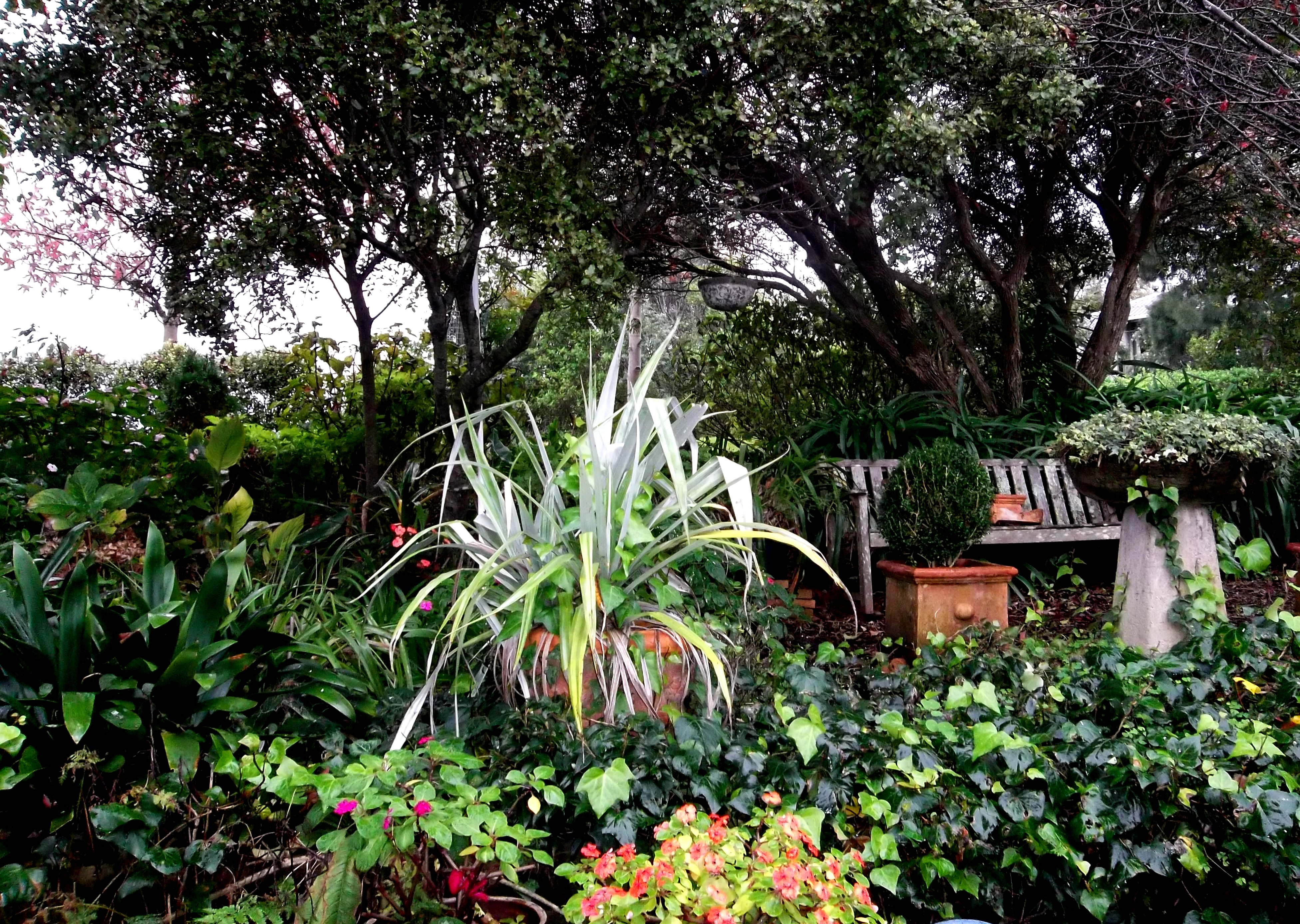
There isn’t a notice saying ‘people give way to birds and plants’, but it’s fairly obvious. It’s quite a mission for anyone to come to my door. First they have to dodge the overhanging branches of the red bottle brush tree, rustling with singing tuis and silver-eyes, and monarch butterflies fluttering in and out. They have to make their way past this tree, between banks of blue agapanthus bending over the path, and down the steps, before pushing past self-seeded white valerian springing across the steps, and bending down beneath the overhanging branches of the plum tree, laden at the moment  with tiny red fruit which will ripen into lovely sour little plums by Christmas – perfect for cooking with red wine, bay leaves and cinnamon…

I hope they will avoid stepping on the bricks where some self- seeded love- in- the- mist are pushing their way up in the cracks, and at the bottom of the steps, they have to avoid a self- seeded garden of valerian, orange nasturtiums and that wonderful purple spiky flower which I think some people consider a weed, because it grows so prolifically. I particularly love self seeded plants.

As they reach the door, the curling suckers of the purple wisteria I was forced to cut back before it prised the roof off, are beginning to wave their pale translucent leaves, and the honeysuckle I grew from a cutting taken from a country road is just beginning to sprawl across the trellis.

The other path into the garden is just as tricky for visitors. They have to negotiate two steps down onto a side path. But I erected a trellis arch above it, and now it’s enveloped with Albertine rose and all its prickles, intertwined with ivy and star jasmine. No room to put their hands on the trellis to steady themselves as they come down that path. And having negotiated the steps, they then have to dodge the overhanging branches of the guava tree – its fruit is the nice red tangy sort, which makes lovely guava jelly, but also makes the path hazardous when they drop.

When visitors get here, they never notice the lovely antique wrought iron French door knocker I’ve nailed up by the door, so after using their knuckles to knock tentatively and fruitlessly on the door, they make their way round to the French doors. When they finally get inside, a warm welcome awaits them, and they’ve worked for it!

Last year I wouldn’t even let them go down the main path, and re-routed everyone to the hazardous steps and prickly roses. There was a blackbird nesting in the bottle brush tree. I twined fine chicken wire around the trunk so that the beloved and wicked little black cat wouldn’t get up there. She had sat on the steps under the trellis for weeks, and I hadn’t realised why until winter, when all the leaves had gone from the Albertine, and there was a half finished nest, abandoned by some canny thrushes. The blackbirds made it safely. I used to tiptoe up the path and look up very slowly so as not to frighten them and there would be a head and a tail peeping over the nest, until the day when there were several little heads and open beaks stretching up instead.

This green garden is a tangle of shrubs and plants. When we first came here, there were only big smooth grey river stones sitting on weed-mat, and planted with cactus, a few succulents and spiky yuccas, which I gave away. The grand-children helped me toss the stones into a corner, but most of them were cemented in around every garden bed and along every path. A demented stonemason must have spent a fortune on these big round river stones. So the only thing to do was cover them. Out came the cactus and the rest, and in went ivy –  I just couldn’t get the weed-mat up, so I planted ivy on top.

Big square terracotta pots with my topiaried box plants were spaced along a terrace, and now it’s a green garden with a few beds riotous with self seeded flowers and perennials like hollyhocks, fox gloves, day lilies, ageratum, lavatera and marguerites. In autumn, dahlias and white Japanese anenomes brighten the green backdrop. At the moment bright orange cliveas, nasturtiums and pink and orange impatiens light up the bosky green bower.

A friend with a flowerless sculpture garden  -with just trees and grass and water –  came to see this tiny garden last year. She said: “It talks to me – all those flowers have a meaning for me”. They have meaning for me too, holding memories of childhood, past gardens and friends. The Mexican daisies that I carefully allow to spread, even though they are on the politically incorrect list, came from a friend called Oiroa, Oi for short. They’ve been known to us for nearly forty years as Oi’s daisies, and their roots carried from garden to garden. Then there’s Keith’s Kreepies, the little purple spreading ajuga.

In a big pot by the front door is a rose that has also been carried from garden to garden. I’ve Googled a description of it, and now know it’s a Reine des Violettes which has no prickles. The scent fills the whole garden for the month that its deep pinky- purple tightly layered petalled heads bloom. So many petals – between 50 and 75  – according to the official description, and bred in France in 1860. It was given to me by a friend who’d spent six months at Findhorn, the famous New Age centre in Scotland where they grow astonishing crops in poor sandy soil by communicating with Gaia – the consciousness of the planet- and the devas of the place. Marjorie came back home and put these principles into practise on her farmlet where she grew macadamias to fund her husband’s sub-Antarctic Islands explorations in his yacht, and grew most of her own food. She gave me this cutting from a rose growing by her door.

At her funeral her daughter told us that at a gathering some years before, each person was asked to say what creature they thought they were like. And what creature they would like to be. Gentle un-assuming Marjorie felt she was a worm, beavering away out of sight under the earth doing a vital job, but hidden and un-appreciated. She said she would like to be a bee, doing another vital job, pollinating and making honey, buzzing around in the sunshine, enjoying the beauty. The third aspect of this exercise was how others saw her. And they saw her as a thrush, a beautiful song bird, bringing joy to the garden and to other gardeners and friends.

Her daughter told us that the day Marjorie died, her garden was suddenly full of bees buzzing in all the flowers, and as her girls gathered at the house, the air was alive with the sound of thrushes singing. And when she left the house for the last time, a flight of birds flew over the garden. Gaia knew her faithful daughter, and Gaia  “works in mysterious ways”.


Food for Threadbare Gourmet

Still pushing the barrow for broccoli, I love the way the Japanese serve it with sesame sauce. Whenever we are out together in a Japanese restaurant, my daughter and I always order it. You can buy bottles of sesame sauce, but it’s not the same. I can’t be bothered to get all the Japanese ingredients just for this, so I adapt the bottled bought stuff, by adding it to a little mayonnaise – the bought stuff – and stirring it altogether.

Or I make a peanut sauce, which is not the same, but just as delicious. You need four tablesp of peanut butter, two tablsp of brown sugar, one tablsp of vinegar (I use cider vinegar) two tablesp of water, and three tablsp of soy sauce. Mix them altogether over a gentle heat until smooth. I use crunchy peanut butter so it has some texture. Pour over steamed broccoli, this makes a delicious vegetarian dish.

Food for Thought

Some people try to turn back their odometers. Not me. I want people to know why I look like this. I’ve travelled a long way, and some of the roads weren’t paved.

I agree with him! This is another quip from Will Rogers, famous part Cherokee cowboy, entertainer, wit, film star and newspaper columnist who died when his plane crashed in 1935


41 Comments

Filed under cookery/recipes, environment, great days, life/style, philosophy, spiritual, sustainability, The Sound of Water, Thoughts on writing and life