



 It would be good to find some quiet inlet where the waters were still enough for reflection. where one might sense the joy of the moment, rather than plan breathlessly for a few dozen mingled treats in the future…
Kathleen Norris
It would be good to find some quiet inlet where the waters were still enough for reflection. where one might sense the joy of the moment, rather than plan breathlessly for a few dozen mingled treats in the future…
Kathleen Norris

It’s been the one of those glorious days when ‘cherubim and seraphim are casting down their golden crowns around the glassy sea.’ Silence… a small white yacht gliding over the still shining water, scarcely leaving a wake, using the engine because there’s no wind for the sails… the islands we never normally see, floating on the horizon, palest purple against a lavender blue sky… an enchanted stillness, the only sound the cooing of the doves in the trees.
When I awoke this morning the sky was just turning pink, so early though it was, I jumped out of bed, dressed, and headed out to watch the rising sun across the sea. The dawn chorus was just beginning, so I turned around and walked by houses with curtains drawn and solitary gardens, thrush and blackbird seeming to pass me on from one song to the next.
Theirs was the longest and sweetest serenade, while the soft incessant cheeping of the sparrows filled the spaces, and the slow crescendo of the doves cooing began. As I retraced my footsteps back along a grassy track, I saw with pleasure that mine were the only footprints in the dewy grass. I never met another soul as I meandered around the sleeping village.
Back home I crossed into the cemetery and disturbed a couple of speckled hens who scurried fussily back into their own garden next door, clucking agitatedly. I walked across to the end of the peninsula to get my daily fix looking out to sea through the grey gnarled branches of the ancient pohutakawas.
Later, I sat on the veranda feasting my eyes on the glittering water, with breakfast of toast and a boiled egg from the errant chickens. When I had visited their owner Kate the day before, she had given me a handful of newly laid eggs, and the one I ate now was so beautiful I could hardly bear to break the shell. It came from her oldest hen, she said, a black Arakan, a breed which presumably comes from Arakan in Burma, and this little black hen lays eggs of the same pale blue as the sky today.
During the morning I went to the next village to buy a birthday card for a man. No flowers then, and since most men’s cards are covered with the inevitable cars or golf clubs, I did some lateral thinking and came away with a card with a message: “ If you resolve to give up drinking, smoking and loving, you don’t actually live longer: it just seems longer.” My son-in-law will be delighted with this encouragement to enjoy these permitted pleasures.
Stopping off at the garden cafe down a long avenue of poplars, the vivacious young Indonesian proprietor greeted me as usual with: ‘Ah Miss Valerie, are you ready for your coffee today?” Since she always jumps the queue for me, and makes piping hot coffee I can forgive her the spinsterly ‘Miss’. I sat in an ivy- covered alcove framed with late wisteria blossom and white jasmine, their scents wafting over the smell of coffee.
Before getting home, I called in on Friend, to collect various things from yesterday’s rollicking party for 45 oldies who came from far and wide. Others were there too to collect their vases, or napkins or fish slices. “The sun’s over the yard arm”, announced the man of the house, which though it was only lunch-time, gave us the excuse to finish off the champagne from the previous day.
Then, we had sat on the terrace in the sun, looking out over the turquoise sea, the lawn fringed with white iceberg roses in full bloom, and red roses lining the long white table cloths.
We’d enjoyed a four course lunch, starting with a terrine followed by freshly baked ham, salmon and asparagus, the cheese course – big rounds of fresh Brie, fresh strawberries and blueberry tarts – each course accompanied by different wines and champagne –French of course! And finally the birthday cake, a pyramid of moist chocolate brownies and truffles. In other words a feast! And all made by friends.
At the end of the afternoon someone brought out a guitar. We sang ‘Blowing in the wind,’ ‘Michael row the boat,’ ‘Kumbiya, ‘He‘s got the whole world in his hands’… all the old favourites. I sang my heart out, and had to restrain myself from dancing.
But as a somewhat acid -tongued acquaintance observed to me, all the men were glued to their seats – and they all look alike, she said. “They all have white hair, and are wearing the same sort of blue and white checked shirts, most of them have walking sticks and a lot of them have paunches!” The women on the other hand, were younger, sprightlier, beautifully dressed and immaculately groomed.
That evening several of the guests came to dinner, though we couldn’t eat much. We sat on the veranda in the dusk, by the loquat tree covered in golden fruit, with a fat green and white wood pigeon rustling around swallowing them whole. We had wine and laughter and fun, discussed everything irreverently, and enjoyed the party all over again.
Days of wine and roses and golden laughter …when I returned flushed with champagne from Friend today, I found another generous neighbour had called while I was out, and left a bag full of freshly picked broad beans hanging on the door handle.
They were so delicious that for supper, I simply ate a dish of the tender little green jewels glistening with hot butter, though the old chap had steak with his. And I’ve just returned from the field above the harbour where the two little white goats live. They feasted on the broad bean pods, and seemed to feel the way I do about them.
‘Gather ye rosebuds while ye may’, wrote the poet, ‘Old time is still a-flying’, and I’m dedicated to this advice…. my rosebuds may be different to other people’s ideas of rosebuds, but I’m picking them as fast as I may.
So I sit here on the veranda writing, watching the evening sky turn pink and lilac and pale turquoise over the still, silver water, the scent of sweet peas, a gift from a friend’s garden drifting through the house, and savour my blessings. I began with the words of a hymn, so I’ll end with some. These shining days are filled with rosebuds – moments of pleasure and goodness – friends and fun and flowers, chickens and birdsong and beans, ‘all things bright and beautiful, all creatures great and small’.
Food for threadbare gourmets
The strawberry season means Eton Mess for me! The first time I tasted it was just outside Eton, at a place called Datchett, at a rather grand dinner to entertain some visiting Argentinian polo players who’d been playing on Smith’s Lawn at Windsor. My best friend and I knew we were only there simply because they needed some girls to balance out the chaps. But we gave the food a lot of attention too.
The version I ate then was a variation, because the crushed strawberries and broken meringue were pressed into a big dish of ice-cream, and then re-frozen. Whipped cream was piled on when it was served, on a huge carving dish. I like doing it this way too, using freshly made local artisan ice-cream. Really, the amounts are up to you… you can’t go wrong. As an added touch I sometimes whizz up a punnet of the fresh strawberries with some sugar, and hand that round in a sauce bowl, to drench the already sumptuous mixture in it! Food for the gods….
Food for Thought
He had picked it up, he said, on a beach; it was a piece of sea-washed wood in the shape of a human head. It was made of hard wood, shaped by the waters of the sea, cleansed by many seasons. He had brought it home and put it on the mantelpiece; he looked at it from time to time and admired what he had done.
One day he put some flowers round it and then it happened every day; he felt uncomfortable if there were not fresh flowers every day and gradually that piece of shaped wood became very important to his life. He would allow no one to touch it except himself; they might desecrate it; he washed his hands before he touched it. It had become holy, sacred, and he alone was the high priest of it; he represented it; it told him of things he could never know by himself. His life was filled with it and he was, he said, unspeakably happy.
From Krishnamurti’s Journal

My husband took one look at my ravaged face, and retreated to his study. I had just returned from seeing the film ‘The Butler.’ Instead of the gracious meander through history at the White House that I’d expected from the trailer, I had watched another episode of the American Civil War which I thought had ended in 1856.
Too appalled even for tears, at the end of the film was I shell – shocked to hear that many of the freedoms fought for in that bitter sixties campaign I’d just watched, had later been repealed, replaced or blocked by President Reagan. ( I’d like to think that information was wrong )
It’s hard to get my head round this long-running disaster for humanity. Having grown up in a country where people joyously belt out: “Britons never, never, never shall be slaves”, in their annual singing orgy at the Albert Hall on the Last Night of the Proms, slavery under its many names had been something I grew up thinking had disappeared from the civilised world,
It ended in England before the founding of the US, when in 1772 the Chief Justice, Lord Mansfield, decreed that anyone who set foot in England was automatically a free man. By this act he initiated the beginning of the abolition movement, led by William Wilberforce, and his supporters who included Quakers and Evangelicals. (Quakers on both sides of the Atlantic had been agitating for emancipation in the ‘Citty upon a Hill’ since George Fox, founder of Quakerism, visited the States, and preached against it in 1672)
Though a sick man, who took opium for most of his life to alleviate his pain, the heroic and persistent Wilberforce brought his anti – slavery bills before Parliament for over twenty years, until finally, Parliament voted against the slave trade in 1807. In 1808 the US also voted to end it, but not slavery itself, and so slaves were still bought and sold in the States. As a result of the British vote, the British Navy created the West Africa Squadron to patrol the African shores to prevent slave trading. The navy patrolled for sixty years, and at times, one sixth of the navy’s ships were at sea on this mission. Freed slaves were taken to Freetown in British Sierra Leone where they were safe from being re-captured. Over 150,000 Africans were freed in this way.
By 1834, England- as personified by Parliament – had come round to the idea of emancipation, and slaves were freed in most of the British colonies, including Canada and South Africa, and slave owners compensated at huge expense to the government. It meant that 800,000 slaves were gradually freed, and it also meant that many imports into England now cost a lot more. In the sometimes unhappy history of the British Empire this is one brownie point.
When Harriet Beecher Stowe wrote Uncle Tom’s Cabin, it had bigger sales in England than America, and as one of her readers, as well as being an afficionado of the American Civil War, I had thought all had ended well for the slaves when the South was defeated. ‘Gone With The Wind’ did incalculable damage to the thinking of ignorant people like me.
The picture it painted of a noble, benevolent society with happy, contented slaves living in harmony with masters they loved, was a travesty of truth, I discovered – no hint of anyone being bought and sold, families destroyed, and later, lynch mobs, Klu Klux Klan or Billie Holiday’s song ‘ Bitter Fruit’- which came out in the same year as the film. The rude way black people were spoken to and humiliated, even in benign films like ‘Driving Miss Daisy’, shocked me. As did the true story of Hadley Hemingway losing all Hemingway’s manuscripts, and when she was too shattered to tell him, he finally confronted her with the thing he dreaded most: “You’ve been sleeping with a Negro.”
Twenty years ago when Ken Burns’ moving films introduced me to the Civil War, I also read a fascinating and horrifying series of reports which jobless students were commissioned to write during the Depression. They interviewed and recorded the memories of the slaves who were still alive in the thirties, and those memories were harrowing, whether before or after Emancipation. Singer and actress, Hattie McDaniels, who played Mammy in ‘Gone With The Wind’ was the daughter of slaves, and her lot was not much better.
She was asked not to attend the opening night of the film in Atlanta in 1939, and when she won Best Supporting Actress at the Oscars, had to sit alone in specially segregated seating. She was also not allowed to be buried in the Hollywood Cemetery which even practised segregation in death! When I learned this, I was still not aware of how the South had been gradually winning the Civil War with Jim Crow laws, and especially in the twenties and thirties, suppressing black civil rights, expanding segregation, and passing laws like the ‘one drop of negro blood’ in 1924, which condemned innocent people to a ‘shadow’ existence.
‘Shadow’ families were those like Thomas Jefferson’s children, born to a slave, Sally Hemings. She was herself more than half white, and thanks to the exploitation of slave women then, was also an aunt of Jefferson’s legitimate daughter through Jefferson’s wife. Jefferson’s and Sally’s children were seven- eighths white. If they hadn’t already disappeared into white society back before the Civil War, they would have been trapped by these creeping race rulings.
A friend whose ancestor was General Pettigrew, the other general who led Pickett’s Charge at Gettysburg, gave me a biography of the general which had been published recently. As I read it I became increasingly puzzled, for the general was such a heroic paragon , who apparently embodied all the chivalric qualities of a noble cavalier, that even his predilection for quarrelling and the resultant duels were held to be virtues, and typical of his aristocratic society.
The barbarians of the North, inhospitable, dour, materialistic Protestants, had destroyed both this magnificent young man and the civilisation of the ‘old South’ that he represented, according to the writer. In the end, I Googled him, and light dawned. He was still fighting the Civil War! Not only was this writer a man of great reputation in the South, but he had founded a league of Southern gentlemen, which some people – like me – would feel that in the light of Southern men’s record, was an oxymoron.
There’s another film due to come out about slavery, the true story of a free black American living in the North who was kidnapped, and sold into slavery in the South. His horrendous ordeal lasted for twelve years, and when he escaped he wrote his story, which has gradually been forgotten.
Two black Englishmen have produced this film, and I won’t be watching it. I know enough. I already believe in the cause of freedom, and I’m too much of a coward to watch the cruelties and inhumanities that I saw in the trailer. The title to this blog comes from a medallion struck in 1787 by Josiah Wedgewood, the great potter, and supporter of Wilberforce’s abolition campaign. The words go straight into my heart.
Food for Threadbare Gourmets
I had a big bunch of watercress, and decided to make soup with it. Mrs Beeton, who I consulted, had three recipes for it, and this was the one I fancied. The fiddliest bit was taking the leaves off the stalks, as I have a feeling the stalks taste bitter. Gently sauté the leaves in butter for a couple of minutes, then remove from heat. Mix about a dessertspoonful of cornflour with some milk, whisk it into chicken stock, and add the cress. I leave a few leaves aside, and then whisk everything with my stick whizzer. Quickly re-heat and add cream to taste, and a pinch of cayenne. The rest of the cress leaves float greenly on the top. The amount of stock depends on how much cress you have, and it’s easy to gauge.
Food for Thought
“The opposite of love is not hate, it’s indifference. The opposite of art is not ugliness, it’s indifference. The opposite of faith is not heresy, it’s indifference. And the opposite of life is not death, it’s indifference” Elie Wiesel- born1928. Writer and survivor of Auschwitz and Buchenwald. When he was awarded the Nobel Peace Prize in 1986, the Norwegian Nobel Committee called him a “messenger of peace”.

A friend went for a happy break away with distant family, and returned home to find the bliss of silence awaiting her. She shared it with her readers, the deep need for solitude and silence, and how simply being with her plants, communing with her creatures, savouring the long views, the huge skies, and never speaking a word, she felt restored and at ease with herself.
Her readers, a band of like minds, responded that silence and solitude were necessities in their lives too. We discovered that we were not strange, we were not eccentric recluses, but that we were all strangely normal !
I thought about this, and realised that this group of women who had responded had probably reached that point in life when we want to experience our Hestia natures. Hestia was the Greek Goddess of the hearth and in her wonderful book, ‘The Goddesses in Everywoman’, Jean Bolen explores Hestia’s nature, and describes the Hestia archetype as being centred on home and family. She suggests that if Hestia wrote a book about her inner process she would call it Zen and the Art of Housekeeping.
Attention to the household, which includes the plants and animals in our care, is almost a spiritual process for a Hestia person. Women with this archetype find a sense of inner harmony as they cherish their surroundings and they know that this nurturing of their corner of the planet, is a form of mindfulness. Jean Bolen called this time in which the Hestia archetype is totally absorbed in her activities: ‘kairos’ time, a lovely Greek word describing that sense of being outside time, and feeling completely fulfilled. It’s also time-Less, we emerge from the ‘Zone’ as some call it, to find that time has flown while we were unconscious of the very word.
It feels like a creative activity, which it is, when we are so immersed in our tasks that time is meaningless. This is psychologically nourishing, and we feel deeply satisfied and energised, powerful and peaceful when we come out of the ‘Zone’; like a writer feels on completing a piece, a poet when her poem has emerged, or an artist after an inspired day at the easel.
Hestia women need and seek solitude, and as children they often felt out of kilter with their families, finding refuge in books and withdrawing emotionally. As adults, they need ‘A Room of Their Own’. The late Ardis Whitman, free-lance writer quoted in ‘The Feminine Face of God’, said that: “…when we are surrounded by people, some of the passion and insight natural to us leaks away through the sieve of small talk. At your most daring moments you believe that what is going on is the ultimate human work – the shaping of a soul. The power of life comes from within: go there. Pray, meditate. Reach for those luminous places in yourself”
The obstacle to taking this time for self is women’s guilt. Too often they feel guilty at making time for themselves, fear they are being selfish, and so give away their vital self-nourishment by trying to please others. With maturity and the confidence of age, they can reclaim the time and space they need, knowing the truth of Rabbi Hillel’s ancient imperative: ‘ If not me –who? If not now – when?’
I have a friend whose stepmother is part Native- American. She was brought up by her Native -American grand-parents, and she told me: “there was no idle chatter in our house. It was silent. My grandparents believed silence was sacred and should not be broken unless we had something of worth to say” … Whenever I feel the need for silence at home, I say to my husband (politically incorrectly – sorry chaps!): Red Indians! He gets the message.
Living in an intimate relationship with one person is so demanding when they no longer go to the office every day, in order to regain the silence and solitude that I need, we have a silent Tuesday, when no words are spoken. The house fills with something more than silence, a full, flowery, beautiful essence, which is only present in that magic space. Sometimes we have a Tuesday on a Thursday or a Sunday… whenever we feel we need it.
It isn’t just women who need solitude… I suspect there are many men too, who need the refreshment of peace and quiet… Thoreau famously wrote that he found it “wholesome to be alone the greater part of the time… I love to be alone”, while one of the early Desert Fathers, Abbas Isias said : ‘Love to be silent rather than to speak. For silence heaps up treasure, while speaking always scatters.’
We’re not talking of the harsh, ascetic, masculine discipline of a Trappist silence, but respite from continual communication. This respite is more like immersing the self in a deep well of nourishment, from which we emerge refreshed and invigorated. In his book ‘A Time to Keep Silence’, famous travel writer Patrick Leigh Fermor described his stay at a Benedictine monastery in France. The Benedictine order with its gracious silences and routines was a revelation to him, and he went through three stages – depression and despair for a few days, then days of deep exhausted sleep, from which he emerged feeling purified, energised, joyful and peaceful. When he remarked one day to the Abbott what a blessed relief it was to refrain from talking all day long, the Abbott replied, ‘Yes, in the outside world, speech is gravely abused.” And even sixty years ago, C.S. Lewis said: “We live… in a world starved for solitude, silence, and privacy.”
I haven’t mentioned the word introverted, as I feel that Jung has no place in this discussion since he felt that spirituality was a masculine quality. Yet the thoughtful, mindful qualities that both men and women develop when they seek silence, which he would define as introversion, does lead to a greater awareness of the spiritual side of life. This inward turning of focus is a path that both men and women are taking more and more in these turbulent times, and if anything women are more likely to take it than men.
I’ve always loved Hestia, the home-loving, feminine personality who is her own woman. Not all women have this side to their personality, but when we deeply focus on our inner life, or give ourselves time to calmly enjoy our household chores – sorting a cupboard or baking a loaf, we are getting in touch with that aspect of ourselves. We all have other archetypes in our natures, from Aphrodite to Athene, Demeter to Hera, the goddesses of love and careers, motherhood and marriage, but as we grow older and wiser it seems that Hestia is more present in our consciousness.
When I was a child we used to buy Vesta matches in red and yellow oblong boxes. I didn’t know then that Vesta was the Roman name for Hestia, the goddess of the hearth, believed to be present in the living flame. Her sacred fire was supposed to provide light, warmth, and heat for food, and her presence to inspire peace, meaning, and sanctuary for family. These things seem very precious in our tempestuous times… they are what can sustain us, and make our homes a serene and happy refuge – and not just for ourselves – but for those we love.
Celi’s post ‘The lack of chatter in the box’ at her beautiful blog http://www.thekitchensgarden.com inspired this post.
Food for Threadbare Gourmets
The French call them ‘bonne-bouche’, and I needed a little something to start an impromptu supper with friends. To make it fun, I collected together the big pink and maroon shells I’d collected from the beach, lined them with slices of cucumber, arranged on the cucumber four fat prawns lightly sauted in garlicky butter, and dabbed freshly made aoli over them. Sprinkled with finely chopped parsley, they were a hit, eaten with fingers, but served with a paper napkin that matched the rest of the table.
Food for Thought
To everything there is a season and a time to every purpose under heaven… a time to keep silence and a time to speak. Ecclesiastes: chapter 3, verses 1 and 7
 “Use your elbow–grease,” my grandmother would chide me good humouredly… or ask: “where’s your gumption?” Where indeed? I searched my somewhat limited seven year old soul but could find no trace of these desirable qualities – whatever they were – for I had no idea. I was completely puzzled, and sad to disappoint her.
However the lack of these mystifying gifts ceased to matter when at a fortnight’s notice, I left my grandmother forever, to join my father just returned from Egypt with his new wife. After a month he disappeared to Germany, and my stepmother and I waited for his summons until a house had been found for us. During those months, instead of going to school, my stepmother gave me lessons in the afternoon. Looking back, though a fully trained physiotherapist, she may not have been quite so well qualified to teach small children, but those were more carefree times, when anything went, and often did.
In my case, we didn’t do much maths, thankfully, but I learnt lots of poetry, mainly, I think, the poets my stepmother had ‘done’ at school in the thirties. These included Sir Walter Scott, Elizabeth Browning, Wordsworth and chunks of Longfellow’s Hiawatha. She was hot on spelling – and as a nine year old, lists of words like phlegm, diaphragm, diphthong, delphinium, rhododendron, asthma, psychology, diarrhoea had to be memorised every day. If I’d ended up in the medical profession this vocabulary might have stood me in good stead, but since then I’ve often wished that I had instead mastered how to spell ‘receive’ and all the exceptions of’ ie’, as well as ‘commitment’, both my constant stumbling blocks.
When it came to composition – as it was called – I was a disappointment to her, the way I’d felt with my grandmother, when I lacked elbow grease and gumption. But what I was lacking now, was imagination. “Use your imagination,” she’d say, and once again, I had no idea what imagination was, though I thought it might have something to do with writing about fairies, which I felt was childish.
I felt mysteriously depressed, as at school I’d always been quite good at composition. But the problem of imagination didn’t seem so important once we got to war-torn Europe. We travelled through apocalyptic scenes – cities of mountains of bricks, with half buildings with crooked pictures still on the wall, a door open and chairs still at a table, and skeletons of ruined churches – before finally reaching the infamous place called Belsen, where our new home was the Beast of Belsen’s old digs.
Those were bleak times in Europe and I often felt bleak too. Now my father, almost unknown after years away at war, expected me to have common sense. This seemed more important than gumption, elbow grease, or imagination all put together, and just as un-attainable. I think they thought I was sensible when my best friend was murdered. I had gone to fetch her for our early morning riding lesson, but she didn’t answer the door. When I got home after riding, Mary had been found shot in the kitchen, and her younger brother was shot at the door as he had tried to escape. Her father had then shot himself because his wife had left him.
I never spoke to my new parents about this, my chief worry being Mary’s brother’s feelings as he dashed for the door, and also that Mary mightn’t have made it into heaven, which I knew my parents didn’t believe in. I cried every night in bed, and begged God to let her in. But though I was apparently phlegmatic, the magic of common sense still eluded me – as in: “do use your common sense, child,” or the unanswerable question: “haven’t you got any common sense?” When I joined the army as a teenager at my father’s behest, I knew he hoped I might now discover some hidden well of this commodity which he seemed to think I really needed for a successful life.
But here was another pitfall. An officer was supposed to have initiative and to use it! This, as a very young officer, I quickly realised, was dangerous. Initiative was a two-edged sword, with unknown consequences, which not everyone appreciated. So it was with relief that I looked forward to marriage, when, I supposed with blind optimism, none of these things would be required of me.
But on the third day into married life, I discovered that things were not as I had thought they were, had to write a big cheque which cleaned me out, and then faced an unpredictable, precarious, and impoverished life on shifting sands. The upside was that I discovered I did have gumption after all! And I needed it.
Elbow grease, on the other hand, was something quite prosaic I came to realise, and was only needed for wax-polishing antique furniture, the idea being that the intense pressure of the elbow grease created friction, and the resultant heat melted the invisible wax crystals, causing them to meld together and create those shining surfaces. Frankly, it was easier just to put the dusters in the oven, and polish with hot dusters instead of elbow grease. The only other use for elbow grease seemed to be for scrubbing burnt saucepans, an activity I have always strenuously avoided.
Common sense? Well I’ve discovered that common sense is merely a matter of opinion, and that one man’s common sense is another man’s madness… so to take a somewhat extreme example, Hitler’s idea of common sense would not be mine – so I’ve flagged common sense. And initiative doesn’t bother me any more – I’m in sole command, and don’t have to answer to any superior officers!
Which leaves me with that lack of imagination. Well, it’s something I’ve got used to, and have had to realise that I never could produce an interesting imaginative novel! I recognise imagination in great works of art, both literary and artistic, in fine blogs, in glorious architecture and opera, in gardening and interior decoration, even in solving problems… but I’m still digging for it in myself…
Jane Austen has sometimes been un-imaginatively accused of lacking imagination, and I used to cling to her definition of her art in a letter to her brother Edward, in which she refers to her: ‘little bit (two inches wide) of Ivory on which I work with so fine a Brush’, but to be brutally realistic, this is not really much comfort, since she painted masterpieces on her little bit of ivory with her fine brush. For me, lacking the flights of fancy that come with a soaring imagination, all I can do is to notice and to describe, and I did find some consolation in these words by the enigmatic writer Fernando Pessoa.
He wrote: “What moves lives. What is said endures. There’s nothing in life that’s less real for having been described. Small-minded critics point out that such and such a poem, with its protracted cadences, in the end says merely that it’s a nice day. But to say it’s a nice day is difficult, and the nice day itself passes on. It’s up to us to conserve the nice day in a wordy, florid memory, sprinkling new flowers and new stars over the fields and skies of the empty, fleeting outer world.”
These words hearten me for I too, can at least conserve the day in wordy, florid memories, try to sprinkle new flowers over the fields and skies of the fleeting outer world, and thoroughly enjoy myself while I’m sprinkling! So here’s to florid memories and new flowers!
Food for threadbare gourmets
This is the strawberry season, so it’s crazy to serve anything else for pudding besides these luscious fruits. Friends for dinner meant a quick foray to the nearest strawberry fields. The ones I wanted, where the strawberries are grown by a Vietnamese genius, whose berries are the biggest, sweetest and cheapest, hadn’t opened, so I had to fall back on the other strawberry fields. I usually find theirs a bit tough and tart, but solved the problem by hulling them, and putting them in a dish out in the sun. As the day went by, the delectable scent of soft, sweet, ripe strawberries warm from the sun tempted my taste-buds every time I passed them.
With them I usually do Chantilly cream. One of my grandsons will eat this neat, and has learned how to make it for himself, a useful skill when he goes flatting at University! Take one cup of thick cream, two table spoons of icing sugar and a few drops of vanilla and whip them together. I usually make three times this amount, just tripling all the ingredients.
Food for thought
So long as a bee is outside the petals of the lotus and has not tasted its honey, it hovers around the flower buzzing. But when it is inside the flower it drinks the nectar silently. So long as a man quarrels about doctrines and dogmas, he has not tasted the nectar of the true faith; once he has tasted it he becomes still.
Sri Ramakrishna 1883- 1886 Famous Hindu teacher and mystic, who believed that all religions led to the same God, and who practised both Christianity and Islam
 In this country the sun is reputed to shine twice as often as it does in England, and it shines with especial clarity on Coromandel, so called when a ship of that name anchored where the township is now. The Coromandel peninsula is a rugged line of purple ranges and deep ravines where clear bright streams and rivers rush over rocks to the sea. Once the peaks of Coromandel were clothed in primeval kauri forests, and once too, those peaks hid seams of ancient gold. But now these two sources of gold have long been mined, the hills are covered in secondary growth, and the mine shafts are empty.
It’s always been a place of passion and politics, where potters and painters, poets and philosophers have fought to defend their way of life in these empty, unpolluted and un-peopled places. Ringing this neck of land, pohutakawa trees flaunt their red flowers along the rocky coast-line, and distant blue horizons beckon to unexplored peaks and impenetrable bush.
Our house on the side of a narrow valley leading down to the water’s edge, looked up to the steep foot hills of the Coromandel ranges behind us. And we faced the Firth of Thames, where the light on the water had a mystic quality in the winter sunshine; where the line of Miranda beach on the opposite shore could just be glimpsed; and where flights of godwits gathering for their heroic autumn journey to Siberia, could be imagined.
Further down the coast was the place where Captain Cook first came ashore in this country. Young Nick, the cabin boy who sighted land, gave his name to Young Nick’s Head, and where Captain Cook observed the transit of Mercury, he called the bay where they anchored, Mercury Bay.
When the Endeavour came sailing into Mercury Bay it was watched by a nine year old boy. Eighty-three years later the magnificent old man told his story. As he watched the great canoe with huge white sails skimming towards them, he was amazed when the ship’s crew then rowed ashore in the time-honoured fashion with their backs in the direction in which they were going.
“Yes, it is so,” said the old people watching with him, “these people are goblins, their eyes are in the back of their heads.” Eventually Horeta Te Taniwha, as he was called, gathered the courage to climb on board the ship with the older people.
“I and my two companions did not walk about on board the ship – we were afraid lest we be bewitched by the goblins; and we sat still and looked at everything at the home of these goblins… the chief goblin… came up on deck again to where I and my boy-companions were, and patted our head with his hand, and he put out his hand towards me and spoke to us at the same time, holding the nail out to us.
“My companions were afraid and sat in silence; but I laughed, and he gave the nail to me. I took it in my hand and said “Ka-pai” (very good), and he repeated my words, and again patted our heads with his hand, and went away.
“My companions said: “This is the leader of the ship, which is proved by his kindness to us; and also he is very fond of children. A noble man – one of noble birth – cannot be lost in a crowd”
“I took my nail and kept it with great care, and carried it wherever I went, and made it fit to the point of my spear, and also used it to makes holes in the side-boards of the canoe, to bind them onto the canoe. I kept this nail until one day I was in a canoe and she capsized in the sea and my god (the nail) was lost to me…”
The descriptions of the pristine land that Cook discovered in 1769, sound as fragrant and unspoiled as the descriptions of Roanoke in 1584. I ache to have seen Auckland harbour as it was then–the first accounts tell of the silence and the sunshine, the flaming pohutakawa trees bending over the still, clear water as the first white men glided spell-bound up the harbour in their sailing ships – it was a magical, mysterious country which seemed like the most exquisite place on earth to those early explorers. On the other side of the coast, where the other great harbour of Manukau lies, they found forests teeming with strange birds, great trees of more than ten metres in girth towering to the skies, cloudy waterfalls, black sand beaches and steep jagged cliffs facing the turbulent Tasman..
Songbirds fluted in the dense forests. Sir Joseph Banks, the great naturalist on board the Endeavour with Cook, wrote at Queen Charlotte Sound: “ the ship lay at a distance of somewhat less than a quarter of a mile from the shore, and in the morning we were awakened by the singing of the birds: the number was incredible. And they seemed to strain their throats in emulation of each other. This wild melody was infinitely superior to any that we had ever heard of the same kind: it seemed to be like small bells most exquisitely tuned.”
Civilisation has made life easier and more comfortable at one level, dentists, drains, and all the rest, and destroyed the planet in the process. And we all know it and yearn for the original untouched Garden of Eden. To have been alive then, and to have savoured this untouched land… it makes me feel homesick just to think of it. So-called civilisation of course, has changed so much of this. From 1840 onwards, the settlers did their best to destroy the forests, using the giant kauris for ships masts, and building wooden homes, wood being the quickest material to use to build a home in a new country. On the newly barren hills they planted grass for the millions of sheep which have brought prosperity to this country, and now erosion means that in some places, the rivers are no longer clear, but sluggish muddy currents.
They took the gold, and now they want the oil. Yet so many of us still want keep this country as unpolluted and unspoiled as possible; so we try to save the native birds, we enclose huge national parks, we preserve the swathes of native bush and forest still here, and we oppose the multi-national oil companies. And nothing can change or spoil the silent, snow-capped mountains and wild waterfalls, the great lakes and endless miles of solitary beaches in an empty land the size of England, which is home to only four million people.
I now live an hour’s drive north of Auckland, looking out on green fields one side, and blue sea the other; and I walk the long deserted stretches of yellow sands, and can only hear larks singing high above the dunes, and the waves breaking on the shore. In a crowded world, where solitude and silence are hard to find, this place still seems like paradise – last, loneliest, loveliest – as Rudyard Kipling once described Auckland.
Food for threadbare gourmets
I love vegetable dishes. This fennel dish I can eat as a meal, and my husband can have it with his steak, though it also goes well with lamb and pork. Allow a fennel bulb for each person, though if I’m having it as a meal, I usually have two. Cut the fennel in half from root to stalk and blanch in boiling salted water and drain well. Cut the fennel again, into quarters, and lay them in a well- buttered baking dish… it doesn’t matter if they break up. Scatter pieces of fried and chopped bacon over the fennel along with a finely chopped garlic clove. Whisk a teasp of flour into 250 ml of cream and pour over the fennel. Bake for about 25 minutes in an oven set at 190 degrees. Check it’s soft with a sharp knife. Eaten with a crusty roll or wholemeal bread, it’s very satisfying.
Food for thought
It may be hard for an egg to turn into a bird: it would be a jolly sight harder for it to learn to fly while remaining an egg. We are like eggs at present. And you cannot go on indefinitely being just an ordinary, decent egg. We must be hatched or go bad.
CS Lewis, 1898 – 1963 English novelist, poet, medievalist and literary critic. Best known for his books ‘The Screwtape Letters’ and ‘Chronicles of Narnia’.
 The white wisteria wafts its scent across the veranda. I can smell it as I sit here writing with the French doors open. The pale purple blossoms of the melia tree, sometimes called the Persian lilac, are scenting the night air too, this tree being the nearest we can get to the real thing in this too temperate climate. Lilac is my favourite shrub, I keep meaning to order a root from afar – actually the South Island – and pile ice around it in winter to fool it into thinking it’s living in a cold climate. I miss not having any lilac.
The cabbage tree- not an attractive name – puts out long stems of blossom at this time of year covered with the sweetest smelling tiny flowers, which turn a creamy brown when dried, with black stems; like the melia tree the scent seems strongest in the evening. Sweet alyssum wafts its fragrance in sunshine, and best of all, my precious Reine de Violette rose in the pot by the front door is now blooming.
I’ve carried it in a big square terracotta pot from garden to garden, and its scent pervades the little courtyard by the door for the month that its deep pinky-purple tightly layered petalled heads bloom. So many petals – between 50 and 75 – according to the official description, and bred in France in 1860. Grown from a cutting given by a friend. Later in the summer, the blue petunias in pots will send their sweet smell through the garden, also strongest at night. My summer garden would be incomplete if I didn’t have masses of foaming pale blue petunias in pots – Cambridge blue is their description. And in midsummer we’ll have the strong, night scent of queen of the night, and the datura tree growing in the wilderness part of the garden which spreads its pervasive sweetness when the sun is going down.
In a few weeks fragrant star jasmine will be blooming, it’s crawling up the walls below the veranda, sprawling over the arch with pink Albertine roses and ivy, and growing outside the bathroom window. And I’ve topiary-ed it so it billows out of two big blue pots the same blue as the petunias, just outside the French doors. The scent will drift everywhere… I’d love to have the exquisite perfume of sweet peas in the garden, but alas, I’ve never been able to grow them successfully.
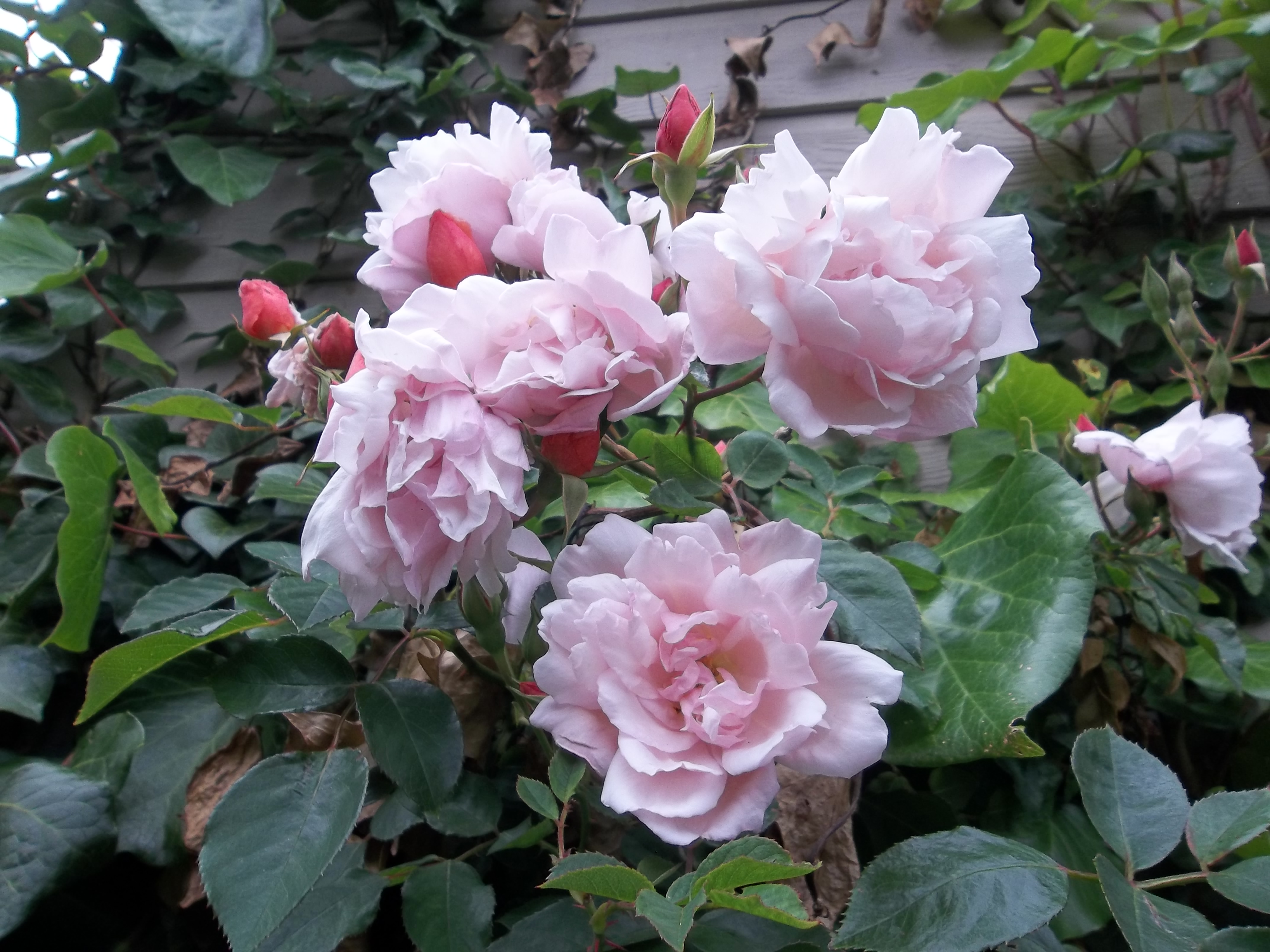
As I’ve grown older, I’ve whittled down the elements I want in my garden, and top of the list is fragrance, closely followed by white flowers which show up in the dusk. So apart from my blue petunias and pink roses, there are always plenty of white lilies, white geraniums, Shasta daisies, fragrant syringa, white Japanese anemones, marguerites, self-seeded valerian, white agapanthus as well as blue, and my favourite white climbing rose Alberic Barbier. That isn’t to say that there aren’t blue hydrangeas shimmering under the trees, a glorious pale gold rose called Crepuscule clambering up a telegraph pole out on the road,( see above) or pink beauties like Jean Ducher which bloom palely all the year. And then there’s Mutatibilis rose which looks like a bush covered in deep pink butterflies about to take flight.
There are two other requirements for my garden – masses of green – so ivy everywhere, box plants and acanthus, and I also ask my long-suffering plants to be undemanding and easy-care, though I contract to water them through the droughts. It’s not a tidy or orderly garden, but an exuberant, prolific little plot, with wilful self-seeded plants welcomed wherever they choose to settle, and every chosen flower and shrub scrambling into its neighbours, cosying up, sharing their space, flaunting their freedom.
Rampant growers like honeysuckle and ivy are allowed to enjoy themselves, instead of wilting under the criticism of real gardeners who despise them for being so invasive. Wandering flaming red and orange nasturtiums have even turned themselves into climbers and threaded themselves through the climbing rose up to the roof, and entangled themselves in an orgy of colour among the pinks and blues of ageratum and lavatera down below in the garden. If it grows, it’s welcome… so though I’m not a discriminating gardener, I am a grateful one!
I learned about flowers from our appropriately named gardener called Mr Appleby. I was nine, and we were living in a rambling Tudor house in Yorkshire while waiting to go to post-war Germany. It had been a monastery before Henry VIII’s Dissolution, and behind it stretched a high walled garden, built of weathered rose-coloured bricks. On either side of the lawn were deep herbaceous beds, the fashion of those times, and indeed, since Edwardian times. At the end, sheltered by the high wall was the vegetable garden, and after we had been to see Bertram Mills circus and I had fallen in love with the trapeze artist, Lady Elizabeth, I tried to practise my rudimentary trapeze skills on top of this wall, unseen from the house.
The end of the lawn was dominated by a big pear tree, where we sat in striped deckchairs in its shade having afternoon tea, and where my step-grandfather would sit on summer evenings reading the Times while he smoked a cigar, it’s rich aroma reaching my bedroom window as I peeped out.
I didn’t go to school while we lived there, and had lessons in the afternoon. In the morning it was my job to arrange the flowers in every room throughout the beautiful old house, and keep them freshly topped up and watered. It was bliss. I had carte blanche to pick flowers! Mr Appleby tended to guard his glorious peonies from me, but let me have enough to keep the vases looking quite ravishing. He taught me the names of his precious plants, and became a great buddy. From his big saggy pockets, he would drag out for me giant gooseberries from his garden, pinkish with long soft hairs all over them, his biggest strawberries, juicy, golden William’s pears, yellow-fleshed purple Victoria plums and red russet apples. I used to hide in the pear tree so as not to have to share these treats.
He told me the names of the tall, smoky blue delphiniums, rosy hollyhocks, pink foxgloves, serried ranks of pastel coloured lupins, and golden rod. They were massed at the back of the borders. Then there were the middling sized flowers, lavender, peonies, pink and white and deep red, dahlias, (I didn’t pick them, too many earwigs crawling around inside) purple irises, stocks and phlox and larkspurs, day lilies in deep maroon, snapdragons massed in mixed jewel colours, delicate grannies bonnets, scented sweet Williams; in the front of the borders were clusters of cat-mint, the soft, furry sage-coloured leaves and pink flowers of lambs lugs,(the country term for ears), yellow cotton lavender and clumps of pinks, the fluffy ones with a gorgeous pepperminty smell.
Then there was purple ajuga and harebell-blue campanula, and snow-in-summer nestling in crevices among the stone flags of the terrace. The names felt like poetry. And smothering the trellis which hid the dustbins outside the kitchen door were pink Dorothy Perkins roses.
Mr Appleby was a weather-beaten, wiry little Yorkshire-man, who wore battered old trousers and an unbuttoned jacket which in novels would be called rusty black, with a grubby white shirt with no collar – in those days you changed the collar, not the shirt, using collar studs, front and back. On his head he wore a flat cap, and he had bright, beady black eyes. He spoke with a broad Yorkshire accent that was hard to understand. Sometimes he took me on walks around the countryside where I learned the North country lingo of becks and scars and fells, which I later learned were the ancient Viking words for stream and cliff and moor. Once he showed me a tiny field mouse peeping out of its miniature nest which was a round grass ball, slung between the top of the stems of two cornstalks growing amidst a forest of other golden stalks, blue cornflowers and red poppies.
Those things I learned from Mr Appleby one summer nearly sixty five years ago have never been forgotten. Who knows what we ourselves unwittingly leave in the memory of the children we encounter? What words, what thoughts, unconscious sharing of experience, spontaneous gifts given without intent, moments that lingered down the years… what imperishable knowledge that helped to lighten ignorance and enlarge understanding, what fragments of fact that sparked a child’s consciousness ? To be the person behind those memories … that must be a very special sort of immortality.
Food for threadbare gourmets
This is a filling meal I make for my husband when I can’t think of anything to give him! Dr de Pomiane, the French-Polish food writer adapted it from a French peasant dish, and this recipe is a much dollied up version of his solid peasant dish. Remove the skin and pips from a medium sized tomato (soaking the tomato in boiling water loosens the skin).
Toast two thick slices of sour dough bread on one side. Spread the untoasted sides with Dijon mustard, grate two ounces of cheese – Gruyere is recommended for purists – I usually use cheddar which is in the fridge – and pile the cheese mixed with the tomato on the mustard side of the bread. Grill until the cheese goes golden, then lay a couple of rashers of streaky bacon on the cheese mixture. Grill until the bacon starts to brown, and serve with black pepper. (De Pomiane didn’t use bacon or tomato – instead when thick slices of cheese had been grilled, he put butter ON the melted cheese!)
Food for thought
“The characteristics of the English are largely unsensational, and since they do not readily fire the imagination they easily slip the memory, but they are nevertheless fundamental and formidable. A love of law and order and a respect for government by consent. A belief in honest administration. A dislike of hurting people and if a hurt be done a great effort to put it right. A tolerant people, offering a hand to victims of intolerance. Skill in devising ways of improving the lot of mankind but a dreadful inability to follow those ideas through. A sweet countryside, but appalling ways of cooking what that countryside produces.”
President Truman describing the English, on being honoured with an honorary degree at Oxford after his retirement. Dreadfully honest, I suppose you could call this somewhat measured and restrained tribute !
 Who would have thought that when a group of murderous men attempted to kill a fourteen year old girl that they would have made her a global heroine and given her cause world-wide coverage? Malala Yousafzai is extraordinary. It’s hard to believe that a school girl should have become such a threat to the oppressive policies of the Taliban that they should try to suppress her and her campaign for women. And so heartening to know that two years later, in spite of her terrible wounds, she is living in peace in England, has written a book, and is still campaigning for the right for all women to an education.
Her poise, beauty and intelligence as I watched her fluently explaining the situation on TV and how she came to be such a campaigner was so moving, that it seemed even the interviewer was nearly in tears. The next day she had tea with the most powerful man in the world and fearlessly asked him to stop killing her people with drones – that anyone should have to ask – since when has it been OK to kill innocent citizens of countries who are allies – and is reported to have told the President that it was counter-productive and caused resentment. A simple enough deduction that one would think the highly educated men in the White House could have reached for themselves!
But what is so exciting about sixteen year old Malala is that she is free to spread her message and to resist oppression and tyranny. She can speak and be heard. Her country and her people listen, and it’s only extremists who want to silence her.
Hers is such a contrast to the life of another inspiring and famous woman who was not free and who had to keep silent. Anna Akhamatova was the beautiful Russian poet whose husband was shot in the Stalin’s terror, and whose son was in and out of gulags until 1956 for the crime of having the parents that he had. In her long poem ‘Requiem’, which took four years to write between 1935 and 1940, she wrote these lines, having resisted the temptation to flee to the West like so many creative people whose lives were also in danger:
‘No foreign sky protected me,
no stranger’s wing shielded my face.
I stand as witness to the common lot,
survivor of that time, that place.’
Later, when the poem was published in 1961, she wrote: ‘Instead of a Preface’.
‘In the terrible years of the Yeshov terror I spent seventeen months waiting in line outside the prison in Leningrad. One day somebody in the crowd identified me. Standing behind me was a woman, with lips blue from the cold, who had, of course, never heard me called by name before. Now she started out of the torpor common to us all and asked me in a whisper (everyone whispered there):
“Can you describe this?”
And I said: “I can.”
Then something like a smile passed fleetingly over what had once been her face.’
Simply because she was a poet, whose writing the Soviet authorities condemned with the usual epithet – bourgeois – Anna’s life was perpetually in danger, and she was banned from most activities. She could have fled, but she stayed to be with her people – their witness – her only weapon, silent passive resistance. Active resistance would simply have meant the anonymity of being one of between forty and fifty million Russians shot, starved or worked to death in the gulag – the common fate of Soviet citizens under Stalin.
Poets met secretly, they wrote their poems in secret, and read them to each other. They each memorised them, and then the dangerous and incriminating pieces of paper were burned. So Anna became a witness. Witnessing was the only thing she could do.
And when Stalin died, and conditions eased, she emerged and she described. Her poetry was published and she became famous, and an inspiration to all who had resisted, and a lesson to those who came after her. Her words meant that no-one could forget.
I’ve often thought about Anna, and how witnessing matters so much to each person who suffers – somehow, to have a witness dignifies and validates the suffering and mitigates the loneliness. And women seem to have always instinctively been witnesses – witnesses at birth and death – witnesses to war, witnesses to life. Watching, validating, and by the very act of being there, loving.
It’s an unsung gift, but when I listen to a friend who works in a hospice, I realise that it’s one of the greatest gifts. Witnessing requires no words. It’s commitment and unspoken love, whether it’s Anna Akhamatova witnessing her country and her people’s agony and being there for it, or the mother, the daughter, the sister, the friend who watches through the night when the great life dramas of birth or death are being played out.
And often it isn’t even as dramatic as that. My daughter was driving a lonely immigrant who had no family, to hospital for a breast cancer operation. As she got out of the car, she saw the woman’s face. My daughter rushed round to her side, and stood, arms around her, just holding her, tears flowing down both faces. Frantic, she called out to the door attendant – “is it alright to park here?” “Of course,” this beautiful man replied, “it’s for people like you”. They stayed holding each other until the friend felt strong enough to go inside – my daughter with her.
And one image is forever imprinted on my mind. I was sitting on a bus with the rain pouring down, dusk just beginning to darken the overcast skies. Something made me look out. There was a man I had got to know on a series of consciousness- raising courses. I hadn’t seen Brian for a while. He was sitting in the gutter in the rain with his arm around the shoulders of a drunk. Being there. Witnessing.
Food for threadbare gourmets
Trying to keep to my resolution to simplify life, and stop giving useless objects to people who lack for nothing, I’m making a jar of lemon curd for a friend who has a birthday. I’ve collected over time some of the nicely shaped Bon Maman French jam jars with red and white check screw- top lids – perfect.
Juice three lemons, and grate the zest. Put in a saucepan with ¾ cup of sugar, 150g of cubed butter, and six free range or organic beaten eggs. Stir over a medium heat until the butter is melted and the mixture has thickened. Don’t boil, take off the heat before it does. Pour into sterilised heat proof containers, and leave to set. Cover and keep in the fridge, and it will last for a month or so.
Food for thought
To organise work in such a manner that it becomes meaningless, boring, stultifying, or nerve-wracking for the worker would be little short of criminal; it would indicate a greater concern with goods than with people, an evil lack of compassion and a soul-destroying degree of attachment to the most primitive side of this worldly existence.
Equally, to strive for leisure as an alternative to work would be considered a complete misunderstanding of one of the basic truths of human existence, namely that work and leisure are complementary parts of the same living process and cannot be separated without destroying the joy of work and the bliss of leisure.
E.F. Schumacher 1911 – 1977 – discussing Buddhist economics in ‘Small is Beautiful’. Schumacher was an international economist whose thoughts on economics evolved to cover many aspects of environmental protection, as well as the preservation of the integrity of small local economies.

I am a bag lady. I cannot resist them. So when I passed a shop with the most beautiful handbag I’d seen for a while, I couldn’t stop myself going in to check the price. It was elegantly flat, not the sort of handbag that I could cram with the wallet that holds all my cards and cash, my photographs that always go with me, and lurking receipts; the other wallet with my cheque books, the small half-empty bottle of Chanel no 5, my spare specs, my lipstick case, my little notebook and diary, my fold-up hairbrush brought back from Holland by a friend, my sparse makeup case, and a pen. It was a soft apricot coloured leather and shrieked class.
It was half price in a sale and was still three or four times as much as I’d normally pay for a nice handbag – if I needed one. And there-in lies the rub. I have a number of handbags which, each time I bought them were intended to be the last handbag I ever bought, as they were such good quality and so timeless in design that they’d never date, I convinced myself!
At the bottom of the pile is a very good and hardly used classic tan handbag which I definitely thought would, as my husband is prone to saying – see me out. Hardly used, actually, because superseded by an elegant slim-line dark brown leather handbag… then there’s the exquisite twenties black snakeskin pochette which I often use in the evening, fought for at an auction, and the thirties brown snakeskin clutch discovered in an op-shop, perfect for my brown winter clothes. The Burberry, found for a song in a sale, always sparks up my winter blacks worn with a cream silk scarf as well, and a very nice boxy black satin evening handbag given me by my daughter is also well-used.
And then there’s the very beautiful black handbag in the softest leather with wide plaited handles, giving it a subtle appearance of haute couture… a wedding anniversary gift after my husband had watched me lusting after it. The large cream leather Dorothy- shaped bag is perfect for summer, and for my landmark 70th birthday I bought the really big red leather handbag which looks so good with black, though I don’t wear it with my red shoes as it looks too dated and matched if I do that. For travelling – wonderful on planes when I want to disguise just how much hand luggage I have – is the huge black tote bag, which has eased many frantic last minute packs and panics. And last year my daughter brought me back from Istanbul (not Constantinople as Danny Kaye would say) the handbag I always use now. It says it’s Prada, and I don’t dare to insult her or hurt her by asking whether it’s real, or a clever beautiful fake. Either way, it’s stood the test of time and looks hardly used.
So do I really need another handbag? The inner dialogue went on for several days… you don’t need another. You could get rid of all the ones you hardly use. It’s too expensive. But I have my little nest egg saved for these extravagances. In a world of conspicuous consumption, and desperate poverty you should not be buying something you don’t need at huge expense. But it’s half price, and I’ll never have the opportunity to have anything half as beautiful, precious, or valuable ever again. That is the most snobbish and shallow thing to even think. But it would go with all my blacks, and with all my browns, and so many other things. I could wear it to lunch on Friday and it would just make my boring old trousers and top look so much more elegant ….Get over it! This inner battle tormented many waking moments, and even broke in on my sleep as I turned over. Sometimes I would wake up quite clear in my mind that I did Not need another handbag, and then the siren voices began again with all the same persuasions.
The sale lasted for another week, and I could pick up the bag when I went back to the big smoke to deliver my grandson’s 22nd birthday present. By yesterday I still hadn’t made a decision, leaving it to fate and a last minute gut feeling. I drove into town with the present and a birthday card, and since the grandson’s parents were away, I thought I’d spoil him with all his favourite cakes I used to treat him and the others with when they were little. So parking the car outside the delectable cake-shop, I chose a selection of cream dough-nuts, choc slices, iced tarts, chocolate éclairs and the rest.
Swinging out with the big box of goodies in my hands, I came on a traffic warden bending over my little car, which was in a free parking space. “Don’t worry”. I beamed at him, “I’m just going.” He looked bleakly at me. “I’m not giving you a parking ticket. I’m giving you an infringement notice”. Walking blindly to my fate, I was unfazed. “What’s an infringement notice?” I blithely inquired. He pointed to the notice on the windscreen, which I have to say, I never bother to look at. “Your warrant of fitness is overdue. It’s a $200 fine.” And he walked off.
No words came to my lips. No point in saying but they must have forgotten to remind me at the garage like they always do. Conscious that there was no-one to blame but myself I glared at his back as he carried on peering officiously into the windscreens of other cars. A wave of hate swept through me as I thought of his pinched face, cold grey eyes, and pursed prim mouth. And then I thought of all the negative energy and hostility and anger he must attract all day, and I wondered how it was for him and for his family when he went home every night bringing that miasma of misery with him. My anger towards him died, but I was still sore. I tried to remember not to sweat the small stuff, and also to remember that this was one of the things I couldn’t change, so to let it go…I clung to the words I’d read in a small book on Epictetus which I’d found on a second hand book stall two days before… which amounted to not fussing about the stuff you have no control over… but.. but – it didn’t give me as much serenity as I hoped for.
Why couldn’t ‘they’ give us a week’s warning or something, I thought bitterly to myself. And then I remembered Socrates As he waited in prison to receive the poisoned hemlock for the crime trumped up against him of corrupting the youth of Athens with his ideas, his friends offered to bribe the guards, and help him escape to another city and avoid death. But Socrates refused – saying that if he did so, he would break his social contract with his city, which he had no desire to do, therefore he would abide by their rules. My resentment faded. Yes, I’d flouted the rules of my society by my carelessness or irresponsibility.
Chastened I delivered the birthday goodies, and drove straight home. The handbag seemed irrelevant now. Not only had I squandered half the money needed for it, but it didn’t seem to matter anymore. Isak Dineson, who had plenty of trials in her life, wrote that all sorrows can be borne if you put them in a story or tell a story about them. She was right… not just the handbag, but the infringement notice are no longer significant… it’s now emotion recollected in tranquillity, to quote Wordsworth. And this morning I was at the garage at 8am to comply with the rules of my society!
Food for Threadbare Gourmets
The roasted almond and lentil loaf has had a few takers, so here’s the recipe, not as simple as most of my cooking… wash and boil until soft half a cup of dried lentils. I’ve used red lentils and puy lentils, and they are both good. While the lentils are cooking, gently toast in a frying pan without any fat, a cup of ground almonds. When lightly browned, set aside. Heat a table spoon of oil and gently fry a finely chopped onion, a stalk of chopped celery and a grated carrot with all the moisture squeezed out of it, plus a teaspoon of dried thyme, sage and finely chopped rosemary. When soft, remove from the heat and stir in the toasted almonds, cooked lentils, four slices of bread crumbled into breadcrumbs, quarter of a cup of tomato sauce, one tablespoon of Worcestershire sauce, and one of balsamic vinegar. Salt and pepper. Mix it all together with an egg and press firmly into a loaf tin lined with well-greased cooking paper long enough to overhang the edges. Bake in an oven 180 degrees for forty-five minutes.
I actually think it tastes best the next day either cold or lightly heated. Cut it in thick slices and serve with the rich gravy from the last post. This is enough for six, and makes a meal served with new potatoes and green beans or asparagus, which is plentiful here in the Antipodes at the moment.
Food for Thought
Suffering occurs from trying to control what is uncontrollable, or from neglecting what is within our power. As part of the universal city that is the universe, it is our duty to care for all our fellow men. Those who follow these precepts will achieve happiness and peace of mind.
Translation of Epictetus’ words. Epictetus AD 55- 135, was an ancient Greek, Stoic philosopher who thought we should live our beliefs. Born a slave, he became a Greek sage. Born in Turkey, taught in Rome, banished to Greece.
 The attention of the whole country was focussed on a charming country house set amid quiet leafy lanes. Everyone was waiting for the Royal baby to be born. The Royal mother had gone home to her mother to have her first baby, which would be the Queen’s great grandson. And it would be the first time in history that there had been three generations of heirs to the throne. When the baby was born, he and his mother stayed with their grandmother at White Lodge for another six weeks.
So many people wanted to congratulate Princess May, who later became Queen Mary, that a marquee was set up on the lawn for hundreds of people to sign the visitors’ book. Queen Victoria came over from Windsor to see the baby, bringing her grand-daughter Alex, and her fiancée- soon to become last Tsar and Tsarina of Russia and eventually meet their fate at Ekaterinburg.
History repeats itself. A hundred and nineteen years later, another mother- to- be and baby are keeping everyone waiting. Catherine, Duchess of Cambridge is going home to her mother’s country home for six weeks, and her baby is also the third in line to the throne. But her baby is the lucky one, whatever lies ahead. And this baby’s great grandmother, Queen Elizabeth, is also awaiting news of the birth at Windsor.
The baby born to Princess May was David, better known as Edward V111, the only king to have abdicated. His mother was not a natural mother, and left him to his nanny. She used to pinch the baby before he came into the room in the evening to see his parents, so he entered, crying, and was hastily sent back in disgrace to his nanny. When he was three this woman had a nervous breakdown, and it was discovered that she had not had a day off in three years.
The next generation was this Queen, and her mother used her own old nanny – Alah, who gave the Queen and Princess Margaret a happy tranquil childhood. This was not the case for the Queens’ children, who had a fierce old dragon to look after them. Like all the Royal children before them, except for Queen Alexandra’s, Charles and his brothers and sisters too only saw their mother for an hour before bed-time, and for a short time in the morning. Someone who knew the Queen well has commented that if she had given her children the same time and attention she had given to her horses, things might have turned out differently.
We all know that Charles’ wife Diana was a devoted mother. But she was back at work within two months carrying out Royal duties, leaving William in the care of his nanny Barbara Barnes. He adored her, and one day after Diana found him cuddled up in bed in the morning with his nanny, she couldn’t cope with this competition so Barbara Barnes left when he was four… a huge emotional blow for him.
So his decision and his wife’s to manage without a nanny is a huge breakthrough in the pattern of Royal maternal and emotional deprivation! Catherine – as she is known in her family rather than the media’s Kate – is the daughter of a devoted hands- on mother. Carol Middleton has endured many slights for her humble background as a working- class builder’s daughter, and as an upwardly mobile air hostess.
But the slim, elegant figure in pale blue who arrived at Westminster Abbey for her daughter’s wedding is a remarkable woman. When her children went to Marlborough other parents said they just gave up – they couldn’t cope with the care that she gave her children right down the beautifully embroidered and hand sewn Cash’s name-tapes on their clothes. We all had these name tapes in my day, but most people use indelible marking pencils these days. She didn’t just give her own children hampers of tuck food, but also supplied a girl from a broken home with a hamper too.
When her flamboyant younger brother who she had always mothered, was set up by the press for a drug sting, rather than belabour him for the bad publicity, she rang and apologised that because of their public profile with Kate, he had been targeted. She’s kind, sensible and conscientious.
And as everyone knows she is the creator and driving force behind the thriving business which supports their now rich life-style. When Catherine was born, her mother devised a little business from her kitchen table so that she could stay at home with the children. From this grew their party-bags empire.
William spends much time in her home with great enjoyment, savouring the tight-knit family and loving informality he never knew. Carole Middleton sounds as though she’ll be the perfect grandmother – always there, experienced, loving, and well-adjusted. So this baby, born in the green English country-side will have all the good fairies ranged on his/her side, and people watchers and royalty fans will have a new and intriguing family saga to watch.
And the builder’s daughter born in a council house, brought up by working class parents with the values of hard work, thrift and good manners will be the the most important maker and shaper of a modern king or queen – if the monarchy lasts for another fifty years.
Walter Bagehot, the Victorian authority on Royalty famously wrote that a ‘Princely marriage is the brilliant edition of a universal fact”, and the birth of a new prince or princess to a couple who we’ve followed with various degrees of interest for years is magnified also. To see Diana’s son emerge from all his childhood traumas to become a father in his own right is of immense interest to many of us, monarchists or not… there’s something irresistible about watching glamour and goodness combined with history, high fashion, drama and domesticity. And this is where Carole Middleton- grandmother- waiting, steps onto the stage to join the other players !
Food for Threadbare Gourmets
I get bored with bread ! So sometimes I make something else to go with bread and cheese – this is a courgette loaf, good with soft blue cheese, or even just good old Cheddar. Mix two cups of SR flour with one cup of grated courgette/zucchini, half a teasp salt, one teasp mild curry powder, and a cup of grated cheese like Cheddar. Add a quarter of a cup of oil, one egg and one and three quarters of a cup of milk.
Lightly mix and tip into a greased loaf tin. Sprinkle the top with grated cheese and bake in a hot oven for forty minutes or so until brown. Switch the oven down after ten to fifteen minutes if it starts to brown too quickly. Serve warm with butter and cheese for a tasty supper…
Food for Thought
The feminine principle is the eagerness to collaborate rather than compete, it is the eagerness to relate rather than stand out as an individual, it is the longing for harmony and community and caring and nurturing.
Lynne Twist – Global activist, fundraiser, speaker, consultant, coach and author. Dedicated to global initiatives that serve humanity.
 valeriedavies