Category Archives: love

Kintsugi, art and life

I wrote a column about my collection of cracked and chipped blue and white china thirty years ago. Some people received the idea of a collection of cracked china with derision and laughter… something cracked or chipped had lost its value, usefulness and good looks was the unspoken message, or I must be too poor to have such a pointless collection instead of perfect objects.

Undeterred, in the years since, I’ve saved shattered fragments of blue and white china when I’ve dropped or broken something, intending to stick them all together in a splendid mould and make a bird bath. I still have all the bits … but though the spirit has been willing, the body has been weak, alas.

So when a few weeks ago a possum knocked a precious piece of pottery off the bird table I was heart-broken. It was a large platter given to me by its maker, a potter of some renown, whose pieces now on sale in the national museum cost more than I could ever have dreamed.

But my platter came into my hands over thirty years ago when I used to take my daughter for piano lessons with a beautiful woman who played the cello in the city orchestra and taught the piano. While my daughter tackled the music of civilisation’s finest composers, I whiled away the time chatting to her teacher’s husband, the potter, admiring his work which was all around and even then, out of my reach to afford.

They lived in an enchanting house he had built himself, and where in the romantic rambling garden black and white speckly bantam hens roamed, kicking up the flower beds with their stubby tufted legs and fearsome claws. One day the potter gave me one of his platters and a few months later by chance, another came into my hands.

I’ve always treasured them, and since I love using beautiful things for mundane purposes have always used them as bird baths. Now in our forest, I use them as bird tables for bird seed, balanced on pedestals made from other treasured ceramics. A possum must have clambered up and knocked the platter off. It had broken into three pieces. I found it when I awoke and got up to fill it with bird seed and scatter seed on the ground for our visiting quails.

Going back to bed with my early morning tea I brooded over this unexpected event, and idly let my mind roam over the five hundred-year-old Japanese art of kintsugi, when cracks or breaks in a piece of pottery or porcelain are pieced together again with glue and gold… the name means golden repairs. They become so beautiful that some pieces have been broken deliberately in order to restore them with veins of gold.

Mentioning this to my love, he immediately Googled, and over the weeks he mastered the technique, and the platter was returned to me on Christmas Day with beautiful veins of gold now holding the broken pieces together… the platter is even more beautiful than before… which is the idea … this exquisite art form has developed to become part of the Japanese philosophy of life… where respecting the past with ‘awe and reverence’ adds to the beauty of the object. It is not seen as flawed or broken, but as re-stored… not to wholeness, but to a beauty reflecting life, its impermanence and poignancy.

Since discovering the concept of kintsugi I’ve thought how though it is an old instinct brought to perfection by Japanese craftsmen, it’s also been used by so many others for so many centuries … I thought of the ancient ruined monasteries scattered around England, dissolved by Henry VIII in the 1530’s in order to enrich himself and turfing out the monks, leaving them homeless and destitute.

Local people were the ones who ruined those abandoned monasteries, dismantling exquisite abbeys, priories and friaries, and using the stones to build or enrich their own homes. Even in this day and age, I have stopped the car in a muddy lane in Cumberland to exclaim over a carved Gothic window blocked up to make part of the wall in a rough stone barn – relic of a local monastery.

I used to walk in a Devon village where the red post box was set into the thick wall of a house rising straight out of the street, which would once have been a cart-track, and next to it in the wall was a small beautifully carved blocked up window from another medieval building. These small architectural gems ennobled the old stone walls they were set in – another Japanese concept – ‘wabi sabi ‘– finding beauty in old or broken things

Shakespeare found beauty in old things, and using the principles of kintsugi, rewrote the ancient legends he had learned in his classical education at Stratford Grammar School, re-creating and transforming the stories of Anthony and Cleopatra, Julius Caesar or Troilus and Cressida – to name a few – into enduring works of art.

Not sublime works of art, but definitely kintsugi, are the pre-loved clothes – as they’re sometimes called – which a friend finds. By changing the buttons, adding a trimming, altering the neckline, edging hemlines or cuffs with contrasting fabric she turns each found item into an enviable work of art as well as a desirable item of clothing.

And there’s something touching and very sweet about the darns or patches in a piece of old linen, or a carefully repaired scrap of precious old lace. I love the chips and worn places on old painted furniture and the scratches on the polished wood of an antique table, or the kicked legs of a well-used chair.

These are the scars of a life well lived, and to iron them out, re-paint, sand them away and restore them to what is so often wrongly called ‘their former glory,’ chills my heart.  I know this means their honourable scars have been destroyed, and their character obliterated. In trying to make things look as good as new we are not honouring their past… the spirit of kintsugi.

When we were told on our personal growth courses to turn sour milk into yogurt, this was the same thing, re-creating and restoring the broken, cracked or scratched parts of our lives, and using them to teach us strength, compassion, insight. Acknowledging the hard places and tough times we had come through, and the buried pain, we were able then to see how they had shaped us.

We learned to face these times with ‘awe and reverence’, and with gratitude too, since without these scars, we would not be the people we had become. Our lives regained both magic and poignancy as we learned to see the mysterious patterns of events which we had endured and previously dismissed or de-valued.

Patterns of pain, loss, anger or despair, once recognised, became our golden repairs, our kintsugi, which enriched us and gave us a sense of the beauty of our lives. The cracks of character and kindness round our mouths, the lines of laughter softening our eyes, the deep furrows of thought and intellect above our brows became testimony to strength of character, to acceptance of the challenges faced, and rejection of bitterness or resistance.

Maybe this is why I find the faces of celebrities who have had a face lift or a botox injection rather sad… they are not honouring the medals earned by a well-lived life.

The most precious example of kintsugi in this place where we live is a diver’s rusty old tank, found while we scoured a demolition yard for re-cycled goodies. It was brought joyfully home, carefully cut in two, sanded, gently polished and re-painted, so it is a dull antique grey, with a few antique coins stuck to the circumference.

It’s mounted at the bottom of our drive with a striker made from an old fishing weight attached to a handle of weathered wood sitting by it. When visitors arrive, they ring the bell to tell us they’re here. Every day at dawn, and in the gloaming we ring our bell in gratitude. It reminds us that life is precious. And so we honour life.

Food for threadbare gourmets

We always used to have goose at Christmas when I was a child, but on the one occasion we had turkey I remember my father saying he wasn’t going to eat cold turkey or turkey sandwiches for the next week. So he devised a rechauffe of turkey eaten on rice.

Faced with lots of left-over turkey this year, I decided to follow his example. I had saved all the turkey juices, so after frying mushrooms and chopped bacon in butter, I stirred in a table spoon of flour to thicken the mixture and added the turkey juices. When this had thickened, I added chopped turkey and a little cream, salt and pepper, nutmeg to taste, and a small chicken bouillon cube.

Served on boiled rice, with peas, chopped parsley and butter stirred through, it was much better than cold turkey sandwiches!

Food for Thought

The self-actualising person is not a normal person with something added, but a normal person with nothing taken away.         Abraham Maslow

25 Comments

Filed under birds, cookery/recipes, culture, food, great days, happiness, history, kindness intelligence, life/style, love, philosophy, self knowledge, The Sound of Water, Thoughts on writing and life, uncategorised, Uncategorized

Snakes alive !

100_0513

Mrs Tiggywinkle, her rounded figure enveloped in her apron, sweet face framed by a ruff of prickles and a frilly white bonnet, quizzical grey eyes gazing kindly out on the world, catching up with her ironing and piles of laundry is one of those childhood images that remain with most children who have encountered her.
Thanks to the genius of Beatrix Potter this little creature who has snuffled around the planet for thirty million years or so, is one of the most beloved of small animals. Fluffy little red Squirrel Nutkin isn’t far behind in the beloved stakes either, another creature with a pedigree going back fifty to thirty million years. Their images, once impregnated in the memory in early childhood ensured their imperishable hold on the imagination and affection of anyone who encountered them.

But there’s another even older species, a hundred million years old, which enjoys none of this fondness and protection. Instead, in the western world, it is reviled and seen as an object of evil. Thanks to the Old Testament – a late Bronze Age work of literature as some see it, or the words of God according to others – and the legend of Adam and Eve and the Temptation, snakes have had a bad time through the ages… through no fault of their own. The sin of the original apocryphal snake has been visited upon them for millennia.

Even as a child I felt sorry for the snake… that he got the blame, as well as Eve, for wanting to know… since I always wanted to know I couldn’t see what the problem was…

Many who’ve never touched a snake assume that it’s slimy… but it isn’t…its skin is dry and supple, and when it loses its skin this has become a metaphor for spiritual transformation for those who can accept the snake as an innocent creature who only bites when attacked, and for the most part lies curled up in beautiful sinuous folds and curves. Different species have exquisite markings and colours which is not surprising since they are a part of the glorious beauty of creation, and it’s not logical to exclude them on the strength of the ancient and apocryphal story.

Other cultures untouched by Judaic snake prejudices have seen the snake as a healing symbol both in ancient Egypt and in Greece, where it was used as a symbol of healing, twined around the staff of Aesculapius, the god of medicine. Even the unprejudiced talk about our reptilian brain -the earliest part of our evolutionary growth – describes a rather unlovable set of qualities –  and the very word reptilian evokes thoughts of coldness, calculation, and lack of emotion…

My dearest friend had a garter snake as a pet as a child. It lived in a terrarium, with stones and branches to give the snake a feeling of home from home. The lid was perforated with holes. My friend hadn’t realised that the snake was pregnant and it quickly gave birth to lots of small four inch long baby snakes. The mother snake then did the most extraordinary thing.

She coiled herself around the branch, so that the top of her body and head reached the roof, making a bridge across the gap from the branch to the roof. Her babies then slithered up the branch and then up their mother’s body out into freedom and fresh air.

There was nothing reptilian about this amazing behaviour, it was pure unconditional mother love, combined with incredible intelligence and imagination. She knew that freedom for her children lay beyond the roof of her prison, and she worked out the way for them all to escape. They all disappeared before my friend had time to prevent their exodus from the snake pit or catch any.

I used to think that eels were a branch of snake species, but they are actually fish. When my grandsons were seven and eight, a river ran past the bottom of our garden, and one day they announced they wanted to go fishing. I found some bamboo poles, and string, and we tied some scraps of bacon on the end of the string, and off they went.

They came back shortly after, bursting with excitement … a couple of eels had come and eaten the bacon. So they wanted more of course. We tied a chicken carcase to the string, thinking it would last them forever. But to their delight, not one, not two, but thirteen eels appeared from beneath stones and rocks and the over- hanging river bank.

Every time the children went down to the river with their fish food supplies (my bacon bill soared during their stay) the eels appeared as if from no-where. They were all sizes from eighteen inches to more than four feet. How did they know… how did the message pass downstream or upstream that the goodies were on offer again.

Eels are still one of nature’s unsolved mysteries… after fourteen or more years, depending on whether they are male or female, the full- grown New Zealand eels return to their breeding grounds, there to spawn and die. No-one knows where these breeding grounds are, though they think it may be near New Caledonia. Having spawned, the eels die, and their progeny, armed with their inherited memory or instinct, set off on the long journey back to where their parents came from. They begin life as larvae, then grow into tiny glass eels, which finally mature into elvers – young eels. These young eels are capable of making their way up waterfalls to reach their ancestral homes. And there they stay until they hear the call to go back to their spawning ground and pass on new life.

My grandsons were so entranced by our eels, that when I found an extraordinary story about a German eel, I made one of those grandmotherly illustrated letters telling them the tale. A German father caught an eel, and brought it home alive, intending to kill it and serve it up as fresh eel. But his children raised such a clamour, that he put off the evil day and popped it in the bath over-night. And there it stayed, for 25 years until someone dobbed them in with the local animal protection society.  He was called Elie.

When anyone wanted a bath, they simply put a bucket in the water and Elie would swim into it and lie coiled up until he was lowered back into the bath and could swim out again. By the time he was discovered, the children had long gone, but there can be no doubt that he must have felt loved, by that peculiar osmosis that other creatures have and we can only guess at.( You’d have to love him to live with an eel in your bath for twenty five years !) I never heard the end of the story – whether he had been separated from the people he knew and loved, and sent off to swim in strange cold waters or not….

The most unbelievable and beautiful story about an eel and love is contained in this one minute video below:
http://www.wimp.com/befriendeel/#comments

If this isn’t love, then as Shakespeare wrote:
If this be error and upon me proved,
I never writ, nor no man ever loved.

Food for threadbare gourmets
One of my closest friends and neighbours is a Frenchwoman, and we spend long satisfying hours talking about food. We both love making soups out of nothing, having kept in the fridge all the stock our vegetables were boiled in.

I made such a soup last night. I had a big dollop of cauliflower cheese left over, not enough for another meal, so I thought it would be a good start for one of these soups… I gently fried in butter some chopped onions, a stick of chopped celery, the heads of the green leaves from two leeks, a grated carrot and a couple of garlic cloves.

When they were soft, I added the cauliflower cheese, the stock, a chicken bouillon cube, salt and pepper, and gently brought it to the boil. When it was soft I whizzed it with the whizz stick, but still left plenty of texture. With some good bread I made croutons in olive oil and with a sprinkling of parmesan, and a dash of cream it was a light satisfying supper.
Food for thought
Your best is going to change from moment to moment; it will be different when you are healthy as opposed to sick. Under any circumstance simply do your best, and you will avoid self-judgement, self-abuse and regret.      Miguel Ruiz

17 Comments

Filed under animals/pets, cookery/recipes, great days, humour, kindness intelligence, life and death, love, shakespeare, The Sound of Water, Thoughts on writing and life, uncategorised, wild life

Following your bliss

100_0510

Follow your bliss, urged the great Joseph Campbell – this used to sound like heaven. Just doing everything you wanted!

Later – just slightly wiser- I supposed this heaven was probably self-actualization – which always sounded like one step below enlightenment, both impossible goals for the likes of me. But then I discovered that self-actualisation was not quite the Everest I had thought.

It was the need to be good, to be fully alive and to find meaning in life – according to Abraham Maslow, one of the grandfathers of personal growth. And yet according to him, all other needs like food, love etc had to be fulfilled before achieving the nirvana of being a free person – another ringing phrase of personal growth.

Research suggests that when people live lives which are different from their true nature and capabilities, they are less likely to be happy than those whose goals and lives match. So pursuing the elusive goal of this self-realisation means we feel more creative and happier, more ‘fully alive’, and ‘find meaning in life’.

And yet it seems to me that happiness isn’t the whole story, and fulfilling our needs isn’t either. Great souls like Nelson Mandela and Victor Frankl have been called self-actualising, and yet their needs can hardly be said to have been met in prison or concentration camp. But their capacity for living, love and forgiveness, wisdom and insight seem more saintly and more profound than the stories of many saints.

They both, like other so- called self-actualisers, had accepted who they were and where they were, and made the best of it, in giant, heroic terms. But self- actualising isn’t just for the heroic and the saintly, I discover, but can be for all of us. Maslow described the fulfilment of following such a path and as I understand it, his description of life as a fully- realised person would be something like this:
We would experience life like a child, with full absorption and concentration and joy and we’d try new things instead of sticking to safe paths; we’d listen to our feelings and inner voice instead being victim to habit and the voice of tradition, authority or the majority.

We’d dare to be ourselves – authentic, in Maslow’s word- and avoid pretence (‘game playing’). And we’d have the courage be unpopular if we didn’t agree with the views of the majority.

We’d take responsibility and work hard; and try to identify our ego defences and be brave enough to give them up, meaning to be honest with ourselves. This also means being vulnerable, which I don’t think Maslow mentions, but this to me, means having the courage to be tender and open hearted and to develop the capacity to feel deeply.

Apart from knowing that we are following our spiritual destiny in becoming the whole person we can be, the rewards seem to be a deeper enjoyment and engagement in life, a profound appreciation of the goodness of life, and therefore less stress and anxiety, and a genuine trust, in Mother Julian’s words, that all will be well.

It sounds like something we could all do, though when we have commitments to children, those duties have to be honoured first … otherwise becoming self – realised can seem more like self-centredness! Hindus recognise this stage of life as ‘householder’, before seeking their own ‘liberation’.

Those making this pilgrimage towards wholeness and authenticity often find that the path to freedom is not an easy one. That road less travelled may be pitted with puddles and pain-filled treks. And the person who’s throwing off the shackles of duty and listening to their inner voice may often be misunderstood or misinterpreted.

The stars that kept me on track as I have tried to walk this way were actually words from the sages and poets – and I have clung to them. From Ibsen’s belief in our ‘sacred duty’ to ourselves, to T.S. Eliot’s dictum that it is not our business what other people think of us, the words of literature – the logbook of the human race as one writer put it – pointed the way.

Trying to become a free person, letting go old self-defeating patterns of doubt and distrust, old fears – those critical inner voices that don’t serve us – means changing many things in our lives and in ourselves … and it’s not always obvious where this is taking us. Werner Erhard once said confusion led to a higher state of consciousness, a belief I have clung to, hoping it to be true!

These transitions take trust and courage and a belief in the goodness of Life. And I am learning that we have to listen to the voice of life and not be tempted by the easy way out – and never settle for less. To reach the end of our days and to realise that we had settled for less, for the sake of pleasing others or making life easier for ourselves, would be the ultimate betrayal of the gift of life.

Loyal, loving friends support us – where would we be without our friends? But in those dark moments which we all have to endure alone when we try to walk this path, the words of Oriah Mountain Dreamer can sustain us.

She wrote: “I want to know if you can disappoint another to be true to yourself. If you can bear the accusation of betrayal and not betray your own soul. If you can be faithless and therefore trustworthy.” (Warning : this hurts !) One friend said to me: “I feel stripped”, as she picked her painful way along the path. And it’s only by staying fully conscious and hanging on to all our reserves of courage that we can reach the end of this road victoriously.

When we strike out, off the beaten track, it can push the buttons of others, living safe conventional lives, sticking to conservative values, and maybe not wanting to tread any but the known way – and maybe feeling uncomfortable when confronted with uncertainty or risk.

But to be free is to stride fearlessly into and through a cloud of unknowing – as the beautiful, extraordinary and self – actualised Helen Keller amazingly said: ‘If life is not an adventure then it is nothing at all’. So like so many others, I have had to step out of my constricted and uncomfortable comfort zone in order to be free. And just as Eliot said it’s not our business what others think of us, so he might also have said that we cannot expect to be understood either.

The words of another poet, Montrose, encourage travellers to find the courage to take what seem like huge steps into the unknown with his words:
He either fears his fate too much,
Or his deserts are small,
That puts it not unto the touch
To win or lose it all…

And so though while we are in process, we may think we have lost all to win all – or maybe in the words of the Spanish proverb – have taken what we wanted and paid for it – freedom is worth the price. It’s freedom from self-limiting beliefs and doubts and from compromising with our own truth and inner knowing. It’s daring to open our hearts, do the unthinkable, find new ways of being, connect with the beating heart of the world and know that when we take these terrible risks, somehow the universe supports us.

So yes, such a life is an adventure, and also laughter and love and truth and beauty, friends and fun. And now I think this is what Joseph Campbell may have meant when he said follow your bliss.

Food for threadbare gourmets

I’ve sometimes thought I could/should write a cookery book called a million ways with chicken – an exaggeration perhaps – but not far off!
I love chicken recipes, and this one I acquired over forty years ago from Clement Freud (yes, Sigmund’s grandson) when he was in his heyday.
It’s a cold mousse, and you need eight ounces of cooked, chopped chicken, two ounces of butter, three eggs, three ounces of fresh white breadcrumbs, three table spoons of dry sherry, quarter of a pint of single cream, salt and nutmeg.
Melt the butter in a large basin over a pan of boiling water. Pour in the cream and breadcrumbs, salt and a good pinch of nutmeg and stir for about five minutes until the mixture thickens. Beat the eggs and sherry together, and add to the basin, followed by the chopped chicken.
Pour this mixture into a buttered soufflé dish, cover with foil and bake in a moderate oven until firm – about half an hour. Let it cool before serving. Freud recommends serving it with a slightly garlicky mayonnaise with mashed avocado added, and for a really creamy texture stirring in a stiffly beaten egg-white.
It’s all rather delicate and delicious.


Food for thought

“Nobody can give you the meaning of your life.
It is your life, the meaning has also to be yours.
Nobody except you can come upon it.
It is your life and it is only accessible to you.
Only in living will the mystery be revealed to you.”
-Rajneesh

35 Comments

Filed under consciousness, cookery/recipes, culture, happiness, human potential, literature, love, philosophy, self knowledge, spiritual, The Sound of Water, Thoughts on writing and life, uncategorised

The world – our village

100_0841 - CopyWhenever we hear the sound of a helicopter circling overhead, we know that someone is in trouble in our little village. The helicopter lands on the school playing field, and the one in need is whisked away to hospital.

Last year it rescued an elderly resident who’d slipped down a cliff, the year before, a village teenager with broken legs and arms after coming off his new motor cycle.

This time it was a profound tragedy when a young mother was suddenly rushed to hospital with a killer illness that struck out of the blue, and who only lived for another two hours. Everyone wants to surround the family and the small children with love and care and food and anything that would assuage the grief that can never be assuaged.

That’s how a village works. When I had a car accident many years ago, the family were swamped with food and help both while I was in hospital and afterwards. My daughter- in- law has the beautiful knack of creating a village wherever she lives or works, whether it’s a block of flats and her work place in London, or her suburban street and her children’s school here in New Zealand.

I’ve often wondered how she does it… I think it’s a mixture of care, interest in everyone around her, a willingness to become involved with their lives, and a sense of responsibility to the world and to her neighbours, however you define neighbour. And tolerance.

I think of other villages where those were the things that not only defined the village but made them unique, and two spring to mind immediately.
At a time when France allowed over 80,000 Jewish men, women and children to be deported to concentration camps, the community of Le Chambon- sur- Lignon in France hid some thousands throughout the war. This tiny community of only several thousand themselves, took Jewish children and families into their homes, and though most were poor, and hard put to feed themselves, they fed and protected their charges throughout the years of Nazi occupation.

No-one was ever turned away. The Germans knew this was happening and several times tried to intimidate the villagers and their leader, Pastor Andre Trocme, arriving with buses to take the Jews away. Whenever the Germans came, the villagers hid their refugees in the forest, and when the Germans had left the villagers would go into the forest, and sing a song. The Jews would then emerge from their hiding place and go back to their homes in the village.

Later one of the villagers said: “We didn’t protect the Jews because it was moral or heroic, but because it was the human thing to do”.

One other village in Occupied Europe also did this human thing. In the tiny village of Nieuwlande in the Netherlands, every one of the one hundred and seventeen villagers took a Jewish person or family into their home and kept them safe throughout the Nazi occupation. The pastor’s son, Arnold Douwe was the moving force behind this act of compassion and unbelievable courage.

The people in both villages showed incredible moral and heroic fortitude, not just for a day or a week or a year, but for years, never knowing how long their ordeal would last. Philosophers may argue about whether altruism exists, but as far as this naive human being is concerned, this was altruism of the highest order.

These apparently ordinary people put themselves and their families in mortal danger, and coped with daily drudgery too – would you want the inconvenience of sharing your home with strangers indefinitely? They did this for no reward except for knowing they had done their best for other human beings, and in doing so were themselves truly human.

Such generosity and compassion in a community can still happen. We all saw on the news the loving welcome the people of Germany offered to the tragic human beings who arrived on their doorstep in the last few days, after their months of unfathomable misery and un-imaginable hardship.

The heart-rending picture of one small boy lying dead on a sunny beach has reached the hearts of most people in the world, and shown us once again that we really are a village. The actions of western governments and power plays of western nations have destroyed these decent, ordinary people’s lives and countries, their towns and their villages. So now perhaps it’s time for the world to remember that it is a global village, and to show with action the loving compassion of village life in societies all over the world.

Maybe every village in the western world could pledge to share their peace and plenty with a refugee family…

And maybe, like Cecil the Lion, whose cruel and untimely death raised the consciousness of the world about the value and nobility of animals, these terrible scenes of refugees struggling to find safety and peace for their children, will raise the consciousness of the world too. These lines of exhausted refugees, and frail boats filled with desperate families, sinking in the sea, are reminding us of our common humanity.

They are reminding us of all that we have in common – love for our families, a love of peace, a longing for freedom, enough food, and education for our children – blurring the lines of division, whether race, religion, nationality or gender.
These strange times could be a turning point in the history of the world if we could use this crisis as an opportunity to bury our differences, and work for a common cause… which is peace on earth and goodwill to all men, women and children.


Food for threadbare gourmets

One of my favourite dishes is risotto, and I have lots of variations. This one is a very subtle version, using leeks instead of onions. Rinse and chop two medium leeks very finely and gently cook them in butter. Don’t let them brown, as they will turn bitter. When soft stir in a cup of risotto rice, I use arborio, and then a glass of white wine or Noilly Prat.
Let it boil up until the alcohol has evaporated, and then add the hot chicken stock in the usual way. When cooked, stir in a knob of butter and four tablespoons of grated parmesan.
Meanwhile grill six rashers of streaky bacon or pancetta if you have it, cut it into small pieces, and when the rice is cooked, stir them into the mix, and serve with more parmesan.


Food for thought

Be kind whenever possible. It is always possible. Dalai Lama


54 Comments

Filed under consciousness, cookery/recipes, family, food, history, human potential, life and death, love, peace, philosophy, spiritual, The Sound of Water, Thoughts on writing and life, uncategorised, village life

Behind every great….

100_0087‘Behind every great man stands a great woman’, one of my dearest friends declared, a propos Winston Churchill and the love of his life, his wife Clementine, and of Franklin Roosevelt and Eleanor. We were lunching at the latest fashionable eatery for ladies who lunch, and I rather lowered the tone by quipping that behind every great man is a woman with nothing to wear!

As I sort through years of accumulation in this house, ready to take my next steps forward, I thought of this conversation, and thought of a much ignored and rather valiant woman who stood behind a great man. Her influence over a hundred years later is behind the room I sit in.

I looked around at this white room, white walls and cream curtains, white French furniture and if not white, then painted white and distressed by me, the guts of the rooms being created by the richness of books, and the colour of china. Only three pieces of furniture are the exception to the reigning white – the pine dresser in the dining area, and the antique round Dutch rosewood table laden with piles of books, and a battered old French bench painted in soft grey and cream.

After years of blue rooms, red rooms and yellow rooms this pale restful room is how I want to live these days. Syrie Maugham, Somerset Maugham’s ex-wife, is usually credited with inventing all-white rooms in the thirties. She bleached and pickled and painted furniture and floors, had carpets specially woven in white, and white on white became all the rage.

But the first white rooms in interior decorative history were Mrs Oscar Wilde’s drawing room and dining room in Tite Street, Chelsea.

The poet W. B Yeats described: ” a white drawing room… with white panels, and a dining room all white, chairs, walls, mantel-pieces, carpets…” The Wildes were leaders of fashion, and the much under-rated Constance Wilde edited the Rational Dress Society’s Gazette, often detailing accidents which had befallen women owing to the restrictions or impracticality of their dress.

Her white dining room may have been impractical, but she was an unusual Victorian parent who allowed her two sons to romp and play in its pristine whiteness – and they also scandalised some – as their unconventional mother allowed them to do this naked.

Though not as talented as the wickedly brilliant Oscar, (arriving in America and being asked what he had to declare, he replied, ‘Nothing but my genius!’) she more than held her own, collaborating with him in many of his projects, writing books for children, as well as writing in, and editing her magazine, while creating the artistic and aesthetic environment which had such an influence on their circle and their times.

Constance was also interested in the spiritual life, and became involved with the famous metaphysical and mystical society The Order of The Golden Dawn, where amongst others, well known personalities like WB Yeats, Maud Gonne, famous mystic Evelyn Underhill and even wicked Aleister Crowley before his fall, used to meet.

After the difficult birth of their second son the Wilde’s sexual relationship dwindled, and it was then that Oscar became involved with the love life (what his lover famously described as ‘the love that dare not speak its name ‘) that ended his career and the happiness of them all.

It’s only recently that it’s been understood that the mysterious and crippling illness which blighted Constance’s life, and probably their marriage in the five years before Oscar’s downfall, was the onset of multiple scelerosis. It was a condition which had only been recognised a few years before, and which Constance’s doctors were obviously not aware of.

This too, must have made a huge difference to the quality of the Wilde’s marriage, though they both obviously loved each other. Constance continued to support Oscar’s achievements after his disgrace and was the first to praise the poignant ‘Ballad of Reading Gaol’. But his inability to keep at a distance the beautiful but destructive and heartless “Bosie” Douglas, the other half in the scandal, finally drove husband and wife apart.

Constance took her two boys to Italy to escape the scandal, and died there a couple of years later from the dangerous quack treatment she sought for her increasingly debilitating illness.

There’s been much sympathy and rightly so, for Oscar Wilde and his trials and tragedy, but Constance is often the forgotten one in this tribulation which affected them all. Not only does a fine woman stand behind most great men, but behind every disgraced man stands a humiliated and heartbroken wife…

Since I learned her story many years ago, Constance Wilde has always had a place in my heart… I can never resist women who make the best of things, however bad the things … and as Eleanor Roosevelt so memorably said: “A woman is like a tea bag – you never know how strong she is until she gets in hot water.”

Food for threadbare gourmets
After my grandsons had been for lunch and I had made gallons – as it were – of chocolate sauce, I wondered what to do with all the sauce left over. Luckily I had a friend for supper a few days later, and decided to put the chocolate sauce to good use.

I gently stewed some peeled and cored pears in hot water with maple syrup, ginger wine, a few cloves, star anise and a bay leaf added. When soft I left them to steep in this juice, and later, boiled it away until it was thick and syrupy.

Served with whipped cream, re-heated chocolate sauce, and a little shortbread biscuit, it was wickedly delicious to one who has renounced sugar!

Food for thought

There is that which has always been there,
Which has never left your side,
Which has always been present,
Whatever the feeling, the circumstance.
When you turn your attention to trusting that,
You surrender to yourself.
Anon

31 Comments

Filed under cookery/recipes, culture, fashion, history, life/style, literature, love, The Sound of Water, Thoughts on writing and life, uncategorised, womens issues, writing

Pit-stop for blogging

100_0809

The vicissitudes of the life, the overwhelming winter, the pressures of people – friendly or otherwise, have caused me to go into overload, to take my eye off the ball, or in this case, my focus off the blog. Like the notice in the door of our village shop occasionally, this is a coded one reading ‘ back in five mins’, or ’gone for lunch,’ or ‘bak sun’.

But since this blog is like an opportunity shop, with a ragbag of ideas and opinions strewn around ( probably second-hand), I invite any readers who stray into the op-shop to feel free to rifle through the shelves of old or pre-loved blogs if they have nothing better to do …

In Auckland in the late sixties, early seventies there was a Love Shop. One of my first assignments on arriving here in NZ, was to cover the closing down of the Love Shop. Queues of people lined the pavement outside to take for free, or in exchange for a metaphorical song, the odds and ends cluttering the shelves.  Similarly, if anyone strays into this little op-shop, they too are welcome to the pre-loved blogs lining the shelves of the archives…

Among my favourites were: ‘Precious Objects’, ‘Places in the Heart’ and ‘Storms of Delight’… though a real delight is when sometimes people write and tell me they’ve re-read an old blog.

So I will leave any stray readers/ shoppers who pop in, to roam through shelves of blogs from the past if they wish, while I hang up my notice – Bak (quite) Sun.


Food for thought

..” It is in our idleness, in our dreams, that the submerged truth sometimes comes to the top”…    Virginia Woolf

13 Comments

Filed under bloggers, humour, life/style, love, The Sound of Water, Thoughts on writing and life, Uncategorized, village life

Living takes up all my time

100_0389
As I drove home this morning I wondered how often I had driven along that same country road with all its winds and curves and hills and one way bridges… ruminating about this, I went back randomly to my diary six years ago to see what has changed… this is what I found:

“ I had the house to myself today – the solitude I’ve always wanted. In his early diaries, Thomas Merton moaned on about not having solitude and silence. I know how he feels, but how could these things be missing in a Trappist monastery? And it’s a lot easier to be alone in a crowd surely, than one in a one-on-one relationship! Silence is easier than solitude. I never have the radio on, rarely the TV, and sometimes go for weeks without playing any music.

‘The days have seemed calm and beautiful. Ken Wilber’s understanding of how to ground the insights of the spiritual life, reminded me of Brother Laurence’s practise of the Presence of God.
It was reported of him that, ‘in the greatest hurry of business in the kitchen he still preserved his recollections and heavenly-mindedness. He was never hasty nor loitering, but did each thing in its season, with an even uninterrupted composure and tranquillity of spirit…’  mindfulness then…

‘I had made a cake from a recipe on the last page of Nigella Lawson’s book ‘Feasts’. This was a funeral cake, but the beautiful loaf in its tin with a long sprig of rosemary for remembrance on top inspired me. It was absolutely delicious, and has entered my repertoire with a fanfare. So yesterday, I got up in good time to make another rosemary cake for morning tea with Kate and Jocelyn. This time I used twice the amount of cooked apple and lemon, more sugar and added vanilla.

‘It was a triumph. The big, tender, golden loaf with a sugary top, infused with the taste of lemon and rosemary, and with the rosemary sprig down the centre, was a culinary poem just to look at. It had a pure, classic feeling, qualities which can be applied to things other than music or sculpture! We all felt it was a work of art, which didn’t stop us devouring it in large moist chunks, and Jocelyn took the recipe.

‘ Both girls very pure, so we had apple tea instead of coffee, (I didn’t realise it was solid sugar) and we talked for hours, until nearly one o’ clock. Jocelyn brought a jar of her fig and ginger jam, Kate, a fragrant bouquet of herbs and pink and violet flowers. I had laid a table with a linen cloth with a heavy crochet lace border, and with the curving regency-style silver tea-pot, the bone china rosebud sprigged cups and saucers edged with gold, silver king’s pattern cake-knives, white lace and linen napkins, it looked like one of those romantic magazine photographs. I left it, cake, crumbs, rosemary sprigs and all, untouched all day long to savour.

Today, I fell off the wagon. Went shopping and doing errands in town, and I never seemed to get into my stride. Going into the spare bedroom to work out where I would start doing paint touch-ups, I found a book left there by the last occupant, Alexander McCall Smith’s, ‘The Sunday Philosophy Club’, which I read till I had finished. Charming, erudite and civilised – art, music, ethics – all merging seamlessly. But apart from meditating, I hadn’t been present all day, just for the sake of blobbing out with a book, going absent without leave as it were. So no mindfulness then…

Thank heavens for Rumi, who I turned to this morning and his wonderful:
Come, come, come, whoever you are! Wanderer,
Worshipper, lover of learning
This is not a caravan of despair.
It doesn’t matter if you’ve
Broken your vow a thousand times
Still and yet again
Come!’

Driving home through the bay, I saw a mother duck shepherding her family of tiny brown fluffy babies along the footpath, while she calmly brought up the rear. There must have been at least a dozen, and one hadn’t managed to make it up onto the low step-up of the pavement, and was now trying to keep up, anxiously scurrying along in the gutter!

Cara (the cat) is still asleep on the unmade bed, a flat, black semi-circle. She slept all night stretched up against me, seeming to be purring every time I awoke. Maybe she was making amends for a dreadful incident last night in the cemetery. As I strolled towards the look-out where I habitually inspect the flat rock far below with waves splashing over it at high tide, a cock pheasant ran across and into the undergrowth on the edge of the cliff.

Cara was a long way behind, and hadn’t seen it, so I thought all was well. But when she reached me, she stood and sensed the area. She could have been a pointer, the way she sussed out the presence of the bird. Ignoring my peremptory calls, she purposefully plunged down the cliff. I attempted to grab her, but it was too dangerous. Occasionally, as I peered into the undergrowth, I would catch sight of her blackness skulking through the bushes. I went home with my arms full of pohutukawa twigs as usual, to use as firewood, and then came back in the hope of tracking her.

She turned out to be sitting behind a grave-stone, and when she attempted to escape me again I grabbed her by a foreleg, and carried her firmly home, where I made sure she stayed. I hope it’s not the breeding season. ‘

Reading this, I realised that much has changed in six years … though I still fall off the wagon regularly, but the beloved cat has gone to a soft cushion in the sky, I am now alone, and have also given up eating sugar… so fewer delicious cakes. But the rhythm of the seasons continues, the full moon still shines across the water as I stand at the cliff’s edge, the mother ducks are still moving majestically across the road shepherding their broods… some friends have moved on, new friends have changed my life in many ways, and life is often a baffling adventure.

But whatever hidden meaning there may be in it, I remember Montaigne’s words: “Alas, I have done nothing this day !”
“What? Have you not lived? It is not only the fundamental but the noblest of your occupations”. So be it. I live.


Food for Threadbare gourmets
Here’s that delicious cake by Nigella Lawson with my wild additions. (I belong to that abandoned school of thought that feels if one thing is delicious, twice as much must be twice as delicious ! I also subscribe to the Hebrew saying that we will be held accountable for all the permitted pleasures we failed to enjoy).

So, first you cook until soft a sliced eating apple with a teaspoon of caster sugar, zest and juice of half a lemon, a teaspoon of butter and a small sprig of fresh rosemary. Fish out the rosemary, leave the apple to cool, and then mash or blitz to a pulp. Line a one pound loaf tin with greased baking paper.

To the pulped apple add 225 grams melted butter, 150 grams of sugar, 3 large eggs and 300 grams of flour. I use self raising, and also double the apple mixture and add a scant teaspoon of vanilla. Mix it quickly to a smooth batter, and pour into the tin. Dredge the top generously with caster sugar, and then lay a long sprig of fresh rosemary down the middle of the cake top. The oil from the herb scents the cake deliciously as it cooks – oven 170C or 325 F, for approximately fifty minutes. Let it cool etc. before cutting and devouring with abandon!


Food for thought
The unexamined life is not worth living.     Socrates died 399 BC

29 Comments

Filed under animals/pets, birds, books, consciousness, cookery/recipes, culture, great days, happiness, life/style, literature, love, philosophy, spiritual, Thoughts on writing and life, uncategorised

My drug of choice

0000621
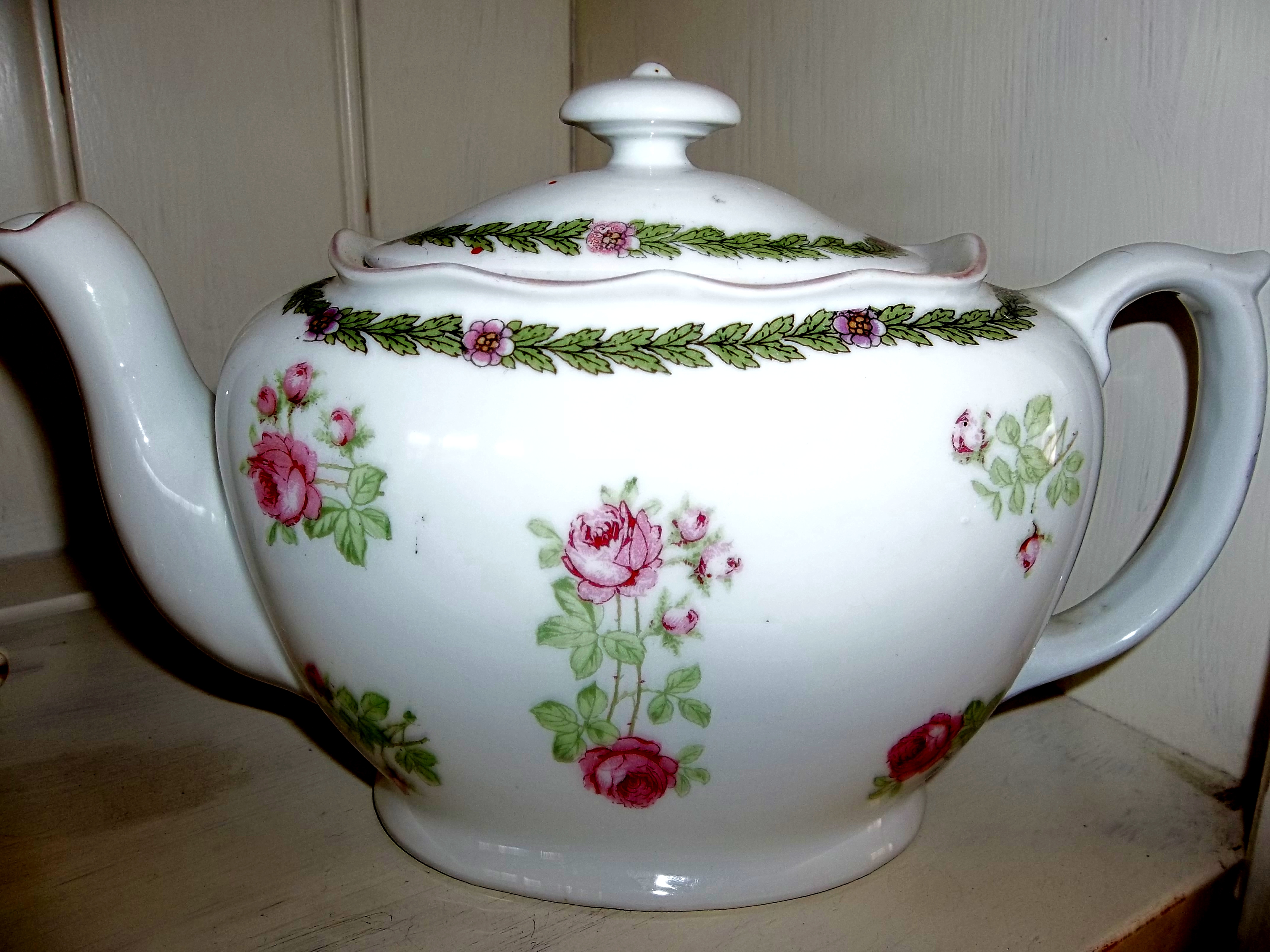
“I thought I’d make a cup of tea”, were the last murmured words of the mother of Janet Frame, NZ writer, as she died in her husband’s arms in the kitchen. They could well be mine… tea for me marks waking up and going to bed, a break mid-morning and that indispensable cup in the afternoon, the cup that cheers when a friend calls, or the one that sustains after a shock or a long day’s retail therapy.

I felt the would-be murderess Mrs McWilliams who shot her enemy Mrs Dick in the Tudor Tea Rooms in Christchurch NZ was a kindred spirit. When she was disarmed after her pot- shot she retorted: “Oh, give me a cup of tea, that’s what I came here for.”
When told that her victim was not dead or even much hurt the redoubtable Mrs McWilliams replied, “Oh isn’t she, what a pity.” (She got seven years jail for her failed attempt to eliminate her enemy)

We can sheet back this country’s addiction to tea to our discoverer Captain Cook, who concocted the first brews from leaves of the manuka tree, which he called, and many still do, the tea tree. He experimented with it in 1769, brewing the leaves in the hope of preventing scurvy, and wrote in his journal ( men write journals – women are downgraded to writing diaries): “The leaves were used by many of us as tea which has a very agreeable bitter scent and flavour when they are recent…. when the infusion was made strong it proved emetic to some in the same manner as green tea.”

In some ways, tea was the answer to coffee… men had gathered to gossip in coffee houses in London and elsewhere, for several centuries, while women had nowhere acceptable to congregate. The first tea-rooms opened in Glasgow in the 1870’s and tea-rooms quickly became as important to women as coffee houses to men in previous centuries.

Afternoon tea at home also became an institution… it was a relaxed time when women took off their corsets before changing into finery for dinner, and wore soft floating tea gowns. The great French food philosopher Brillat-Savarin called afternoon tea: “an extraordinary meal … in that, being offered to persons that have already dined well, it supposes neither appetite nor thirst, and has no object but distraction, no basis but delicate enjoyment…”

I’ll say – and not just for tea but for chocolate cake and shortbread, meringues and cucumber sandwiches. I used to think tea was an occasion just for ladies to enjoy… I couldn’t imagine inviting a man to tea… but then I remembered the delicate courtships conducted over silver tea- pots by the fireside in Edwardian times, and realised what pleasures we have forfeited in our nine to five world. I also wondered if this was the raison d’etre for those loose floating tea gowns… easier for making love?

Portly philanderer, Edward the Seventh used to visit his lady loves for afternoon tea, arriving in an elegant black carriage with his coat of arms on the door. Inside, his inamoratas awaited him. They could be the ravishing Lily Langtry, the Jersey Lily, as famous for her beauty which adorned postcards, as Kim Kardashian is today; or others, like Winston Churchill’s gorgeous mother Jennie, or even Camilla Parker Bowles’, (aka Prince Charles’ second wife) great-grandmother, Mrs Alice Keppel. She was Edward’s mistress for twelve years and was invited to his death-bed by his generous wife, Queen Alexandra.

Afternoon tea for me has never been graced by the presence of king, prince, or even lover… my most un-forgettable afternoon tea was at a Catholic convent in Ipoh, Malaya. The Chinese nuns in this little convent had been accredited to examine children taking GCE, the Cambridge University secondary schools exam, in oral French. So accordingly, I and nine classmates, embarked on the day- long journey in stifling armoured vehicles (to protect us from lurking Chinese bandits) and then by train, from the Cameron Highlands down to Ipoh.

Arriving in the early evening after travelling all day, we went to sleep in a dormitory with other Chinese teenagers who all, to our amazement, managed to get undressed and shower without showing an inch of flesh. This proved quite a challenge to us less inhibited girls trying to do in Rome as the Romans did. The next day we hung around until afternoon in the steamy convent grounds, and then I was first in alphabetical order for the exam.

I was shown into a little room, where a bowing, smiling, gentle little Chinese nun in heavy black horn-rimmed spectacles and starched veil awaited me. It would have been bad enough trying to understand a Chinese person’s French, spoken by someone who had never been to France or met a French person, but worse was to come. She made a cup of tea and offered me a cake, baked especially for us all, she explained in broken English.

So there we were, an Asian nun, performing, not the tea ceremony of her culture, but an adulterated version of a western ritual, and speaking a foreign language to a person who couldn’t make out a word she was saying, and who knew that shortly an even greater ordeal awaited, in which two people who already couldn’t understand each other, were about to embark on a conversation in a language foreign to them both.

But it was the preliminary that almost silenced me. I bit into the cake, and discovered with horror that the nuns knew no more about baking English cakes than they did about speaking French. They had obviously used sawdust held together, not with butter and eggs, but with some sort of inedible glue. With the first bite drying out my mouth and clogging my throat, I realised that now I had to struggle through the whole of this un-eatable culinary disaster, as well as bluff my way through the exam. Each bite nearly choked me, and I still had to look as though it was delicious.

Somehow I got to end of this terrible experience, and there seemed to be an unspoken agreement that if I ate the cake, she would find my school girl French understandable and acceptable to her Chinese ears. I left with us both bowing and smiling, with great good humour, and walked into my classmate waiting to go in. She raised her eye-brows questioningly, and I smiled maliciously, which she optimistically took for re-assurance… later our profane school- girlish post mortems and accusations would have curled the ears of these innocent kindly nuns.

Other teas, with silver teapots, even a white-capped maid, tiers of scrumptious cakes, and lace napkins have never blotted out the memory of this ordeal. And now, a law unto myself, I break all the rules of the English ritual afternoon tea, which is a very different thing to tea ceremonies in parts of the world where tea drinking originated. My most daring break with convention is to put the milk in first, considered so vulgar by generations of tea drinking aficionados.

And having discovered that tea tastes much nicer when the milk goes in first, I have now also discovered that science supports my taste buds. According to research carried out by the Royal Society of Chemistry in 2003,”… if milk is poured into hot tea, individual drops separate from the bulk of the milk and come into contact with the high temperatures of the tea for enough time for significant denaturation or degradation of the milk to occur.” There you go, as they say in this country…

I have n’t space to touch on one of the most thrilling aspects of drinking tea, which used to be illegal in this country, and provoked fiery debate by male Members of Parliament; and now since 1981, it’s become illegal again ( MEN !!!). I refer to the innocent pastime of reading the tea leaves… but that is too vast and esoteric a subject for this little blog to tackle!


Food for threadbare gourmets

Cucumber sandwiches are de rigueur for the ritual English afternoon tea, and very dull they can be too. These I served for a friend’s birthday party, and we gobbled them up… with relish….
Apart from white bread sliced as thinly as possible – even supermarket sliced does the job… you need peeled and thinly sliced cucumber, eight ounces of softened cream cheese, quarter of a cup of mayonnaise, a good sprinkling of onion powder, garlic powder and a pinch of lemon pepper if you have it.
Mix everything except the bread and cucumber, spread the mix on the bread, and arrange the cucumber on top. Cover with another slice of bread also spread with the mixture. Press down firmly, and cut into dainty bite-sized sandwiches. Irresistible.

Food for thought

By experts in poverty I do not mean sociologists, but poor men.
GK Chesterton

35 Comments

Filed under addictions, colonial life, cookery/recipes, culture, great days, humour, life/style, love, The Sound of Water, Thoughts on writing and life, uncategorised

A tearful (sob) tale !

100_0223
If I’m going to cry I want it to be when I’m laughing. I think that may be one of my favourite pleasures, to laugh till I cry… but it’s not something that can be planned… such moments seize us out of the blue, and swoop down without any warning. And then it’s bliss…I love it – having laughed my way not just to good health but to aching sides and streaming eyes.

Tears come more easily to some than others… my tear ducts are the sort that let me down and embarrass me constantly… it was about the only thing I had in common with Princess Diana, being neither blonde, rich, thin, Royal or any of the other things she was…. but she cried easily… she cried waving goodbye to her fiancée when he flew off to NZ for a couple of weeks, she cried, bless her, when the band played God Bless the Prince of Wales on her honeymoon, and she cried among other times, when she was complimented on her work on the day her separation was announced. By contrast her sister-in-law Princess Anne has only gone on record crying once… when she waved farewell to any more cruises on the royal yacht Britannia as it was de-commissioned.

The tough and the strong are sometimes tempted to despise we weaker vessels, and that’s when tears are so humiliating, if we forget that some of the sweetest moments in life, and the most memorable, are those which move us to tears. Tears are one of the things that make us human beings – though I have watched that heart-breaking video when an elephant who had been starved and beaten for fifty years was finally freed, and he wept – rivers of tears slowly trickling down his wrinkled old grey cheeks -and I wept too.

So yes, tears reveal us as feeling human beings… and though times of hormonal change… those teenage years, pregnancy, post-natal months, menopause, depression, even the wrong medical drugs can cause unexpected floods of tears, nevertheless, tears should not be sniffed at. A baby’s tears are his only means of showing his hunger, hurt, fear, anger, discomfort, insecurity and other problems…. but as we grow older and find less direct forms of communication, tears assume a different place in our lives.

They still mark emotions like fear, misery, anger, grief, hurt, but as we grow older – joy too. So why does our culture sneer at tears and try to train children not to cry, with the jeer: ‘cry baby’ or ‘softie’ being an allowed insult in the playground or even worse: ‘don’t be such a girl’.

When I landed in New Zealand in the middle of winter many years ago, my luggage two small children, tears of fright flowed behind my huge black sunglasses in spite of all my efforts at control. And there have been many other moments since when tears marked unforgettable moments of joy and sorrow… including watching first my children, and then my grand-children’s nativity plays… I cried when I watched my tall, skinny thirteen year old son walking away from his childhood into ‘big’ school, head and shoulders above the others his age… at my daughter’s wedding, and my grandchild’s christening… a perfect watering can.

‘Don’t cry when you say goodbye to us’, my eight year old daughter had said before they took off across the world to see their father. So I smiled and waved, and tried to pretend tears weren’t coursing down my cheeks in great rivers. Later, the exquisite voice of Joan Sutherland singing in concert brought tears to my eyes and to many others. Few of us could define what these involuntary tears were triggered by but they were precious, and the moments memorable. I’ve heard other great singers in person including the incomparable Kathleen Battle, but none of them drew that spontaneous tribute.

When my first baby was born the midwife who delivered her did so in floods of tears… she said she always cried when a baby was born. Now, tenderised by life, I know what she means. I only have to see a new born to feel those tears start gushing. It’s hard not feel embarrassed or humiliated by these ever-ready tear ducts.

I am famous in the family for beginning to cry in the cinema at the beginning of a film. As the credits went up on the film ‘The Young Winston’… the traditional ride of the Adjutant on his white horse, up the flight of steps to the library at the end of the Passing- Out Parade at Sandhurst filled me with such nostalgia for my military childhood that I was lost at the first frame.

And I remember lingering in the cinema loo mopping my eyes with my best friend as we tottered out after Disney’s ‘Old Yeller’ (about a Labrador) had ended, ravaged with tears and nearly blinded with clogged mascara. I can go to a funeral of someone I hardly know, as a courtesy to a family member, and become a tearful wreck… not quite sure whether I’m crying in sympathy with those who are really mourning, whether tears are contagious like yawns, or whether I’m touching into old and forgotten griefs.

In the end it’s animals who really pull the heart-strings and have provoked so many gallons of tears I could fill buckets with them … I was ten when I wept over the shooting of the ponies in the film ‘Scott of the Antarctic’… blow the men dying heroically in the snow, it was the ponies I cried over. The deaths of our fifteen or more rescued dogs and a cat was always a tear- streaked nightmare over the years, and it isn’t just me who’s reduced to an emotional wreck by animals.

On one particular personal growth course, a man who had remained unmoved by harrowing moments supposed to break down our innermost defences, went home one night to find his precious bull terrier fighting for her life, and losing it in child birth. The next day, as he told us all about his beloved ‘Maggie’, he dissolved into heart- broken sobs, as did all the women and most of the strong men in the room. Loved animals in distress can make even the toughest weep.

Broken with grief, this man was then able to do the inner work he had come for, the tears had dissolved his emotional barriers, and he became a softer, kinder, warmer person overnight. So in spite of the superiority of those who have well controlled tear ducts, it does seem that weeping is good for the soul, even though it’s terrible for the complexion. Doesn’t seem to matter whether we’re weeping from laughter or weeping from grief, or weeping from any other emotion, tears seem to loosen us up.

Yet mostly, tears don’t seem to come in the moments of great crisis… then the mind is focussed. Shock and intense attention keep us icy cold, functioning unhampered by anguish or emotion… so maybe tears are a bit like Wordsworth’s definition of poetry: emotion recollected in tranquillity, but in the case of tears: emotion when there’s time for it. I rather treasure the words of Kahlil Gibran, who puts tears and laughter into perspective, as ever… that they are both – in the pompous self-mocking phrase of a friend – part of ‘life’s rich pageant’!

Gibran says: “I would not exchange the laughter of my heart for the fortunes of the multitudes; nor would I be content with converting my tears, invited by my agonized self, into calm. It is my fervent hope that my whole life on this earth will ever be tears and laughter.”

So weepers of the world – unite! Hang onto your sodden tissues, and leave off your mascara. Don’t feel intimidated by the stiff upper lips or cold embarrassment of stronger mortals, our ability to cry at the drop of a hat means that we’re living, breathing, sentient beings,
Yours tearfully…


Food for threadbare gourmets

A friend for supper on a cold winter’s night meant that I wanted to spoil her with comfort food, and what more comforting than blackberry and apple crumble?

I had the apples, and a tin of blackberries, though I prefer fresh or frozen, and also often use boysenberries instead. I tipped the cold, cooked sliced apples and the blackberries into a pie dish, with plenty of juice, and sugar to taste; then the crumble was spread on top, baked in a moderate oven for forty minutes, tested with a knitting needle to make sure the crumble was cooked, and served with cream… delicious and she loved it.
The trick is the crumble… eight ounces of flour, four ounces of cold butter, grated and mixed with the flour, six ounces of brown sugar, the grated rind of a lemon, and two ounces of ground almonds. Mixed altogether, it only takes a few minutes to prepare, and not much more to eat!


Food for thought

All children long for recognition and acceptance of their essence – secretly so do most adults. The insistent question inside all of us is: do you see me, not only my body, but my essence; the gifts, potential, needs, wounds, character and quality of soul that shape me individually?
Professor Richard Whitfield

49 Comments

Filed under animals/pets, army, babies, british soldiers, consciousness, cookery/recipes, family, films, food, happiness, humour, love, princess diana, royalty, self knowledge, spiritual, Thoughts on writing and life, uncategorised

The wilder shores of love

100_0542
I’m a sucker for romance, passion, adventure – is there a woman who isn’t? Not the bodice ripper stories of the supermarkets racks but the real thing… the: ’Love is an ever-fixed mark ‘ stuff of life.

I admit I revelled in The Prisoner of Zenda as a teenager, the ‘I did not love thee dear so much, loved I not honour more’, and the red rose delivered once a year to the ravishing queen from her honourable and faithful cavalier, a very English gentleman. And it took me a while to recognise Ashley Wilke’s gutless having his cake and eating it with Melanie and Scarlet, I was so dazzled by his weary elegance and assumption of honour.

But it’s the real thing that hooks me now… the courage to dare and love and think the world well lost in order to follow the heart. So how could I resist Jane Digby? Not her famous descendant, Pamela Digby.

She married the famously un-likeable Randolph Churchill, becoming Winston Churchill’s daughter- in- law, lover of Averill Harriman during the war, mistress of every millionaire, playboy and sex symbol in the post war years… Prince Aly Khan, Marquis de Portago, Fiat heir Gianni Agnelli, Baron Elie de Rothschild, and Stavros Niarchos amongst others. Ed Murrow intended to give up his wife for her, and returned home to fix it, and reneged. She became the fifth wife of impresario Leland Hayward, and finally, when he was eighty-one, snaffled Averill Harriman again, this time in marriage, and became powerful and respectable as US Ambassador to France. No, Pamela Digby’s quest feels like something other than love.

But her beautiful ancestor Jane Digby was something else. Jane was married very young to a man twice her age, who dallied with a servant girl on their honeymoon, and not surprisingly the marriage never took off. Left to her own devices while Lord Ellenborough devoted himself to his political career, she not surprisingly fell in love with a gorgeous playboy, Prince Felix Schwarzenberg, who was besotted with her. Jane, young and naive, never thought of hiding her love, and of course they came to grief.

The Prince was withdrawn from London in the interests of his glittering diplomatic career, Ellenborough divorced Jane – a horrendous and tortuous decision which entailed Jane’s actions being dragged through the House of Lords and the House of Commons and her becoming a pariah – and she followed her lover to Paris where she gave birth to a daughter. Schwarzenberg kept her on a string for some years, and Jane was too blinded by love to see it.

Finally she left and went to Munich, where the King Ludwig, a clever intelligent man became a close and loving friend, and an upright but ultimately boring German aristocrat wooed her for some years before she gave in… and then she fell in love with a handsome Greek count. Her husband Baron Karl von Vennigen fought a duel with Count Spiridion Theotsky… and Jane ended by running off with her glamorous Greek. They enjoyed a lotus- eating life in places like Corfu, before ending up at the court in Athens. Von Vennigen never stopped loving the fascinating Jane and wrote to her until he died.

In Athens her Greek husband became unfaithful so Jane took up with a sixty- year old white mustachioed Pallikari bandit chieftan , Cristos Hadji-Petros.
She entered  into mountain life wholeheartedly, dressing like the peasant women of the tribe, and learning to cook, make feta cheese, sleep in the open air on goats-hair blankets, galloping on horseback around the mountains, drinking retsina and making mad, passionate love with the wicked old bandit.

It all fell to pieces when Jane’s maid told her she having trouble fending off the calculating rough brigand who smelt of garlic and too few baths. Jane and her maid disappeared from Athens, Jane now sad and depressed and nearly fifty… and she decided to explore all the ancient cities and historical sites now under the sway of the latest bandits, Isis.

She negotiated a bodyguard to escort her to the glorious ruins of Palmyra. Even back in 1853, tourists were drawn to the dangerous journey to this fabled city, and the Bedouin tribes competed against each other to guard travellers from other tribes who threatened to rob the Europeans. Sheik Medjuel el Mesrab was the Bedouin chief who commanded Jane’s bodyguard, and by the time they had reached Palmyra, he had proposed to Jane and offered to give up his wife.

She didn’t succumb straightaway, and later had to fend off an offer from another determined Arab sheik. Feeling depressed and lonely she continued travelling before returning to Damascus. But Medjuel had kept tracks on her, and as she approached Damascus he rode out to meet her, with an Arab mare as a gift of welcome, and his wife already sent back to her people with her dowry.

They fell deeply in love and married. Jane spent the last twenty five years of her life living partly in Damascus and partly in the desert whenever her husband had to take his flocks and people to different areas of grazing, or to fight other tribes. Jane rode with him into battle. She was a brilliant horsewoman and broke in many of Medjuel’s Arab thoroughbreds, she spoke nine languages, was a witty conversationalist and a talented artist. Her exquisite manners, gentleness, beauty and charm won over both the reluctant tribe and the disapproving local community.

Jane threw herself into the life of the Bedouins when they camped in the desert, and dyed her long fair hair and eyebrows black as the Arabs felt that fair hair attracted the Evil Eye. She plaited her hair in two long braids which reached to her feet and wore the clothes of the Bedouin women, learning to milk camels, prepare her husband’s food, and stand and wait on him, and wash his hands and hair, face and feet. Medjuel on the other hand, impressed everyone who met him with his refinement, intelligence, and elegance.

In her home in Damascus she had a huge menagerie of creatures and created one of the most famous gardens in a city famous for its gardens. She and Medjuel had a passionate and tempestuous relationship which never lost its intensity in over twenty five years. Nearing seventy four, she wrote in her diary: “it is now a month and twenty days since Medjuel last slept with me. What can be the reason?“ Though younger than Jane, Medjuel was feeling his age by now, and this year stayed close to his wife instead of joining his tribe. Not long after writing these words, she faded away after an attack of dysentery, Medjuel by her side.

The Sheik was persuaded to ride in a closed black carriage to her funeral, until suddenly overcome by grief and needing open space he bolted from the carriage and fled in the opposite direction to the cortege. Everyone was shocked by this breach of funeral etiquette. But as the clergyman was intoning: ‘ashes to ashes’, Medjuel galloped up on his wife’s favourite black Arabian mare. He sat motionless staring down into the grave and no-one moved or spoke. Moments passed as he sat there in anguish and then the Bedouin Chief rode away.

Jane would have loved her husband’s farewell. He returned to the grave once more. He brought a rough slab of Mazoni rock, carved to fit over the base of Jane’s tomb. He carved her name: Madame Digby el Mezrab on it in Arabic and disappeared into the desert.

A missionary who knew her well described her life as: ‘wild, passionate and reckless’, while her devoted friend, the explorer Sir Richard Burton said that her ‘life’s poetry never sank to prose’. Her life is an inspiration to a romantic. By following her heart she finally found the one person in the world, in Truman Capote’s touching words in The Grass Harp:’ … from whom nothing is held back…’ and: ‘to whom everything can be said’.

And those words, it seems to me, are the definition of true love. They mean perfect trust. No co-dependency, neediness or misunderstandings through lack of communication. But trust takes courage, and maybe to paraphrase the words of that haunting song ‘The Rose’, true love is only for the brave … like Jane Digby el Mesrab.


Food for threadbare gourmets

Sometimes I just want a plate of roast vegetables, but also feel I must need some protein. I kid myself that this pea-nut sauce will fill the gap. It’s quite unlike the traditional pea-nut sauce, and was dreamed up in front of me by a chef at a demonstration.
In a stick blender, I spoon a cup or more of pea-nut butter, the skin thinly peeled from a lemon, plus the juice, a good teaspoon or more to taste of dried thyme, a couple of garlic cloves, a tea-spoon of fish sauce, a dessert-spoon or more to taste of brown sugar, plenty of salt and black pepper, and a cup or more of olive oil. Just whizz everything together. And add more olive oil if you need it. It lasts for plenty of time in the fridge, and is good with baked or sauted vegetables for a light meal, and also with baked salmon.


Food for Thought

He either fears his fate too much,
Or his deserts are small,
That puts it not unto the touch
To win or lose it all…
From ‘My dear and only love’, John Graham, Marquis of Montrose


Lesley Blanch who died this year at 103 wrote The Wilder Shores of Love


26 Comments

Filed under cookery/recipes, gardens, great days, happiness, history, life/style, love, Thoughts on writing and life, travel, uncategorised